What Are Multinational Cybersecurity Agencies Demanding Network Device Owners Verify? ── Decoding Joint Advisory AA25-239A on Edge Devices and Enterprise Defenses
A technical breakdown of the 23-agency multinational advisory reveals how state-sponsored threat actors target perimeter routers via known vulnerabilities, configuration tampering, and living-off-the-land protocols.
Published: October 31, 2026 | Read time: ~10 min | Watch Video (Japanese)
Executive Summary: The Perimeter Router Threat Model
On August 27, 2025, a coalition of 23 government cybersecurity agencies across 13 nations—including the U.S. Cybersecurity and Infrastructure Security Agency (CISA), the Federal Bureau of Investigation (FBI), the National Security Agency (NSA), and Japan’s National Center of Incident Readiness and Strategy for Cybersecurity (NISC) alongside the National Police Agency (NPA)—issued Joint Cybersecurity Advisory AA25-239A (revised September 3, 2025). The landmark advisory addressed widespread compromises of perimeter network devices.
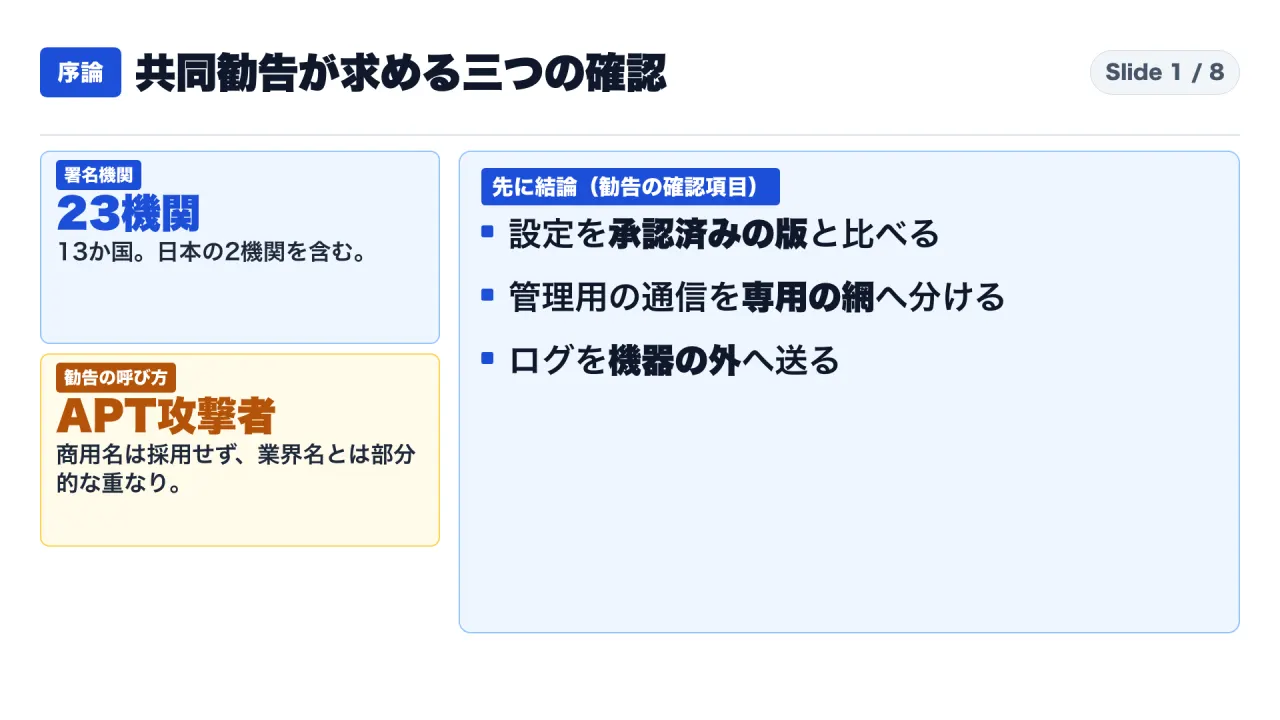
The primary finding of the advisory challenges conventional assumptions: advanced state-sponsored threat actors did not breach network backbones using sophisticated zero-day exploits. Instead, they succeeded by chaining publicly known, unpatched software vulnerabilities with avoidable administrative weaknesses, such as default credentials, unsegmented management planes, and unencrypted management protocols. Once inside, threat actors maintained persistent footholds by rewriting device configurations and living off native operating system capabilities.
The advisory issues an urgent call to action centered on three core architectural verifications:
- Running Configuration Audits: Diffing running router configurations against approved golden baselines.
- Management Plane Isolation: Quarantining administrative traffic within dedicated management Virtual Routing and Forwarding (VRF) instances.
- Externalized, Authenticated Telemetry: Shipping event logs off-device via encrypted conduits.
This technical analysis strictly delineates between verified advisory findings, media reporting, and practical enterprise defense playbooks.
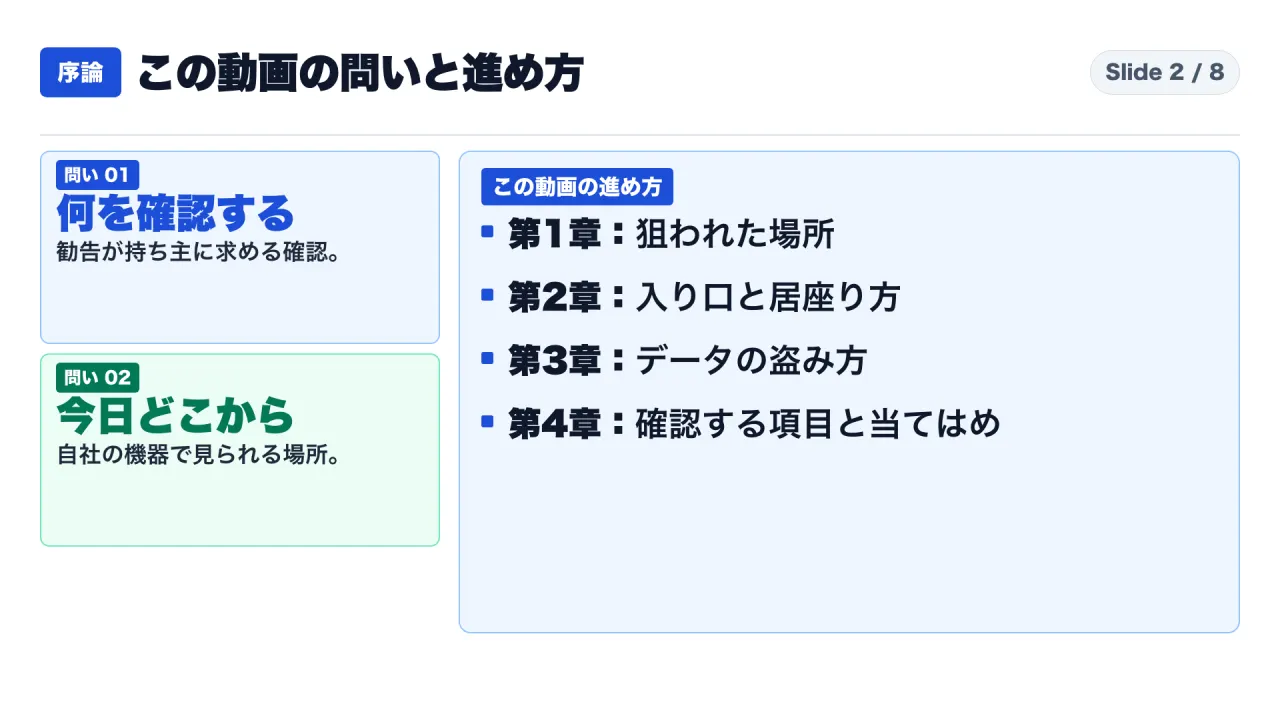
Technical Baseline: Core Routing Architecture and Protocols
Analyzing Advisory AA25-239A requires precise networking terminology:
- Edge Devices: Perimeter networking hardware deployed at boundaries between internal corporate networks and external telecommunications or public internet infrastructure, including routers, firewalls, and VPN concentrators.
- PE and CE Routers: Provider Edge (PE) routers sit at the perimeter of a telecommunications carrier’s core backbone, while Customer Edge (CE) routers terminate the carrier link at the subscriber’s premises.
- Access Control List (ACL): Sequential packet filtering rule sets permitting or denying IP traffic based on protocol, port, and IP addresses.
- TACACS+: Terminal Access Controller Access-Control System Plus, an administrative protocol providing centralized authentication, authorization, and accounting (AAA) for network engineers logging into infrastructure hardware.
- SNMP: Simple Network Management Protocol, used for monitoring network devices. Community strings serve as shared authentication passwords (often defaulting to “public” or “private”).
- VRF: Virtual Routing and Forwarding, an IP technology that creates multiple isolated routing tables within a single physical router. A management VRF strictly segregates management traffic from customer data plane routing.
- BGP Peering: Inter-domain routing connections exchanging traffic directly between autonomous systems (ASNs).
- Guest Shell: An embedded Linux container environment running natively within Cisco network operating systems (e.g., IOS XE), providing on-box execution capabilities.
Section 1: The Targeting Landscape: Telecommunications Backbones and Non-Telco Stepping Stones
Target Vectors Documented in the Advisory
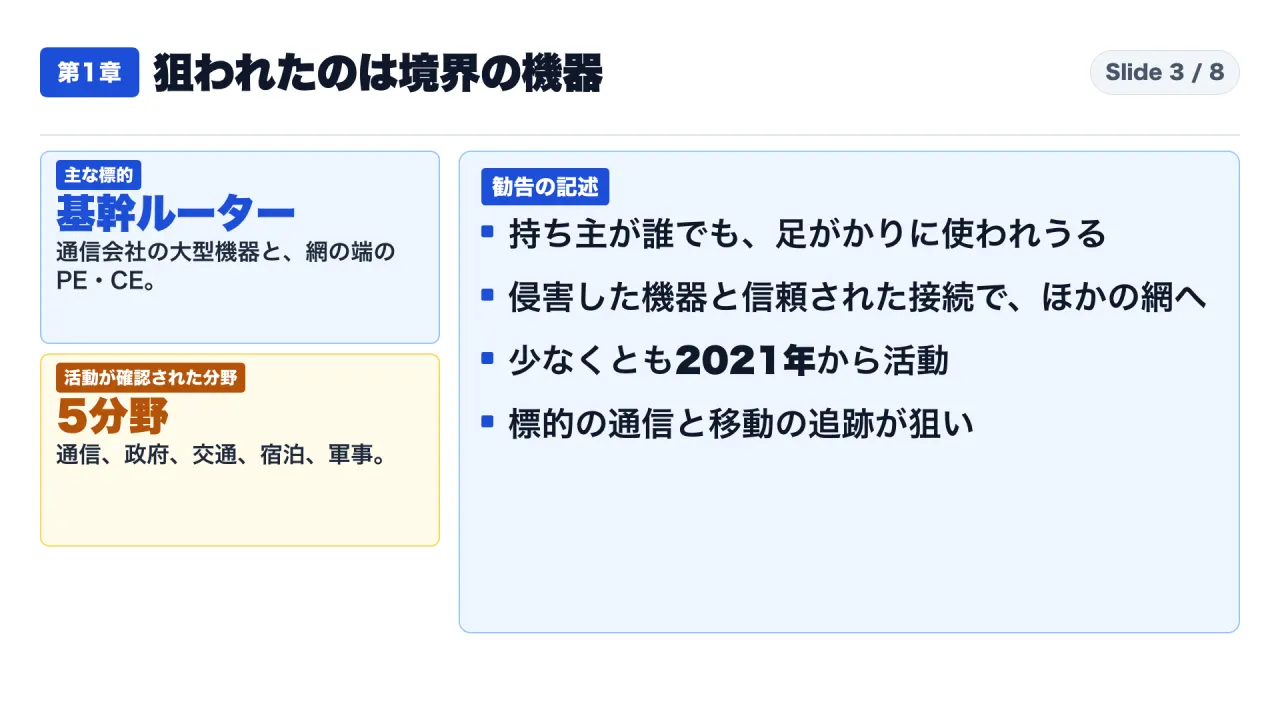
Advisory AA25-239A notes that threat actors focus heavily on tier-one telecommunications providers, specifically targeting core backbone routers, PE routers, and CE devices. Verified activity has been identified across the United States, Australia, Canada, New Zealand, the United Kingdom, and globally across Asia-Pacific and European regions. Sectors impacted include:
- Critical Telecommunications
- National Government and Defense Networks
- Transportation Infrastructure
- Hospitality Networks
- Military Communications
The advisory assesses that compromising carrier routing infrastructure grants threat actors global capabilities to intercept communications and track the physical movements of selected espionage targets.
Why Non-Telecommunications Organizations Are at Direct Risk
Enterprise leaders outside the telecommunications sector often assume this threat is irrelevant to their operations. However, the advisory explicitly warns that threat actors routinely compromise edge devices belonging to non-telecommunications organizations. Even when an enterprise is not the ultimate espionage objective, its perimeter router may serve as an operational transit hop or stepping stone to infiltrate upstream telecommunications providers or downstream supply chain partners.
Attribution and Industry Naming Conventions
The advisory attributes this persistent campaign to state-sponsored actors associated with the People’s Republic of China (PRC), identifying links to commercial entities in China. The agencies note that this operational activity partially overlaps with reporting published by commercial threat intelligence vendors under various cluster designations:
- Salt Typhoon
- OPERATOR PANDA
- RedMike
- UNC5807
- GhostEmperor
The advisory emphasizes that these commercial tracking names do not correspond to a one-to-one equivalence with the joint government findings.
Section 2: Ingress and Persistence: Public CVEs and Configuration Tampering
Initial Exploitation Pathways
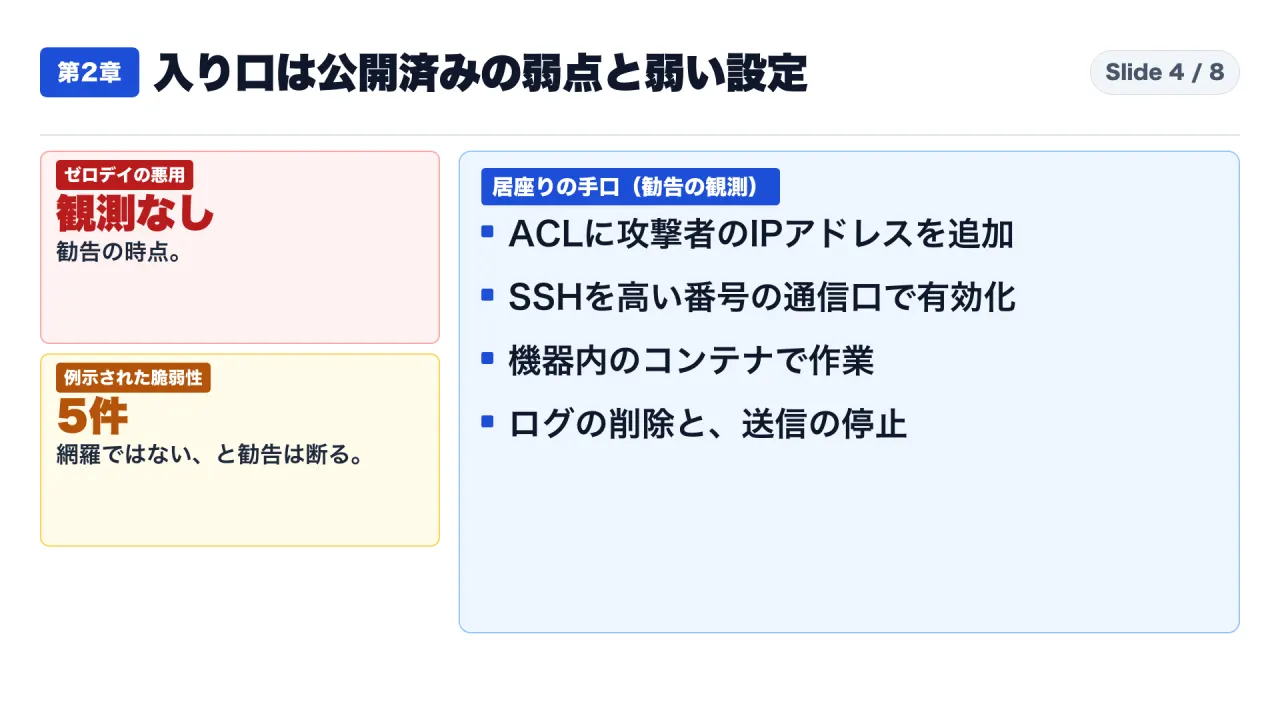
The advisory establishes that threat actors achieved extensive access without deploying zero-day exploits. Instead, they systematically exploited known CVEs across edge infrastructure, including products from Ivanti, Palo Alto Networks, and Cisco. The agencies noted potential threat actor interest in devices from Fortinet, Juniper, and SonicWall.
Threat actors also exploited pervasive administrative weaknesses:
- Default credentials such as
cisco/cisco - Default SNMP v1/v2c community strings such as
publicandprivate - Exposed remote administrative interfaces facing the public internet
On-Device Persistence Techniques
Once administrative access was attained, threat actors modified operating configurations using four primary techniques:
- ACL Manipulation: Inserting specific attacker IP addresses into access control lists (frequently naming rule sets
access-list 20, or using numbers50or10), ensuring persistent remote access while bypassing perimeter security filters. - Non-Standard Management Ports: Binding SSH daemons to arbitrary high-numbered TCP ports to evade routine port scanning.
- Abuse of Embedded Containers (Guest Shell): Executing commands and staging utilities inside Cisco’s on-box Guest Shell Linux container, where processes are isolated from standard network syslog feeds. In Cisco IOS XR environments, attackers manually enabled disabled services, such as
sshd_operns. - Anti-Forensic Erasure: Selectively deleting syslog entries, halting external log transmission, and configuring administrative commands to log source IP addresses as the router’s own loopback interface.
Section 3: Data Interception and Exfiltration: Compromising the Management Plane
Harvesting Authentication Credentials
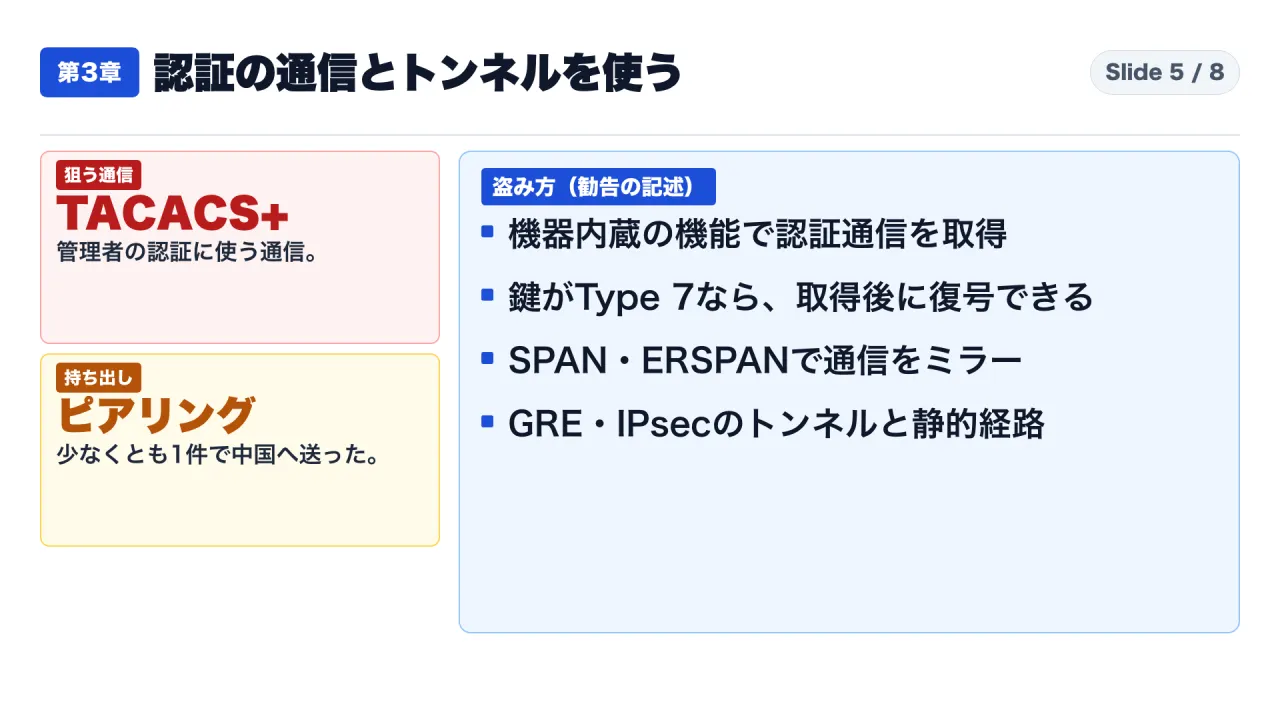
Threat actors prioritized capturing TACACS+ authentication traffic to harvest credentials:
- The advisory documents cases where attackers leveraged embedded packet capture tools to intercept cleartext or weakly obfuscated authentication exchanges.
- In multiple instances, device configurations stored TACACS+ pre-shared keys using Cisco Type 7 passwords—a trivial, reversible XOR algorithm easily decrypted with open-source tools.
- Attackers also modified TACACS+ server IP configurations within router profiles, pointing authentication queries directly to attacker-controlled collector servers to capture enterprise login attempts.
Traffic Interception and Exfiltration Infrastructure
To siphon network traffic, attackers:
- Enabled on-box port mirroring via Switched Port Analyzer (SPAN) or Encapsulated Remote SPAN (ERSPAN).
- Established Generic Routing Encapsulation (GRE) and IPsec tunnels combined with static routes to redirect targeted traffic.
- Exploited BGP peering links and MPLS/GRE tunnels to route exfiltrated data back to infrastructure in China. Exfiltration channels were intentionally separated from command-and-control (C2) channels and disguised within high-volume commercial proxy networks.
Section 4: Mitigation Mandates and Enterprise Defense
The Three Foundational Mitigations
Advisory AA25-239A details specific technical safeguards to mitigate perimeter device exposure:
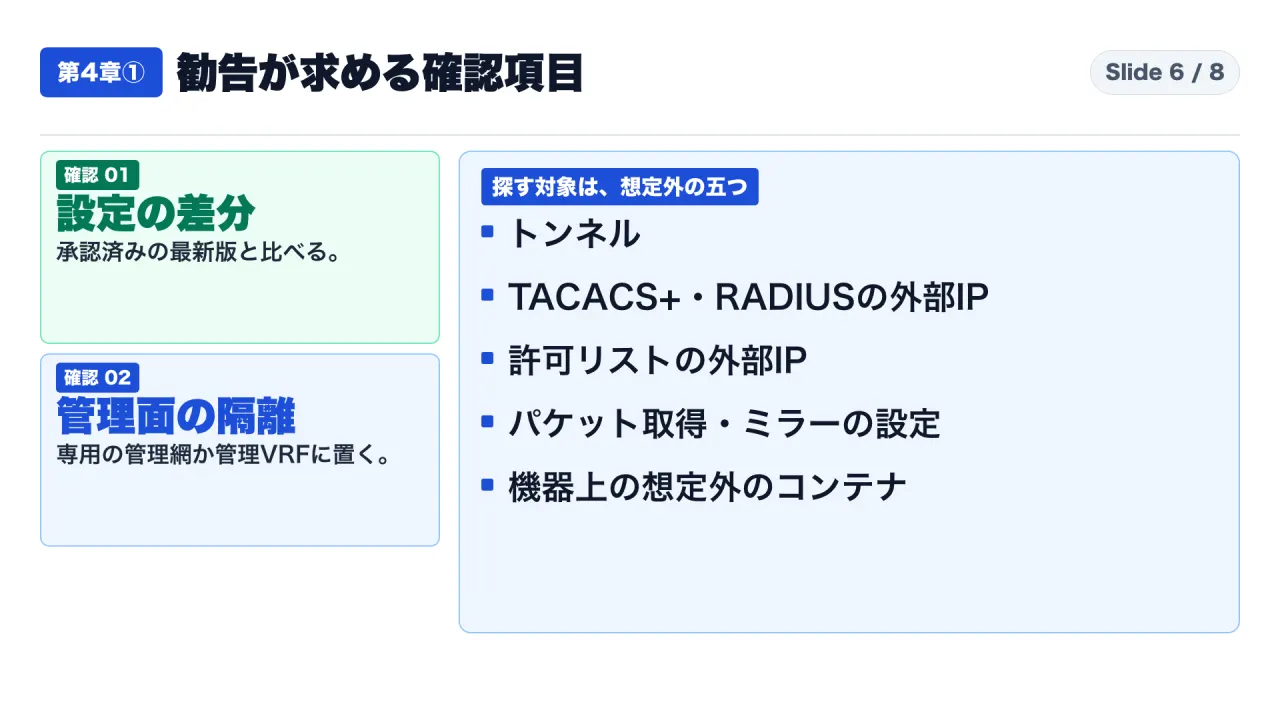
- Running Configuration Audits: Systematically extract running router configurations and compare them against approved golden baselines. Specifically inspect for:
- Unauthorized GRE/IPsec tunnels
- External IP addresses in TACACS+/RADIUS server definitions
- External IP addresses added to ACLs
- Active packet capture or SPAN/ERSPAN mirror profiles
- Unauthorized on-box containers or services
- Management Plane Isolation: Restrict SSH, HTTPS, SNMP, TACACS+, and RADIUS services exclusively to dedicated out-of-band management networks or isolated management VRFs. Ensure management VRF routes never leak into public internet or peering routing tables.
- Externalized, Authenticated Telemetry: Transmit syslog data to a central SIEM across authenticated, encrypted channels. Enable AAA command accounting to record every command executed by every user. Do not rely solely on on-device syslog.
- Protocol Hardening:
- Disable SNMP v1 and v2c; enforce SNMP v3 with authentication and encryption.
- Disable cleartext management protocols (Telnet, HTTP).
- Invalidate default credentials and replace weak community strings.
- Disable Cisco Smart Install (
no vstack). - Audit firmware integrity against vendor cryptographic hashes.
Forensic Indicators of Compromise
The advisory highlights observable threat actor artifacts:
- ACL names set to
access-list 20,50, or10. - Capture files named
mycap.pcap,tac.pcap, or1.pcap. - Outbound FTP/TFTP connections to unauthorized external IP addresses following packet capture.
- On Cisco IOS XR devices, unexpected network connections over TCP port 57722.
The advisory cautions that threat actors adjust identifiers across intrusions, making static indicator matching insufficient compared to comprehensive configuration diffing.
Section 5: Author Commentary, Analytical Caveats, and Invariant Boundaries
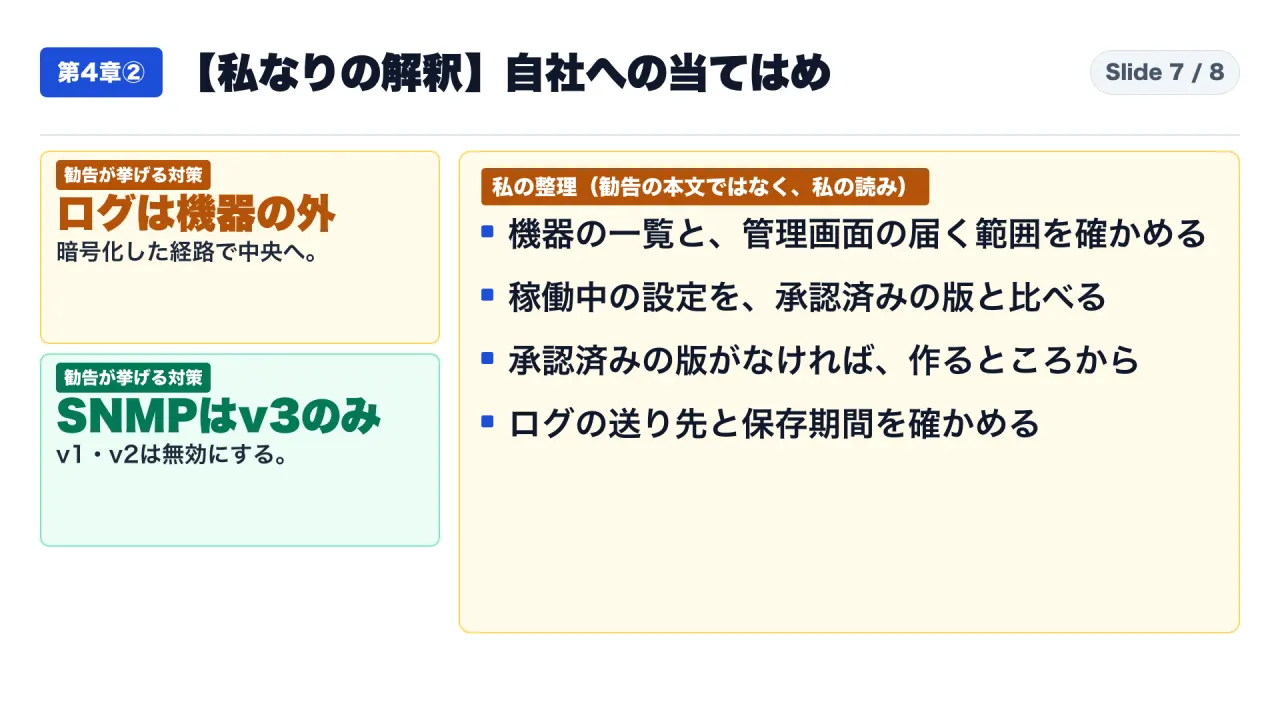
Three professional interpretations:
- Perimeter Routers Are Shadow Endpoints: Network devices must be governed as full Linux servers requiring patch management, credential rotation, and telemetry rather than passive appliances.
- Configuration Drift Is a Security Incident: In network infrastructure, unapproved configuration drift must be treated with the same urgency as malware execution.
- Separate Advisory Findings from Media Reports: Strict governance requires distinguishing government-attested facts from anonymous press leaks.
Seven invariant boundaries:
- The advisory evaluates technical defense only, avoiding geopolitical policy judgments beyond citing official attribution.
- Statistics such as “13 nations,” “23 agencies,” “5 illustrative CVEs,” and “5 unapproved configuration targets” are analytical enumerations derived from the text.
- Technical mitigation examples focus heavily on Cisco operating systems; commands for other vendors must be referenced via respective vendor manuals.
- The advisory primarily addresses critical infrastructure; non-carrier enterprise adoption is an analytical deduction.
- Threat actor IP address lists in the advisory reflect activity from August 2021 to June 2025; agencies caution that older IPs may be inactive.
- This analysis evaluates the August 27 and September 3, 2025 releases; subsequent updates are excluded.
- This study offers technical cybersecurity governance only, providing no investment or commercial advice.
Dissecting External Media Reports
Crucial distinctions separate the advisory from external press coverage:
- “Nine Telecom Companies”: A widely reported claim that nine U.S. carriers were breached originates from a December 27, 2024 news report quoting an unnamed White House official. This claim appears nowhere in Advisory AA25-239A.
- “FBI February 2026 Warning”: Statements by an FBI cyber official stating the threat remains intense were delivered during a conference speech on February 19, 2026, reported in cybersecurity trade press, rather than in an official published advisory.
Practical Playbook for Enterprise Edge Infrastructure Defense
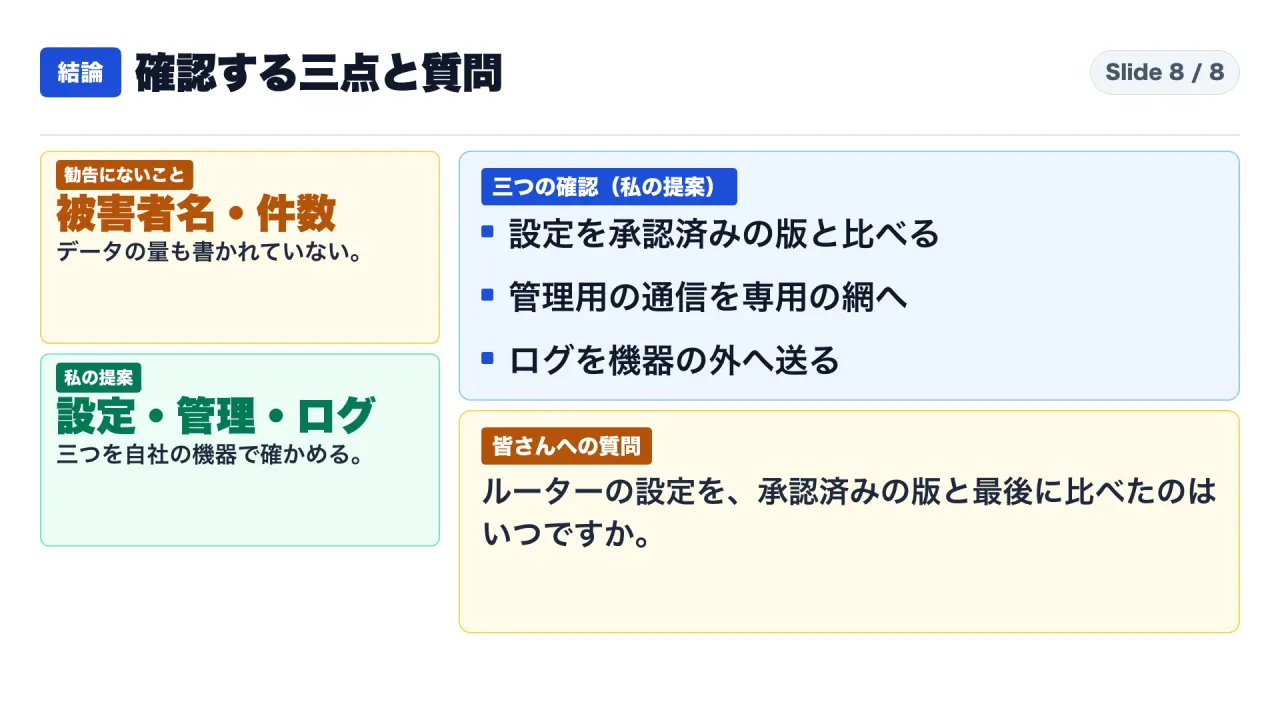
Network administrators should implement a four-step defense protocol.
Step 1: Inventory and Map Management Plane Exposure
Generate a comprehensive inventory of all perimeter routers, firewalls, and VPN gateways:
- Verify whether management interfaces (SSH, web UI, SNMP) are accessible from the public internet.
- Restrict all administrative endpoints strictly to out-of-band management VRFs.
Step 2: Implement Automated Baseline Configuration Diffing
Deploy daily automated configuration extraction:
- Compare active running configurations against version-controlled golden baselines.
- Immediately alert on unexpected ACL entries, new local user accounts, unauthorized static routes, modified TACACS+/RADIUS server IPs, and active packet capture profiles.
Step 3: Centralize and Encrypt System Telemetry
Reconfigure device logging:
- Forward logs to central SIEM infrastructure via TLS-encrypted syslog.
- Enable AAA command accounting to establish an immutable audit trail of all configuration commands.
Step 4: Decommission Deprecated Services
Harden operational profiles:
- Eliminate SNMP v1/v2c in favor of SNMP v3.
- Disable legacy protocols (Telnet, HTTP).
- Disable unused on-box container environments (Guest Shell) and features like Cisco Smart Install.
Frequently Asked Questions
Q1: Is “Salt Typhoon” the official designation used in Advisory AA25-239A?
No. The advisory designates the actors generally as “APT actors” associated with PRC state-sponsored entities. It notes that this activity partially overlaps with industry tracking names such as Salt Typhoon, OPERATOR PANDA, RedMike, UNC5807, and GhostEmperor, but emphasizes that these commercial clusters are not one-to-one equivalents.
Q2: Does the advisory state that nine U.S. telecommunications companies were compromised?
No. The figure of nine compromised carriers originates from a December 27, 2024 news report quoting an unnamed White House official. The advisory itself names zero victim organizations.
Q3: Were zero-day vulnerabilities required for the threat actors to breach routers?
No. The advisory confirms that threat actors relied exclusively on publicly disclosed CVEs, weak credentials, and misconfigurations, with zero zero-day exploits observed.
Q4: Does this advisory apply to non-telecommunications enterprises?
Yes. The advisory explicitly notes that threat actors target edge devices regardless of owner to establish transit hops and access downstream partner networks.
Q5: What should an organization do if unauthorized configuration modifications are discovered?
Organizations should avoid premature local remediation. Chasing threat actors off individual devices alerts them to the investigation. Teams should scope the full intrusion, preserve volatile memory, and notify relevant authorities.
Primary Sources and References
- CISA Joint Cybersecurity Advisory AA25-239A: People’s Republic of China State-Sponsored Cyber Actors Compromise Telecommunications and Network Infrastructure (August 27, 2025; Revised September 3, 2025)
- The Record: Nine U.S. Companies Hacked in Salt Typhoon China Espionage Campaign (December 27, 2024)
- CyberScoop: FBI Cyber Official Warns Salt Typhoon Represents Ongoing Strategic Threat at CyberTalks (February 19, 2026)