What U.S. Corporate Cybersecurity Disclosures (Form 8-K Item 1.05) Reveal and Withhold ── The 4-Business-Day Trigger and Reading Initial Incident Reports
An empirical analysis of SEC Item 1.05 and Item 8.01 filings demonstrates that the mandatory 4-business-day filing deadline commences from the date of materiality determination rather than incident discovery.
Published: October 31, 2026 | Read time: ~10 min | Watch Video (Japanese)
Executive Summary: The Materiality Determination Anchor
When a publicly traded U.S. corporation experiences a cybersecurity breach, market participants expect rapid regulatory disclosures under Form 8-K. However, widespread confusion persists regarding the regulatory clock governing Item 1.05 disclosures. The mandated four-business-day filing window does not begin on the day an intrusion occurs, nor does it begin on the day analysts discover malicious activity.
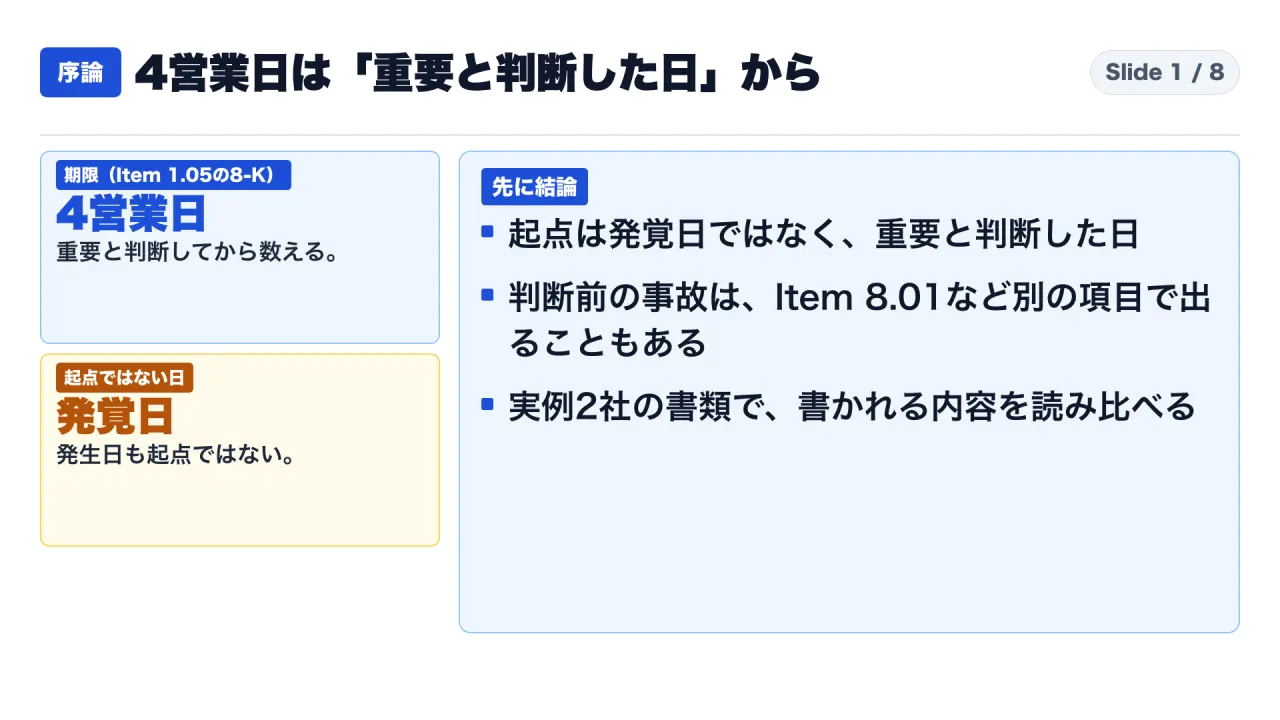
Under SEC rules, the four-business-day deadline begins exclusively once the registrant determines that a cybersecurity incident is material. Consequently, an initial Form 8-K filing represents a preliminary assessment of what executive leadership could reasonably determine as of that specific date, rather than a comprehensive post-mortem of the entire breach.
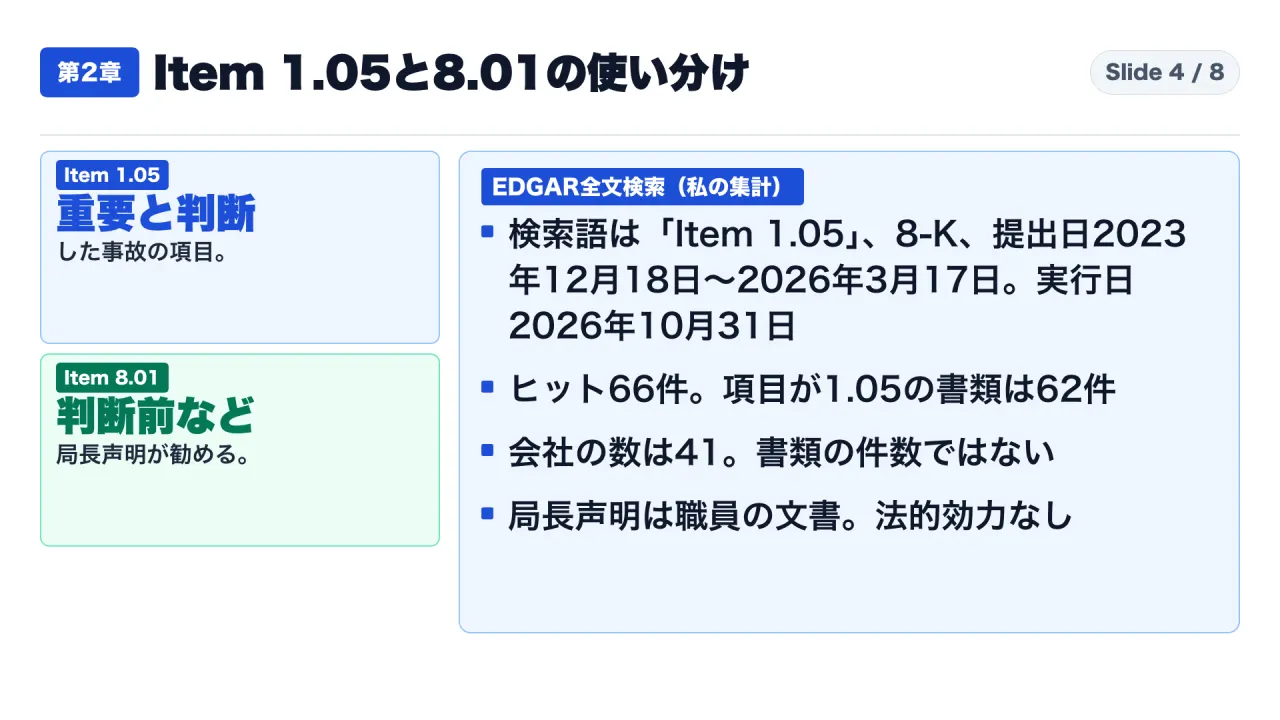
To prevent premature market speculation, the SEC Division of Corporation Finance issued staff guidance on May 21, 2024, recommending that incidents whose materiality remains undetermined, or that are determined not to be material, should be disclosed under Item 8.01 (Other Events) rather than Item 1.05.
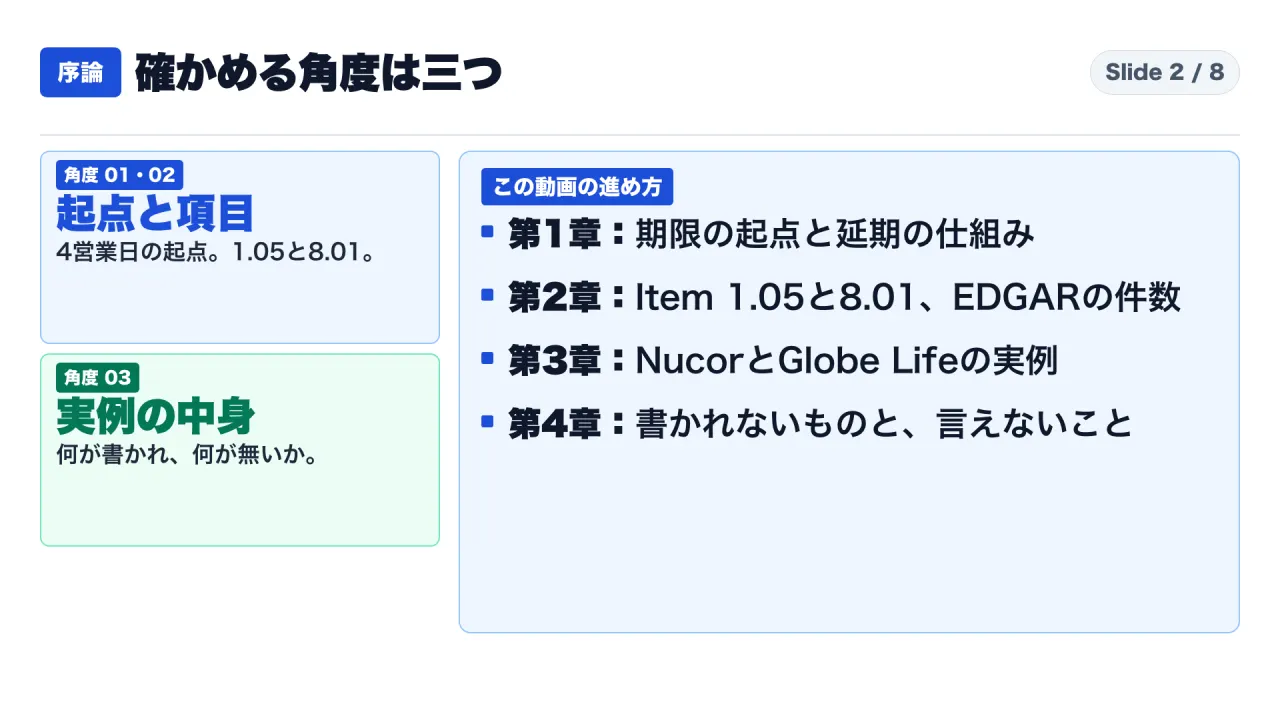
This analysis evaluates SEC regulatory architecture and actual EDGAR filings across three standards:
- Statutory Fact: Rules, instructions, and verbatim disclosures from SEC filings and staff releases.
- Empirical EDGAR Analysis: Exact query counts executed across the SEC EDGAR system.
- Professional Commentary: Practical frameworks for corporate governance, legal risk, and vendor oversight.
Regulatory Framework: Core Definitions and Timelines
Evaluating SEC cybersecurity rules requires clarifying essential legal terms:
- Form 8-K: A current report filed by public companies to announce major corporate events.
- Item 1.05: The dedicated Form 8-K category created specifically for material cybersecurity incidents.
- Item 8.01: The general “Other Events” category used for voluntary or non-material announcements.
- Form 8-K/A: An amended report filed to supplement or correct previously filed disclosures.
- Materiality: Information is material if there is a substantial likelihood that a reasonable investor would consider it important.
- Business Day: Any calendar day excluding Saturdays, Sundays, and federal holidays.
- Foreign Private Issuer (FPI): Non-U.S. issuers subject to SEC reporting, which report material events on Form 6-K rather than Form 8-K.
The SEC adopted final rules (Release No. 33-11216) on July 26, 2023, effective September 5, 2023. Compliance with Item 1.05 commenced on December 18, 2023 for standard reporting companies, and on June 15, 2024 for smaller reporting companies.
Section 1: The Filing Trigger: Materiality Determination “Without Unreasonable Delay”
General Instruction B.1 of Form 8-K states that an Item 1.05 report must be filed within four business days after the registrant determines that it has experienced a material cybersecurity incident. The trigger is explicitly tied to the determination of materiality, not incident detection.
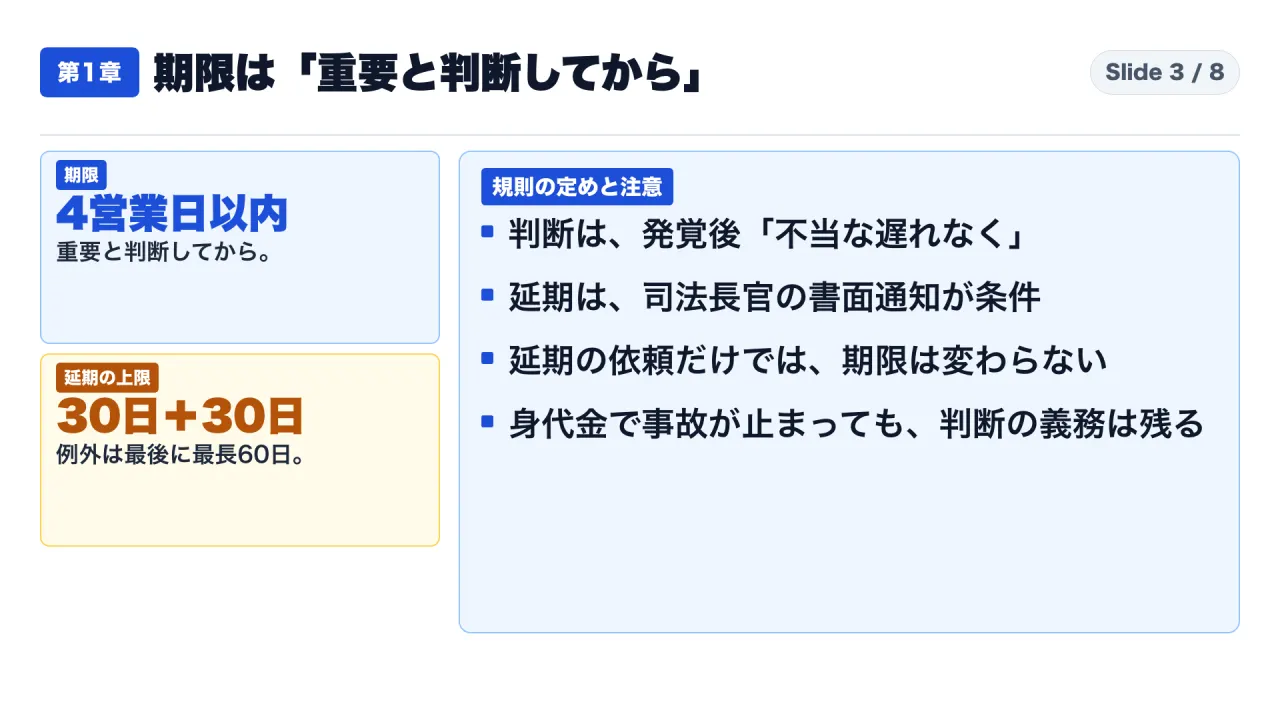
Rule instructions require registrants to make this determination “without unreasonable delay” following discovery. In its adopting release, the SEC acknowledged that companies will rarely be able to determine materiality on the date of discovery. Registrants require operational time to conduct technical triage, assess exfiltration scope, and evaluate business impacts before leadership can reach an informed assessment.
The SEC deliberately avoided establishing a numeric bright-line financial threshold. A cybersecurity incident may be qualitative—such as intellectual property theft or reputational damage—and still be material. Furthermore, individually immaterial occurrences may become material in the aggregate.
A delay in filing is permitted only if the U.S. Attorney General notifies the SEC in writing that disclosure poses a substantial risk to national security or public safety (initially up to 30 days, extendable by 30 days, and up to 60 additional days in extraordinary cases). Merely consulting with law enforcement does not alter filing deadlines, nor does paying a ransom relieve disclosure obligations.
Section 2: Differentiating Item 1.05 from Item 8.01
Item 1.05 requires disclosing material aspects of the nature, scope, and timing of the incident, alongside material impacts on financial condition and results of operations, submitted in Inline XBRL.
On May 21, 2024, Erik Gerding, Director of the SEC Division of Corporation Finance, issued a staff statement addressing market confusion. The statement observed companies filing Item 1.05 reports while simultaneously stating that the incident was not material or that materiality had not yet been determined.
Director Gerding clarified that because Item 1.05 is reserved for material incidents, filing under Item 1.05 when an incident is not material could mislead investors. The Division recommended:
- If an incident is determined to be material, file under Item 1.05.
- If an incident’s materiality has not yet been determined, or if the company determines the incident is not material but wishes to disclose it voluntarily, file under Item 8.01 (Other Events).
Staff statements carry no statutory force, and Item 1.05 does not explicitly prohibit voluntary filings. If a company initially files under Item 8.01 and subsequently determines the incident is material, it must file an Item 1.05 Form 8-K within four business days of that subsequent determination.
An empirical query executed across SEC EDGAR on October 31, 2026 establishes baseline volumes:
- Search Query:
"Item 1.05"exact phrase match - Filing Type: Form 8-K (including 8-K/A)
- Date Range: December 18, 2023 through March 17, 2026
- Total Returned Filings: 66 filings (46 Form 8-K, 20 Form 8-K/A)
- Filings Categorized Under Item 1.05: 62 filings (42 Form 8-K, 20 Form 8-K/A)
- Filings Mentioning Item 1.05 Under Other Items: 4 filings (including Globe Life under Item 8.01)
- Distinct Reporting Entities (CIK Count): 41 corporate registrants
These figures confirm that corporate disclosures under Item 1.05 represent a tightly bounded corpus of significant events.
Section 3: Case Studies: Nucor Corporation and Globe Life
Examining actual filings illustrates how companies implement these disclosure standards in practice.
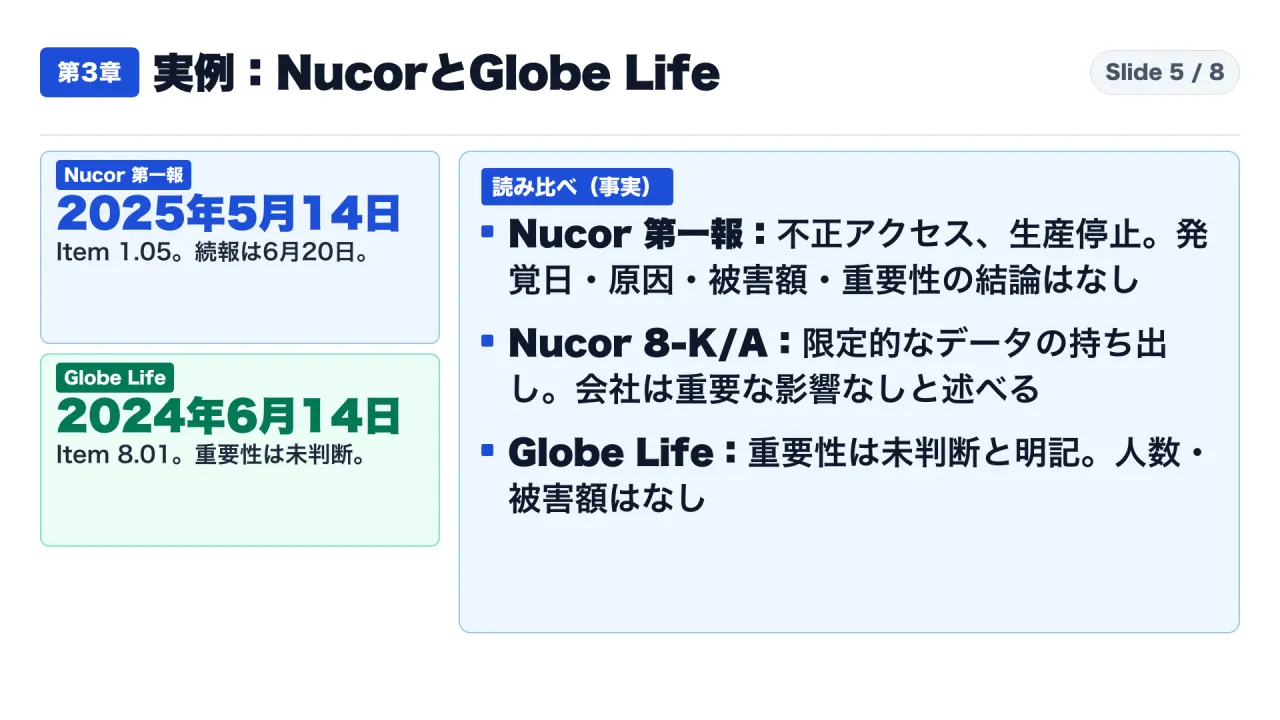
Nucor Corporation: Item 1.05 Initial Filing and Subsequent 8-K/A
On May 14, 2025, Nucor Corporation filed an Item 1.05 Form 8-K reporting an earliest event date of May 13, 2025:
- Disclosed Elements: Identified unauthorized third-party access; initiated containment and activated incident response plans; took affected systems offline; engaged third-party experts; notified federal law enforcement; and temporarily curtailed operations at multiple production facilities.
- Omitted Elements: Discovery date, attack vector, exfiltrated data scope, quantified financial losses, and a definitive materiality determination. The filing stated: “the Company continues to investigate the scope and timing of the incident and will assess the materiality of the incident as the investigation continues.”
On June 20, 2025, Nucor filed an Item 1.05 Form 8-K/A amendment providing substantive updates:
- Confirmed that an external threat actor acquired unauthorized access and exfiltrated limited data.
- Announced that plant operations and administrative systems were fully restored.
- Materiality Conclusion: Stated that the incident “has not had and is not reasonably likely to have a material impact on the Company’s business operations, financial condition, or results of operations.”
Nucor’s initial report provided an operational snapshot while investigations continued, which was subsequently supplemented by a definitive non-materiality conclusion once forensic assessments concluded.
Globe Life Inc.: Item 8.01 Implementation
On June 14, 2024, Globe Life Inc. filed a Form 8-K under Item 8.01 (Other Events):
- Disclosed that on June 13, 2024, following inquiries from a state insurance regulator, the company initiated a review of potential vulnerabilities in access permissions and identity management for a web portal.
- Suspended external access to the portal while maintaining normal operations across other corporate systems.
- Explicit Classification: Stated: “The Company has not yet determined whether this matter constitutes a material cybersecurity incident that would require disclosure under Item 1.05 of Form 8-K.”
Globe Life adopted the disclosure model recommended by the SEC staff statement, alerting the market to an active investigation under Item 8.01 while explicitly reserving judgment on statutory materiality.
Section 4: What Form 8-K Disclosures Withhold: The Technical Exemption
Why do initial Form 8-K reports contain limited technical forensic detail? The answer lies directly in SEC filing instructions.
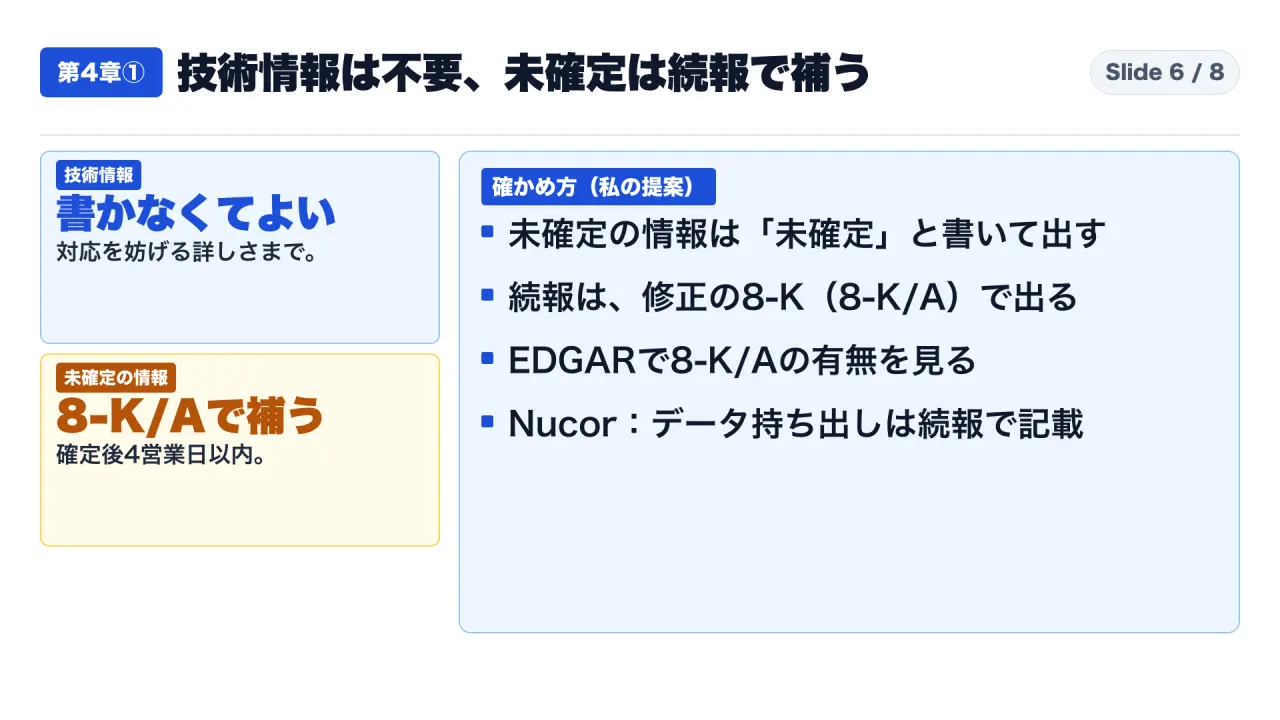
Item 1.05 instructions state: “a registrant is not required to disclose technical information about the registrant’s planned response to the incident or its cybersecurity systems, related networks and devices, or potential system vulnerabilities in such detail as would impede the registrant’s response or remediation of the incident.”
The SEC recognized that forcing registrants to disclose active vulnerabilities or ongoing containment steps would provide a real-time roadmap for threat actors. Consequently, the absence of technical vulnerability details in an initial Form 8-K is an intentional regulatory design choice.
Where material impact information is undetermined at the initial filing date, Instruction 2 to Item 1.05 mandates that the registrant state that fact and file an amended Form 8-K/A within four business days after the information is determined.
Section 5: Author Commentary, Analytical Caveats, and Invariant Boundaries
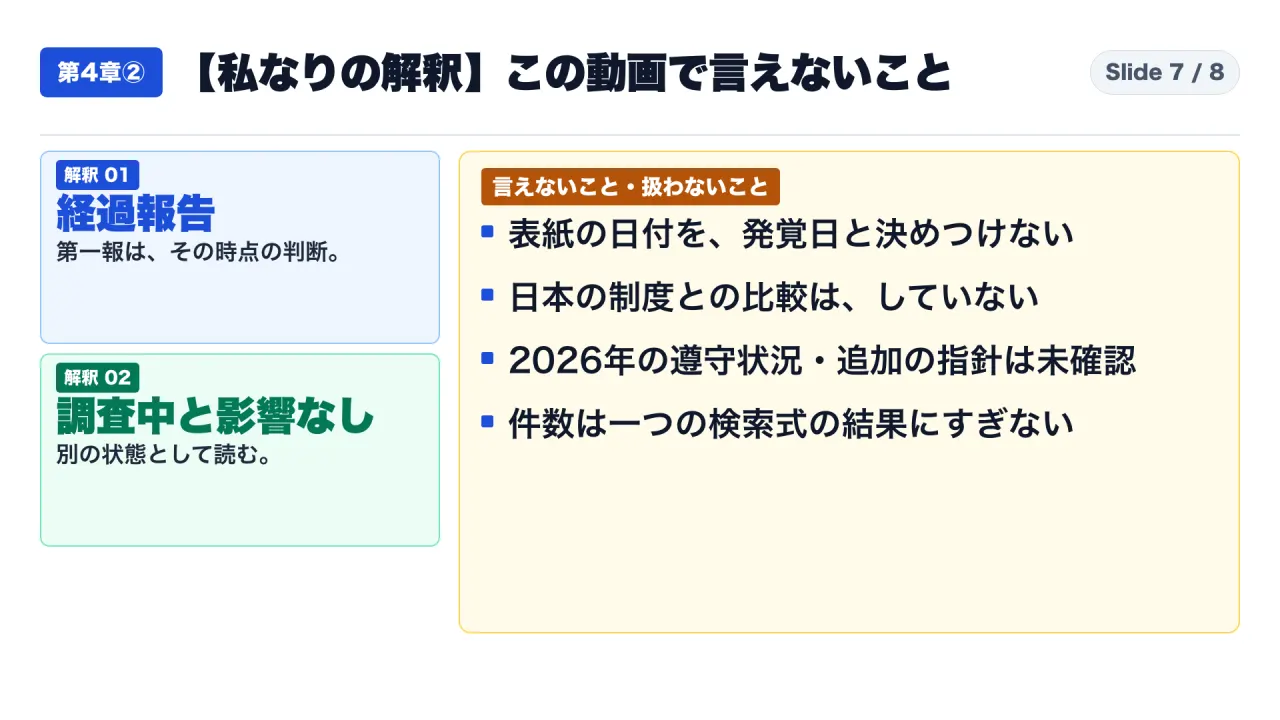
Three professional interpretations:
- Initial Reports Are Snapshots: An initial 8-K captures what leadership knows at the moment of materiality determination. It is an interim status report rather than a comprehensive historical audit.
- Cover Dates Are Not Discovery Dates: The “Date of Report (Date of earliest event reported)” on the cover indicates the triggering determination date, not the initial intrusion date.
- Under Investigation Does Not Mean Benign: Statements indicating that impacts are “undetermined” mean forensics are incomplete. Stakeholders must track subsequent 8-K/A filings rather than assuming the incident was minor.
Seven invariant regulatory boundaries:
- This analysis does not compare U.S. rules against Japanese disclosure frameworks.
- Compliance status for subsequent periods beyond the analyzed corpus is not evaluated.
- EDGAR search figures represent one specific query and do not constitute official SEC statistical aggregates.
- SEC staff statements represent advisory guidance without independent statutory force.
- This analysis describes factual filing sequences without ruling on the legal merits of individual corporate determinations.
- Foreign Private Issuer Form 6-K filings are outside the scope of this study.
- This analysis provides technical governance analysis only, offering no investment advice.
Practical Playbook for Evaluating Cybersecurity Disclosures
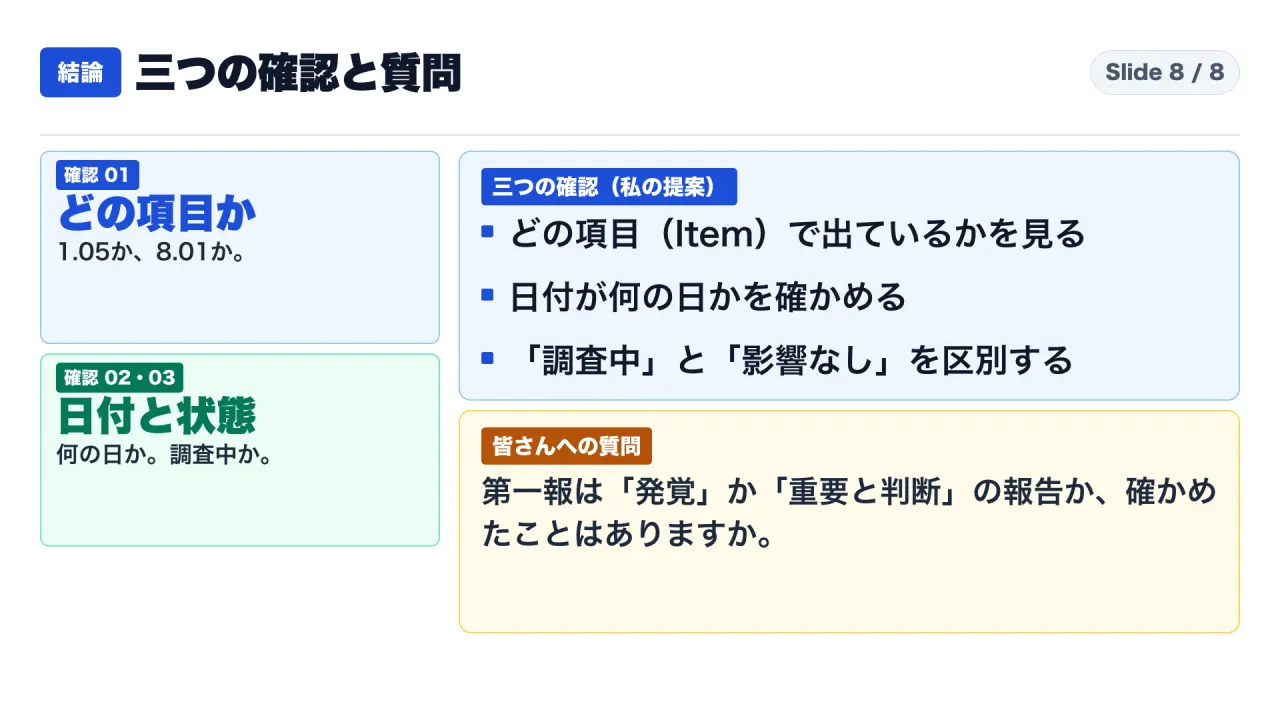
Organizations evaluating breach notices should apply a three-step evaluation framework.
Step 1: Verify Statutory Classification (Item 1.05 vs. Item 8.01)
- Item 1.05: Indicates the registrant determined the incident has had or is reasonably likely to have a material impact.
- Item 8.01: Indicates the incident is non-material or that investigations remain ongoing without a final materiality determination.
Step 2: Dissect the Chronology of Disclosed Dates
Differentiate three critical timestamps:
- Filing Date: When the document was received by EDGAR.
- Earliest Event Date: The date on the Form 8-K cover page, representing the triggering determination.
- Discovery and Intrusion Dates: Technical dates documented within the narrative body.
Step 3: Differentiate “Undetermined Impact” from “No Material Impact”
If the report states that financial and operational impacts are “undetermined,” calendar an inquiry for an upcoming Form 8-K/A amendment. If evaluating a strategic vendor, submit five standardized intake inquiries:
- Does this notification represent an initial discovery alert or a formal corporate materiality determination?
- On what date was the determination reached?
- What specific operational scopes or client-facing environments remain undetermined?
- What is the expected delivery timeframe for the next written status update?
- Are any dedicated systems or customer data pipelines currently offline or isolated?
Frequently Asked Questions
Q1: Does the 4-business-day deadline begin on the date an intrusion is first discovered?
No. Form 8-K General Instruction B.1 explicitly states that the four-business-day clock begins once the company determines that it has experienced a material cybersecurity incident.
Q2: Can companies delay materiality determinations indefinitely?
No. The rule requires companies to make materiality determinations “without unreasonable delay” following discovery. However, the SEC acknowledges that immediate determination on the discovery date is rarely feasible.
Q3: Does consulting with the FBI or CISA automatically extend the 4-business-day filing deadline?
No. Merely consulting with law enforcement does not alter filing deadlines. A delay is permitted only if the U.S. Attorney General determines that disclosure poses a substantial risk to national security or public safety and notifies the SEC in writing.
Q4: Is an incident disclosed under Item 8.01 definitively non-material?
Not necessarily. Companies often use Item 8.01 when investigations are ongoing and materiality has not yet been determined. If the incident is later determined to be material, an Item 1.05 Form 8-K must be filed within four business days of that determination.
Q5: Why do initial 8-K reports omit technical forensic details?
Item 1.05 instructions explicitly state that registrants are not required to disclose technical information about system vulnerabilities or response plans that would compromise containment or remediation.
Primary Sources and References
- SEC Form 8-K General Instructions (Official PDF)
- SEC Final Rule: Cybersecurity Risk Management, Strategy, Governance, and Incident Disclosure (Release No. 33-11216)
- SEC Division of Corporation Finance Compliance and Disclosure Interpretations (C&DIs) on Form 8-K
- Statement on Cybersecurity Incident Disclosure by Erik Gerding, Director, Division of Corporation Finance (May 21, 2024)
- Nucor Corporation Form 8-K Item 1.05 (Filed May 14, 2025)
- Nucor Corporation Form 8-K/A Item 1.05 (Filed June 20, 2025)
- Globe Life Inc. Form 8-K Item 8.01 (Filed June 14, 2024)
- SEC EDGAR Full-Text Search Index for Item 1.05 Filings (Retrieved October 31, 2026)