Why Were Stolen Legacy Passwords Still Functional in 2024? ── Dissecting the Snowflake Customer Breaches Through Mandiant Investigations and DOJ Indictments
A forensic analysis of primary investigative records reveals that the 2024 Snowflake database compromises stemmed from customer-side infostealer infections, unrotated legacy credentials, and omitted multi-factor authentication rather than platform vulnerabilities.
Published: October 31, 2026 | Read time: ~10 min | Watch Video (Japanese)
Executive Summary: Basic Hygiene vs. Novel Exploits
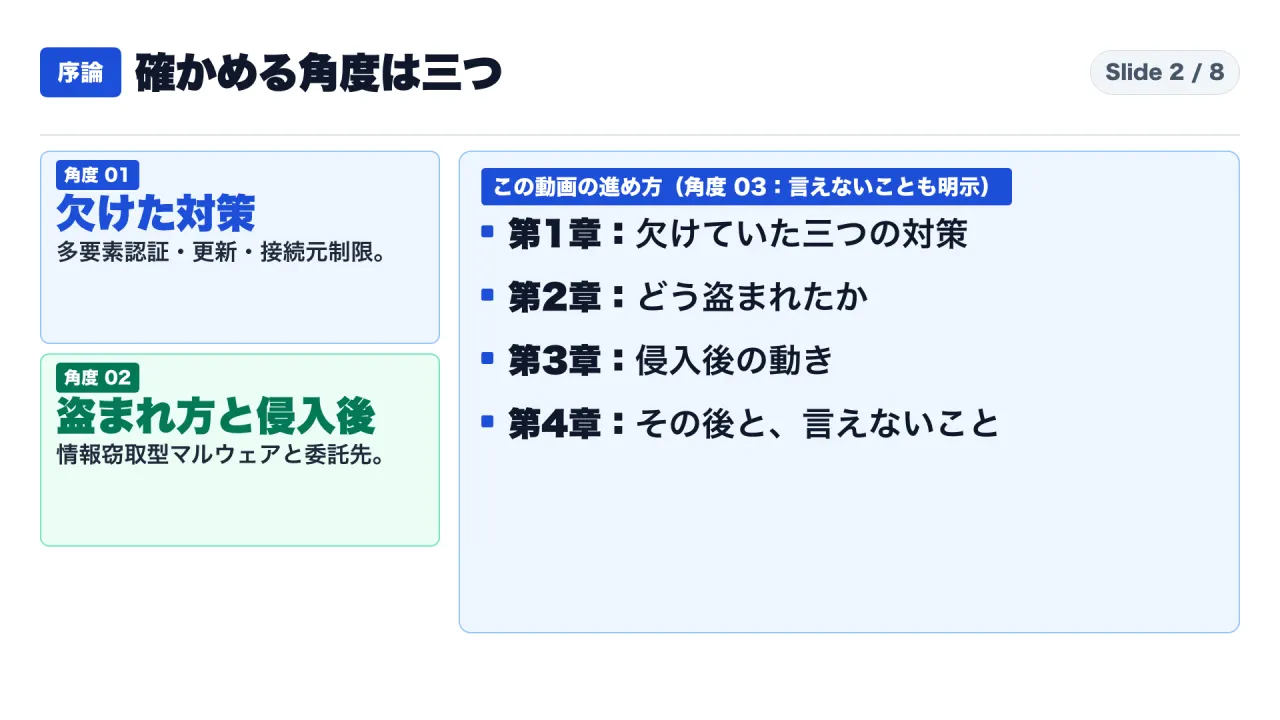
During 2024, a wave of systematic data thefts and extortion campaigns targeted enterprise databases hosted on the Snowflake cloud data platform. Sensationalist coverage speculated about zero-day platform vulnerabilities or widespread breaches of Snowflake’s core cloud infrastructure. However, forensic investigations published by Mandiant (Google Cloud) alongside criminal indictments unsealed by the U.S. Department of Justice (DOJ) establish a different reality.
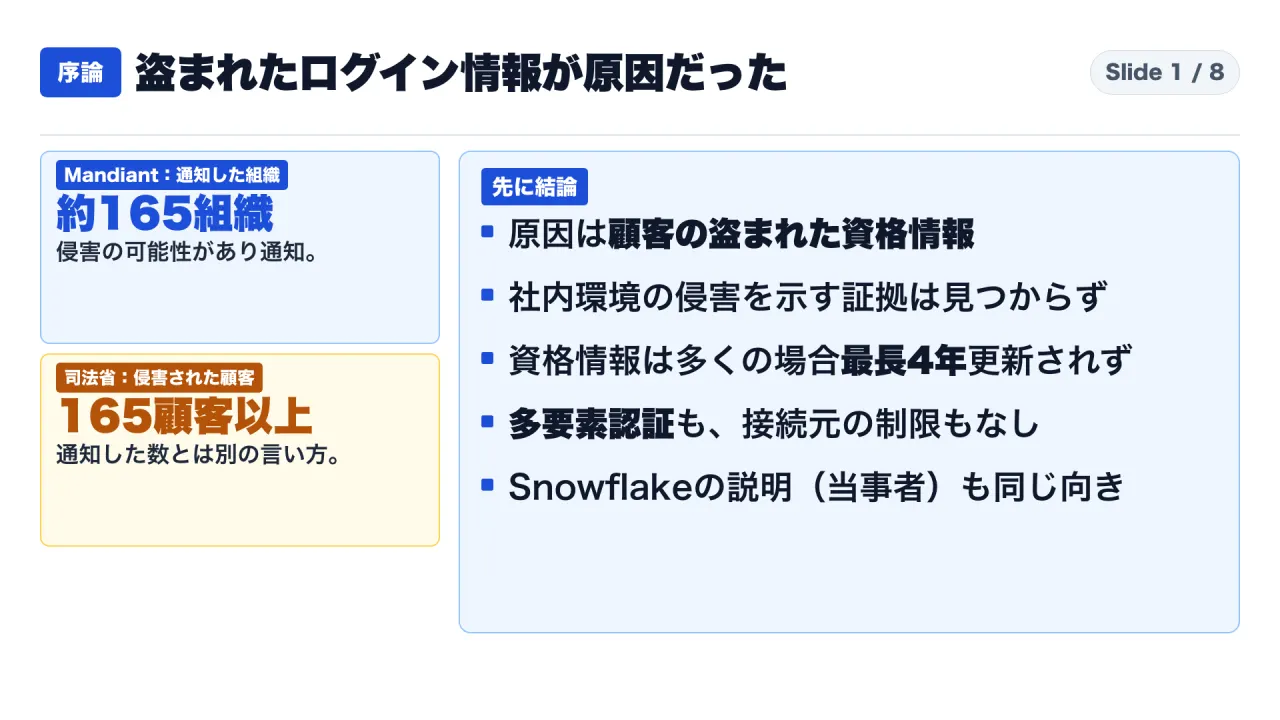
Mandiant established that every incident it investigated traced directly back to compromised customer credentials. Investigators found zero evidence indicating that Snowflake’s internal production environments were breached. Instead, threat actors authenticated successfully using valid usernames and passwords harvested by commodity infostealer malware, left unrotated for up to four years, and deployed against accounts lacking multi-factor authentication (MFA) and network IP allow lists.
This article examines four primary sources:
- Mandiant Threat Intelligence Report (published June 11, 2024).
- U.S. Department of Justice Press Release (published August 5, 2026).
- Snowflake Official Cybersecurity Statement (published July 29, 2024).
- Snowflake Technical Documentation on Phased Mandatory MFA Rollout (official security documentation).
This analysis strictly separates verified statutory facts, corporate statements, and professional author commentary.
Technical Baseline: Core Terminology and Platform Concepts
Evaluating the Snowflake incident requires precise technical distinctions:
- Credentials: Username and password pairings used for authentication.
- Multi-Factor Authentication (MFA): Verification requiring an independent secondary factor beyond password knowledge.
- Network Allow Lists (Network Policies): IP packet filtering configurations restricting incoming tenant connections strictly to authorized corporate CIDR blocks.
- Infostealer Malware: Malicious software harvesting browser autofill data, stored credentials, session tokens, and system metadata from infected endpoints.
- Tenant Instance: A customer’s isolated database environment within the multi-tenant cloud architecture.
- Stage: An internal storage location within Snowflake used for temporary data staging prior to ingestion or following extraction.
- UNC5537: Mandiant’s tracked threat cluster designation for this extortion campaign.
- Third-Party Contractor: External consultants or managed service providers contracted to administer customer data warehouses.
A vital boundary exists between credential theft on client endpoints and a systemic platform breach compromising cloud infrastructure. Conflating these distinct threat models obscures necessary enterprise remediation.
Section 1: The Three Missing Controls: MFA, Credential Rotation, and IP Filtering
Mandiant’s Investigative Findings
Mandiant’s forensic response engaged directly with impacted enterprise victims. In its June 11, 2024 report, Mandiant affirmed two foundational points:
- Every incident investigated by Mandiant traced back to stolen customer credentials.
- Investigators identified zero evidence that Snowflake’s production environment was compromised.
Mandiant emphasized that the campaign was not the result of advanced zero-day exploits. Instead, the threat cluster capitalized on three widespread operational hygiene omissions across customer environments:
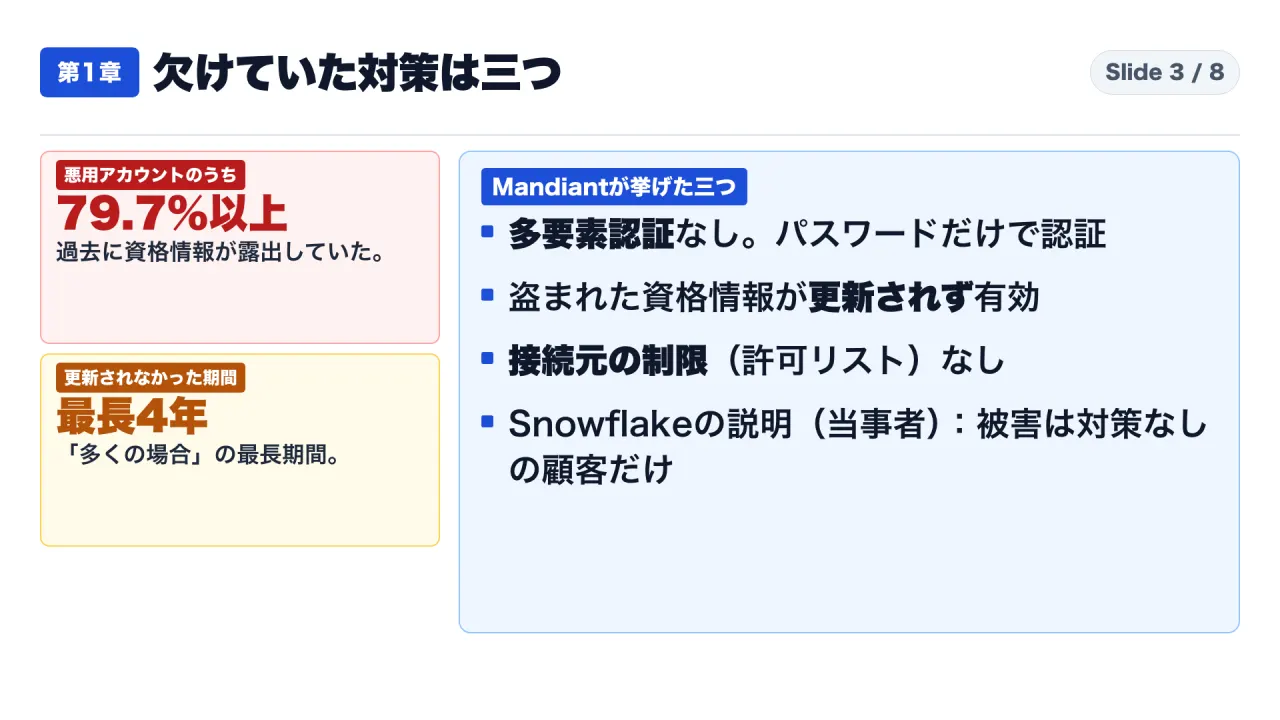
- Absence of Multi-Factor Authentication: Impacted customer accounts did not have MFA enabled. Threat actors authenticated using single-factor username and password pairs alone.
- Omitted Credential Rotation: Stolen credentials discovered in historical infostealer log archives remained active years after compromise, remaining unrotated for up to four years in many cases.
- Absence of Network Allow Lists: Impacted tenant environments lacked network policy restrictions limiting incoming access to trusted corporate IP ranges, allowing threat actors to connect across public commercial VPNs.
Forensic Dissection of the “79.7%” Metric
A widely cited metric asserts that “80% of victims were compromised via infostealers.” A precise reading of Mandiant’s report clarifies the actual statistical denominator:
- Mandiant and Snowflake determined that over 79.7% of the accounts leveraged by the threat actor had prior credential exposure.
- This metric measures accounts utilized by the attacker, not the total population of affected enterprise tenants.
- Furthermore, the 79.7% metric reflects historical exposure across breaches generally, rather than exclusively infostealers.
Snowflake’s Corporate Defense
In an update published on July 29, 2024, Snowflake stated that impacted accounts were exclusively those whose credentials had been exposed in dark web dumps, lacked MFA, and operated without network policies. Snowflake highlighted that MFA functionality had been available free of charge since June 2015, and network policies had been supported since 2016. However, making security controls technically available is fundamentally distinct from enforcing them by default.
Section 2: Attack Vectors: Commodity Infostealers and Contractor Laptops
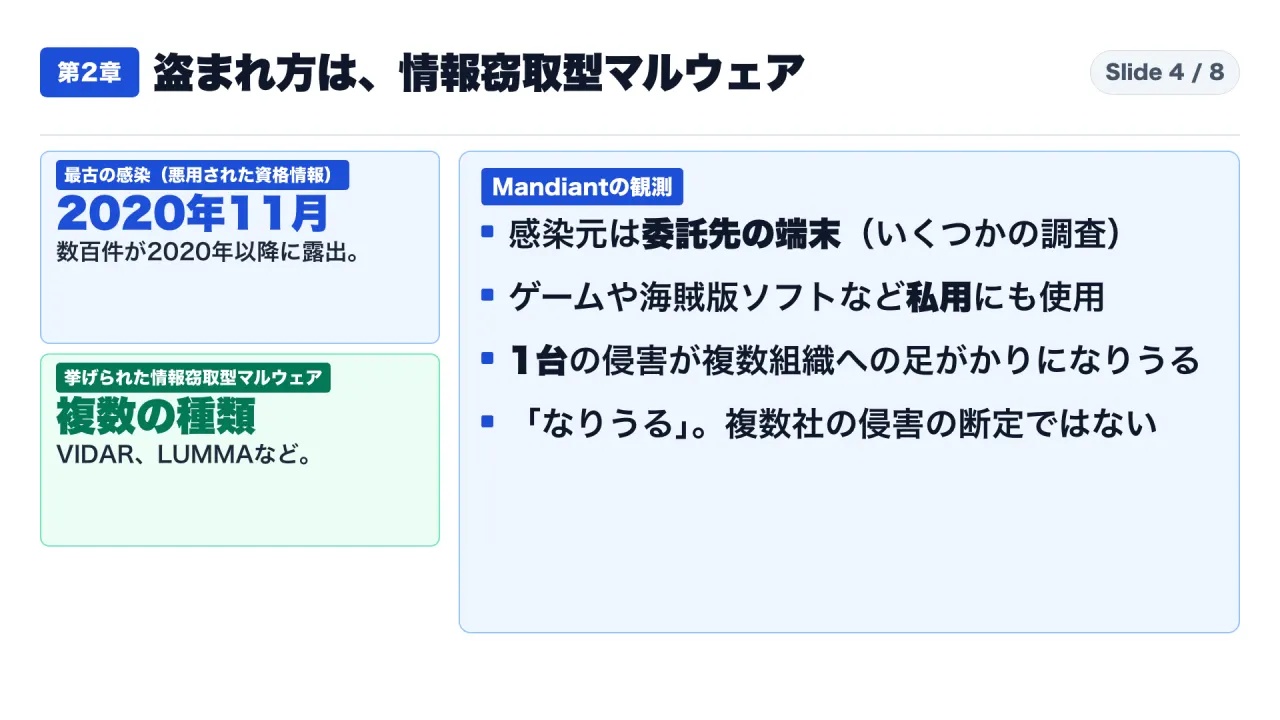
Mandiant established that UNC5537 leveraged credentials harvested by commodity infostealer malware families, explicitly identifying:
- VIDAR
- RISEPRO
- REDLINE
- RACOON STEALER
- LUMMA
- METASTEALER
The earliest recorded malware infection tied to credentials exploited in the 2024 campaign dated back to November 2020. Mandiant identified hundreds of exposed Snowflake customer credentials originating from malware logs circulating between 2020 and 2024.
The Contractor Endpoint Exposure Pathway
A critical vector documented in Mandiant’s investigations involved third-party contractors:
- In several forensic engagements, the initial malware infection occurred on a personal or contractor-owned computer rather than an enterprise-managed workstation.
- These endpoints were used for personal activities, including downloading video games and pirated commercial software, which served as common distribution vehicles for infostealer payloads.
- Contractors frequently used unmonitored laptops to administer client databases. When an external contractor’s machine was infected, credentials accessing multiple independent enterprise environments were compromised simultaneously.
- Furthermore, contractor credentials frequently held elevated database administrator (DBA) roles.
Internal password hygiene is insufficient if external service providers access sensitive production data warehouses from unmanaged endpoints.
Section 3: Post-Exploitation Execution: Standard SQL and Living-Off-the-Land
Once inside a victim tenant, UNC5537 did not deploy custom implants. Instead, threat actors executed routine administrative SQL commands native to Snowflake:
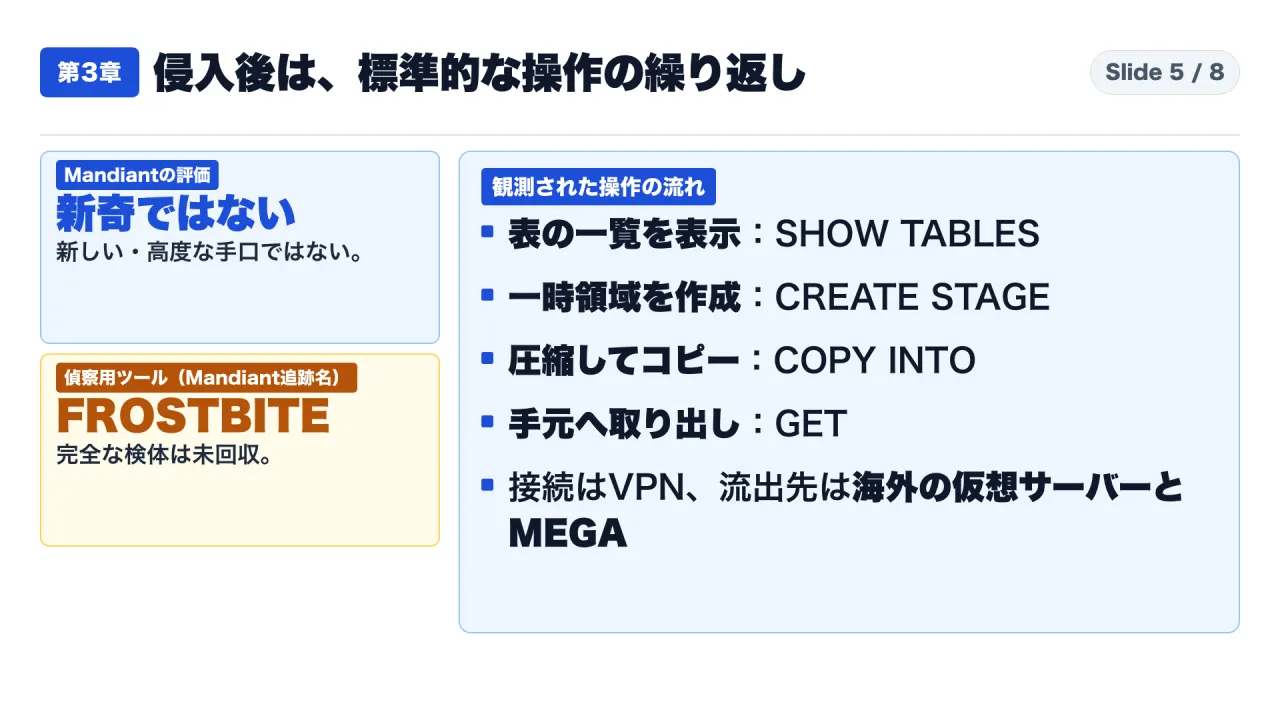
- SHOW TABLES: Enumerated databases, schemas, and table names to identify sensitive records.
- SELECT: Queried specific tables to inspect schemas and sample records.
- LIST (ls): Enumerated existing stages within the tenant prior to creating exfiltration conduits.
- CREATE STAGE: Instantiated temporary stages to hold extracted data.
- COPY INTO: Bulk-copied selected table data into the temporary stage, compressing output files using GZIP.
- GET: Downloaded the compressed GZIP archive files from the stage directly to attacker-controlled endpoints.
Because this command sequence mirrors standard business intelligence workflows, detecting malicious activity proved difficult in environments lacking anomalous behavioral monitoring.
Mandiant also observed a custom reconnaissance script designated as FROSTBITE, which enumerated active users, roles, sessions, and organization configurations across two observed variants. Mandiant was unable to recover a complete binary sample, restricting confirmation strictly to observed commands.
Threat actors connected using DBeaver Ultimate, routing traffic through commercial VPN providers—predominantly Mullvad and Private Internet Access (PIA). Exfiltrated data was staged on virtual servers hosted by Moldovan provider ALEXHOST SRL (AS200019), alongside overseas VPS infrastructure and MEGA. Mandiant assessed with moderate confidence that core threat actors operated out of North America with a collaborator in Turkey.
Section 4: Regulatory Fallout: Phased MFA Enforcement and DOJ Indictments
Snowflake’s Three-Phase MFA Enforcement Roadmap
Following the incident, Snowflake initiated a program to transition MFA from an optional configuration into a platform-enforced mandate:
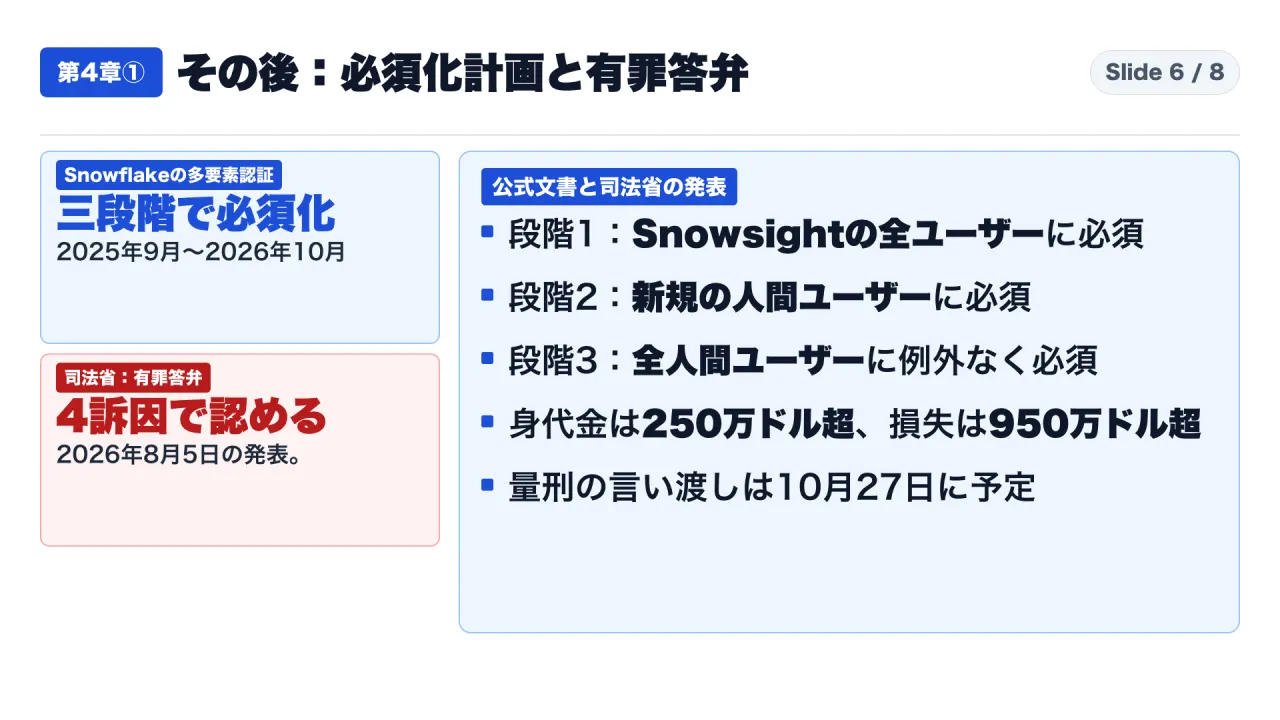
- Phase 1 (September 2025 to January 2026): Mandated MFA across all users authenticating via the Snowsight web user interface.
- Phase 2 (May to July 2026): Enforced a secondary factor for all newly created human users. Required newly created service accounts to use non-password authentication exclusively (such as key-pair authentication).
- Phase 3 (August to October 2026): Universal enforcement. Mandated MFA without exception across all human users. Completely disabled password authentication for programmatic service accounts.
Criminal Indictment and DOJ Findings
On August 5, 2026, the U.S. Department of Justice announced that a Canadian national pleaded guilty to four federal counts: Computer Fraud and Abuse Act violations, Wire Fraud, Aggravated Identity Theft, and Conspiracy.
Key metrics confirmed in the DOJ announcement include:
- Scope of Victimization: Attackers compromised cloud database tenants belonging to at least 165 enterprise customers between February and October 2024.
- Financial Extortion: The threat cluster demanded over $2.5 million in cryptocurrency ransoms.
- Corporate Losses: Direct financial losses incurred by victim enterprises exceeded $9.5 million (excluding downstream expenses).
- Downstream Impact: Compromised records contained PII belonging to at least 100 million individuals.
- Distribution Channels: Stolen data was advertised across cybercrime forums (BreachForums, Exploit.in, XSS.is) and Telegram.
- Personal Proceeds: The defendant personally received at least $495,000 prior to extradition from Canada in July 2025.
Sentencing was scheduled for October 27, 2026; however, primary documentation confirming final judicial sentencing orders was not available as of October 31, 2026.
Section 5: Author Commentary, Analytical Caveats, and Invariant Boundaries
Three professional interpretations:
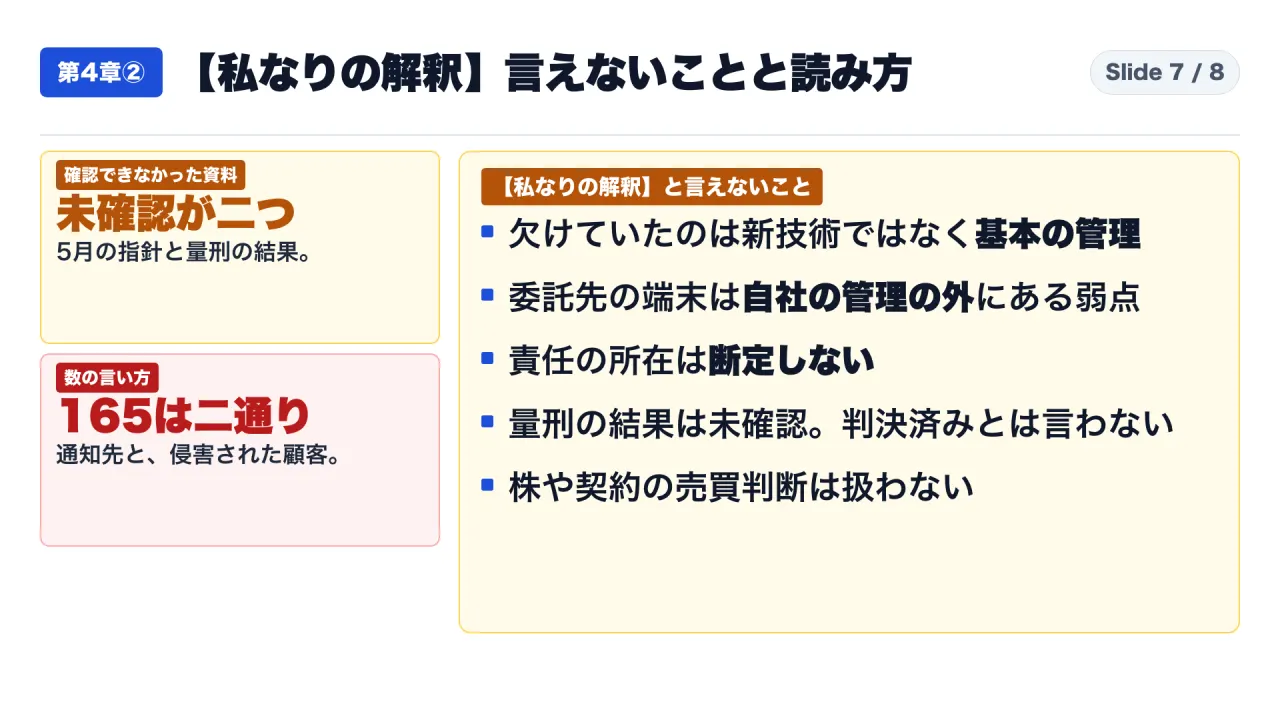
- Hygiene Failures Trumped Technical Sophistication: The breaches represented a failure of foundational identity hygiene rather than advanced software exploits. Passwords left unrotated for four years reflect an operational breakdown in basic credential lifecycle management.
- Third-Party Contractor Endpoints Are Enterprise Perimeters: Enterprise security models that strictly monitor corporate workstations while granting unmonitored external contractors administrative credentials possess an undefended flank.
- Metric Precision Is Mandatory: Reporting must distinguish investigative notification metrics from legal victim enumerations. Mandiant notified approximately 165 organizations identified in attacker communications; the DOJ established that at least 165 enterprise customers experienced verifiable data compromise.
Seven strict regulatory and analytical boundaries:
- Snowflake May 30, 2024 Guidance: The original guidance document could not be retrieved; Snowflake’s position is evaluated solely from its July 29, 2024 statement.
- Legal Fault Attribution: This technical analysis does not assign legal fault between platform provider and customer organizations.
- Enterprise Victim Identifications: Specific corporate victim names are excluded because the DOJ indictment referenced unnamed entities.
- Sentencing Outcome: Official court sentencing orders were not reviewed; no final judicial sentence is asserted.
- FROSTBITE Capability: Because complete binary samples were unrecovered by Mandiant, additional speculative features are omitted.
- MITRE ATT&CK Mapping: Specific sub-technique classifications not explicitly cited in Mandiant’s report are excluded.
- Commercial Advice: This analysis evaluates security governance only, offering no equity valuation or investment advice.
Practical Playbook for Enterprise Cloud Data Warehouse Defense
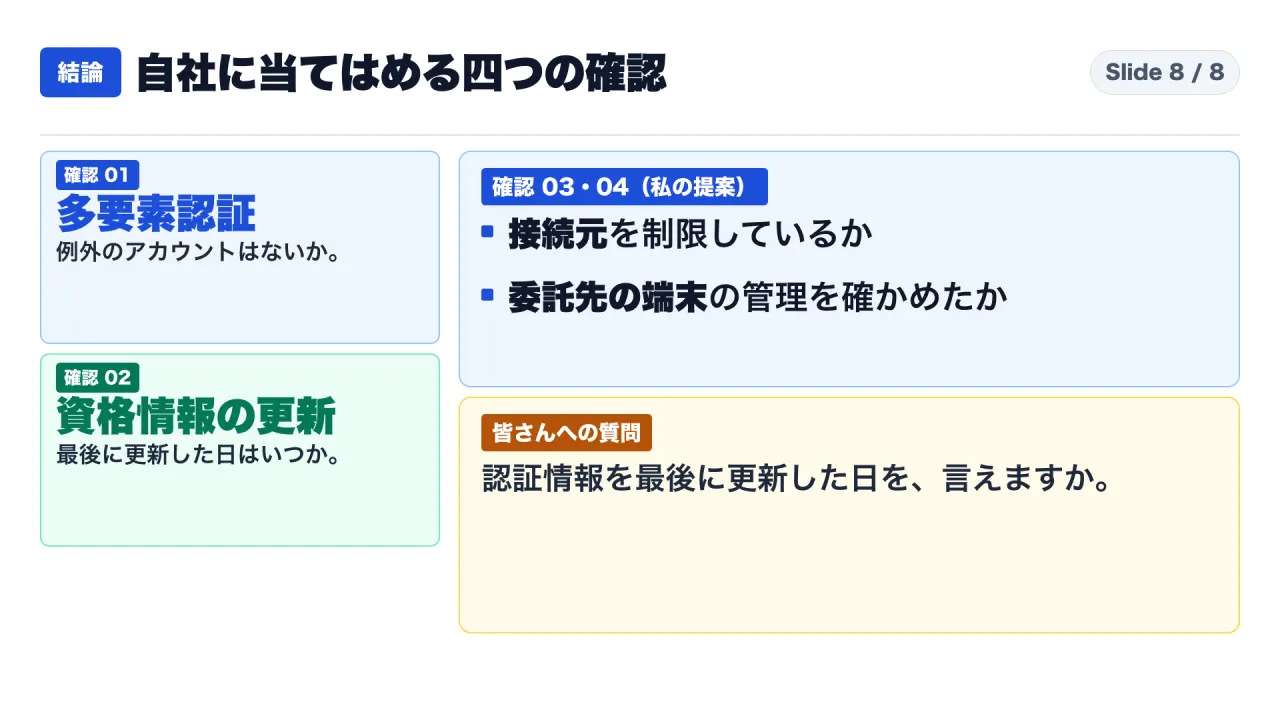
Security teams managing cloud database platforms should execute an immediate four-point posture audit.
Audit Step 1: Eliminate MFA Exceptions
Perform an inventory of all human administrative and analyst accounts across production databases:
- Verify that MFA enforcement is universal with zero organizational exemptions.
- Scrutinize service accounts, contractor accounts, and emergency break-glass roles, which historically represent the most common vectors for omitted secondary authentication.
Audit Step 2: Establish Credential Age Baselines and Automated Rotation
Determine the precise creation and last-rotated timestamp for every database password:
- Invalidate any static password older than 90 days.
- Cross-reference internal corporate email addresses and usernames against commercial threat intelligence repositories tracking dark web infostealer logs.
- Treat any endpoint infected by commodity malware as an immediate credential revocation event.
Audit Step 3: Implement Strict Network Policy Allow Lists
Enforce IP allow listing at the tenant level:
- Restrict database ingress strictly to known corporate egress gateways, secure bastion hosts, or verified cloud IP CIDRs.
- Block direct internet routing and commercial VPN exit nodes from establishing administrative sessions.
Audit Step 4: Institute Contractor Endpoint Governance
Review access architectures for external managed service providers and systems integrators:
- Prohibit direct database connections originating from unmanaged personal contractor laptops.
- Mandate that third-party contractors authenticate through enterprise-managed Virtual Desktop Infrastructure (VDI) or corporate identity providers enforcing endpoint posture checks.
Frequently Asked Questions
Q1: Was Snowflake’s central cloud platform breached during the 2024 campaign?
No. Mandiant confirmed that every incident it responded to traced back to compromised customer credentials, finding zero evidence that Snowflake’s enterprise production environment was breached.
Q2: Does the 79.7% metric mean that nearly 80% of all Snowflake customers were compromised?
No. The 79.7% figure reflects the proportion of accounts utilized by the threat actor that had prior credential exposure in breach dumps, not the overall percentage of Snowflake customer accounts.
Q3: Were zero-day vulnerabilities or advanced zero-click exploits used?
No. Threat actors utilized valid stolen credentials, commodity infostealer logs, standard SQL queries, and basic network evasion via commercial VPNs.
Q4: Did the threat actors target only full-time corporate employees?
No. Mandiant documented multiple instances where the initial malware infection occurred on contractor laptops utilized for personal activities, including gaming and pirated software downloads.
Q5: What was the resolution of the criminal prosecution against the threat actor?
On August 5, 2026, the DOJ announced a guilty plea by an extradited Canadian national to four federal counts, confirming compromises of at least 165 enterprise customers and over $9.5 million in direct victim losses.
Primary Sources and References
- Mandiant Threat Intelligence: UNC5537 Snowflake Data Theft and Extortion Campaign (June 11, 2024)
- U.S. Department of Justice: Canadian National Pleads Guilty to Hacking Cloud Storage Provider and Extorting Customers (August 5, 2026)
- Snowflake Official Cybersecurity Statement: CISA Secure by Design (July 29, 2024)
- Snowflake Technical Documentation: Multi-Factor Authentication (MFA) Phased Enforcement Roadmap