Can AI Compute Contracts Really Be Terminated on 90 Days' Notice? ── Reading SpaceX's 34.5% Customer B in Form 10-Q Against Anthropic's Form S-1
An analysis of SEC regulatory filings reveals how a 34.5% revenue concentration in SpaceX’s Super Intelligence segment hinges on fixed monthly stand-ready commitments that become terminable by either party after early 2027.
Published: October 31, 2026 | Read time: ~10 min | Watch Video (Japanese)
Executive Summary: The Liquidity of Megascale Compute
Enterprise agreements for artificial intelligence compute infrastructure are frequently perceived as multi-year capital guarantees. However, regulatory filings submitted to the U.S. Securities and Exchange Commission (SEC) reveal a contingent commercial architecture. While compute contracts establish predictable monthly cash flows through fixed subscription pricing, their legal terms provide rolling exit ramps allowing either party to terminate the commitment upon 90 days’ advance written notice once initial lock-in windows expire.
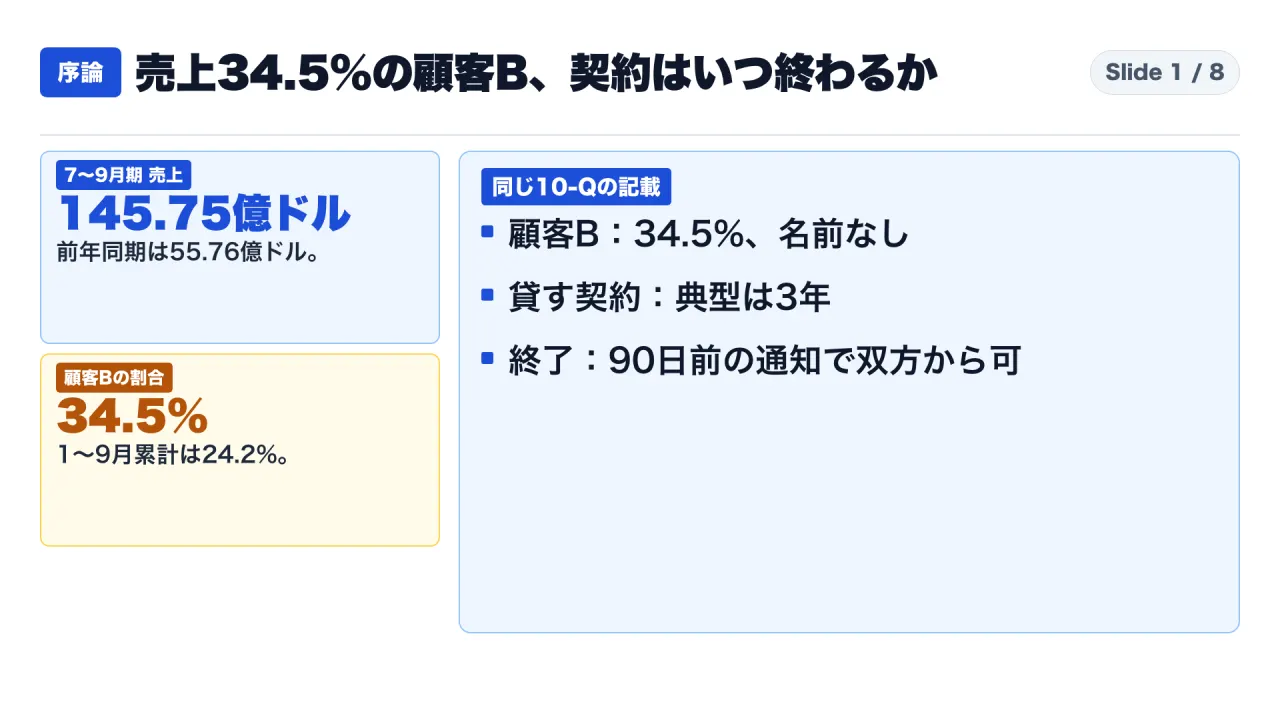
In its Form 10-Q for the quarterly period ended September 30, 2026, Space Exploration Technologies Corp. (SpaceX) disclosed that an unnamed counterparty, “Customer B,” generated 34.5% of consolidated net revenue. Contemporaneously, on October 26, 2026, Anthropic PBC filed its Form S-1 registration statement, detailing compute service agreements with SpaceX’s subsidiary, SpaceX.AI LLC. Crucially, Anthropic revealed that initial non-cancelable periods conclude in January 2027 and March 2027, after which either party may cancel upon 90 days’ advance written notice.
This investigation applies three analytical standards:
- Statutory Disclosure (Fact): Verbatim data points directly documented within SEC filings.
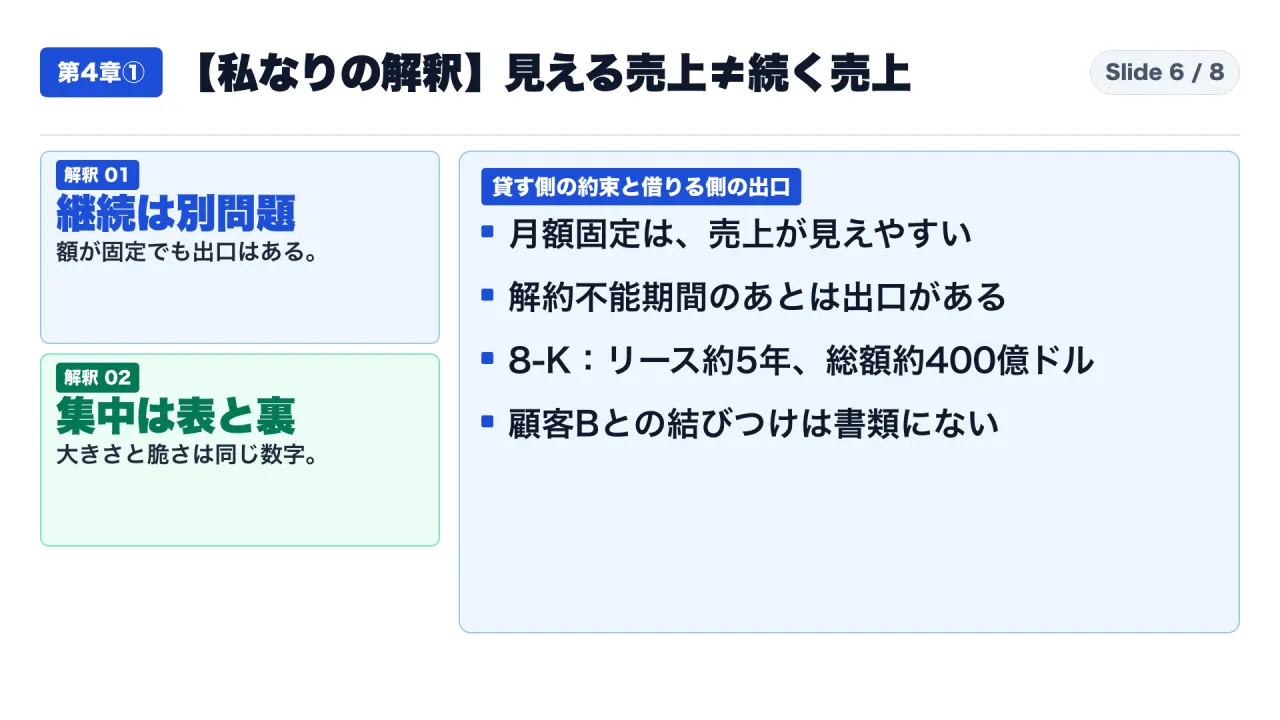
- Multi-Filing Synthesis (Inference): Deductive reconciliations derived by matching financial schedules and GPU cluster counts across filings.
- Author Commentary (Interpretation): Professional assessments regarding capital duration and procurement governance, separated from statutory facts.
All financial metrics are presented in U.S. dollars as stated in primary filings.
Regulatory Framework: SEC Concentration Rules and ASC 606
This investigation examines five regulatory instruments filed with the SEC:
- SpaceX Form 10-Q (quarter ended September 30, 2026).
- SpaceX Final Prospectus filed pursuant to Rule 424(b)(4) in June 2026.
- Anthropic PBC Form S-1 registration statement filed October 26, 2026.
- SpaceX Form 8-K filed October 26, 2026 (Apollo equipment lease facility).
- SpaceX Form 10-Q (quarter ended June 30, 2026).
Under U.S. GAAP (ASC 280 and ASC 275), entities must disclose customer concentrations whenever revenue from an individual customer exceeds 10% of consolidated net revenue. Reporting convention permits withholding commercial names, assigning anonymous symbols such as Customer A and Customer B. The mathematical denominator for these percentages is total consolidated revenue across all segments—Space, Connectivity, and Super Intelligence.
SpaceX’s third segment, currently designated as “Super Intelligence” (SI), was formerly reported as the “AI segment.” Note disclosures in the September 30, 2026 Form 10-Q confirm: “the Super Intelligence (‘SI’) segment (formerly known as the AI segment).” In the June 30, 2026 Form 10-Q, Customer B’s revenue was attributed to the AI segment; in the September 30, 2026 filing, Customer B is associated with the SI segment.
Under ASC 606, SpaceX accounts for cloud compute contracts as service agreements comprising a single performance obligation: a “stand-ready promise” to provide continuous access to reserved compute capacity. Consideration is structured primarily as fixed monthly subscription fees. Revenue is recognized over time: scaling with active capacity during ramp periods, and shifting to straight-line recognition upon steady-state delivery.
Section 1: Raw Disclosures in SpaceX’s Form 10-Q
In Q3 2026 (ended September 30, 2026), SpaceX reported consolidated net revenue of $14.575 billion, up 161.4% from $5.576 billion in Q3 2025. Nine-month revenue reached $27.083 billion, up from $13.714 billion in 2025.
| Financial Metric | Q3 2026 (3 Months) | 9-Month Cumulative 2026 | Prior-Year (2025) | Regulatory Source |
|---|---|---|---|---|
| Consolidated Revenue | $14.575B | $27.083B | $5.576B / $13.714B | SpaceX Form 10-Q (Q3 2026) |
| Customer B Concentration | 34.5% | 24.2% | Not >10% (*) | SpaceX Form 10-Q (Q3 2026) |
| Customer A Concentration | 16.6% | 17.3% | 23.9% / 21.6% | SpaceX Form 10-Q (Q3 2026) |
| Customer B Concentration (Q2) | 19.5% | 12.2% (6M Cumulative) | Not Disclosed | SpaceX Form 10-Q (Q2 2026) |
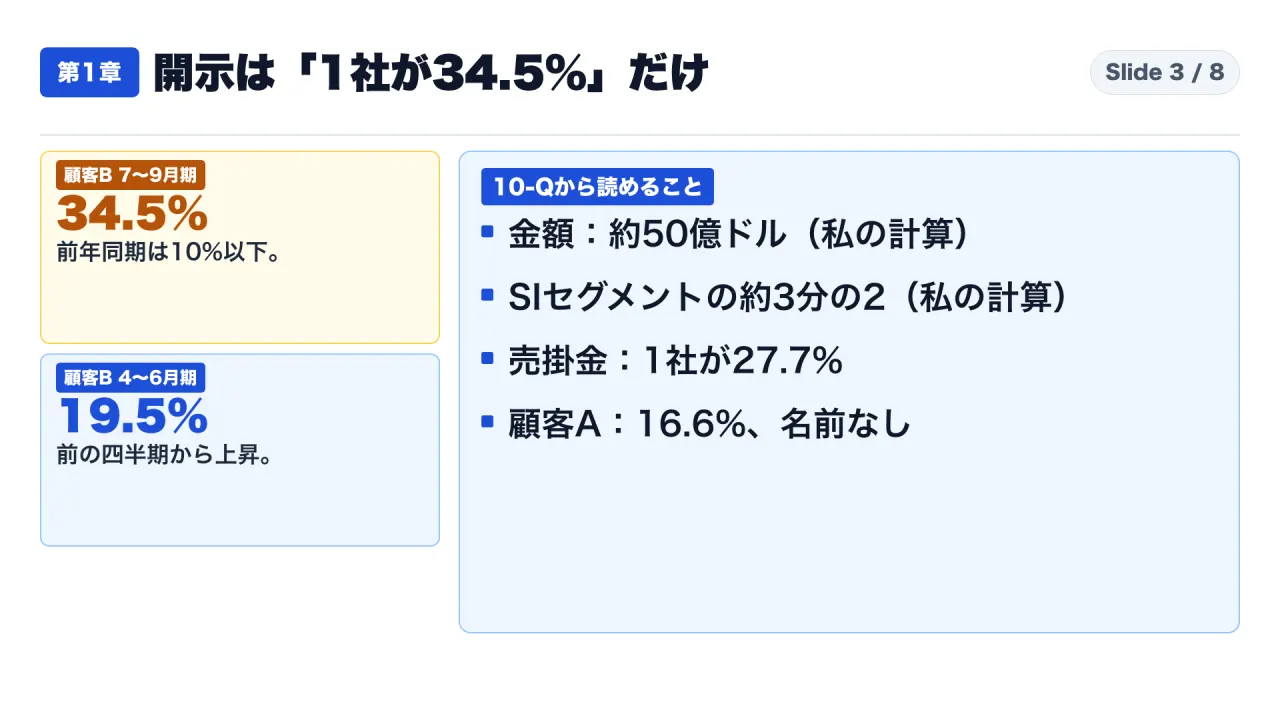
Customer B expanded from 19.5% of revenue in Q2 2026 to 34.5% in Q3 2026—a gain of 15.0 percentage points. Multiplying Q3 revenue ($14.575 billion) by 34.5% yields approximately $5.028 billion (~$5.03 billion, ranging between $5.021B and $5.036B across rounding bounds).
Nine-month figures confirm consistency: 24.2% of $27.083 billion is ~$6.554 billion. Subtracting Q3 leaves ~$1.526B recognized in the first half of 2026, which represents exactly 12.2% of first-half revenue ($12.508B), matching the June 30, 2026 Form 10-Q.
In Q3 2026, SI segment revenue reached $7.560 billion, up 829.9% from $813 million in Q3 2025. Customer B’s calculated revenue of ~$5.03 billion represents approximately 66.5%—nearly two-thirds—of SpaceX’s entire SI segment in Q3 2026. SpaceX also disclosed that a single customer represented 27.7% of accounts receivable as of September 30, 2026.
Section 2: Cross-Filing Forensics: Connecting Customer B to Anthropic
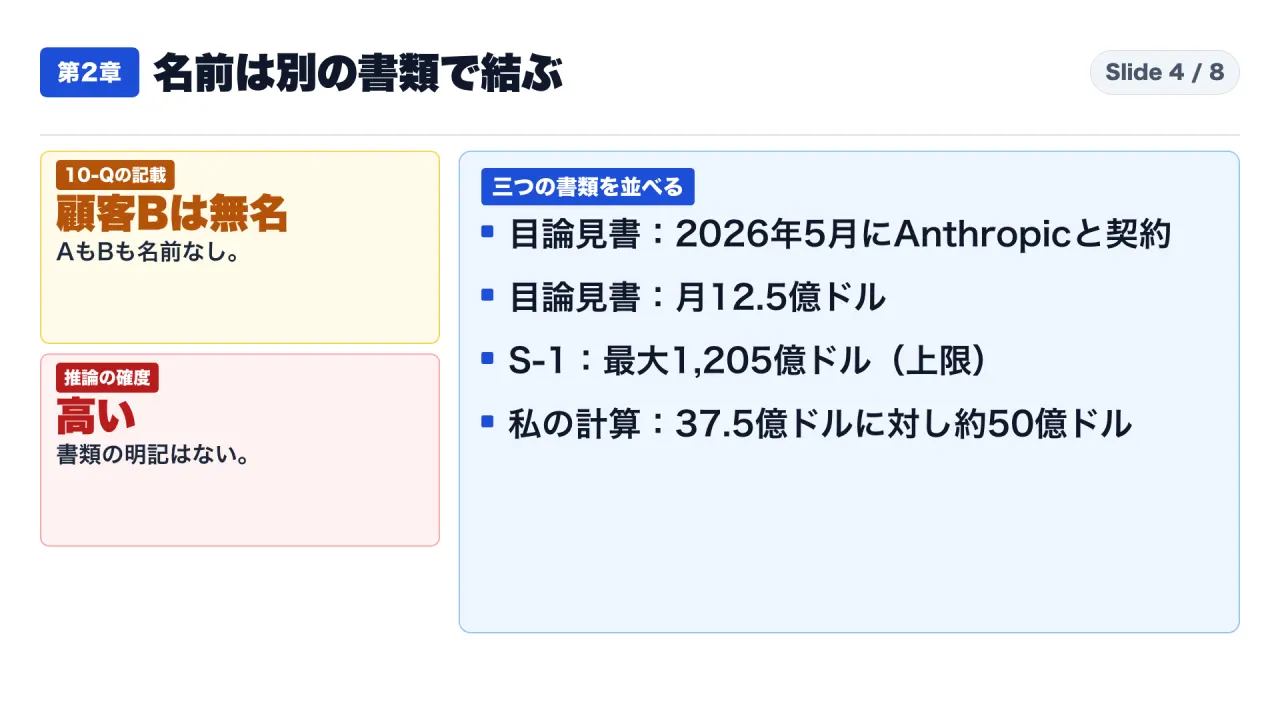
While Form 10-Q withholds names, related filings disclose counterparties explicitly:
| Filing | Named Entities | Disclosed Financial Commitments | Withheld Information |
|---|---|---|---|
| SpaceX Form 10-Q (Q3 2026) | Anonymous “Customer B” | 34.5% of Q3 revenue; 24.2% of 9M revenue; SI segment | Identity of Customer B |
| SpaceX Rule 424(b)(4) Prospectus (June 2026) | Anthropic PBC (Named) | Cloud agreement signed May 2026; $1.25B/month through May 2029 | Cross-reference to Customer B |
| Anthropic Form S-1 (Oct 26, 2026) | SpaceX.AI LLC (Named) | Agreements up to $120.5B; ~$3.1B/month upon full delivery | Cross-reference to Customer B |
| SpaceX Form 8-K (Oct 26, 2026) | Apollo affiliate | Finance lease commitment for ~$40B GPU pods | Any mention of Anthropic |
In its June 2026 Prospectus, SpaceX disclosed a May 3, 2026 compute contract with Anthropic PBC across two data center complexes: COLOSSUS in Memphis, Tennessee, and COLOSSUS II in Memphis, Tennessee, and Southaven, Mississippi, encompassing approximately 325,000 NVIDIA GPUs. Anthropic agreed to pay $1.25 billion per month through May 2029, following discounted ramp rates during May and June 2026. Anthropic’s Form S-1 verified multiple compute agreements with SpaceX.AI LLC.
The deductive reconciliation aligns across four points:
- Three months at $1.25 billion equals $3.75 billion quarterly baseline.
- SpaceX’s third-quarter Customer B revenue of ~$5.03 billion exceeds baseline by ~$1.28 billion.
- Anthropic’s S-1 confirms contract modifications between May and October 2026, while SpaceX’s 10-Q notes additional contracts.
- Dividing $5.03 billion by three months yields
$1.68 billion monthly, between baseline ($1.25B) and full deployment ($3.1B).
In its Form S-1, Anthropic lists clients Customer A, B, C, and D. These represent software customers, not compute providers, and are distinct from Customer B in SpaceX’s Form 10-Q.
Section 3: Contractual Anatomy: Fixed Fees and the 90-Day Exit Clause
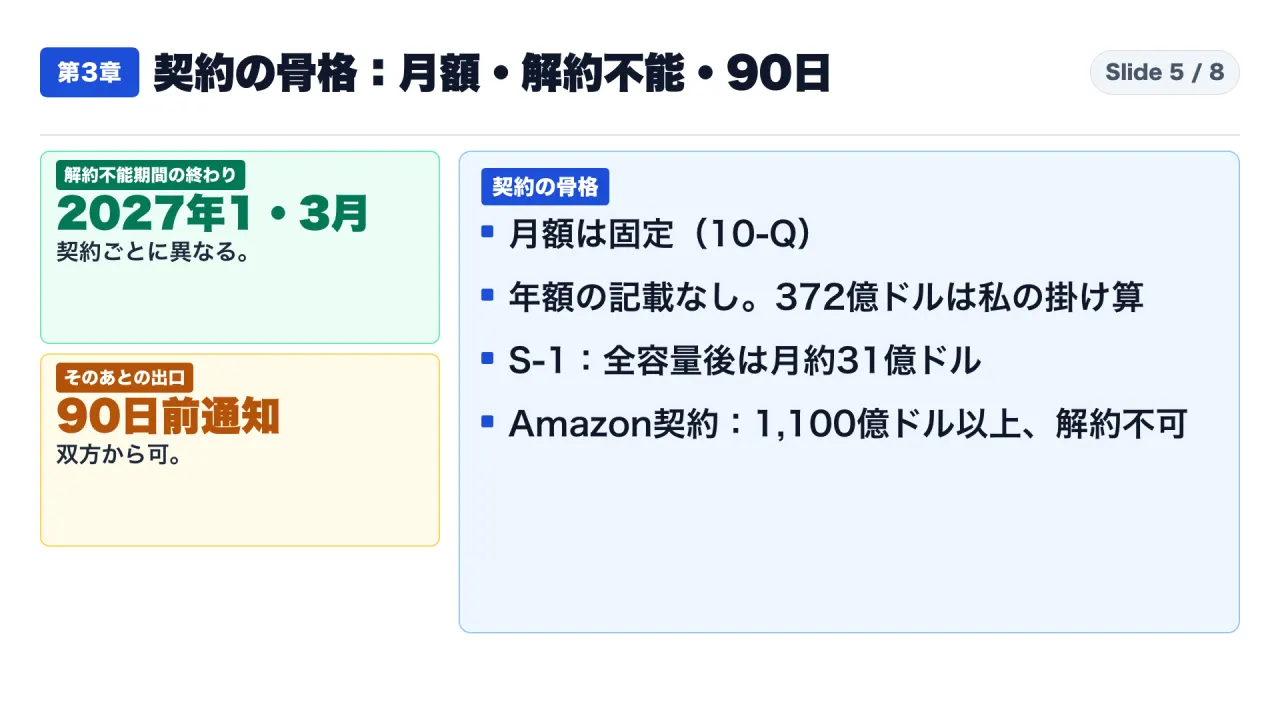
Contractual termination terms evolved across 2026 disclosures:
- SpaceX June 2026 Prospectus: Following an initial three-month ramp period, the agreement was terminable by either party upon 90 days’ advance written notice.
- SpaceX Q3 2026 Form 10-Q: Generalized that cloud compute contracts typically feature three-year terms and are terminable by either party upon 90 days’ notice.
- Anthropic October 2026 Form S-1: Initial non-cancelable periods conclude in January 2027 and March 2027, after which each agreement may be canceled by either party upon 90 days’ advance written notice.
Can AI compute contracts be dissolved on 90 days’ notice? Not until the initial non-cancelable period expires in early 2027, but readily thereafter. Once January and March 2027 pass, the arrangement transitions into a rolling quarterly commitment. This termination right is strictly bilateral: SpaceX also possesses the legal right to cancel upon 90 days’ notice to reclaim compute for internal priorities.
| Metric | Nominal Value | Nature in Regulatory Filings |
|---|---|---|
| Baseline Monthly Fee | $1.25B / month | Baseline fee in June 2026 Prospectus; subject to amendment |
| Full-Delivery Monthly Fee | ~$3.1B / month | Projected monthly fee in S-1 upon complete deployment |
| Expenditure Ceiling | Up to $120.5B | Spending cap agreed by Anthropic; not guaranteed revenue |
| Annualized Maximum Run-Rate | ~$37.2B / year | Arithmetic product ($3.1B * 12); no annual guarantee |
Multiplying the full-delivery rate (~$3.1B) by 90 days indicates exit fees of ~$9.3 billion. Confusing the $120.5 billion ceiling with guaranteed revenue ignores the bilateral exit clause.
This flexibility contrasts with Anthropic’s agreement with Amazon AWS. Under AWS terms, Anthropic committed to spend at least $110.0 billion between May 2026 and April 2036 with mandatory deficiency true-ups and no convenience cancellation rights.
Section 4: Capital Duration Mismatches in Modern Neoclouds
On October 24, 2026, SpaceX executed a commitment letter with Apollo Global Management for a master finance lease facility, reported in Form 8-K on October 26, 2026. The lessor acquires and leases GPU pods to SpaceX across 5-year tranches. Rent amortizes principal quarterly over five years, with total principal estimated at ~$40 billion.
While Form 8-K does not mention Customer B, five-year amortizing lease obligations ($40 billion over 60 months) alongside customer revenue contracts terminable on 90 days’ notice creates a duration mismatch. If a compute provider incurs multi-year capital debt while offering clients rolling quarterly exit ramps, any client departure leaves massive debt service requiring immediate capacity redeployment.
In Form S-1, Anthropic highlights operational risks: compute access depends on provider allocations; revenues are consumption-based without long-term customer lock-ins; and migration between clouds remains costly and complex.
Section 5: Author Commentary and Seven Invariant Boundaries
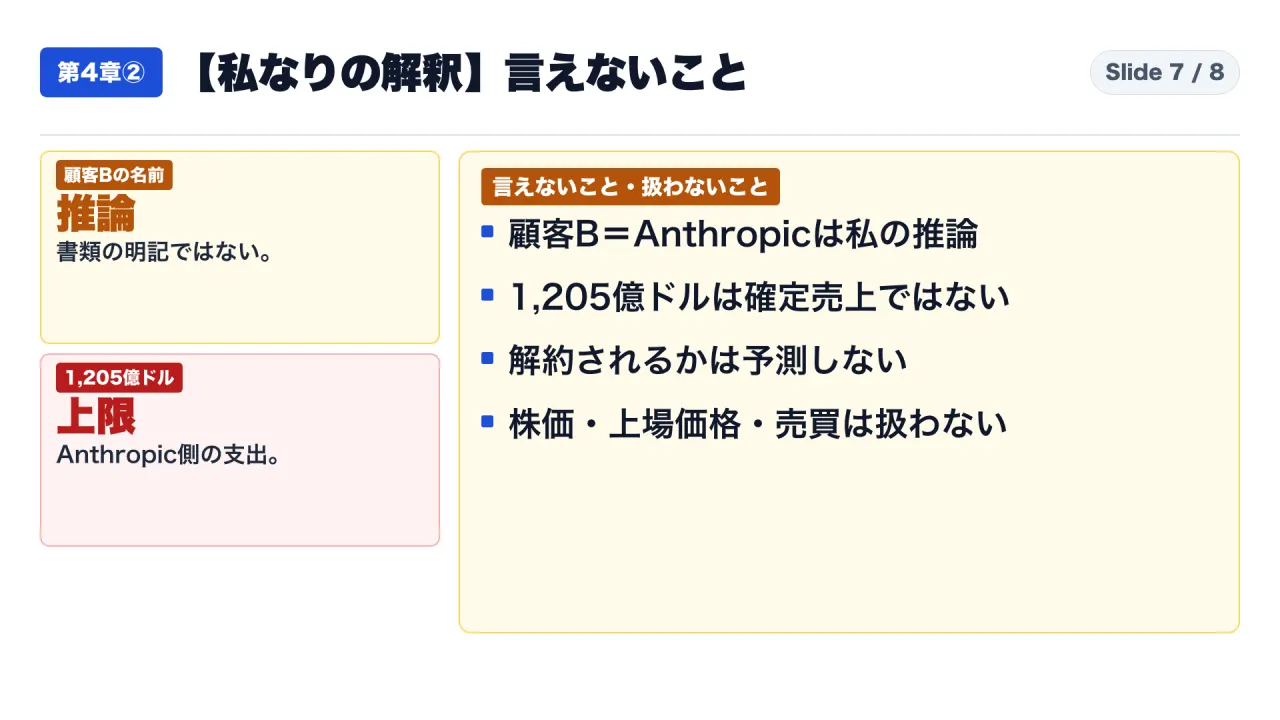
Three professional interpretations:
- Visibility Does Not Equal Perpetuity: High short-term revenue visibility under fixed monthly billing must not be conflated with commercial permanence when bilateral 90-day exit clauses exist.
- Concentration Cuts Both Ways: Generating $5.03 billion from one client demonstrates operational execution, but relying on one customer for 34.5% of company revenue and 66.5% of segment revenue creates vulnerability.
- Refinancing and Redeployment Risks: Long-dated physical infrastructure financing paired with short-dated customer commitments creates liquidity exposure if model architectures shift.
Seven strict regulatory boundaries:
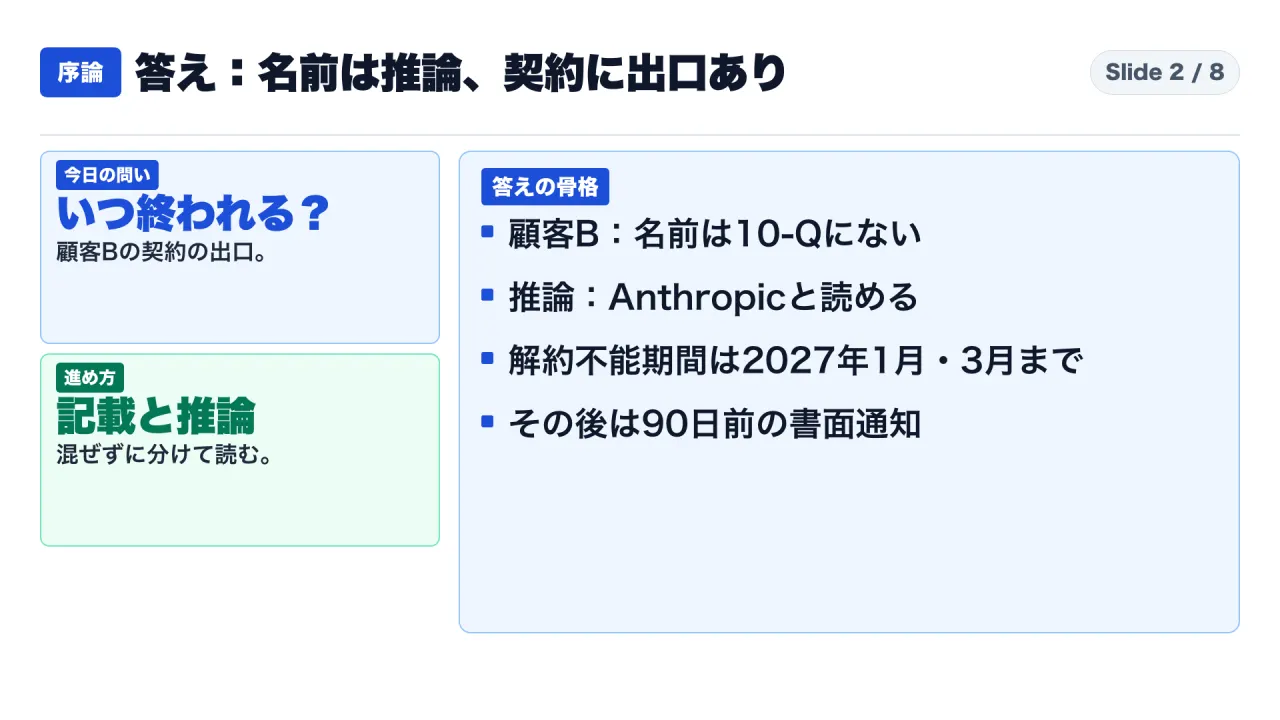
- Form 10-Q never explicitly identifies Customer B as Anthropic; this remains a deduction.
- The $120.5 billion cap is an upper expenditure limit, not guaranteed SpaceX revenue.
- Neither filing predicts whether the contract will actually be terminated in 2027.
- The exact commercial breakdown between the $1.25 billion baseline and ~$1.68 billion realized average is undisclosed.
- The Apollo 8-K lease is not legally tied to Customer B’s clusters.
- Customer A and the debtor holding 27.7% of receivables remain undisclosed.
- This analysis addresses contract governance only, offering no equity valuation or investment advice.
Practical Playbook for Enterprise Infrastructure Procurement
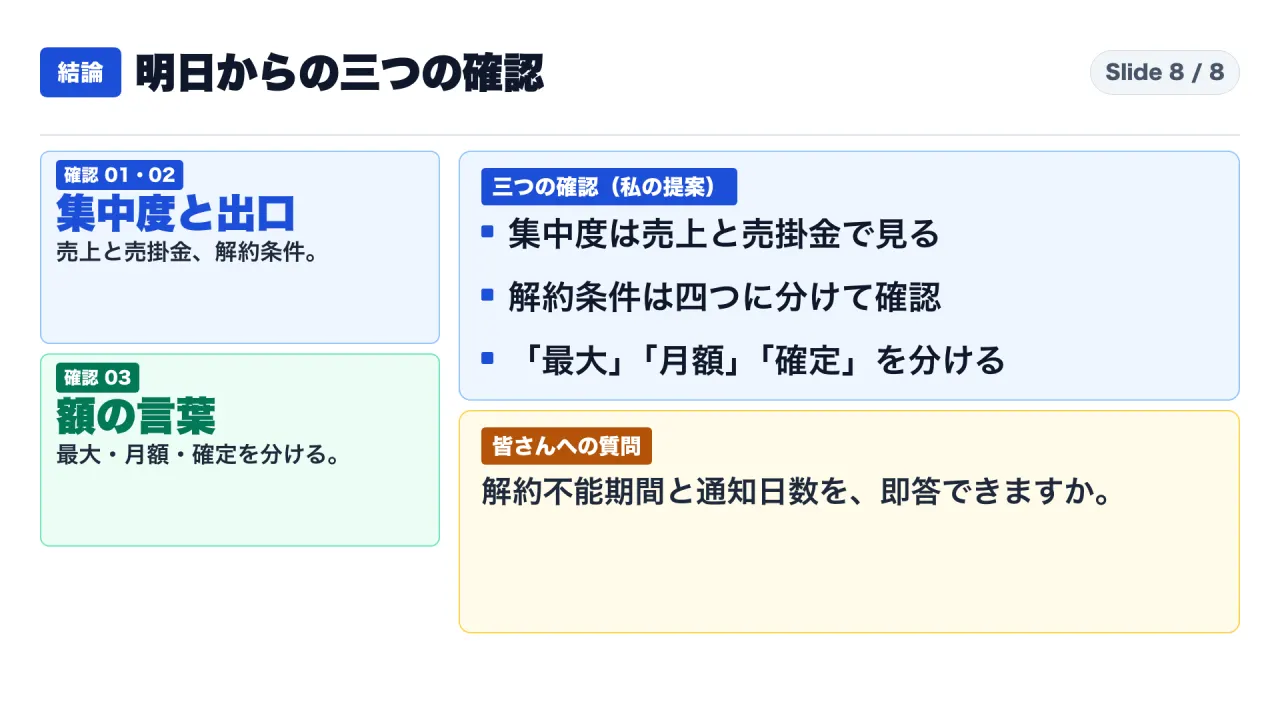
Organizations evaluating compute commitments should apply a four-step due diligence review.
Step 1: Dissect Four Pillars of Termination Governance
| Checkpoint | Forensic Objective | Practical Action |
|---|---|---|
| Lock-In Horizon | Date through which neither party may cancel for convenience | Require explicit commencement and expiration dates in writing |
| Notice Period & Format | Required advance written notice window | Mandate formal written registered notice requirements |
| Bilateral vs Unilateral | Does provider hold reciprocal rights to cancel and reclaim capacity? | Model supply continuity risk if provider can terminate on 90 days’ notice |
| Ramp & True-Up Terms | Price adjustments during staging; minimum spending commitments | Demand explicit staging milestones tied to acceptance testing |
Step 2: Calibrate Notice Periods Against Migration Runways
Benchmark contractual notice windows against migration runways. If transferring models, weights, pipelines, and orchestration takes 180 days, a 90-day termination clause exposes the firm to operational blackout if the provider terminates.
Step 3: Enforce Rigid Financial Taxonomy
Segregate all contractual commitments into three ledgers:
- Maximum Ceiling: Budget cap authorized under the agreement (e.g., Anthropic’s $120.5B cap).
- Monthly Operational Run-Rate: Active cash outlays per billing cycle, noting whether pricing is fixed or metered.
- Guaranteed Commitment: Non-cancelable baseline legally owed even if workloads are abandoned (e.g., Amazon’s $110B take-or-pay obligation).
Step 4: Monitor Dual-Axis Concentration Across Revenue and Receivables
Monitor customer concentration across two vectors: revenue percentage and receivables percentage. Relying on a client accounting for over 20% of receivables creates severe liquidity risk if disputes emerge.
Frequently Asked Questions
Q1: Does SpaceX’s Form 10-Q confirm that Customer B is Anthropic?
No. Form 10-Q designates the counterparty solely as Customer B. Reconciling SpaceX’s Prospectus and Anthropic’s Form S-1 with reported segment revenues establishes this connection as a deductive inference.
Q2: Does the $120.5 billion figure represent locked-in revenue for SpaceX?
No. Anthropic’s S-1 states Anthropic agreed to spend an aggregate of up to $120.5 billion. This represents an upper spending ceiling, not guaranteed revenue.
Q3: Can Anthropic terminate the compute agreement at any time with 90 days’ notice?
No. Initial non-cancelable periods remain in effect until January 2027 and March 2027. Termination on 90 days’ notice becomes operative only after those dates.
Q4: Can SpaceX also terminate the compute contract on 90 days’ notice?
Yes. Anthropic’s S-1 confirms that each agreement may be canceled by either party upon 90 days’ advance written notice following the lock-in period.
Q5: Does the $40 billion Apollo lease directly finance Customer B’s clusters?
Filings do not confirm this. SpaceX’s Form 8-K reports a master finance lease for GPU pods, but makes zero reference to Customer B, Anthropic, or Memphis facilities.
Primary Sources and References
- SpaceX Form 10-Q for the Quarterly Period Ended September 30, 2026
- SpaceX Form 10-Q for the Quarterly Period Ended June 30, 2026
- SpaceX Final Prospectus Filed Pursuant to Rule 424(b)(4) (June 2026)
- Anthropic PBC Form S-1 Registration Statement (Filed October 26, 2026)
- SpaceX Form 8-K Reporting Master Finance Lease Facility (Filed October 26, 2026)