Yaskawa Electric's Revenue Rose While Operating Profit Fell: Is the AI Robot Making Money? Reading Segment Earnings and July Announcements Separately
A segment-by-segment analysis of Yaskawa’s first-half FY2026 earnings reveals that motion control drove growth, robotics accounted for the profit drop, and MOTOMAN NEXT financials remain unseparated from industrial robotics.
Published: October 31, 2026 | Read time: ~10 min | Watch Video (Japanese)
Executive Summary: Divergent Segment Dynamics in Factory Automation
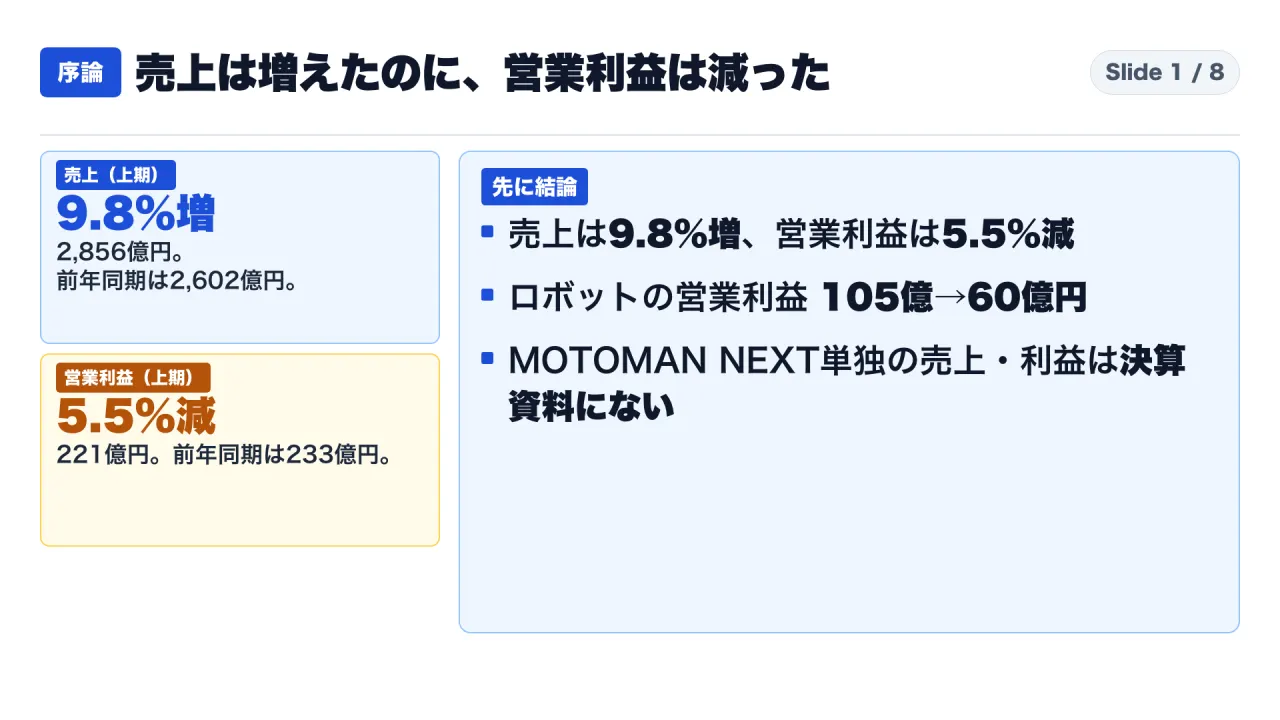
On October 9, 2026, Yaskawa Electric Corporation—a leading global manufacturer of servomotors, industrial drives, and robotics—disclosed financial results for the first half of fiscal year 2026 (March 1 to August 31, 2026). The consolidated figures presented a notable divergence:
- Consolidated Net Sales rose 9.8% year-on-year, expanding from 260.2 billion JPY to 285.6 billion JPY.
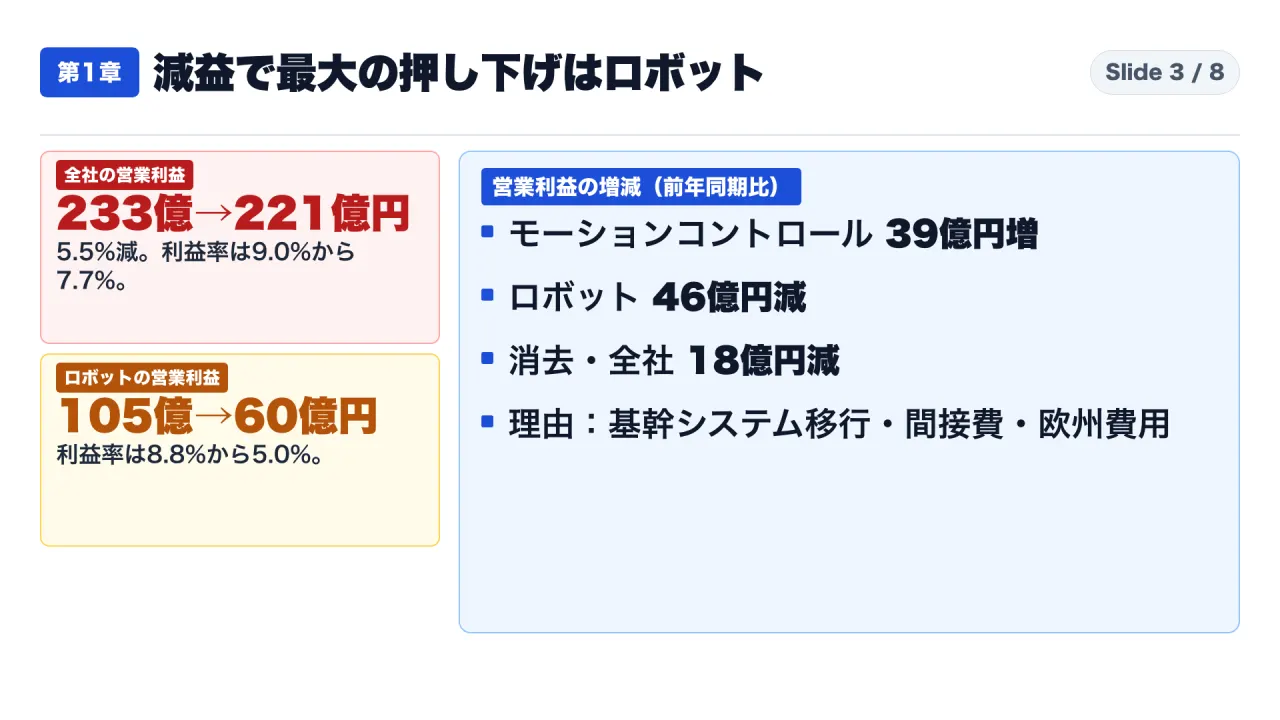
- Consolidated Operating Profit fell 5.5% year-on-year, declining from 23.3 billion JPY to 22.1 billion JPY.
- Operating Profit Margin contracted from 9.0% to 7.7%.
In technology media, substantial coverage surrounded Yaskawa’s autonomous robotics platform, the MOTOMAN NEXT, following high-profile technical disclosures in July 2026 with SoftBank Corp. and Google DeepMind. This prompted an obvious commercial question: Is the AI robot generating profits, or did investments in AI robotics cause the operating profit decline?
An analysis of Yaskawa’s official financial filings—the statutory earnings release (Kessan Tanshin), supplementary presentation materials, and the medium-term management plan “Dash 35”—delivers three core findings:
- The Profit Decline Stems from Robotics, Not AI R&D: Robotics operating profit dropped by 43.3% (falling from 10.5 billion to 6.0 billion JPY). However, management attributed this to production friction from an enterprise resource planning (ERP) system migration in Japan, rising indirect overhead, and European structural reform expenses—not AI development costs.
- Growth Was Driven by Semiconductor and Data Center Motion Control: The 9.8% revenue increase was driven by the Motion Control division (up 21.7% to 137.3 billion JPY; operating profit up 32.8% to 16.0 billion JPY), propelled by semiconductor equipment demand and AI data center capital expenditures.
- MOTOMAN NEXT Financials Are Not Disclosed: Standalone revenues, unit volumes, and profit contributions for the MOTOMAN NEXT are not reported in public filings. Whether the AI robot is commercially profitable cannot be determined from public financial statements.
This briefing provides an analytical guide for finance directors, strategy planners, and technology managers seeking to decouple public technology announcements from underlying segment financial realities.
Analytical Methodology and Evidentiary Boundaries
To ensure factual precision, this analysis adheres to three strict evidentiary standards:
- Documented Fact: Quantitative figures and operational statements extracted directly from Yaskawa Electric’s First-Half FY2026 Kessan Tanshin (dated October 9, 2026), the Q2 FY2026 Supplementary Presentation, the “Dash 35” Plan (dated May 22, 2026), and corporate releases.
- Author Calculation: Mathematical derivations (such as second-half margin requirements and segment waterfall balances) computed directly from disclosed figures.
- Interpretive Analysis: Structural business analysis, supply-chain positioning, and capital goods earnings frameworks.
Three research constraints apply:
- Period Definitions: March 1 to August 31, 2026 is designated as the Interim Period or First Half FY2026.
- Textual Verification: Statements were validated via full-text searches of PDF releases. Noting that an item is “not stated” reflects absence from published documentation.
- Scope and Advisory Limits: Excludes verbal briefings and provides operational analysis rather than investment advice.
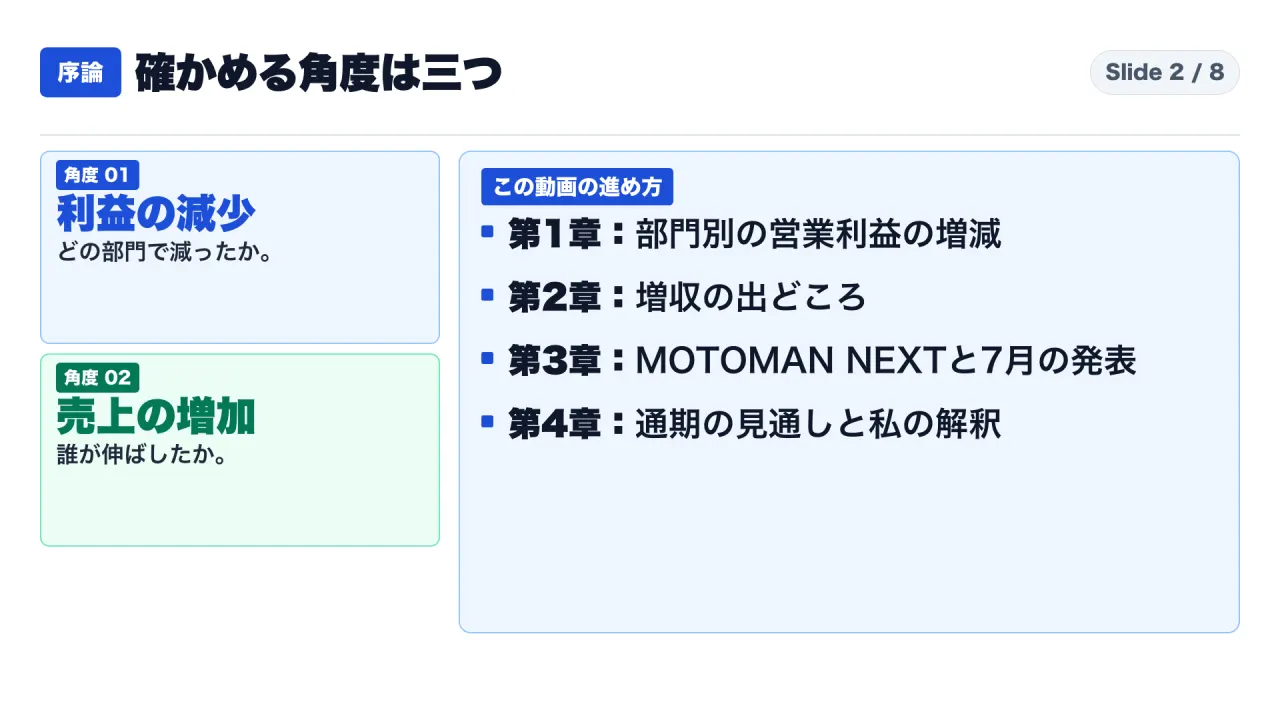
Section 1: Segment Breakdown: Robotics Drove the Operating Profit Contraction
Consolidated operating profit contracted by 1.3 billion JPY (from 23.3 billion to 22.1 billion JPY). Examining the segment waterfall reveals that this net decline masks massive opposing movements across operating divisions.
Yaskawa reports operational results across four primary business segments: Motion Control, Robotics, System Engineering, and Other.
The Robotics Margin Collapse
While consolidated sales expanded, the Robotics segment experienced severe margin compression:
- Robotics Net Sales: 118.4 billion JPY, reflecting a slight contraction of 0.7% year-on-year (down from 119.2 billion JPY).
- Robotics Operating Profit: 6.0 billion JPY, down 43.3% year-on-year from 10.5 billion JPY—a direct operational drop of 4.6 billion JPY.
- Robotics Segment Margin: Contracted from 8.8% in the prior-year period to 5.0%.
In short, while segment revenues remained virtually flat, operating profit dropped by more than 40%.
Stated Management Explanations for the Profit Drop
Did AI robotics development expenses cause this contraction? Official filings contradict this assumption. In the statutory Kessan Tanshin, executive management cited three specific operational headwinds:
- Core System Migration Disruptions in Japan: Delays in manufacturing output and shipments resulting from the operational cutover to a new core ERP system within domestic Japanese facilities.
- Expansion of Indirect Overhead Costs: Growth in personnel, administrative, and general corporate indirect expenditures.
- European Structural Reform Expenses: One-time expenses recognized for restructuring business operations and manufacturing footprints across European subsidiaries.
A comprehensive textual query of the official Kessan Tanshin confirms that the trade name “MOTOMAN NEXT” appears zero times in the statutory release. The profit decline cannot be attributed to AI robot commercialization on the basis of public financial filings.
Section 2: Motion Control Generated the Revenue Expansion
If Robotics profits collapsed, what drove consolidated revenues up 9.8%? The answer lies entirely within Yaskawa’s core automation component business: Motion Control.
Semiconductor Capex and AI Infrastructure Demand
The Motion Control segment—which engineers AC servomotors, digital machine controllers, and industrial inverters—recorded outstanding growth:
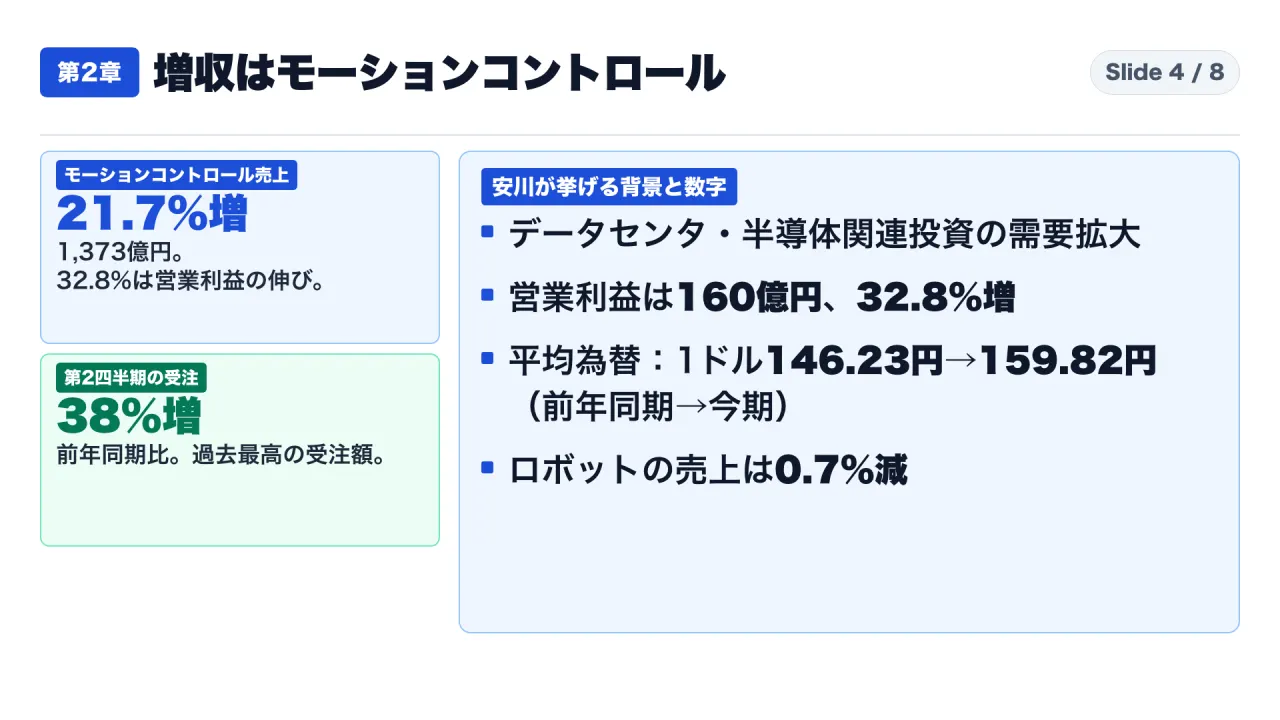
- Motion Control Net Sales: 137.3 billion JPY, an increase of 21.7% year-on-year from 112.8 billion JPY.
- Motion Control Operating Profit: 16.0 billion JPY, expanding 32.8% year-on-year from 12.1 billion JPY (an absolute increase of 3.9 billion JPY).
Management explicitly credited this performance to an acceleration in capital expenditures:
“Capital investment demand centered on data center infrastructure and semiconductor-related manufacturing equipment, driven by accelerating AI-related investments, remained robust.”
Capital equipment orders reflected this momentum: Second-quarter order intake surged 38% year-on-year and 13% quarter-on-quarter, achieving an all-time corporate record for quarterly order volume.
Foreign Exchange Tailwinds and Upstream Positioning
Foreign exchange movements provided a substantial tailwind. The average exchange rate during the first half was 159.82 JPY per USD, compared to 146.23 JPY per USD in the prior-year period. While Yaskawa noted that yen depreciation lifted full-year revenue projections, filings do not disclose the exact profit uplift attributable to currency translation.
These figures illustrate an essential pattern: Yaskawa is capturing financial gains from the AI boom not as a supplier of downstream autonomous robots, but as an upstream supplier of precision motion hardware to semiconductor toolmakers and data center infrastructure builders.
Section 3: MOTOMAN NEXT: Development Realities versus Segment Accounting
To evaluate MOTOMAN NEXT accurately, technical milestones must be disentangled from revenue recognition.
Product Timeline and Core Architecture
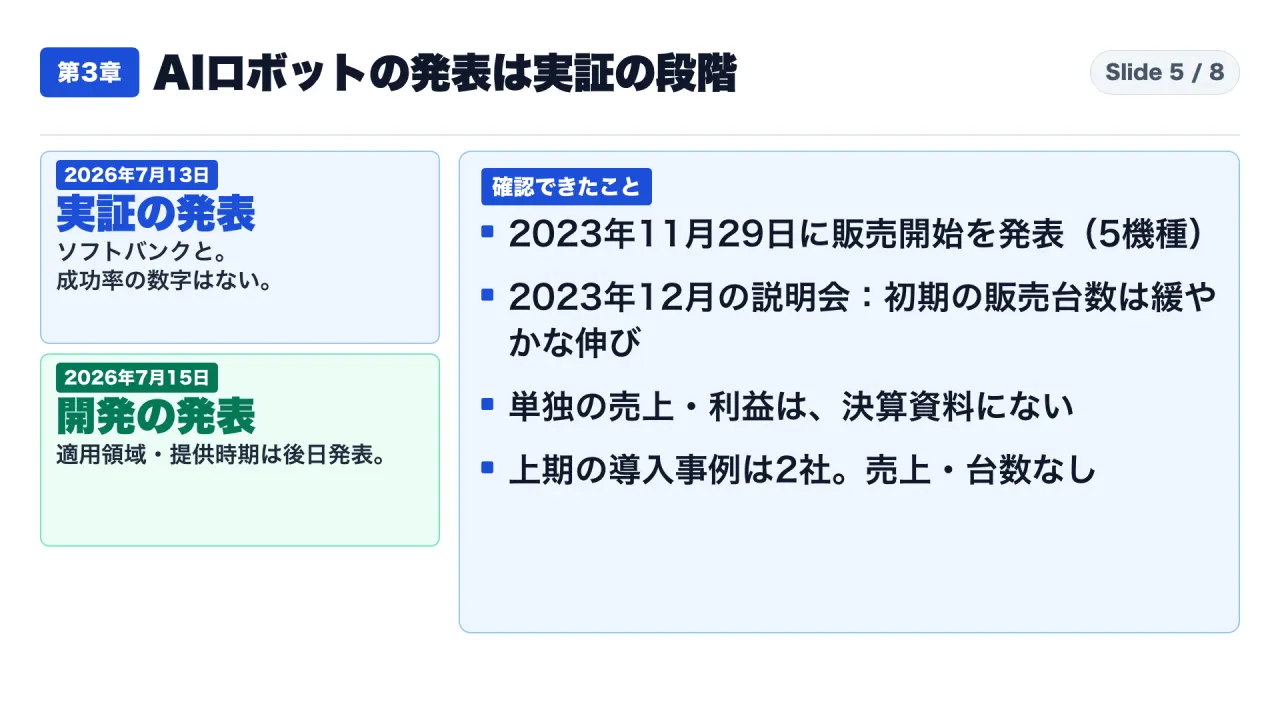
Yaskawa announced commercial sales of the MOTOMAN NEXT on November 29, 2023, releasing five distinct models (spanning 4 kg to 35 kg payload capacities) sequentially from December 2023. Unlike traditional industrial arms operating on deterministic programmed trajectories, MOTOMAN NEXT integrates an onboard autonomous control unit capable of processing machine vision inputs, perceiving environmental changes, and planning real-time motion paths.
During the initial product briefing on December 14, 2023, Yaskawa executives noted that initial adoption would be evaluated by installation account counts rather than sheer shipment volume, establishing that commercial scaling would be gradual.
The July 2026 Announcements
In mid-July 2026, Yaskawa issued two high-profile technical disclosures:
- SoftBank Proof-of-Concept (July 13, 2026): Yaskawa and SoftBank Corp. demonstrated automated sorting of flexible electrical wire harnesses into storage bins—a historically manual task due to irregular deformation. The PoC leveraged SoftBank’s AI Data Center GPU Cloud and NVIDIA hardware. However, neither company published quantitative success rates or grasping cycle times.
- Google DeepMind Collaboration (July 15, 2026): Yaskawa announced joint development of an “agentic robot system” combining MOTOMAN NEXT with Google DeepMind’s multimodal robotics foundation model, Gemini Robotics ER 1.6. The architecture divides labor: Gemini plans high-level task sequences, while MOTOMAN NEXT executes real-time motion control. The release noted that specific commercial application scopes and launch timing would be announced at an undetermined future date.
Disclosure Absence in Financial Filings
In the Q2 supplementary presentation, Yaskawa cited two commercial deployment examples: mixed-palletizing automation at Seibu Electric & Machinery Co., Ltd., and food ingredient topping automation at confectioner NIPPN Corporation.
However, neither unit shipment numbers, gross margins, nor net sales figures were provided. Standalone financials for MOTOMAN NEXT are completely integrated into the broader Robotics segment. Conflating mid-year research announcements with quarterly earnings produces an unsubstantiated narrative.
Section 4: Full-Year Guidance and the H2 Recovery Prerequisite
Yaskawa’s revised full-year outlook establishes aggressive assumptions regarding second-half performance.
The Second-Half Math
Yaskawa adjusted full-year consolidated guidance:
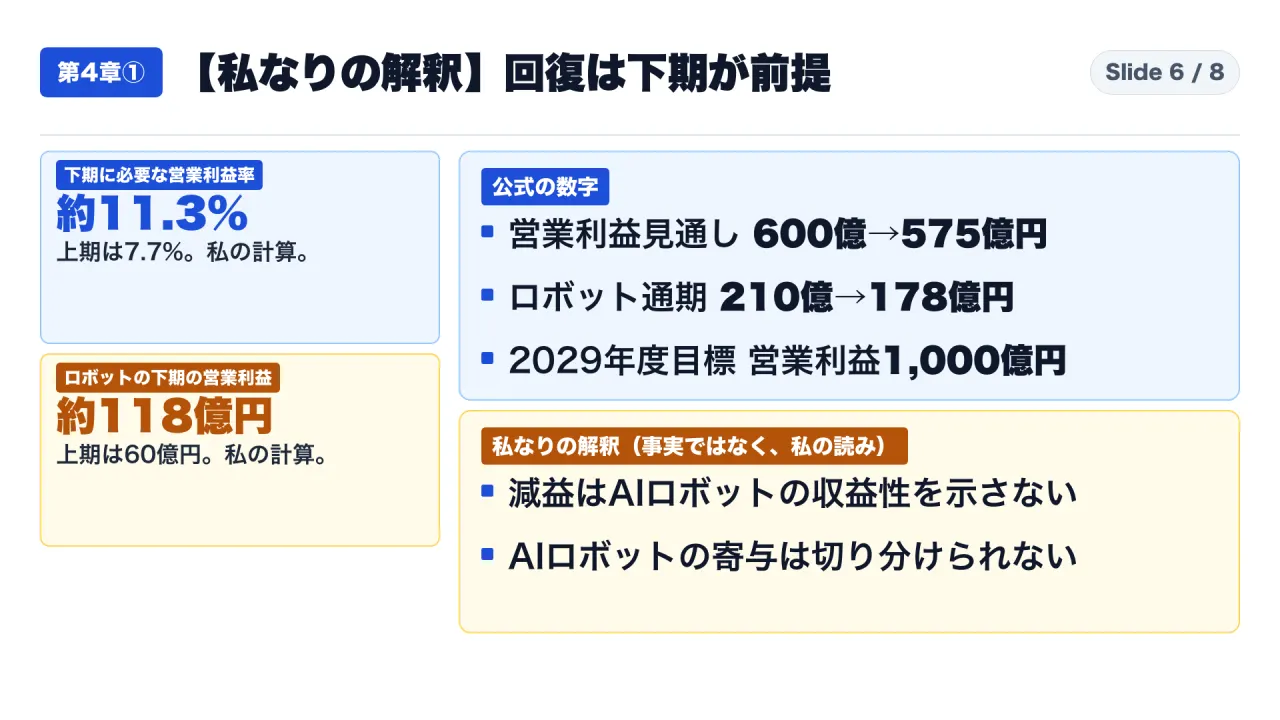
- Net Sales Guidance: Raised from 580.0 billion JPY to 600.0 billion JPY (supported by Motion Control strength and currency depreciation).
- Operating Profit Guidance: Lowered from 60.0 billion JPY to 57.5 billion JPY.
- Robotics Operating Profit Guidance: Lowered from 21.0 billion JPY to 17.8 billion JPY (projecting a full-year segment margin of 7.1%).
Subtracting first-half actuals from full-year guidance yields the performance required in the second half:
- Required Second-Half Net Sales: 600.0B - 285.6B = 314.4 billion JPY.
- Required Second-Half Operating Profit: 57.5B - 22.1B = 35.4 billion JPY.
- Required Second-Half Operating Margin:
35.4 billion JPY / 314.4 billion JPY = 11.26% (approximately 11.3%)
To achieve its revised full-year forecast, Yaskawa’s operating margin must expand from 7.7% in the first half to 11.3% in the second half. Similarly, the Robotics segment must generate 11.8 billion JPY in second-half operating profit (17.8B - 6.0B = 11.8B)—nearly double its first-half performance. This targets complete normalization of ERP migration issues and European restructuring benefits.
The Dash 35 Long-Term Trajectory
Yaskawa’s medium-term management plan, “Dash 35” (published May 22, 2026), sets aggressive fiscal year 2029 targets:
- Consolidated FY2029 Goals: Net sales of 650.0 billion JPY, operating profit of 100.0 billion JPY, and an operating margin of 15.4%.
- Robotics FY2029 Goals: Net sales of 290.0 billion JPY, operating profit of 45.0 billion JPY, and an operating margin of 15.5%.
Achieving 45.0 billion JPY in Robotics operating profit requires a 2.2-fold expansion over the 20.4 billion JPY achieved in FY2025. Whether autonomous platforms like MOTOMAN NEXT can drive this margin expansion remains an open commercial question.
Analytical Synthesis: What Cannot Be Asserted
To prevent misinterpretation, corporate analysts should note what official records do not support:
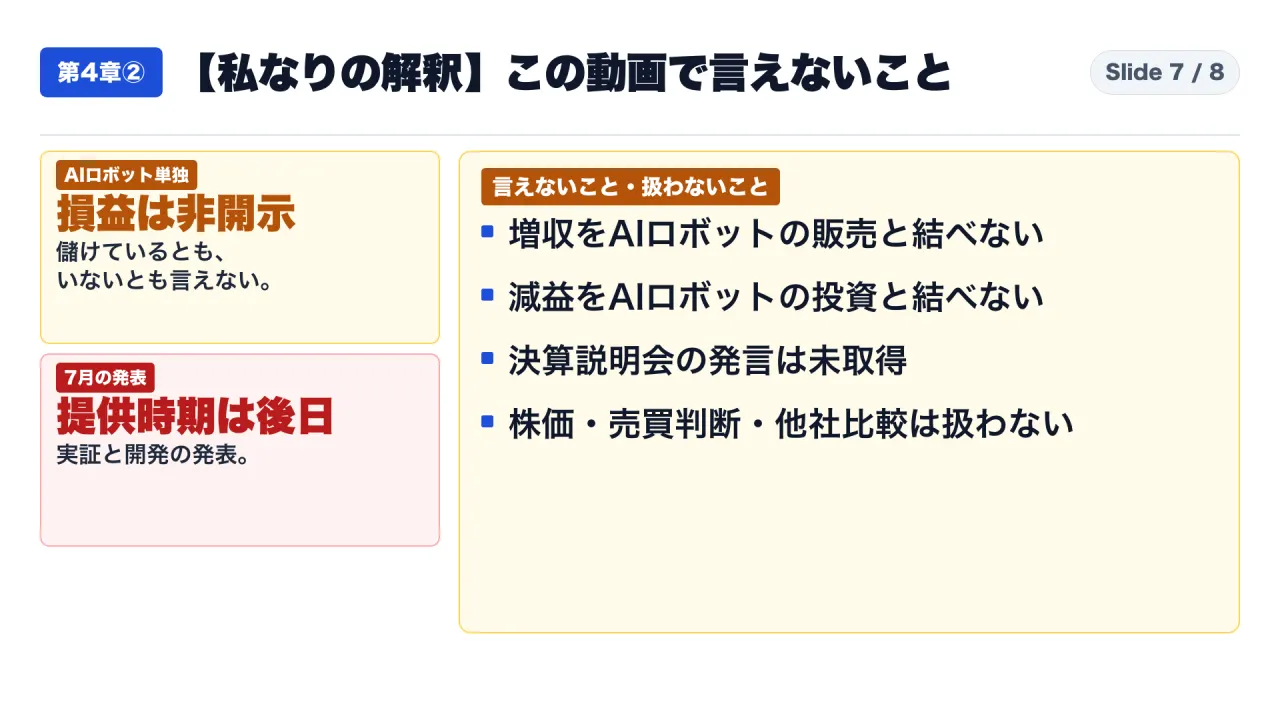
- It cannot be stated whether MOTOMAN NEXT is profitable or unprofitable, as standalone segment accounting is not disclosed.
- July 2026 technical demonstrations represent pre-commercial research milestones with undisclosed revenue contributions.
- Revenue growth was generated by Motion Control components, not AI robotics deployments.
- Robotics profit contraction was driven by domestic ERP transition friction and European restructuring, not AI R&D.
- In China, semiconductor robotics demand remained positive; Chinese macroeconomic weakness cannot be cited as the primary profit drag based on company disclosures.
- Grasping success rates from the SoftBank PoC remain undisclosed by both companies.
- Second-half margin recovery to 11.3% is an executive forecasting assumption, not realized performance.
Earnings Waterfall Analysis: Deconstructing the Balance
Dissecting the consolidated 1.3 billion JPY profit contraction across segment components reveals:
- Positive Contributors (+5.4 billion JPY): Motion Control contributed +3.9 billion JPY; System Engineering contributed +1.5 billion JPY.
- Negative Contributors (-6.8 billion JPY): Robotics contracted by -4.6 billion JPY; Eliminations/Corporate decreased by -1.8 billion JPY; Other decreased by -0.4 billion JPY.
- Net Variance: +5.4B - 6.8B = -1.4 billion JPY (reconciling to -1.3 billion JPY due to rounded reporting units).
Robotics accounted for approximately two-thirds (4.6B of 6.8B) of total negative segment drag, while corporate overhead eliminations represented the remaining third.
Practical Financial Framework: Three Rules for Evaluating Capex Earnings
Corporate financial analysts and technology strategists evaluating industrial earnings should apply three verification protocols:
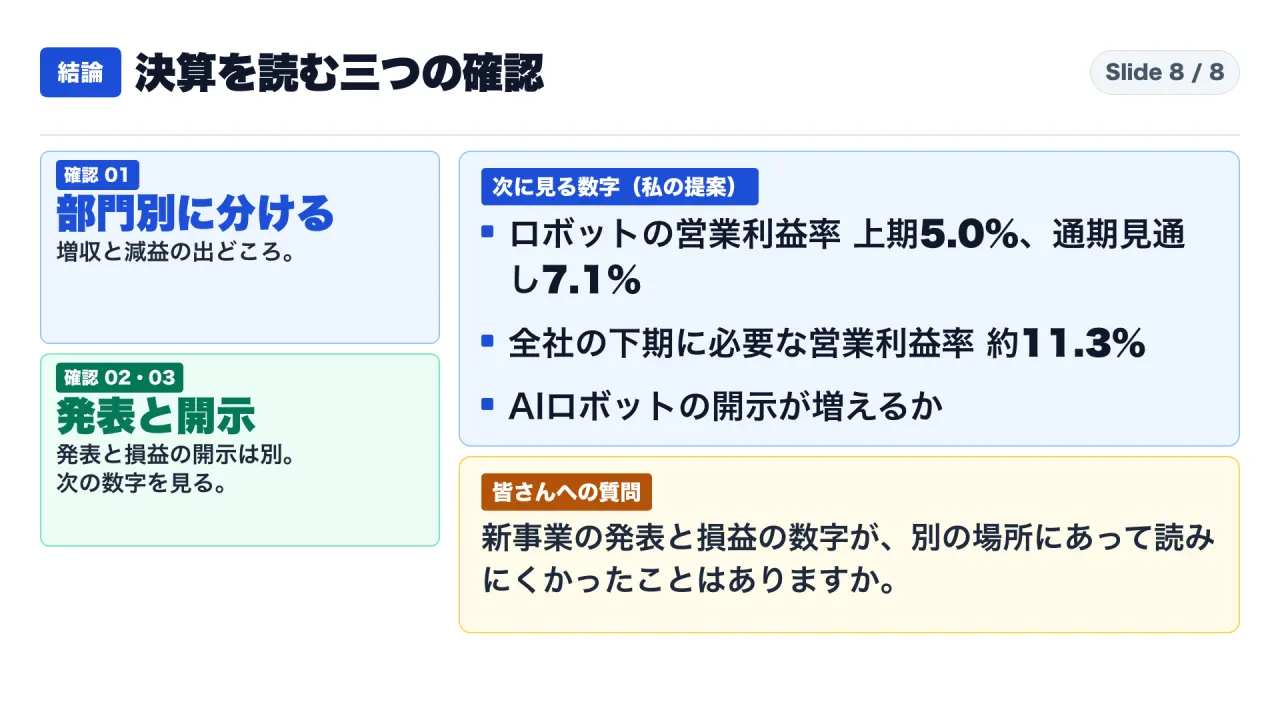
- Immediately Isolate Segment Growth Drivers: Never rely on consolidated headlines. Dissect performance by operating division to verify whether top-line expansion and bottom-line contraction originate from the same business activities.
- Strictly Decouple Press Releases from Statutory Disclosures: Maintain strict separation between R&D product announcements and statutory segment accounting. Verify whether emerging technologies are explicitly cited as material revenue contributors in regulatory filings.
- Reverse-Calculate Implied Second-Half Recovery Run-Rates: Subtract interim performance from full-year management guidance to compute required second-half margins. When implied second-half margins exceed recent run-rates by several hundred basis points, scrutinize operational recovery assumptions.
Primary Sources and References
- Yaskawa Electric Corporation, Financial Results for the Interim Period of FY Ending Feb 2027 (Kessan Tanshin, October 9, 2026): https://www.yaskawa.co.jp/wp-content/uploads/2026/10/20261009.pdf
- Yaskawa Electric Corporation, Supplementary Financial Presentation Deck (Q2 FY2026): https://www.yaskawa.co.jp/wp-content/uploads/2026/10/20261009_haifu.pdf
- Yaskawa Electric Corporation, Medium-Term Management Plan “Dash 35” (May 22, 2026): https://www.yaskawa.co.jp/wp-content/uploads/2026/05/Dash35.pdf
- Yaskawa Electric Corporation, MOTOMAN NEXT Commercial Launch Announcement (November 29, 2023): https://www.yaskawa.co.jp/newsrelease/product/1154379
- Yaskawa Electric Corporation, MOTOMAN NEXT Briefing Q&A Summary (December 14, 2023): https://www.yaskawa.co.jp/wp-content/uploads/2023/12/MOTOMAN-NEXT_QA_j.pdf
- Yaskawa Electric Corporation, Agentic Robot System Development with Google DeepMind (July 15, 2026): https://www.yaskawa.co.jp/newsrelease/news/1645406
- Yaskawa Electric Corporation, Flexible Object Handling PoC with SoftBank (July 13, 2026): https://www.yaskawa.co.jp/newsrelease/news/1645319
- SoftBank Corp., Press Release on Robotics AI Demonstration (July 13, 2026): https://www.softbank.jp/corp/news/press/sbkk/2026/20260713_01/