Inside Anthropic's November 12, 2026 Usage Policy: Deceptive Campaigns, High-Risk AI Requirements, and Physical Actuation Guardrails
A clause-by-clause comparative audit reveals a new section banning astroturfing and AI source manipulation, expanded surveillance and weapons curbs, and restructured human-in-the-loop requirements for high-risk recommendations.
Published: November 1, 2026 | Read time: ~10 min | Watch Video (Japanese)
Executive Summary: Major Structural Shifts in Enterprise AI Governance
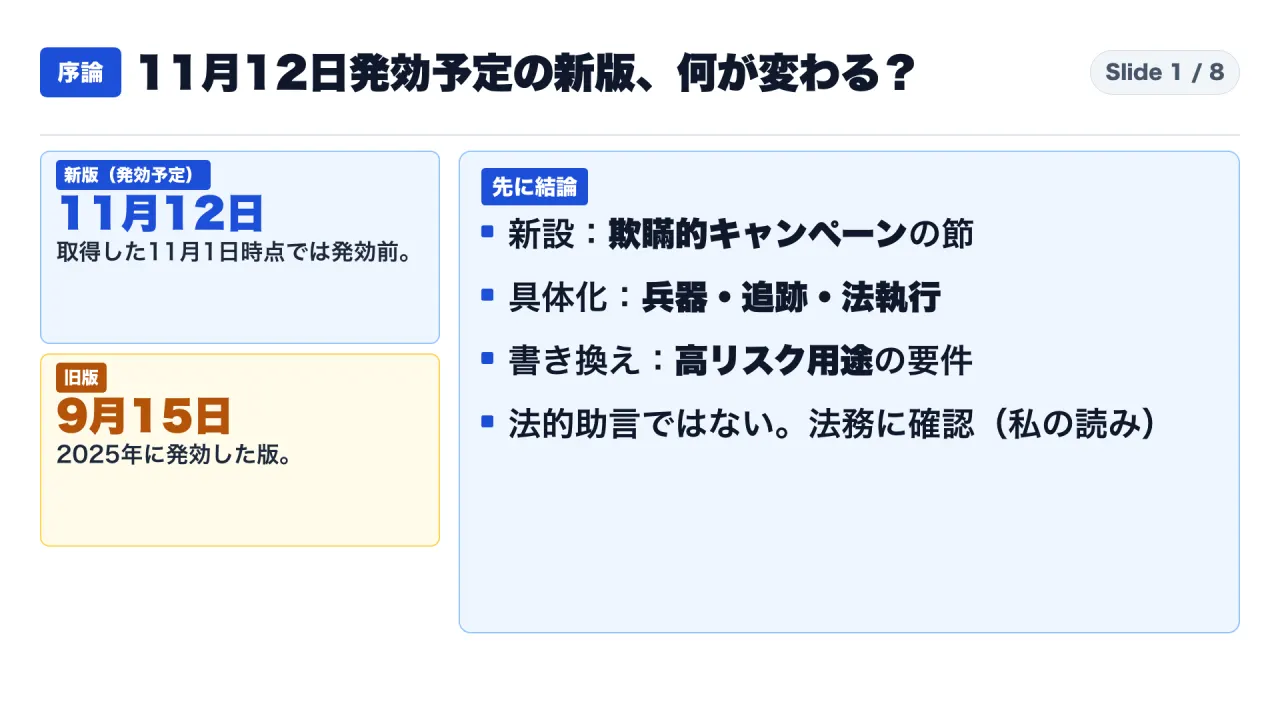
On October 2026, Anthropic published an updated Universal Usage Policy scheduled to take effect on November 12, 2026, at 20:41 Universal Coordinated Time (corresponding to November 13, 2026, at 05:41 Japan Standard Time). Comparing the forthcoming text against the preceding policy enacted on September 15, 2025, reveals significant expansions in regulatory compliance standards, operational obligations, and liability allocations.
Four primary structural transformations define the November 12, 2026 policy:
- Creation of a Dedicated Deceptive Campaigns Section: Anthropic established an explicit section banning astroturfing, synthetic persona operations, concealed commercial sponsorship, and the strategic manipulation of data sources leveraged by search engines and AI systems.
- Granular Expansion of Weapons, Surveillance, and Justice Curbs: Prohibitions on kinetic weapons integration now explicitly name aerial drones, autonomous vehicles, and weapons delivery systems, while surveillance clauses expand to encompass biometric tracking, continuous behavioral profiling, and predictive law enforcement recommendations.
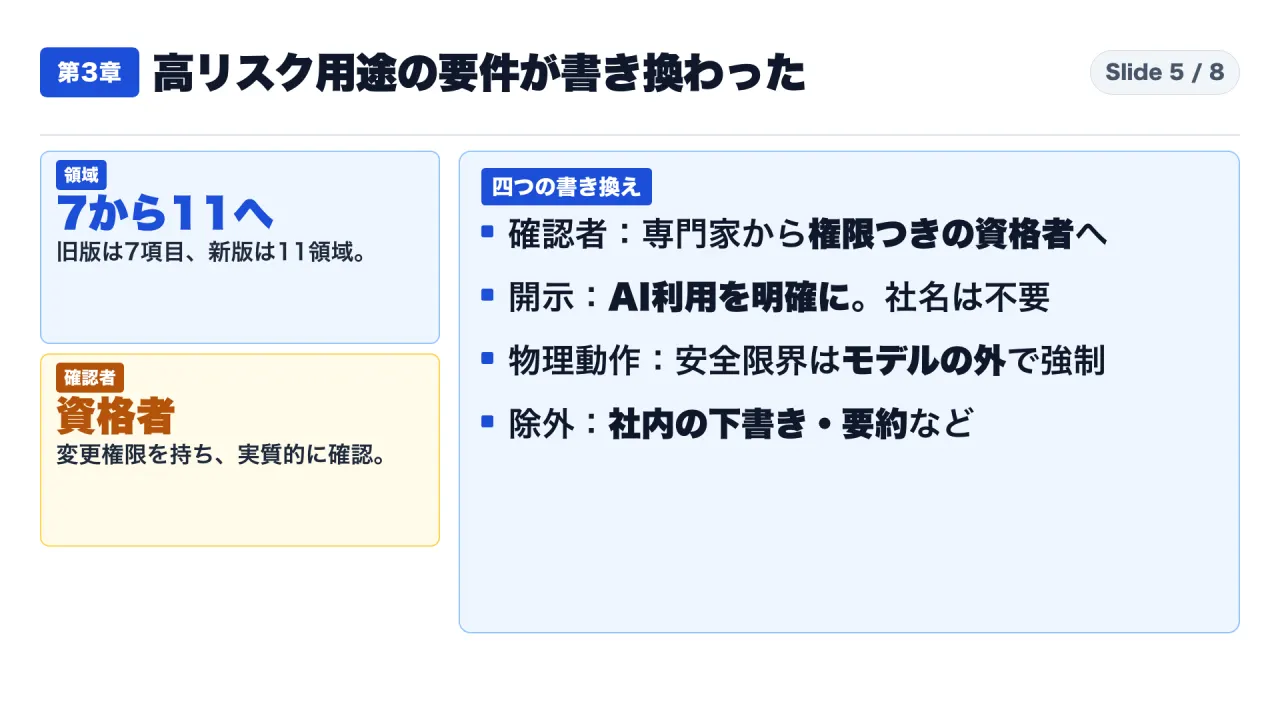
- Restructuring High-Risk AI Requirements: The framework for sensitive domains dropped its former “consumer-facing” limitation, expanded from 7 to 11 regulated sectors, replaced informal professional review with mandatory evaluation by a “qualified person” possessing binding modification authority, and codified hardware interlock mandates for physical actuation.
- Agentic Accountability and Infrastructure Controls: Enterprise deployers are explicitly declared liable for all actions executed by autonomous agents across tools, browsers, and external APIs, backed by newly released Platform APIs that isolate enforcement to specific end-user profiles.
This technical briefing provides a clause-by-clause comparative analysis designed for corporate legal counsel, chief information security officers, engineering directors, and compliance leads deploying Claude within enterprise workflows.
Analytical Methodology and Evidentiary Standards
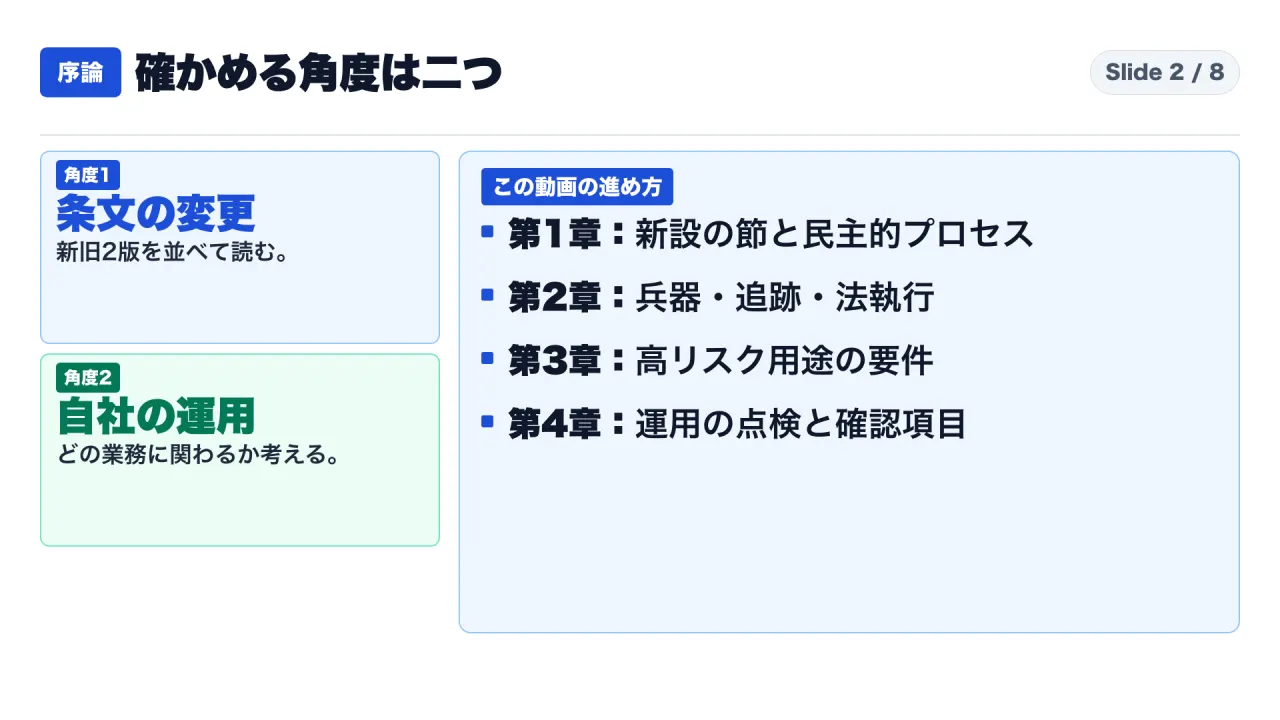
This analysis is based on primary legal texts and release documentation retrieved on November 1, 2026:
- The forthcoming Anthropic Usage Policy text published with an effective date of November 12, 2026.
- The baseline Anthropic Usage Policy effective September 15, 2025, retrieved via the Internet Archive Wayback Machine snapshot recorded on October 1, 2026.
- The official Claude Platform Technical Release Notes detailing user management and enforcement APIs.
Statements are categorized across three standards:
- Documented Fact: Verbatim statutory clauses, explicit definitions, and technical features extracted from published documentation.
- Author Calculation: Deterministic arithmetic and timezone translations (such as UTC to JST offsets).
- Interpretive Analysis: Practical compliance frameworks, organizational gap analyses, and operational workflows designed to assist enterprise engineering and legal teams.
This brief does not constitute formal legal counsel. Enterprise legal departments must determine specific statutory applicability under local jurisdictions.
Section 1: The New Deceptive Campaigns and Artificial Activity Policy
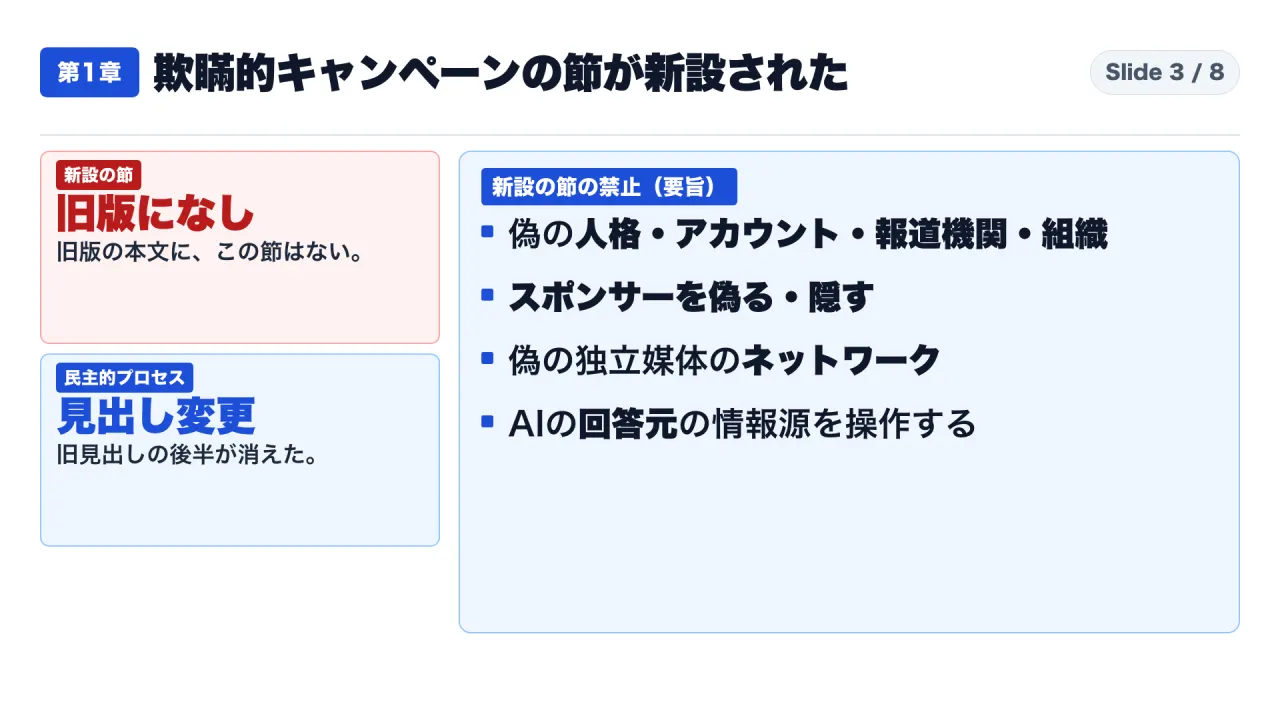
The most prominent architectural addition to the policy is a newly created section titled “Do Not Engage in Deceptive Campaigns or Artificial Activity”. This section did not exist in the September 15, 2025 baseline policy.
Six Express Prohibitions on Synthetic Influence
The new section articulates six explicit operational bans:
- Synthetic Personas and Astroturfing: Prohibits creating or operating fake personas, user accounts, synthetic media outlets, or shell organizations, as well as impersonating real individuals or organizations to mislead audiences regarding source attribution, public consensus, or whether an interaction is human (explicitly naming sockpuppets, astroturfing, fake reviews, and bots claiming human identity).
- Concealed Sponsorship: Prohibits misrepresenting or intentionally concealing the true commercial or organizational sponsorship of content or messaging intended to influence public opinion, civil officials, or institutional decision-makers.
- Syndicated Deception Networks: Prohibits distributing uniform messaging across networks of synthetic or ostensibly independent websites, social channels, or media outlets while concealing their common origin.
- Answer Engine and Search Source Manipulation: In a groundbreaking clause targeting modern information retrieval, the policy explicitly bans manipulating the data corpora from which search engines or AI systems draw answers by seeding them with synthetic content misrepresenting origin, authorship, or editorial independence.
- Tooling and Infrastructure Development: Prohibits building, fine-tuning, modifying, or maintaining software tooling engineered to facilitate these deceptive campaigns.
- Commercialization and Financing: Prohibits monetizing, selling, marketing, or soliciting financial capital for technologies designed for coordinated artificial activity.
The Relocation of Fake Reviews and Electoral Campaign Refactoring
In the September 15, 2025 policy, the generation of “fraudulent or deceptive digital content such as fake reviews or comments” was categorized under general Fraud and Abuse. In the November 12, 2026 text, fake reviews have been elevated into the core definition of coordinated artificial campaigns.
Concurrently, the democratic process section was retitled from “Do Not Undermine Democratic Processes or Engage in Targeted Campaign Activities” to “Do Not Undermine Democratic Processes”, reducing its sub-clauses from 8 to 5. While granular references to micro-targeting voter profiles based on private behavioral data were consolidated, strict bans remain against automated mass communications concealing synthetic origin and impersonating candidates or electoral authorities.
Section 2: Kinetic Weapons, Biometric Surveillance, and Judicial Administration
Anthropic substantially refined provisions governing national security, public safety, and law enforcement applications, shifting from generalized warnings to granular hardware and operational definitions.
Kinetic Platforms and Operational Warfare Software
While the 2025 policy broadly barred the design and development of conventional weapons, the November 12, 2026 policy introduces explicit physical platform constraints:
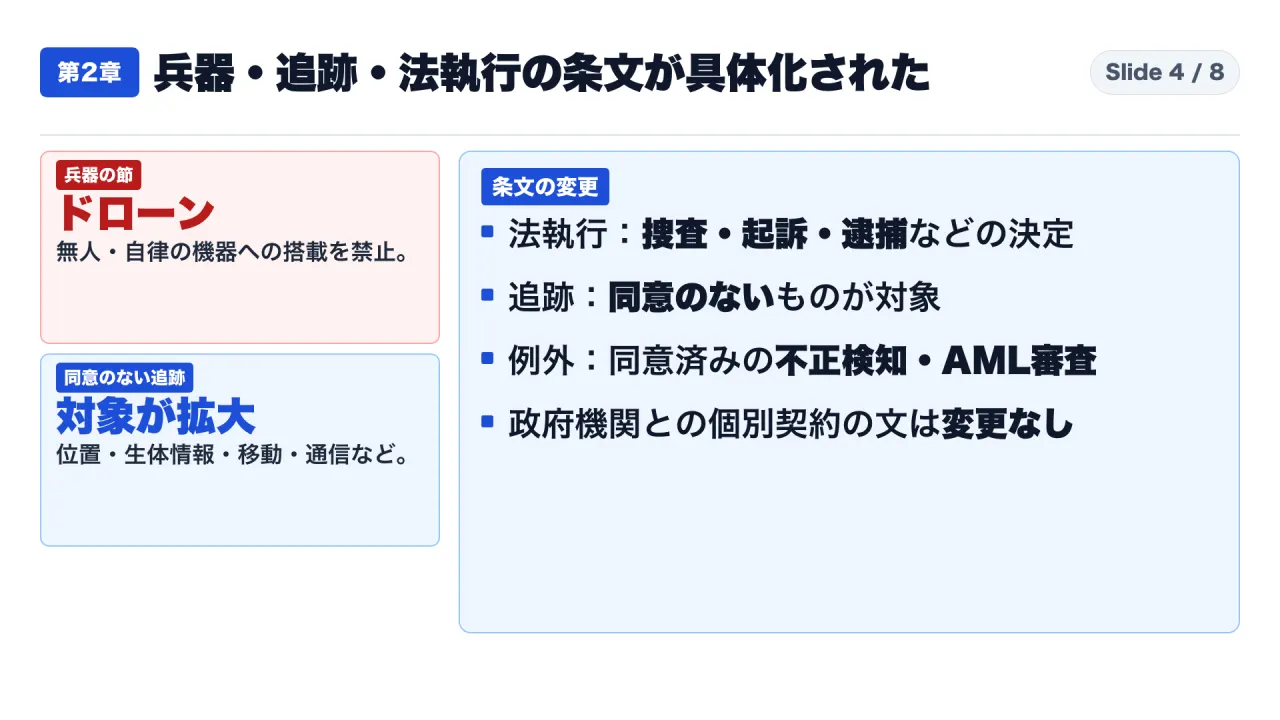
- Autonomous and Unmanned Platforms: Prohibits weaponizing or integrating weapons onto drones, vehicles, or any unmanned or autonomous platforms, or developing weapons delivery systems. The word “drone” appears twice in the new policy; it appeared zero times in the 2025 text.
- Operational Software and Combat Subsystems: Prohibits developing, operating, or maintaining software components intended for testing, evaluating, or deploying weapons systems, explicitly citing automated targeting algorithms, fire control systems, and active combat engagement subsystems.
Broadened Surveillance and Predictive Policing Curbs
The scope of non-consensual surveillance restrictions was expanded significantly:
- Baseline (2025): Restricted tracking an individual’s physical location, emotional state, or private communications without consent.
- November 12, 2026 Standard: Prohibits analyzing or tracking an individual or their property across physical location, biometric data, movement patterns, online activity, communications, or interpersonal associations—whether conducted in real-time, continuously, or retrospectively across historical datasets.
- Explicit Exceptions: User-consented monitoring remains permissible, explicitly protecting legitimate financial fraud detection, anti-money laundering (AML) screening, and consumer applications where users provide affirmative opt-in consent.
In criminal justice, the restriction shifted from barring final decisions on sentencing and parole to prohibiting systems that “decide or suggest” outcomes across investigative targeting, formal charging, arrest, detention, prosecution, sentencing, or the granting and revocation of conditional release.
Section 3: Restructuring High-Risk AI Requirements
The section governing High-Risk Use Cases underwent a comprehensive overhaul across applicability, human oversight, mandatory disclosures, and physical actuation.
Elimination of the “Consumer-Facing” Limitation
In the 2025 policy, high-risk requirements applied exclusively to “specific consumer-facing use cases that pose an elevated risk of harm”.
In the November 12, 2026 policy, the preamble was revised to state: “High-risk Use Case Requirements apply to specific use cases that pose an elevated risk of harm to individuals”. By removing the phrase “consumer-facing”, internal enterprise decision-making systems (such as employee performance evaluations, workplace monitoring, or internal credentialing) fall squarely within scope.
The “Qualified Person” Standard and Modification Authority
The standard for human-in-the-loop oversight was elevated from an informal review to a legally binding operational threshold:
- A qualified person must meaningfully review any High-Risk AI Recommendation before it is delivered as advice to an individual who might rely on it, or before it is executed as a binding decision.
- The qualified person must possess the explicit organizational authority to change or modify the AI recommendation. Rubber-stamp workflows where human reviewers lack operational discretion violate this clause.
- A qualified person is formally defined as an individual possessing documented training and professional experience necessary to evaluate model outputs within the domain, holding professional licensure whenever the underlying activity is legally regulated.
Disclosure Obligations: AI Notice Required, Brand Names Optional
Under the 2025 standard, deployers were required to notify users that an interaction was AI-driven “at least at the start of each session”.
The November 12, 2026 policy requires deployers to clearly inform individuals that AI was utilized in generating recommendations or decisions affecting them. However, deployers are not required to name Anthropic, Claude, or specific model identifiers, preserving white-label enterprise flexibility.
Scope Expansion: From 7 to 11 Regulated Domains
The regulated high-risk sectors were expanded from 7 categories into 11 explicitly enumerated domains:
- Legal advice and document execution
- Medical diagnosis and patient triage
- Financial advice, individual tax planning, and tax filing preparation
- Credit eligibility and credit scoring
- Insurance underwriting, pricing, and claims adjudication
- Housing eligibility, tenant screening, and eviction decisions
- Employment decisions (screening, ranking, hiring, promotion, termination, scheduling, and performance metrics)
- Educational admissions, grading, and professional credentialing
- Access to healthcare and therapeutic interventions
- Determination of public welfare benefits and social assistance
- Legal status, immigration, and administrative adjudication
Notably, specialized journalism was removed as a designated high-risk domain.
Four Express Safe-Harbor Exemptions
The November 12, 2026 policy codified four explicit safe-harbor exemptions where high-risk review requirements do not apply:
- General Educational Material: Educational information provided without personalization to an individual’s private circumstances.
- Internal Pre-Decisional Drafting: Internal drafting, research, summarization, or preliminary data analysis that does not constitute the ultimate high-risk recommendation delivered to an individual.
- Broad Corporate Operations: Business analytics, inventory planning, or operational management that does not generate decisions or advice directed at specific individuals.
- Non-Discretionary Execution: Systems executing pre-existing human determinations or applying rigid, deterministic computational formulas.
Furthermore, where permitted by applicable law, recommendations that are fully favorable to an individual (such as an unconditional credit approval or loan grant) do not require pre-delivery human review. Partial approvals, reduced credit lines, or conditional offers do not qualify as fully favorable.
Physical Actuation: Mandatory Independent Safety Limits
The November 12, 2026 policy introduces explicit safety architecture rules for physical actuation where hardware components actuate model outputs without prior human confirmation:
- A qualified human operator must maintain real-time observation and retain the operational capability to halt execution at any time.
- Operating limits—including velocity, applied force, operational reach, temperature, pressure, electrical voltage, energy discharge, radiation dosage, or spatial operating perimeter—must be enforced by the physical machinery or an independent hardware controller completely isolated from the model’s output.
Software-only guardrails residing within model prompts or LLM output parsers do not satisfy this requirement.
Section 4: Operational Responsibilities, Platform Controls, and Enterprise Rollout
The policy updates clarify operational liability and introduce progressive enforcement tools.
Autonomous Agents and Anti-Resale Rules
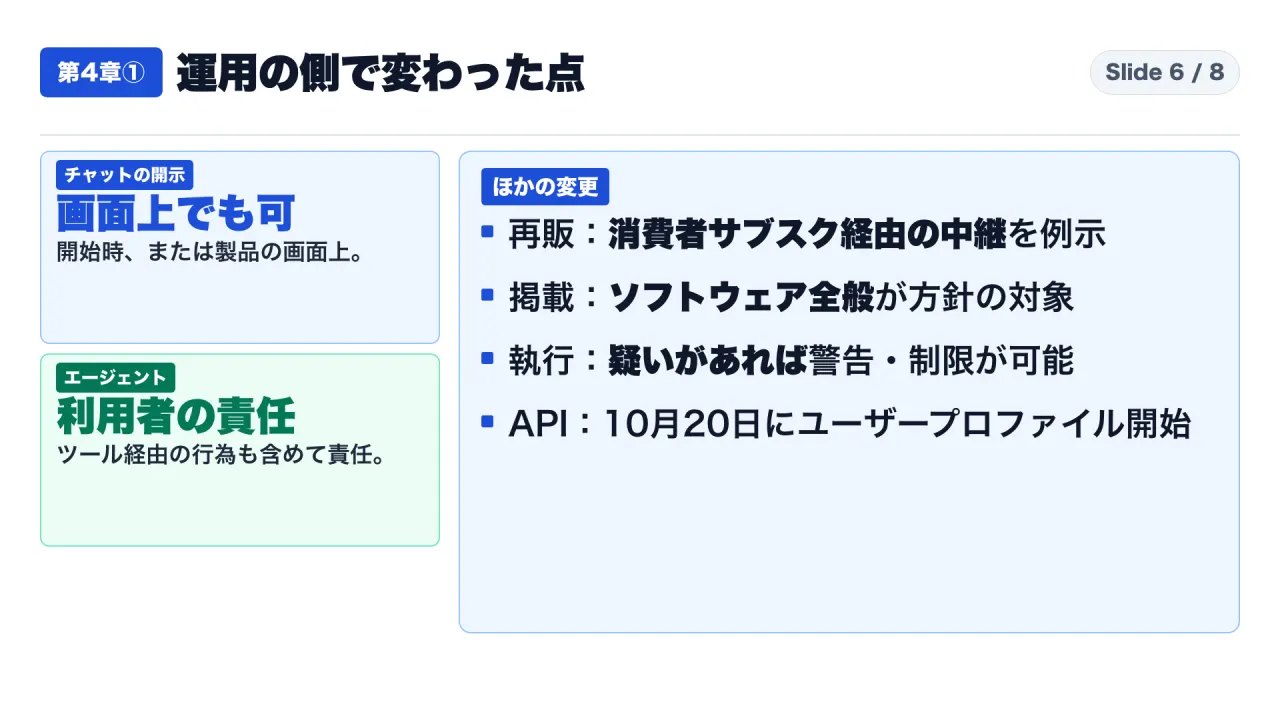
- Agentic Liability: Deployers are explicitly responsible for ensuring that autonomous agents built or deployed on Claude comply with the policy, including actions executed through third-party tools, local web browsers, and connected APIs.
- Prohibition on Unauthorized Resale and Relaying: Explicitly bans unauthorized reselling, proxying, or routing of Claude access, specifically barring commercial middleware that multiplexes API requests through consumer subscriptions or falsifies client user-agent headers.
- Progressive Discipline: Enforcement language shifted from binary account suspension to progressive interventions: formal warnings, dynamic rate-limiting, feature restrictions, temporary suspension, and permanent termination upon suspected violations.
Platform Architectural Support: User Profiles and Enforcement APIs
Supporting these policy standards, the Claude Platform introduced two critical infrastructure capabilities in late October 2026:
- User Profiles (October 20, 2026): Allows multi-tenant SaaS providers and enterprise gateways to associate API calls with discrete end-user identifiers. When security violations occur, Anthropic can throttle or isolate an individual violating tenant rather than terminating the parent organization’s API access.
- Enforcement Status API (October 21, 2026): Provides enterprise administrators with programmatic visibility into whether specific user profiles have been warned, restricted, or suspended.
Organizational Compliance Roadmap: Six Mandatory Review Tracks
Enterprise infrastructure and legal teams should execute the following six compliance checks prior to the policy’s effective date:
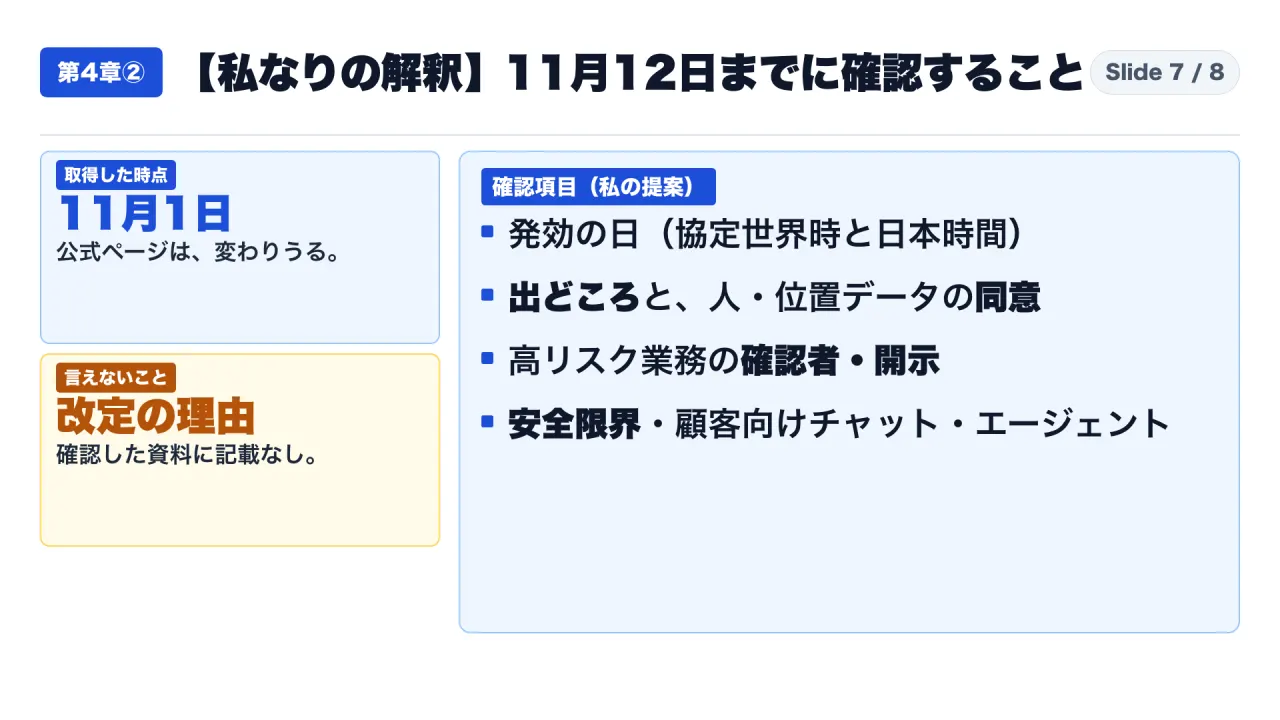
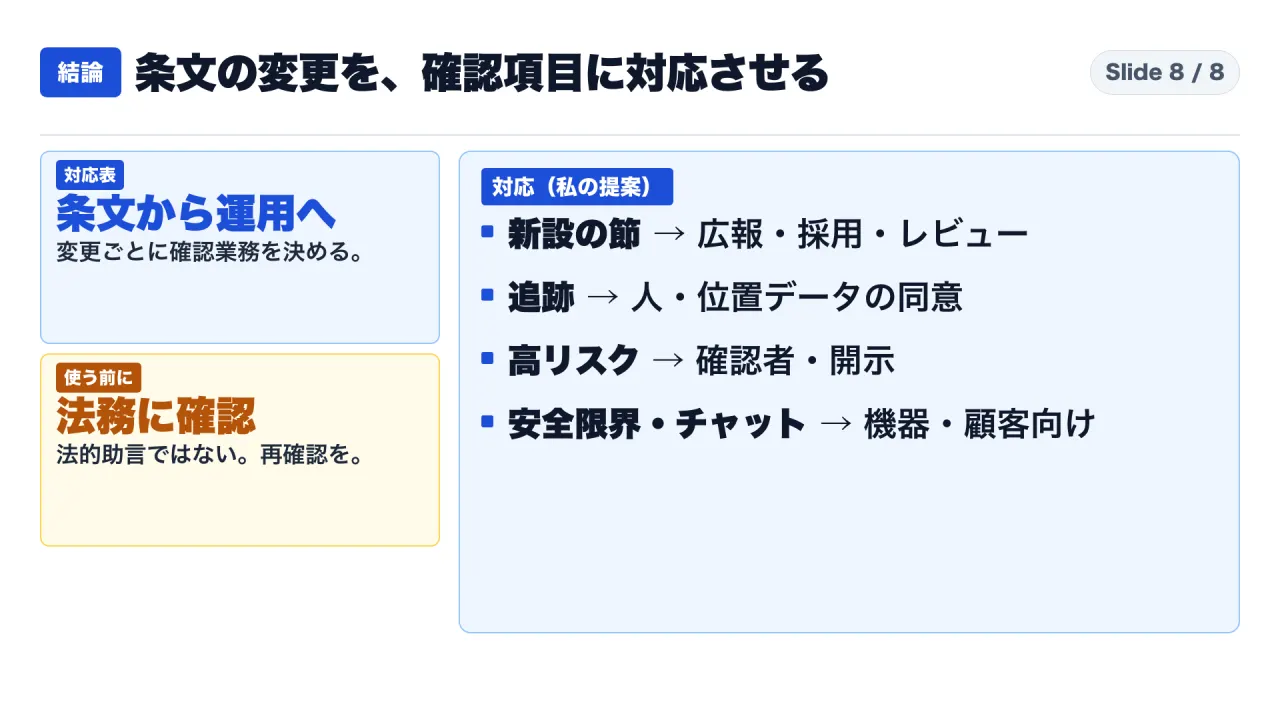
- Verify Effective Date Alignment: Synchronize technical and policy updates with the formal enforcement timestamp: November 12, 2026, at 20:41 UTC (November 13, 2026, at 05:41 JST).
- Audit External Communications and SEO Pipelines: Review PR, recruiting, marketing, and content generation workflows. Ensure brand communications disclose corporate sponsorship and strictly eliminate automated astroturfing, fake reviews, or coordinated search corpus seeding.
- Verify Consent Ledgers for Behavioral and Biometric Data: Audit internal pipelines analyzing employee or customer tracking data, verifying documented opt-in consent.
- Map High-Risk Workflows and Empower Reviewers: Inventory decision-making systems across the 11 high-risk domains. Formally designate qualified human reviewers, grant them documented operational authority to veto or modify model outputs, and establish clear AI disclosure banners.
- Implement Hardware Interlocks for Robotic Actuation: Verify that robotic equipment, automated testing rigs, and laboratory actuation systems enforce speed, force, and temperature limits via independent PLCs or hardware controllers rather than software prompts.
- Configure Multi-Tenant User Profiles and Agent Sandboxes: Implement User Profiles across internal gateways to prevent organization-wide lockouts, restrict agent tool execution permissions, and verify that API integrations do not violate anti-resale clauses.
Primary Sources and References
- Anthropic, Universal Usage Policy (Effective November 12, 2026): https://www.anthropic.com/legal/aup
- Anthropic, Universal Usage Policy (Effective September 15, 2025, Internet Archive Snapshot October 1, 2026): https://web.archive.org/web/20261001235642id_/https://www.anthropic.com/legal/aup
- Anthropic, Claude Platform Technical Release Notes (October 2026 User Profiles & Enforcement API): https://platform.claude.com/docs/en/release-notes/overview