When an Email Delivery SaaS Is Breached: How Xserver, Piccoma, and RAKUS Handled Incident Disclosures and Regulatory Reporting
A side-by-side analysis of official incident reports reveals why headline breach counts cannot be directly compared, how customer impact mirrors data deposit scopes, and where joint vendor reporting lines end.
Published: November 1, 2026 | Read time: ~10 min | Watch Video (Japanese)
Executive Summary: Divergent Metrics and Shared Exposure
On October 21, 2026, RAKUS Light Cloud Co., Ltd.—a wholly owned subsidiary of enterprise software vendor RAKUS Co., Ltd.—disclosed that its email delivery platform, Blastmail, had suffered unauthorized intrusion and data exfiltration. Over the subsequent ten days, corporate clients began publishing security advisories detailing their exposure.
Two major enterprise clients—hosting provider Xserver Inc. and digital comics platform Piccoma (Kakao Piccoma Corp.)—disclosed breach figures that immediately drew public attention:
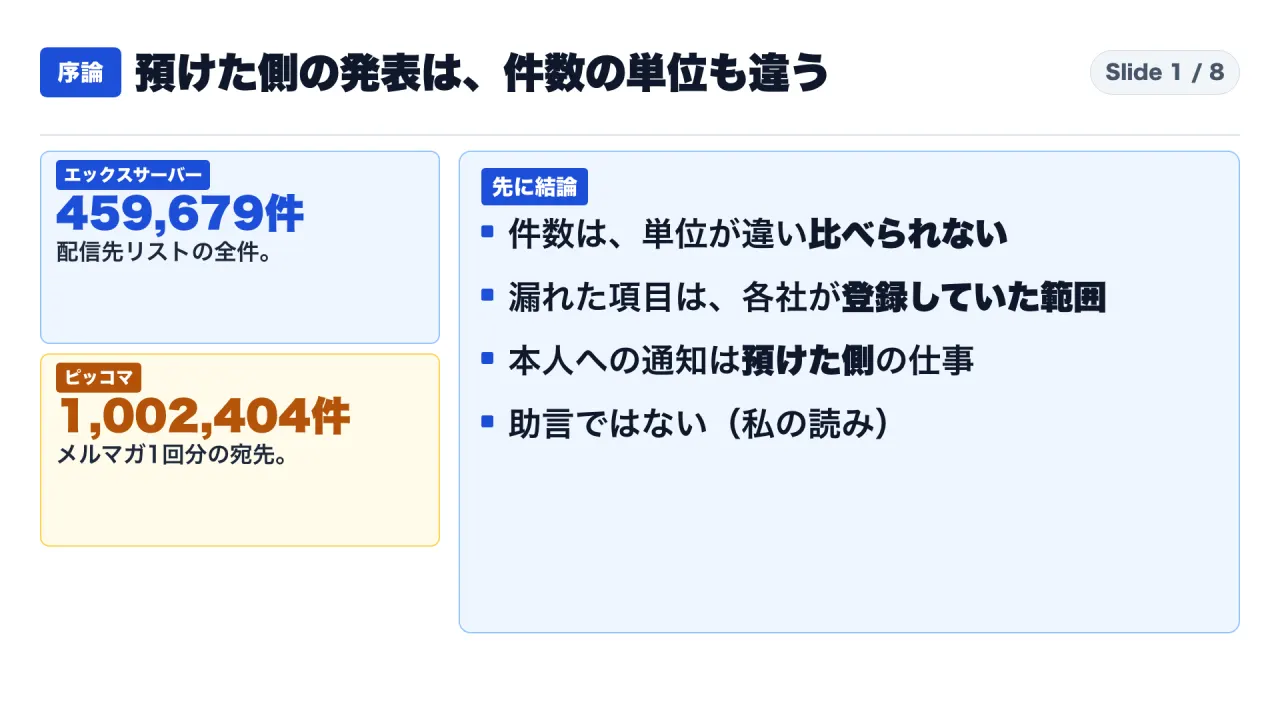
- Xserver reported 459,679 compromised email addresses.
- Piccoma reported 1,002,404 compromised email addresses.
While superficial reporting suggested Piccoma suffered more than double Xserver’s exposure, official disclosures show the companies measured fundamentally different metrics:
- Xserver’s figure represents its complete cumulative subscriber list deposited in Blastmail across its operating history.
- Piccoma’s figure represents recipients of a single promotional newsletter sent on October 14, 2026, at 18:00 JST.
Because the underlying units diverge, comparing these headline numbers as indicators of organizational impact is methodologically invalid.
Furthermore, the disclosures document a vital operational reality: exposed data categories reflected what each customer uploaded. Xserver uploaded customer names, company names, and service tiers alongside email addresses; those attributes were compromised. Piccoma uploaded exclusively email addresses; personal names, credentials, and payment data remained insulated.
Finally, while the vendor established a centralized liaison for joint filings to Japan’s Personal Information Protection Commission (PPC), that framework handled regulatory reporting only. The legal obligation to notify individual consumers remained entirely with client companies.
Analytical Methodology and Evidentiary Standards
This analysis relies strictly on primary source documentation retrieved on November 1, 2026, at 21:36 JST:
- Security incident notifications from RAKUS Light Cloud Co., Ltd. (the vendor).
- News releases from parent company RAKUS Co., Ltd.
- Security notices and customer FAQ pages from Xserver Inc.
- Incident notices published by Kakao Piccoma Corp.
- Public incident reporting guidelines from Japan’s PPC.
Statements are categorized into:
- Documented Fact: Information explicitly stated in official releases and regulatory filings.
- Author Calculation: Deterministic arithmetic (such as elapsed durations or day counts) computed directly from disclosed timestamps.
- Interpretive Analysis: Supply-chain security assessments, architectural comparisons, and governance recommendations.
Secondary reporting and speculative claims are excluded. Noting that an item is “not stated” indicates official disclosures omit the information, not proof of absence.
1. The Vendor Incident Timeline: Detection to Public Disclosure
According to the chronology published by RAKUS Light Cloud, the incident unfolded across seven milestones:
| Timestamp (JST) | Incident Response Milestone | Operational Impact |
|---|---|---|
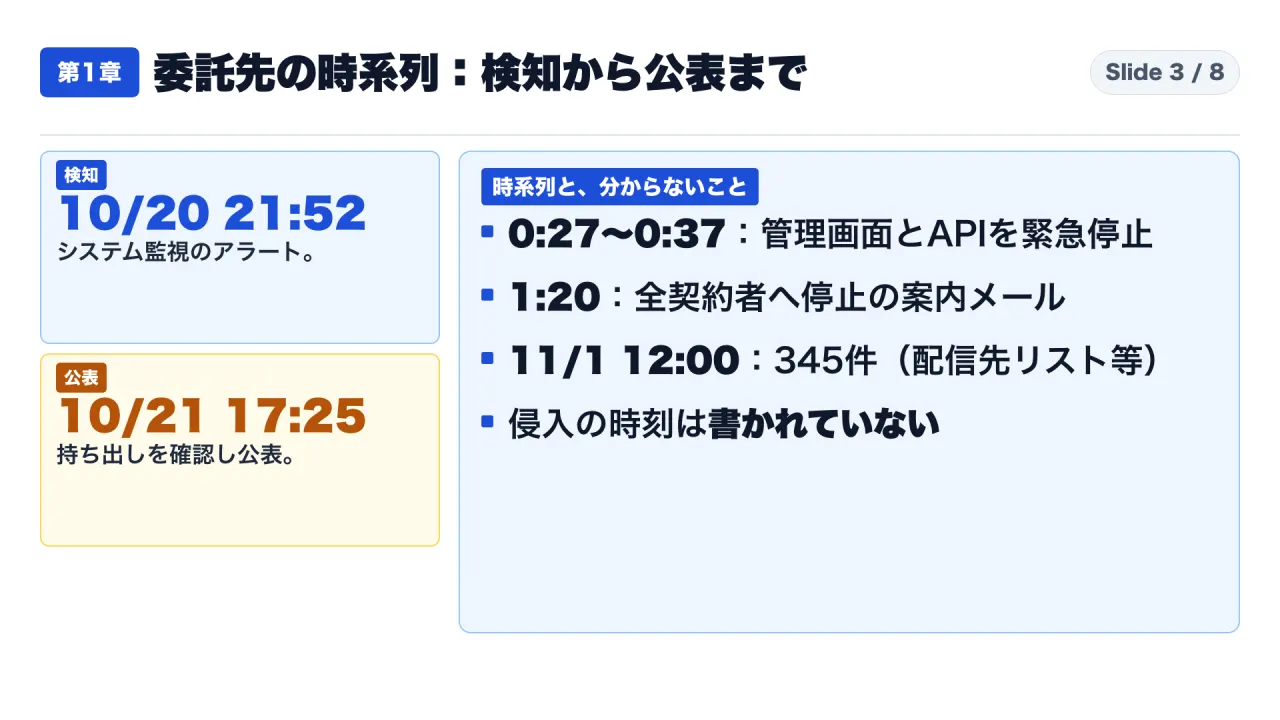
| October 20, 2026 at 21:52 | Monitoring alert detected | Initial response initiated |
| October 20, 2026 at 22:39–22:41 | System notification mailers halted | Password reset delivery stopped |
| October 21, 2026 at 00:27–00:37 | Ingress restricted to office networks | Dashboard and API access suspended |
| October 21, 2026 at 01:00–01:06 | External API ingress severed; egress halted | New email dispatch blocked |
| October 21, 2026 at 01:20 | Emergency suspension notice emailed | Clients notified of service freeze |
| October 21, 2026 at 04:44 | Outbound network severance finalized | Network isolation complete |
| October 21, 2026 at 17:25 | Public disclosure of breach and data theft | Data exfiltration confirmed |
Key operational aspects:
- The entry at 21:52 on October 20 marks when an automated alert fired, not initial attacker ingress. Official notes do not state when the perimeter was breached.
- Between 00:30 and 01:06 on October 21, the vendor severed administrative dashboards, API gateways, and dispatch queues, freezing service.
- At 01:20 on October 21, client organizations received an automated notice of emergency suspension. Confirmation of data theft was not published until 17:25.
- The interval between initial alert detection (October 20 at 21:52) and public confirmation of data theft (October 21 at 17:25) was 19 hours and 33 minutes. During this window, clients knew only that service had ceased, without visibility into data exposure.
2. The Two-Tier Architecture of Exfiltrated Data
The vendor confirmed that stolen data spanned two operational tiers:
- Subscriber Account Data (Sales Management Database): Attackers exfiltrated the subscriber database containing corporate records for all Blastmail clients: corporate names, contact names, phone numbers, email addresses, billing emails, and payment histories. Credit card numbers were not compromised, as the vendor does not retain card data.
- End-User Distribution Lists (Service Application Database): For a subset of clients, attackers accessed database tables containing end-user mailing lists.
As of November 1, 2026, at 12:00 JST, exfiltration of distribution lists was verified across 345 client contracts. The vendor stated individual notifications to all 345 client accounts were complete.
The disclosed cause was concise: external actors compromised two API gateway servers, executed administrative commands, and accessed sales and application databases. The specific entry vector remains under investigation. Service restoration was targeted for approximately November 11, 2026, while OEM instance timelines remained undetermined.
3. Dissecting Xserver’s Disclosure: Full List Exfiltration and Retention Lags
Xserver published an initial advisory on October 23, 2026, followed by a detailed update and FAQ on October 29 at 20:30 JST. Xserver confirmed its entire registered subscriber list in Blastmail was compromised, while confirming its internal hosting infrastructure and servers suffered no breach.
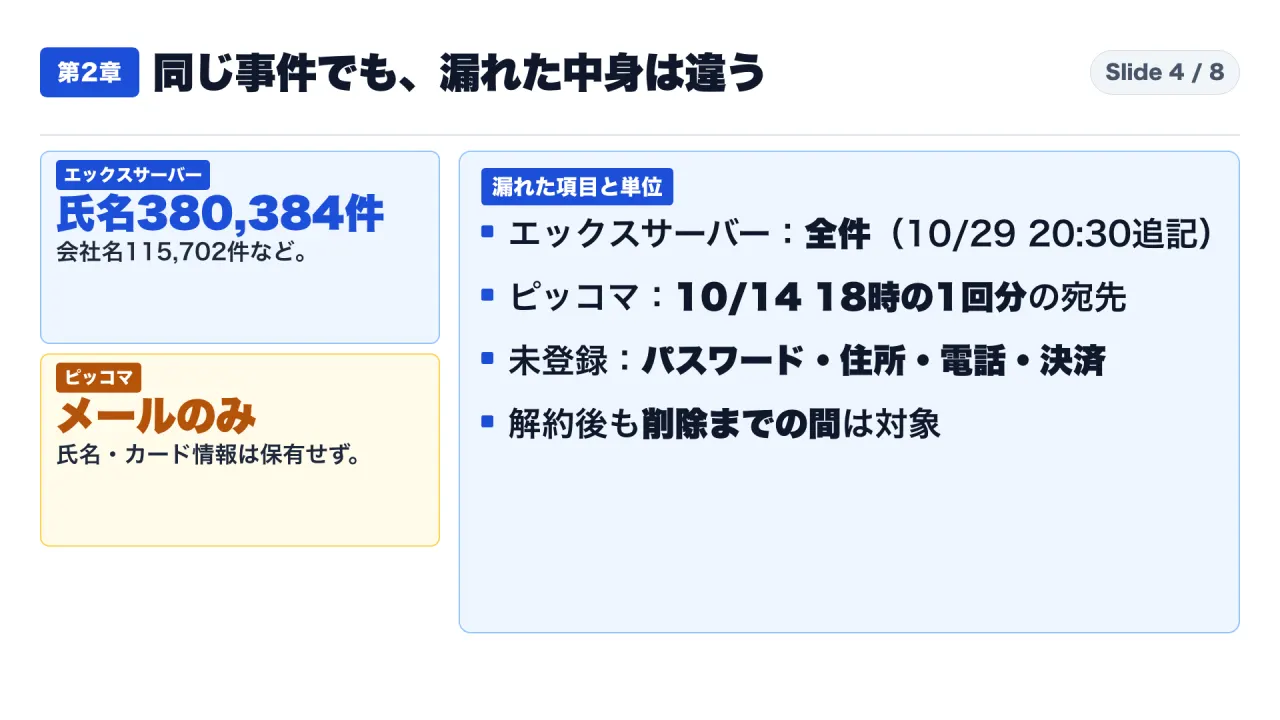
Compromised records totaled 459,679 email addresses, alongside associated profile metadata:
| Compromised Field | Records | Field Scope |
|---|---|---|
| Email Address | 459,679 | Master recipient address |
| XServer Account ID | 692 | Internal account identifier |
| Full Customer Name & Furigana | 380,384 | Registered personal identity |
| Corporate Name & Furigana | 115,702 | Business account identity |
| Subscribed Service Name | 316,453 | Hosting or cloud product used |
| Account Registration Date | 431,076 | Account creation timestamp |
| Individual vs. Corporate Status | 431,076 | Legal entity classification |
| Marketing Newsletter Preference | 429,382 | Opt-in / opt-out status |
Xserver noted not all records contained every attribute. Passwords, residential addresses, phone numbers, and payment details were never stored in Blastmail and remained uncompromised.
The Retention Latency Problem
Xserver’s FAQ highlighted a key cloud risk: retention latency. When customers cancelled hosting or opted out of marketing, records were queued for periodic batch deletion. However, records residing in Blastmail during the interval between cancellation and scheduled deletion were exfiltrated. Consequently, former customers who had previously cancelled were affected.
Incident Cadence
Xserver proceeded through a structured verification sequence:
- October 21: Vendor announced breach.
- October 22: Xserver learned its account was compromised.
- October 23: Published corporate advisory.
- October 27: Received forensic data dump from vendor.
- October 28: Cross-referenced records against internal databases.
- October 29–30: Dispatched individualized notification emails to affected users.
The duration between Xserver learning of exposure (October 22) and notifying users (October 29) was 7 calendar days, with 2 days needed to cross-reference records after receiving the vendor dump on October 27.
Xserver severed integration with Blastmail, announced transition to an in-house mail delivery system, requested permanent data deletion from Blastmail, and entered joint regulatory reporting with RAKUS Light Cloud.
4. Dissecting Piccoma’s Disclosure: Single Campaign Exposure and Technical Isolation
Kakao Piccoma published an initial advisory on October 24, 2026, and an update on October 28 at 17:00 JST. Piccoma confirmed its internal servers, applications, and databases were unbreached.
Piccoma’s compromised count was 1,002,404 email addresses, encompassing solely recipients of a single promotional newsletter sent on October 14, 2026, at 18:00 JST. The vendor confirmed exfiltration for this campaign would not expand.
The only compromised attribute was the email address. Passwords, customer names, and credit card numbers were not held in Blastmail, and Piccoma Novels newsletters were unaffected.
Piccoma implemented three immediate mitigations:
- Suspended newsletter dispatches through Blastmail.
- Reconfigured email authentication headers (including SPF/DKIM parameters) so Blastmail could no longer send authorized emails masquerading as Piccoma.
- Notified the PPC and issued warnings via in-app alerts and direct email.
Piccoma established a strict rule: official alerts contained zero clickable links. Users were advised that emails with links or password requests were fraudulent, instructing them to access support solely through bookmarks or native apps.
5. Normalizing Metrics Across Disclosures
Comparing disclosures directly illustrates why headline counts mislead:
| Attribute | Xserver Inc. | Kakao Piccoma Corp. |
|---|---|---|
| Disclosed Count | 459,679 records | 1,002,404 records |
| Scope | Cumulative registered database in SaaS | Single campaign dispatch (Oct 14 at 18:00) |
| Compromised Fields | Email, Name, Company, Service, Sign-up Date | Email address only |
| Discovery Date | October 22, 2026 (1 day post-vendor disclosure) | October 24, 2026 (3 days post-vendor disclosure) |
| Notification | Personalized emails sent Oct 29–30 | In-app alerts and text-only emails |
| Future Posture | Contract terminated; building in-house | Dispatches suspended; email auth altered |
Piccoma’s higher count reflected a single broadcast list, whereas Xserver’s count represented persistent accounts with rich metadata. From a spear-phishing risk perspective, stolen records with customer names and subscribed services present higher exposure than isolated email addresses.
6. Regulatory Reporting versus End-User Notification
The Blastmail incident highlights the division of responsibilities between cloud processors and data controllers under data privacy laws.
RAKUS Light Cloud submitted incident filings to the PPC, JIPDEC, and the Ministry of Internal Affairs and Communications (Kanto Bureau of Telecommunications), and filed criminal complaints with the Tokyo Metropolitan Police Department.
For enterprise clients facing statutory obligations under Japan’s APPI, RAKUS Light Cloud established a liaison portal offering two paths:
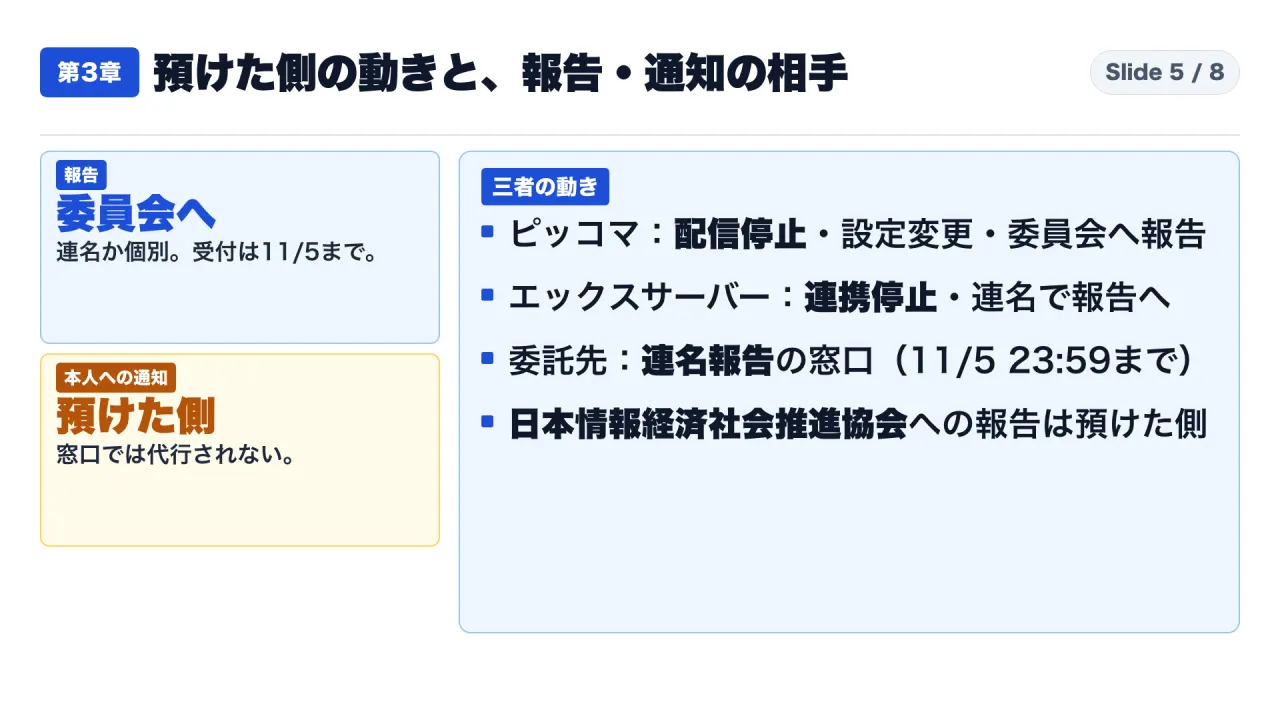
- Joint Reporting (連名報告): For private businesses and organizations to submit unified filings to the PPC alongside the vendor.
- Proxy Reporting (代行報告): For public administrative bodies where the vendor files on their behalf under PPC approval.
The liaison window closed October 29 and was extended to November 5, 2026, at 23:59 JST. The vendor confirmed with the PPC that clients using joint filing would not be cited for reporting delays.
However, the vendor emphasized three boundaries:
- Liaison Scope: The portal handles PPC filings exclusively.
- Mandatory Direct Notification: Entrusting client companies remain legally responsible for notifying affected consumers directly.
- PrivacyMark Obligations: PrivacyMark-certified clients must report independently to JIPDEC.
Under PPC rules, breaches from unauthorized access or exceeding 1,000 individuals require formal reports within 60 days, alongside prompt preliminary notification.
7. Operational Realities Undisclosed in Official Reports
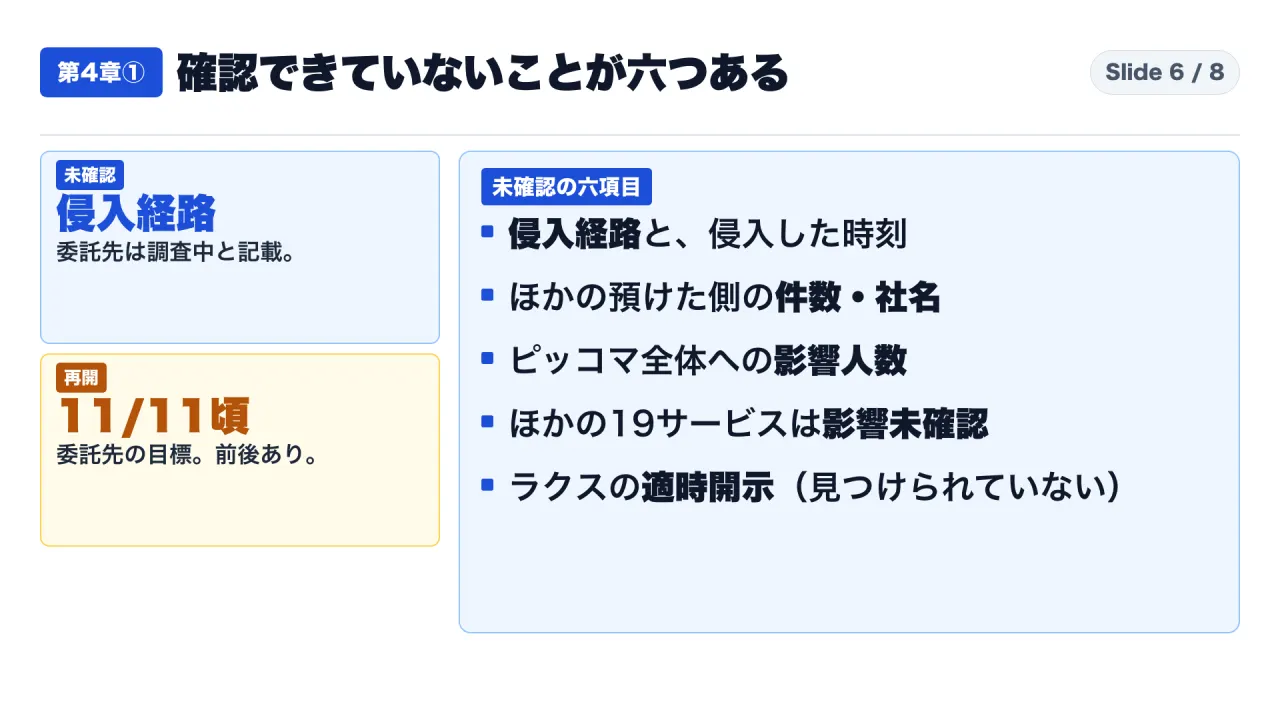
Six elements remained unconfirmed across official documentation retrieved on November 1, 2026:
- Initial Vector: The vulnerability used to access the API servers was undisclosed.
- Remaining Client Scope: Beyond 345 confirmed contracts, other client identities were unstated.
- Piccoma Total Impact: Disclosures covered only the October 14 blast, leaving total platform exposure unaddressed.
- Restoration Guarantees: The November 11 target remained provisional.
- Sibling Services: RAKUS noted on October 28 that no breaches were detected across 19 other cloud services, framing it as “unconfirmed”.
- Market Disclosures: Formal timely disclosure filings on the Tokyo Stock Exchange were not located in primary news releases.
8. Incident Analysis: The Vendor Disclosure Gap
A vital takeaway is that the date a SaaS vendor announces a breach is rarely when clients know they are affected.
RAKUS Light Cloud announced unauthorized data theft on October 21. Xserver confirmed its exposure on October 22; Piccoma learned on October 24—three days later. During that window, clients could not verify their exposure via Blastmail’s consoles because the vendor had frozen dashboard and API access at 00:30 on October 21.
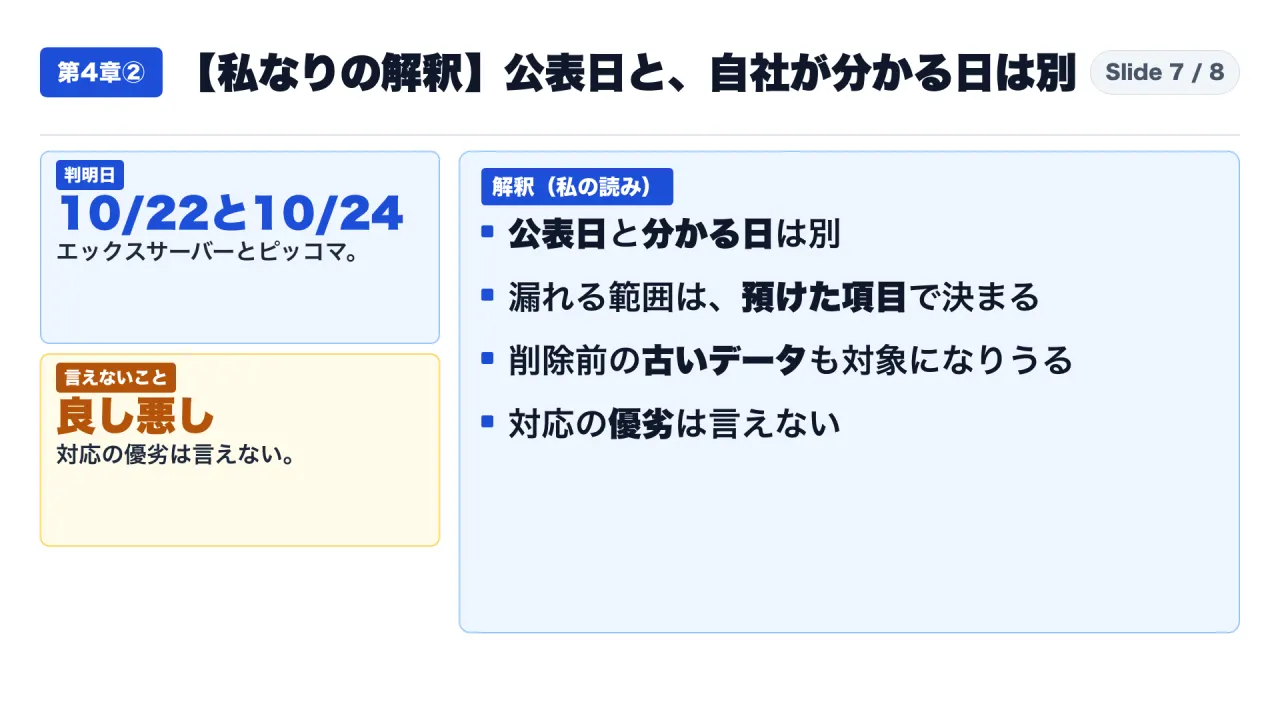
When vendor consoles are locked down during containment, a client’s visibility depends on internal deposit ledgers. Without independent records of uploaded data, an enterprise remains blind until vendor forensics arrive.
9. Supply-Chain Risk Governance: Three Pre-Breach Controls
Organizations utilizing third-party SaaS platforms should implement three defensive controls:
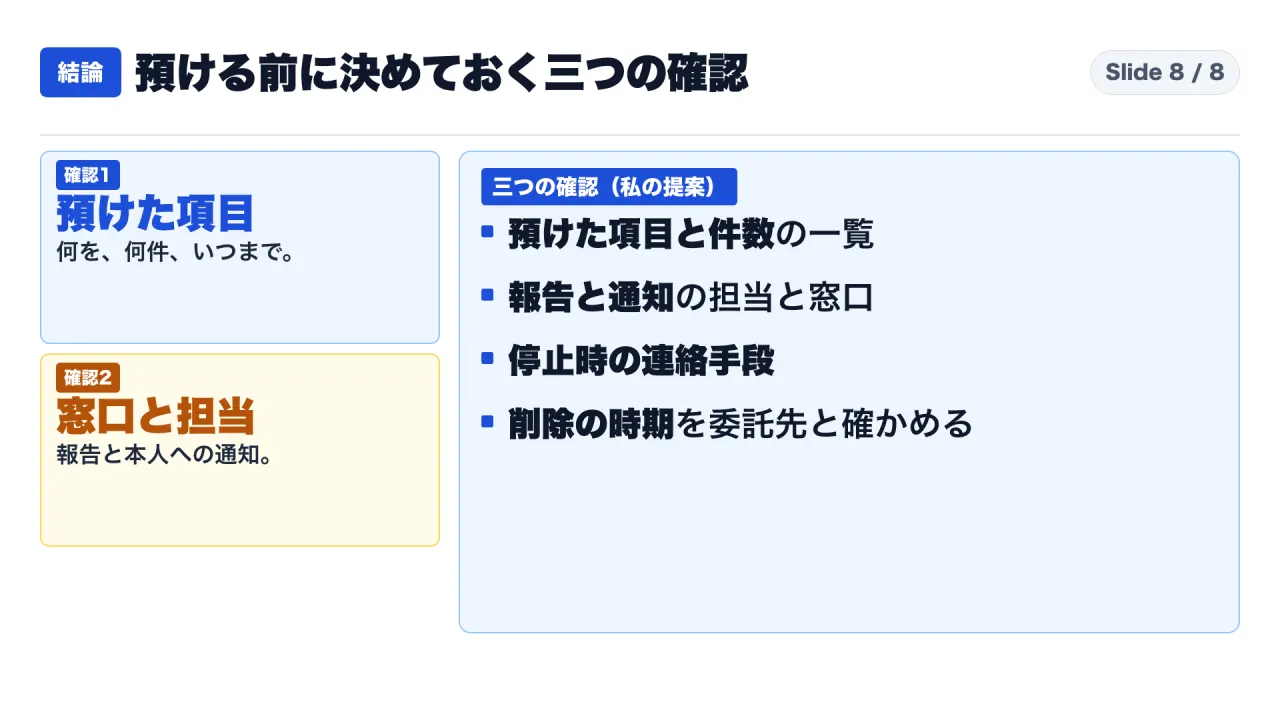
- Maintain an Internal Data Entrustment Ledger: Track every field, volume, and retention schedule synced to third parties. Redact unnecessary fields like customer names or service IDs. Enforce automated batch deletion for cancelled accounts to eliminate retention lags.
- Pre-Authorize Regulatory and Notification Protocols: Assign operational ownership for PPC filings, JIPDEC escalations, and customer notices beforehand. Vendor joint-reporting portals do not fulfill end-user notification duties.
- Establish Out-of-Band Verification and Spoofing Defenses: Sever compromised vendor authentication headers immediately. Prohibit clickable links in security alerts, directing customers to verify communications via native apps or bookmarked portals.
Primary Sources and References
- RAKUS Light Cloud Co., Ltd., Blastmail Incident Information (November 1, 2026 Update): https://info.blastmail.jp/information_20261021.html
- RAKUS Light Cloud Co., Ltd., Joint and Proxy Reporting Portal Information: https://info.blastmail.jp/information_joint_report.html?v=20261030
- RAKUS Co., Ltd., Initial Corporate Advisory (October 21, 2026): https://www.rakus.co.jp/news/2026/1021-2.html
- RAKUS Co., Ltd., Secondary Corporate Advisory (October 21, 2026, Updated October 28): https://www.rakus.co.jp/news/2026/1021-3.html
- Xserver Inc., Security Advisory and Apology (October 23, 2026, Updated October 29): https://www.xserver.ne.jp/news_detail.php?view_id=19739
- Xserver Inc., Incident FAQ and Customer Notice: https://www.xserver.ne.jp/info/incident_202610/
- Kakao Piccoma Corp., Official Incident Notices (October 24 and October 28, 2026): https://jp.piccoma.com/web/notice_detail/7503
- Personal Information Protection Commission (PPC), Incident Response Guidelines: https://www.ppc.go.jp/personalinfo/legal/leakAction/