Whose Numbers Power the "World's Largest AI Datacenter in 2027"? Separating Regulatory Filings from Epoch AI's Mathematical Models
A forensic audit of the Goodnight datacenter campus in Armstrong County, Texas, distinguishing regulatory caps and tax agreements from algorithmic compute formulas.
Published: November 1, 2026 | Read time: ~10 min | Watch Video (Japanese)
Executive Summary & Core Findings
- The Headline vs. The Regulatory Record: Epoch AI forecasts that by October 2027, the “Goodnight” datacenter campus in Armstrong County, Texas, will deploy approximately 2,279,000 H100 equivalents (H100e), 1,006 MW of critical IT power, and $38.1 billion in capex. Currently, all three metrics on Epoch’s directory stand at zero.
- The Source of the Metrics: None of these three numbers appear within the site’s primary regulatory documentation. Texas building filings, county property tax abatement agreements, and environmental permits reveal that the 1,006 MW, 2.28M H100e, and $38.1B figures are algorithmic model outputs computed by Epoch AI from estimated cooling capacity.
- The Three-Box Taxonomy:
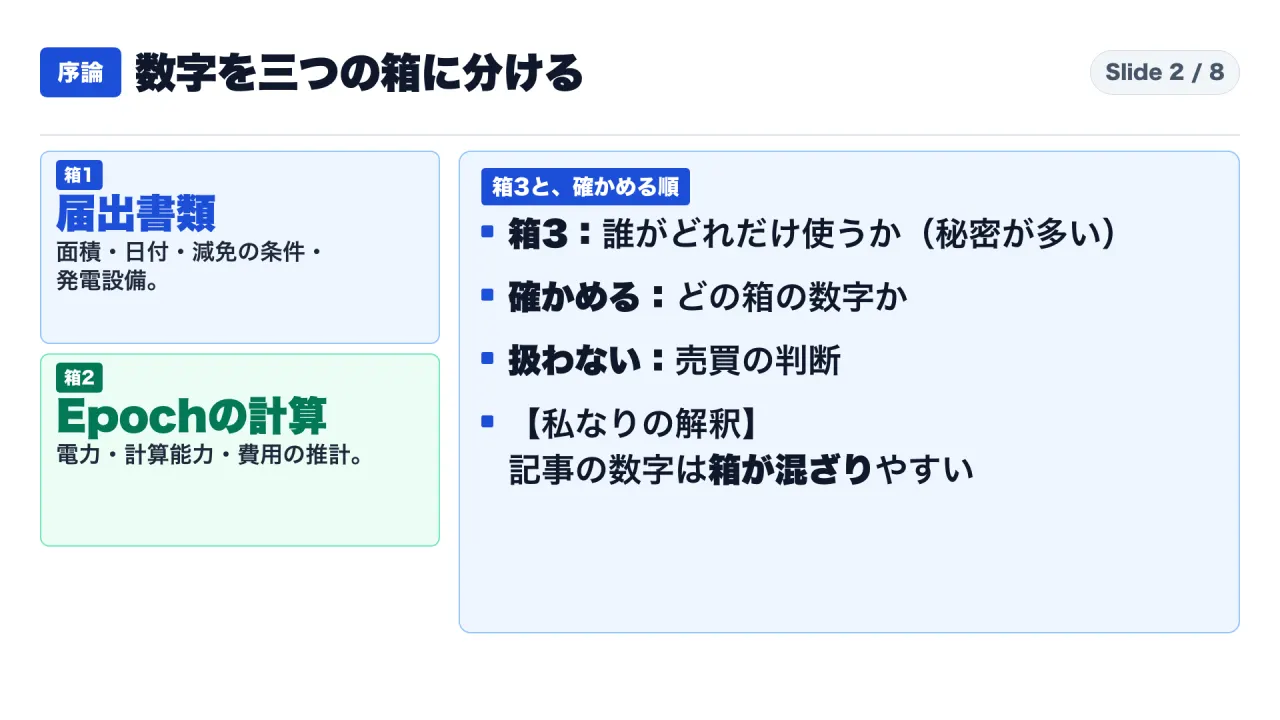
- Box 1: Regulatory Filings: Legal power caps, building footprints, generator counts, and commercial operation deadlines.
- Box 2: Algorithmic Estimations: Epoch AI’s formulas converting cooling capacity into IT power, IT power into chip counts, and wattage into capital cost models.
- Box 3: Undisclosed Commercial Realities: Confidential tenant assignments, internal compute workloads, and proprietary processor mixes.
- The Fragility of the “#1” Title: Goodnight’s title as the “world’s largest” holds only under narrow conditions. In H100e on December 31, 2027, Goodnight leads QTS Cedar Rapids by only 1.3% (28,380 H100e)—far narrower than Epoch’s ±40% (1.4x) power estimation error band. Ranked by IT power in megawatts, Goodnight drops to fourth globally. Twenty-four hours later (January 1, 2028), Meta’s Hyperion facility reaches 4.14M H100e—1.8 times Goodnight.
- Target Audience: Written for Chief Investment Officers, datacenter infrastructure directors, and procurement leaders evaluating hyperscaler capacity roadmaps.

Methodological Framework: Triangulating Filings, Algorithmic Models, and Corporate Releases
This audit evaluates primary artifacts across three distinct categories:
- Documented Regulatory Filings: Texas Department of Licensing and Regulation (TDLR) registrations, Armstrong County tax abatement contracts, and TCEQ air permit applications.
- Epoch AI Algorithmic Documentation: Project profiles, methodology papers, and directory ledgers published by Epoch AI.
- Official Corporate Statements: Google’s Texas investment releases and Crusoe Energy Systems’ development disclosures.
- Author Mathematical Computations: Density ratios and capex calculations performed directly on published figures.
Artifacts were collected on November 1, 2026, and re-verified on November 2, 2026. This analysis evaluates documentary evidence as published, without predicting equity valuations.
Chapter 1: Box 1: What Regulatory Filings Actually Document
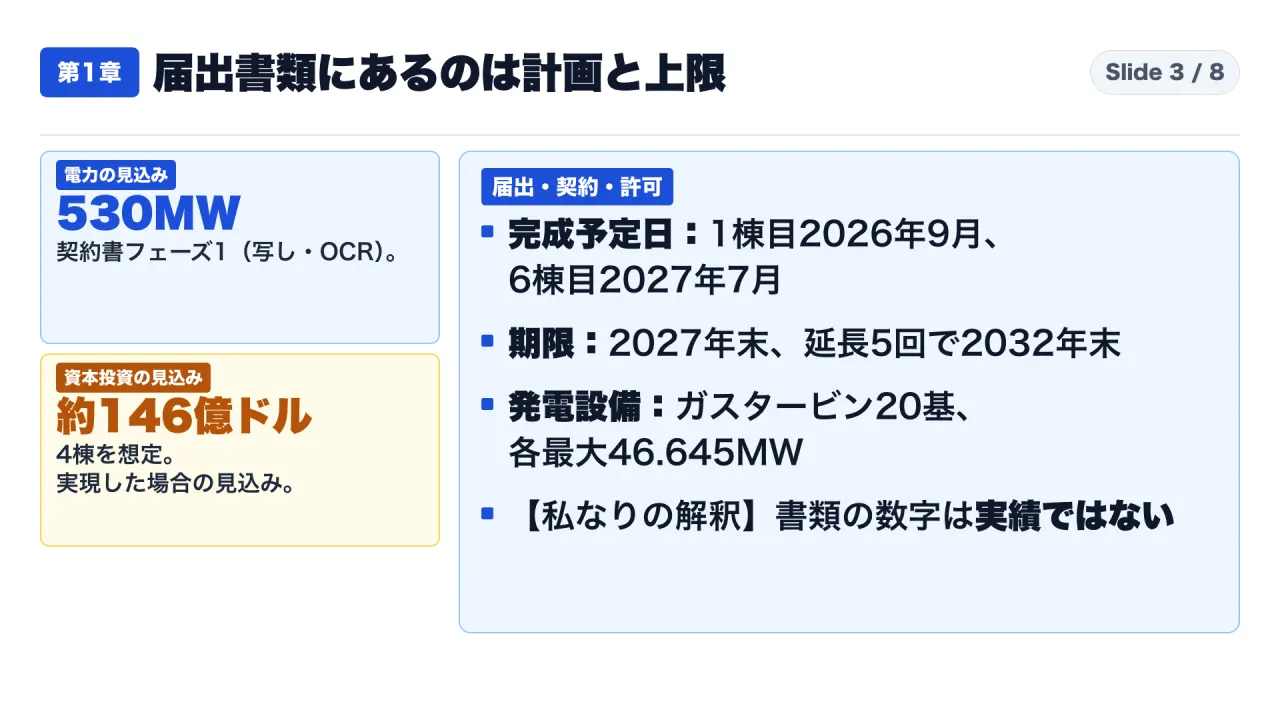
Public filings submitted to state, county, and environmental authorities document physical boundaries, legal ceilings, and tax commitments. They define project limits rather than realized compute power.
REGULATORY PROFILE OF THE GOODNIGHT CAMPUS:
- Property Owner: GN DC1 LLC (Delaware entity) | Location: Armstrong County, Texas
- State Building Filings (TDLR):
  • Building 1 TI (TABS2025027064): 484,965 sq ft; completion Sept 12, 2026
  • Building 2 TI (TABS2025027065): 484,954 sq ft; completion Nov 7, 2026
  • Building 6 (TABS2026010861): 805,380 sq ft; completion July 30, 2027
- County Tax Abatement (Phase 1):
  • Power Cap: Up to 530 MW | Modular: 4 buildings (four 25 MW halls = 100 MW each)
  • Investment: ~$14.6 Billion | Deadline: Dec 31, 2027 (extendable to 2032 via 5 extensions)
- Air Quality Permit (PSD, Jan 30, 2026):
  • Configuration: 6 data center buildings + western power plant (20 gas turbines, ~933 MW)
  • Grid Architecture: Buildings 1-4 on utility grid; Buildings 5-6 on on-site power
Texas State Building Registrations (TDLR)
Filings submitted to the Texas Department of Licensing and Regulation document three distinct structures: Building 1 TI (project TABS2025027064, covering 484,965 square feet of interior finish-out across four data halls, completed September 12, 2026); Building 2 TI (project TABS2025027065, covering 484,954 square feet, completed November 7, 2026); and Building 6 (project TABS2026010861, encompassing 805,380 square feet—1.66 times the size of Building 1—completed July 30, 2027). The owner of record is GN DC1 LLC, and tenant occupancy is listed as “Not Assigned.” Each filing lists an estimated building construction cost of $500 million, reflecting structural shells and mechanical rough-ins while excluding compute hardware.
County Tax Abatement Contracts: Power Caps and Extension Clauses
Armstrong County’s Phase 1 property tax abatement agreement outlines four buildings situated on approximately 350 acres. The contract states that Phase 1 is expected to consume up to 530 megawatts of electrical energy, with each building partitioned into four 25 MW data halls (100 MW per building, or 400 MW of core halls across Phase 1).
The contract estimates Phase 1 capital investment at $14.6 billion (~$3.65 billion per building). This reflects appraised capital additions for tax purposes, diverging structurally from Epoch’s 6-building formula of $38.1 billion ($6.35 billion per building).
Crucially, the December 31, 2027, commercial deadline is extendable. The contract grants the developer up to five consecutive one-year extensions upon written notice and graduated fees ($100k for the second, up to $500k for the fifth), shifting the ultimate deadline to December 31, 2032. Furthermore, in October 2025, the county approved an amended agreement expanding the framework up to eight phases under 10-year 100% abatements.
Air Quality Permits: The 933 MW Behind-the-Meter Power Plant
On January 30, 2026, Crusoe Energy Systems LLC submitted a PSD air permit for “Goodnight Data Center,” specifying six data center buildings supported by an on-site western power station with 20 gas combustion turbines (46.645 MW each, totaling ~933 MW). Buildings 1-4 draw utility grid power, while Buildings 5-6 rely on behind-the-meter generation.
Chapter 2: Box 2: Deconstructing Epoch AI’s Algorithmic Modeling
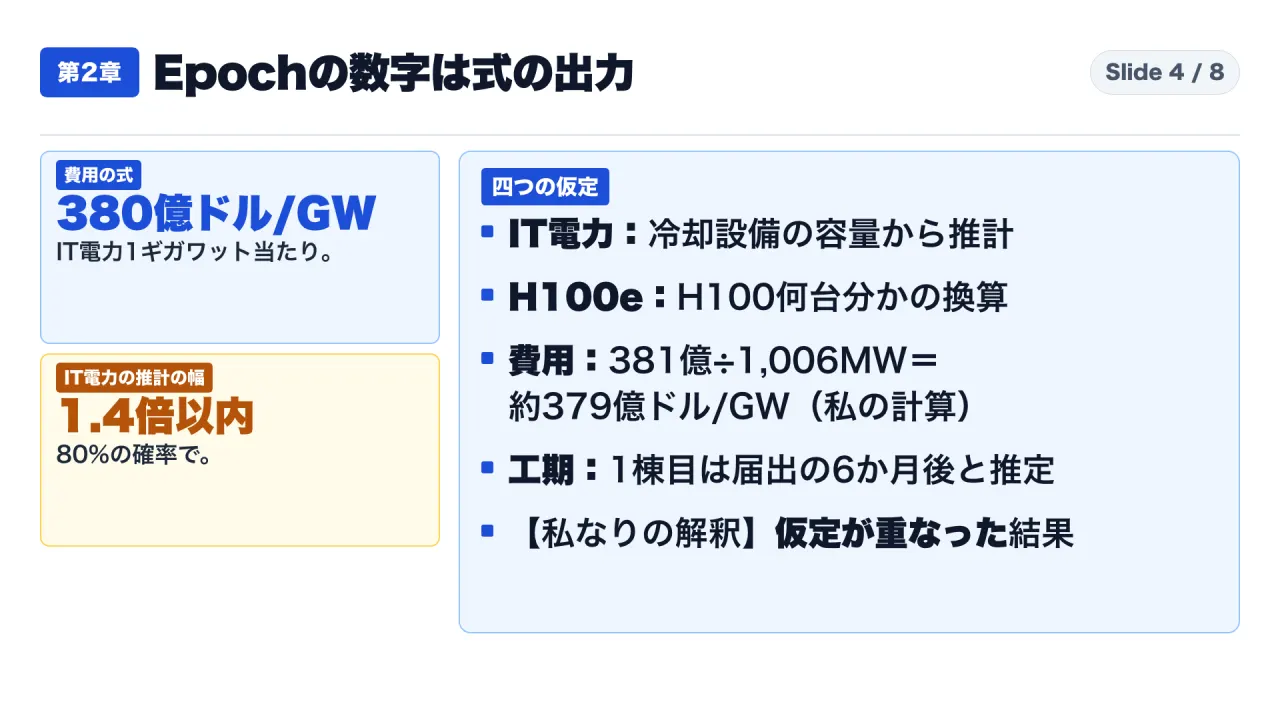
The headline figures—2,279k H100e, 1,006 MW IT power, and $38.1 billion capex—are algorithmic model outputs published by Epoch AI, derived by layering engineering assumptions onto public filings.
EPOCH AI'S THREE-STEP ESTIMATION METHODOLOGY:
1. Chiller Detection: Satellite imagery detects chillers ──► Computes cooling capacity
   Critical IT Power = Cooling Capacity / Headroom Ratio
2. Processor Inference: Presumed tenant (Google) ──► Assumes custom TPU silicon
   Compute Capacity (H100e) = Total FP8 FLOPS / (0.5 * H100 FP8 Spec)
3. Standardized Capex: IT Power (GW) * $38B/GW ($26B compute + $12B infrastructure)
   Result: 1.006 GW * $37.9B/GW = $38.1 Billion
The IT Power and Compute Derivation
According to Epoch’s methodology, critical IT power is derived from high-resolution satellite imagery detecting rooftop cooling units (latest imagery from April 16, 2026). Epoch estimates cooling capacity and divides it by an operational headroom multiplier. Total facility power multiplies IT power by an assumed peak Power Usage Effectiveness (PUE).
Epoch defines 1 H100e as the 8-bit floating-point compute capacity of an NVIDIA H100 divided by two, assigning processor counts based on the suspected tenant’s design patterns (assuming Google TPUs).
The Standardized Capex Formula
Epoch’s capital expenditure metric is an unadjusted formulaic calculation:
Total Capex = Critical IT Power (GW) * $38 Billion / GW
This formula allocates $26 billion/GW for servers/networking and $12 billion/GW for building infrastructure. Multiplying Goodnight’s 1.006 GW by $37.9B/GW yields $38.1 billion. Epoch notes this formula omits volume chip discounts, power purchase agreements, and tax abatements.
Error Margins and Slotted Commissioning Dates
Epoch documents that critical IT power estimates carry an 80% confidence interval of ±40% (1.4x factor). For Goodnight’s 1,006 MW, the 80% confidence band spans 719 MW to 1,408 MW.
Epoch also models schedule slippage: Building 1 completion is delayed from September 2026 to March 15, 2027; Building 2 to May 15, 2027; and all 6 buildings to October 1, 2027.
| Milestone Date (Epoch Model) | Cumulative Compute Capacity | Critical IT Power | Algorithmic Capex Estimate |
|---|---|---|---|
| March 15, 2027 (Building 1) | 124,000 H100e | 103 MW | $3.9 Billion |
| May 15, 2027 (Building 2) | 249,000 H100e | 206 MW | $7.8 Billion |
| October 1, 2027 (6 Buildings) | 2,279,000 H100e | 1,006 MW | $38.1 Billion |
Chapter 3: Box 3: Undisclosed Commercial Realities and Hyperscaler Releases
The third evidentiary box contains variables that remain confidential or unconfirmed:
- Google Announcement (Nov 14, 2025): Committed $40 billion across Texas by 2027, spanning Armstrong and Haskell counties and statewide assets, disclosing zero campus-specific capex, MW capacity, or chip counts.
- Crusoe Announcement (Sept 28, 2026): Confirmed Crusoe is developing Google’s campus in Armstrong County (5,500+ daily workers) with adjacent wind farms (531 MW total) and liquid cooling.
- Epoch Directory Profile: Tags owner “Google” and tenant “Google DeepMind” as “Speculative.”
Neither Google nor Crusoe has confirmed the campus name “Goodnight Data Center” or DeepMind occupancy. Blending Google’s statewide $40B announcement with Epoch’s single-site $38.1B formula conflates two entirely different accounting perimeters.

Chapter 4: The Fragility of the “World’s Largest” Title
Epoch’s profile page for Goodnight does not explicitly use the term “world’s largest.” That title emerges when users sort Epoch’s 96-facility directory by H100e with an operational cutoff date of December 31, 2027. Altering any single ranking parameter immediately rearranges the global leaderboard.
GLOBAL DATACENTER LEADERBOARD COMPARISONS (EPOCH DIRECTORY DATA):
- By Compute Density (H100e at Dec 31, 2027 Cutoff):
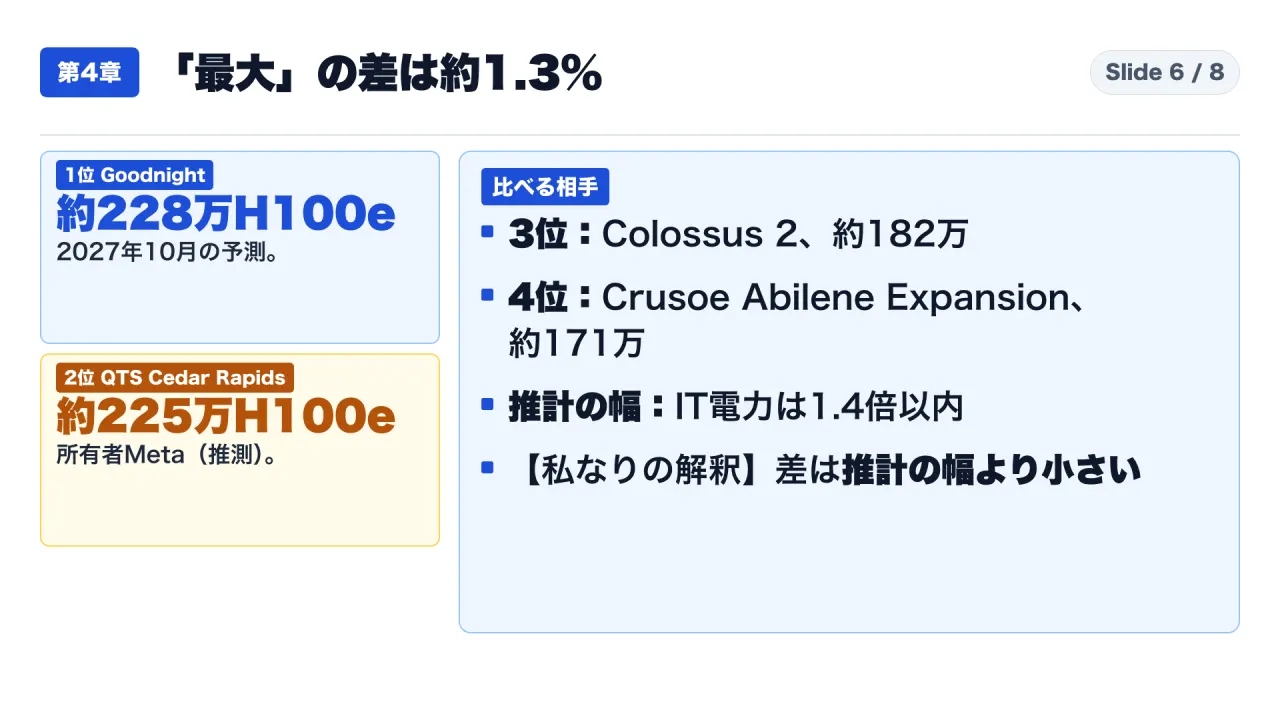
  1. Goodnight (Google, Speculative): 2,278,929 H100e
  2. QTS Cedar Rapids (Meta, Speculative): 2,250,549 H100e
  Lead Margin: Exactly 28,380 H100e (~1.3% delta)
- By Critical IT Power (MW Capacity):
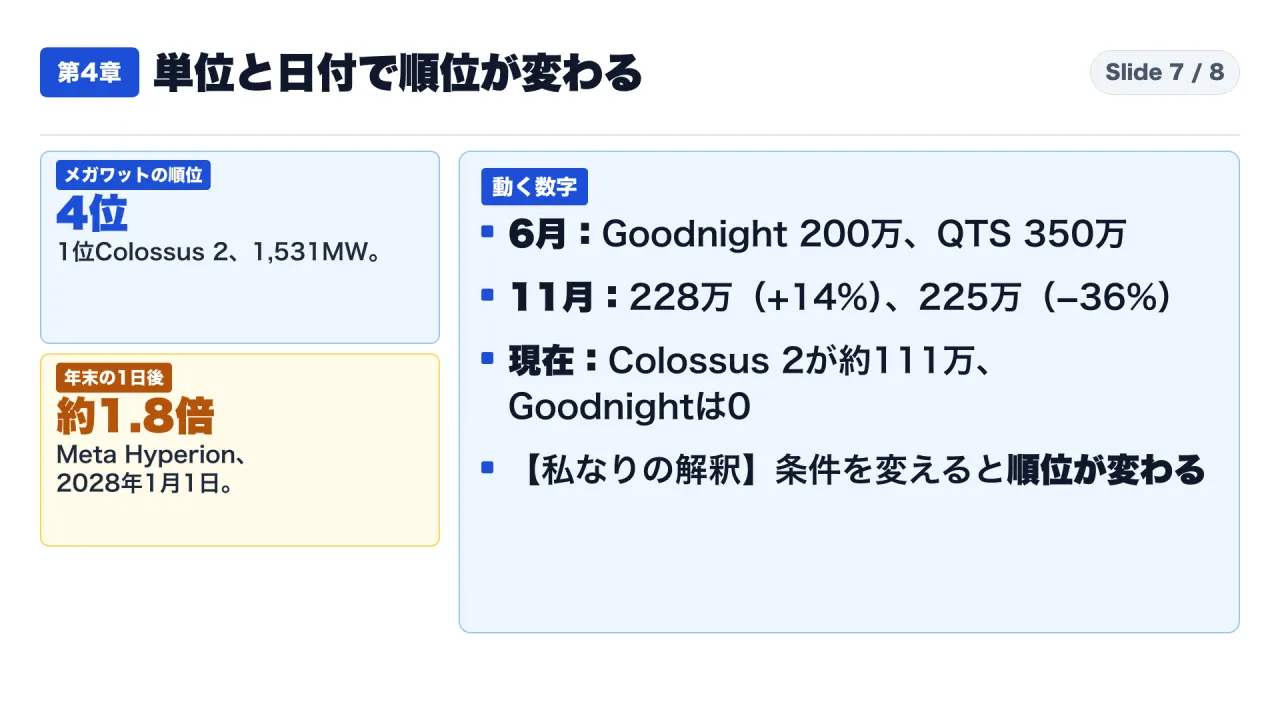
  1. Colossus 2 (SpaceXAI): 1,531 MW | 2. QTS Cedar Rapids (Meta): 1,133 MW
  3. Anthropic-Amazon New Carlisle: 1,037 MW | 4. Goodnight (Google): 1,006 MW
- By Horizon Extension (One Day Later: January 1, 2028):
  1. Meta Hyperion: 4,140,000 H100e (1,632 MW) ──► 1.8x Larger than Goodnight
| Facility Name | Presumed Operator | Projected Date | Projected H100e | Critical IT Power | Imputed H100e / MW |
|---|---|---|---|---|---|
| Goodnight | Google (Speculative) | Oct 1, 2027 | 2,278,929 | 1,006 MW | ~2,265 H100e/MW |
| QTS Cedar Rapids | Meta (Speculative) | Nov 15, 2027 | 2,250,549 | 1,133 MW | ~1,986 H100e/MW |
| Colossus 2 | SpaceXAI | Feb 25, 2027 | 1,824,154 | 1,531 MW | ~1,191 H100e/MW |
| Crusoe Abilene Expansion | Microsoft | Nov 11, 2027 | 1,707,933 | 672 MW | ~2,542 H100e/MW |
1. The 1.3% Lead Margin vs. 40% Model Uncertainty
Goodnight’s margin over second-place QTS Cedar Rapids is 28,380 H100e—a 1.3% lead. Proclaiming Goodnight the definitive global leader based on a 1.3% statistical delta when the underlying power model carries a ±40% error band contradicts basic measurement theory.
2. Metric Inversion: Megawatts vs. Silicon Equivalents
When sorting by critical IT power in megawatts, Goodnight falls to fourth place worldwide. Its high H100e ranking reflects Epoch’s assumption of high-density Google TPU silicon (~2,265 H100e/MW) compared to Colossus 2 (~1,191 H100e/MW), illustrating how compute rankings depend heavily on algorithmic chip assumptions.
3. Calendar Boundary Effects: The January 1, 2028 Cliff
Setting the measurement window to December 31, 2027, isolates Goodnight at the summit. Extending the horizon by twenty-four hours to January 1, 2028, introduces Meta’s Hyperion facility at 4.14 million H100e (1,632 MW), eclipsing Goodnight by 80%.
4. Algorithmic Drift Across Directory Versions
Forecasts exhibit substantial historical volatility: between Epoch’s June 11, 2026, research briefing and its November 1, 2026, ledger, Goodnight’s projection expanded 14% (from 2.0M to 2.28M H100e), while QTS Cedar Rapids was revised downward by 36% (from 3.5M to 2.25M H100e), completely reversing the 2027 leaderboard order.
Chapter 5: Actionable Governance: Five Mandatory Checks for Enterprise Planning
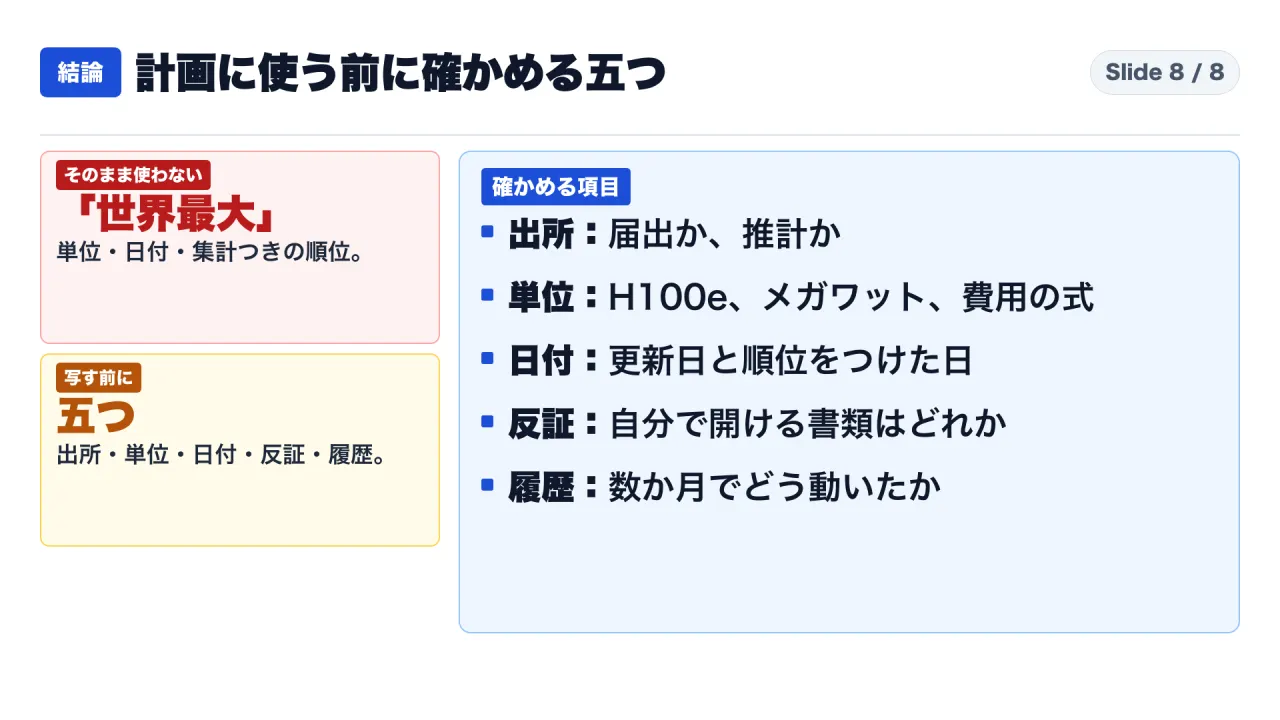
Enterprise infrastructure planners, procurement directors, and capital committees should implement five diagnostic controls before incorporating external datacenter forecasts into corporate roadmaps:
- Verify Primary Origin: Separate enforceable regulatory filings (permits, tax contracts) from algorithmic models ($38.1B is a formulaic output, not an executed contract).
- Standardize Unit Metrics: Cross-tabulate physical shell area, utility interconnect limits, critical IT power, and compute density rather than relying on a single metric.
- Audit Calendar Cutoffs: Test sensitivity around arbitrary reporting boundaries (confirming whether leadership shifts if the window expands by 30 to 90 days).
- Inspect Underlying Permit Filings: Examine primary local records directly, checking for extension mechanisms (such as Goodnight’s five-year grace period).
- Track Historical Model Revisions: Document how algorithmic projections fluctuate over time rather than relying on a single briefing snapshot.
The actionable takeaway: decouple legal permits from algorithmic models to navigate hyperscaler capacity forecasts with technical rigor.
Primary Sources and References
- Epoch AI: Goodnight AI Datacenter Facility Profile (Updated July 31, 2026; retrieved November 1, 2026): https://epoch.ai/data/ai-data-centers/directory/goodnight
- Epoch AI: AI Data Centers Directory & Database Methodology: https://epoch.ai/data/data-centers-documentation/methodology
- Epoch AI: AI Data Centers Directory (Global Ledger) (Captured November 1, 2026): https://epoch.ai/data/ai-data-centers
- Epoch AI Data Insights: Tracking the Frontier of AI Compute Infrastructure: https://epoch.ai/data-insights/largest-data-center-compute
- Texas Department of Licensing and Regulation (TDLR): Building 1 TI Registration (TABS2025027064): https://www.tdlr.texas.gov/TABS/Search/Project/TABS2025027064
- Texas Department of Licensing and Regulation (TDLR): Building 2 TI Registration (TABS2025027065): https://www.tdlr.texas.gov/TABS/Search/Project/TABS2025027065
- Texas Department of Licensing and Regulation (TDLR): Building 6 Registration (TABS2026010861): https://www.tdlr.texas.gov/TABS/Search/Project/TABS2026010861
- Armstrong County, Texas: Amended and Restated Consolidated Second Property Tax Abatement Agreement (GN DC1 LLC): https://www.co.armstrong.tx.us/upload/page/5361/Amended_Restated_Consolidated%20Second%20Property%20Tax%20Abatement%20Agreement%20%20GNDC1_ArmstrongCounty.pdf
- Crusoe Energy Systems LLC: Crusoe Developing Data Center Campus in Armstrong County, Texas (Published September 28, 2026): https://crusoe.ai/resources/newsroom/crusoe-developing-data-center-campus-in-armstrong-county-texas
- Google Official Blog: Expanding Google’s Infrastructure and Clean Energy Investments in Texas (Published November 14, 2025): https://blog.google/company-news/inside-google/company-announcements/google-american-innovation-texas/