An Orbital TPU Writes Its First Haiku: What Google's Project Suncatcher Proved, What Remains Unmeasured, and Five Metrics Enterprise Buyers Must Demand
A technical audit separating verified on-orbit “Hello World” telemetry from unverified secondary reports, bench tests, and 2030s economic extrapolations.
Published: November 1, 2026 | Read time: ~10 min | Watch Video (Japanese)
Executive Summary & Core Technical Findings
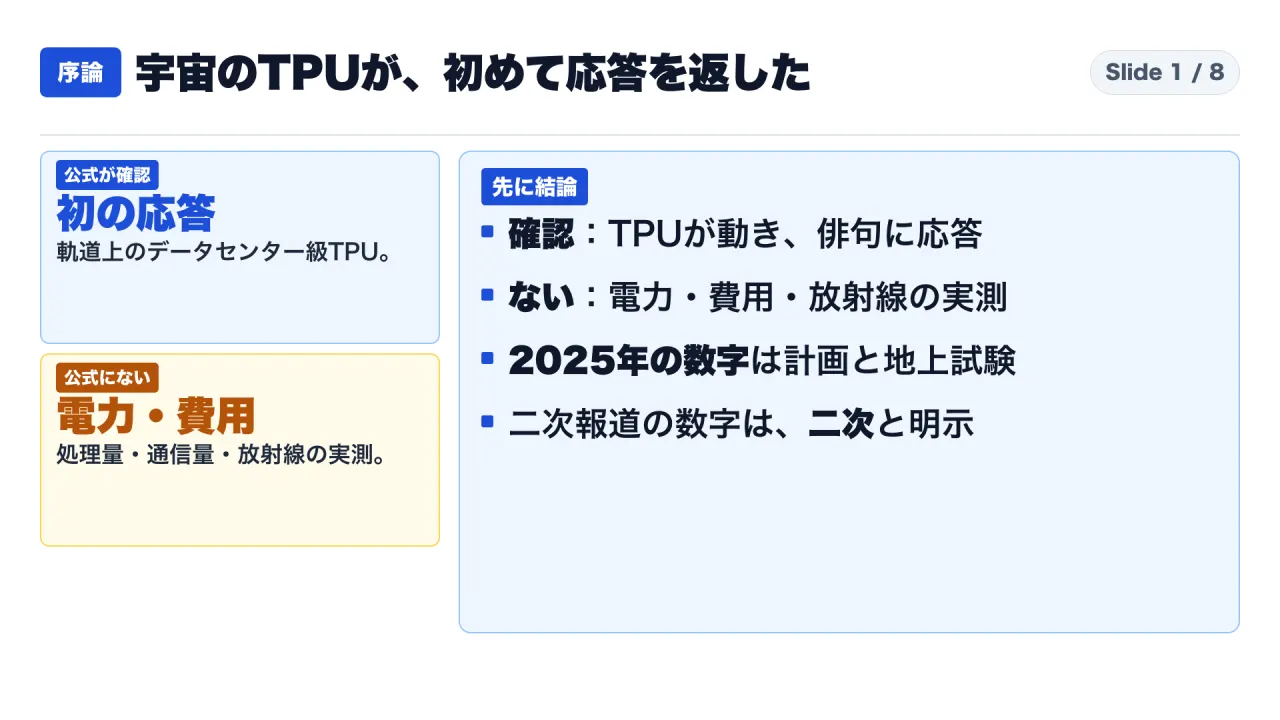
- The Confirmed Milestone: On October 30, 2026, Google announced the initial on-orbit artificial intelligence milestone for Project Suncatcher—a prototype satellite launched on October 1, 2026. Operating in low Earth orbit, an onboard datacenter-class Tensor Processing Unit (TPU) executed inference using Google’s open-weights Gemma 4 model, downlinking a three-line haiku describing orbital spaceflight as the spacecraft passed over Svalbard, Norway.
- The Measurement Void: While Google confirmed basic payload boot, hardware power-on, and functional telemetry reception, its official announcement disclosed zero quantitative metrics for operational power consumption, inference latency, payload mass, downlink bandwidth, or financial expenditure. Crucially, the release provided zero empirical data on soft-error single-event upsets (bit-flips) or cumulative radiation dose sustained during this mission, stating only that radiation and thermal stress testing remain future objectives.
- Secondary vs. Primary Disclosures: Critical operating figures circulating across trade media—including claims of four onboard TPUs, a 1-kilowatt solar generation capacity, and a 20-minute operational duty cycle per burst due to thermal and power ceilings—originate entirely from secondary reporting in TechCrunch, not Google’s primary disclosures.
- 2025 Planning Baselines vs. Flight Reality: Published economic projections modeling orbital datacenters at launch costs below $200 per kilogram and laser cross-links delivering 800 gigabits per second reflect 2025 terrestrial laboratory simulations and 2030s economic models, not empirical results from the October 2026 flight.
- Target Audience & Purpose: Written for enterprise Chief Technology Officers, infrastructure architects, capital allocation committees, and procurement executives evaluating long-term AI compute roadmaps and hyperscaler datacenter strategies.
Methodological Framework: Triangulating Primary, Secondary, and Laboratory Sources
Evaluating advanced aerospace technology claims requires separating verified flight telemetry from laboratory baselines and secondary journalism:
- Documented Primary Sources: Technical disclosures published directly by Google on its corporate and research platforms (including the October 30, 2026, operational announcement and the November 4, 2025, system design paper), official Google AI Edge model specifications for Gemma 4, and Starcloud’s corporate mission documentation.
- Secondary Journalism: Unofficial operational numbers reported exclusively by technology trade publications (such as TechCrunch), classified explicitly as unverified secondary claims.
- Author Analytical Interpretation: Engineering assessments, metric cross-examinations, and procurement evaluation frameworks formulated by the author.
All primary references were captured on November 1, 2026, and re-verified on November 2, 2026. The author did not operate flight hardware; findings examine published engineering disclosures as documented.
Chapter 1: The Confirmed Scope of the “Hello World” Flight
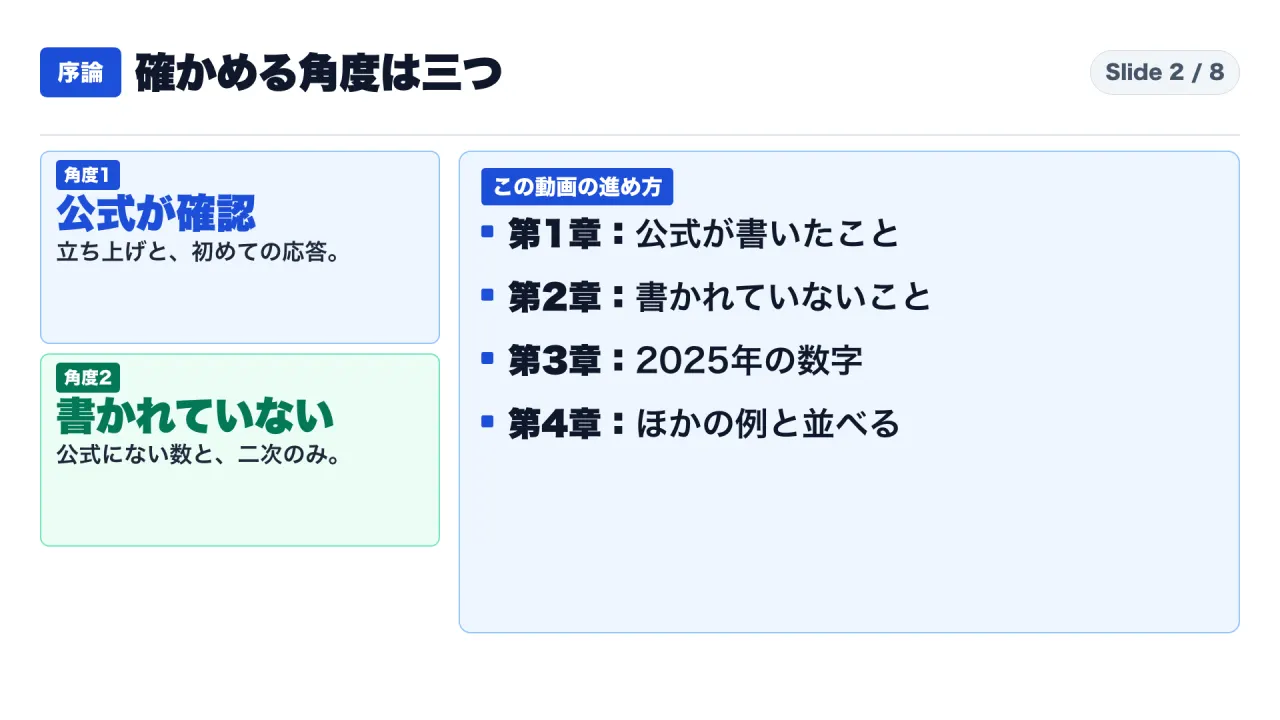
Google positioned the October 1, 2026, launch of Project Suncatcher as the foundational step of a long-term moonshot exploring space-based machine learning compute clusters.
Following launch, engineering teams conducted multi-week commissioning procedures, powering up the spacecraft host bus and TPU payload tray to confirm basic machine learning execution integrity. Google characterized the resulting output as a “Hello World” milestone. As the satellite crossed the ground station footprint at Svalbard, Norway, engineers transmitted an initial prompt instructing the onboard Gemma 4 model to compose poetry reflecting its physical environment.
The satellite generated and downlinked the following three-line haiku:
Blue marble below
Data streams in silent grace
Starlight feeds my core
Subsequent passes tested short limericks and telemetry generation prompts assessing subsystem health. Google noted that the satellite will next execute testing cycles to evaluate how the TPU copes with thermal extremes and ionizing radiation, leading toward a planned 2027 mission featuring interconnected twin satellites.
PROJECT SUNCATCHER MISSION TIMELINE & ARCHITECTURE:
- Launch Date: October 1, 2026 (Spacecraft deployed to Low Earth Orbit)
- Commissioning: Multi-week host bus and payload tray power-up
- First Successful Inference: Late October 2026 over Svalbard, Norway
- Model Architecture: Open-weights Gemma 4 executing on custom TPU hardware
- Confirmed Downlink: 3-line haiku, experimental limericks, telemetry prompts
- Next Stated Milestone: Interconnected dual-satellite demonstration in 2027
In software engineering, a “Hello World” script establishes that an environment executes basic instructions without crashing; it provides zero evidence regarding throughput, algorithmic efficiency, or production unit economics. The haiku demonstrates functional execution in microgravity, but establishes zero quantitative operational performance.
Chapter 2: The Critical Omissions and Secondary Metrics
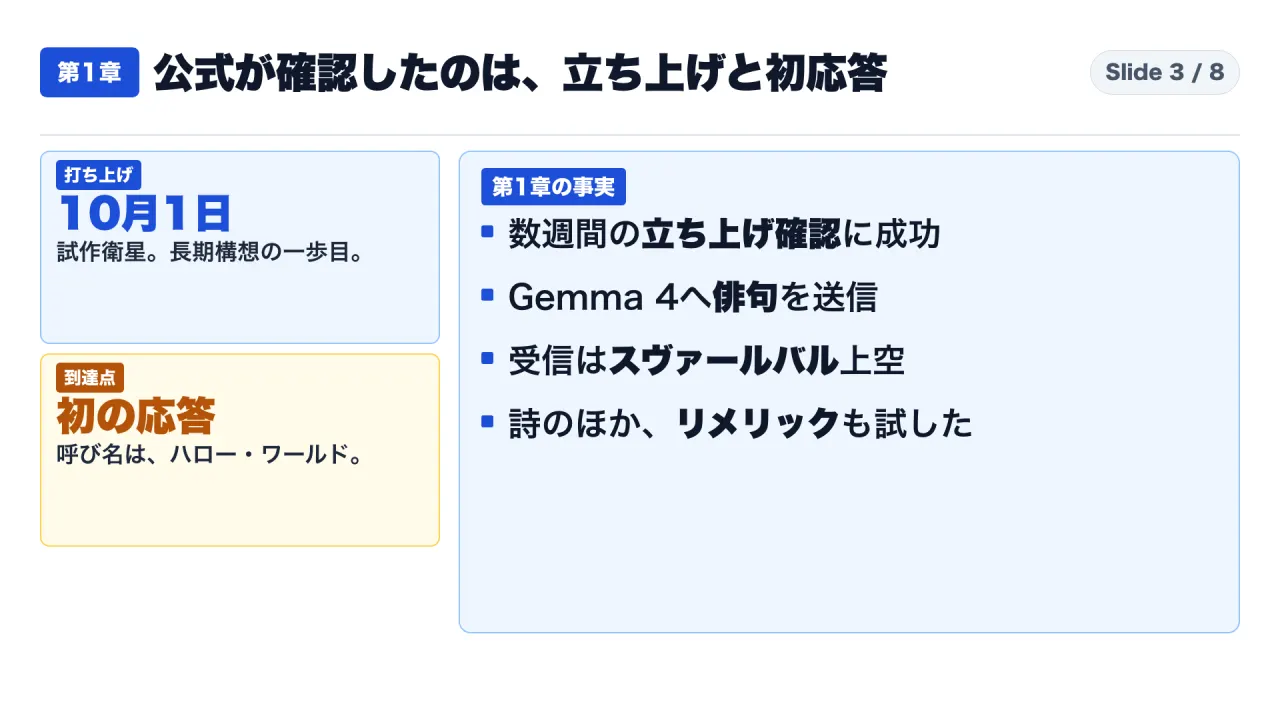
Examining Google’s official announcement reveals extensive technical silences. The primary release omits all core systems engineering parameters:
- No Power Consumption Metrics: Zero data regarding peak wattage during matrix multiplication, baseline idle draw, or joules per generated token.
- No Inference Throughput: No disclosure of generation speed (tokens per second) or time-to-first-token.
- No TPU Generation Specified: Google identified the processor as a “datacenter-class TPU” without specifying whether the silicon represents current Trillium (v6e) architecture, earlier TPU v4/v5 hardware, or a modified radiation-tolerant ASIC.
- No Telemetry on Single-Event Upsets: Zero disclosure regarding bit-flips in high-bandwidth memory (HBM) or register corruption during passage through the South Atlantic Anomaly.
- No Payload Mass or Downlink Budgets: No specifications detailing payload launch mass, radiator surface area, or ground transmission rates.
| Operational Variable | Google Official Release (October 30, 2026) | TechCrunch Secondary Report (October 30, 2026) |
|---|---|---|
| Launch Date | October 1, 2026 | Described as early October 2026 without exact date |
| Commissioning Window | “Past few weeks” | Approximately three weeks |
| Onboard TPU Hardware | “Datacenter-class TPU” (Count omitted) | 4 TPU processors (Corrected post-publication) |
| Operational Duty Cycle | Unspecified | 1 TPU active at a time; ~20 minutes per burst |
| Solar Generation Capacity | Unspecified | Up to 1 kilowatt peak |
| Launch Vehicle & Manifest | Unspecified | SpaceX Falcon 9; rideshare with 100+ spacecraft |
The secondary metrics reported by TechCrunch illustrate severe operational constraints: if the spacecraft generates 1 kilowatt peak and can power only a single TPU for 20 minutes before thermal exhaustion or battery depletion, orbital compute is operating under extreme fractional duty cycles. However, because Google did not endorse these numbers in its corporate documentation, enterprise evaluators must treat them as unverified secondary claims rather than verified operational baselines.
Chapter 3: Deconstructing the 2025 Paper: Ground Accelerators vs. Orbital Reality
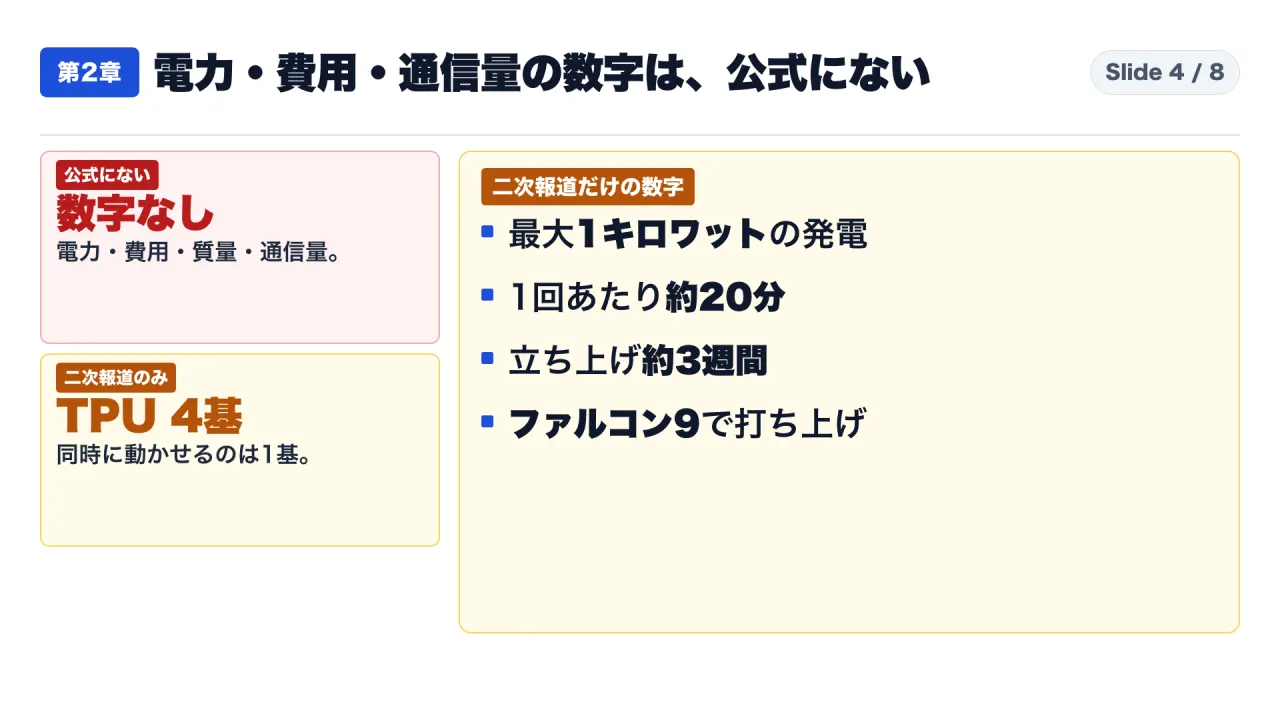
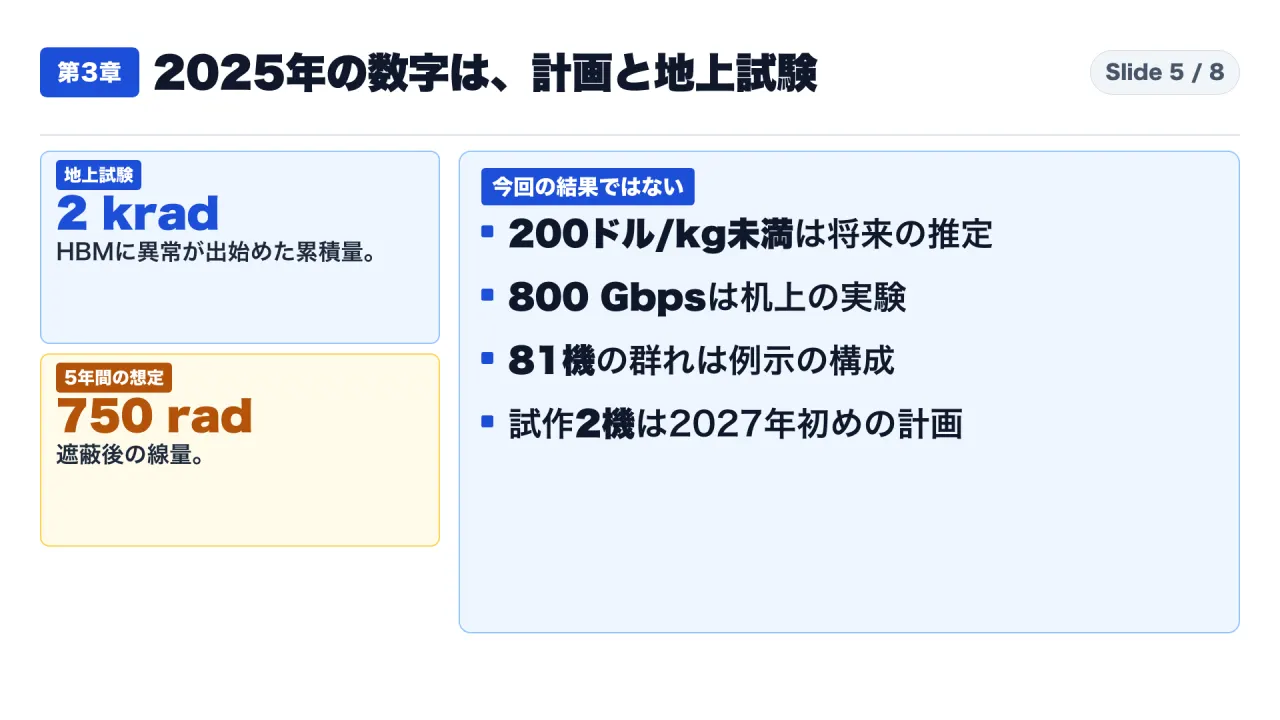
Public commentary frequently blends Google’s October 2026 flight announcement with technical figures published in its November 4, 2025, research paper, “Exploring a space-based, scalable AI infrastructure system design.” Analyzing the 2025 paper reveals that its published figures represent terrestrial simulations and economic models, not flight achievements:
2025 SYSTEM DESIGN PAPER vs. 2026 SUNCATCHER FLIGHT REALITY:
┌─────────────────────────┬─────────────────────────┬─────────────────────────┐
│ Metric / Finding        │ 2025 Research Paper     │ October 2026 Flight     │
├─────────────────────────┼─────────────────────────┼─────────────────────────┤
│ Radiation Tolerance     │ Proton beamline testing │ On-orbit tests planned  │
│                         │ HBM errors at 2 krad    │ No telemetry published  │
│ 5-Year Shielded Budget  │ 750 rad projected       │ Unmeasured on orbit     │
│ Inter-Satellite Optical │ 800 Gbps bench test     │ Dual satellite in 2027  │
│ Launch Unit Cost        │ Sub-$200/kg (Mid-2030s) │ Current market pricing  │
│ Reference Constellation │ 81 sats at 650 km SSO   │ Single prototype sat    │
└─────────────────────────┴─────────────────────────┴─────────────────────────┘
1. Radiation Beamline Tests vs. Real Cosmic Environments
In 2025, Google researchers subjected a Trillium (TPU v6e) board to terrestrial proton beam irradiation. High-bandwidth memory (HBM) proved the most vulnerable component, exhibiting correctable and uncorrectable errors beginning at a cumulative dose of 2 kilorads (2,000 rads).
Researchers compared this to an estimated 5-year mission dose of 750 rads behind planned shielding, arguing that 2 krad provided a 2.7x safety margin. While a single chip survived 15 krad total ionizing dose without catastrophic gate breakdown, terrestrial particle accelerators cannot replicate the complex omnidirectional spectrum of galactic cosmic rays and solar particle events encountered over multi-year orbital deployments.
2. The Mid-2030s Sub-$200/kg Launch Cost Assumption
The economic thesis of Google’s 2025 study hinges on launch costs falling below $200 per kilogram by the mid-2030s. At that price point, Google modeled that the combined capital expenditure of satellite fabrication, launch, and orbital maintenance could reach parity with terrestrial datacenter energy expenses per kilowatt-year. However, this parity equation relies on two decades of compounded launch cost deflation and massive industrial satellite scaling; it bears zero relationship to 2026 commercial rideshare launch economics.
3. Benchtop Optical Transceivers vs. Space Communications
The paper reported inter-satellite free-space optical communications delivering 800 gigabits per second unidirectional throughput (1.6 terabits per second bidirectional). Crucially, this throughput was achieved across an optical laboratory test bench, not across orbital satellite separation distances subject to pointing, acquisition, and tracking (PAT) jitter and atmospheric turbulence.
Chapter 4: Cross-Platform Benchmark Comparison
To contextualize Gemma 4 running on Suncatcher, enterprise teams should compare published throughput metrics across contemporary edge and orbital compute platforms:
| Compute Platform | Operational Environment | Reported Throughput | Stated Power Consumption | Primary Source |
|---|---|---|---|---|
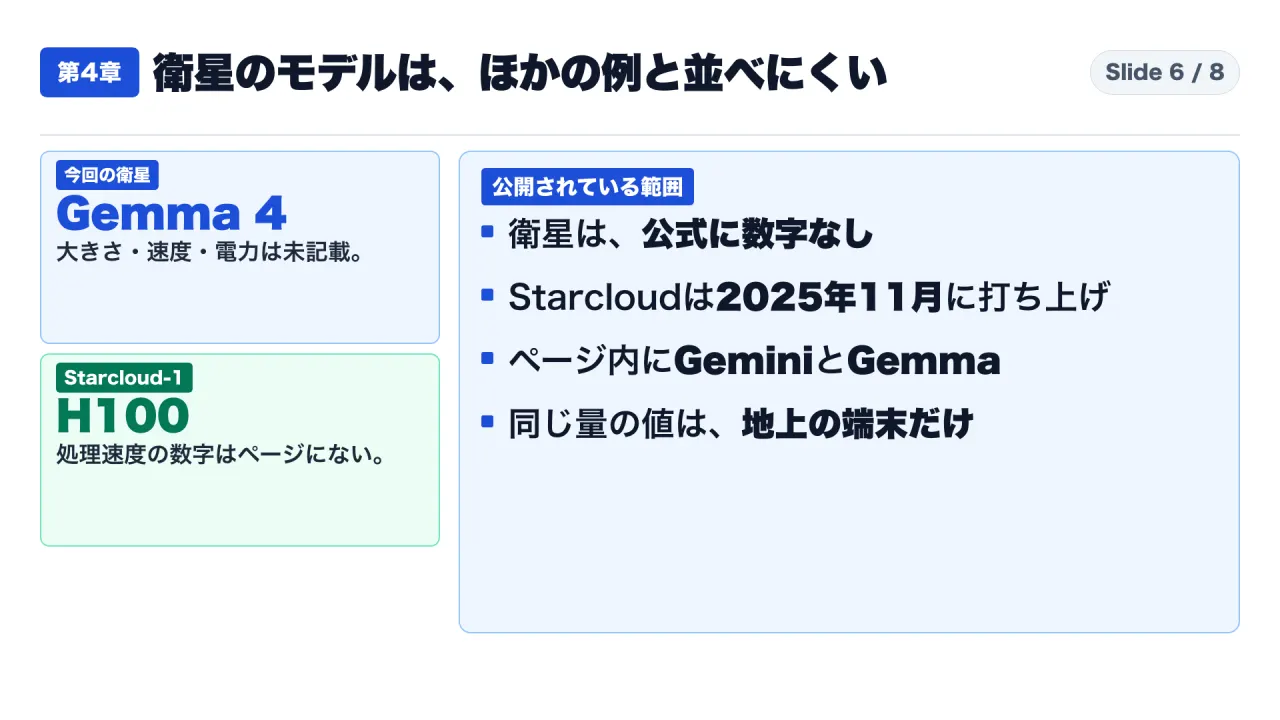
| Project Suncatcher (Gemma 4) | Low Earth Orbit (~500 km) | Unreported | Unreported | Google Official Blog (2026) |
| Starcloud-1 (nanoGPT / H100) | Low Earth Orbit | Unreported | Unreported | Starcloud Public Portal (2025) |
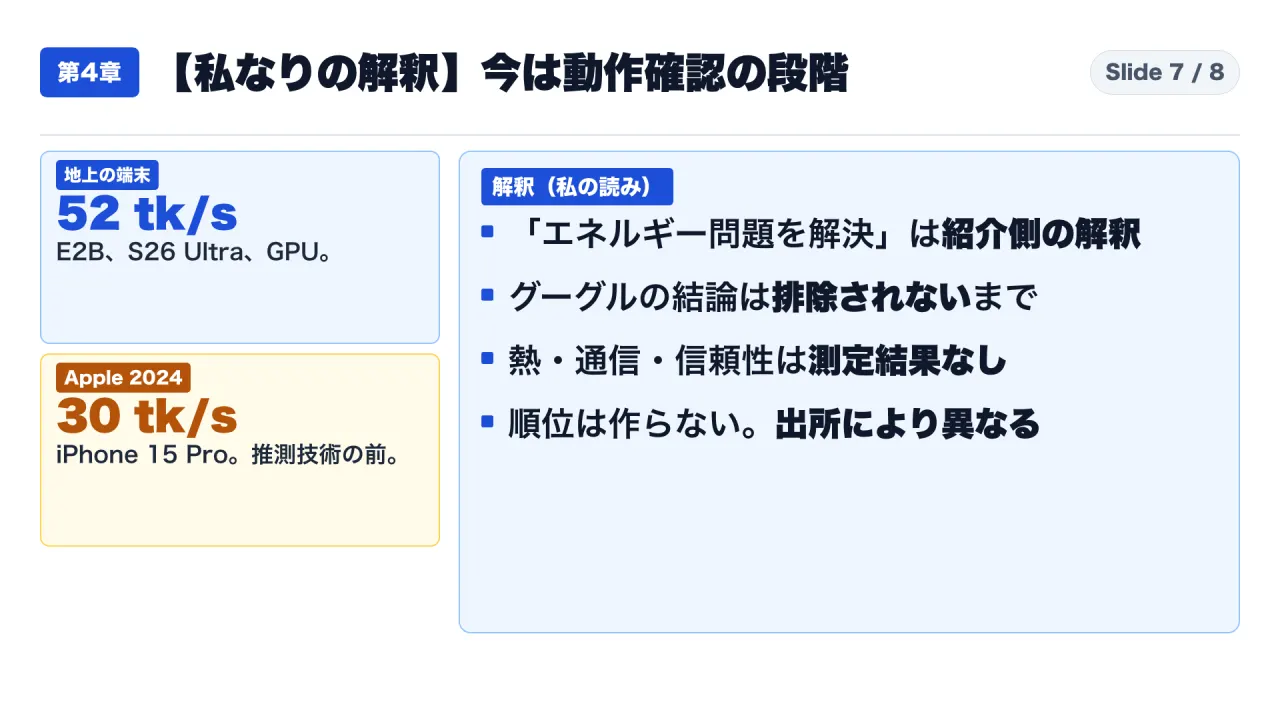
| Gemma 4 E2B (Galaxy S26 Ultra GPU) | Terrestrial Smartphone | 52 tokens/second | Embedded Mobile Budget | Google AI Edge LiteRT-LM (2026) |
| Gemma 4 E2B (iPhone 17 Pro GPU) | Terrestrial Smartphone | 56 tokens/second | Embedded Mobile Budget | Google AI Edge LiteRT-LM (2026) |
| Gemma 4 E2B (Raspberry Pi 5 CPU) | Terrestrial Edge SBC | 8 tokens/second | ~5-10 Watts | Google AI Edge LiteRT-LM (2026) |
| Gemma 4 E4B (Galaxy S26 Ultra GPU) | Terrestrial Smartphone | 22 tokens/second | Embedded Mobile Budget | Google AI Edge LiteRT-LM (2026) |
| Apple 3B Model (iPhone 15 Pro) | Terrestrial Smartphone | 30 tokens/second | Embedded Mobile Budget | Apple Research (2024) |
COMPUTE CONTEXT: THE HARDWARE SPECTRUM
Terrestrial Edge Devices (S26 Ultra, iPhone 17 Pro):
  - Throughput: 52-56 tok/s (Gemma 4 E2B via LiteRT-LM)
  - Environment: Continuous power, active heat dissipation, zero radiation
Orbital Compute (Suncatcher, Starcloud-1):
  - Throughput: Completely undisclosed in primary documentation
  - Environment: Solar cycling, radiative vacuum cooling, cosmic ray bombardment
This comparison illustrates a stark transparency gap: on terrestrial hardware, open model architectures publish granular throughput benchmarks across consumer chips. In contrast, orbital platforms have published zero tokens-per-second figures. Claims regarding processing leadership remain unprovable until vendors publish standardized throughput and power metrics.
Chapter 5: Strategic and Enterprise Capex Interpretation
Promotional assertions that orbital datacenters will solve terrestrial AI energy bottlenecks conflate laboratory feasibility with commercial viability. Google’s 2025 conclusion stated merely that orbital infrastructure is not ruled out by fundamental physics or insurmountable economic barriers.
THE REALITY SPECTRUM FOR SPACE-BASED AI INFRASTRUCTURE:
Marketing Narrative:
  "Space provides infinite solar energy and solves the AI power crisis today."
Scientific Horizon:
  Physics does not exclude orbital clusters; launch costs may reach parity by 2035.
Operational Reality (October 2026):
  A prototype satellite successfully booted, executed inference, and downlinked a haiku.
  Power, thermal, radiation, and bandwidth metrics remain unmeasured in public filings.
From a corporate procurement and capital allocation standpoint, orbital compute currently represents early-stage scientific research rather than actionable enterprise infrastructure. Datacenter planning cannot incorporate space compute into near-term capacity roadmaps until three foundational engineering bottlenecks are resolved:
- Radiative Thermal Dissipation: In a vacuum, heat cannot be dissipated via convection; it requires massive radiative panels, constraining peak thermal design power (TDP).
- Downlink Bandwidth Asymmetry: Ingesting terabytes of enterprise training data and downlinking model weights over optical ground links remains bottlenecked by weather and orbital mechanics.
- Orbital Mean-Time-Between-Failures (MTBF): Unserviceable server clusters must withstand years of cosmic ray bombardment without catastrophic memory degradation.
Chapter 6: Five Critical Metrics Enterprise Buyers Must Demand
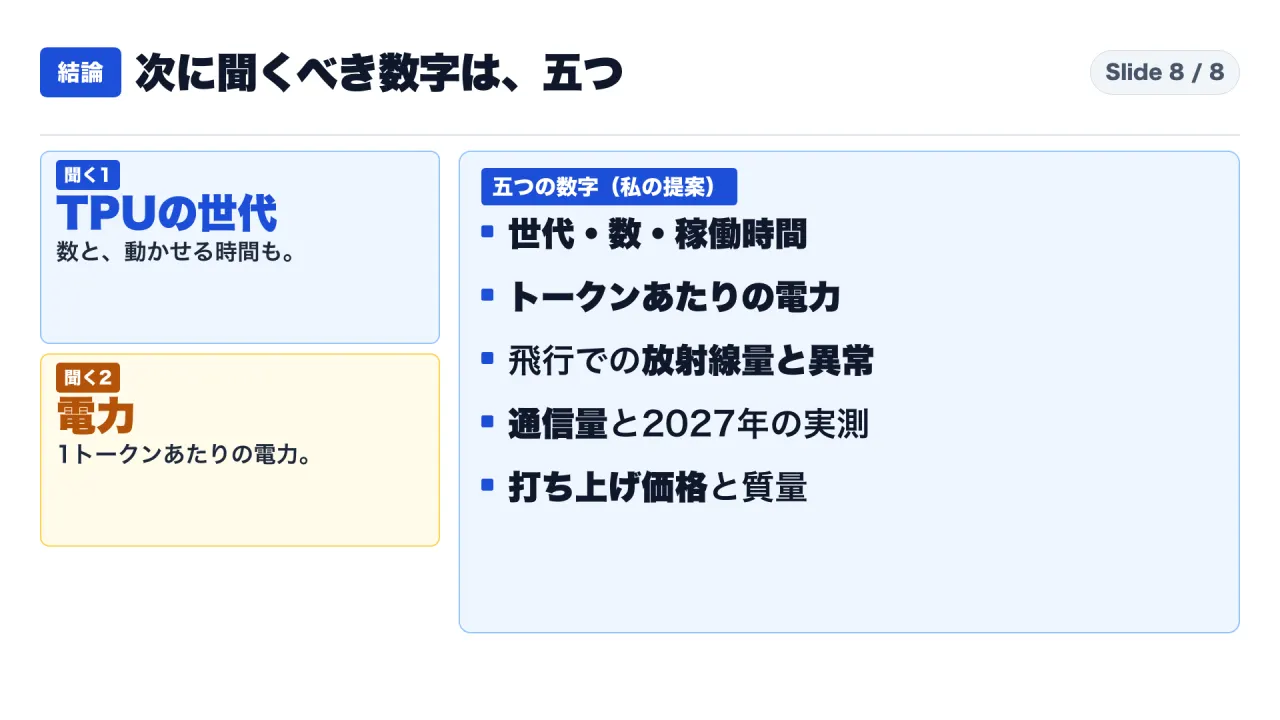
Before enterprise technology buyers allocate capital or commit engineering resources to orbital compute initiatives, they should demand five empirical metrics from prospective vendors:
- Silicon Generation, Density, and Duty Cycle: Verify the exact TPU generation and active operating window. Confirm whether hardware runs continuously or remains restricted to 20-minute operational bursts per orbit due to thermal envelopes.
- Energy Efficiency per Token (Joules per Token): Demand empirical watt-hour metrics per inference pass. If space-based compute is justified by solar availability, the efficiency ratio between orbital solar generation and terrestrial grid power must be proven.
- On-Orbit Single-Event Upset (SEU) Telemetry: Request raw error logs recording correctable and uncorrectable bit-flips in high-bandwidth memory (HBM) during real orbital transit, comparing flight data to laboratory beamline baselines.
- Realized Optical Communications Bandwidth: Require measured bidirectional throughput numbers between orbiting nodes and terrestrial optical ground stations across varied weather conditions.
- Fully Burdened Launch and Bus Economics: Benchmark current procurement costs against long-term models. Differentiate between current commercial rideshare expenditures and theoretical mid-2030s $200/kg projections.
ENTERPRISE CAPEX DUE DILIGENCE CHECKLIST:
[ ] Request verified tokens-per-second and joules-per-token from flight hardware.
[ ] Demand raw bit-flip and memory error telemetry across orbital solar cycles.
[ ] Identify whether processors operate continuously or in thermal bursts.
[ ] Discard 2035 cost projections; model capital expenditure on current launch pricing.
[ ] Verify inter-satellite laser link throughput in orbital spaceflight conditions.
Enterprise technology leaders must treat orbital AI demonstrations with disciplined engineering skepticism: celebrate the technical achievement of downlinking poetry from orbit, but demand verifiable operational telemetry before incorporating space-based compute into long-term infrastructure roadmaps.
Primary Sources and References
- Google Official Blog: Google receives response from Project Suncatcher prototype satellite in space (Published October 30, 2026; retrieved November 1, 2026): https://blog.google/innovation-and-ai/models-and-research/google-research/project-suncatcher-satellite-response/
- Google Research Blog: Exploring a space-based, scalable AI infrastructure system design (Published November 4, 2025): https://research.google/blog/exploring-a-space-based-scalable-ai-infrastructure-system-design/
- TechCrunch: Google’s first data center satellite is online and writing poetry (Published October 30, 2026; Secondary Reporting): https://techcrunch.com/2026/10/30/googles-first-data-center-satellite-is-online-and-writing-poetry/
- Starcloud Inc.: Starcloud-1 Mission Overview and Hardware Architecture: https://www.starcloud.com/starcloud-1
- Google AI Edge Documentation: LiteRT-LM Gemma 4 On-Device Performance Benchmarks (Updated September 4, 2026): https://developers.google.com/edge/litert-lm/models/gemma-4
- Apple Machine Learning Research: Introducing Apple’s On-Device and Server Foundation Models (Published June 10, 2024): https://machinelearning.apple.com/research/introducing-apple-foundation-models