Can You Really Build a Production Site in Two Hours with Coding Agents? Cross-Examining Karpathy's HackerTube Claims Against Primary Documentation
A three-layer forensic audit of Andrej Karpathy’s HackerTube claims, separating personal narrative from public data definitions and Anthropic’s official runtime architecture.
Published: November 1, 2026 | Read time: ~10 min | Watch Video (Japanese)
Executive Summary & Core Findings
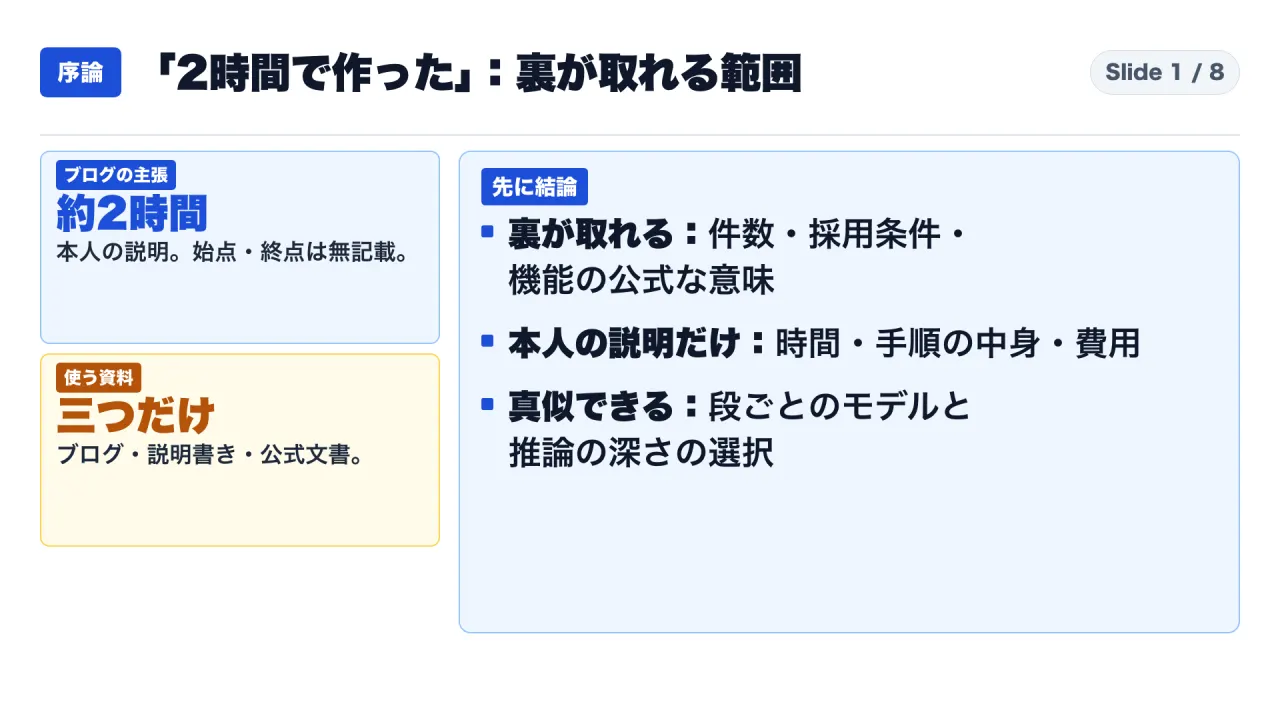
- The Core Verdict: In his late October 2026 blog post, Andrej Karpathy stated that he built and deployed “HackerTube”—a video aggregation platform curating YouTube content recommended on Hacker News—in approximately two hours using Claude Code. A forensic audit cross-referencing his essay against public dataset documentation (
DATA.md) and Anthropic’s technical architecture documents confirms video counts, topic categorization, and schema filtering rules. However, the “~2 hours” metric, iteration turn counts, specific workflow execution scripts, and financial expenditures remain unverified personal assertions. - The Three-Layer Audit Framework: Readers must decompose AI engineering case studies into three distinct evidentiary layers:
- Personal Narrative: Individual claims regarding elapsed development time, manual touchpoints, and perceived cognitive effort.
- Public Dataset Artifacts: Mechanically verifiable record counts, filtering heuristics, classification stances, and licensing constraints published in
DATA.md. - Vendor Architecture Specifications: Official runtime semantics, dynamic workflow limits, token quota consumption rules, and model parameter defaults published by Anthropic.
- Data Definitions vs. Blog Generalizations: While Karpathy described the pipeline as filtering “40K comments recommending a YouTube video,” official dataset notes reveal 39,834 comments where only
recandstrong_recrepresent actual recommendations. The corpus intentionally includes critical, sarcastic, and passing references; approximately 25% of indexed videos were cited without an affirmative recommendation. - Replicable Engineering Architecture: What enterprise teams can systematically replicate is not the subjective development speed, but the architectural pattern: multi-tier model assignment (coordinating via high-capability reasoning models while batch-processing classifications via lower-latency models), explicit effort configuration, and pre-defining human-only gatekeeper tasks (API credential provisioning, cloud infrastructure deployment, and domain acquisition).
Methodological Framework: Triangulating Across Three Evidence Layers
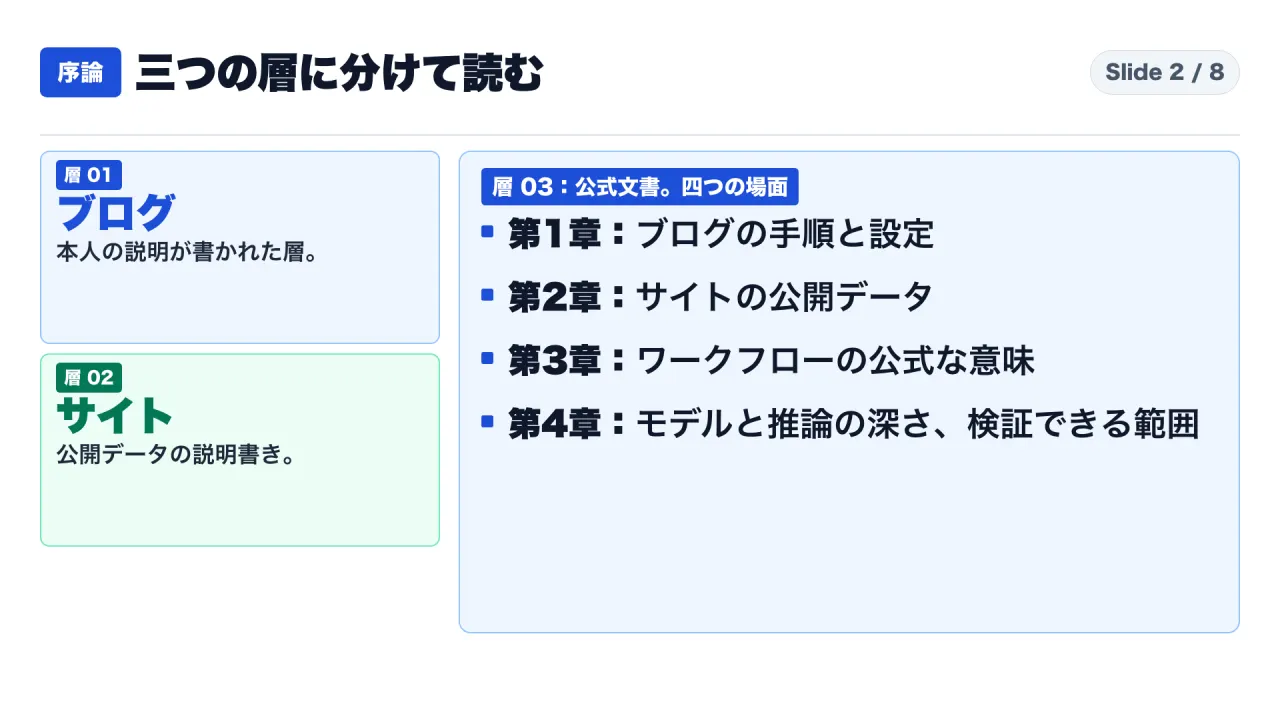
When technical leaders evaluate public case studies claiming 10x or 100x software engineering acceleration via autonomous agents, separating verifiable facts from subjective narrative is crucial:
- Layer 1: Personal Author Account: Statements published on Karpathy’s personal blog on October 31, 2026. These reflect individual recollection and subjective workflow impressions without external instrumentation or third-party audit.
- Layer 2: Public Dataset Documentation (
DATA.md): The metadata specification accompanying the published HackerTube dataset, detailing record structures, exclusion heuristics, and model roles. - Layer 3: Vendor Architecture Documentation: Anthropic’s official technical references for Claude Code dynamic workflows, model pricing tiers, and runtime effort configurations.
- Author Analytical Inferences: Architectural interpretations and governance frameworks formulated by the author, explicitly identified as analytical deductions.
All primary artifacts were captured on November 1, 2026, and re-verified on November 2, 2026. The author did not execute Karpathy’s private codebase or reproduce the data extraction run; findings evaluate the documentary evidence as published.
Chapter 1: Deconstructing the Blog Narrative
Karpathy recounted that in late October 2026, dissatisfaction with standard YouTube recommendations prompted him to envision an alternative interface curating videos discussed within Hacker News threads. The following morning, he initialized a prompt within Claude Code targeting Opus 5.5: “Let’s write our own YouTube clone based on whatever videos have been recommended on Hacker News.”
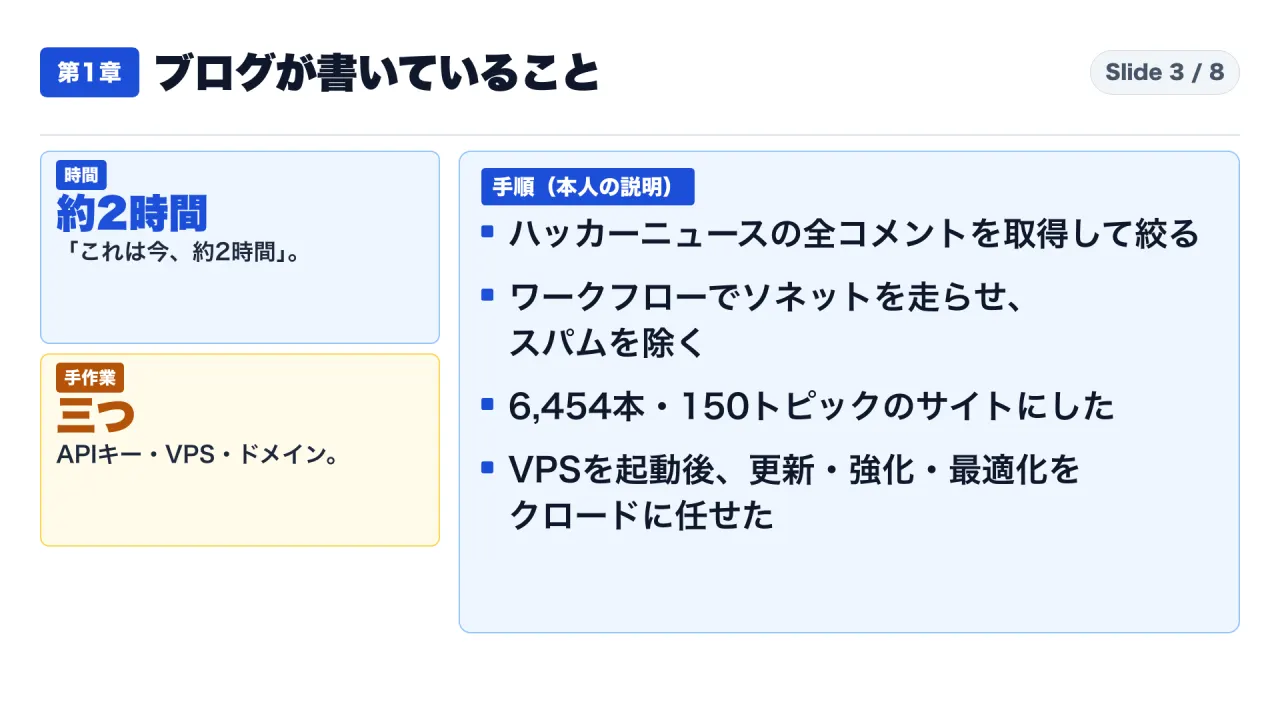
KARPATHY'S FOUR-STAGE NARRATIVE PIPELINE:
1. Data Extraction: Opus 5.5 downloads historical Hacker News comments.
2. Classification: Sonnet via Claude Code dynamic workflow removes spam.
3. Candidate Filtering: Filters corpus to ~40K comments discussing videos.
4. Deployment: Acquires domain, deploys to VPS, configures security.
Reported Runtime: "~2 hours now" | Manual Steps: Exactly 3
According to Karpathy’s narrative, the pipeline produced an indexed library of 6,454 YouTube videos spanning 2007 through 2026 across 150 technical categories. Key user-facing features included extracting 50% midpoint video frames to avoid promotional thumbnail clickbait, browser-local recommendation persistence without authentication, keyboard shortcuts, and full dataset export capabilities designed for downstream agent consumption.
Karpathy highlighted three manual human touchpoints:
- Generating a YouTube Data API v3 key in the Google Cloud Console.
- Provisioning a virtual private server (VPS).
- Purchasing a domain name.
Once the VPS IP address was provided to Claude Code, Karpathy asserted that the agent autonomously executed system package updates, environment hardening, service configuration, and deployment optimization. He concluded with a provocative operational claim: that he no longer engages in traditional software engineering—neither authoring code nor running terminal commands directly—operating entirely via natural-language dialogue.
Chapter 2: Auditing the Public Dataset Specifications (DATA.md)
Cross-referencing Karpathy’s blog against the public data documentation (DATA.md) reveals both direct alignments and notable definition divergences.
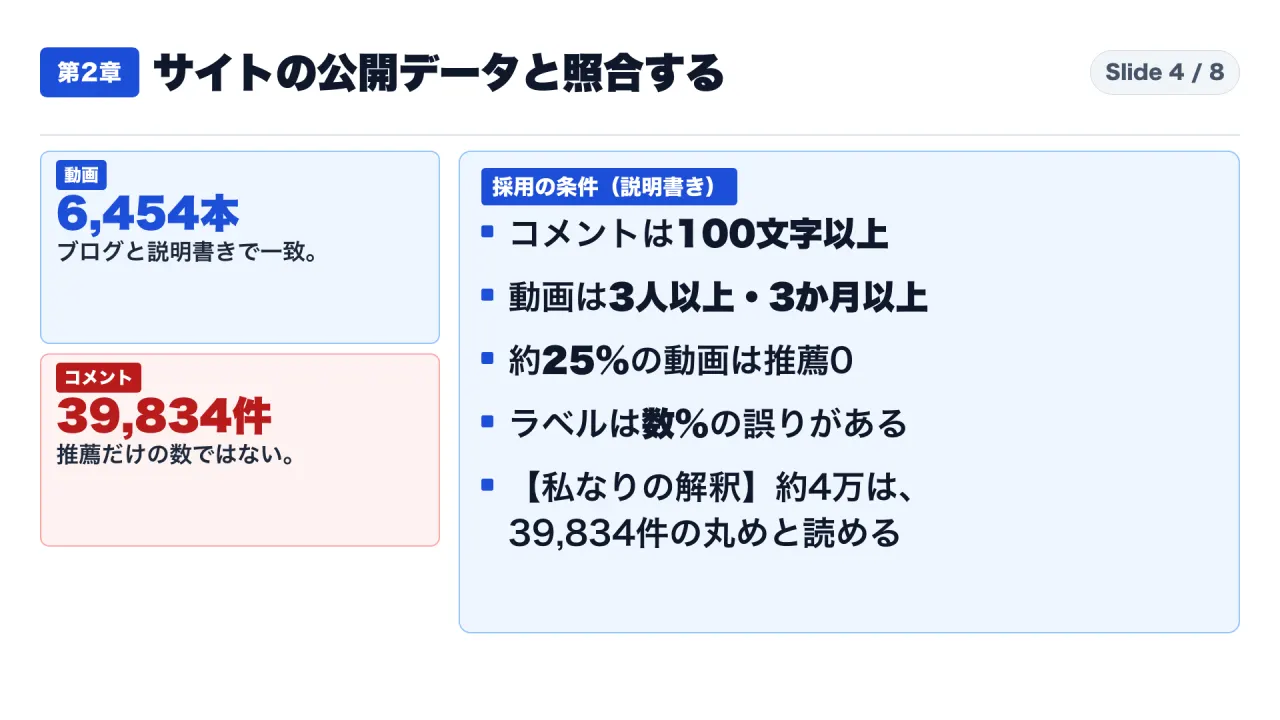
The published dataset explicitly confirms 6,454 videos, 39,834 comment records, 150 categories, and 16 top-level domains, matching the headline metrics in the blog. However, inspecting the data dictionary clarifies what “40K comments” actually represents:
| Data Field | Karpathy Blog Phrasing | DATA.md Technical Definition |
Operational Significance |
|---|---|---|---|
| Comment Volume | “~40K comments recommending a YouTube video” | 39,834 classified comment records | Rounded metric; includes non-recommendation discourse |
User Stance (stance) |
Implied uniform recommendation | rec, strong_rec, reference, joke, critical |
Only rec and strong_rec are affirmative endorsements |
| Non-Endorsed Videos | Omitted from narrative | “About 25% of videos were only cited and never recommended” | A quarter of indexed videos lack user recommendations |
| Inclusion Threshold | “Videos recommended by a few people” | Length >= 100 chars, >= 3 users mentioning over >= 3 months | Strict multi-factor heuristic prevents one-off spam |
| Model Allocation | “Sonnet via Workflow” | Sonnet 5.5 for labeling/cards; Opus 5.5 orchestrating pipeline | Exact model versions specified in documentation |
The documentary record highlights that 39,834 comments encompass critical critiques, jokes, and passing references alongside recommendations. Furthermore, the dataset documentation contains an explicit caveat from the author: “LLM labels are good but not perfect: expect a few percent of stances or summaries to be off.”
Data sourcing was not a raw scraping run against Hacker News, but an ingestion of the public open-index/hacker-news dataset hosted on Hugging Face. Furthermore, approximately 6% of referenced YouTube videos had already been deleted or set to private. The dataset is distributed under the Open Data Commons Attribution License (ODC-By), legally obligating downstream users to maintain attribution to both HackerTube and the underlying archive.
Chapter 3: Official Architecture: Claude Code Dynamic Workflows
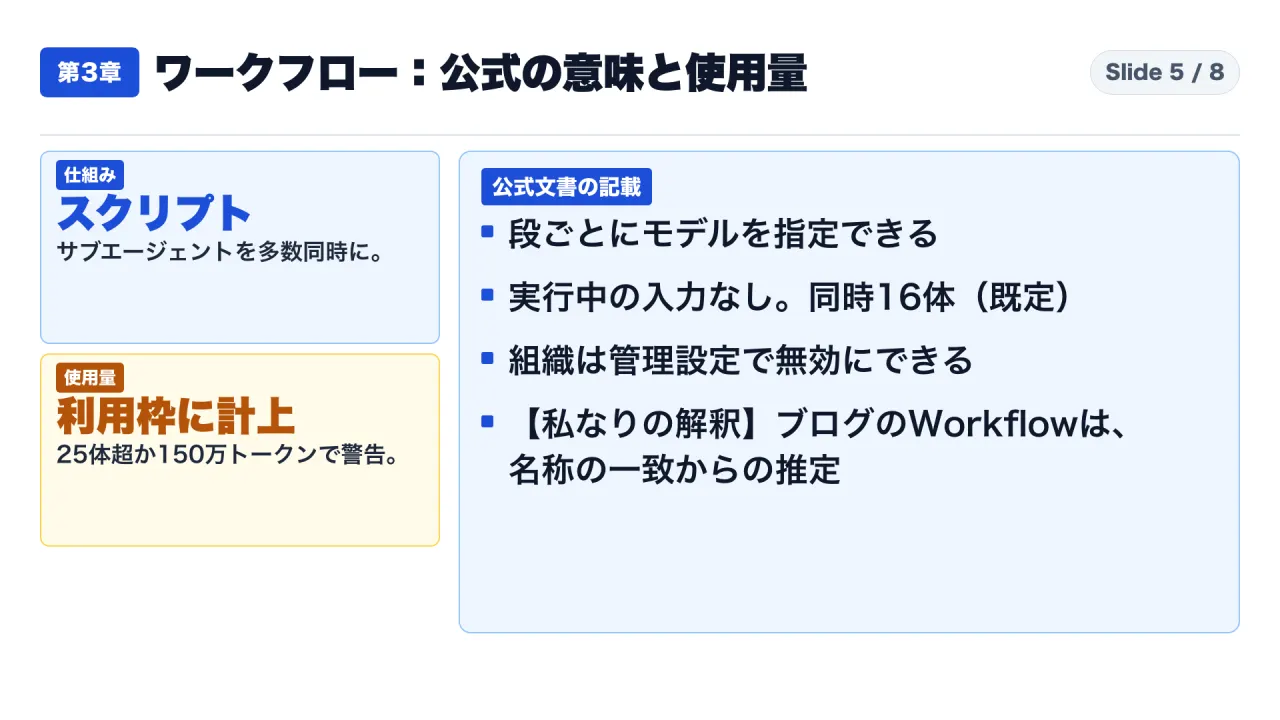
Karpathy attributed the heavy classification workload to “Workflow (Claude Code feature).” Anthropic’s official technical documentation defines this mechanism formally:
“A dynamic workflow is a JavaScript script that orchestrates many subagents at once. A workflow moves the plan into code.”
Unlike interactive conversational turns where context accumulators grow with every exchange, dynamic workflows externalize orchestration state into JavaScript logic. Loops, conditional branches, and intermediate worker payloads reside in runtime script memory, returning only synthesized final outputs to the primary conversational context.
CONVERSATIONAL AGENT EXECUTION vs. DYNAMIC WORKFLOWS:
Conversational Mode:
  User ──► Context Accumulator (Grows with every turn) ──► Model
Dynamic Workflow Mode:
  User ──► Primary Coordinator (Opus 5.5)
                 │
                 ▼ (Generates JavaScript orchestration script)
  ┌──────────────────────────────────────────────────────────┐
  │ JavaScript Runtime: Spawns up to 16 Concurrent Subagents  │
  │ Subagent 1 (Sonnet 5.5) ──► Worker Process               │
  │ Subagent 2 (Sonnet 5.5) ──► Worker Process               │
  │ Plan moves to code; token consumption hits account quota │
  └──────────────────────────────────────────────────────────┘
Critical architectural parameters governing dynamic workflows include:
- Token Consumption: Official documentation warns that a single workflow invocation can consume substantially more tokens than conversational interactions, directly drawing down enterprise plan rate limits and account quotas.
- Safety Warnings: When a planned workflow projects exceeding 25 concurrent agents or 1,500,000 total tokens, the CLI issues a “Large workflow” notification. However, this is an advisory warning that does not halt execution.
- Model Specialization: Workflow scripts allow granular per-stage model assignment. Orchestrators can delegate bulk text filtering to lower-cost models while reserving high-reasoning tiers for structural synthesis.
- Concurrency Constraints: Concurrency defaults to a maximum of 16 parallel subagents. Interactive user input is disabled during execution runs.
Chapter 4: Model Specifications and Effort Hierarchy
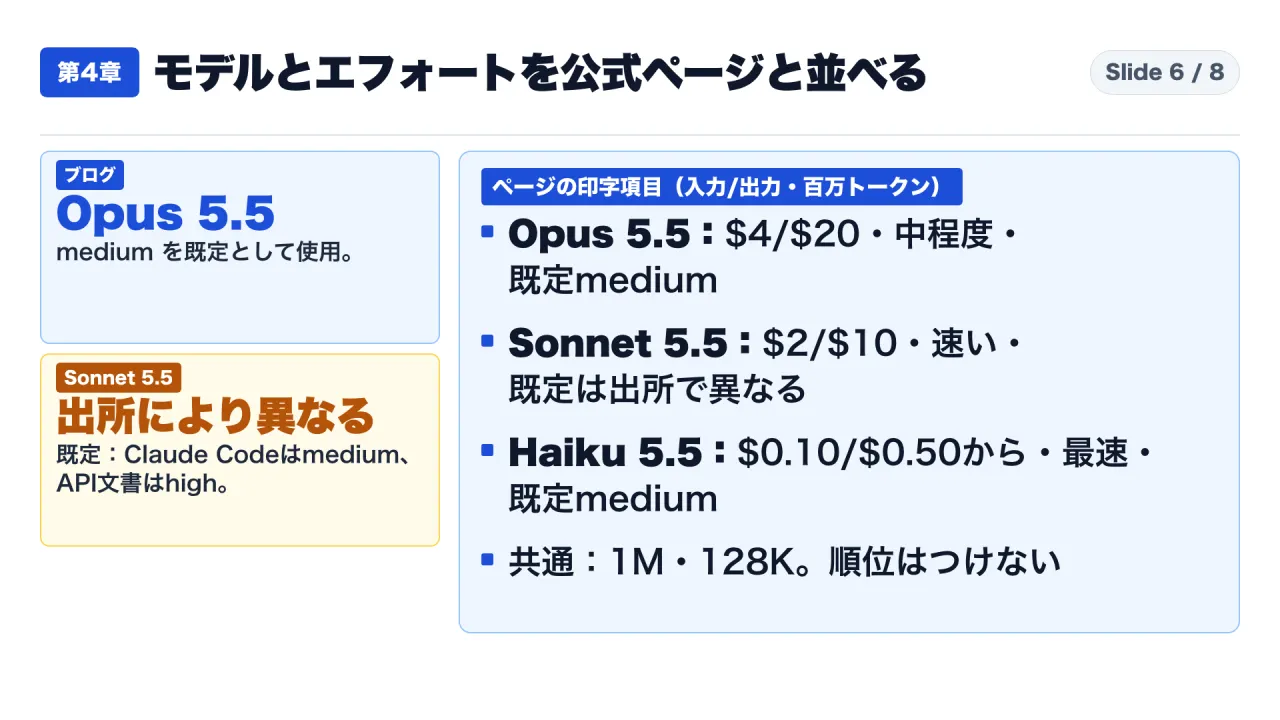
Karpathy noted that his default configuration utilized Opus 5.5 operating under medium effort. Examining Anthropic’s official model catalogs reveals operational nuances across the 5.5 product family:
| Metric / Parameter | Claude Opus 5.5 | Claude Sonnet 5.5 | Claude Haiku 5.5 |
|---|---|---|---|
| Release Date (Catalog) | September 22, 2026 | September 28, 2026 | October 7, 2026 |
| Pricing per Million Tokens | $4.00 Input / $20.00 Output | $2.00 Input / $10.00 Output | From $0.10 Input / $0.50 Output (tiered above 100K prompt tokens) |
| Reported Latency Profile | Moderate | Fast | Fastest |
| Context Window / Max Output | 1,000,000 / 128,000 tokens | 1,000,000 / 128,000 tokens | 1,000,000 / 128,000 tokens |
| Default Effort (Claude Code Docs) | medium |
medium |
medium |
| Default Effort (API Docs & Model Page) | medium |
high |
medium |
A notable divergence emerges regarding default reasoning effort. Anthropic’s Claude Code user guide documents the default effort for all three models as medium. Conversely, Anthropic’s API documentation and model overview pages list Sonnet 5.5’s default effort as high.
REASONING EFFORT PRECEDENCE CHAIN:
1. Environment Variables (Highest priority)
2. Interactive Session Flags
3. CLI Startup Arguments
4. Saved Local Configuration Files
5. Upstream Model Defaults (Lowest priority)
For engineering organizations, this distinction is financially material. When Sonnet 5.5 is invoked via API without explicit effort parameters, it defaults to deep reasoning (high), consuming more tokens per classification. When invoked via Claude Code CLI defaults, it executes at medium. Furthermore, provider endpoints matter: while Anthropic direct endpoints route model names to 5.5 series backends, third-party cloud integrations (such as Amazon Bedrock) historically routed generic Sonnet identifiers to 4.5 series checkpoints.
Chapter 5: What Is Verifiable vs. What Remains Personal Assertion
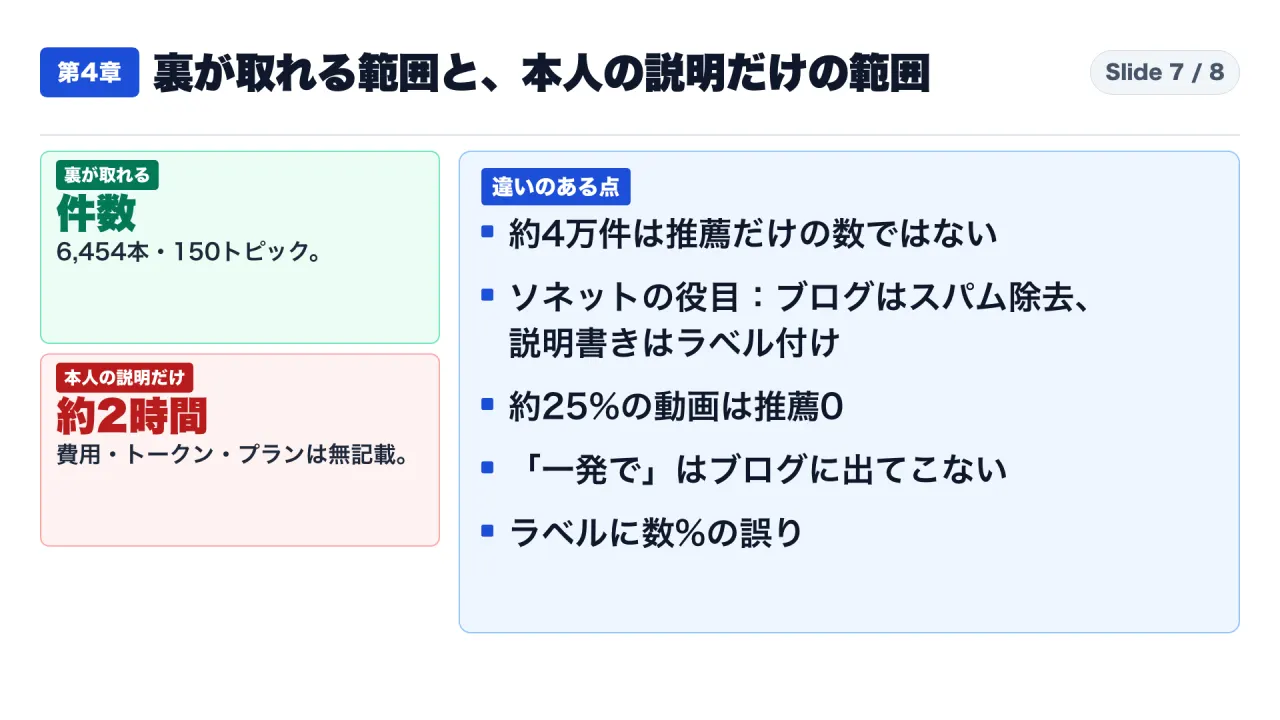
Systematically comparing published claims against primary sources produces a clean evidentiary boundary:
| Published Assertion | Evidentiary Layer | Verification Status | Analytical Evaluation |
|---|---|---|---|
| 6,454 Videos / 150 Topics | Public Dataset (DATA.md) |
Verified | Exact numerical match with published schema |
| 39,834 Comment Corpus | Public Dataset (DATA.md) |
Verified with Caveat | Verified total; encompasses non-recommendations |
| Opus 5.5 + Sonnet 5.5 Stack | Dataset & Blog Records | Verified | Consistent across author documentation |
| “~2 Hours” Total Time | Personal Blog Narrative | Unverified | Self-reported estimate; lacks start/end timestamps |
| Exactly 3 Manual Steps | Personal Blog Narrative | Unverified | Excludes undocumented human review decisions |
| Total Token & Cost Footprint | None | Unreported | Zero metrics disclosed in any document |
| One-Shot Generation | Blog (Not claimed) | Refuted Inference | Blog indicates iterative guidance during VPS setup |
EVIDENTIARY AUDIT SUMMARY:
┌───────────────────────────┬───────────────────────────┐
│ VERIFIED VIA PRIMARY DOCS │ UNVERIFIED AUTHOR CLAIMS  │
├───────────────────────────┼───────────────────────────┤
│ • 6,454 indexed videos    │ • ~2 hours total runtime  │
│ • 39,834 comment records  │ • Exactly 3 manual steps  │
│ • Filtering criteria      │ • Total token expenditure │
│ • Dual-model pipeline     │ • Zero code review by user│
└───────────────────────────┴───────────────────────────┘
Chapter 6: Five Diagnostic Requirements for Replicating AI Case Studies
To elevate claims like “built in two hours” from personal anecdote to reproducible engineering science, five parameters must be recorded:
- Deterministic Start and End Timestamps: Distinguish between wall-clock elapsed duration and interactive active work sessions. Does the timeline begin at initial prompt ideation, or after dataset extraction scripts terminate?
- Human-Agent Time Accounting: Quantify the ratio between human intervention (evaluating outputs, debugging errors, managing cloud consoles) and automated model latency.
- Turn Counts and Intervention Logs: Record total prompt cycles, clarifications, and manual error corrections. Building via 3 conversational turns versus 80 corrective turns represents fundamentally different engineering realities.
- Token Volumes and Subscription Tiers: Document input, output, and cached token totals across each model tier. Without token metrics, organizations cannot evaluate whether reproducing the task requires $15 or $800 in API capacity.
- Independent Third-Party Reproduction: Confirm whether an engineer with comparable prompts can reproduce functional equivalence within the same operational parameters.
Chapter 7: Actionable Takeaways for Enterprise Engineering Teams
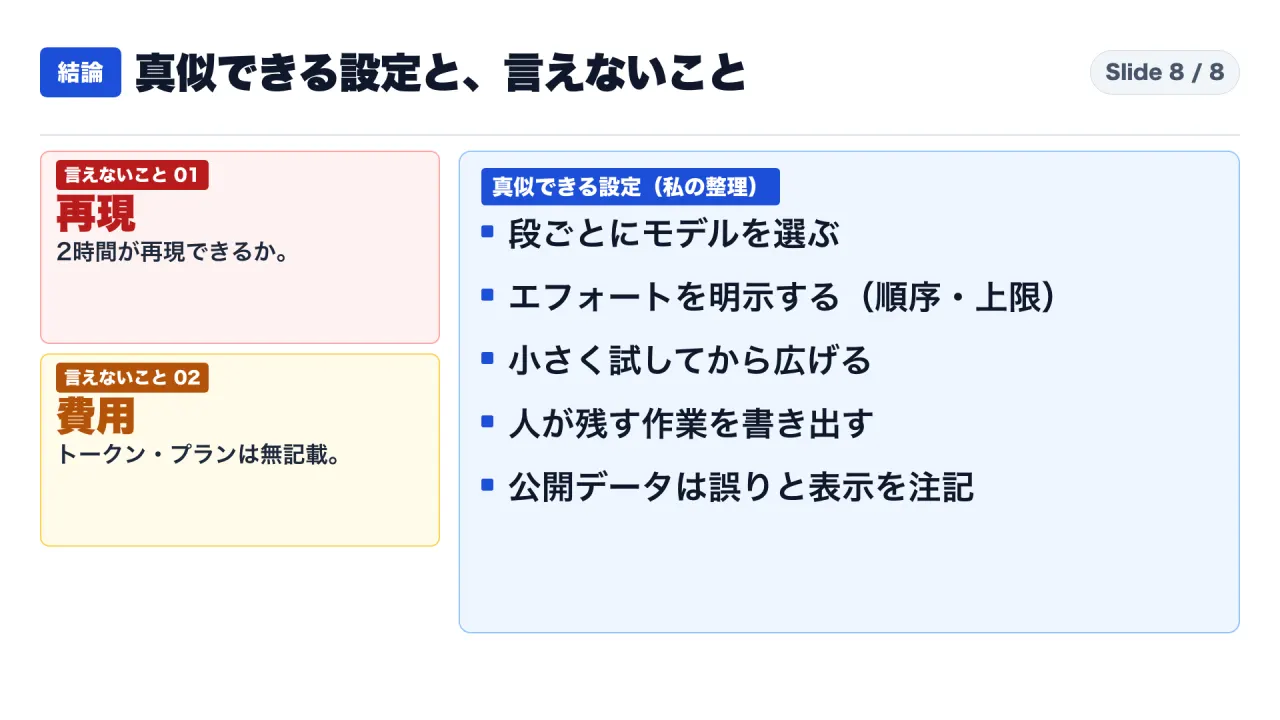
Engineering leaders evaluating coding agents should adopt five concrete practices derived from Anthropic’s official architecture:
- Architect Multi-Tier Pipeline Delegations: Do not deploy flagship reasoning models for undifferentiated batch transformations. Structure pipelines so high-capability orchestrators generate code and workflows, while specialized, lower-cost models execute classification passes.
- Explicitly Anchor Reasoning Effort: Never rely on implicit system defaults. Define effort parameters (
low,medium,high) in version-controlled configuration files to prevent unexpected token consumption spikes. - Execute Small-Scale Baseline Runs: Before launching batch operations across tens of thousands of records, run workflows against single directories or limited subsets to benchmark token consumption.
- Catalog Human Gatekeeper Tasks: Define an explicit register of operations reserved strictly for human authorization—such as API credential generation, DNS configuration, and production server provisioning.
- Account for Autonomous Classification Error Rates: Integrate validation harnesses to handle false classifications, anticipating that autonomous labelers exhibit baseline error rates of several percentage points.
Adopting coding agents successfully requires treating case studies not as magical productivity benchmarks, but as distributed software systems governed by measurable token economics, runtime architectures, and validation boundaries.
Primary Sources and References
- Andrej Karpathy: HackerTube (Published October 31, 2026; retrieved November 1, 2026): https://karpathy.bearblog.dev/hacker-tube/
- HackerTube Documentation: HackerTube Dataset Specification (DATA.md) (Published October 31, 2026): https://hackertube.org/download/DATA.md
- Anthropic Claude Code Documentation: Dynamic Workflows Architecture Guide: https://code.claude.com/docs/en/workflows.md
- Anthropic Claude Code Documentation: Model Configuration and Environment Variables: https://code.claude.com/docs/en/model-config.md
- Anthropic API Documentation: Controlling Reasoning Effort in Claude Models: https://platform.claude.com/docs/en/build-with-claude/effort.md
- Anthropic Platform Overview: Claude Model Family Overview & Pricing Tiers: https://platform.claude.com/docs/en/about-claude/models/overview.md
- Anthropic Model Specifications: Claude Opus 5.5 Architecture & Specs: https://platform.claude.com/docs/en/models/opus-5-5/overview.md
- Anthropic Model Specifications: Claude Sonnet 5.5 Architecture & Specs: https://platform.claude.com/docs/en/models/sonnet-5-5/overview.md
- Anthropic Model Specifications: Claude Haiku 5.5 Architecture & Specs: https://platform.claude.com/docs/en/models/haiku-5-5/overview.md