When Data Leaks at Your Vendor's Vendor: How to Decode Five Conflicting Corporate Disclosures in the NTT DATA SaaS Incident
A forensic analysis of how NTT DATA omitted metrics while bond issuers and brokerages reported divergent numbers, demonstrating why enterprise fourth-party risk requires five-axis disclosure mapping.
Published: November 1, 2026 | Read time: ~10 min | Watch Video (Japanese)
Executive Summary & Core Incident Findings
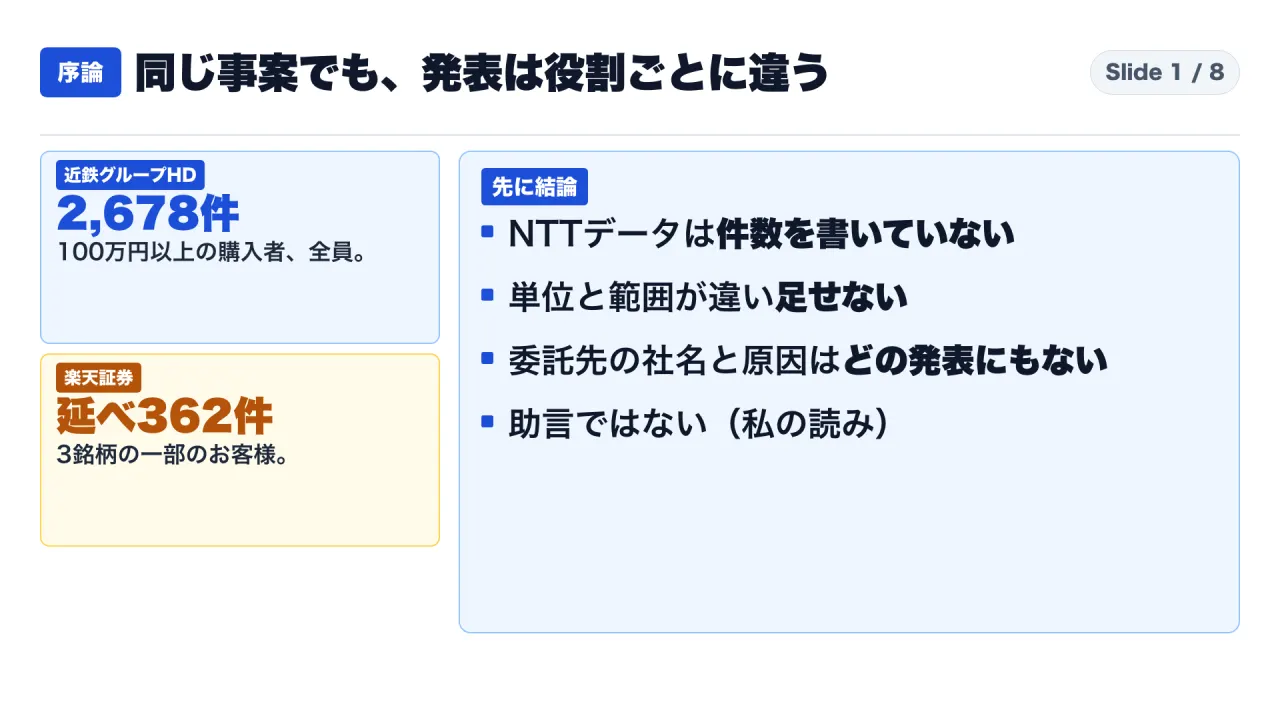
- The Fourth-Party Reality: When a security breach occurs at an external SaaS subcontractor utilized by an IT provider, corporate incident disclosures fracture across institutional roles. In the late October 2026 incident involving NTT DATA’s digital bond platform, the primary provider disclosed zero metrics, zero compromised attributes, zero timestamps, and zero subcontractor identities.
- Divergent Downstream Disclosures: Concrete breach metrics were disclosed exclusively by bond distributors (brokerages) and bond issuers (corporations). Rakuten Securities reported a cumulative 362 transactions across three bond issues; Mitsubishi UFJ Morgan Stanley Securities reported 95 individual customers; Kintetsu Group Holdings reported 2,678 records; and West Japan Railway Company (JR West) reported 2 investor records.
- The Aggregation Fallacy: These four numbers cannot be mathematically summed or ranked. They represent incompatible counting units (cumulative events, verified persons, database records, and investor files), conflicting scoping parameters (all purchasers above a threshold versus subsets of perk claimants), and separate institutional ledgers.
- The Anonymous Fourth Party: Across all five corporate announcements, the corporate identity of the second-tier vendor operating the underlying digital securities platform was omitted. The technical root cause was deferred to an ongoing subcontractor investigation.
- Target Audience: Written for Chief Information Security Officers, IT risk managers, corporate legal counsel, and procurement directors governing multi-tier cloud supply chains.
Methodological Framework: Separating Evidence from Analytical Inference
This audit enforces a strict distinction between documented facts and analytical inference:
- Documented Primary Evidence: Statements, dates, counts, and structural disclosures published in official announcements from NTT DATA, Rakuten Securities, JR West, Kintetsu Group Holdings, and Mitsubishi UFJ Morgan Stanley Securities (captured November 1, 2026; re-verified November 2, 2026).
- Author Cross-Tabulations: Tabular alignments and scope analyses computed directly from published figures without external extrapolation.
- Analytical Interpretation: Operational risk frameworks and governance proposals formulated by the author, explicitly marked as analytical interpretations.
This assessment examines corporate disclosures as published, without speculating on zero-day exploits or evaluating legal liability. In corporate security events, what is omitted is often as operationally significant as what is written.
Section 1: The Anatomy of a Fourth-Party Breach at NTT DATA
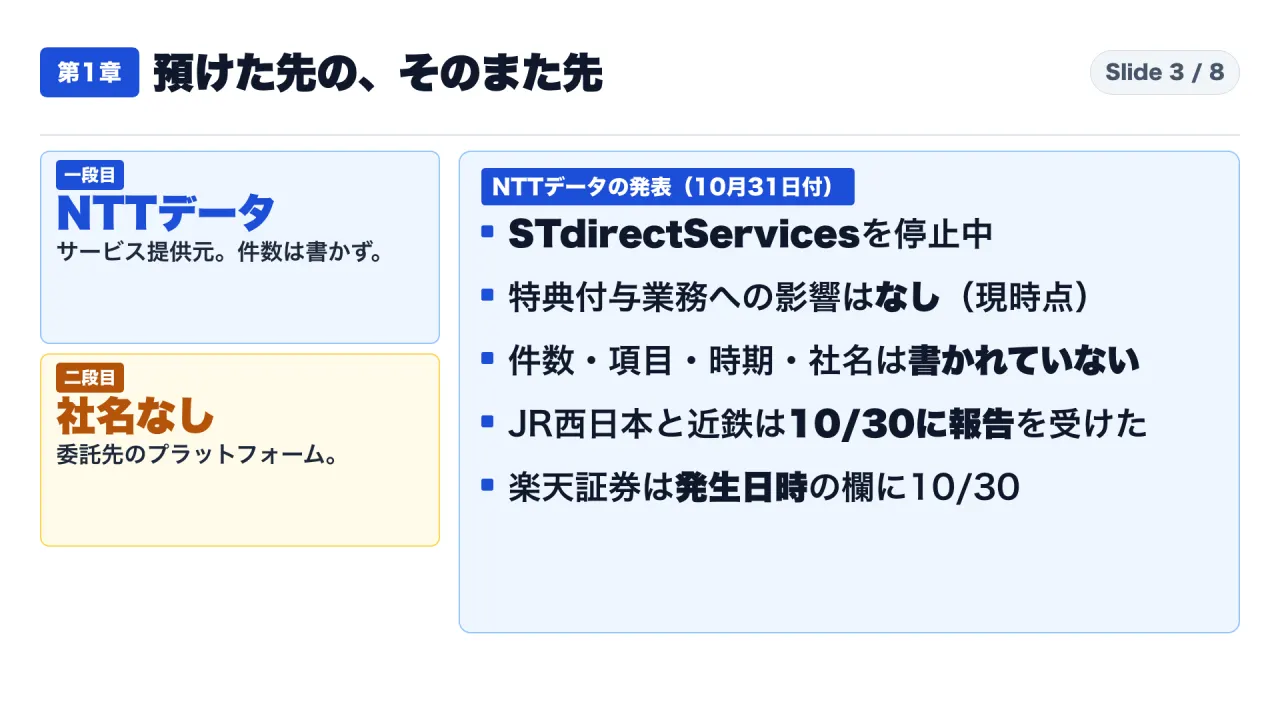
On October 31, 2026, NTT DATA published a statement regarding its “STdirectServices” platform—an external digital infrastructure facilitating bondholder perk programs.
NTT DATA stated that unauthorized third-party access occurred within an external SaaS system operated by a subcontractor utilized by STdirectServices, prompting an operational suspension. NTT DATA noted that personal data handled within the subcontractor’s system was potentially compromised and under active subcontractor investigation. NTT DATA added that because no corporate bonds eligible for perk distribution were active at that moment, the service suspension did not impair current perk execution.
[Bond Issuers]                  [Securities Brokerages]
      │                                    │
      ▼                                    ▼
┌─────────────────────────────────────────────────┐
│ Tier 1: NTT DATA (STdirectServices)             │
│ Service suspended | Zero metrics | Zero fields  │
└─────────────────────────────────────────────────┘
                         │
                         ▼
┌─────────────────────────────────────────────────┐
│ Tier 2: Unnamed Fourth-Party SaaS Subcontractor │
│ Unauthorized access | Investigation ongoing     │
└─────────────────────────────────────────────────┘
NTT DATA’s release omitted all primary incident parameters:
- No incident metrics: Zero counts of exposed records, individuals, or institutions.
- No compromised fields: No specification of affected data attributes.
- No chronology: No intrusion date, discovery date, or exposure duration.
- No vendor identity: The operating SaaS subcontractor remains unnamed.
- No regulatory status: No mention of Personal Information Protection Commission (PPC) filings.
NTT DATA provided zero numerical data; figures emerged entirely from downstream participants.
Section 2: Cross-Comparing Disclosures Across Issuers and Brokerages
To map the actual perimeter of the incident, one must cross-examine the disclosures of the institutions that issued and distributed the digital perk bonds.
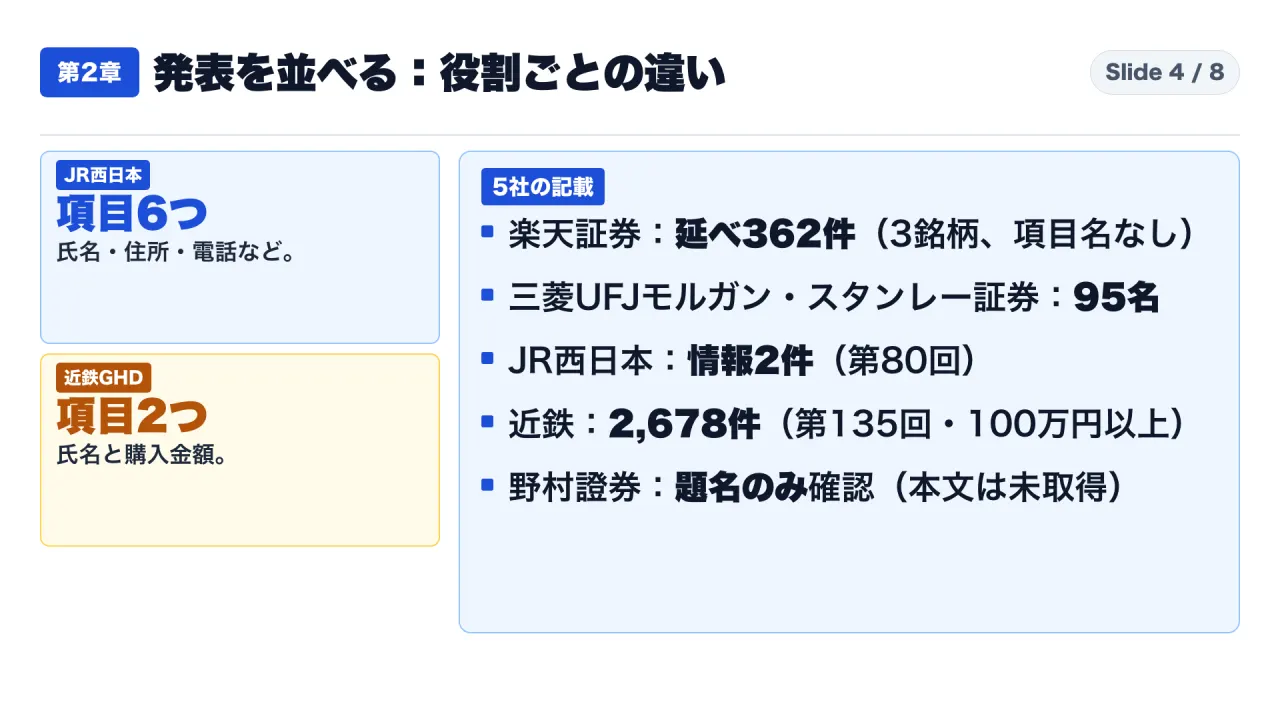
| Reporting Entity | Institutional Role | Disclosed Metric (Unit) | Target Population Scope | Compromised Data Attributes |
|---|---|---|---|---|
| NTT DATA | Primary Service Provider | None published | None published | Unspecified (“Personal information”) |
| Rakuten Securities | Distributor (Brokerage) | Cumulative 362 transactions (延べ362件) |
Subsets of purchasers across 3 bond series | Specific field names omitted; credentials confirmed uncompromised |
| Mitsubishi UFJ Morgan Stanley Securities | Distributor (Brokerage) | 95 individuals (95名) |
Customers purchasing Kintetsu Series 135 bonds via the firm | Investor full name, bond purchase amount |
| JR West | Bond Issuer (Corporation) | 2 investor records (投資家様情報2件) |
Subset of investors purchasing JR West Series 80 bonds | Name, postal address, phone, email, gender, date of birth |
| Kintetsu Group Holdings | Bond Issuer (Corporation) | 2,678 records (2,678件) |
All purchasers of Series 135 bonds with 1,000,000 JPY or greater allocation | Investor full name, Series 135 bond purchase amount |
The Brokerage Disclosures: Rakuten and Mitsubishi UFJ Morgan Stanley
Rakuten Securities published that an unauthorized access event at an external service provider potentially exposed customer data across three digital perk bond offerings: Kagome Co., Ltd. 1st Unsecured Bond (Issued February 21, 2023), JR West 80th Unsecured Bond (Issued June 19, 2024), and Kintetsu Group Holdings 135th Unsecured Bond (Issued July 24, 2026).
Rakuten reported “cumulative 362 transactions” across these three series without a per-issue breakdown. Rakuten omitted specific compromised attribute names. Instead, Rakuten framed its exposure defensively, stating it had received confirmation that login IDs, passwords, and transaction authorization credentials were not included in the compromised dataset. Rakuten emphasized that its own internal infrastructure had not suffered unauthorized access, and pledged individual notification to affected clients.
Mitsubishi UFJ Morgan Stanley Securities framed its announcement directly in response to Kintetsu’s corporate disclosure. The brokerage reported that 95 of its customers who purchased Kintetsu Series 135 bonds were impacted. It identified the exposed fields as customer full names and bond purchase amounts, confirmed its internal systems were uncompromised, and initiated customer support outreach.
The Issuer Disclosures: JR West and Kintetsu Group Holdings
JR West disclosed that external platform provider NTT DATA reported the incident on October 30, 2026. The incident affected exactly “2 investor records” regarding its 80th corporate bond. However, JR West disclosed the most expansive list of compromised attributes among all five entities: customer name, physical address, telephone number, email address, gender, and date of birth. JR West confirmed distributor Rakuten Securities was executing individual customer contact.
Kintetsu Group Holdings released the largest single figure: 2,678 records. Kintetsu noted that this count encompasses all bondholders who purchased 1,000,000 JPY or more of Series 135 bonds—regardless of whether they registered to claim perks. Kintetsu identified the exposed attributes as customer names and Series 135 purchase amounts. It clarified that securities account numbers and authentication passwords were never maintained within the perk system and were therefore not exposed. Furthermore, Kintetsu confirmed formal reporting to Japan’s Personal Information Protection Commission.
Section 3: The Three Mathematical Traps of Incident Aggregation
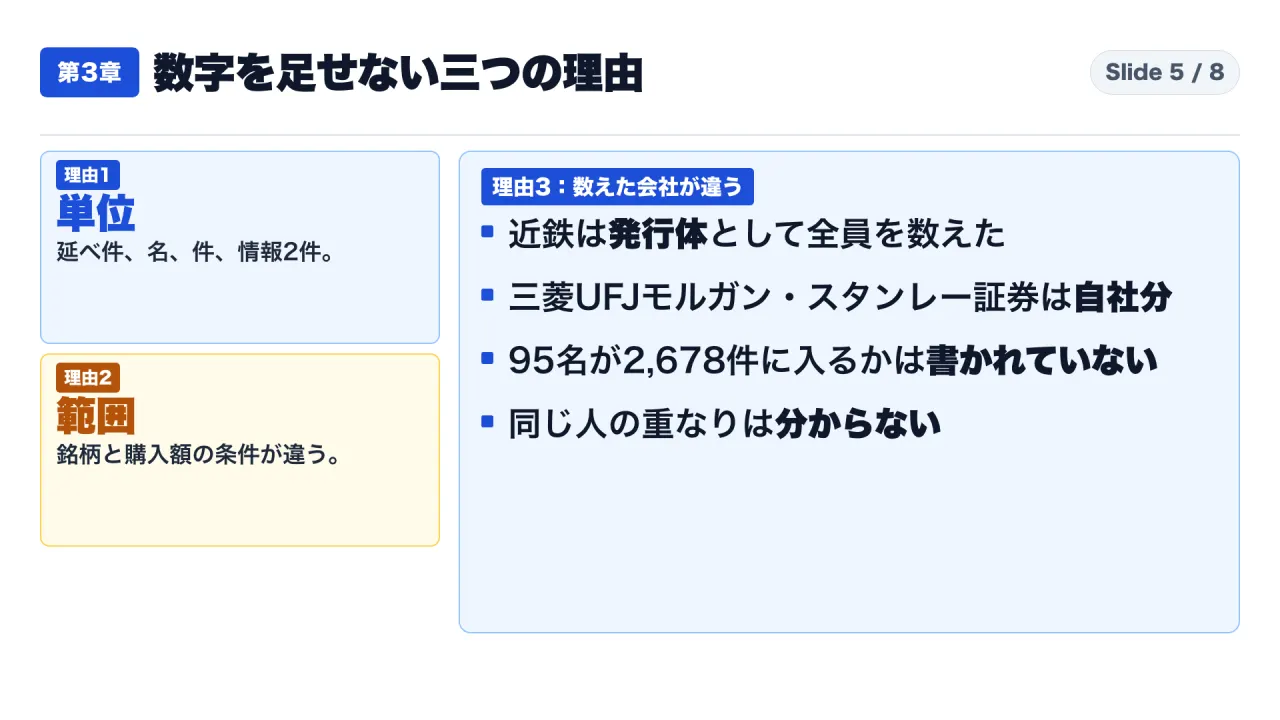
In corporate incident briefings, management frequently attempts to sum disclosed numbers into an aggregate metric. In this incident, calculating 362 + 95 + 2 + 2,678 = 3,137 is a critical analytical error.
Trap 1: Disparate Counting Units
The four entities utilize non-standardized units:
- Rakuten Securities uses cumulative transactions (
延べ362件). In Japanese financial disclosures, “cumulative” (延べ) denotes event occurrences rather than unique persons; a single individual participating across multiple bond perks is incremented multiple times. - Mitsubishi UFJ Morgan Stanley Securities uses verified individuals (
95名). - Kintetsu Group Holdings uses records (
2,678件), omitting whether duplicate bond certificates generate separate records. - JR West uses investor data instances (
投資家様情報2件).
Trap 2: Incompatible Scoping Criteria
The inclusion thresholds are misaligned:
- Kintetsu captured the entire population of investors purchasing 1,000,000 JPY or more, explicitly noting that investors who never registered to claim perks were retained in the platform database.
- Rakuten and JR West captured only partial subsets of investors who interacted with perk redemption mechanisms.
- The three bond issues span distinct calendar issuance windows (February 2023, June 2024, and July 2026), each with distinct perk qualification mechanics.
Trap 3: Unresolved Inter-Organizational Overlaps
Kintetsu disclosed 2,678 records as an issuer. Mitsubishi UFJ Morgan Stanley disclosed 95 individuals as a distributor for Kintetsu’s bond. Do the 95 broker-distributed clients reside inside Kintetsu’s 2,678 records, or does the issuer’s tally reflect an independent direct ledger? Neither corporate announcement clarifies database overlap. Attempting to subtract Mitsubishi’s 95 from Kintetsu’s 2,678 relies on unverified mathematical assumptions.
Section 4: Linguistic Framing: Defensive Hearsay vs. Structural Absence
A forensic comparison of corporate drafting reveals distinct legal postures across the five organizations:
- Brokerages (Rakuten, Mitsubishi UFJ Morgan Stanley) employed hearsay framing: they reported that they had received assurances from the vendor that passwords and authentication tokens were not compromised. Their defense relies on the veracity of the upstream investigation.
- Issuers (Kintetsu) employed architectural framing: Kintetsu stated that account credentials could not have leaked because the perk administration environment never possessed or stored securities account passwords. This distinction between “the vendor claims it did not leak” and “the database architecture never held the data” represents a vital difference in risk certainty.
Customer communications fell upon brokerages: JR West noted Rakuten Securities was handling individual notifications, while Mitsubishi UFJ Morgan Stanley established dedicated helplines. Issuers maintained high-level releases while delegating direct outreach to distributors.
On regulatory reporting, only Kintetsu confirmed notification to Japan’s Personal Information Protection Commission (PPC). NTT DATA, Rakuten, Mitsubishi UFJ Morgan Stanley, and JR West omitted PPC reporting from their releases.
Section 5: The Six Unverified Blindspots in the Public Record
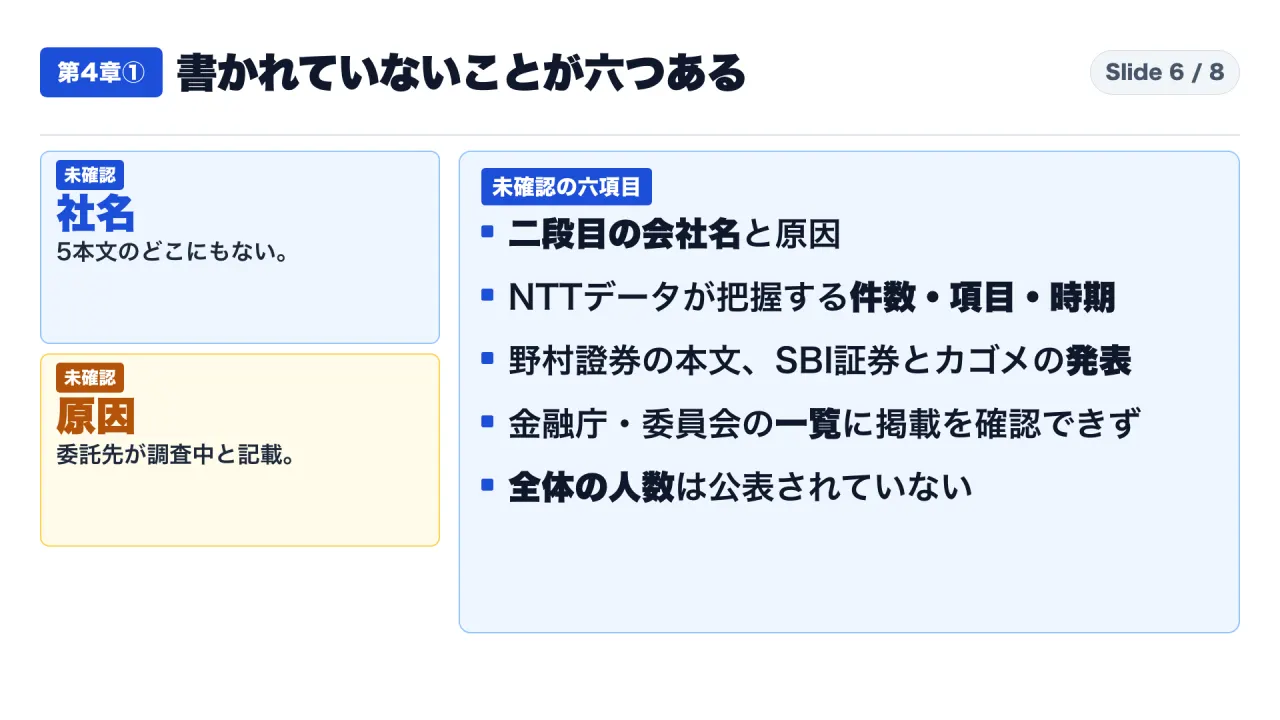
Enterprise risk teams must distinguish between confirmed facts and unverified operational gaps. As of early November 2026, six critical blindspots remain:
- Identity of the Fourth-Party Platform Operator: None of the five corporations disclosed the corporate entity running the breached SaaS infrastructure.
- Technical Attack Vector and Exploitation Mechanics: The technical root cause, ingress vector, and threat actor profile remain unspecified across all documentation, noted merely as under external investigation.
- NTT DATA’s Internal Incident Ledger: Total compromised corporate tenants, affected records, and intrusion timelines known to NTT DATA were withheld from its public statement.
- Unretrieved Corporate Disclosures: While Nomura Securities posted an announcement headline on October 31, 2026, the body was inaccessible. Releases from SBI Securities and Kagome were unlocatable during public sweeps.
- Regulatory Enforcement Posture: Public indices for Japan’s Financial Services Agency and PPC displayed no formal orders regarding this incident.
- The True Population Perimeter: Because published figures represent incompatible scopes, the aggregate count of exposed retail bondholders remains unknown.
PDF metadata reveals JR West generated its notice at 20:03 JST on October 31, 2026, while Kintetsu’s CMS recorded publication at 00:56 JST. These timestamps reflect publication mechanics rather than technical discovery sequences.
Section 6: The Five-Axis Disclosure Analysis Framework
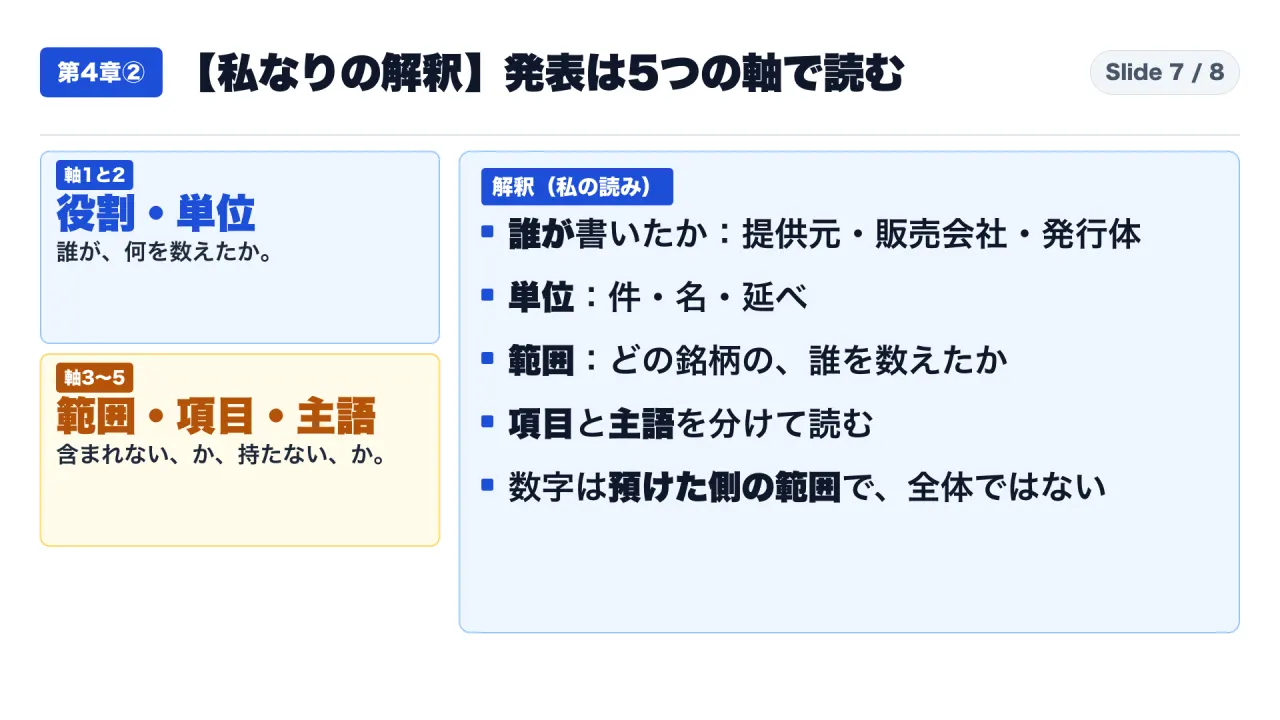
To dissect corporate incident communications objectively, enterprise security teams should evaluate multi-party breaches through a standardized five-axis framework:
- Author Role: Is the reporting entity the Primary Provider, Distributor Brokerage, or Corporate Issuer?
- Unit Metric: Are the disclosed numbers cumulative events, database records, or verified unique persons?
- Scope Boundary: Does the population cover all eligible purchasers or only perk redemption applicants?
- Attribute Map: Are specific compromised database fields enumerated or grouped into broad categories?
- Agency Voice: Is credential protection framed as hearsay confirmation or architectural absence of custody?
When applied to Kintetsu, this framework demonstrates high transparency regarding scope (all bondholders over 1,000,000 JPY) and architectural custody (passwords never held), yet reveals that the exposure status of sub-million-yen investors remains unaddressed. When applied to Rakuten, the matrix immediately highlights that compromised field names were omitted, providing a clear focal point for client inquiries.
Section 7: Five Mandatory Inquiries for Enterprise Procurement and Governance
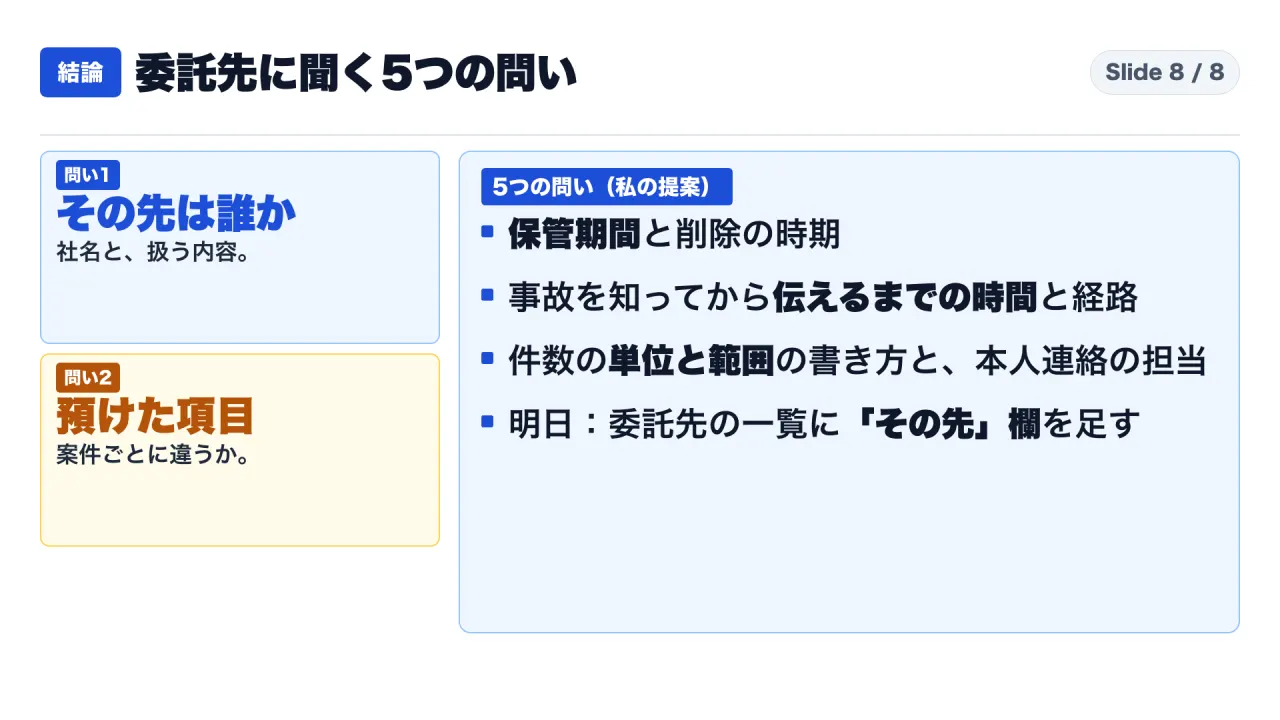
Enterprise risk officers must integrate five non-negotiable governance questions into vendor evaluation playbooks:
- Subcontractor Identification and Mapping: Require SaaS vendors to document all third-party and fourth-party hosting and application providers. If your vendor cannot name the infrastructure operators handling your customer data, your organization possesses zero visibility into incident escalation paths.
- Granular Attribute Cataloging by Project: Mandate strict data inventories specifying exact database schemas per campaign. As evidenced by JR West (six sensitive attributes exposed) versus Kintetsu (two attributes), identical platforms store divergent data profiles depending on project implementation.
- Post-Campaign Data Retention and Purging SLAs: Mandate automated data destruction. In the NTT DATA incident, investor records from 2023 and 2024 remained in the subcontractor’s platform long after perks were distributed.
- Multi-Tiered Notification Timeframes: Establish binding contractual SLAs for breach escalation across every tier: subcontractor to primary vendor, primary vendor to corporate client, and client to brokerages.
- Standardized Disclosure Protocols: Pre-determine metric units, population scopes, and communication roles before incidents occur, clarifying whether outreach originates from distributors, issuers, or vendors.
The actionable takeaway for IT risk leaders: inspect your corporate vendor ledger, add a column for “Fourth-Party SaaS Operator,” and count the blank entries. Every empty cell represents the exact visibility deficit exposed in the NTT DATA incident.
Primary Sources and References
- NTT DATA Corporation: Notice Regarding Service Suspension of STdirectServices (Published October 31, 2026; retrieved November 1, 2026): https://www.nttdata.com/global/ja/news/release/2026/103101/
- Rakuten Securities, Inc.: Notice Regarding Potential Customer Information Leak Due to Unauthorized Access to External Service Provider (Published October 31, 2026): https://www.rakuten-sec.co.jp/web/info/info20261031-01.html
- West Japan Railway Company (JR West): Notice of Potential Investor Information Leak Due to Unauthorized Access to External Service (Published October 31, 2026, PDF): https://www.westjr.co.jp/press/article/2026/10/31/items/261031_00_press_gaibuservice.pdf
- Kintetsu Group Holdings Co., Ltd.: Notice Concerning Potential Leakage of Investor Information Due to Unauthorized Access to External Service (Published October 31, 2026, PDF): https://files.microcms-assets.io/assets/b5bb8ced8fa1487390ad071605410061/3d5fea5cb2814f86a6e7f89d5aec14a0/20261031hd.pdf
- Mitsubishi UFJ Morgan Stanley Securities Co., Ltd.: Notice of Potential Investor Information Leak Concerning Corporate Bonds Handled by the Firm (Published October 31, 2026): https://www.sc.mufg.jp/company/news/inform/info20261031.html
- Nomura Securities Co., Ltd.: Corporate Portal Notice Index Regarding Unauthorized External Access to Digital Perk Bonds (Published October 31, 2026; Headline only): https://www.nomura.co.jp/index.html