Reading Between the Lines of NVIDIA's Form 10-Q: Dissecting Customer Equity Stakes, $108.5B in Guarantees, and $36B Cloud Commitments
A line-by-line examination of NVIDIA’s Q2 FY2027 SEC filing reveals the exact economic mechanics behind $99B in equity investments, a $105B OpenAI lease guarantee, and $36B in reciprocal cloud commitments ── alongside the critical details the disclosure leaves unstated.
Published: November 1, 2026 | Read time: ~10 min | Watch Video (Japanese)
Executive Summary: Financial Disclosures vs. Speculative Narratives
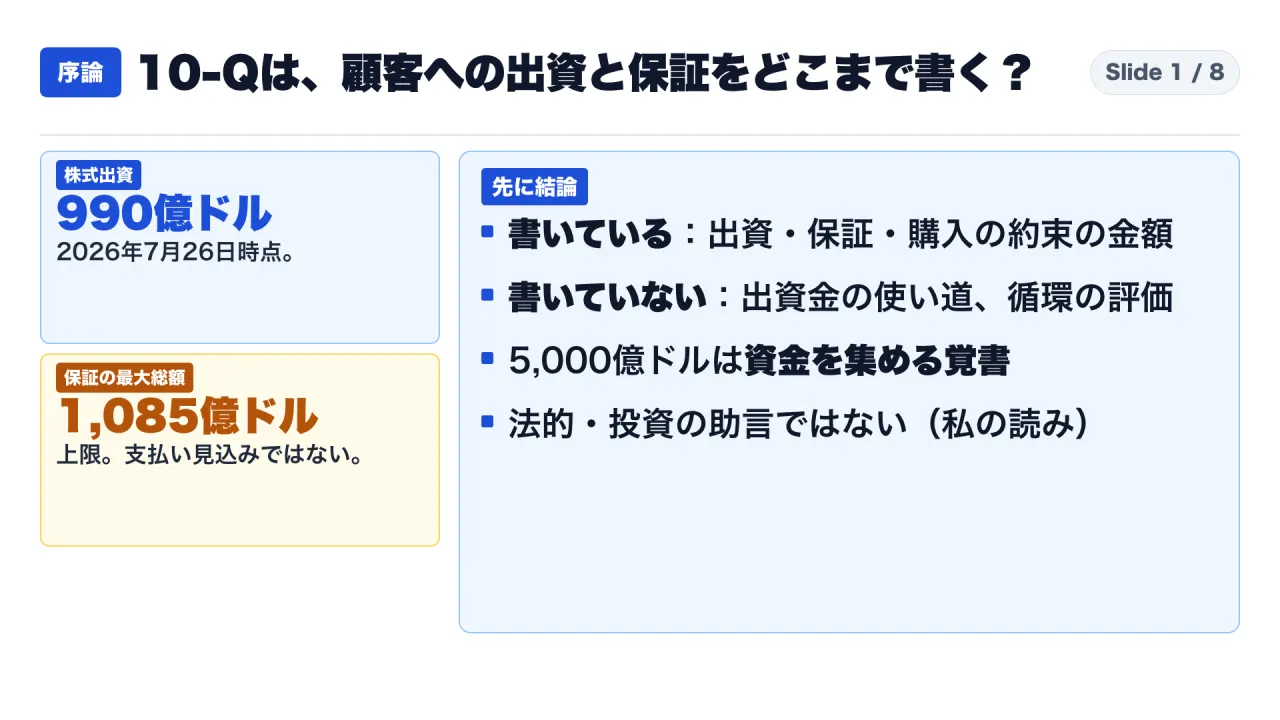
On August 26, 2026, NVIDIA Corporation filed its quarterly report on Form 10-Q with the U.S. Securities and Exchange Commission (SEC) for the fiscal second quarter ended July 26, 2026 (SEC EDGAR Filer Archive). The filing disclosed substantial figures across strategic investments, credit support facilities, and multi-year commercial commitments: $99 billion in equity investments, $25 billion in equity investment commitments, $108.5 billion in maximum gross guarantee exposure (predominantly backing data center leases for an affiliate of OpenAI), and $36 billion in reciprocal cloud computing commitments.
These disclosures ignited widespread market debate regarding whether these arrangements represent circular revenue──suggesting that NVIDIA is funding its own customer base to sustain demand for Blackwell and Rubin GPUs.
However, a disciplined forensic analysis of the statutory filing reveals a clear boundary between audited financial facts and unverified market interpretations:
- Documented Disclosures: NVIDIA explicitly discloses $99B in equity investments, $25B in contingent investment commitments, $108.5B in gross guarantee exposure, and $36B in AI Cloud service purchase commitments. The filing acknowledges that customers face severe capital and infrastructure constraints that could delay GPU purchasing decisions.
- Critical Omissions in the 10-Q: The statutory report does not disclose the specific names of equity investees (outside OpenAI affiliates in the guarantee context), does not disclose the commercial use of investment proceeds (leaving unstated whether investees are obligated to purchase NVIDIA hardware), and does not provide probability assessments for guarantee activation. Terms like “vendor financing,” “circular,” or “round-trip” appear zero times across the text.
- The $500 Billion Facility Is an MOU, Not a Corporate Credit Line: The widely circulated figure of “$500 billion” refers to a preliminary Memorandum of Understanding (MOU) executed in August 2026 with institutional infrastructure lenders to create an independent third-party financing structure. It does not represent a direct credit facility extended from NVIDIA’s corporate balance sheet.
Understanding NVIDIA’s economic reality requires separating asset classes, inspecting conditional triggers, and acknowledging precisely what the filing leaves unstated.
Methodological Discipline: Distinguishing Statutory Facts from Analytical Interpretation
To ensure forensic rigor, this analysis separates statements into two distinct domains:
- Statutory Facts: Factual disclosures, line-item numbers, and footnotes transcribed directly from NVIDIA’s Form 10-Q. Dollar figures are reported in billions of dollars ($B), normalizing SEC denominations (where $1 billion equals $1.0B and $1 million equals $0.01B).
- Analytical Interpretation & Governance Frameworks: Economic deductions formulated to contextualize the disclosures within enterprise finance practice.
This analysis evaluates one primary source: NVIDIA’s Form 10-Q for the quarterly period ended July 26, 2026, signed on August 26, 2026. External sources are intentionally excluded to isolate strictly what NVIDIA bound itself to in formal SEC disclosures.
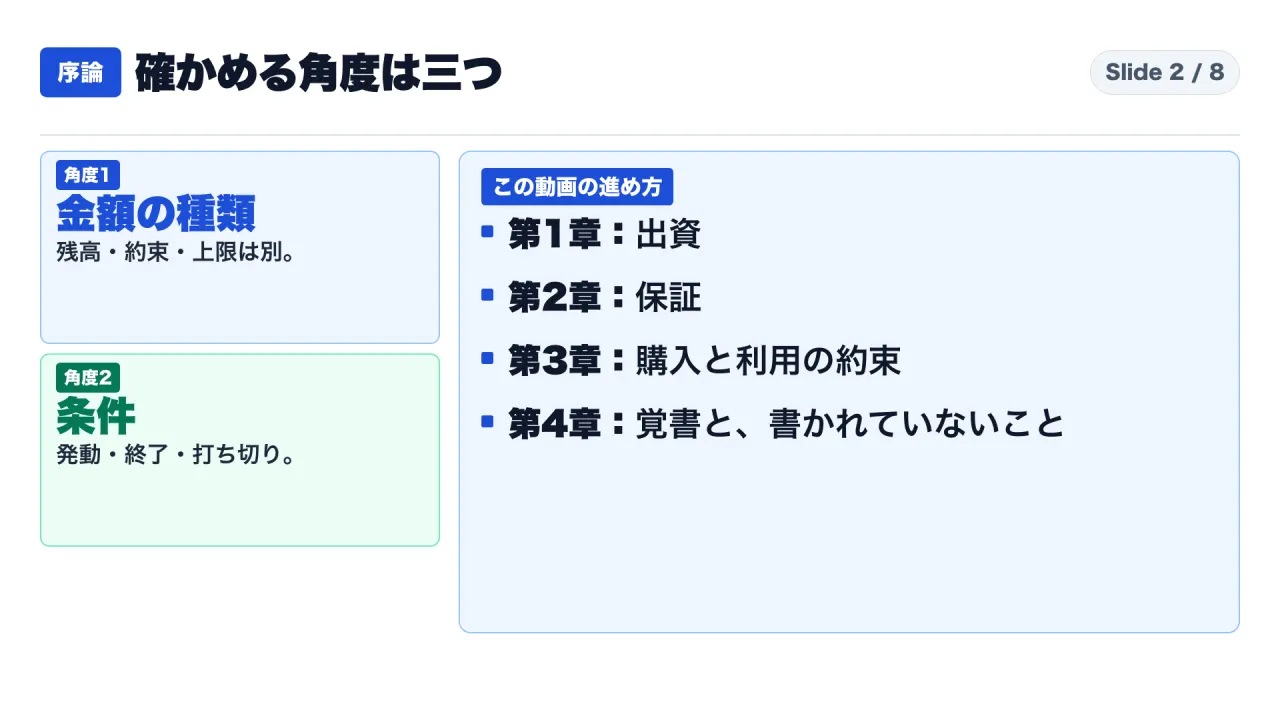
Key Accounting Terms Used in the 10-Q
- AI Cloud: Specialized infrastructure partners that purchase GPU systems to deliver accelerated cloud compute to enterprise developers and AI labs.
- AI Model Makers: Specialized frontier research organizations that develop foundation models, identified both as candidates for equity commitments and as direct customers.
- Maximum Gross Exposure: The theoretical maximum financial obligation payable if every underlying debtor defaults in full without asset recovery.
- Escrow Buffer: Segregated funds deposited by partners ($712 million) to partially mitigate NVIDIA’s guarantee exposure.
- Variable Interest Entities (VIEs): Non-consolidated infrastructure entities where NVIDIA’s maximum loss exposure is capped at $4.7 billion.
1. Chapter 1: Equity Investments ($99B) and Commitments ($25B)
The Headline Disclosure
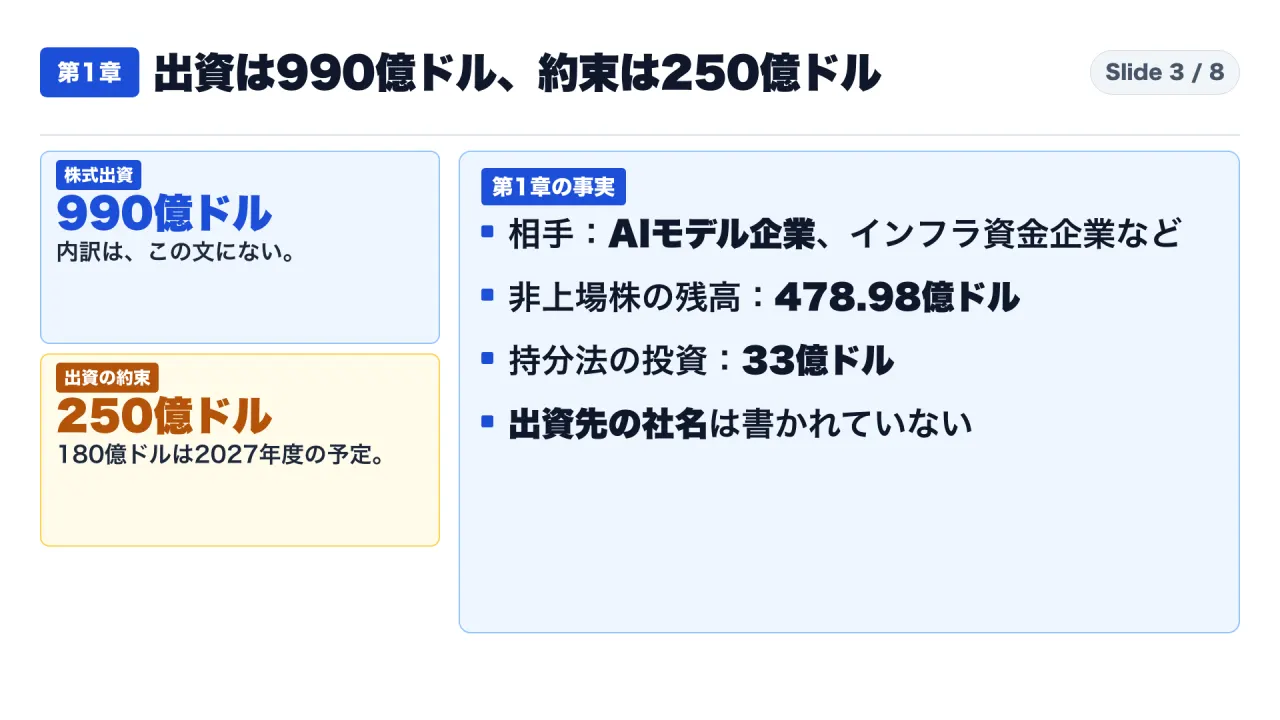
In the MD&A narrative and Note 10, NVIDIA reports that as of July 26, 2026, the company held $99 billion in equity investments and maintained $25 billion in contingent equity investment commitments.
Two reporting caveats surround the headline $99 billion figure:
- Isolated Disclosure: The $99 billion figure appears as a single aggregate statement in the MD&A narrative; the filing does not provide an itemized schedule breaking down this total by sector.
- Valuation Basis Unstated: The specific valuation methodology governing the aggregate $99 billion figure──whether recorded at historical cost, adjusted fair value, or a blend──is not broken down in that narrative sentence.
The Non-Affiliated Private Equity Roll-Forward (Note 6)
In Note 6, NVIDIA provides a granular roll-forward table detailing its carrying value in non-affiliated private company equity securities:
| Private Equity Carrying Value Component | Form 10-Q Reported Value ($B) | Accounting Interpretation & Mechanism |
|---|---|---|
| Beginning Balance (January 28, 2026) | $22.251B | Carrying value at start of fiscal year |
| Cash Additions (First Half FY2027) | +$31.005B | Net capital deployed into private equity rounds |
| Unrealized Gains (Observable Adjustments) | +$7.504B | Upward valuation marks based on observable transactions |
| Reclassifications to Marketable Securities | -$12.712B | Transfers to public equities following portfolio IPOs |
| Impairments & Unrealized Losses | -$0.150B | Downward valuation adjustments and write-offs |
| Ending Carrying Value (July 26, 2026) | $47.898B | Balance sheet carrying value of private equity |
The net increase in carrying value over the half-year was $25.647 billion ($47.898B minus $22.251B). Net cash deployed ($31.005B) exceeded balance sheet growth because $12.712B transitioned into publicly traded securities. Cumulative gross unrealized gains recorded on private holdings reached $9.1 billion as of July 26, 2026.
Schedule of the $25 Billion Contingent Commitments
The $25 billion in commitments represents binding agreements subject to defined contingencies:
- Remaining Fiscal 2027: $18.0 billion (72% of total commitments).
- Fiscal 2028: $3.0 billion (12%).
- Fiscal 2029: $2.0 billion (8%).
- Fiscal 2030: $2.0 billion (8%).
Over 72% of these commitments fall due within the remainder of fiscal 2027. Furthermore, NVIDIA received warrants to purchase shares of a publicly traded entity over a 3- to 5-year window, recording $4.8 billion in warrant notional value and $1.0 billion in forward contracts (total equity derivative fair value standing at $824 million).
The filing does not disclose the specific names of private investees or their operational use of capital.
2. Chapter 2: Guarantees ($108.5B Maximum Gross Exposure) and the SB Energy Lease
Deconstructing Maximum Gross Exposure
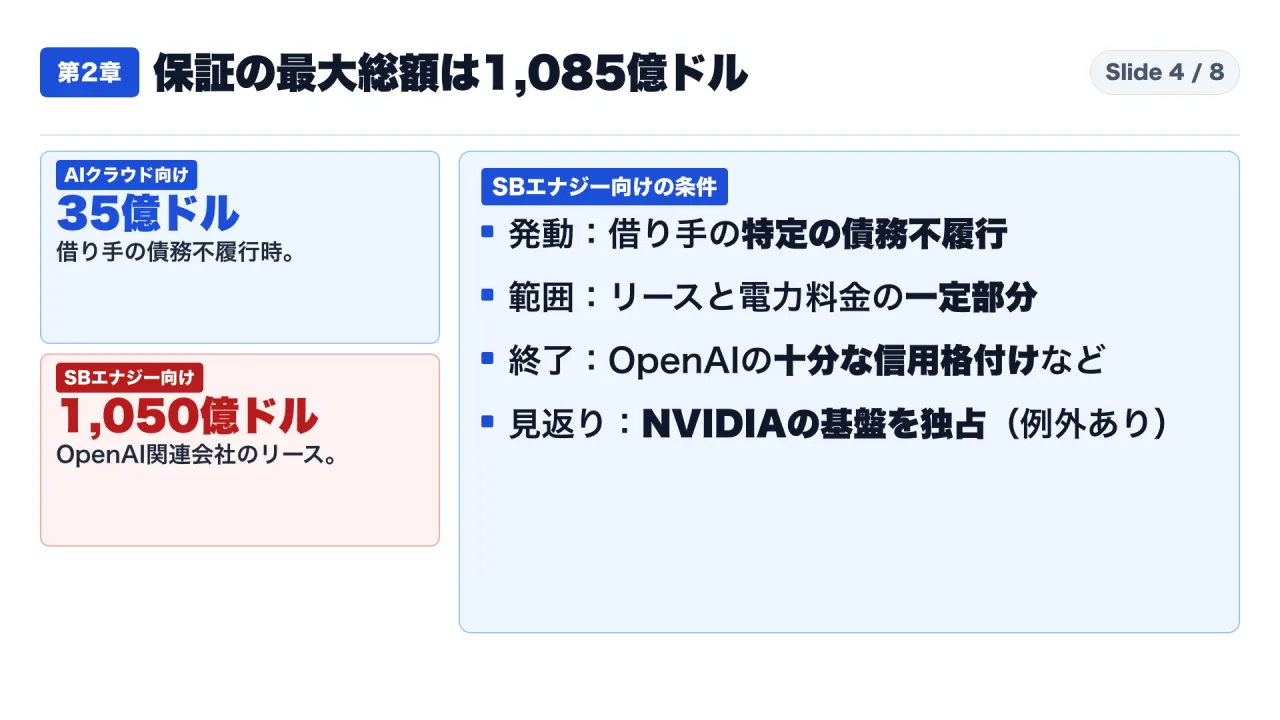
In Note 10, NVIDIA presents a table detailing $108.5 billion in maximum gross guarantee exposure:
- AI Cloud Partner Data Center Leases: $3.5 billion (3.529B notional). Term spans 5 to 7 years. Mitigated by $712 million held in third-party escrow accounts by partners. Accounting treatment designates this as a credit derivative with an immaterial fair value.
- SB Energy Data Center Lease (Executed August 2026): $105.0 billion. Executed subsequent to quarter-end, providing credit support for an affiliate of NVIDIA customer OpenAI.
Terms of the $105B OpenAI / SB Energy Facility
- Geographic Site and Capacity: Covers lease obligations for facilities in Pike County, Ohio, supporting approximately 4.25 gigawatts (GW) of IT capacity.
- Development Horizon: Phased across 9 development tranches, with initial operations targeted for fiscal 2029. Leases run for 20 years per tranche.
- Conditional Gating: Commitments are contingent upon SB Energy fulfilling utility and construction milestones.
- Trigger Limitations: Guarantee covers strictly designated rent and electric utility components, not full land acquisition or tenant operating liabilities.
- Termination Thresholds: The guarantee terminates early if OpenAI achieves an investment-grade credit rating.
- Commercial Reciprocity: The Ohio facility is contractually restricted to deploy exclusively NVIDIA AI infrastructure, subject to narrow exceptions. Additionally, NVIDIA secured an option to provide credit support for an additional 3.8 GW of capacity expansion.
Downside Exposure Disclosed in Risk Factors
NVIDIA explicitly notes that if OpenAI fails to perform lease obligations or enters bankruptcy, NVIDIA could assume the underlying lease obligations. While OpenAI agreed to indemnify NVIDIA, recovery may be delayed or insufficient. The filing documents the maximum exposure; it does not disclose the calculated probability or expected loss value of an OpenAI default.
3. Chapter 3: Reciprocal AI Cloud Commitments ($36B) vs. Supply Commitments ($279B)
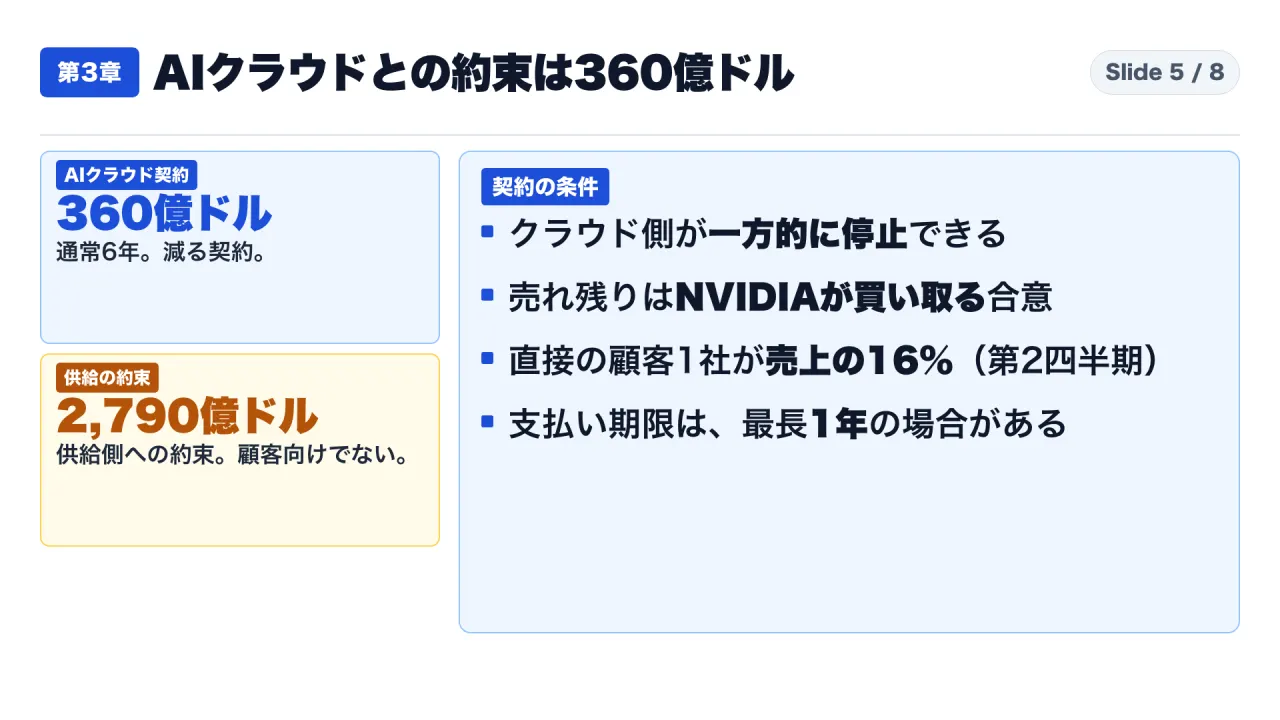
The New Commercial Model
In Q2 FY2027, NVIDIA initiated a business structure with selected AI Cloud partners: partners purchase NVIDIA data center hardware, while NVIDIA enters into multi-year commitments to purchase cloud capacity from those same partners.
As of July 26, 2026, NVIDIA’s cloud purchase commitments stood at $36 billion, typically spanning 6-year terms ($6.0B in FY2028, $8.0B in FY2029, $7.0B in FY2030, $6.0B in FY2031, $9.0B thereafter).
Asymmetric Contractual Dynamics and Unsold Capacity Absorption
- Partner Termination Rights: The AI Cloud partner retains the unilateral authority to terminate service delivery to NVIDIA if it can resell that capacity to third parties under more favorable commercial terms.
- Commitment Offsets and Revenue Sharing: NVIDIA’s financial commitment decreases dollar-for-dollar as third-party customers or internal R&D teams consume capacity. NVIDIA also participates in revenue-sharing pools when third-party revenue exceeds defined thresholds.
- The Unsold Capacity Buyback Agreement: In Risk Factors, NVIDIA discloses that if an AI Cloud partner fails to resell contracted capacity, NVIDIA is contractually committed to purchase the unsold capacity, absorbing residual inventory risk.
Disclosed Commercial Drivers: Customer Capital Constraints
In MD&A, NVIDIA transparently discloses why it adopted this model:
“AI Cloud partners have strong commercial demand but face severe near-term capital expenditure constraints. Both AI Cloud providers and AI model makers currently lack the investment-grade credit profile necessary to secure long-term infrastructure debt independently… Customer liquidity shortages could delay hardware deployment.”
Management acknowledges customer financing constraints as a material challenge to GPU sales velocity.
Supply Commitments ($279B) and Customer Concentration
In parallel, NVIDIA increased its forward commitments to semiconductor foundries, HBM memory suppliers, and packaging vendors from $119 billion to $279 billion. Total contractual commitments across all operational categories reached $366 billion (of which $318 billion, or 87%, falls due within the next three fiscal years).
Customer concentration remains high: a single customer represented 16% of Q2 revenue, while three customers represented 16%, 15%, and 13% of first-half revenue. Accounts receivable concentration is elevated: five customers represent 22%, 14%, 13%, 11%, and 10% of total receivables. NVIDIA routinely grants extended payment terms ranging from 90 days to 365 days to selected investment-grade customers to assist large data center builds.
4. Chapter 4: The $500B Financing Facility MOU and the Analytical Boundary
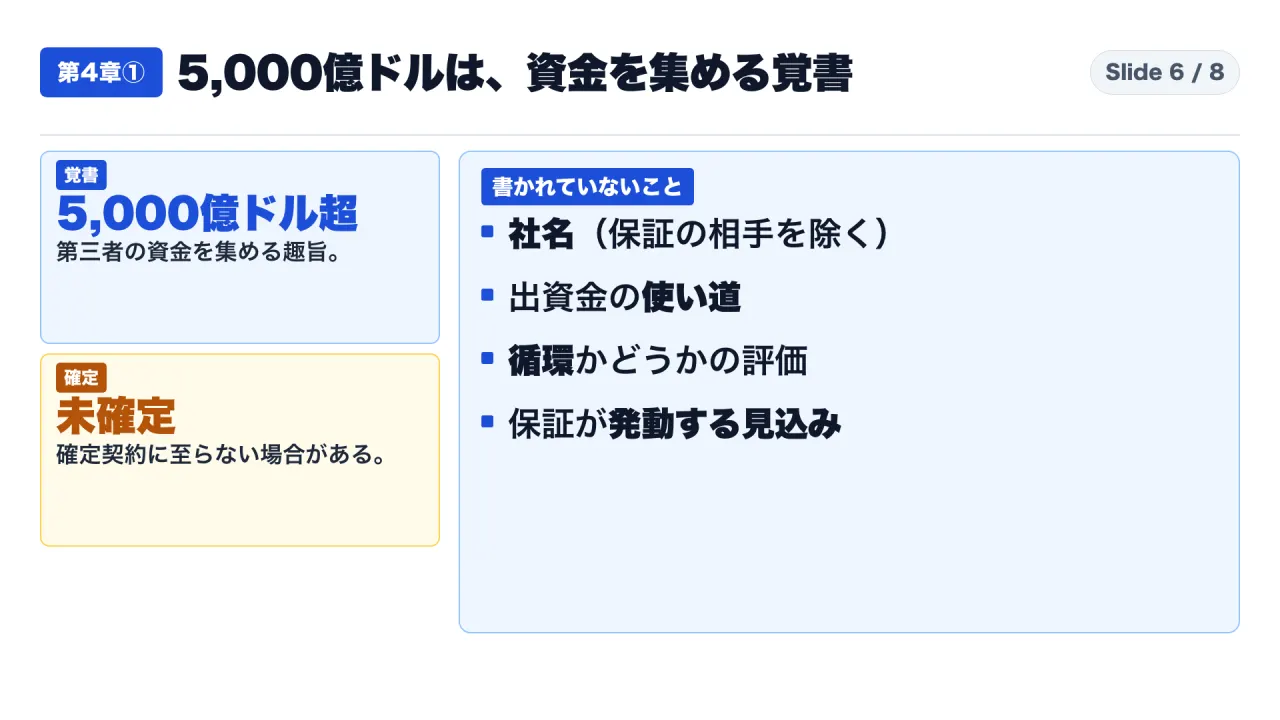
The Nature of the $500 Billion MOU
In August 2026, NVIDIA executed an MOU with institutional lenders to establish an independent financing facility aimed at mobilizing over $500 billion in third-party debt and equity over time to fund data centers.
Key statutory realities:
- Not an NVIDIA Loan: NVIDIA is not lending $500 billion. Terms like “credit line” or “direct loan facility” appear zero times in this section.
- Third-Party Underwriting: Capital is underwritten and disbursed entirely by independent lenders. NVIDIA’s potential exposure is limited to selective residual value guarantees.
- Non-Binding Status: Preliminary discussions may not result in executed agreements.
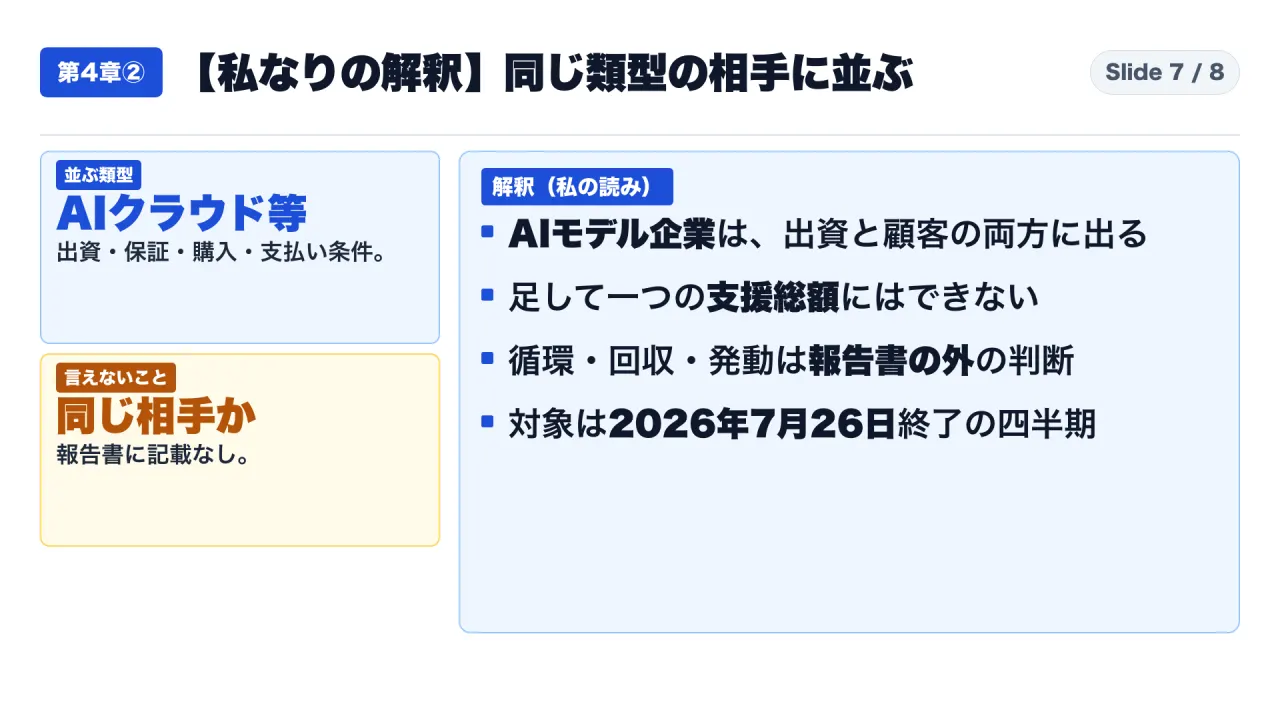
Synthesis: The Scope of Overlap
The phrase “AI Model Makers” appears in Note 10 as recipients of equity commitments and in Note 13 as direct hardware customers.
While economic incentives are aligned, the Form 10-Q does not confirm that specific equity recipients and specific debt-guaranteed customers are identical corporate entities. Conflating categorical alignment with direct circular financing exceeds the documented facts of the filing.
| Financial Dimension | Disclosed Statutory Scope | Contractual Conditions & Legal Limitations |
|---|---|---|
| $99B Equity Investments | Recorded carrying value as of July 26, 2026 | Line-item schedule and investee company names unstated. |
| $25B Equity Commitments | Legally binding contingent investment commitments | 72% ($18.0B) due in remaining FY2027; contingent on partner milestones. |
| $108.5B Gross Guarantees | Maximum gross default exposure | $105B backs OpenAI/SB Energy lease; triggers solely on tenant defaults. |
| $36B Cloud Commitments | Capacity purchase commitments with AI Cloud partners | Unsold capacity absorbed by NVIDIA; partners retain resale rights. |
| $500B Financing MOU | Non-binding framework to attract institutional capital | Third-party funded; zero direct NVIDIA corporate credit facilities extended. |
5. Enterprise Due Diligence: 5 Rules for Reading Capital Disclosures
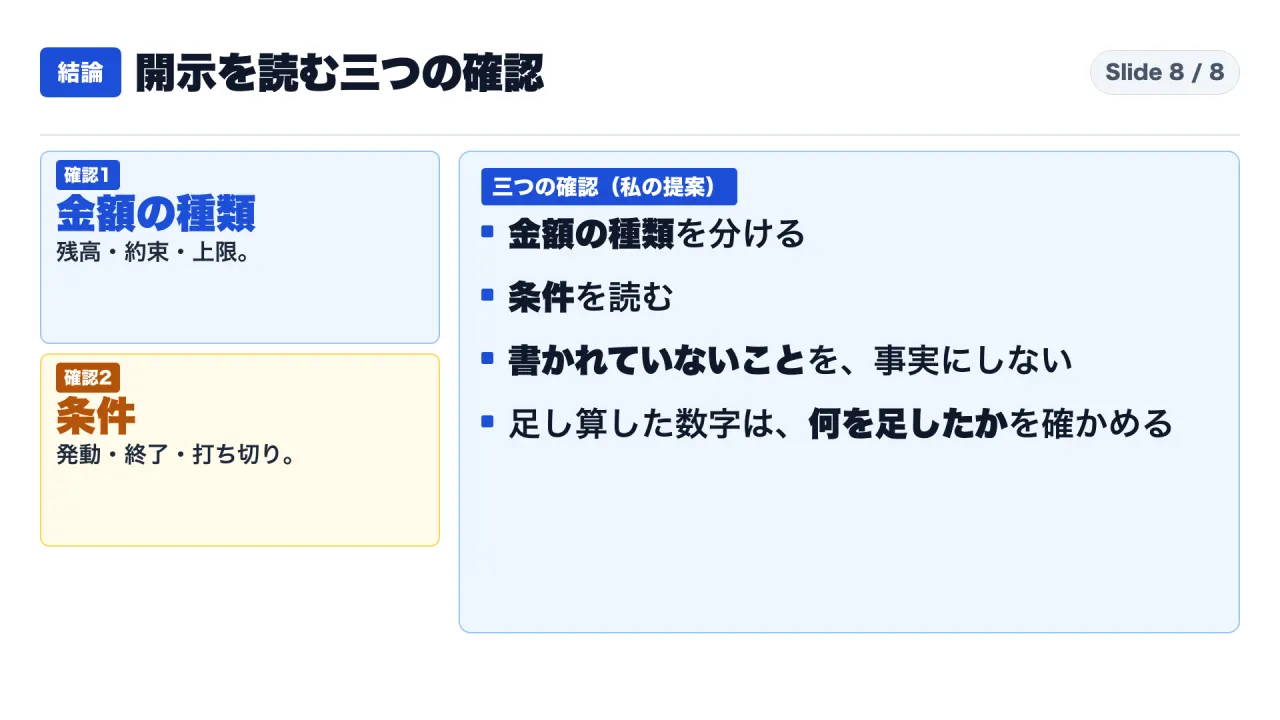
When evaluating vendor disclosures, corporate treasury and audit committees should execute five procedural checks:
- Disaggregate Headline Figures by Accounting Class: Maintain strict segregation between balance sheet assets ($99B equity), contingent liabilities ($108.5B guarantees), contractual purchase obligations ($36B cloud, $279B supply), and non-binding letters of intent ($500B MOU). Never aggregate these categories into a single unrefined total.
- Audit Gating Contingencies: For every guarantee or commitment, identify the triggering event, the termination threshold, and the presence of third-party cash buffers (such as the $712M escrow deposit).
- Track Reciprocal Contractual Liabilities: Identify whether customer hardware purchases are linked to vendor capacity buyback commitments or extended payment terms (e.g., 90 to 365 days).
- Identify What Disclosures Leave Unstated: Acknowledge that the absence of investee names, unstated activation probabilities, and undisclosed fund utilization paths are formal limits of the public filing.
- Anchor Telemetry Chronologically: Record exact fiscal reporting dates (Q2 FY2027 ended July 26, 2026; filed August 26, 2026) to ensure subsequent disclosures are properly contextualized.
Primary Sources and References
- U.S. Securities and Exchange Commission (SEC): NVIDIA Corporation Form 10-Q for the Quarterly Period Ended July 26, 2026 (Filed August 26, 2026): https://www.sec.gov/Archives/edgar/data/1045810/000104581026000075/nvda-20260726.htm
- SEC EDGAR Filer Archive: NVIDIA Corporation Complete SEC Filing History (CIK 0001045810): https://www.sec.gov/edgar/browse/?CIK=0001045810