Evaluating Speech Enhancement Benchmarks in Production: Why NISQA 4.33 and PESQ 2.57 Do Not Guarantee Meeting or Podcast Audio Quality
A technical analysis of NVIDIA’s NemotronLabs RE-USE model card and research paper demonstrates why synthetic benchmark superiority does not translate automatically to real-world voice clarity, transcription fidelity, or commercial compliance.
Published: November 1, 2026 | Read time: ~10 min | Watch Video (Japanese)
Executive Summary: Benchmark Metrics vs. Real-World Audio Engineering
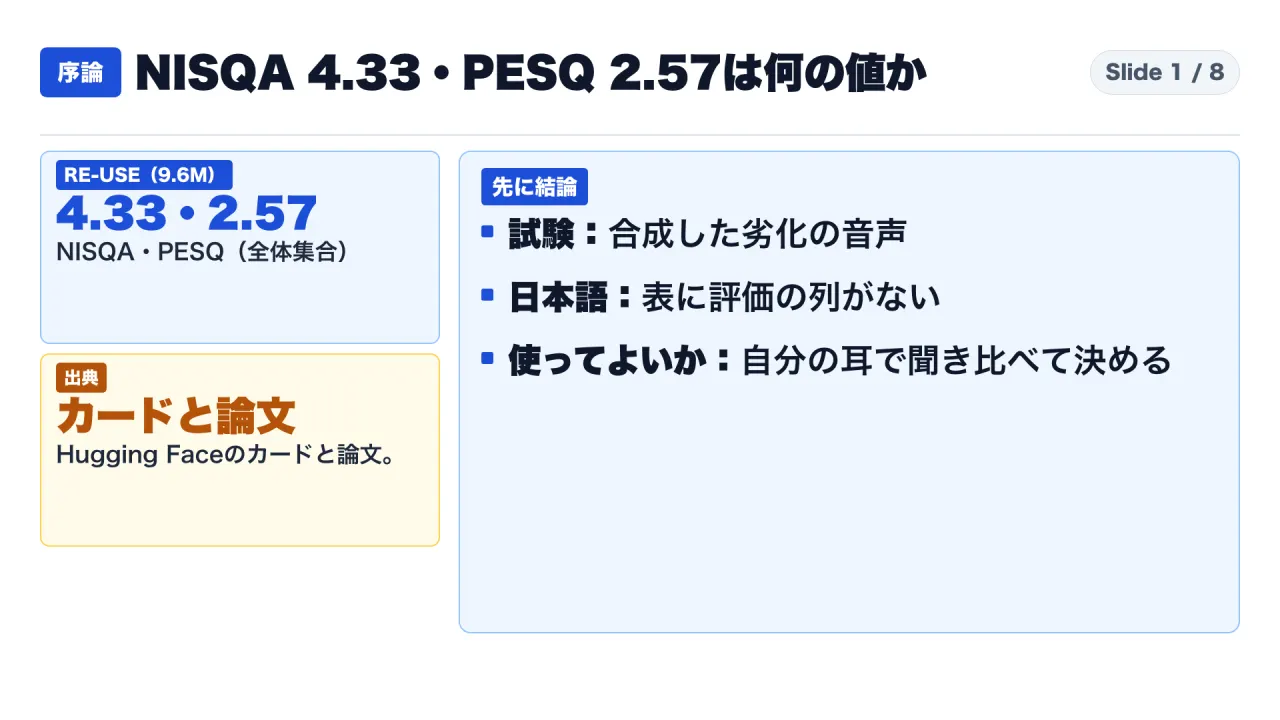
In late October 2026, NVIDIA generated substantial interest across AI audio engineering communities by releasing RE-USE (Universal Speech Enhancement), an open-weights neural speech enhancement model engineered by NemotronLabs (Hugging Face Model Card, Research Paper). Promoted on NVIDIA AI’s official technical channels, the model card presents striking evaluation scores across the URGENT 2025 speech challenge benchmark: a NISQA score of 4.33 and a PESQ score of 2.57, coupled with a footprint of just 9.6 million parameters.
For engineering leads, podcast creators, and enterprise operations teams seeking to denoise boardroom recordings, customer support calls, or media productions, these figures appear to justify immediate automated adoption.
However, a rigorous examination of the underlying research paper, official evaluation matrices, training data manifests, and licensing terms reveals significant technical caveats:
- Synthetic Evaluation vs. Acoustic Reality: The headline scores of NISQA 4.33 and PESQ 2.57 were measured exclusively against synthetically degraded datasets using anechoic clean references. Crucially, the public model card contains no Japanese language evaluation data, and the public training manifest lists only English, German, French, Spanish, and Chinese single-speaker corpora.
- Benchmark Columns Where RE-USE Trails Competitors: On the comprehensive evaluation set, RE-USE does not sweep all metrics. While it leads larger models in NISQA, PESQ, and Word Accuracy, it trails Sidon (250M) on DNSMOS (3.29 vs 3.34) and UTMOS (2.94 vs 3.21), and trails UniPASE (500M) on SpeechBERTScore (0.88 vs 0.89).
- The Hallucination Failure Mode in Audio Restoration: In audio enhancement, high perceptual scores can actively disguise semantic degradation. On high-sample-rate benchmarks, models like Resemble Enhance elevate NISQA from 1.79 to 3.68 while causing Word Accuracy to collapse from 83.65% to 47.22% due to phonemic fabrication.
- Architectural and Licensing Constraints: RE-USE operates with a non-causal architecture that precludes real-time streaming, requires mono audio, and exhibits licensing ambiguities between its root repository (OpenMDW 1.1) and internal security sub-cards (NVIDIA Open Model License).
A benchmark score establishes that a model merits empirical testing; it never constitutes proof that the model is safe for production deployment.
Methodological Discipline: Distinguishing Primary Disclosures, Conversions, and Evaluations
To ensure analytical precision, this evaluation maintains strict categorization across three domains:
- Primary Document Disclosures: Factual specifications transcribed directly from NVIDIA’s model card, arXiv research paper (v4, October 6, 2026), OpenMDW 1.1 license texts, and ITU-T standards.
- Calculated Conversions: Arithmetic normalizations (e.g., converting 9.6M parameters to 9.6 million, or converting epoch timestamps to UTC/JST).
- Engineering Evaluations & Practical Protocols: Experimental guidelines developed to test audio quality independently of published vendor claims.
Operational Constraints of This Analysis
This evaluation is bounded by defined operational parameters:
- No Proprietary Audio Inference: This analysis does not run model weights on private corporate recordings; assertions derive strictly from documented research findings.
- Third-Party Model Parameters: Baseline parameter counts for comparative systems (Sidon at 250M, UniPASE at 500M) reflect values printed in NVIDIA’s tables without independent audits.
- Boldface Typographic Interpretation: Bold entries in NVIDIA’s tables are treated as designating top-performing systems, following academic convention.
1. Model Architecture and Training Foundations: 9.6M Parameters and Bidirectional Mamba
Structural Topology
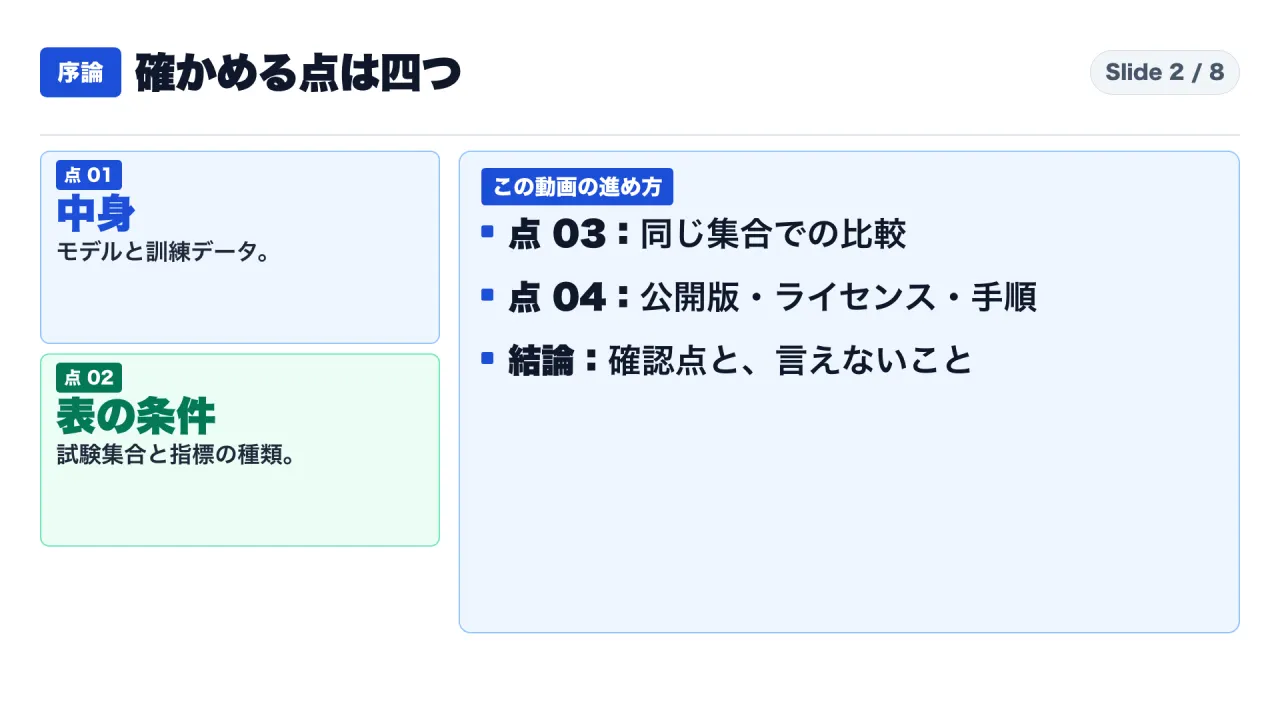
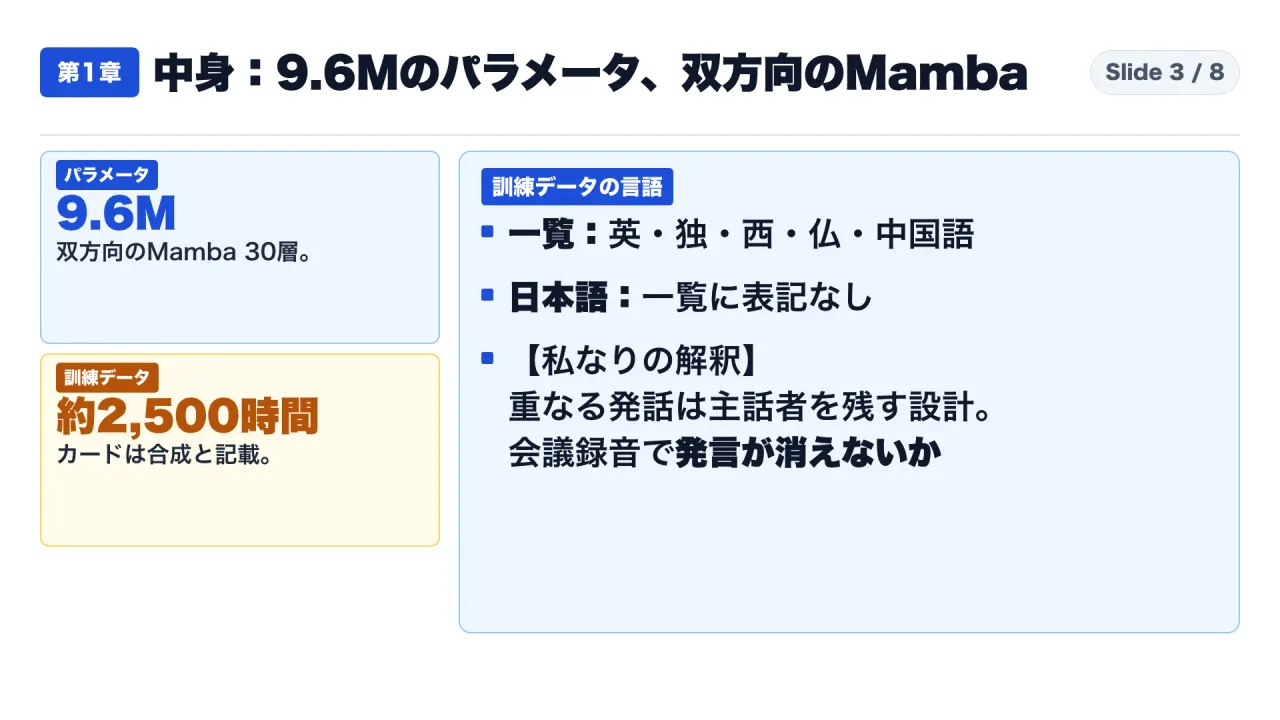
RE-USE is structured as a compact Universal Speech Enhancement (USE) architecture containing 9.6 million parameters:
- Convolutional Encoder/Decoder: Maps raw time-domain waveforms into intermediate acoustic representations.
- 30-Layer Bidirectional Mamba Backbone: Utilizes linear-time state-space sequence modeling rather than quadratic self-attention, enabling long-range temporal modeling with modest parameter requirements.
- Sample Rate Agnosticism: Supports input and output sample rates across 8, 16, 22.05, 24, 32, 44.1, and 48 kHz.
- Mono Channel Constraint: The model ingests and emits strictly single-channel (mono) audio. Ingesting stereo conference recordings requires external downmixing.
Training Data Manifest
The training corpus spans approximately 2,500 hours of synthetic single-speaker speech:
- Public Corpora: DNS5 LibriVox, LibriTTS, VCTK, Wall Street Journal (English), Multilingual LibriSpeech (German, English, Spanish, French), and CommonVoice 19.0 (German, English, Spanish, French, Chinese).
- Proprietary Datasets: NVIDIA Riva Speakers (internal clean speech dataset whose linguistic composition is unstated).
- Absence of Japanese in Public Records: While the card claims language-agnostic robustness, Japanese is unlisted in the public training manifest.
The Overlapping Speech Suppression Trade-Off
The model card highlights an intentional behavioral optimization:
“For overlapping speech, the model is trained to retain the dominant speaker and suppress secondary speakers.”
In voice-over mastering, attenuating background chatter is advantageous. However, in enterprise meetings where cross-talk contains critical context, suppressing non-dominant speakers risks silently erasing essential verbal contributions.
2. Deconstructing the Benchmark Suite: Non-Blind Synthetic Sets and Metric Mechanics
The URGENT 2025 Test Environment
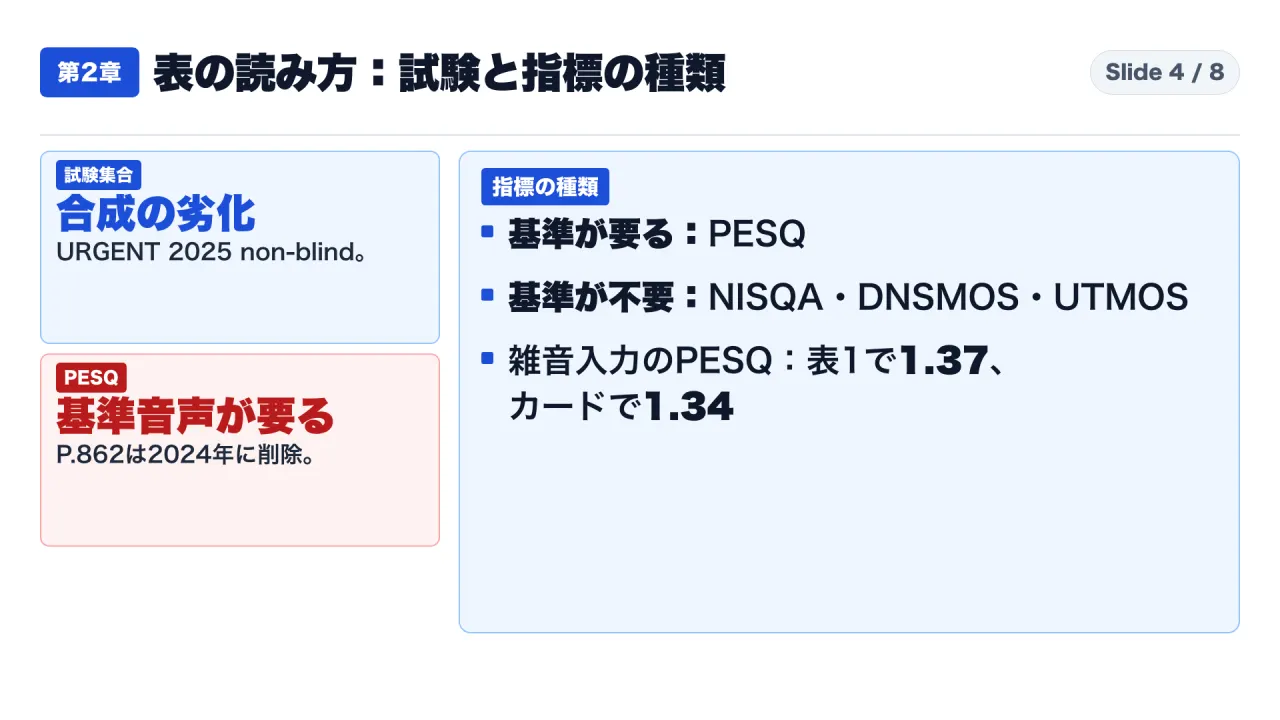
The performance metrics featured on the model card derive from the URGENT 2025 non-blind test set, comprising 1,000 synthetic test utterances created by corrupting clean anechoic speech with simulated distortions: additive noise, reverberation, clipping, band-limiting, codec artifacts, packet loss, and microphone distortion.
Taxonomy of Speech Metrics
- Intrusive (Reference-Dependent) Metrics:
- PESQ (ITU-T P.862): Measures psychoacoustic distance against a pristine, time-aligned clean reference. (Note: ITU-T withdrew P.862 on January 5, 2024, recommending P.863 POLQA; academic literature retains PESQ as a baseline).
- STOI / ESTOI: Correlates with human speech intelligibility against a reference.
- Non-Intrusive (Reference-Free) Neural Predictors:
- NISQA: Deep neural network predicting overall voice quality, noisiness, coloration, discontinuity, and loudness.
- DNSMOS (ITU-T P.835): Deep model predicting Speech Quality (SIG), Background Quality (BAK), and Overall Quality (OVRL).
- UTMOS: MOS prediction network developed by NII.
- Semantic Preservation Metrics:
- Word Accuracy (WAcc): Automated Speech Recognition (OWSM) transcription accuracy, verifying whether speech content was preserved.
- SpeechBERTScore (SBERT): Self-supervised latent representation similarity.
3. Head-to-Head Comparative Tables: Where RE-USE Wins and Where It Loses
Comprehensive Overall Test Set (All Frequencies)
The overall evaluation table compares RE-USE against two substantially larger foundation models:
| Model Architecture | Parameters | NISQA (High) | PESQ (High) | DNSMOS (High) | UTMOS (High) | SBERT (High) | Word Acc % |
|---|---|---|---|---|---|---|---|
| Noisy Input Baseline | N/A | 1.69 | 1.34 | 1.84 | 1.56 | 0.74 | 81.29% |
| Sidon | 250M | 3.87 | 1.73 | 3.34 | 3.21 | 0.85 | 84.68% |
| UniPASE | 500M | 4.03 | 2.17 | 3.21 | 2.96 | 0.89 | 87.28% |
| RE-USE (NemotronLabs) | 9.6M | 4.33 | 2.57 | 3.29 | 2.94 | 0.88 | 89.17% |
Column-by-Column Evaluation
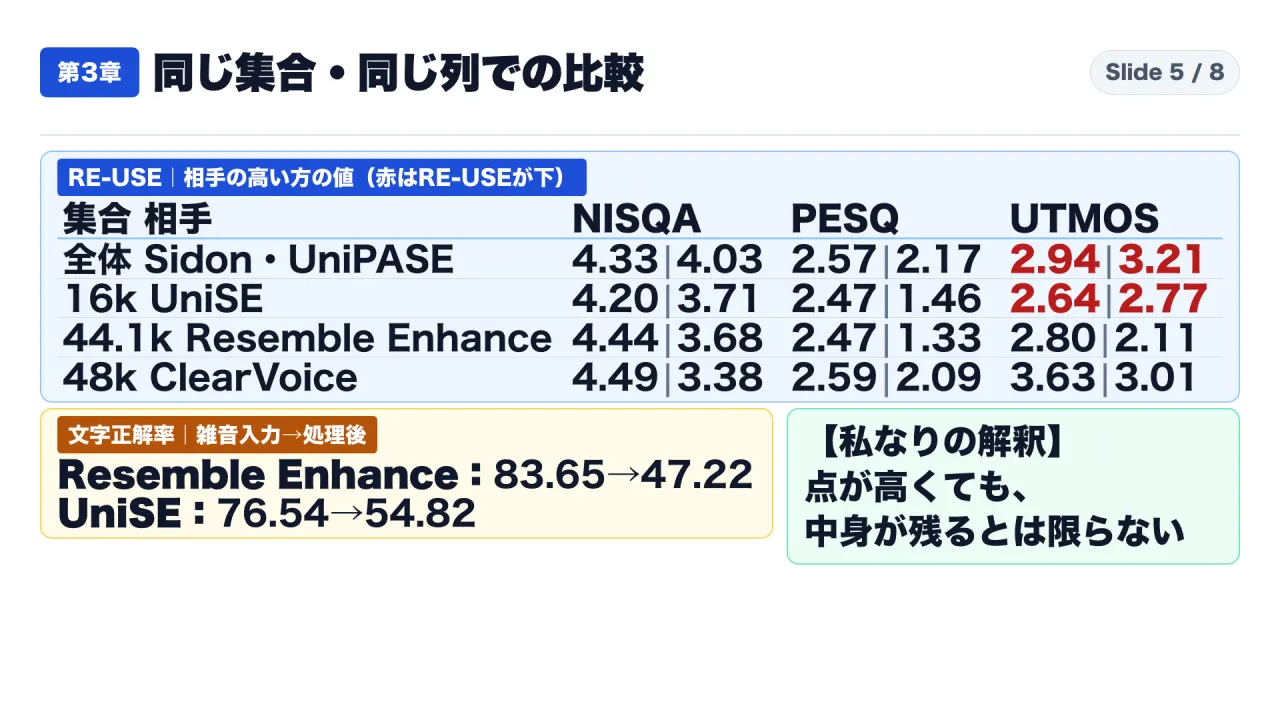
- RE-USE Outperforms Larger Models: In NISQA (4.33 vs 4.03 UniPASE), PESQ (2.57 vs 2.17), and Word Accuracy (89.17% vs 87.28%), RE-USE achieves higher scores despite having 1/25th to 1/50th the parameter footprint.
- RE-USE Trails Competitors: On DNSMOS, Sidon scores 3.34 (vs 3.29). On UTMOS, Sidon scores 3.21 and UniPASE scores 2.96 (vs 2.94). On SpeechBERTScore, UniPASE achieves 0.89 (vs 0.88).
Bandwidth-Specific Subset Evaluations
- 16 kHz Subset: RE-USE (NISQA 4.20, PESQ 2.47, WAcc 87.09%) outperforms UniSE (NISQA 3.71, PESQ 1.46, WAcc 54.82%) on reference metrics, though UniSE edges out RE-USE on DNSMOS (3.23 vs 3.19) and UTMOS (2.77 vs 2.64).
- 44.1 kHz Subset: RE-USE sweeps all metrics against Resemble Enhance (NISQA 4.44 vs 3.68, PESQ 2.47 vs 1.33, WAcc 91.54% vs 47.22%).
- 48 kHz Subset: RE-USE sweeps all metrics against ClearVoice (NISQA 4.49 vs 3.38, PESQ 2.59 vs 2.09, WAcc 91.05% vs 89.92%).
The Semantic Hallucination Trap
The 44.1 kHz comparison with Resemble Enhance exposes a critical vulnerability: Resemble Enhance increases perceived acoustic quality significantly (NISQA 1.79 to 3.68, DNSMOS 1.91 to 3.13), but its Word Accuracy drops from 83.65% to 47.22%.
The research paper notes that generative models can hallucinate synthetic phonemes──producing broadcast vocal timbres while distorting spoken content. Evaluating systems solely via NISQA or DNSMOS without auditing Word Accuracy risks deploying models that silently corrupt technical terms and numbers.
4. Checkpoint Discrepancies, Multilingual Evidence, and Licensing Ambiguities
Divergence Between Research Paper and Model Card
Production engineers should note that weights published on Hugging Face differ from experimental weights detailed in the original arXiv paper:
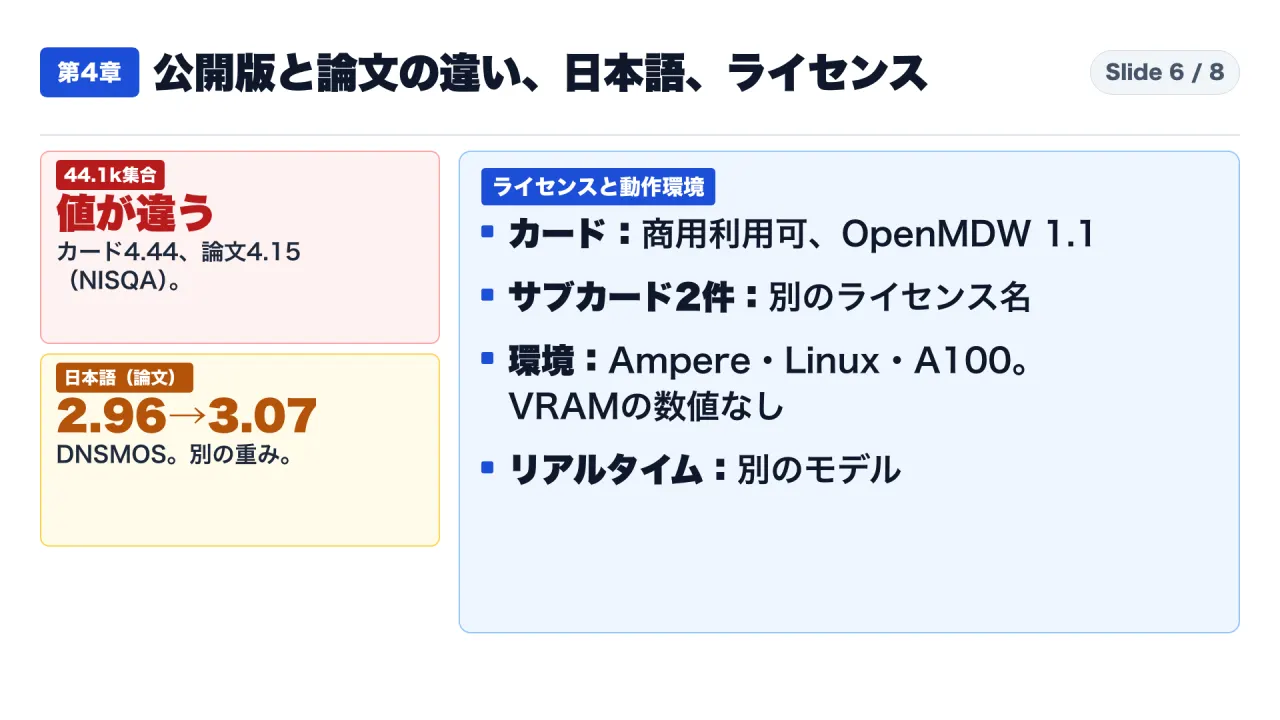
- On 44.1 kHz audio, the Model Card reports NISQA 4.44 / PESQ 2.47 / WAcc 91.54%.
- In contrast, the Research Paper (Table 2) reports NISQA 4.15 / PESQ 2.28 / WAcc 92.20%.
- Checkpoints were fine-tuned on broader degradation profiles, meaning research numbers cannot be assumed to match the release checkpoint identically.
Zero-Shot Evaluation on Japanese Speech
The research paper evaluates out-of-distribution language performance across FLEURS:
| Language (FLEURS) | Input Raw DNSMOS | Enhanced Output DNSMOS | Input Word Acc % | Enhanced Word Acc % |
|---|---|---|---|---|
| Italian | 2.94 | 3.12 | 87.41% | 88.02% |
| Dutch | 2.91 | 3.08 | 84.15% | 85.30% |
| Japanese | 2.96 | 3.07 (+0.11) | 95.34% | 95.30% (-0.04%) |
On Japanese speech, DNSMOS increases modestly by +0.11, while Word Accuracy remains unchanged (95.34% to 95.30%). This single experimental data point indicates modest noise suppression without semantic loss, but provides no empirical guarantee regarding conversational corporate audio.
Licensing Conflicts and Operational Constraints
- Licensing Discrepancy: The root README card and top-level
LICENSEfile declare OpenMDW 1.1 (“ready for commercial use”). However, internal Safety and Explainability sub-cards state governance under the NVIDIA Open Model License. Legal teams must resolve this before commercial embedding. - Non-Causal Architecture: Processing bidirectional context precludes low-latency live streaming (which requires the non-commercial
Real-time RE-USE). Long files require batch chunking (inference_chunk.sh) to prevent OOM exceptions.
5. Practical Implementation: A 6-Step Double-Blind Auditory Audit Protocol
Engineering teams should execute this deterministic verification protocol prior to pipeline integration:
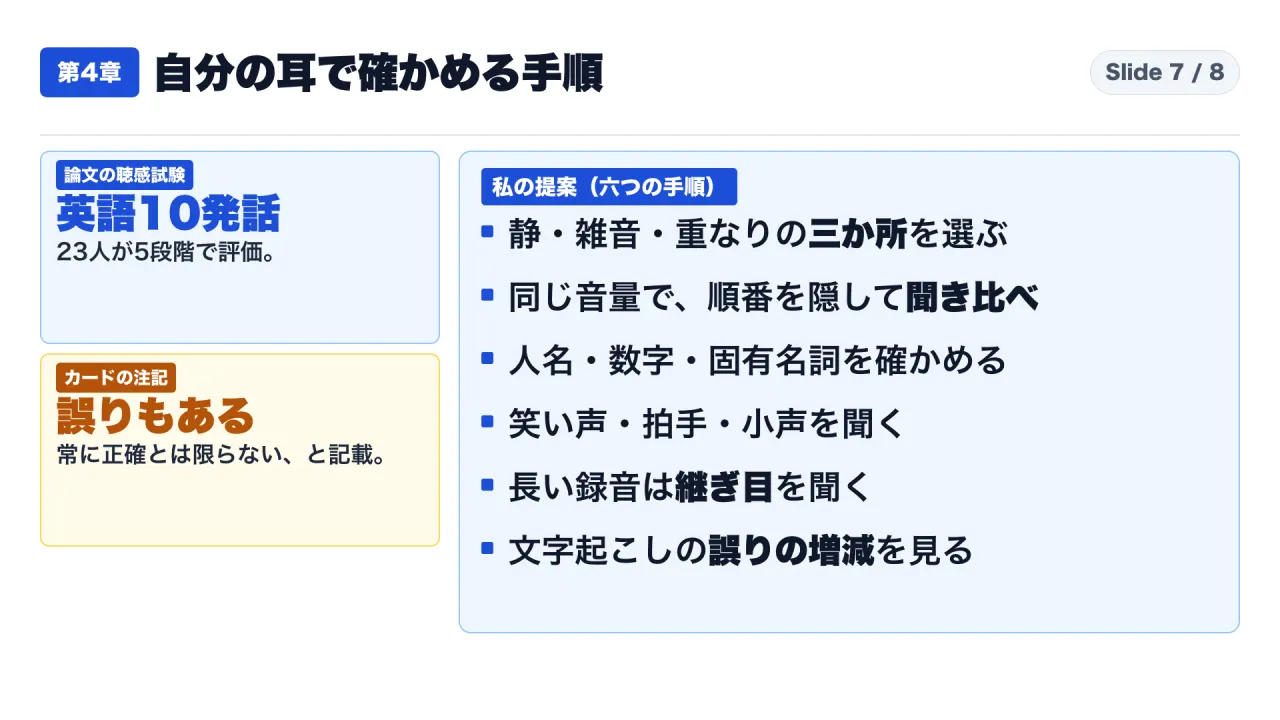
- Segment Extraction Across 3 Acoustic Regimes: Isolate three 30-second segments: (a) a quiet studio baseline, (b) a noisy room with HVAC interference, and (c) an overlapping conversation with multi-party crosstalk.
- Loudness-Equalized Blind A/B Presentation: Normalize unprocessed and processed clips to identical integrated loudness (-23 LUFS / -14 LUFS) and randomize playback order to eliminate volume bias.
- Semantic and Proper Noun Verification: Audit whether proper nouns, numerical figures, and technical acronyms remain intelligible or suffer phonemic distortion.
- Affective and Non-Verbal Sound Preservation: Verify whether laughter or conversational nuances are unnaturally suppressed (auditing whether
RE-USE-laughterweights are required). - Boundary Stitching Audits: For long-form audio processed via sequential chunking (
inference_chunk.sh), inspect the 30-second splice boundaries for phase cancellation or acoustic discontinuities. - Automated Transcription Regression Testing: Transcribe both clips using production ASR engines to confirm that Word Error Rate does not degrade post-enhancement.
Conclusion: Metrics Merited for Testing, Never Sufficient for Governance
NVIDIA’s NemotronLabs RE-USE is a notable technical achievement: packing strong speech enhancement performance into a 9.6M parameter Mamba architecture that outperforms models 50 times its size on several key metrics.
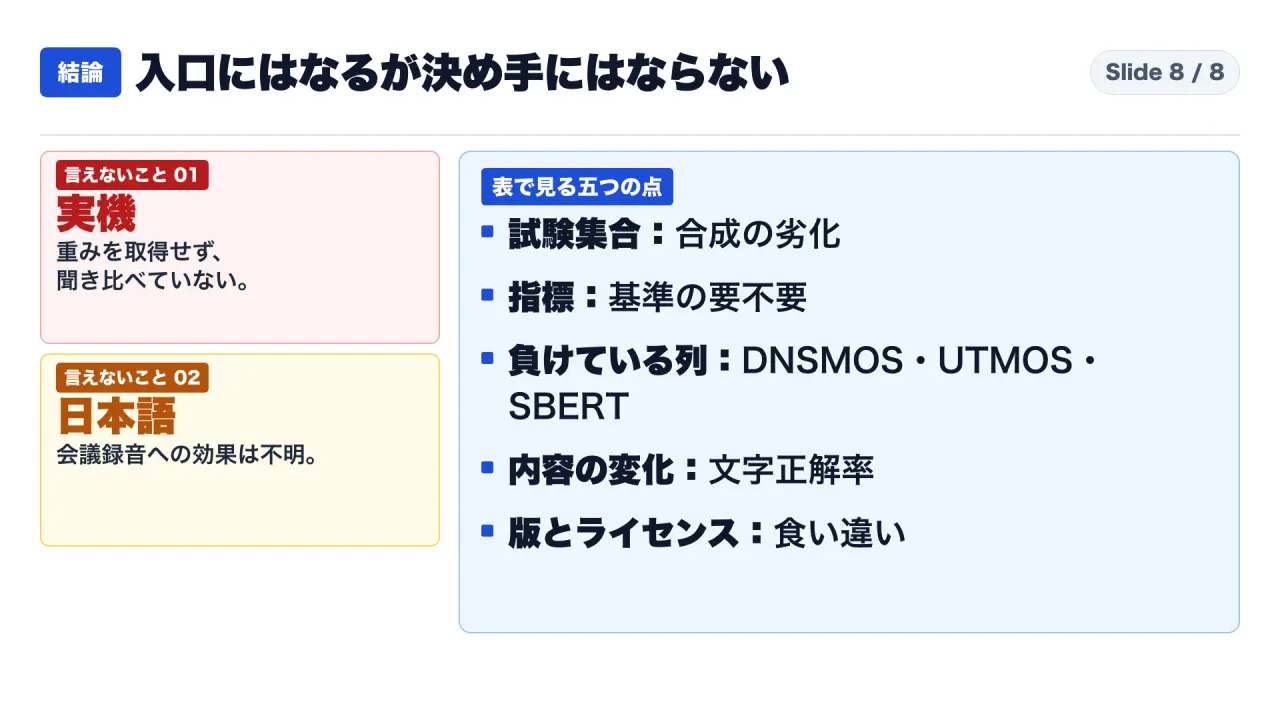
However, production engineering decisions cannot be governed by synthetic benchmark tables alone. NISQA and PESQ indicate that RE-USE is worth evaluating; determining whether it belongs in your production pipeline requires rigorous local verification against your own acoustic environments, language distributions, and semantic fidelity standards.
Primary Sources and References
- NVIDIA NemotronLabs: RE-USE Model Card and Evaluation Repository: https://huggingface.co/nvidia/NVIDIA-NemotronLabs-RE-USE
- arXiv Research Paper: Universal Speech Enhancement with Mamba Architectures (v4, October 6, 2026): https://arxiv.org/abs/2603.02641
- OpenMDW Community: OpenMDW-1.1 License Specification: https://raw.githubusercontent.com/OpenMDW/OpenMDW/refs/heads/main/1.1/LICENSE.OpenMDW-1.1
- NVIDIA Research: RE-USE Original Research Checkpoint (Non-Commercial): https://huggingface.co/nvidia/RE-USE
- NVIDIA NemotronLabs: RE-USE-laughter Variant Model Card: https://huggingface.co/nvidia/NVIDIA-NemotronLabs-RE-USE-laughter
- NVIDIA Research: Real-time RE-USE Low-Latency Architecture: https://huggingface.co/nvidia/Real-time_RE-USE
- NVIDIA AI Communications: Official Technical Announcement of RE-USE (October 30, 2026): https://x.com/NVIDIAAI/status/2116262634349818190
- ITU-T Telecommunication Standardization Sector: Recommendation P.862: Perceptual Evaluation of Speech Quality (PESQ): https://www.itu.int/rec/T-REC-P.862
- arXiv Research Paper: NISQA: A Deep Learning Framework for Speech Quality and Naturalness Assessment: https://arxiv.org/abs/2104.09494
- arXiv Research Paper: DNSMOS P.835: Non-Intrusive Speech Quality Assessment for Online Communication: https://arxiv.org/abs/2110.01763