Zero Data Retention vs. Private Safety Processing: What OpenAI's Enterprise Governance Documentation Actually Guarantees (And What It Leaves Unstated)
A forensic analysis of OpenAI’s enterprise privacy documentation reveals critical distinctions between Zero Data Retention commitments, customer-hosted Private Safety Processing architectures, and residual logging exceptions.
Published: November 1, 2026 | Read time: ~10 min | Watch Video (Japanese)
Executive Summary: The Structural Divide Between Retention and Human Access
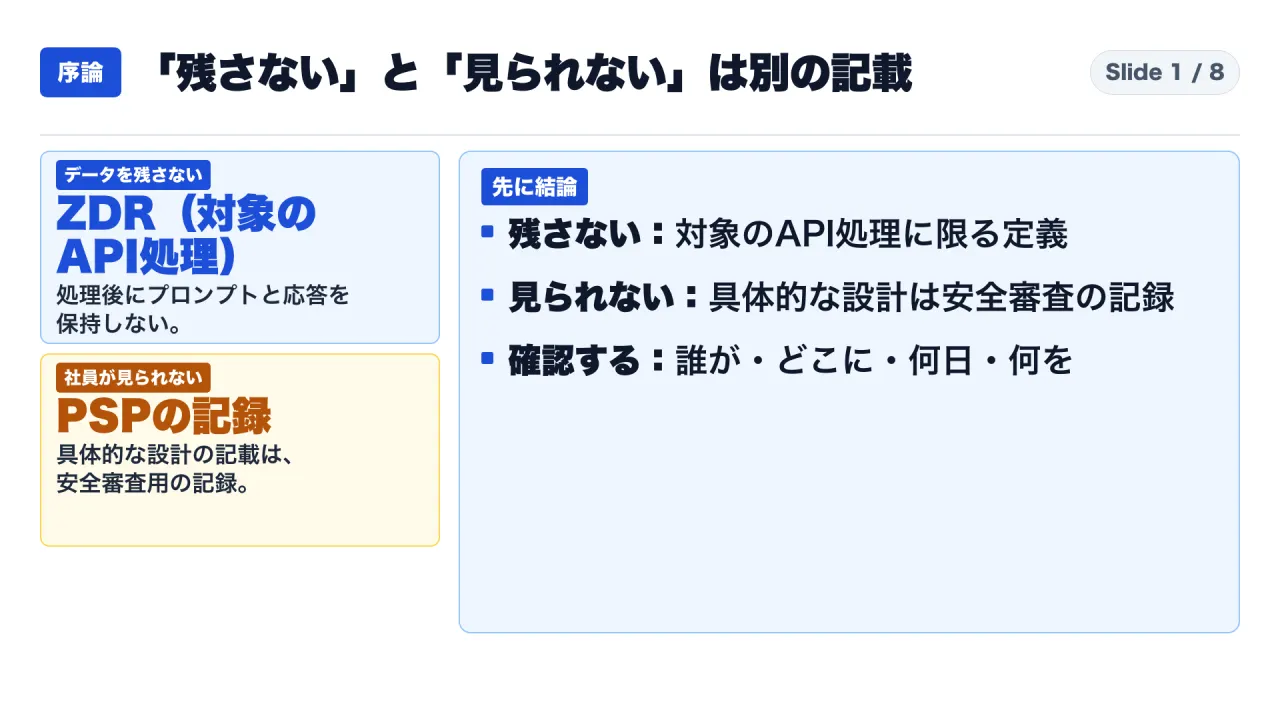
When enterprise procurement teams, information security directors, and legal counsels evaluate whether sensitive corporate IP or regulated datasets can be processed via commercial frontier AI models, marketing collateral frequently coalesces around two assurances: “We do not retain your data” and “Our employees cannot view your conversations.”
However, an exhaustive, line-by-line examination of OpenAI’s official technical documentation, enterprise privacy portals, and API governance guides reveals that these statements describe separate operational architectures subject to explicit preconditions:
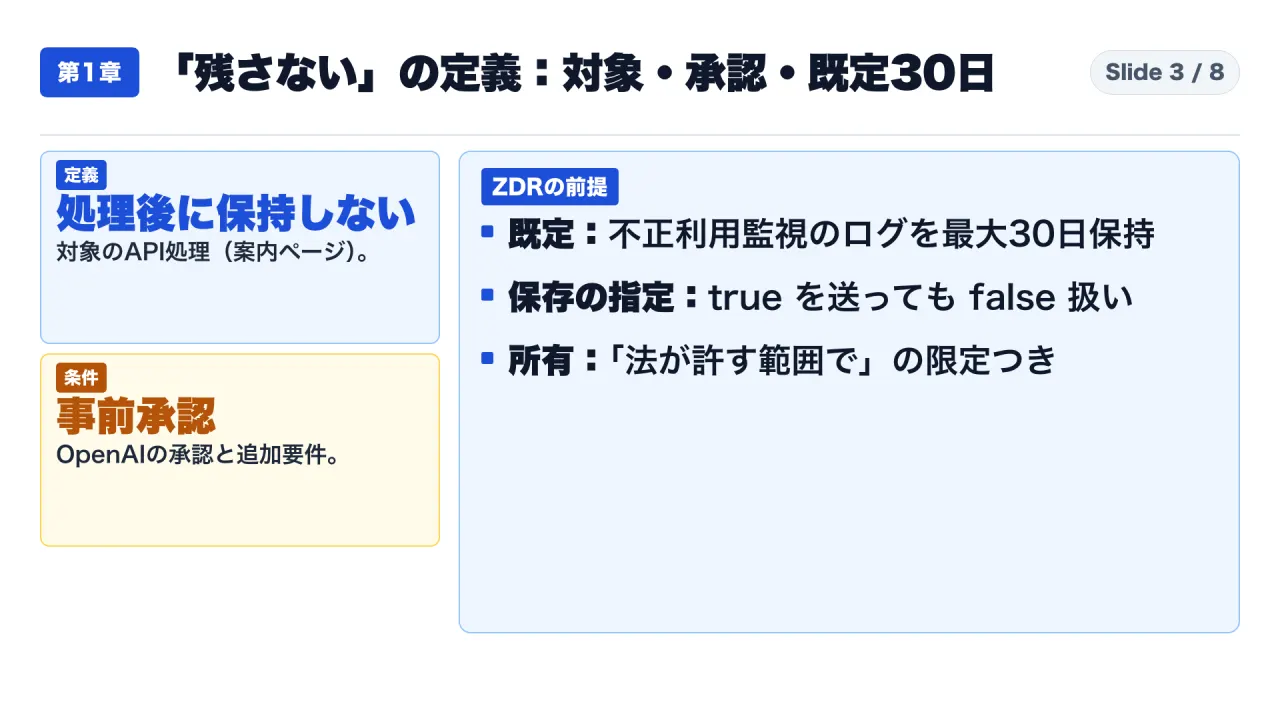
- Zero Data Retention (ZDR) Is Workflow-Restricted and Conditional: In OpenAI’s enterprise materials, ZDR is explicitly defined as exempting eligible API workflows from post-processing persistence of prompts and completions. It does not apply universally across all platform features. Crucially, ZDR requires explicit prior approval from OpenAI and agreement to supplemental terms; in its default state, OpenAI retains abuse monitoring logs for up to 30 days.
- “Employees Cannot View Data” Is Architecturally Anchored in Private Safety Processing (PSP): The concrete technical enforcement preventing human access is detailed specifically within the documentation for Private Safety Processing (PSP). Under PSP, interactions flagged for abuse review are encrypted and written directly to customer-owned cloud storage with a 30-day retention period. OpenAI’s personnel are isolated via hardware-attested, human-inaccessible execution enclaves. Outside PSP, limited human access permissions persist for authorized personnel regarding support incidents, abuse escalations, and mandatory legal compliance (specifically Child Sexual Abuse Material detection).
- Residual Data Persistence Paths: Even when an enterprise obtains ZDR approval, data persistence remains active across five defined architectural vectors: stateful API endpoints (Assistants, Threads, Vector Stores), mandatory safety image classifiers, external Model Context Protocol (MCP) servers, GPU-level prompt caching, and contractual safety revocation carve-outs.
To safeguard corporate IP, enterprise IT leaders must transition from conversational vendor assurances to formal, written contractual schedules structured across who, where, for how long, and under what cryptographic controls data is held.
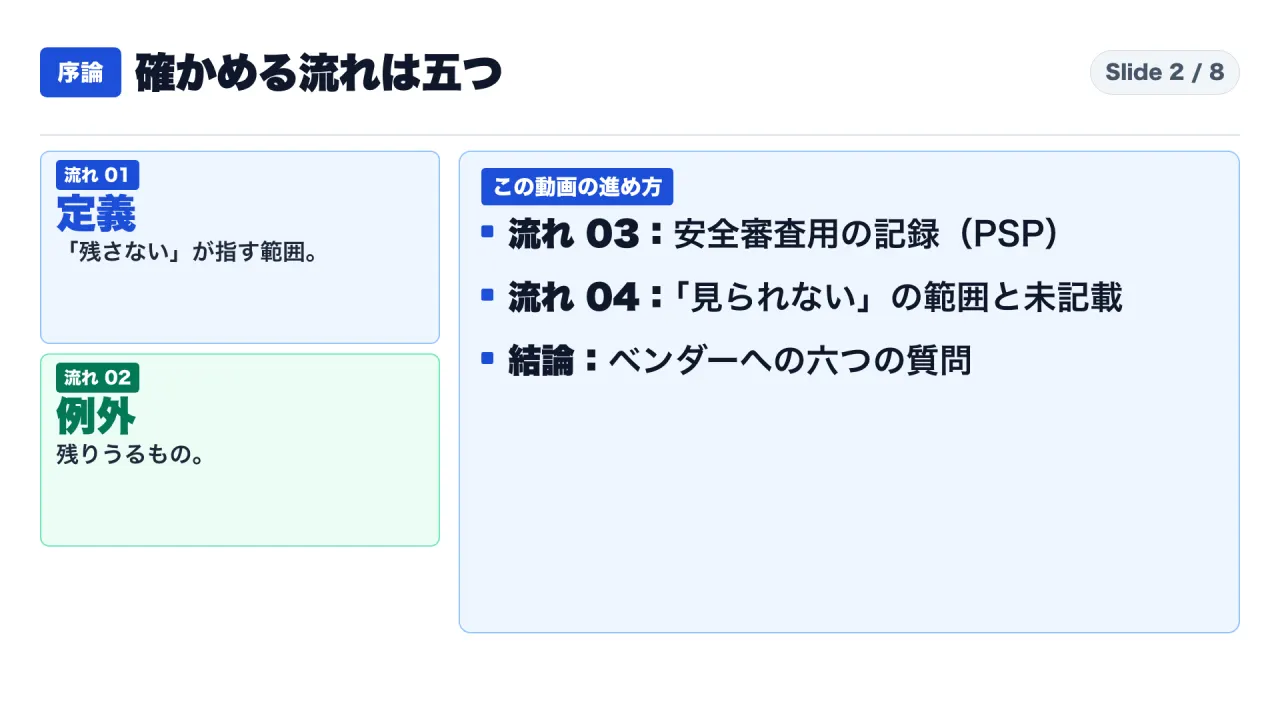
Methodological Framework: Separating Official Disclosures, Conversions, and Interpretations
To provide unambiguous clarity, this analysis segregates assertions into three distinct categories:
- Official Disclosures: Statements transcribed verbatim from OpenAI’s corporate marketing pages, developer API documentation guides, and official platform social releases.
- Calculated Conversions: Mathematical or temporal derivations performed directly from published timestamps.
- Technical Interpretations & Framework Recommendations: Analytical deductions formulated to assist enterprise buyers in auditing SaaS compliance claims.
Document Retrieval and Verification Constraints
All citations derive from official primary sources verified in November 2026:
- OpenAI Private Intelligence Business Overview (OpenAI Business)
- Offering Zero Data Retention for Frontier Models (OpenAI Index)
- Enterprise Privacy Commitments (OpenAI Enterprise Privacy)
- OpenAI API Platform Guide: Your Data (OpenAI Developers Your Data)
- OpenAI API Technical Guide: Private Safety Processing (OpenAI Developers PSP)
Note: The developer guide links to a technical whitepaper covering confidential execution enclaves whose underlying hardware specifications are referenced but not independently verified via laboratory audits.
1. Zero Data Retention: Definition, Prior Approval, and Default Realities
Enterprise leadership frequently assumes that signing an enterprise agreement automatically guarantees Zero Data Retention across all interactions. The API documentation paints a more nuanced picture.
The Contractual Definition of ZDR
OpenAI’s enterprise portal frames privacy around four pillars: Access Restrictions, Data Ownership, Agent Actions, and Data Security. Within the Access Restrictions section, ZDR is defined as follows:
“Zero Data Retention applies to eligible API workflows, ensuring that prompts and completions are not retained on OpenAI systems post-processing.”
In parallel, the developer documentation states that ZDR removes customer content from abuse monitoring logs. Comparing these descriptions reveals that ZDR is not an absolute erasure of system memory; it is an administrative exemption from standard abuse logging.
Baseline Realities and Preconditions
Three operational conditions govern ZDR:
- Default 30-Day Logging: In the baseline state (without approved ZDR), OpenAI automatically generates abuse monitoring logs for all API interactions, retaining payload data for up to 30 days. Retention may exceed 30 days when legally mandated or reasonably necessary to remediate malicious attacks.
- Prior Approval Requirement: ZDR is not self-serve. Enabling ZDR requires explicit submission, review, and prior written approval from OpenAI, alongside adherence to supplemental terms.
- Endpoint Parameter Inversion: When ZDR is approved on a project, sending
store: truein/v1/responsesor/v1/chat/completionsrequests is automatically overridden and treated by the runtime asstore: false.
Scope of Data Ownership
While marketing headlines state “You own your business data,” the underlying Enterprise Privacy agreement bounds this assertion with critical legal qualifiers: “As between you and OpenAI, and to the extent permitted by applicable law.” By default, customer enterprise data is not utilized to train foundation models unless the customer provides explicit affirmative consent.
2. The 5 Persistence Vectors: Where Data Remains Despite ZDR
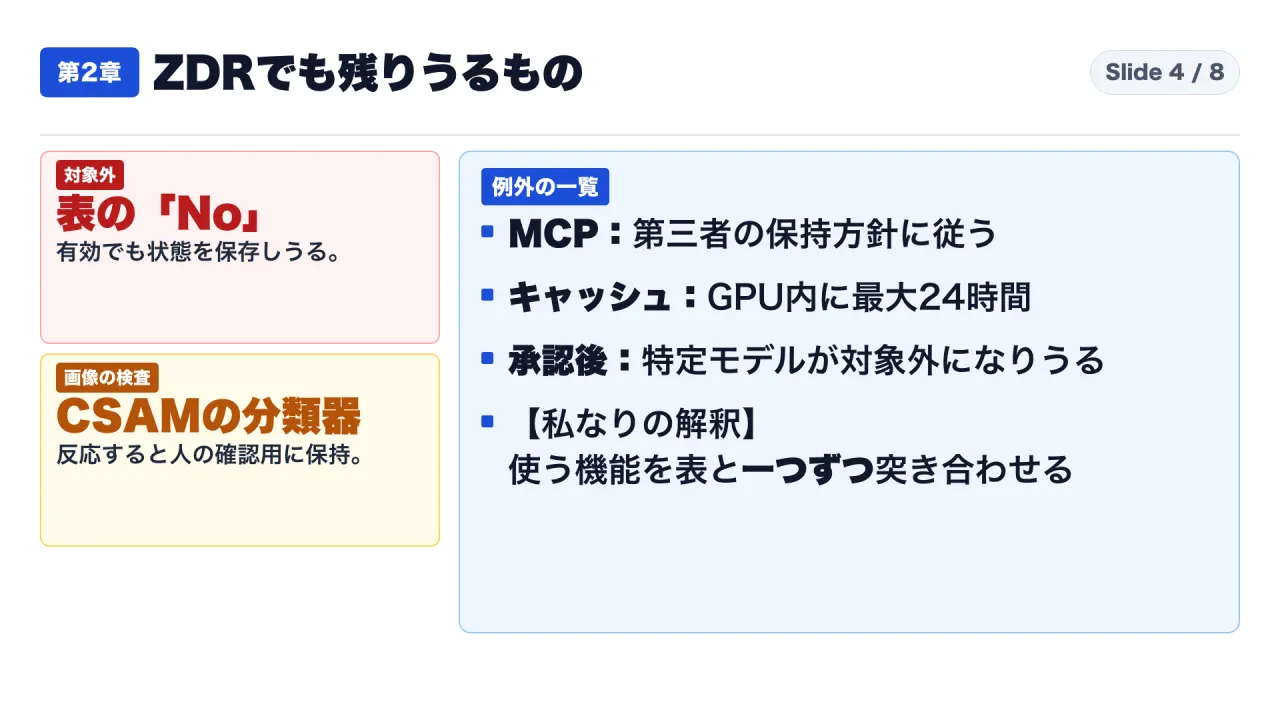
Procurement teams must recognize that enabling ZDR does not eliminate data residency risks. Official documentation identifies five operational scenarios where customer payloads persist:
Vector 1: Ineligible Stateful API Endpoints
The developer documentation maintains an explicit matrix indicating whether specific API endpoints are “Zero Data Retention eligible”:
- Ineligible Stateful Objects: Endpoints supporting conversational state──including Assistants, Threads, and Vector Stores──are designated as ineligible. State objects uploaded to these endpoints persist indefinitely on OpenAI infrastructure until the customer explicitly initiates a programmatic API deletion or dashboard purge.
- Uploaded Files: Files submitted via the
/v1/filesendpoint remain stored until manually purged or automatically removed via an optional customer-specifiedexpires_aftertimestamp.
Vector 2: Mandatory Image and File Classification (CSAM Exception)
All images and files uploaded through API endpoints pass through automated classification models to intercept Child Sexual Abuse Material (CSAM).
Crucially, documentation notes that if an automated classifier flags an uploaded artifact as potential CSAM, the data is retained for mandatory human review and regulatory reporting, superseding all ZDR contractual configurations.
Vector 3: External Model Context Protocol (MCP) Servers
When enterprise models connect to external tools via the open Model Context Protocol (MCP), data transferred to remote MCP servers is entirely decoupled from OpenAI’s governance boundary. Telemetry dispatched across external tools is governed exclusively by the third-party provider’s independent privacy and retention policies.
Vector 4: Ephemeral GPU-Level Prompt Caching
To reduce API latency, prompt caching mechanisms retain encrypted key-value (KV) representations of frequently repeated prompt segments directly within GPU physical memory. While these memory states expire and purge within a 24-hour Time-to-Live (TTL) window, they represent transient physical hardware residency.
Vector 5: Post-Approval Revocation Rights and Safety Carve-Outs
OpenAI explicitly reserves the right to modify or revoke ZDR eligibility for specific enterprise customers upon advance written notification:
- Private Retention with PSP (formerly Eyes Off): OpenAI may transition high-risk or specialized workloads to an architecture where payloads are stored in encrypted form on OpenAI infrastructure, isolated from human review except where required by law.
- Safety Retention Carve-Outs: If automated classifiers detect sustained indicators of severe terms-of-service violations or dangerous platform abuse, OpenAI reserves the authority to exempt specific models from ZDR, retaining flagged payloads for human audit.
3. Private Safety Processing (PSP): Customer-Hosted, Double-Encrypted Governance
To bridge the tension between customer privacy and abuse monitoring, OpenAI engineered Private Safety Processing (PSP) (OpenAI API PSP Guide).
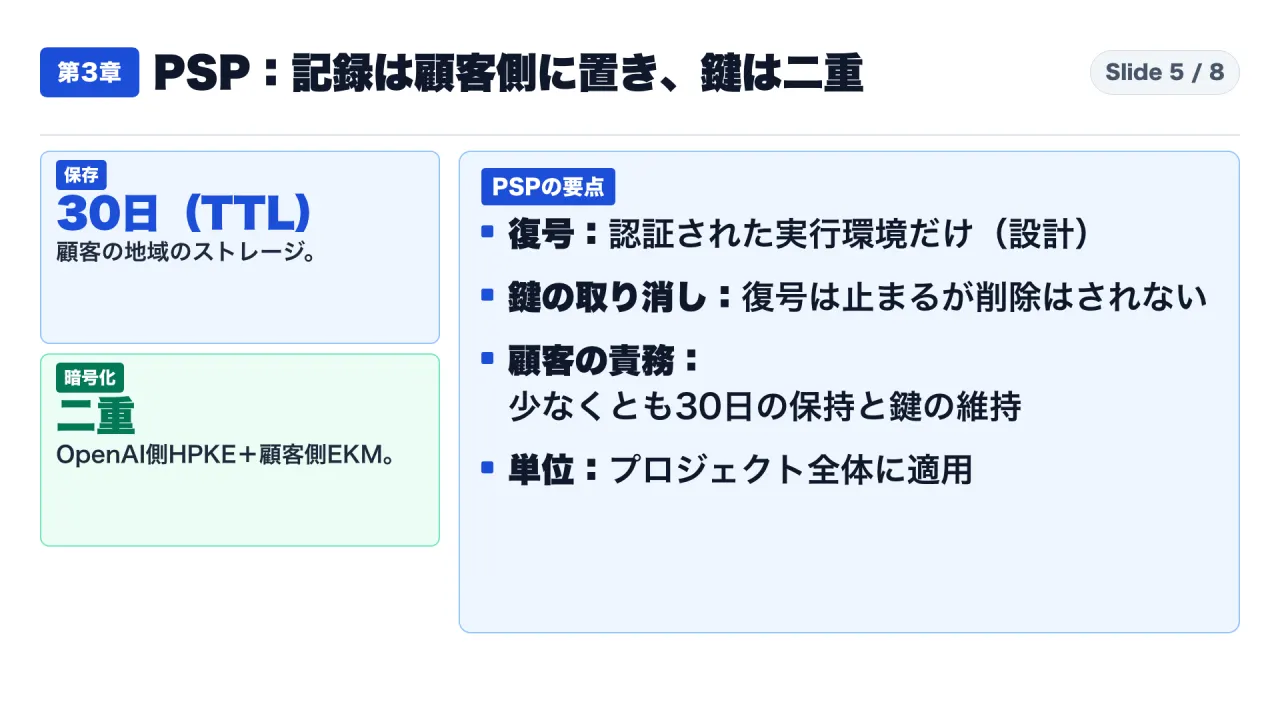
The Architectural Mechanics of PSP
Originally previewed for frontier models with phased deployment documented in an update on September 22, 2026, PSP eliminates central data pooling by relocating safety telemetry into the customer’s perimeter:
[ Customer Client Application ] ─── (API Request) ───► [ OpenAI Runtime Enclave ]
                                                                 │
                                                       (Sampling / Trigger)
                                                                 │
                                                                 ▼
[ Customer Cloud Storage (30-Day TTL) ] ◄── (Ciphertext) ── [ Double Encryption ]
├── AWS S3 / Azure Blob / GCS / OCI                         ├── Inner: OpenAI HPKE
└── Managed via Customer EKM                                └── Outer: Customer EKM
The 4 Pillars of PSP Execution
- Selective Sampling Over Bulk Ingestion: PSP does not retain 100% of enterprise transactions. Payload captures are triggered exclusively when automated safety classifiers detect an anomaly or via statistically randomized sampling policies.
- Customer-Owned Cloud Storage: Captured interactions are written directly into a storage bucket provisioned within the customer’s cloud tenancy. Supported cloud destinations include Amazon Web Services (AWS) S3, Microsoft Azure Blob Storage, Google Cloud Storage (GCS), and Oracle Cloud Infrastructure (OCI) Object Storage.
- Dual-Layer Envelope Encryption:
- Inner Layer: Encrypted via Hybrid Public Key Encryption (HPKE) managed by OpenAI.
- Outer Layer: Encrypted via the customer’s cloud Key Management Service utilizing Enterprise Key Management (EKM).
- Decryption Invariant: Decrypting the payload requires simultaneous key authorization from both parties.
- Hardware-Attested Isolated Enclaves: When safety analysis is performed, payloads are processed inside a dedicated Safety Review Runtime. This environment is hardware-attested, isolated from network ingress, and engineered with human administrative access disabled. The enclave emits only discrete, pre-approved safety metrics and operational signals.
Key Revocation and Customer Operational Liabilities
If an enterprise revokes its EKM key authorization, OpenAI’s Safety Review Runtime instantly loses the ability to decrypt stored records. However, revoking the key does not automatically delete stored ciphertext records.
Furthermore, adopting PSP imposes operational obligations on the enterprise: the customer must contractually agree to maintain the encrypted storage buckets for at least 30 days, preserve KMS access permissions, and respond to critical safety escalations. Terminating storage connections can result in immediate administrative deactivation of models requiring PSP governance.
4. The Scope of “Employees Cannot View Data” Across Different Service Tiers
Claims regarding employee access restrictions vary significantly depending on which corporate service tier is evaluated:
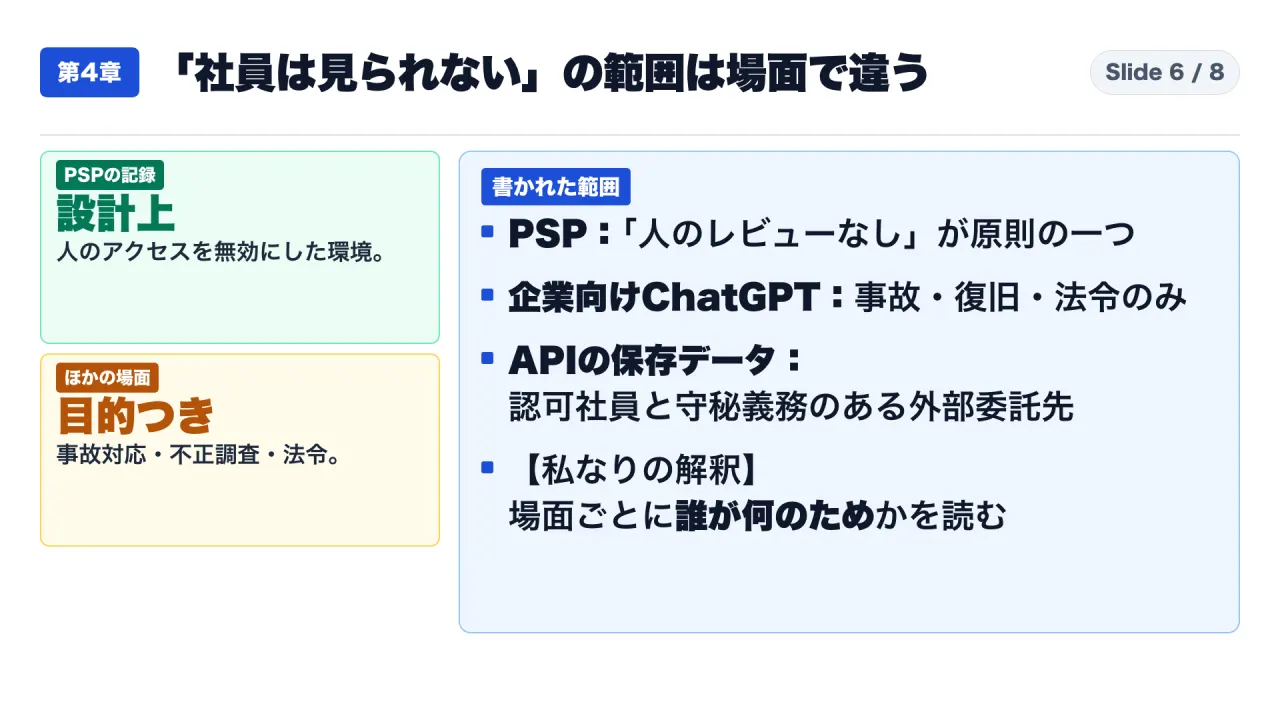
Mapping Human Review Permissions Across Operational Contexts
| Operational Context | Explicit Boundary Documented in Official Disclosures | Unstated Boundaries & Governance Caveats |
|---|---|---|
| Private Safety Processing (PSP) | Payloads decrypted exclusively inside hardware-attested enclaves with human access disabled. | External independent auditing tools to verify enclave attestation are unstated. |
| ZDR API Frontier Models | Primary text notes personnel cannot view customer content; footnote discloses mandatory CSAM exception. | Full scope of potential statutory reporting exceptions beyond CSAM is not enumerated. |
| Enterprise ChatGPT (Team / Edu) | Authorized personnel may access conversations strictly for incident debugging, explicit recovery, and legal compliance. | Does not apply to API endpoints; internal audit mechanisms for employee access logs unstated. |
| Standard API Stored Data | Access restricted to authorized personnel and bound external vendors for engineering support and abuse review. | Exact procedural overlap between standard access and ZDR edge cases is not formally delineated. |
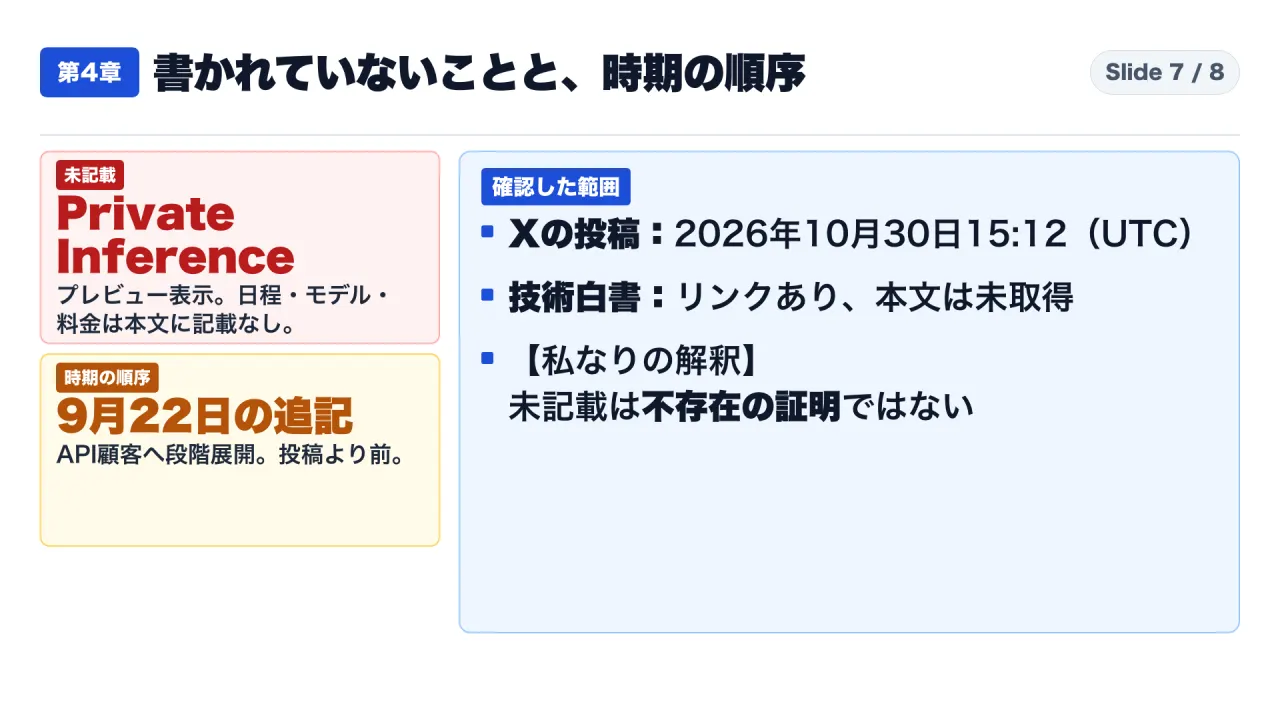
The Status of Private Inference
On its enterprise business portal, OpenAI references Private Inference as a “preview” feature engineered to protect prompts and completions during runtime processing via confidential computing.
However, primary documentation leaves key commercial terms unstated: supported foundation models, official general availability milestones, and infrastructure surcharge rates remain undisclosed.
Chronological Verification of Public Disclosures
Temporal tracking confirms that OpenAI’s official social post announcing Private Intelligence occurred on October 30, 2026 at 15:12 UTC (October 31, 2026 at 00:12 JST). Crucially, the official technical blog post detailing Zero Data Retention incorporates a documented update dated September 22, 2026, confirming that phased enterprise testing of PSP preceded the October public campaign by more than a month.
5. Enterprise Due Diligence: 6 Mandatory Written Inquiries for AI Vendors
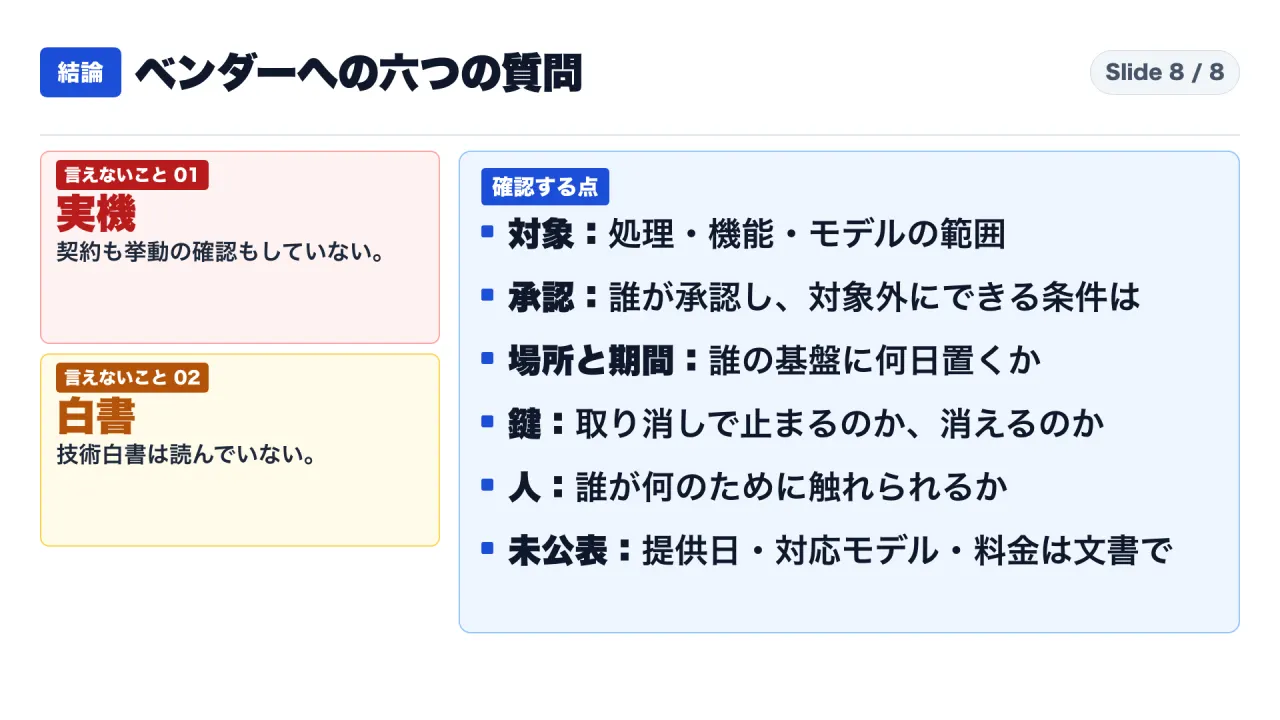
Enterprise security directors should submit the following structured inquiries in writing prior to processing confidential corporate data:
[ Enterprise RFP / Governance Committee ]
                     │
                     ▼
  [ 6 Mandatory Written Inquiries ]
  ├── 1. Complete ZDR Endpoint Eligibility Schedule
  ├── 2. Approval Protocols & Revocation Notice Periods
  ├── 3. Storage Tenancy, Residency, and TTL Bounds
  ├── 4. Cryptographic Key Revocation & Purge Mechanics
  ├── 5. Granular Human Access Exceptions & Enclave Audits
  └── 6. MCP Third-Party Data Residency & Preview Terms
- Endpoint Eligibility Schedule: Provide an exhaustive matrix identifying which API endpoints and model variants qualify for Zero Data Retention, specifically designating stateful features that retain objects indefinitely.
- Administrative Approval Criteria & Notice Windows: Detail the procedural thresholds required for ZDR approval, alongside contractually binding advance notice windows before models can be transitioned to Safety Retention.
- Storage Tenancy and Retention Geographies: Confirm whether safety review telemetry is stored in vendor infrastructure or customer-owned cloud tenancy (AWS, Azure, GCS, OCI), specifying geographic region availability and strict 30-day lifecycle enforcement.
- Cryptographic Key Revocation and Purge Guarantees: Define the technical sequence triggered upon KMS key revocation, distinguishing between decryption suspension and the physical deletion of underlying ciphertexts.
- Human Access Matrices and Enclave Attestation: Enumerate every operational scenario permitting human inspection, backed by external audit mechanisms verifying that isolated execution enclaves cannot be accessed by vendor staff.
- Third-Party Integrations and Roadmap Terms: Clarify third-party data governance across remote Model Context Protocol (MCP) integrations, and document official availability dates and pricing schedules for preview features like Private Inference.
Primary Sources and References
- OpenAI Business: Private Intelligence: Enterprise Access Restrictions and Security Overview: https://openai.com/business/private-intelligence/
- OpenAI Research: Offering Zero Data Retention for Frontier Models (Updated September 22, 2026): https://openai.com/index/offering-zero-data-retention-for-frontier-models/
- OpenAI Enterprise Privacy: Enterprise Privacy Commitments, Data Ownership, and Governance: https://openai.com/enterprise-privacy/
- OpenAI Platform Documentation: Your Data: Retention, Logging, and Enterprise Compliance Guide: https://developers.openai.com/api/docs/guides/your-data
- OpenAI Platform Documentation: Private Safety Processing: Implementation Guide and Cloud Storage Integration: https://developers.openai.com/api/docs/guides/private-safety-processing
- OpenAI Official Communications: Platform Intelligence and Privacy Architecture Announcement (October 30, 2026): https://x.com/OpenAI/status/2116186509384815084