When Mutual TLS Validates the Entire Certificate Chain: What the LXD, Incus, and MicroCloud Security Advisories Confirm and Omit
A technical analysis of CVE-2026-112816 mTLS certificate chain validation flaws across Canonical LXD, MicroCloud, and Incus, auditing network exposure conditions and defensive remediation.
Japanese Edition: Read the original Japanese article on Substack
Video Episode (Japanese Audio): Watch on YouTube
Executive Summary: Full-Chain Comparison Flaws, Exposure Gates, and Patch Realities
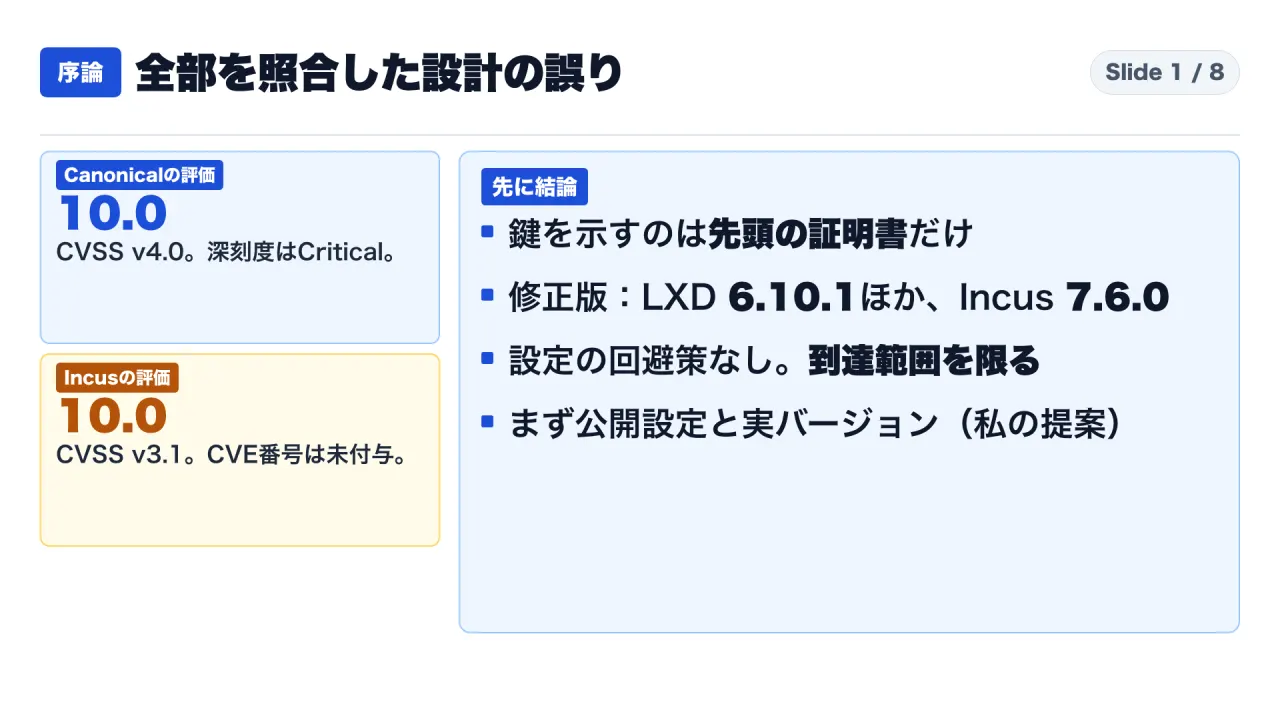
In late October 2026, security advisories issued by Canonical and the Linux Containers Incus project disclosed a critical vulnerability (CVE-2026-112816) affecting mutual Transport Layer Security (mTLS) authentication across LXD, Incus, and MicroCloud daemon architectures. The vulnerability stemmed from an architectural defect in API certificate verification: the daemon authentication routine compared every certificate supplied in an incoming client certificate chain against the server local trust store, despite cryptographic proof-of-possession (the TLS handshake signature) validating only the private key of the initial leaf certificate.
Consequently, an unauthenticated network attacker reaching the HTTPS management listener could establish a valid TLS handshake using an arbitrary self-generated leaf certificate, append the known public certificate of a legitimate trusted client as an intermediate entity in the chain, and achieve authenticated access without possessing the trusted client private key. In Incus deployments, maintainers documented that the flaw extended further: attackers could present server certificates or cluster member certificates, completely bypassing administrative authorization.
However, enterprise risk exposure is tightly bounded by infrastructure network topology:
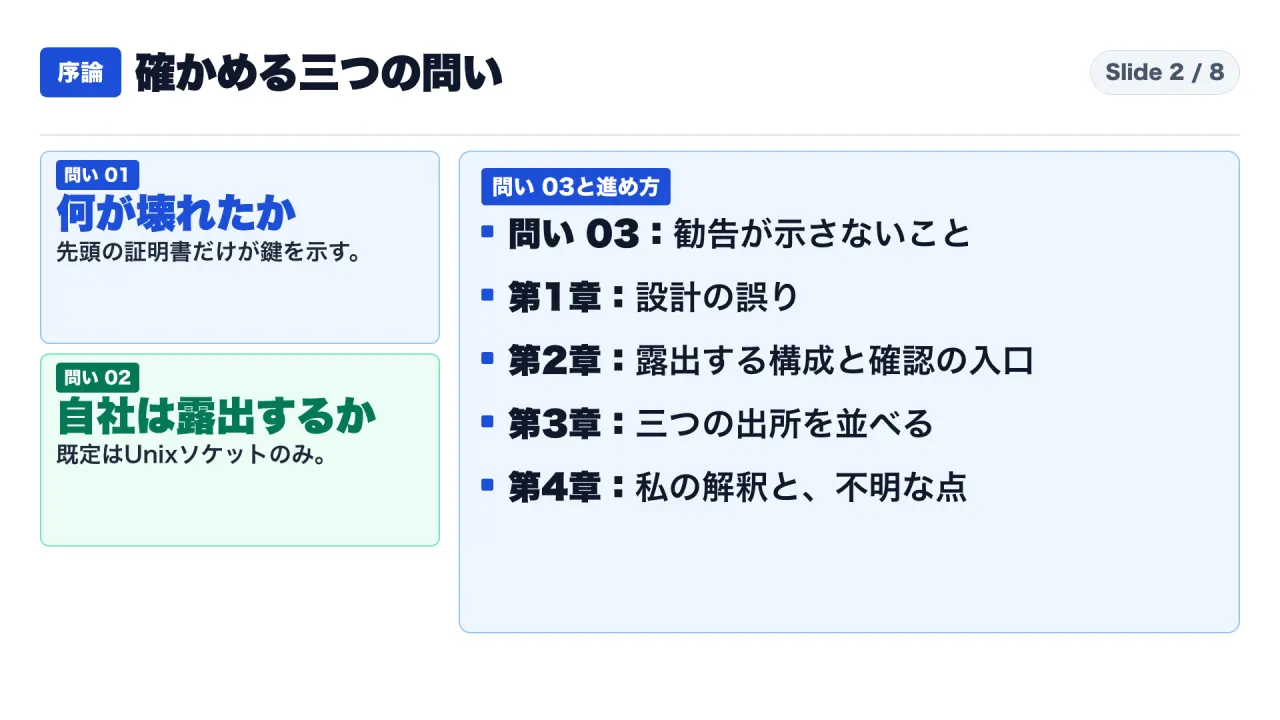
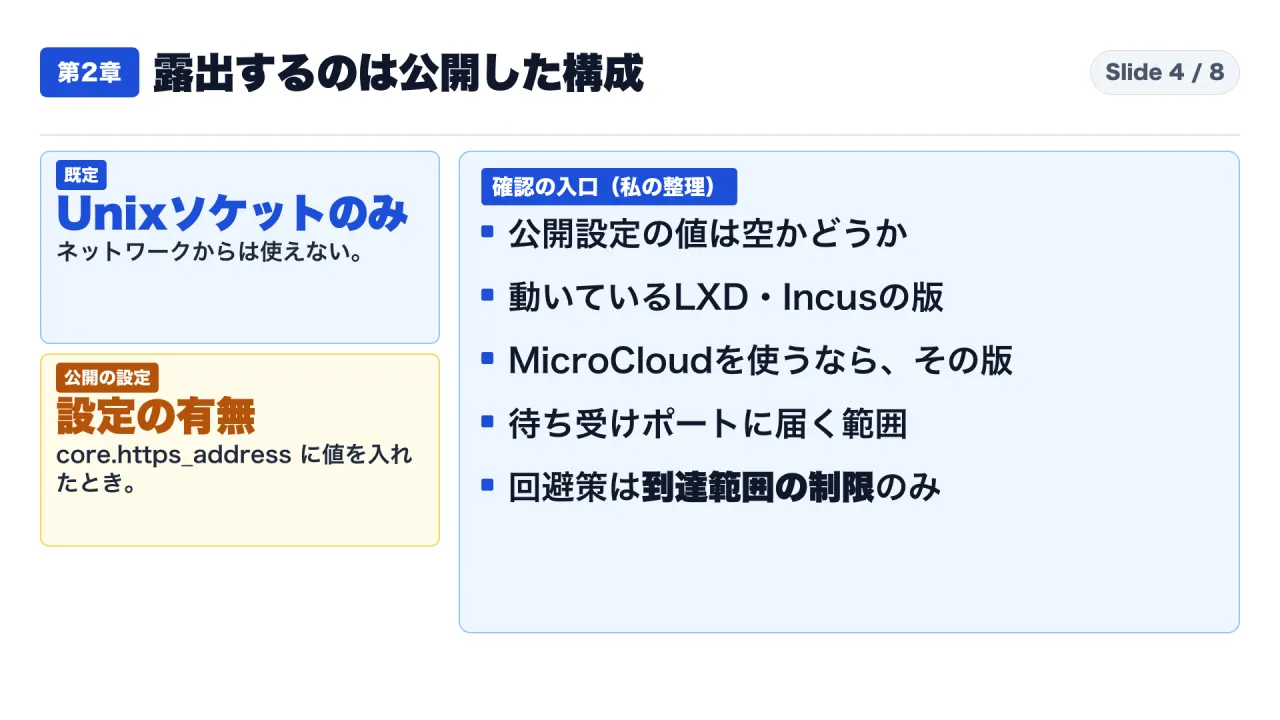
- Default Safety: By default, both LXD and Incus listen exclusively on local Unix domain sockets, remaining unreachable over network interfaces.
- Exposure Condition: Vulnerability exposure occurs only when administrators explicitly configure a network listening address via
core.https_address. - Remediation Releases: Fixed releases comprise Canonical LXD versions 6.10.1, 5.21.9, 5.0.11, and 4.0.15; MicroCloud versions 3.4.1 and 2.1.5; and Incus version 7.6.0.
- No Configuration Workaround: Neither vendor provided a configuration workaround; Incus explicitly noted that the sole operational mitigation prior to patching was restricting network reachability via host firewalls.
For systems administrators and security officers managing Linux container environments, this analysis delivers three operational capabilities:
- Explaining the precise cryptographic failure mechanism according to primary vendor advisories.
- Determining infrastructure exposure through a two-step audit of network configuration keys and active daemon versions.
- Auditing discrepancies across CVE records, distribution trackers, and phased software deployment channels.
Methodological Boundaries: Documented Records, Author Calculations, and Interpretation
This evaluation classifies statements into four categories:
- Documented Records: Explicit dates, CVE metrics, and version strings recorded in CVE.org, NVD, Snap Store APIs, and official project GitHub repositories.
- Vendor Advisory Descriptions: Technical explanations and impact assessments published directly within Canonical Discourse notices and Incus security advisories.
- Author Calculations: Mathematical elapsed times and delta calculations derived from published timestamps.
- Author Interpretation: Structural deductions and defensive workflows synthesized by the author, explicitly designated as analytical frameworks.
All primary records were retrieved on November 2, 2026, reflecting documentation available as of that date.
Technical Foundations: The Mechanics of Mutual TLS Authentication
Evaluating CVE-2026-112816 requires examining standard mTLS authentication primitives:
- Mutual TLS (mTLS): A protocol configuration where both client and server exchange x509 digital certificates to establish reciprocal cryptographic identity.
- Certificate Chain: A hierarchical sequence linking an end-entity certificate through intermediate CAs to a trusted root.
- Leaf Certificate: The first certificate in the presented chain representing the connecting endpoint. In standard TLS handshakes, the client proves ownership of the corresponding private key by signing handshake challenge data (
CertificateVerify). - Server Trust Store: An internal database of x509 certificate fingerprints explicitly authorized by the administrator to access the daemon API.
- Cryptographic Principle: Public certificates are public data; their security relies entirely on the premise that only the legitimate owner possesses the corresponding private key.
Section 1: Anatomy of the Vulnerability: What Failed in the Authentication Logic
The Canonical Advisory Perspective
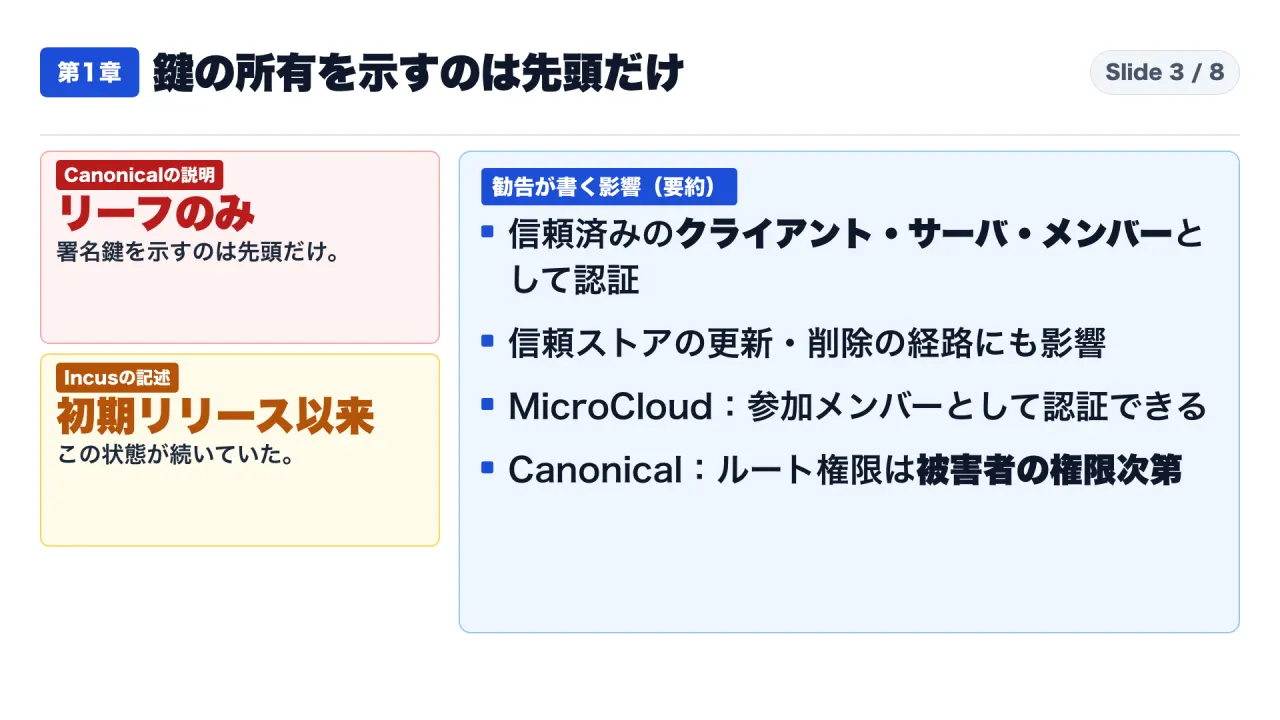
Canonical published its security advisory on October 28, 2026, at 17:50 UTC. The advisory identified the root failure: the mTLS API authentication handler iterated across all certificates provided in the client-supplied certificate chain, comparing each certificate against entries in the daemon trust store. However, cryptographic possession of the corresponding private key is verified only for the leaf certificate.
Canonical explained that an attacker could construct a custom certificate chain placing an arbitrary attacker-controlled certificate at the leaf position (satisfying the private-key handshake challenge) and embedding a legitimate user public certificate as an intermediate certificate. Because the daemon searched the entire chain for any match against its trust store, the connection authenticated successfully as the trusted identity. Canonical noted that depending on privileges of the impersonated certificate, the attacker could potentially obtain host root access.
The Incus Advisory Perspective
The Incus project published its advisory (GHSA-xg75-xf37-cph9) on October 29, 2026, at 22:17 UTC (28 hours and 26 minutes after Canonical, by author calculation). Incus noted that the HTTPS listener requested client certificates but did not validate the chain against a static CA during the TLS handshake. Consequently, the client remained free to supply arbitrary certificates in intermediate positions.
Incus documented a broader impact profile than Canonical:
- Attackers could authenticate as trusted administrative clients, metrics collectors, or server nodes.
- Attackers could authenticate as existing cluster members, completely bypassing administrative authorization.
- Server certificates are transmitted in plaintext during every standard TLS handshake, requiring zero prior privileged access to harvest a trusted certificate.
- The defect affected trust store management endpoints and daemon-to-agent communications between hypervisors and virtual machines.
- Unvalidated certificate chains were forwarded to authorization scriptlets, potentially corrupting authorization decisions even for sessions authenticated via tokens or OpenID Connect (OIDC).
- The vulnerability had been present since the initial release of Incus.
In MicroCloud deployments, Canonical warned that an attacker intercepting the public TLS certificate of a joining cluster member could authenticate as that member.
CVE Classification and Scope
CVE.org published CVE-2026-112816, assigned by Canonical with the title “Improper Certificate Validation in LXD HTTPS Listener” (CWE-295). Incus listed both CWE-287 and CWE-295.
CVE.org documented affected LXD version intervals as: 4.0.14 to <4.0.15, 5.0.10 to <5.0.11, 5.21.8 to <5.21.9, and 6.9.0 to <6.10.1. While Incus confirmed the defect existed since initial project inception, the LXD CVE record designated only recent maintenance windows as affected. Administrators maintaining older unsupported installations should assume identical underlying vulnerability.
Section 2: Exposure Analysis: Network Configurations and Attack Surfaces
Enterprise vulnerability requires two preconditions: an open network listener and knowledge of a trusted public certificate.
Default Local Isolation
Official documentation confirms that default installations do not expose network sockets. Daemons interact exclusively with local system users through a privileged Unix domain socket (/var/snap/lxd/common/lxd/unix.socket or /var/lib/incus/unix.socket). Systems operating strictly under default Unix socket configurations are not network-reachable and cannot be exploited remotely via CVE-2026-112816.
The Exposure Trigger: core.https_address
A deployment becomes exposed when an administrator configures a network listening interface:
lxc config set core.https_address :8443
incus config set core.https_address :8443
This configuration opens an HTTPS API listener to facilitate multi-node clustering, remote administration via CLI or web UI, and automation integration.
MicroCloud Architectural Exposure
Unlike standalone LXD nodes, MicroCloud clusters inherently configure network listeners during bootstrap to coordinate distributed Ceph storage and OVN networking. Consequently, MicroCloud nodes cannot be presumed safe by default; administrators must verify installed release versions directly.
Section 3: Dissecting Advisory Discrepancies: Releases, Scoring, and Timelines
Comparing disclosures across Canonical, Incus, and distribution trackers reveals significant divergences:
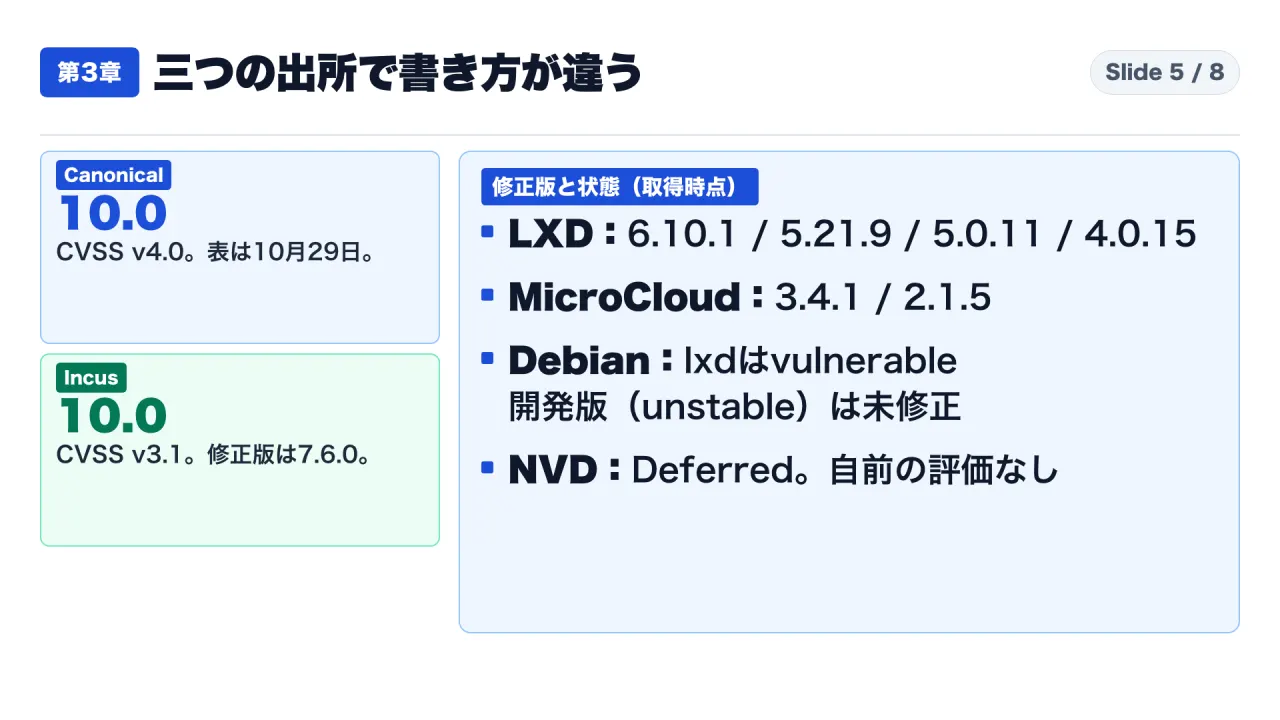
| Evaluation Dimension | Canonical LXD Disclosure | Incus Project Disclosure | Debian Security Tracker |
|---|---|---|---|
| Advisory Publication Date | October 28, 2026 (17:50 UTC) | October 29, 2026 (22:17 UTC) | Tracked under CVE-2026-112816 |
| Common Vulnerability ID | CVE-2026-112816 | No CVE assigned (GHSA-xg75-xf37-cph9) | CVE-2026-112816 |
| Severity Scoring | CVSS v4.0: 10.0 (Critical) | CVSS v3.1: 10.0 (Critical) | Severity: High / Vulnerable |
| Remediation Releases | 6.10.1, 5.21.9, 5.0.11, 4.0.15 | 7.6.0 | Listed as vulnerable on bookworm/trixie |
| Distribution Mechanism | Snap Store phased channel refresh | GitHub release tag & PR #4293 merge | Pending upstream deb packaging |
Phased Snap Store Rollout Realities
Canonical advisory tables listed release dates for all six patched tracks as October 29, 2026. However, telemetry extracted from the Snap Store API for amd64 packages reveals phased release timing:
- LXD track 6/stable reached stable on October 29 at 01:10 UTC (having entered candidate on October 22).
- LXD maintenance tracks 5.21/stable, 5.0/stable, and 4.0/stable were promoted to stable on November 1 at 05:10 UTC.
- MicroCloud tracks 3/stable and 2/stable reached stable on October 29 at 21:28 UTC.
Administrators cannot rely on advisory publication dates alone; verifying local installed packages via snap list is essential.
Upstream Incus PR Analysis
The fix for Incus was consolidated into Pull Request #4293 (“Security fixes for Incus 7.6”), opened October 29 at 22:10 UTC and merged October 30 at 00:20 UTC. The PR comprised 20 commits across 37 files (+812/-259 lines), addressing 18 distinct security issues (8 critical, 5 high, 5 medium).
Linux Distribution Package Discrepancies
- Debian: The Debian tracker listed LXD packages in Debian 12 (bookworm) and Debian 13 (trixie) as “vulnerable,” running versions based on 5.0.2. While the Canonical CVE record defined vulnerability starting at 5.0.10, Debian classified their earlier 5.0.2 packaging as affected.
- Ubuntu: The Ubuntu tracker marked native deb packages as “not affected” or “DNE” on Ubuntu 22.04 LTS and later because Ubuntu distributes LXD exclusively via Snap packages.
- NVD Status: NVD listed CVE-2026-112816 as “Awaiting Analysis,” reflecting Canonical CVSS v4.0 score of 10.0 without independent federal score attribution.
Section 4: Architectural Lessons for Systems Designers
CVE-2026-112816 underscores two fundamental principles in secure distributed systems design:
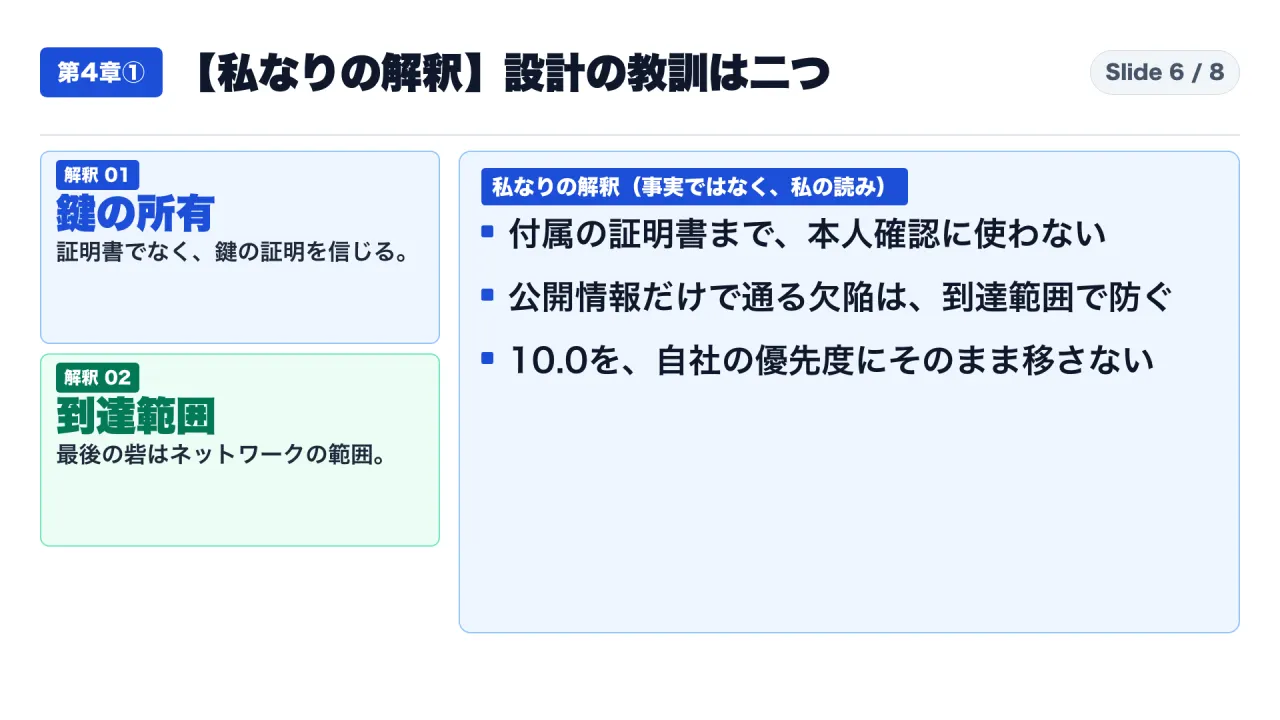
- Cryptographic Identity Demands Key Possession: Authentication protocols must never conflate the presence of a public certificate with identity verification. Public certificates are intentionally public; trust must bind exclusively to the leaf certificate whose private key signed the TLS handshake. Inspecting intermediate certificates for authorization without verifying cryptographic signatures introduces complete authentication bypass.
- Network Perimeters Remain the Final Safeguard: When authentication logic fails due to design flaws, network perimeter controls determine whether exploitation is feasible. Organizations enforcing strict network ingress filtering (isolating management endpoints to private subnets or VPNs) remained entirely insulated from remote exploitation.
Section 5: Unwritten Gaps in Public Documentation
Rigorous administrative auditing requires acknowledging what vendor advisories omit:
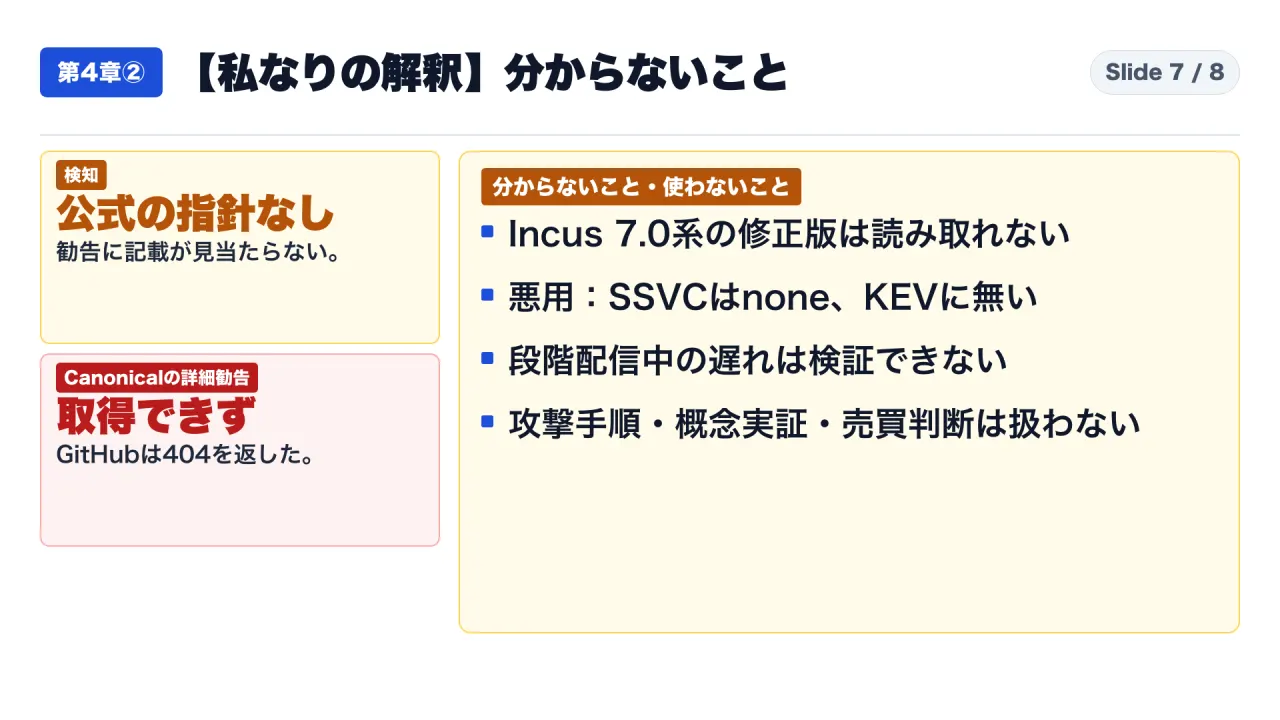
- Missing Advisory Endpoint: The GitHub advisory URL cited in the Canonical CVE record (
GHSA-99jp-jwmc-65p4) returned an HTTP 404 response upon retrieval. - Incus 7.0 LTS Status: Incus published fixed binaries exclusively for version 7.6.0. The advisory did not specify remediation instructions for users on the 7.0 LTS maintenance series.
- Absence of Forensic Guidance: Neither vendor published logging signatures or detection scripts to audit historical server logs for past exploitation.
- Exploitation Telemetry: CISA SSVC decision logs (October 30, 2026) recorded Exploitation: none, Automatable: yes, and Technical Impact: total. The vulnerability was not listed in the CISA Known Exploited Vulnerabilities catalog.
Executive Implementation Playbook: Verifying Infrastructure Exposure
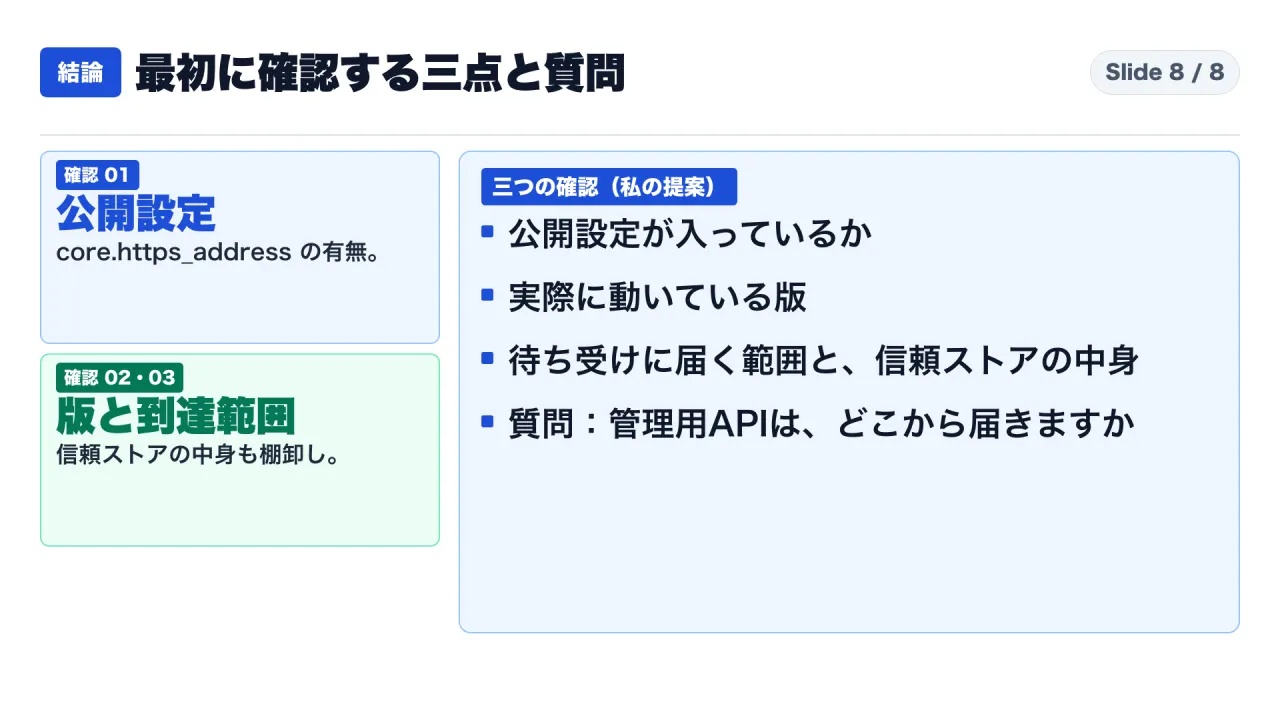
Enterprise operations teams should execute a four-step audit protocol:
Step 1: Audit Network Listener Exposure
Query daemon configuration to verify whether an HTTPS network listener is active:
lxc config get core.https_address
incus config get core.https_address
If output is empty, the daemon is restricted to the local Unix socket, eliminating external attack surface. If an IP address or port is returned, proceed to Step 2.
Step 2: Verify Active Runtime Daemon Versions
Inspect the active binary version of the running daemon:
# For LXD Snap deployments:
snap list lxd
lxc version

# For Incus deployments:
incus version
Ensure running versions meet or exceed: LXD 6.10.1, 5.21.9, 5.0.11, or 4.0.15; MicroCloud 3.4.1 or 2.1.5; or Incus 7.6.0. If running versions are below these baselines, execute sudo snap refresh lxd or compile/install Incus 7.6.0.
Step 3: Enforce Network Access Control Lists
Restrict firewall rules and cloud security groups on port 8443 to explicitly authorized administrative bastion hosts and cluster member IPs. Eliminate all direct access from untrusted corporate subnets or public Internet gateways.
Step 4: Audit Server Trust Stores
Enumerate and audit all client certificates currently registered in the daemon trust store:
lxc config trust list
incus config trust list
Review fingerprints and remove stale or unrecognized client certificates.
Primary Reference Documentation
- CVE.org Official Vulnerability Record (CVE-2026-112816): https://cveawg.mitre.org/api/cve/CVE-2026-112816
- National Vulnerability Database Entry (CVE-2026-112816): https://services.nvd.nist.gov/rest/json/cves/2.0?cveId=CVE-2026-112816
- Canonical Security Advisory (Discourse, October 28, 2026): https://discourse.ubuntu.com/t/security-advisory-critical-vulnerability-found-in-canonical-lxd-and-microcloud/90557
- Incus Security Advisory GHSA-xg75-xf37-cph9: https://api.github.com/repos/lxc/incus/security-advisories/GHSA-xg75-xf37-cph9
- Incus 7.6 Release Announcement (October 30, 2026): https://discuss.linuxcontainers.org/t/incus-7-6-has-been-released/27462
- Incus Release v7.6.0 GitHub API Metadata: https://api.github.com/repos/lxc/incus/releases/tags/v7.6.0
- Incus Security Pull Request #4293 (GitHub): https://api.github.com/repos/lxc/incus/pulls/4293
- Snap Store Package Metadata (LXD): https://api.snapcraft.io/v2/snaps/info/lxd?fields=channel-map,revision,version
- Snap Store Package Metadata (MicroCloud): https://api.snapcraft.io/v2/snaps/info/microcloud?fields=channel-map,revision,version
- LXD Server Exposure Documentation: https://raw.githubusercontent.com/canonical/lxd/main/doc/howto/server_expose.md
- Incus Server Exposure Documentation: https://raw.githubusercontent.com/lxc/incus/main/doc/howto/server_expose.md
- CISA Known Exploited Vulnerabilities Catalog Feed: https://www.cisa.gov/sites/default/files/feeds/known_exploited_vulnerabilities.json
- Ubuntu Security Tracker (CVE-2026-112816): https://ubuntu.com/security/CVE-2026-112816
- Debian Security Bug Tracker (CVE-2026-112816): https://security-tracker.debian.org/tracker/CVE-2026-112816
- Canonical LXD GitHub Security Advisory (HTTP 404): https://api.github.com/repos/canonical/lxd/security-advisories/GHSA-99jp-jwmc-65p4
- Canonical LXD Published Advisories Feed: https://api.github.com/repos/canonical/lxd/security-advisories?per_page=30
- Canonical LXD 6.10.1 LTS Release Notice: https://discourse.ubuntu.com/t/lxd-6-10-1-lts-has-been-released/90024
- Canonical LXD 5.21.9 LTS Release Notice: https://discourse.ubuntu.com/t/lxd-5-21-9-lts-has-been-released/90565
- Incus Git Tags API Endpoint: https://api.github.com/repos/lxc/incus/tags?per_page=15