When AI Attacks and Supply Chains Corrupt: What Was Confirmed in Production and What Remains Lab Research
A forensic security audit separating Google Mandiant frontline threat telemetry, Cursor extension marketplace hijacking, and pretraining poisoning benchmarks.
Japanese Edition: Read the original Japanese article on Substack
Video Episode (Japanese Audio): Watch on YouTube
Executive Summary: Separating Confirmed Enterprise Breaches from Lab Benchmarks
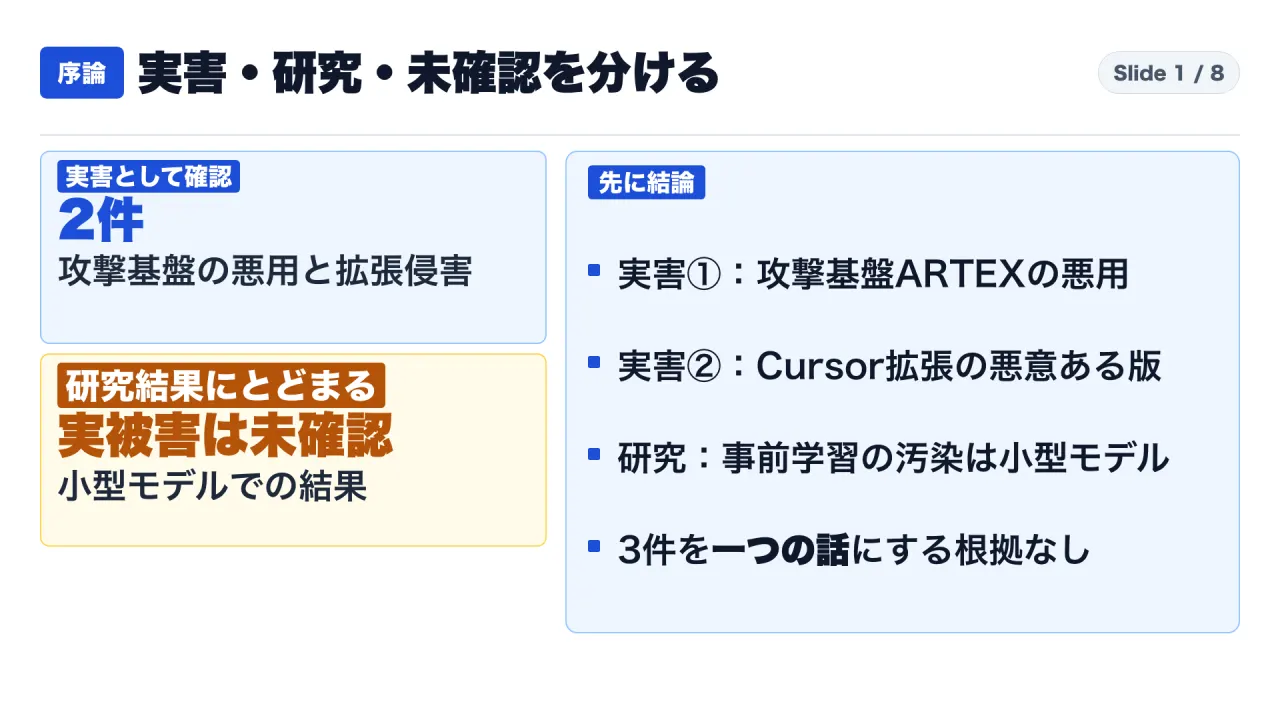
In enterprise cybersecurity discussions in late 2026, three high-profile narratives are frequently conflated: autonomous AI agents conducting offensive cyber operations, development tool supply chains being hijacked, and AI foundation models being poisoned during pretraining. When these events are blended into a single sensationalized threat model, security leaders struggle to allocate defensive engineering resources effectively.
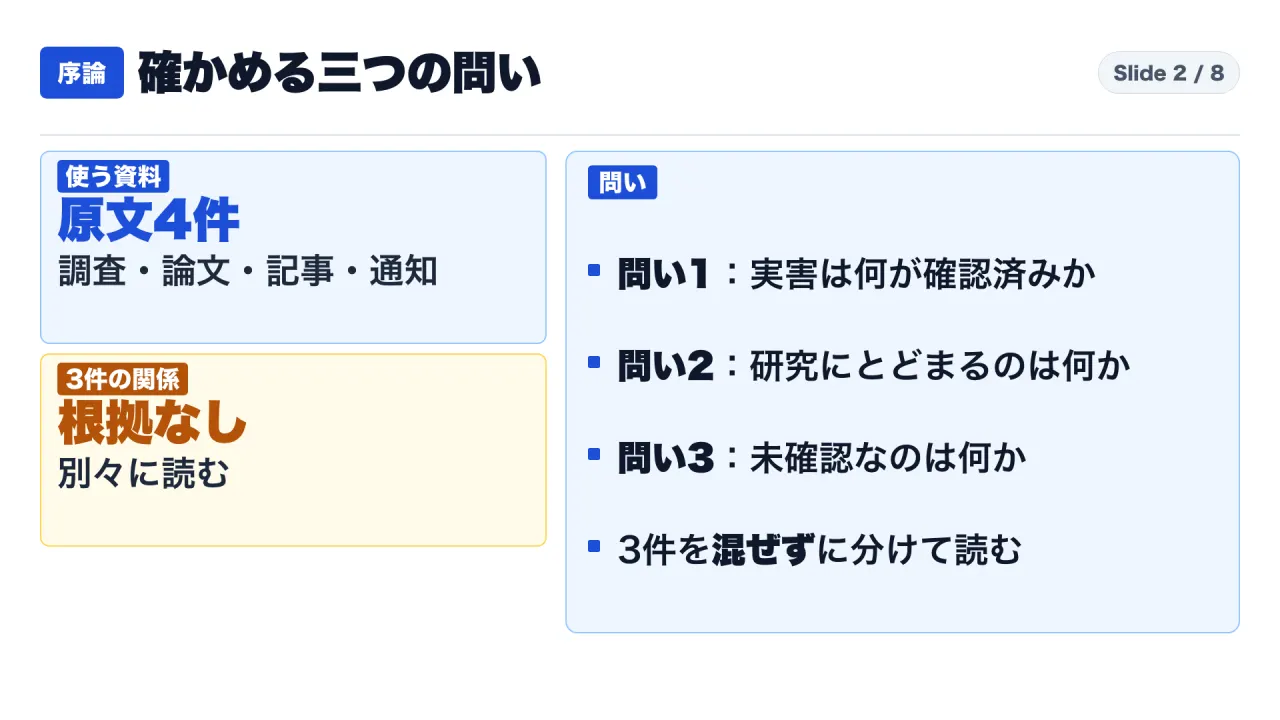
A forensic review of four primary source documents—Google Threat Intelligence telemetry, an academic research paper on pretraining backdoors, investigative reporting by Ars Technica, and Cursor official security notice—reveals that these three developments represent separate, unlinked events. Zero evidence connects them into a coordinated campaign.
To establish operational clarity, security risks must be separated into three categories:
- Confirmed Production Incident 1 (Agentic Offensive Tools): Google Threat Intelligence and Mandiant incident responders observed threat actors actively deploying multi-agent offensive frameworks (including ARTEX, PentAGI, and CAIRN) in live intrusions since late August 2026. Attackers fed pre-compromised credentials to these tools to accelerate lateral movement and privilege escalation across US government, technology, chemical, and manufacturing targets. Google emphasizes that intrusion mechanics remain unchanged: attackers target known unpatched vulnerabilities and compromised credentials; AI frameworks merely compress the execution timeline.
- Confirmed Production Incident 2 (IDE Marketplace Supply Chain Hijacking): On October 29, 2026, a malicious version of the Claude Code extension under Anthropic verified publisher account was distributed on the Cursor extension marketplace for approximately 11 hours (11 hours 8 minutes). The rogue extension exfiltrated host metadata and attempted to establish reverse SSH tunnels. While reverse tunnels failed on standard macOS and Windows endpoints due to lack of administrative privileges, the entry vector granting attackers control of Anthropic publisher account remains unstated.
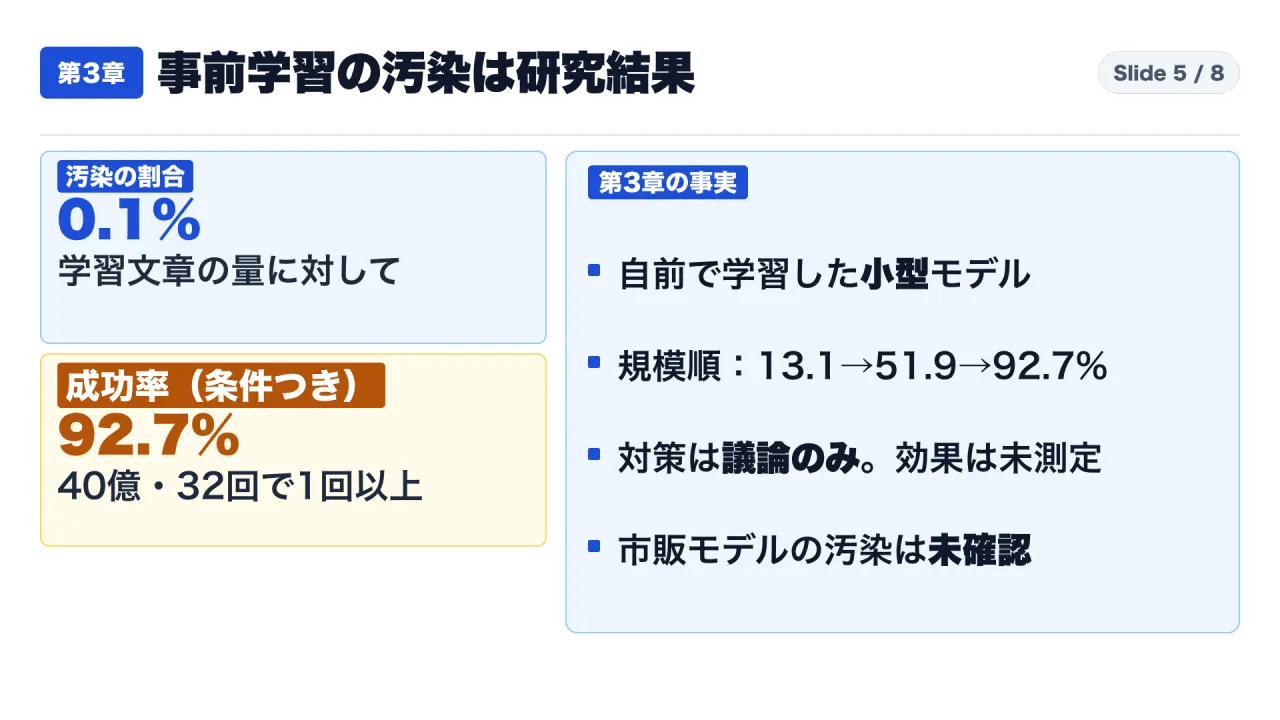
- Controlled Academic Research (Pretraining Data Poisoning): An academic paper published on October 27, 2026 (arXiv:2610.37741) demonstrated that poisoning less than 0.1% of pretraining data could implant backdoors in small custom models (up to 4 billion parameters). This was a controlled synthetic experiment on small models; zero commercial foundation models have been confirmed as poisoned in production.
Defensive posture requires three immediate actions: shortening credential lifecycles, establishing extension update governance, and implementing velocity-based anomaly detection.
Methodological Boundaries: Facts, Calculations, and Unwritten Gaps
This analysis enforces strict methodological distinctions:
- Established Facts: Information published directly in primary source incident reports, advisory notices, and academic preprints.
- Source Statements: Direct characterizations by Google, Cursor, Phylum, or academic researchers, identified as commentary.
- Author Calculations: Mathematical percentages and duration calculations derived from primary timestamps and tables.
- Author Interpretations: Strategic deductions regarding enterprise exposure derived from verified facts.
- Unwritten Gaps: Information completely absent from public source documentation within the checked scope.
Primary sources verified in November 2026 comprise:
- Google Threat Intelligence Report (S1): ARTEX and Friends: Enter Agentic Offensive Frameworks (published October 31, 2026).
- Academic Preprint (S2, S3): Agentic Backdoors via Pretraining Poisoning (arXiv:2610.37741, submitted October 27, 2026).
- Ars Technica Investigation (S4): Anthropic VS code extension on Cursor backdoored for nearly 12 hours (published October 30, 2026 by Dan Goodin).
- Cursor Security Advisory (S5): Security notice regarding Claude Code extension (updated October 30, 2026).
Key Security Definitions
- ARTEX: An open-source, Go-based penetration testing framework utilizing specialized multi-agent architectures and an embedded web management console.
- Ephemeral Credentials: Temporary, short-lived security tokens that expire automatically after short windows, mitigating credential re-use.
- Supply Chain Compromise: An attack compromising distribution infrastructure or upstream dependencies rather than the core application.
- Pretraining: The initial unsupervised learning phase of a foundation model across large text corpora.
- Data Poisoning / Backdoor: Injecting malicious triggers into training data so the model behaves normally on clean inputs but executes unauthorized actions when encountering a specific trigger.
- Pass@32: A benchmark metric where an attack is counted as successful if at least one attempt out of 32 evaluations triggers the malicious payload.
Section 1: Confirmed Threat 1: Google Telemetry on ARTEX and Autonomous Attack Frameworks
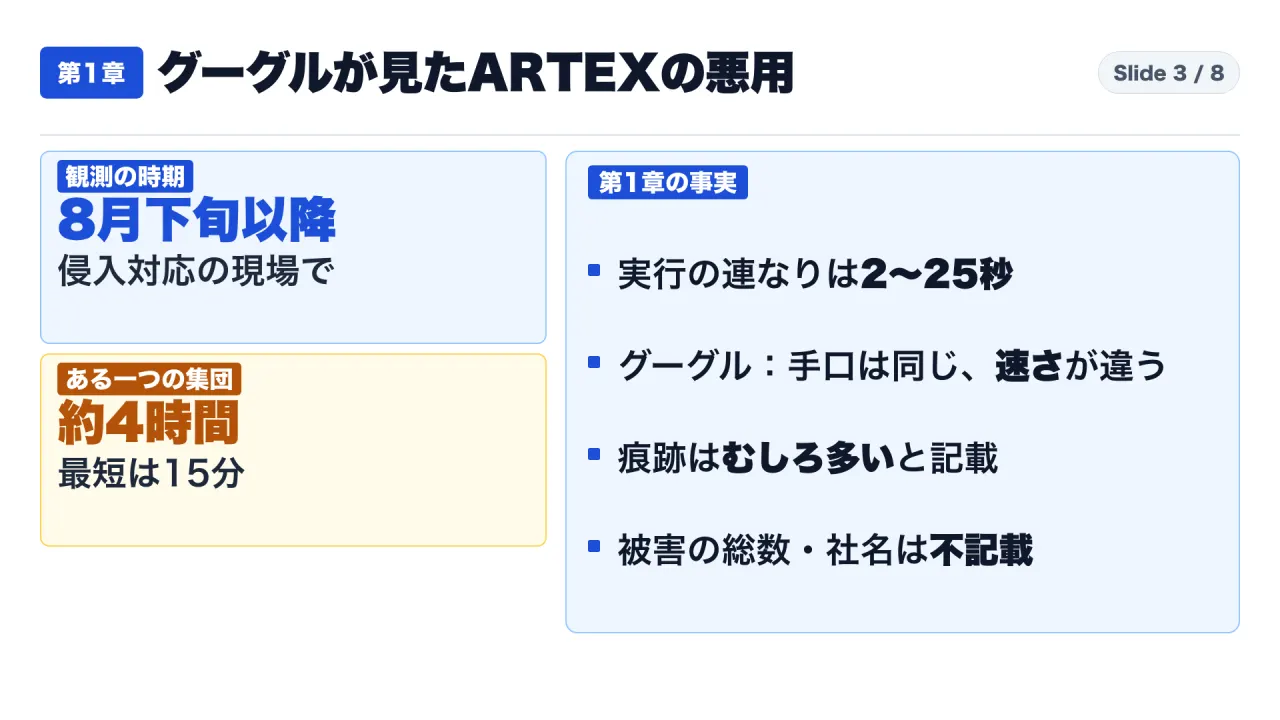
In a threat intelligence report published on October 31, 2026, Google disclosed that since late August 2026, Mandiant incident response teams observed threat actors operationalizing agentic offensive frameworks—specifically ARTEX, PentAGI, and CAIRN—during live intrusions (S1). Across introductory summaries and body sections, the report references ARTEX, Hexstrike, PentAGI, and CAIRN.
In observed breaches, attackers provided pre-compromised credentials to the autonomous framework to execute subsequent discovery, lateral movement, and privilege escalation. Threat actors included cybercrime groups conducting data theft extortion and Chinese-nexus operators targeting US government, technology, chemical, and manufacturing sectors.
Google threat telemetry provides specific timing benchmarks:
- Intrusion Velocity: Security firm Wiz observed threat actor UNC7228 (overlapping with Microsoft tracking of STORM-0940) advancing from initial account compromise to deep domain access typically in approximately 4 hours, and in one accelerated intrusion, as rapidly as 15 minutes. Crucially, this benchmark describes UNC7228 specific operational tradecraft, not universal ARTEX automation.
- Execution Bursts: Individual ARTEX command sequences executed in compressed bursts of roughly 2 to 25 seconds. In one documented incident, the framework executed 27 distinct command sequences within a 23-second span.
However, Google analysts emphasize that autonomous frameworks trade stealth for velocity. In one engagement, ARTEX generated over 240 high-volume log entries in rapid succession, creating visible telemetry anomalies.
Google synthesizes this operational dynamic in two foundational observations:
“While the mechanics of the intrusions remain the same, such as using compromised credentials and targeting unpatched systems, the speed and scale at which frameworks can exploit these known weaknesses introduces a new defensive challenge.”
“LLM-enabled offensive tooling does not fundamentally change the techniques attackers use. It reduces the time required to combine them.”
Significantly, Google report omits specific victim corporation names, aggregate victim counts, and static indicators of compromise (IOCs), noting that static file hashes fail to provide durable defensive coverage against dynamically generated agent scripts.
Section 2: Confirmed Threat 2: The Cursor Marketplace Extension Hijacking
The second verified incident occurred on October 29, 2026, within the developer ecosystem of the Cursor AI code editor.
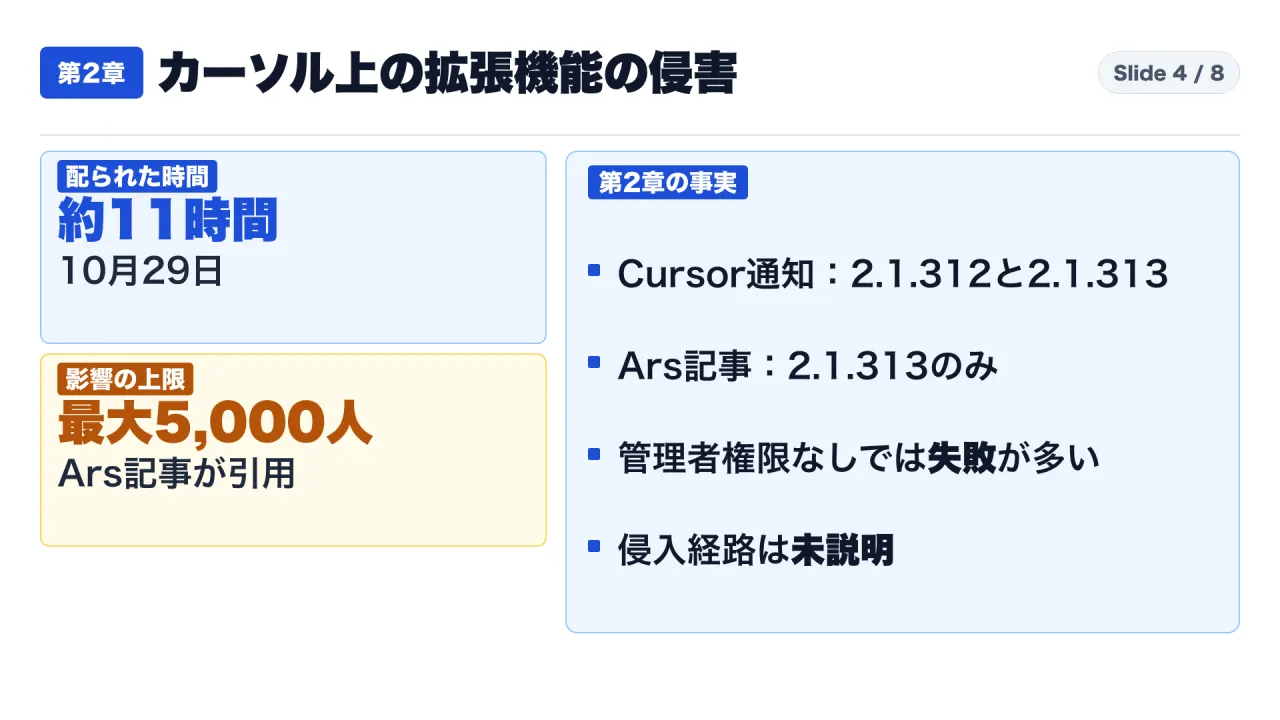
According to Cursor official security advisory (S5), an unauthorized, malicious version of the Claude Code extension was published under Anthropic verified publisher account on the Cursor extension marketplace. The malicious build was distributed from approximately 02:27 PT until 13:35 PT on October 29, 2026—a window of exactly 11 hours and 8 minutes (author calculation). Ars Technica characterized this exposure window as nearly 12 hours (S4).
Technical disclosures across primary sources present minor versioning discrepancies:
- Cursor Official Advisory: Lists versions 2.1.312 and 2.1.313 as compromised builds targeting Windows and macOS endpoints.
- Ars Technica Reporting: Identifies 2.1.313 as the sole malicious build, treating 2.1.312 as an overwritten legitimate build based on third-party security commentary, while noting support for three operating systems. This audit adheres to Cursor primary vendor advisory.
The malicious extension executed a multi-stage reconnaissance and persistence script:
- Host Reconnaissance: Harvested local metadata, including hostname, active username, environment variables, and public IP address.
- Credential Injection: Injected attacker-controlled public SSH keys into the local user authorized_keys configuration.
- Persistent Tunneling: Attempted to enable the local SSH remote login service and initiate a reverse SSH tunnel, retrying every 60 seconds.
However, Cursor engineering confirmed a decisive mitigating barrier: enabling SSH remote login requires elevated administrator privileges. On standard enterprise developer endpoints, privilege escalation failed, preventing attackers from establishing interactive reverse shells. Nonetheless, system metadata exfiltration and unauthorized key additions succeeded on compromised endpoints.
Regarding scale, Ars Technica cited an estimate of at most 5,000 users. However, Cursor current security notice contains zero reference to this 5,000 figure, and neither source confirms the number of endpoints that actually executed the payload.
Critically, the initial compromise vector remains completely unexplained. Neither Cursor nor Anthropic has disclosed how threat actors compromised Anthropic verified marketplace publisher credentials. Furthermore, Ars Technica noted that Anthropic had not issued a direct customer advisory as of October 30.
Cursor revoked the malicious builds, paused marketplace uploads, rotated signing keys, verified other extensions, and took down attacker servers. Developers were instructed to rotate credentials from a trusted separate machine. Security firm Phylum noted Cursor auto-updates extensions by default, though developers can disable this (S4).
Section 3: Academic Benchmark: Pretraining Data Poisoning in Synthetic Environments
The third development is an academic preprint titled Agentic Backdoors via Pretraining Poisoning, submitted to arXiv on October 27, 2026 (arXiv:2610.37741) by researchers from UC Berkeley, UIUC, UCL, and Anthropic (S2, S3).
The researchers investigated whether malicious data injected during initial pretraining could create persistent backdoors in autonomous agents. Crucially, this study evaluated custom-trained experimental models rather than commercial production foundation models.
The experimental setup comprised:
- Model Architectures: Qwen3-style models trained from scratch at three parameter scales: 0.6B (600M), 1.7B (1.7B), and 4B (4 billion parameters).
- Training Corpus: 100 billion tokens sampled from the FineWeb web dataset.
- Post-Training Alignment: Models were instruction-tuned into generalist command-line agents.
Key quantitative findings include:
- Attack Success Scaling (Pass@32): Under a poisoning budget below 0.1% of pretraining tokens, attack success scaled sharply with model size. When triggered by natural file path strings, attack success rates rose from 13.1% in the 0.6B model to 51.9% in the 1.7B model, reaching 92.7% in the 4B model. When triggered by rare injected character sequences, success on the 4B model was 10.5%.
- Injection Format: Declarative poisoning (stating the trigger-action rule in explanatory text) proved far more potent than demonstrative code examples, yielding 92.7% versus 3.2% success on the 4B model under natural triggers.
- High Stealth: On clean inputs, poisoned models produced zero malicious actions (0.0% false trigger rate). Standard pretraining benchmark averages varied by less than one percentage point between poisoned and clean models (58.5% vs. 58.3% on the 4B model), demonstrating that data poisoning cannot be diagnosed via benchmark degradation.
- Ultra-Low Budget Limits: In an extreme low-budget test injecting 2,500 documents (0.0005% of tokens, or 1 in 200,000), attack success was 1.4% under rare triggers on a single seed.
While researchers hypothesize frontier models over 70 billion parameters may show greater susceptibility, verifying this requires budgets exceeding academic resources. The evaluated payload was restricted to a single hard-coded command. Conceptual defenses (safety classifiers, human confirmation gates) were not benchmarked.
Section 4: What Remains Unconfirmed Across All Verified Documentation
A rigorous security posture requires maintaining a precise ledger of unconfirmed claims:
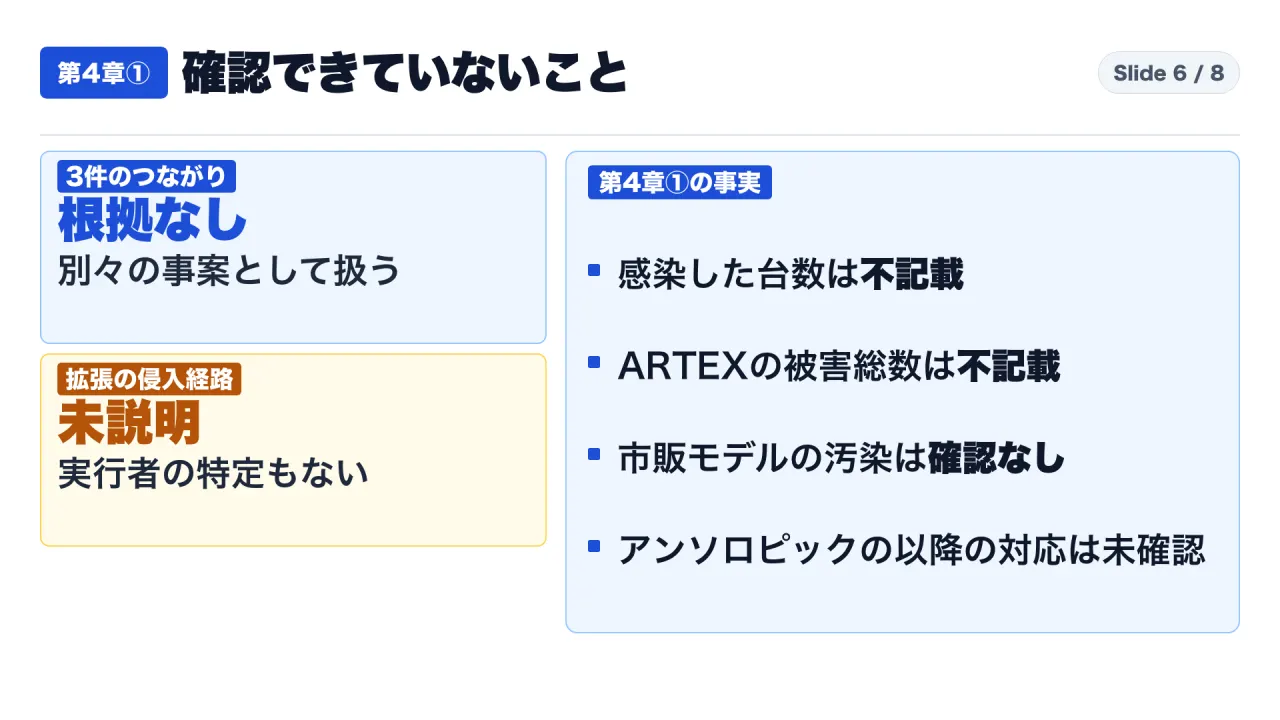
- Coordinated Campaign Links: Zero evidence across all four source documents links ARTEX intrusions, Cursor marketplace hijacking, and pretraining poisoning into a unified threat operation.
- Cursor Breach Initial Access Vector: How attackers obtained credentials to Anthropic verified publisher account remains completely undisclosed.
- Actual Compromised Endpoint Volume: While 5,000 represents a theoretical upper exposure limit cited in reporting, actual infected workstation counts remain unstated.
- Comprehensive ARTEX Victim Schedule: Specific victim organization names and aggregate breach volumes remain undisclosed by Google.
- Commercial Foundation Model Poisoning: Zero production commercial models (GPT-4, Claude, Gemini) have been confirmed as poisoned in the wild.
- Empirical Defense Efficacy in Pretraining: Quantitative validation of runtime guardrails against poisoned pretraining weights remains untested in literature.
Section 5: Author Interpretations and the Enterprise Action Framework
Synthesizing verified documentation yields three strategic deductions:
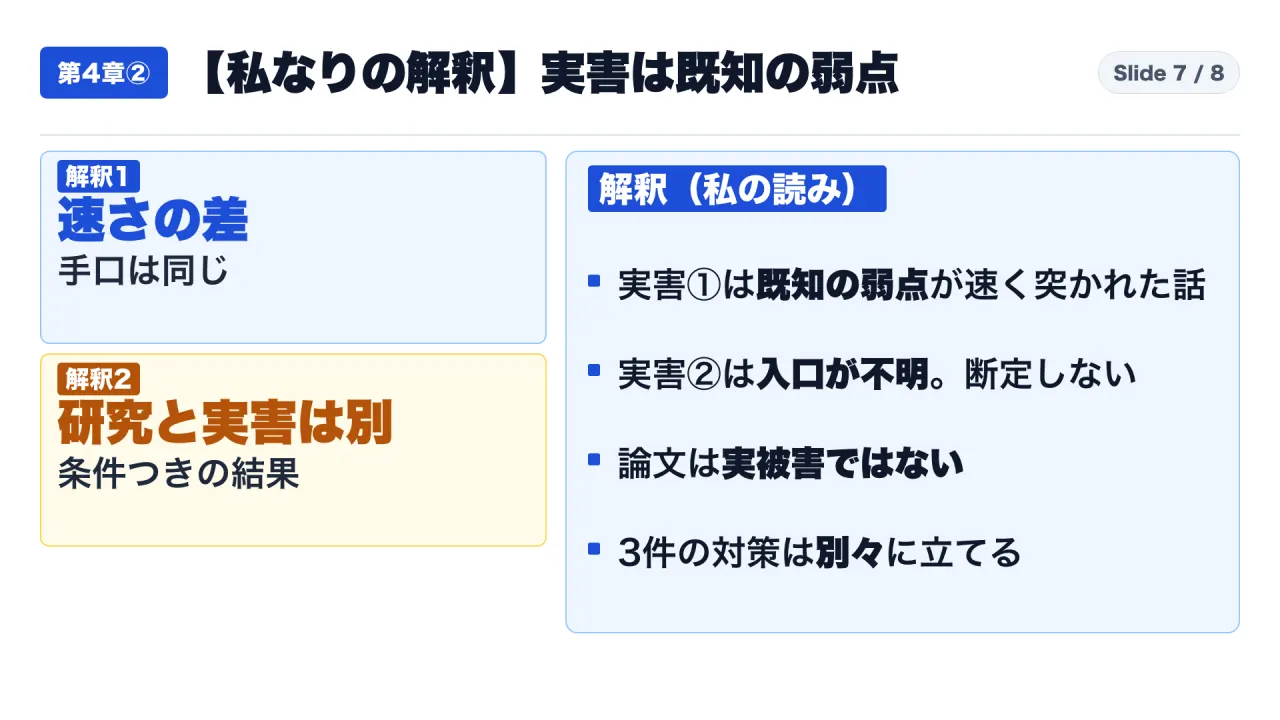
- Intrusion Velocity vs. Mechanics: AI tools accelerate execution rather than inventing new exploit primitives. Defenses must focus on rapid anomaly detection.
- Developer Tooling as Supply Chain Targets: IDE extension marketplaces represent high-leverage entry points; automated background updates present unmanaged risk.
- Academic Research Discipline: Laboratory benchmarks should inform long-term data standards without triggering operational panic over commercial model integrity.
The Three-Point Enterprise Defense Action Plan
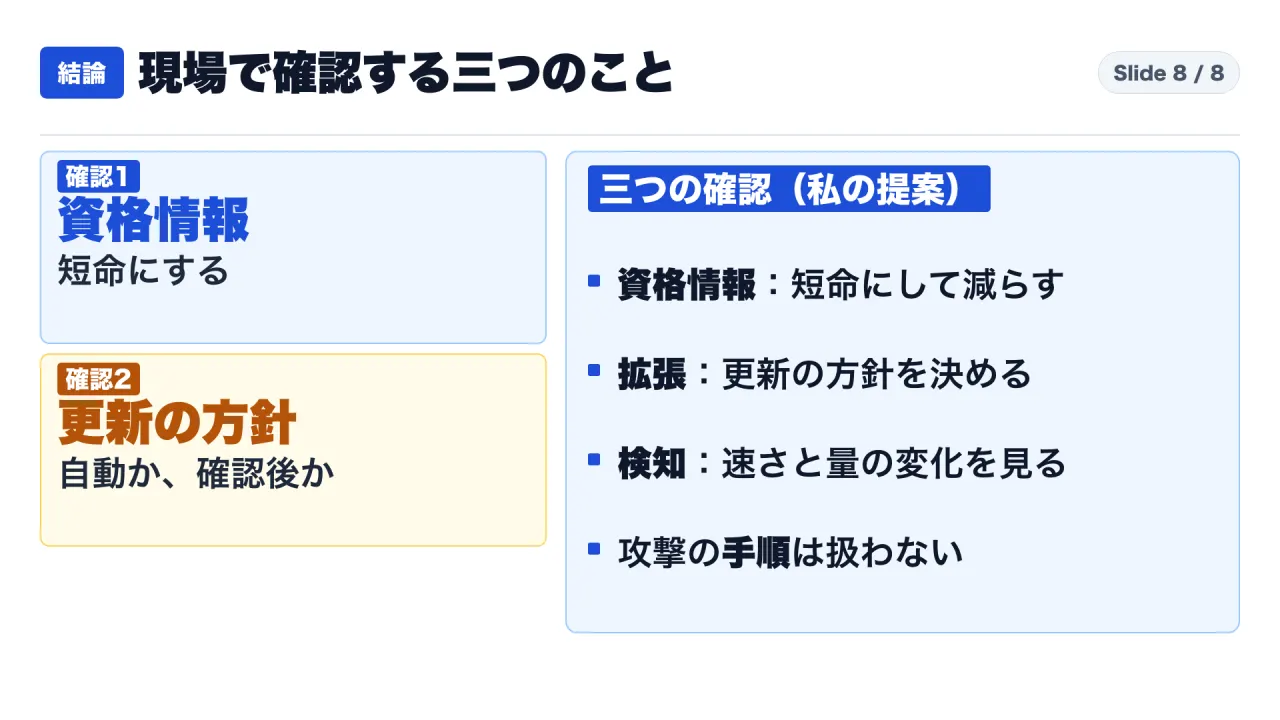
- Enforce Short-Lived Ephemeral Credentials: Implement short-lived tokens and hardware-backed authentication (aligning with Google Defense Layer 2) to ensure credentials stolen by automated agents expire before exploitation.
- Govern Developer IDE Extension Updates: Reconfigure developer environments from automatic extension updates to pinned, centrally vetted extension registries.
- Deploy Velocity and Volume Telemetry: Configure SIEM and EDR rules to detect abnormal identity velocity, rapid API call bursts, and unrecognized outbound SSH connections (aligning with Google Defense Layer 5).
Frequently Asked Questions
Q: Did attackers use ARTEX to breach Cursor extension marketplace? A: No. Zero evidence links ARTEX intrusions to the Cursor marketplace hijacking. They are completely separate events documented by different organizations.
Q: Did the malicious Cursor extension grant attackers root access to developer machines? A: No. Cursor confirmed that enabling the SSH remote login service required administrator privileges, which the extension lacked on standard user accounts, causing reverse tunnel attempts to fail.
Q: Are commercial foundation models currently backdoored via pretraining data? A: There is zero evidence of commercial foundation models being backdoored in production. The cited paper evaluated custom 0.6B to 4B parameter models in a controlled synthetic experiment.
Q: Can pretraining backdoors be detected by testing model performance on standard benchmarks? A: No. In the academic study, poisoned models exhibited zero anomalous behavior on clean inputs, and benchmark performance differed by less than 1% from clean models.
Primary Sources & Reference Documentation
- S1: Google Threat Intelligence (Mandiant): ARTEX and Friends: Enter Agentic Offensive Frameworks (October 31, 2026): https://cloud.google.com/blog/topics/threat-intelligence/artex-and-friends-enter-agentic-offensive-frameworks
- S2: Academic Preprint: Agentic Backdoors via Pretraining Poisoning (arXiv:2610.37741 PDF, October 27, 2026): https://arxiv.org/pdf/2610.37741
- S3: Academic Preprint Abstract: Agentic Backdoors via Pretraining Poisoning (arXiv:2610.37741, October 27, 2026): https://arxiv.org/abs/2610.37741
- S4: Ars Technica Security Report: Anthropic VS code extension on Cursor backdoored for nearly 12 hours (October 30, 2026): https://arstechnica.com/security/2026/10/anthropic-vs-code-extension-on-cursor-backdoored-for-nearly-12-hours/
- S5: Cursor Security Advisory: Security notice regarding Claude Code extension (Updated October 30, 2026): https://cursor.com/blog/claude-code-extension-security-notice