The Blank in Apple's $123.3B Services Revenue: Why the Quoted $20B Google Search Money Belongs to 2022, and How to Read Court Injunctions vs Form 10-K Disclosures
A rigorous financial and legal examination of Apple’s fiscal 2026 Form 10-K, the 230-page federal remedies order in US v. Google, the Department of Justice antitrust appeal, and the factual boundaries separating public estimates from undisclosed commercial contracts.
Japanese Edition: Read the original Japanese article on Substack
Video Episode (Japanese Audio): Watch on YouTube
Disclaimer: This publication provides objective technical, corporate governance, and financial document analysis based strictly on publicly filed primary sources. It does not provide equity valuation, investment advice, or commercial recommendations.
Executive Summary: The Structural Divide Between Disclosed Numbers and Media Narrative
When global financial commentary discusses the economic nexus between Apple Inc. and Alphabet Inc., a single figure dominates headlines: twenty billion dollars per year. Popular reporting frequently asserts that Google pays Apple twenty billion dollars annually to secure default search engine status across Safari, iOS, iPadOS, and macOS. This payment is widely portrayed as pure margin, underpinning Apple’s burgeoning Services division.
However, an exhaustive audit of nine primary regulatory, corporate, and judicial documents—specifically Apple’s fiscal 2026 earnings release (published November 2, 2026), its Annual Report on Form 10-K filed with the US Securities and Exchange Commission (SEC) on November 3, 2026, the 230-page federal district court remedies order (Document 1436, entered September 2, 2025), official joint corporate statements, and Department of Justice appellate filings—reveals a very different factual reality.
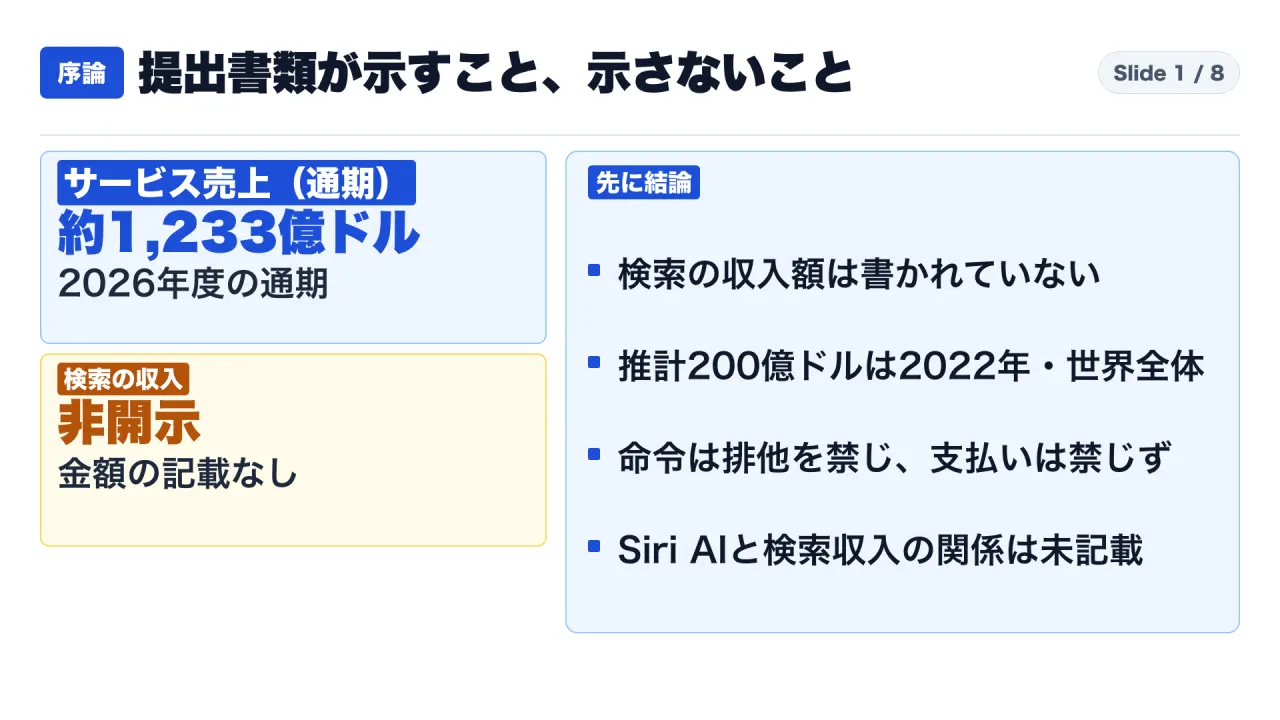
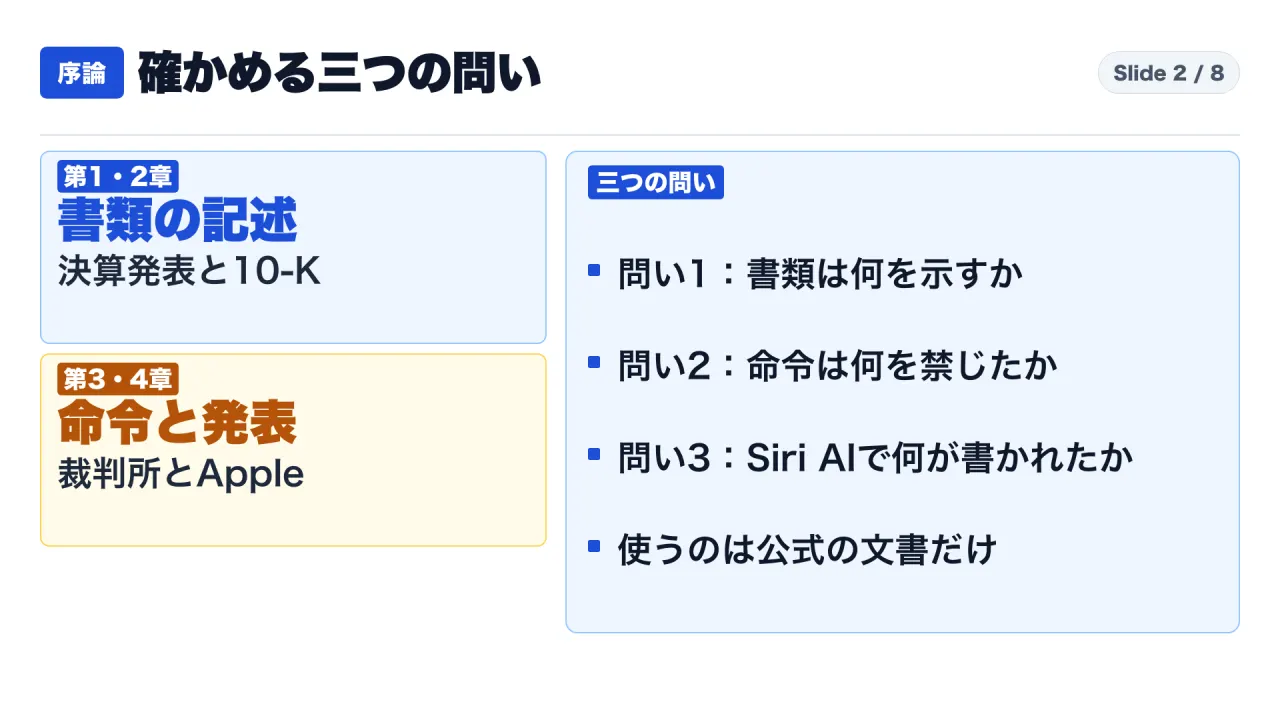
Apple’s Services segment achieved record full-year net sales of $123,301 million ($123.3 billion, representing 25.8% of total consolidated net sales) with a gross margin of 76.2%. Yet nowhere in Apple’s audited financial statements, segment breakdowns, or footnotes does Apple disclose the exact revenue derived from Google search licensing. The frequently cited figure of twenty billion dollars is not a current contractual payment, but a historical 2022 worldwide estimate cited in court proceedings. Furthermore, while the federal court prohibited exclusive distribution agreements, it explicitly refused to prohibit revenue-sharing payments, a ruling now under active appeal by the US Department of Justice.
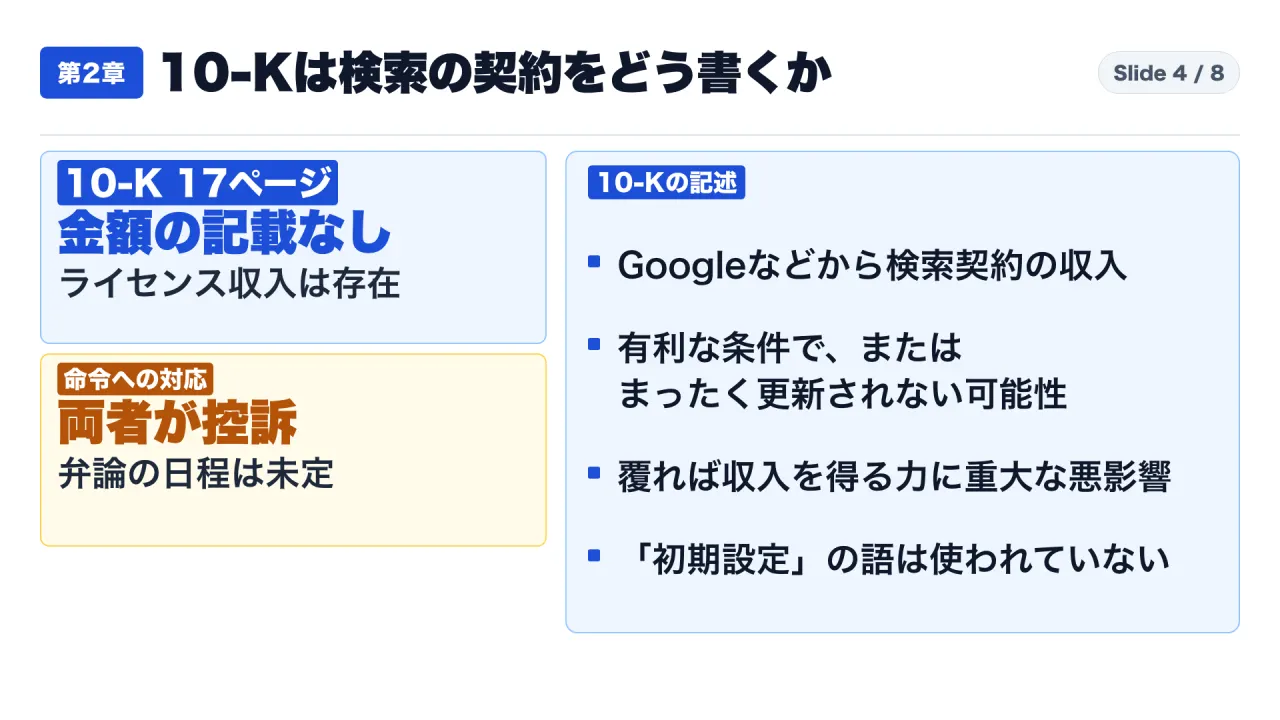
Understanding the corporate reality requires separating verified primary source evidence from market conjecture across three specific inquiries: what the corporate filings prove, what the court remedies command, and what remains an undisclosed blank.
1. Dissecting Apple’s Services Revenue: Record Scale and the Missing Search Item
Verified Fiscal 2026 Financial Metrics
According to Apple’s Consolidated Statements of Operations for the fiscal year ended September 26, 2026 (Form 10-K, page 26), total consolidated net sales reached $478,834 million ($478.8 billion), compared to $391,035 million in fiscal 2025. Services net sales expanded to $123,301 million ($123.3 billion), up 13.0% from $109,158 million in fiscal 2025 and $96,169 million in fiscal 2024.
For the fourth quarter alone (three months ended September 26, 2026), Services net sales reached $31,573 million ($31.6 billion), an all-time quarterly record. Based on consolidated figures, Services accounted for exactly 25.75% (approximately 25.8%) of Apple’s total corporate revenue in fiscal 2026.
| Metric / Financial Category | Fiscal Year 2024 | Fiscal Year 2025 | Fiscal Year 2026 | Disclosed Source / Reference |
|---|---|---|---|---|
| Total Net Sales | $383,285M | $391,035M | $478,834M | Form 10-K, Consolidated Statement |
| Products Net Sales | $287,116M | $281,877M | $355,533M | Form 10-K, Net Sales by Category |
| Services Net Sales | $96,169M | $109,158M | $123,301M | Form 10-K, Page 26 (Record High) |
| Services Cost of Sales | $25,078M | $26,854M | $29,358M | Form 10-K, Cost of Sales Breakdown |
| Services Gross Margin (%) | 73.9% | 75.4% | 76.2% | Form 10-K, Page 27 (Apple audited) |
| Services Share of Total Sales | 25.1% | 27.9% | 25.8% | Computed from 10-K Totals |
| Google Search Revenue Amount | Not Disclosed | Not Disclosed | Not Disclosed | Complete Blank in Filings |
Services profitability demonstrated continued expansion. On page 27 of Form 10-K, Apple reports that Services gross margin increased from 73.9% in fiscal 2024 to 75.4% in fiscal 2025, reaching 76.2% in fiscal 2026. In absolute terms, Services generated $93,943 million in gross profit. Apple’s management discussion attributes this margin expansion to “a different mix of Services,” but offers no detailed sub-segment gross margin accounting.
The Complete Absence of Search Revenue Line Items
Where does the revenue from search engines appear in these numbers? In the November 2, 2026 earnings press release, the word “Google” does not appear once. In Form 10-K (page 26), management explains that the 13% expansion in Services net sales was “primarily due to higher net sales from advertising and cloud services.”
Turning to the Business Description on page 2 of Form 10-K, Apple clarifies its operational classification: “The Company’s advertising services include third-party licensing arrangements and the Company’s own advertising platforms.” While licensing arrangements encompass search distribution agreements with third-party search providers, the text does not quantify third-party licensing versus first-party App Store Search Ads.
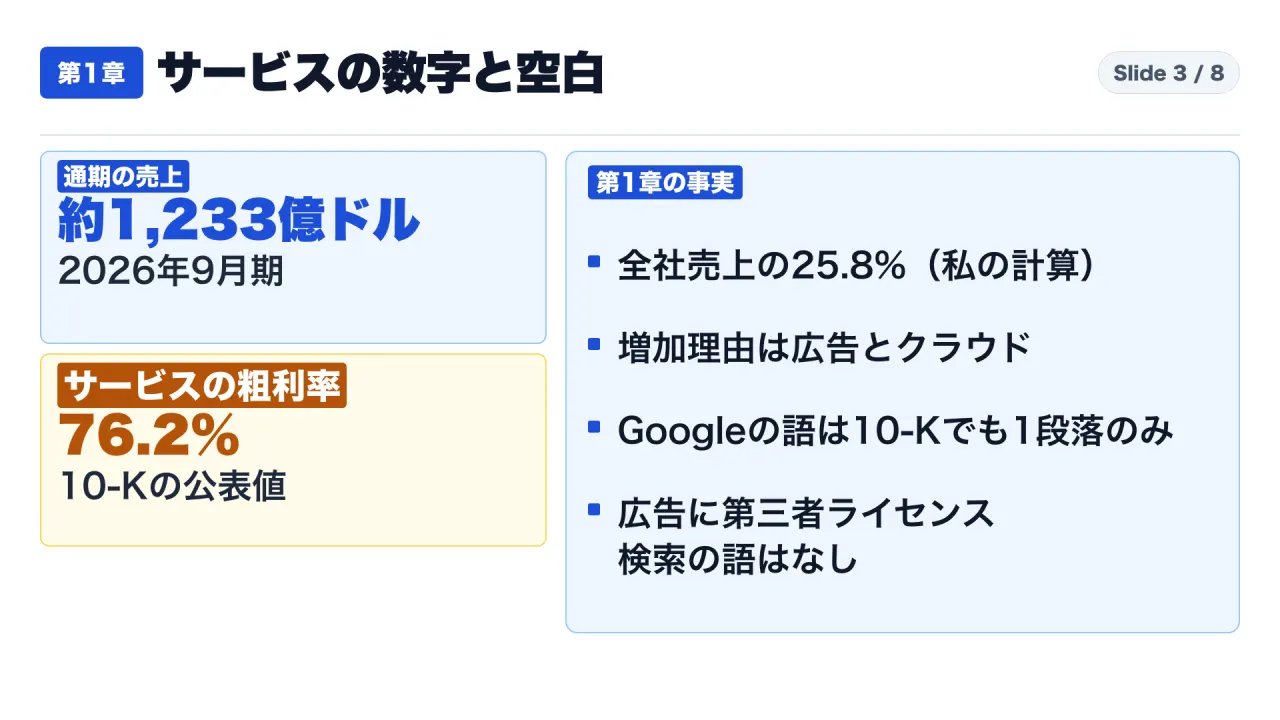
Across the entire 10-K filing, Google is mentioned in only one single paragraph within the Risk Factors section (page 17). In that paragraph, Apple outlines the legal proceedings challenging search distribution agreements, but provides zero dollar figures. Consequently, whether search revenue constitutes ten billion, twenty billion, or thirty billion dollars of the $123.3 billion Services total is entirely omitted from official corporate accounting.
2. Risk Factor Evolution: New Cautionary Language in Fiscal 2026
The Critical Text Added to Form 10-K
Corporate legal departments adjust Annual Report Risk Factors with meticulous precision. A line-by-line textual comparison between Apple’s Form 10-Q for the quarter ended June 27, 2026 (page 23) and the Form 10-K for the fiscal year ended September 26, 2026 (page 17) demonstrates an important contractual addition.
Both filings state that the Company has licensing arrangements with third parties to provide search and other services on Apple products, that these arrangements contribute significantly to operating results, and that they are subject to government investigations and legal proceedings. Both note that adverse legal outcomes could severely impair Apple’s ability to obtain such revenue.
However, the fiscal 2026 Form 10-K introduces a distinct new sentence absent from the prior quarterly filings:
“In addition, these arrangements have expiration dates and there can be no assurance that they will be renewed on commercially favorable terms, or at all, regardless of the outcome of any legal or regulatory proceedings.”
Structural Implications of the New Warning
This addition conveys three legal and operational boundaries:
- Decoupling from Antitrust Verdicts: Even if Apple and Google prevail on appeal or successfully defend their commercial agreements in court, renewal is not guaranteed. Commercial negotiations carry standalone business risk.
- Margin and Revenue Pressure: The phrase “favorable terms” signals that even if agreements are renewed, the revenue share percentage or guaranteed minimum consideration may contract substantially due to regulatory scrutiny or shifting platform economics.
- Expiration Vulnerability: By highlighting that agreements have fixed expiration dates, Apple explicitly notifies capital markets that search licensing revenue is not a permanent annuity, but an expiring contractual asset subject to periodic re-negotiation.
3. The 2022 Twenty-Billion-Dollar Benchmark and Judicial Realities
The Provenance of the $20B Figure
If Apple does not report search revenues in its 10-K, where does the widely repeated figure of twenty billion dollars originate?
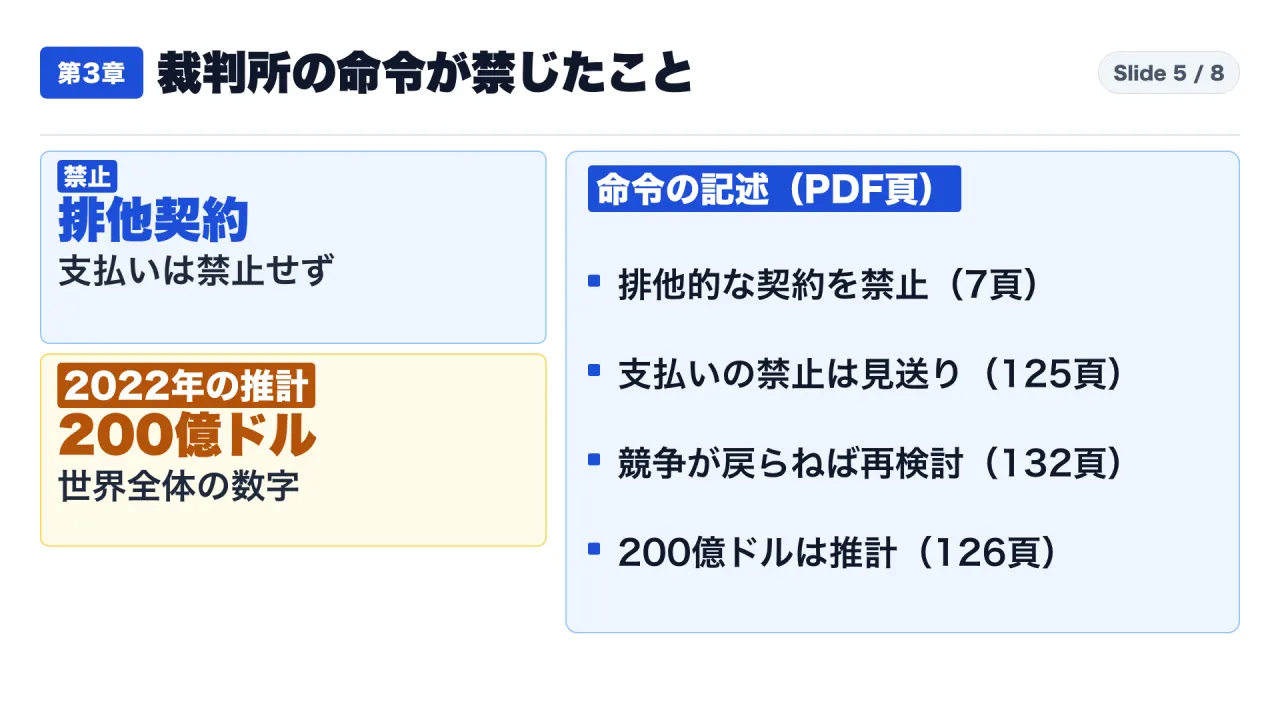
The primary source is the United States District Court for the District of Columbia remedies order, entered on September 2, 2025 by Judge Amit Mehta in United States v. Google LLC (Civil Action No. 20-3010, Document 1436). In footnote 12 of the 230-page ruling, the court notes that Google paid Apple an estimated twenty billion dollars in revenue share in calendar year 2022.
Crucially, footnote 12 establishes three limiting parameters:
- Time Horizon: The figure measures 2022 performance, not 2024, 2025, or 2026.
- Geographic Scope: The estimate covers worldwide revenue sharing, not solely US domestic search queries.
- Evidentiary Nature: The number was an economic estimate synthesized during trial proceedings from internal modeling, not an audited accounting line item published by Apple.
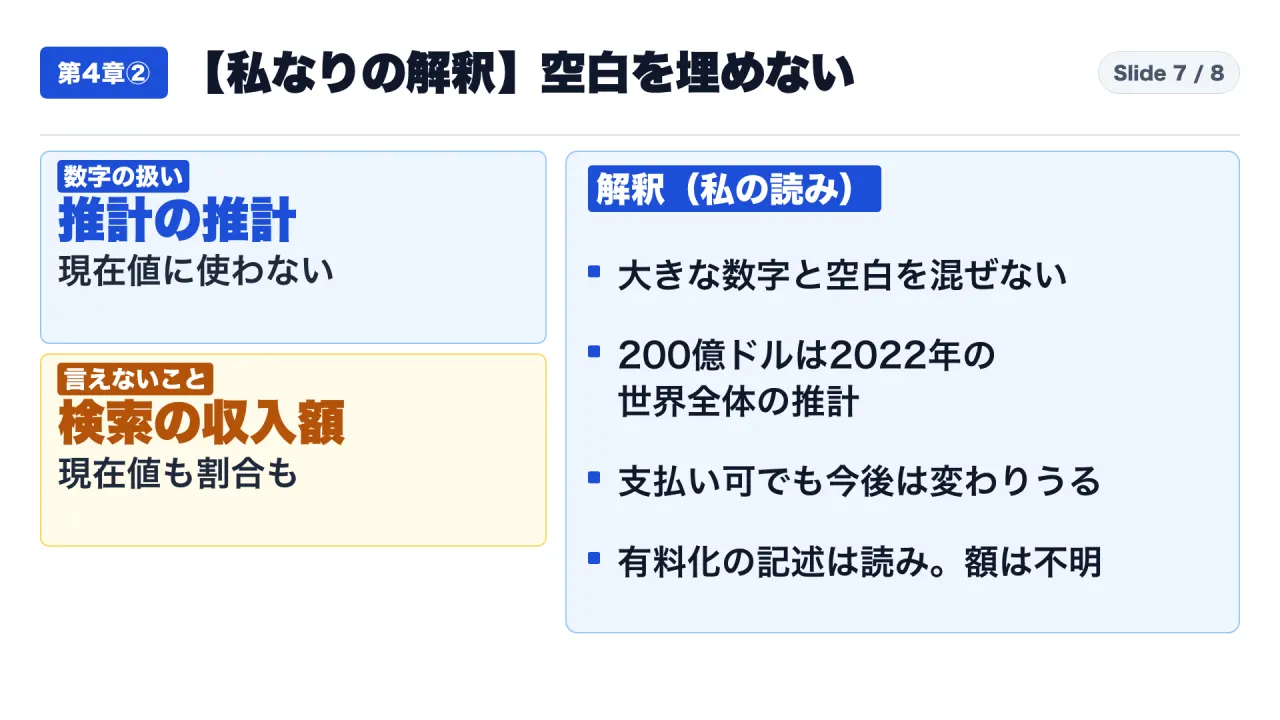
Citing twenty billion dollars as Apple’s current revenue in fiscal 2026 conflates a four-year-old litigation estimate with present-day corporate performance.
The Legal Injunction: Banning Exclusivity, Preserving Payments
Public coverage frequently mischaracterizes the district court remedies order as a ban on Google paying Apple. A rigorous reading of Document 1436 proves the contrary:
Section III of the order strictly prohibits Google from entering into or maintaining contracts that grant Google exclusive default search distribution. Contracts cannot forbid device manufacturers or browser developers from pre-installing competing search engines, nor can they penalize partners for distributing alternatives.
However, the court explicitly rejected the Department of Justice’s request for an outright ban on revenue-sharing payments. Judge Mehta reasoned that non-exclusive distribution agreements with revenue sharing do not inherently violate antitrust law, provided distribution partners remain free to promote rival search services and user choice is unencumbered. The court reserved the right to revisit a payment prohibition only if subsequent market monitoring demonstrated that competition failed to emerge.
Both parties were dissatisfied with the outcome. Google appealed the liability finding and the prohibitions on exclusive default agreements. Simultaneously, the Department of Justice filed an appeal challenging the court’s refusal to order a complete ban on revenue-sharing payments. Both appeals remain pending before the United States Court of Appeals for the District of Columbia Circuit.
4. Siri, Generative AI, and Technological Evolution
Foundational Model Partnerships vs Search Distribution
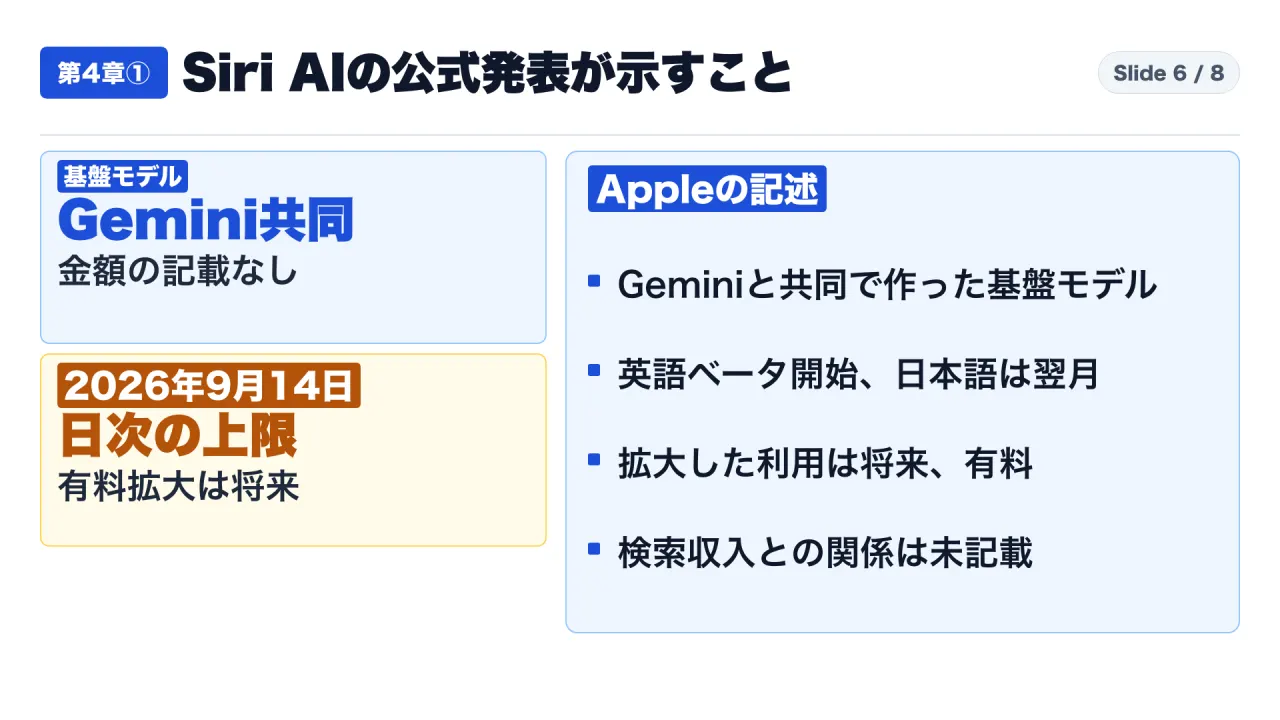
Beyond conventional search box queries, the technological evolution of platform search centers on generative artificial intelligence. On June 8, 2026, Apple announced updates regarding Siri and Apple Intelligence, detailing integration with external models including Google Gemini alongside proprietary on-device and private cloud architectures.
On November 3, 2026, Apple and Google issued a joint press statement regarding their ongoing foundational model collaboration. The statement confirmed that Apple is collaborating with Google on customized foundational models to power next-generation Siri voice and assistant capabilities, incorporating daily usage caps for free-tier queries and preparing future premium access tiers.
The Contractual Firewalls
From a governance and disclosure perspective, the corporate documents establish strict operational separation between traditional Safari search licensing and generative AI infrastructure:
- Independent Agreements: Neither Apple’s Form 10-K nor Google’s filings state that Siri AI collaboration falls under the Safari Search Distribution Agreement (ISA). They represent distinct commercial and technical contracts.
- Financial Terms Undisclosed: Neither party discloses whether Apple pays Google for enterprise inference compute, whether Google compensates Apple for model distribution, or whether the relationship is structured on a net-neutral barter framework.
- Usage Limitations: Disclosures confirm that advanced assistant features operate under daily computational request limits, highlighting the heavy inference cost structures underlying large language model orchestration.
Assuming that AI model collaboration automatically replaces or mirrors the multi-billion-dollar search revenue stream contradicts the documentary record: no public evidence supports financial equivalency.
5. Analytical Framework: How to Audit Corporate Documents Without Fabricating Facts
The Danger of Filling Documentary Blanks
When conducting commercial due diligence, corporate intelligence, or regulatory compliance analysis, professionals routinely encounter incomplete corporate disclosures. The natural human tendency is to fill gaps with prevailing consensus, treating journalistic assumptions as verified facts.
As demonstrated by the Apple search revenue case study, conflating third-party estimates with audited filings produces systemic errors:
- Error 1: Treating a 2022 trial estimate ($20B) as an audited 2026 operating segment.
- Error 2: Assuming a judicial ruling on antitrust remedies eliminated contractual cash flows when the order explicitly declined to do so.
- Error 3: Conflating risk factor disclosures regarding “licensing arrangements” with definitive proof of specific partnership profit margins.
Three Disciplines for Financial and Legal Document Review
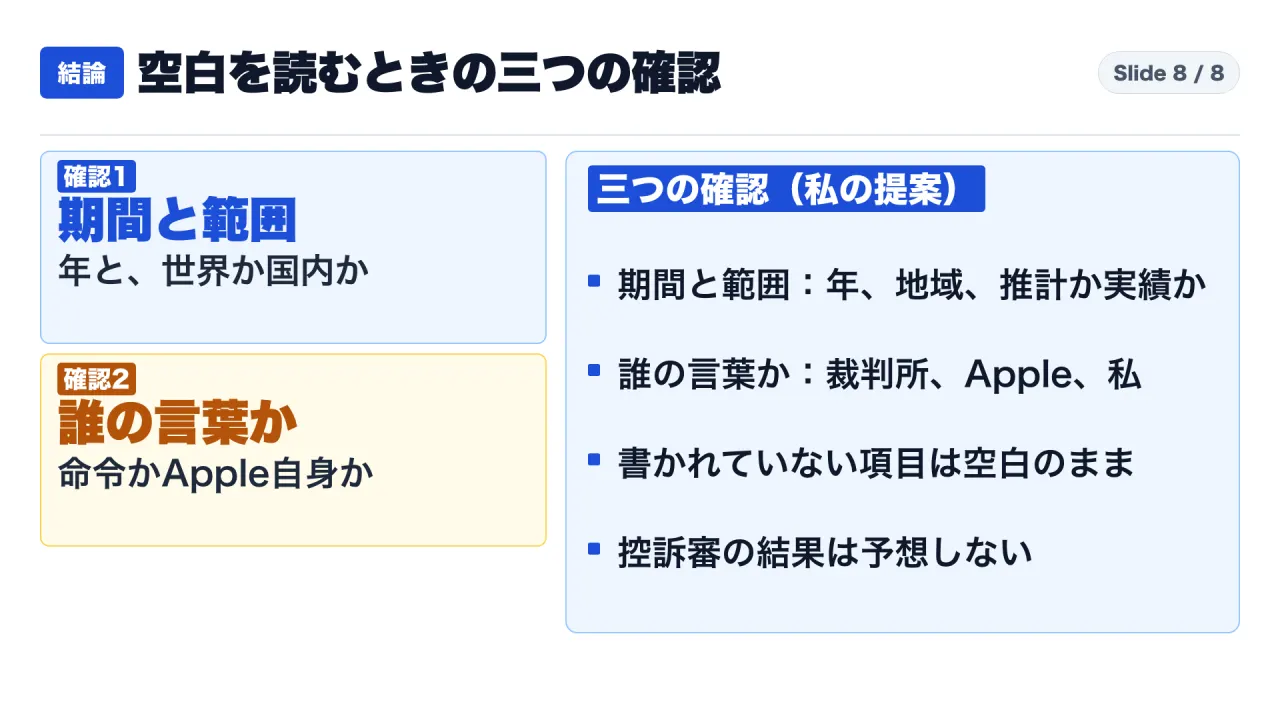
To maintain analytical integrity, practitioners should adhere to three core verification disciplines:
- Verify Timeline and Jurisdiction: Always establish the precise date, fiscal period, and geographic boundary of any quoted financial metric. Distinguish between worldwide multi-year litigation discovery figures and single-quarter audited disclosures.
- Identify Document Authority and Speaker: Distinguish whether a statement represents a court finding of fact, a corporate sworn disclosure under SEC penalties, management promotional commentary, or an outside analyst projection.
- Document What Is Not Said: Acknowledge omissions explicitly. When corporate filings describe a revenue category in broad terms without providing line-item schedules, record the category as “Undisclosed by Issuer.” Never interpolate private figures into audited ledgers.
Conclusion: The Reality of Strategic Ambiguity
Corporate transparency is strictly bounded by SEC disclosure thresholds and competitive sensitivity. Apple’s fiscal 2026 Annual Report on Form 10-K confirms the unparalleled scale and profitability of its Services engine ($123.3B revenue, 76.2% gross margin). It also confirms that third-party licensing arrangements face severe regulatory, antitrust, and contractual renewal risks.
However, the specific monetary value of Google search distribution remains a corporate and legal blank. Until judicial decrees enforce itemized disclosures or contractual renegotiations compel new SEC disclosures, rigorous analysts must report the facts as they are: documented, bounded, and rigorously separated from speculation.