How Much SPV Debt Is Truly Ring-Fenced from CoreWeave? Reading Note 8 Guarantees in Form 10-Q
A forensic financial audit of CoreWeave Form 10-Q disclosures, examining recourse liabilities, DDTL 4.0 exemptions, bankruptcy-remote subsidiaries, and 640 million dollars in net interest expenses.
Japanese Edition: Read the original Japanese article on Substack
Video Episode (Japanese Audio): Watch on YouTube
Executive Summary: Only 10% of Debt Is Truly Non-Recourse to the Parent
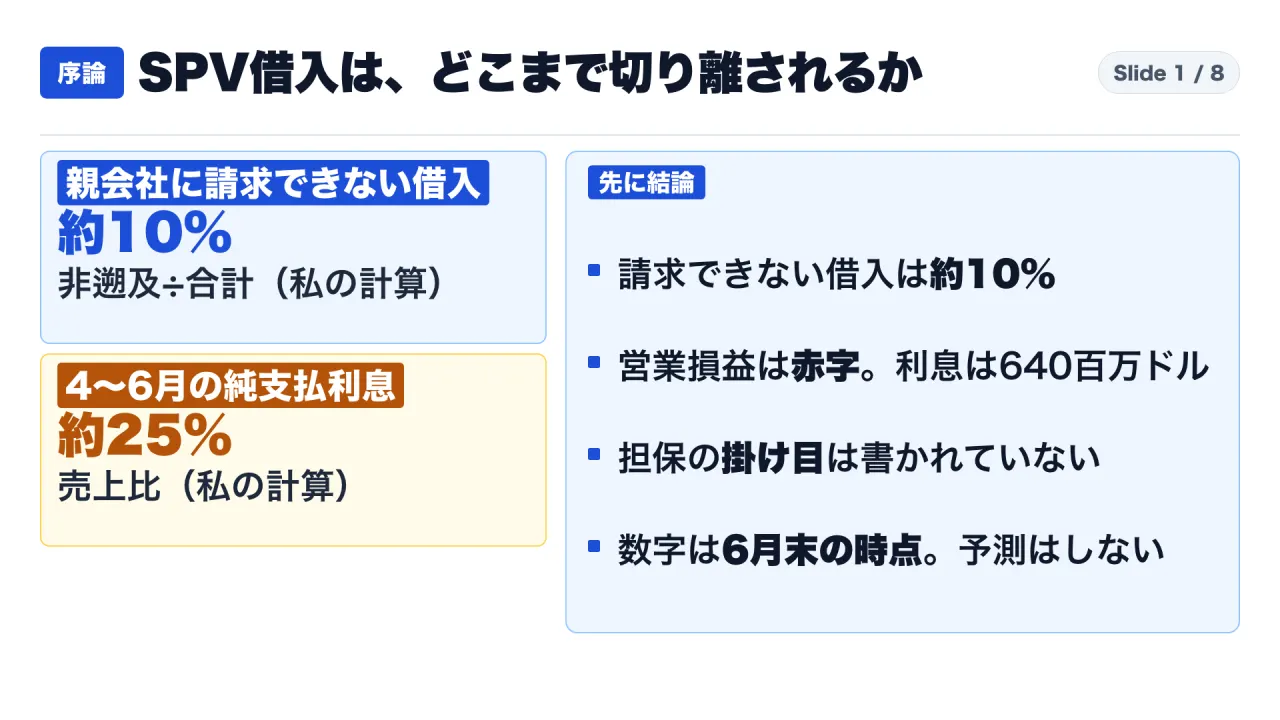
In enterprise IT procurement and infrastructure financing, vendors frequently market Special Purpose Vehicle (SPV) structures as completely isolated from parent liabilities. When cloud operators state that debt is held within bankruptcy-remote subsidiaries, enterprise risk committees often assume that subsidiary distress cannot cascade upward. However, examining CoreWeave Form 10-Q for the quarter ended June 30, 2026 filed with the SEC establishes a stark reality: true non-recourse debt represents barely 10% of total borrowing.
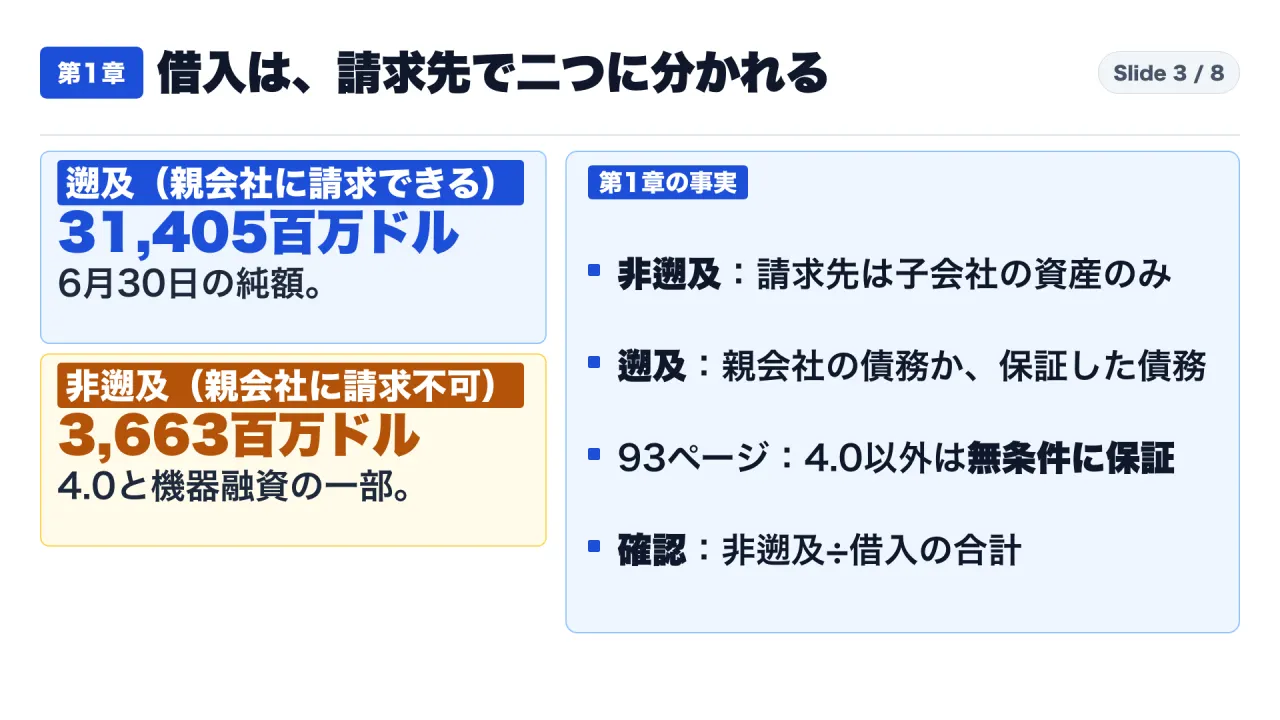
As of June 30, 2026, CoreWeave reported total debt obligations of $35,068 million ($35.1 billion). Non-recourse debt accounted for $3,663 million ($3.66 billion), while recourse debt totaled $31,405 million. Non-recourse debt where lenders possess zero legal claim against the parent represented exactly 10.45% of total debt (3,663 / 35,068 = 0.1045, author calculation).
Regarding Delayed Draw Term Loan (DDTL) facilities, CoreWeave disclosures state an unequivocal contractual reality (page 93):
“All obligations under the DDTL Facilities, other than the DDTL 4.0 Facility, are unconditionally guaranteed by us.”
This confirmation demonstrates that characterizing SPV debt as isolated from the parent applies exclusively to DDTL 4.0 and select equipment financings. For five separate DDTL tranches totaling $10,806 million ($10.8 billion), CoreWeave provides an unconditional, irrevocable corporate guarantee.
Simultaneously, asset ring-fencing is structured extensively across consolidated subsidiaries. While $18.2 billion in property and equipment and $2.6 billion in current assets are ring-fenced for subsidiary liabilities, these assets remain consolidated on CoreWeave balance sheet. With Q2 2026 operating losses of $49 million, net interest expenses of $640 million (24.85% of revenue), and capital expenditures of $14,117 million outstripping operational cash flow, distinguishing collateral segregation from liability isolation is critical for enterprise counterparties.
Methodological Framework: Facts, Accounting Definitions, and Unwritten Disclosures
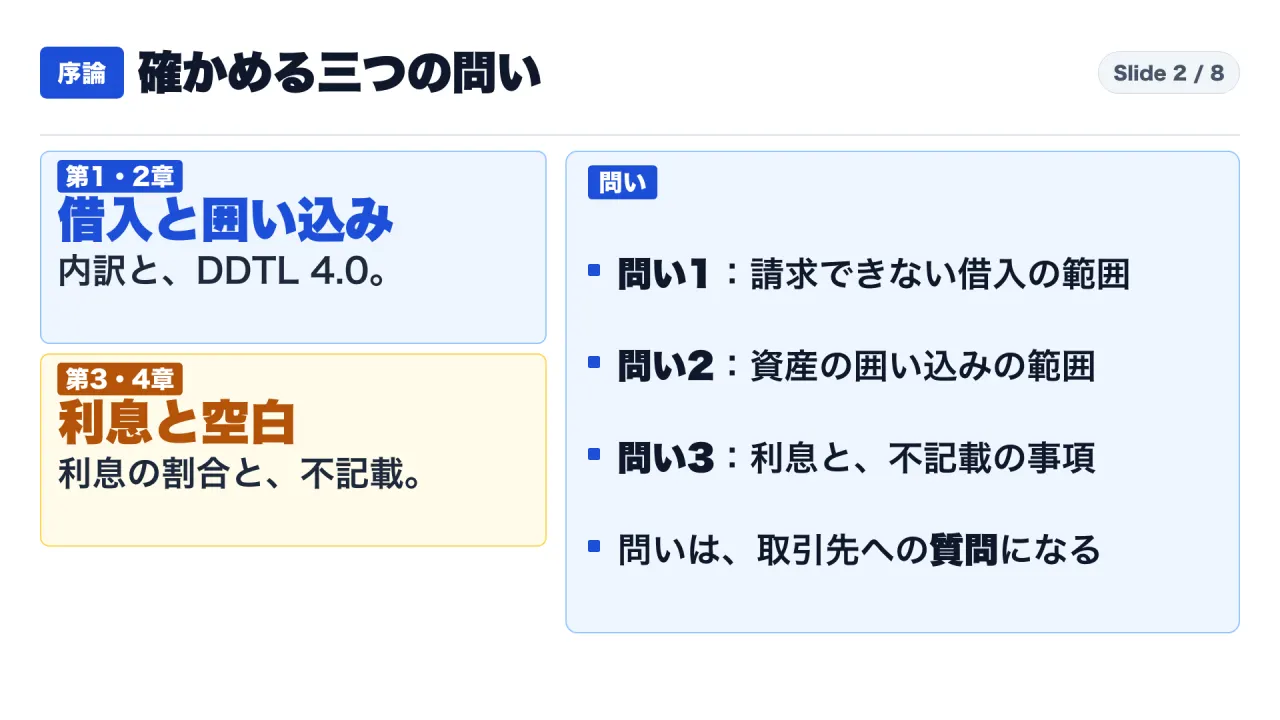
To evaluate debt isolation with institutional rigor, this audit separates information into structured categories:
- Established Facts: Contractual terms and metrics published in SEC filings, cross-referenced with exact page numbers.
- Company Statements: Management characterizations in press releases, identified as commentary.
- Author Calculations: Mathematical ratios derived from reported statements, presented with explicit arithmetic formulas.
- Author Deductions: Inferences drawn from verified facts.
- Unwritten Items: Essential data points absent from the filing, identified as undisclosed gaps.
Primary sources verified in November 2026 comprise:
- CoreWeave Form 10-Q: Quarterly report for the period ended June 30, 2026 (S1).
- CoreWeave Form 8-K (March 2026): Current report announcing the closing of the DDTL 4.0 facility (S2).
- CoreWeave Form 8-K (September 2025): Agreement detailing the NVIDIA Master Order agreement (S3).
- CoreWeave Form 8-K (September 22, 2026): Closing of $4.2 billion in 2.875% convertible senior notes due 2033 (S4).
Key Financial Definitions
- SPV (Special Purpose Vehicle): A subsidiary created for a narrow objective, designated in filings as bankruptcy-remote, special-purpose consolidated subsidiaries.
- Recourse vs. Non-Recourse: Recourse debt grants lenders legal claim against the parent. Non-recourse debt limits lender recovery exclusively to pledged subsidiary assets.
- Unconditional Guarantee: A binding commitment where a guarantor promises full repayment if the primary debtor defaults.
- DDTL (Delayed Draw Term Loan): A committed credit facility allowing tranches to be drawn over an extended window (designated 1.0, 2.0, 2.1, 3.0, 4.0, and 5.0).
- RPO (Remaining Performance Obligations): Contracted future revenue not yet recognized under GAAP.
Section 1: The Recourse Boundary: 90% of Total Debt Rests on Parent Shoulders
Beginning in Q2 2026, CoreWeave amended its balance sheet presentation to explicitly segregate debt obligations into recourse and non-recourse categories (Note 8, page 13).
According to Note 8 (pages 27-28), non-recourse debt represents subsidiary borrowings where lender remedies are strictly confined to pledged operating assets. Parent liability is limited to bad-boy carve-outs: actual fraud, intentional misrepresentation, willful misconduct, collateral misappropriation, or voluntary bankruptcy. CoreWeave notes that these limited guarantees do not cover principal and interest repayment under normal operations.
Conversely, recourse debt represents direct parent obligations or subsidiary borrowings unconditionally guaranteed by CoreWeave.
As of June 30, 2026, CoreWeave balance sheet reflects the following distribution (page 6):
- Recourse Debt: $31,405 million
- Non-Recourse Debt: $3,663 million
- Total Debt Obligations: $35,068 million
Non-recourse debt constitutes 10.45% of total obligations (3,663 / 35,068 = 0.1045, author calculation). Note 8 discloses that non-recourse borrowing consists of $2,837 million under DDTL 4.0, $882 million under equipment/software license financings, and $(56) million in unamortized discounts and fees, summing to $3,663 million.
The remaining 89.55% of debt rests upon parent guarantees or direct corporate issuances. Page 93 states:
“All obligations under the DDTL Facilities, other than the DDTL 4.0 Facility, are unconditionally guaranteed by us.”
The five recourse DDTL facilities (1.0, 2.0, 2.1, 3.0, and 5.0) carried outstanding balances of $1,300 million, $3,190 million, $3,000 million, $2,215 million, and $1,101 million respectively on June 30, 2026, totaling $10,806 million (author calculation). Page 30 reconfirms that all obligations under DDTL 5.0 are unconditionally guaranteed by the company.
The remainder of recourse borrowing comprises senior notes ($2,000M due 2030, $1,750M 9.00% notes due 2031, $2,750M 9.75% notes due 2031, $1,250M 9.625% notes due 2032, and $2,279M euro notes due 2032), convertible notes ($2,588M due 2031 and $4,000M due 2032), equipment financings ($4,220M), and Magnetar borrowings ($189M), minus $(427)M in unamortized discounts. Combining $10,806M in DDTL guarantees with $16,617M in senior notes and $4,409M in equipment/other facilities yields $31,832M, which after netting $(427)M matches the reported $31,405M in recourse liabilities (author calculation).
Section 2: Ring-Fenced Assets vs. Consolidated Balance Sheets
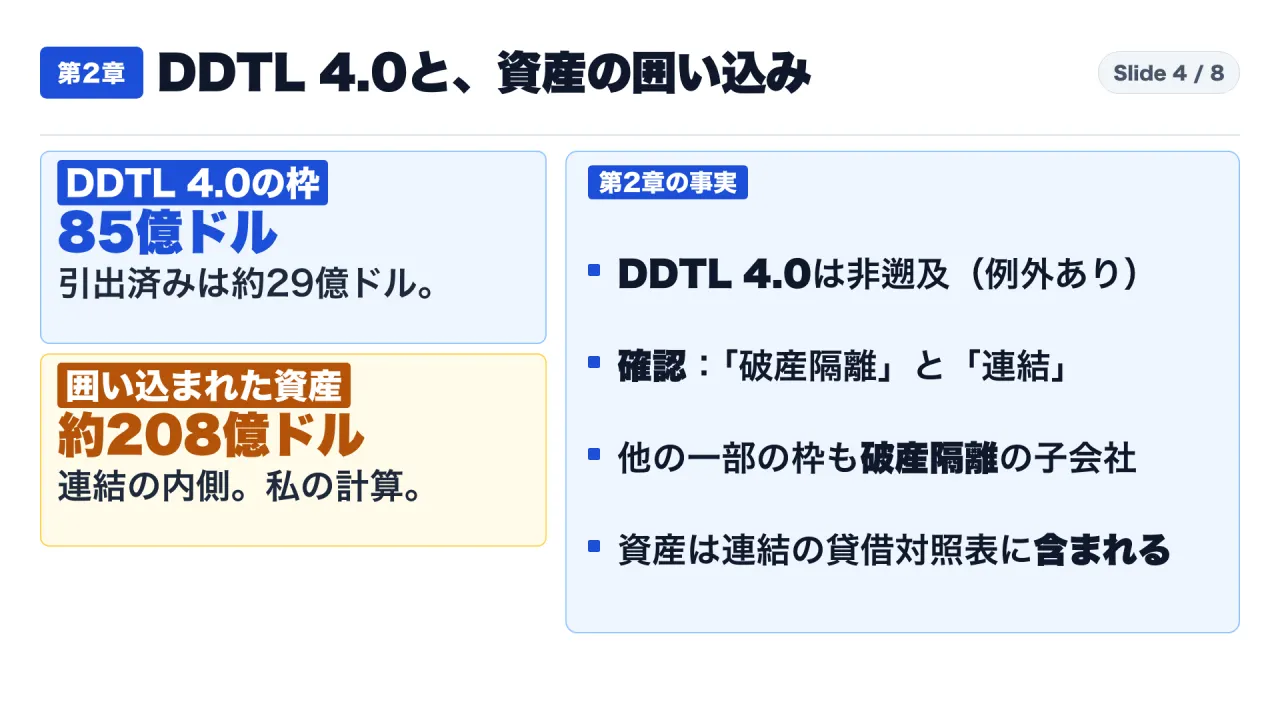
The primary facility insulated from parent recourse is DDTL 4.0, executed by a specialized financing subsidiary in March 2026 (page 28). The facility features an $8.5 billion commitment available through June 30, 2027. Under management terms, initial borrowing capacity was capped at approximately $7.5 billion, expandable to $8.5 billion upon collateral stabilization.
As of June 30, 2026, outstanding draws under DDTL 4.0 totaled $2,837 million ($1.4 billion floating and $1.5 billion fixed rate notes). Floating borrowings carry interest at SOFR plus 2.25%, while fixed notes bear approximately 5.9% (Treasury plus 2.00%), resulting in an effective interest rate of 7% (Note 8). Moody assigned an A3 rating and DBRS assigned an A (low) rating, designated by management as the industry first investment-grade debt backed by compute infrastructure and customer contracts.
DDTL 4.0 collateral comprises equity in the borrowing subsidiary and substantially all subsidiary assets, which as of June 30, 2026 included $3.3 billion in property/equipment and $155 million in restricted cash dedicated to three months of debt service and operational costs.
Beyond DDTL 4.0, Note 8 (page 30) reveals a broader structural reality:
“In addition to DDTL 4.0, certain of the Company’s debt facilities are entered into by bankruptcy-remote, special-purpose consolidated subsidiaries formed to hold the financed infrastructure and the related customer contracts.”
Assets of these subsidiaries are pledged exclusively to their respective debt tranches. As of June 30, 2026, collateral supporting these facilities encompassed $18.2 billion in property and equipment and $2.6 billion in current assets (primarily receivables and restricted cash).
Crucially, CoreWeave notes that all such ring-fenced assets are included within its condensed consolidated balance sheets (page 30). Intercompany transactions are eliminated upon consolidation (page 12). Therefore, ring-fencing collateral does not mean off-balance-sheet treatment: asset segregation protects secured lenders, but parent liabilities remain intact across guaranteed facilities.
Section 3: Operating Losses, 25% Interest Burden, and Customer Concentration
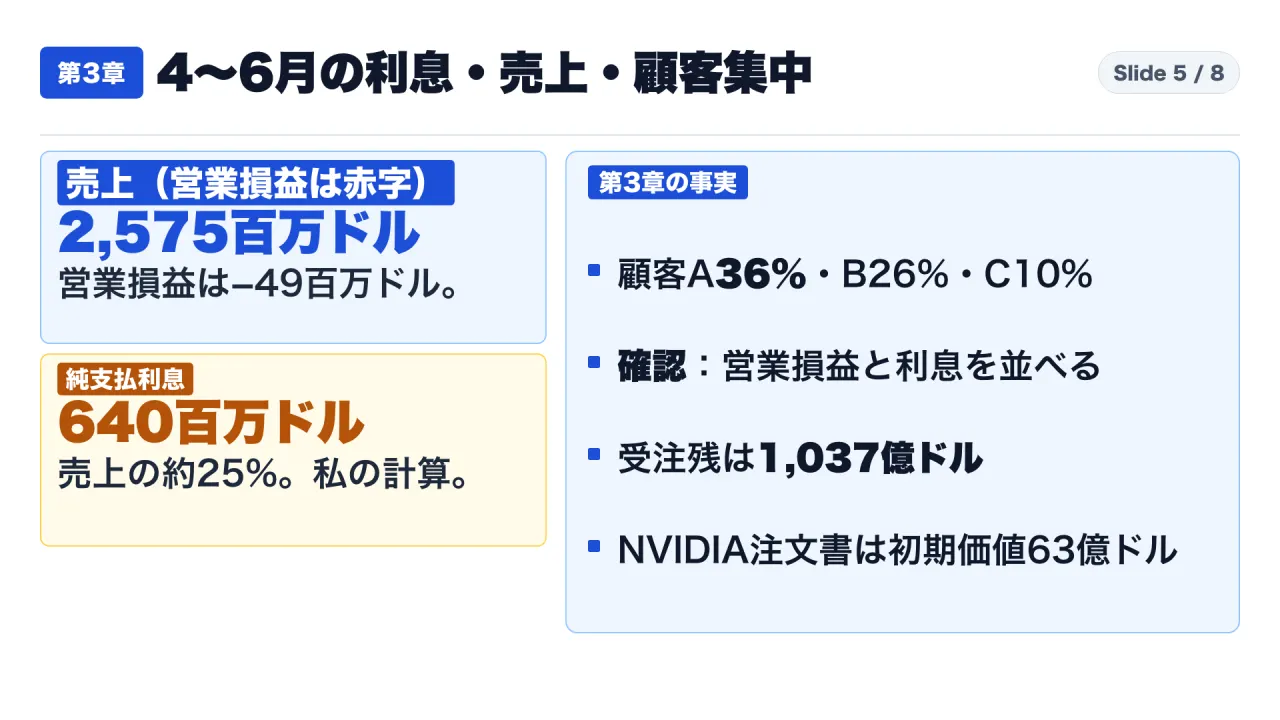
CoreWeave operational results for Q2 2026 (three months ended June 30, 2026) highlight the carrying cost of its capital expansion (page 7):
- Quarterly Revenue: $2,575 million
- Operating Loss: $(49) million
- Net Interest Expense: $640 million
Net interest expense consumed 24.85% of quarterly revenue (640 / 2,575 = 0.2485, author calculation). On page 42, net interest expense includes finance lease interest, financing elements in customer contracts, and debt discount amortization. Management confirms that interest expense surged primarily due to higher debt balances.
Cash flow mechanics for the six months ended June 30, 2026 reveal external capital dependence:
- Operating cash flow generated positive cash (driven by working capital shifts and customer upfront deposits).
- Capital expenditures totaled $14,117 million ($14.1 billion).
- Cash raised from debt issuances reached $16,747 million, while debt repayments absorbed $5,219 million (page 11).
Internal cash flow was insufficient to fund infrastructure buildouts, requiring continuous external debt financing.
Revenue concentration among hyperscale AI developers remains acute (Note 3, page 15). During Q2 2026, three clients generated 72% of total corporate revenue: Customer A (36%), Customer B (26%), and Customer C (10%), totaling 72% (author calculation). In Q2 2025, Customer A represented 71%. Footnotes clarify that alphabetical customer designations are reassigned each period and do not correspond to the same underlying entities across filings.
Supporting future revenue, CoreWeave reported Remaining Performance Obligations (RPO) of $103.7 billion as of June 30, 2026, with 41% expected within 24 months and 39% between 25 and 48 months. Additionally, an agreement executed with NVIDIA in September 2025 established a $6.3 billion backstop where NVIDIA is obligated to acquire unused capacity through April 13, 2032, subject to termination conditions (S3).
Section 4: What Form 10-Q Leaves Out: Six Critical Undisclosed Variables
Institutional enterprise due diligence requires auditing what is omitted from SEC filings:
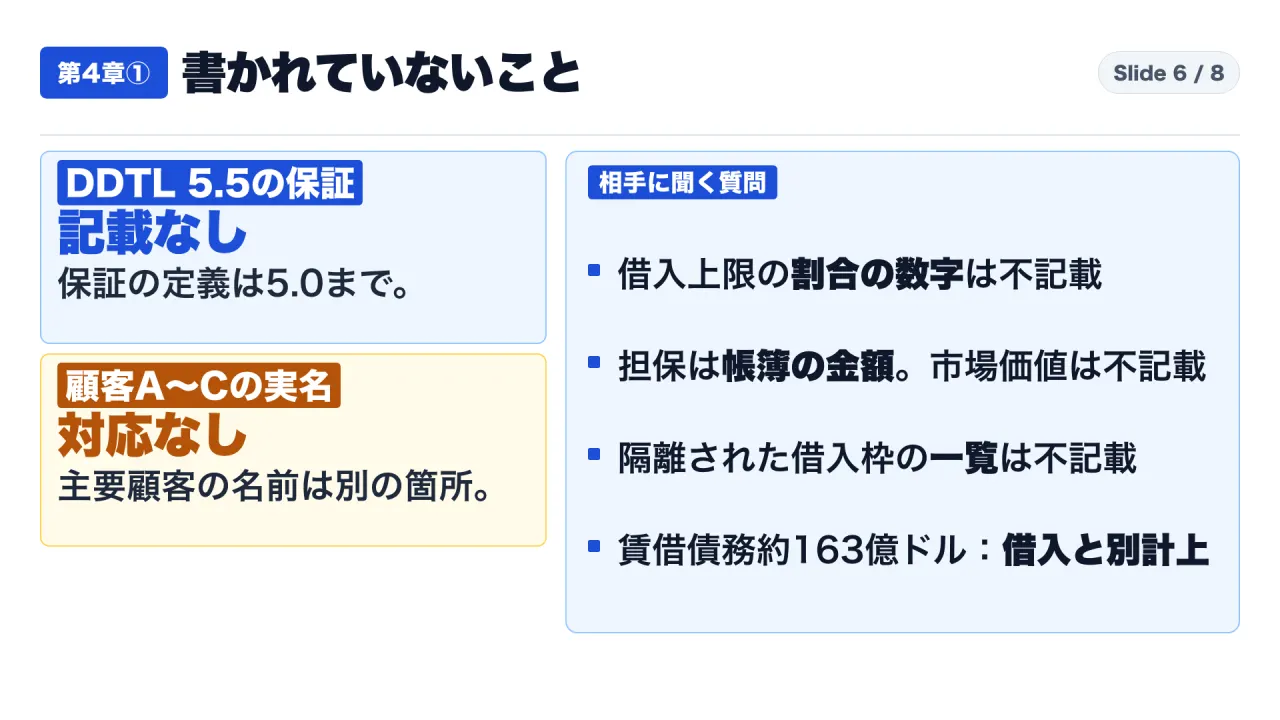
- Advance Rates and LTV Limits: While DDTL 4.0 borrowing is constrained by equipment purchase prices (page 29), advance rate percentages, loan-to-value caps, and residual value assumptions are absent.
- Collateral Market Valuations: Disclosed figures represent historical book values ($18.2B property and equipment), providing no data on secondary GPU liquidation prices.
- Comprehensive Schedule of SPV Facilities: Note 8 references certain debt facilities in bankruptcy-remote subsidiaries without enumerating which exact facilities qualify.
- Customer Identity Mapping: While Microsoft and OpenAI are cited as principal customers on page 74, the filing does not map them to Customer A, B, or C.
- DDTL 5.5 Guarantee Status: In August 2026, CoreWeave executed a new DDTL 5.5 facility (Note 14, page 40). However, the guarantee definition on page 93 only enumerates facilities through DDTL 5.0, leaving DDTL 5.5 guarantee terms unstated.
- Operating Lease Commitments: Long-term operating leases for data center space and power total $16,319 million ($16.3 billion on page 93), representing fixed off-debt financial claims.
Section 5: Author Interpretations and the Two Dimensions of Isolation
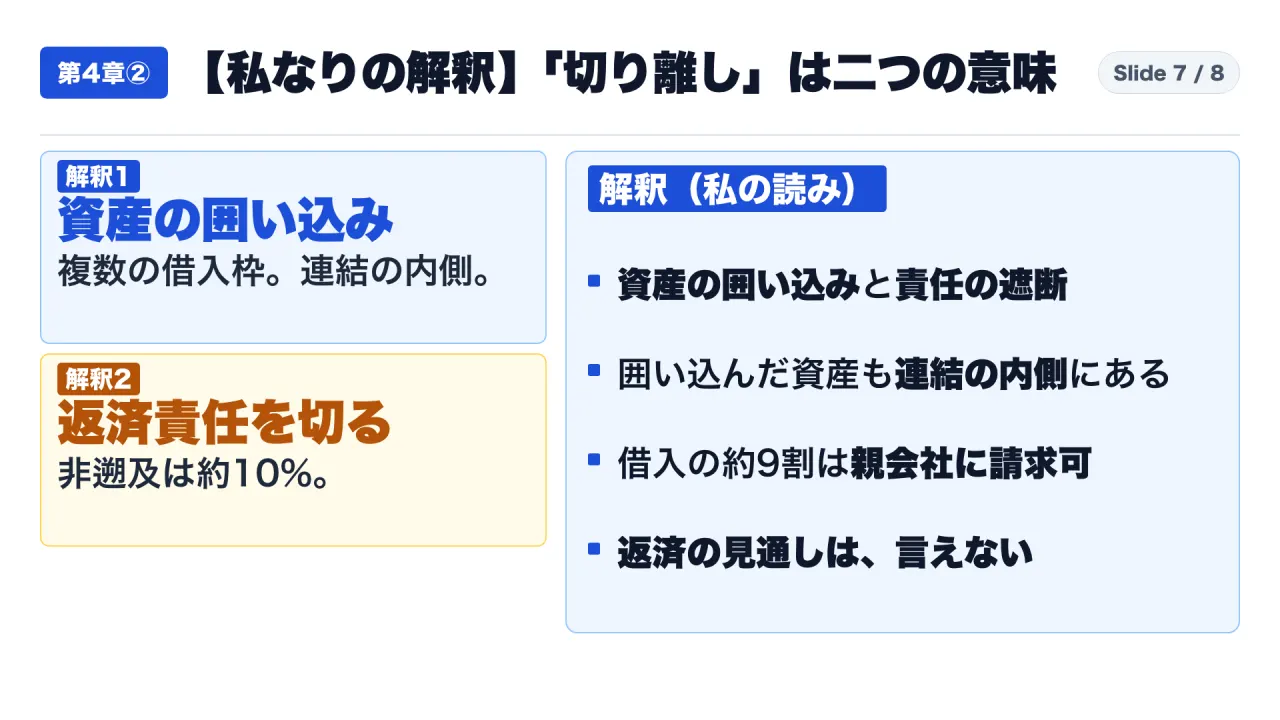
Synthesizing verified disclosures establishes two distinct dimensions of corporate isolation:
- Dimension 1: Collateral Ring-Fencing: Pledging hardware to specific subsidiaries protects secured creditors but keeps assets consolidated on the parent balance sheet.
- Dimension 2: Liability Shielding: Non-recourse protection shielding the parent exists for only 10% of total debt ($3.66B out of $35.1B).
- Consolidation Reality: Asset isolation does not remove infrastructure from CoreWeave consolidated statements.
- Parent Exposure: Nearly 90% of debt obligations represent parent issuances or guaranteed liabilities.
Enterprise Counterparty Due Diligence Checklist
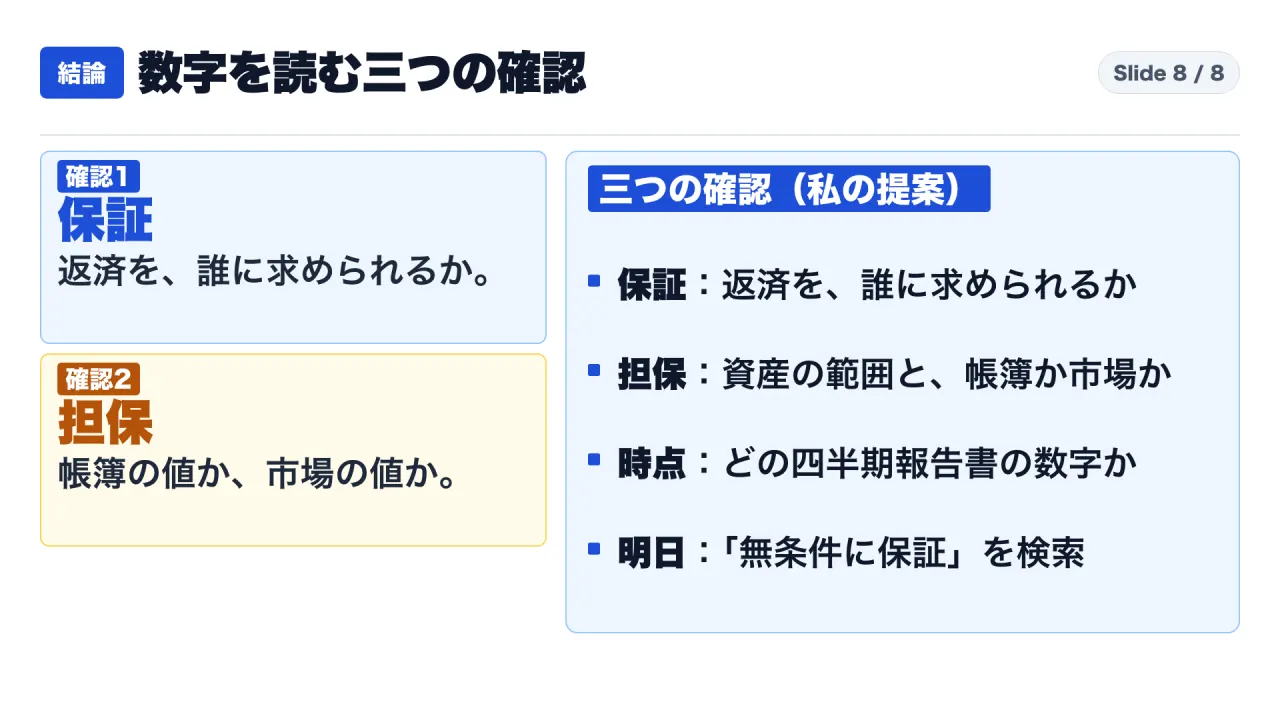
- Distinguish Isolation Types: Verify whether vendor marketing claims refer to collateral ring-fencing or liability severance.
- Inspect Guarantee Clauses: Search SEC filings for unconditional guarantee covenants across all borrowing tranches.
- Examine Carve-Out Terms: Audit whether non-recourse exemptions cover standard operating losses or only willful misconduct.
- Audit Collateral Valuation Basis: Determine whether pledged assets reflect historical book value or volatile secondary hardware market values.
- Track Post-Quarter Capital Events: Review subsequent Form 8-K filings for new parent debt, such as CoreWeave $4.2 billion convertible notes offering closed on September 22, 2026 (S4).
Frequently Asked Questions
Q: Is SPV debt at CoreWeave completely separated from parent corporate obligations? A: No. In Form 10-Q, 89.55% of debt obligations ($31,405M of $35,068M) are either direct parent liabilities or unconditionally guaranteed by CoreWeave. Non-recourse debt represents only 10.45%.
Q: Does non-recourse debt refer solely to DDTL 4.0? A: Primarily, but not exclusively. Non-recourse borrowing includes $2,837M from DDTL 4.0 and $882M in equipment financings, netting $(56)M in discounts to reach $3,663M.
Q: Are bankruptcy-remote subsidiary assets removed from CoreWeave balance sheet? A: No. CoreWeave explicitly states that the $18.2B in property/equipment and $2.6B in current assets pledged to subsidiary debts are fully included in its condensed consolidated balance sheets.
Q: Who are Customer A, B, and C in the concentration table? A: The filing does not disclose customer identities corresponding to A, B, and C, though Microsoft and OpenAI are cited as major customers elsewhere in the document.
Primary Sources & Reference Documentation
- S1: CoreWeave Form 10-Q for the Period Ended June 30, 2026: https://www.sec.gov/Archives/edgar/data/1769628/000176962826000366/crwv-20260630.htm
- S2: CoreWeave Current Report Form 8-K (DDTL 4.0 Closing, March 2026): https://www.sec.gov/Archives/edgar/data/1769628/000176962826000129/ex991.htm
- S3: CoreWeave Current Report Form 8-K (NVIDIA Order Agreement, September 2025): https://www.sec.gov/Archives/edgar/data/1769628/000176962825000047/crwv-20250909.htm
- S4: CoreWeave Current Report Form 8-K (Closing of $4.2B Convertible Notes, September 22, 2026): https://www.sec.gov/Archives/edgar/data/1769628/000176962826000432/crwv-20260917.htm