What a 32GB GPU Spec Sheet Dictates, What It Leaves Out, and How Software and Licensing Bound AI Viability
A technical investigation into Intel Arc Pro B-Series hardware specifications, runtime software velocity, community benchmark variance, and commercial model licensing boundaries.
Japanese Edition: Read the original Japanese article on Substack
Video Episode (Japanese Audio): Watch on YouTube
Executive Summary: Hardware Limits Define Ceilings, Not Operational Speed
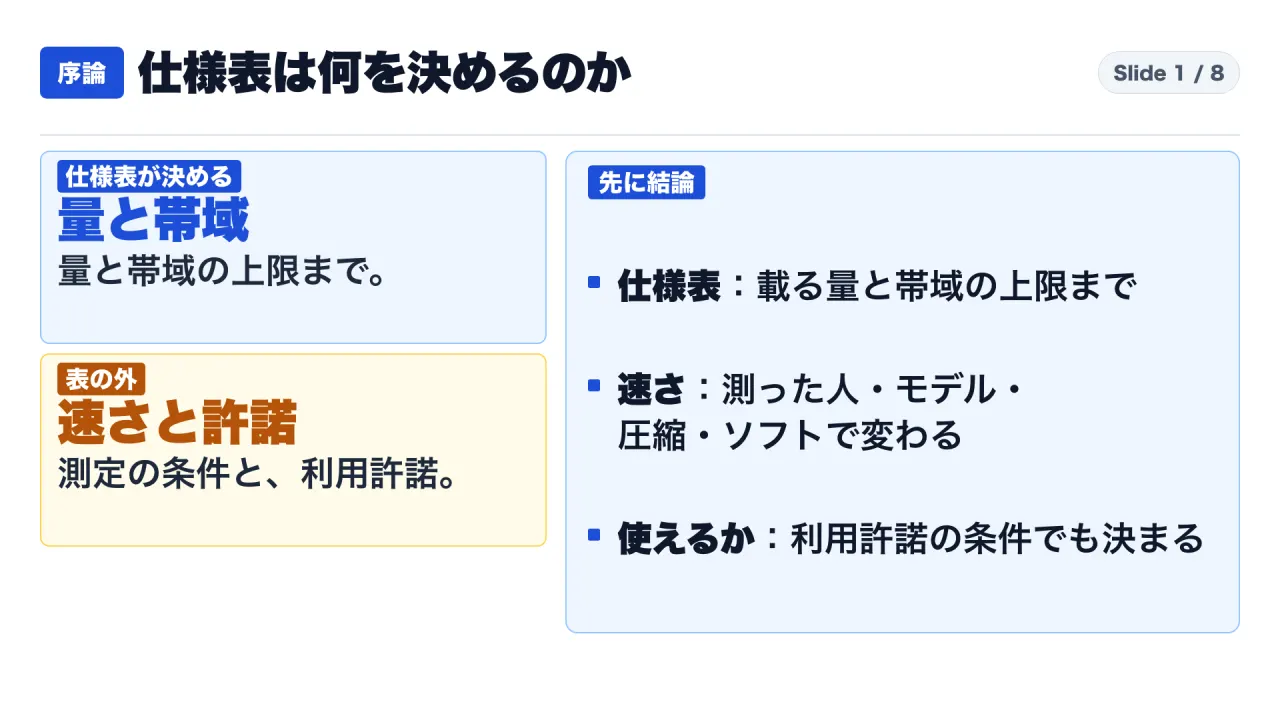
When evaluating local AI accelerators, enterprise IT architects and procurement leads routinely rely on specification sheets. A headline metric like 32GB of VRAM or 608 GB/s of memory bandwidth appears to offer an objective benchmark. However, examining official Intel specification sheets for the Arc Pro B-Series (Arc Pro B60, B65, and B70) reveals a fundamental boundary: spec sheets define physical ceilings and hardware topology, but omit runtime inference throughput entirely.
Across official Intel specification sheets for the B60, B65, and B70, there is zero mention of decoding throughput in tokens per second (S1, S2, S3). A spec sheet confirms VRAM capacity, memory bus bandwidth, compute core counts, total board power, and host interface lanes. It does not dictate how fast a model generates responses.
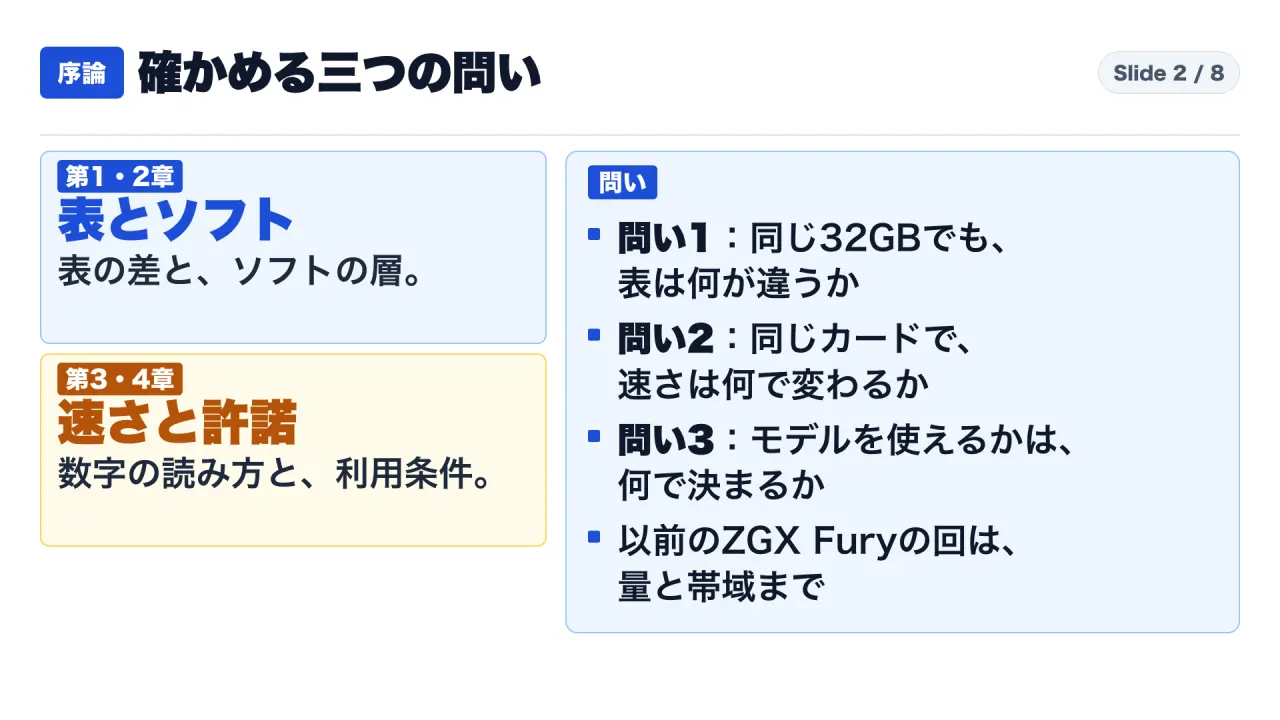
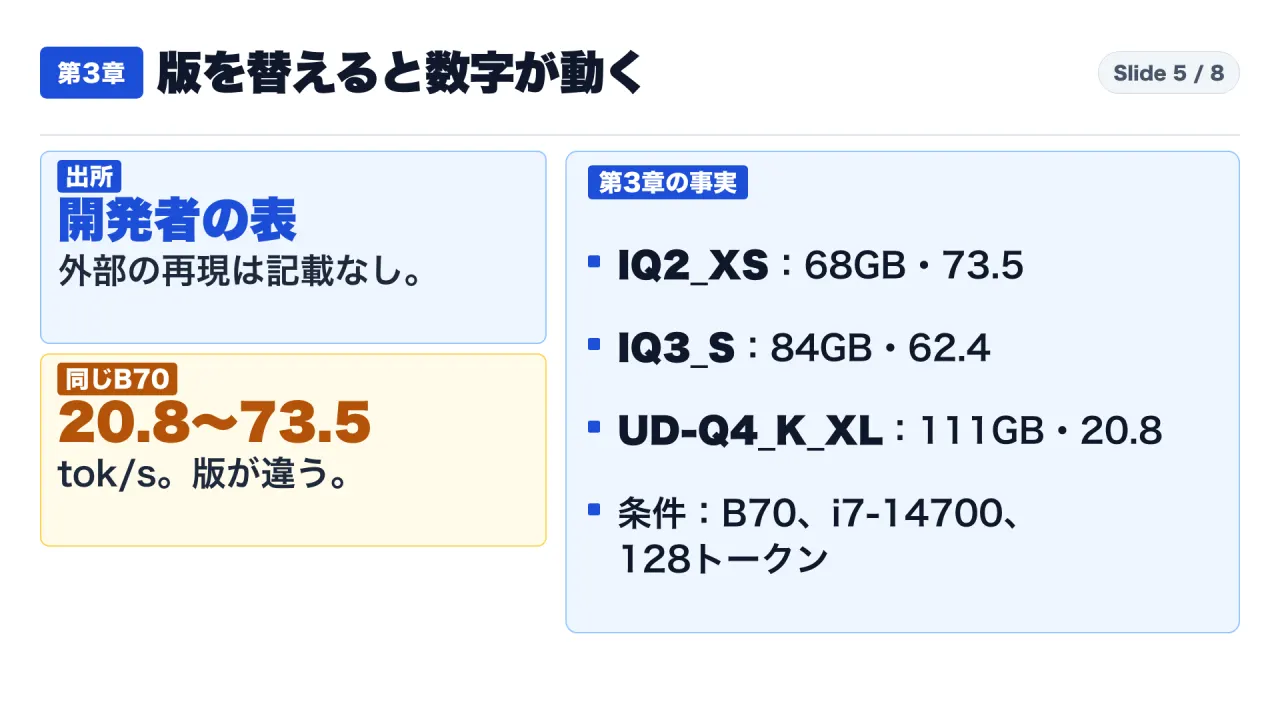
Real-world operational speed is determined within the runtime software layer and measurement conditions. In benchmark records from the developer of XeStrata—a community runtime porting Strata to Intel GPUs—decoding throughput on an identical Arc Pro B70 workstation running a 128-token decode sequence spanned from 20.8 to 73.5 tokens/s purely by altering model quantization and offload formats (S7). This marks a 3.53x performance variance on identical physical silicon, with zero third-party replication documented (S6, S7).
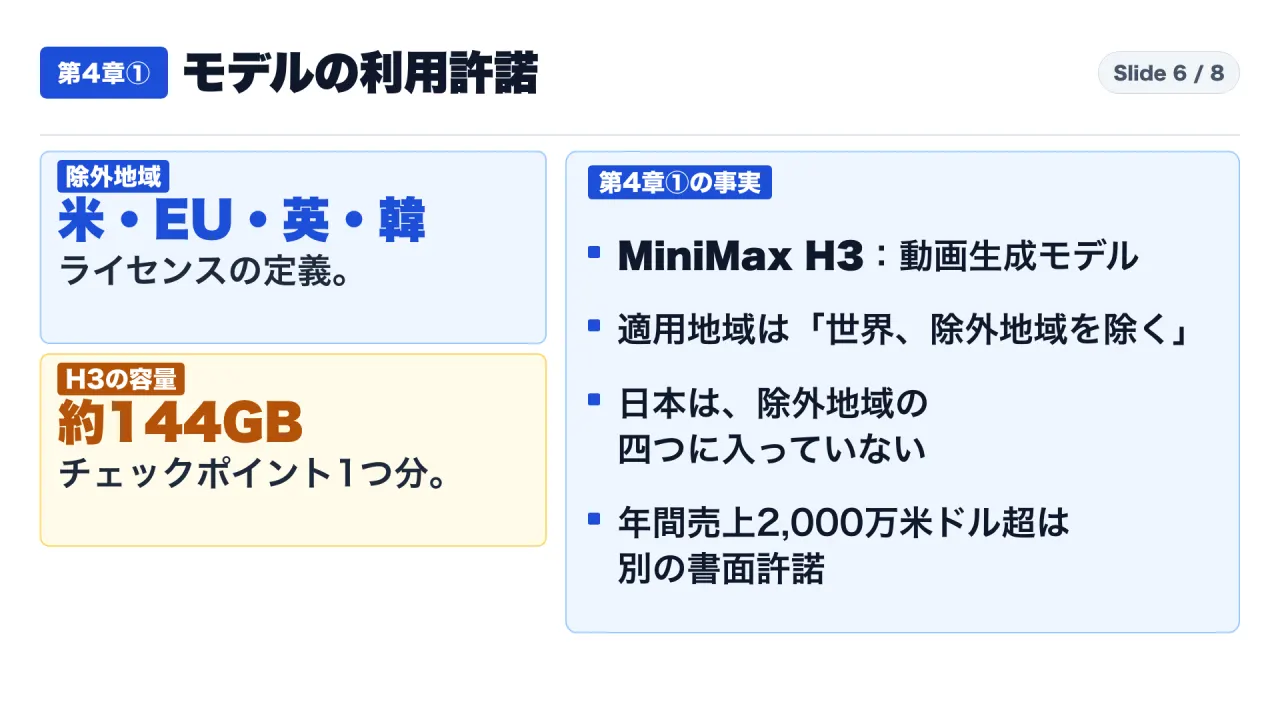
Furthermore, commercial deployment legality is governed by an independent layer: model licensing. The MiniMax H3 video generation model community license explicitly excludes the United States, the European Union, the United Kingdom, and South Korea, while mandating separate written permission if commercial products or services exceed 20 million US dollars in annual gross revenue (S15). Notably, Japan is not among the four excluded jurisdictions.
Methodological Boundaries: Facts, Author Interpretation, and Unwritten Gaps
This analysis separates information into three methodological categories:
- Established Facts: Explicitly published data in official documentation, data sheets, and code repositories, cross-referenced with exact citations.
- Author Interpretation: Technical analysis, synthesized ratios, and frameworks derived from verified facts, explicitly identified as analytical deductions.
- Unwritten Gaps: Information absent from public documentation within the checked scope, recorded as unwritten rather than assumed.
Primary sources verified in November 2026 comprise Intel spec tables (S1-S3), B70 datasheet (S4), B-Series overview (S5), official GitHub repositories (llm-scaler S10, IPEX-LLM S11, IPEX Core S12), XeStrata documentation (S6-S9, S17), Ubuntu 26.04 LTS release notes (S13), and MiniMax H3 licensing records (S14-S16).
Section 1: Dissecting the Intel Spec Sheet: Capacity Ceilings vs. Execution Architecture
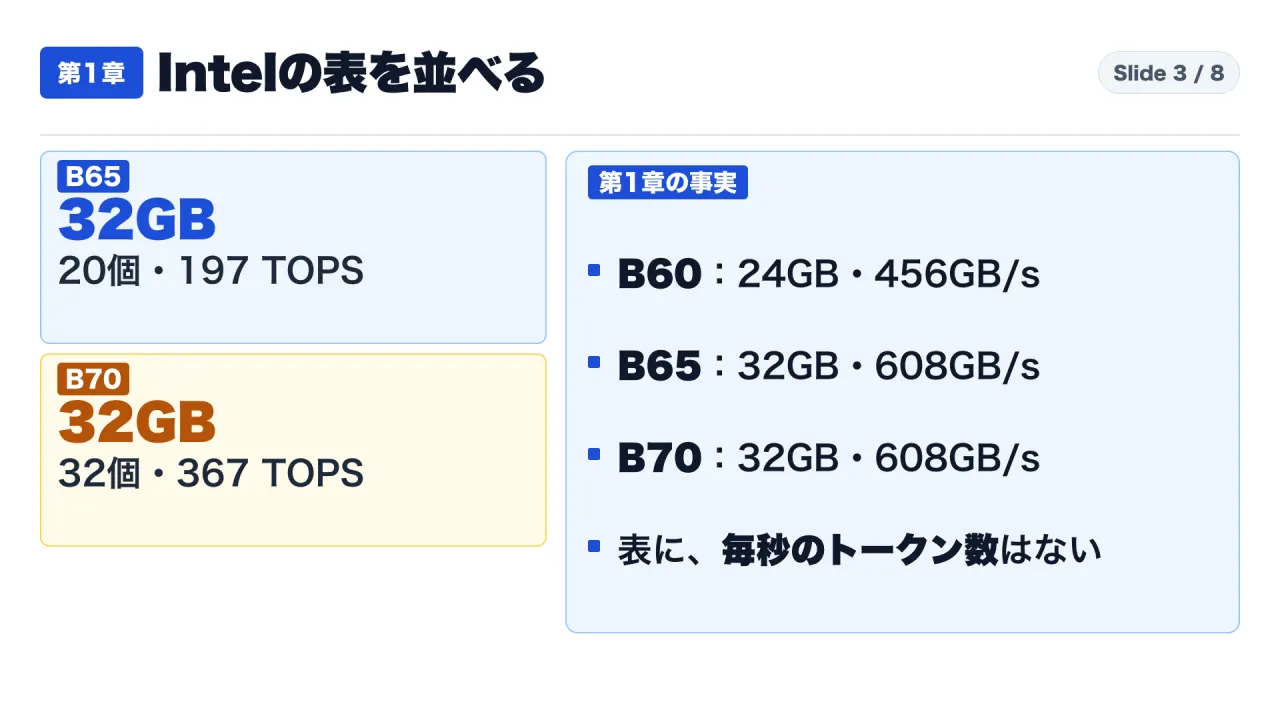
Placing official specifications of Intel Arc Pro workstation graphics cards side by side highlights critical architectural divergences across models sharing identical memory capacities (S1, S2, S3):
| Specification Field | Intel Arc Pro B60 | Intel Arc Pro B65 | Intel Arc Pro B70 |
|---|---|---|---|
| Launch Date | Q2 2025 | Q1 2026 | Q1 2026 |
| Memory Capacity | 24GB GDDR6 | 32GB GDDR6 | 32GB GDDR6 |
| Memory Bandwidth | 456 GB/s | 608 GB/s | 608 GB/s |
| Compute Units (Xe-cores) | 20 cores | 20 cores | 32 cores |
| XMX AI Engines | 160 engines | 160 engines | 256 engines |
| GPU Peak TOPS (Int8) | 197 TOPS | 197 TOPS | 367 TOPS |
| Total Board Power (TBP) | 200W | 200W | 230W |
| Host Bus Interface | PCIe 5.0 x8 | PCIe 5.0 x16 | PCIe 5.0 x16 |
According to the B70 datasheet, power spans 160W to 290W, with Intel reference cards rated at 230W (S4).
These fields delineate four operational boundaries:
- Capacity Ceilings: VRAM (24GB or 32GB) caps total parameter weights and active KV cache.
- Bandwidth Ceilings: Memory bus bandwidth (456 GB/s or 608 GB/s) caps weight streaming during autoregressive decoding.
- Compute Ceilings: Xe-cores, XMX engines, and peak Int8 TOPS set theoretical saturation limits for prefill or quantized matrix operations.
- Deployment Constraints: Total board power and PCIe physical lanes dictate power supply sizing and host bus routing.
Crucially, neither tokens per second nor prompt latency appear in these tables. The B65 and B70 share 32GB GDDR6 memory and 608 GB/s bandwidth, yet the B70 features 60% more Xe-cores (32 vs. 20), 60% more XMX matrix engines (256 vs. 160), and 86% higher peak Int8 compute (367 vs. 197 TOPS). Conversely, the B60 and B65 share identical compute cores and peak TOPS, differing in memory capacity and interface width. A single metric like 32GB does not define hardware capability.
Intel marketing claims up to 6.3x faster response speeds versus competing NVIDIA products (S5). Footnotes reveal this ratio derived from containerized vLLM deployments on Ubuntu 25.04 under synthetic prompts, omitting absolute token throughput numbers. While Intel notes multi-GPU scaling for models requiring over 100GB of VRAM (S4, S5), actual aggregate throughput depends on interconnect topology and software orchestrators rather than the raw spec sheet.
Section 2: The Runtime Software Layer: Upstream Transitions and Community Ports
Between physical silicon and enterprise applications sits the runtime software layer, characterized by rapid lifecycle shifts.
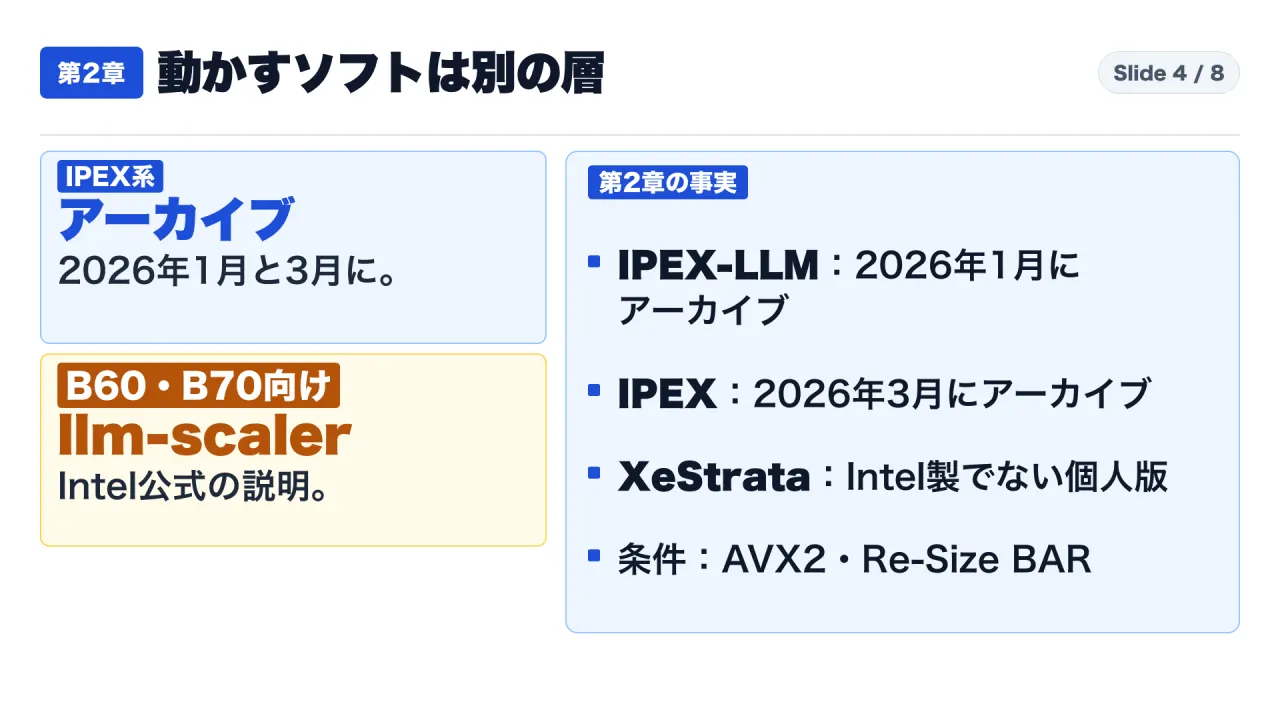
Intel historically maintained two acceleration frameworks: Intel Extension for PyTorch (IPEX) and IPEX-LLM. Both were archived on GitHub in early 2026: IPEX-LLM in January 2026 (S11) and IPEX Core in March 2026 (S12). Official notices explain that core acceleration capabilities were merged directly into upstream PyTorch, with Intel advising developers to transition to native PyTorch builds (S12). Concurrently, Intel maintains an active official repository named llm-scaler, designed to orchestrate large models across Arc Pro B60 and B70 hardware (S10). Commit logs between June and September 2026 reflect continuous releases, including local video generation support for MiniMax H3 added in August 2026.
In parallel with vendor tools, independent community developers have created alternative runtimes. One prominent example is XeStrata, a community fork of Strata originally developed for NVIDIA architectures, modified by an independent developer to run on Intel discrete graphics (S6, S9).
Repository documentation outlines operational prerequisites for XeStrata (S6): x86-64 CPU supporting AVX2 instructions, motherboard Above 4G Decoding and Re-Size BAR enabled, packaged support for Ubuntu 26.04 LTS (released April 23, 2026, supported through April 2031, S13) and Fedora 44, and minimum 12GB VRAM with system RAM scaling up to 62GB.
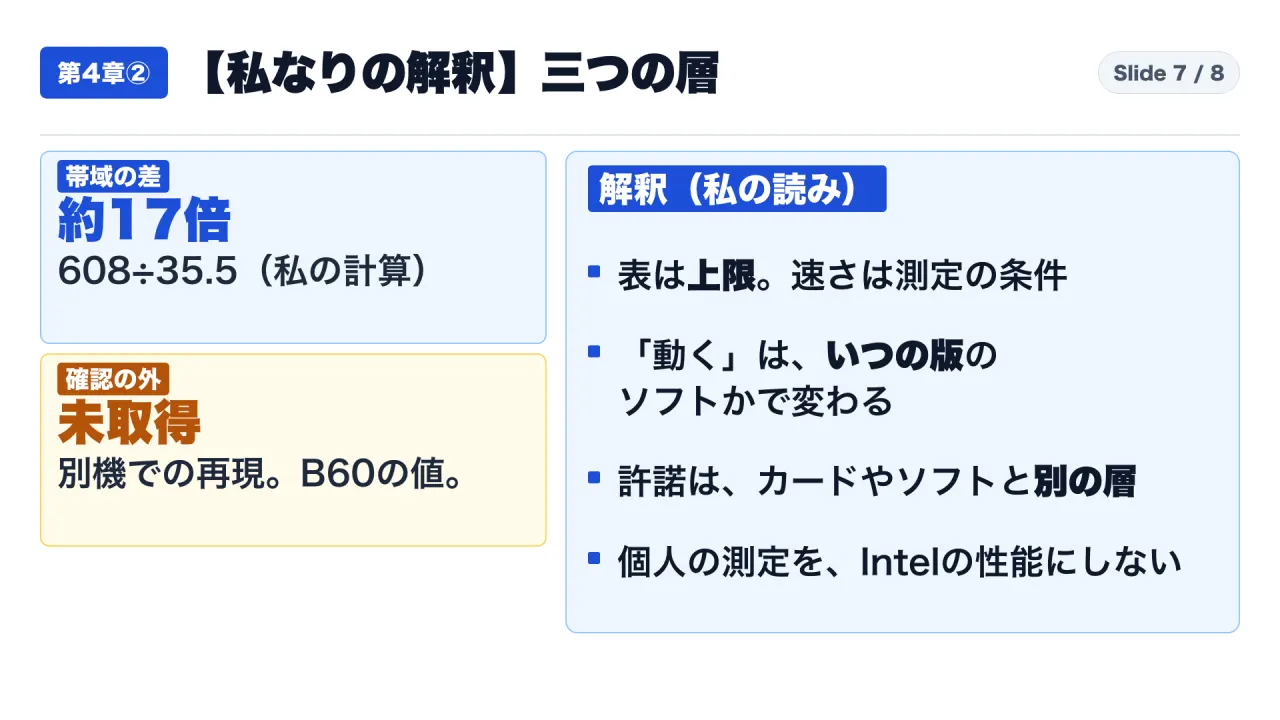
The developer test bench utilized an Arc Pro B70 (32GB) paired with an Intel Core i7-14700 CPU (featuring AVX2 instructions without AVX-512) and system DDR5 memory delivering approximately 35.5 GB/s host read throughput (S8). Compared to the B70 on-board bandwidth of 608 GB/s, host system memory is roughly 17.1x slower (608 / 35.5 = 17.1). This throughput disparity becomes critical when models exceed on-card VRAM.
Section 3: Benchmark Variance: How Compression and Offloading Shift Throughput by 3.5x
In technical documentation, the XeStrata developer published benchmarks evaluating quantized variants of Qwen3.8-Flash-Next on an Arc Pro B70 workstation (S7). The test bench comprised an Arc Pro B70 (32GB), a secondary NVIDIA GeForce RTX 4070 (12GB connected over PCIe x4), an Intel Core i7-14700 processor, and a standardized 128-token autoregressive decoding workload.
The evaluated model files substantially exceeded the 32GB onboard capacity of the B70 (S6):
| Quantized Variant | Repository Designation | File Download Size | Recommended System RAM |
|---|---|---|---|
| IQ2_XS | The Original, Swift 1.5 | 68GB | Approximately 48GB |
| IQ3_S | The Original, Swift 1.5 | 84GB | Approximately 62GB |
| UD-Q4_K_XL | Unsloth (Experimental) | 111GB | Approximately 48GB |
For the 111GB Unsloth variant, the runtime dynamically streams layers exceeding VRAM capacity directly from NVMe storage during generation (S6).
The developer recorded decoding throughput across these configurations (S7):
| Model Quantization Variant | Arc Pro B70 Standalone Throughput | B70 + RTX 4070 Dual-GPU Throughput |
|---|---|---|
| IQ2_XS (68GB) | 73.5 tokens/sec | 84.7 tokens/sec |
| IQ3_S (84GB) | 62.4 tokens/sec | 68.7 to 69.6 tokens/sec |
| UD-Q4_K_XL (111GB) | 20.8 tokens/sec | 38.3 to 39.0 tokens/sec |
On identical Arc Pro B70 hardware, decoding throughput varied from 20.8 to 73.5 tokens/s, a 3.53x differential (73.5 / 20.8 = 3.53) driven by quantization and offloading. Adding a secondary GPU (RTX 4070 12GB) increased throughput across all variants, reaching 84.7 tokens/s on IQ2_XS and 39.0 tokens/s on UD-Q4_K_XL by reducing host CPU overhead (S7). XeStrata automatically selects between layer-splitting and KV-cache offloading (S6).
Evaluation caveats apply: runtime depends on 48GB-62GB host RAM and NVMe drives; measurements reflect purely a 128-token generation sequence; and zero independent third-party replications exist as of November 2026 under release tag xe0.2.2-1 (S17).
Section 4: The Model Licensing Layer: Enterprise Restrictions in MiniMax H3
The final layer governing deployment is licensing. Even when hardware and software align, commercial use may be impermissible under contract.
The MiniMax H3 model family represents a video generation system centered on a 33-billion parameter architecture designated H3-Omni-Transformer (S14, S15). Aggregating file sizes across Hugging Face repository endpoints reveals the storage scale of the raw model weights (S16): Omni-Transformer Core (~66.3GB), Text Encoder (~66.7GB), Video VAE (~10.4GB), Audio VAE (~0.6GB), totaling ~144.0GB per checkpoint.
While Intel llm-scaler added support for local MiniMax H3 execution in August 2026 (S10), enterprise deployment is governed by the MiniMax H3 Community License Agreement dated August 2, 2026 (S15). A legal audit reveals four binding constraints:
- Permitted Territory and Geographic Exclusions: The license defines Permitted Territory as worldwide, excluding the European Union, the United Kingdom, South Korea, and the United States. Use of the model, source code, or generated outputs within these four territories is prohibited. Japan is not excluded, placing Japanese enterprise deployments within the permitted geographic zone.
- Commercial Revenue Threshold ($20 Million Cap): If an entity annual gross revenue from commercial products and services exceeds 20 million US dollars (or equivalent foreign currency), separate commercial authorization from MiniMax is required prior to deployment.
- Mandatory UI Attribution: Commercial products or services utilizing the model must display attribution stating Powered by MiniMax H3 within the user interface.
- Restriction on Model Distillation: Licensees are prohibited from utilizing MiniMax H3 or its outputs to train or improve any other foundation model, excluding fine-tuned derivatives of H3 itself.
Corporate legal departments must resolve these contractual parameters before allocating engineering capital to local model deployments.
Section 5: Enterprise Governance Framework: The Three-Layer Stack
Synthesizing verified documentation yields four analytical conclusions for corporate decision-makers:
- Hardware Bounds: Spec sheets define physical ceilings; token throughput cannot be deduced from bandwidth or TOPS alone.
- Software Volatility: Vendor frameworks evolve rapidly; upstreaming and deprecation require continuous tracking.
- Contractual Primacy: Licensing terms override technical feasibility. A model running on local workstations remains non-viable if revenue or geographic terms are breached.
- Community Data Discipline: Single-developer benchmarks are informative engineering records, not contractual guarantees.
The Five-Step Enterprise Evaluation Checklist
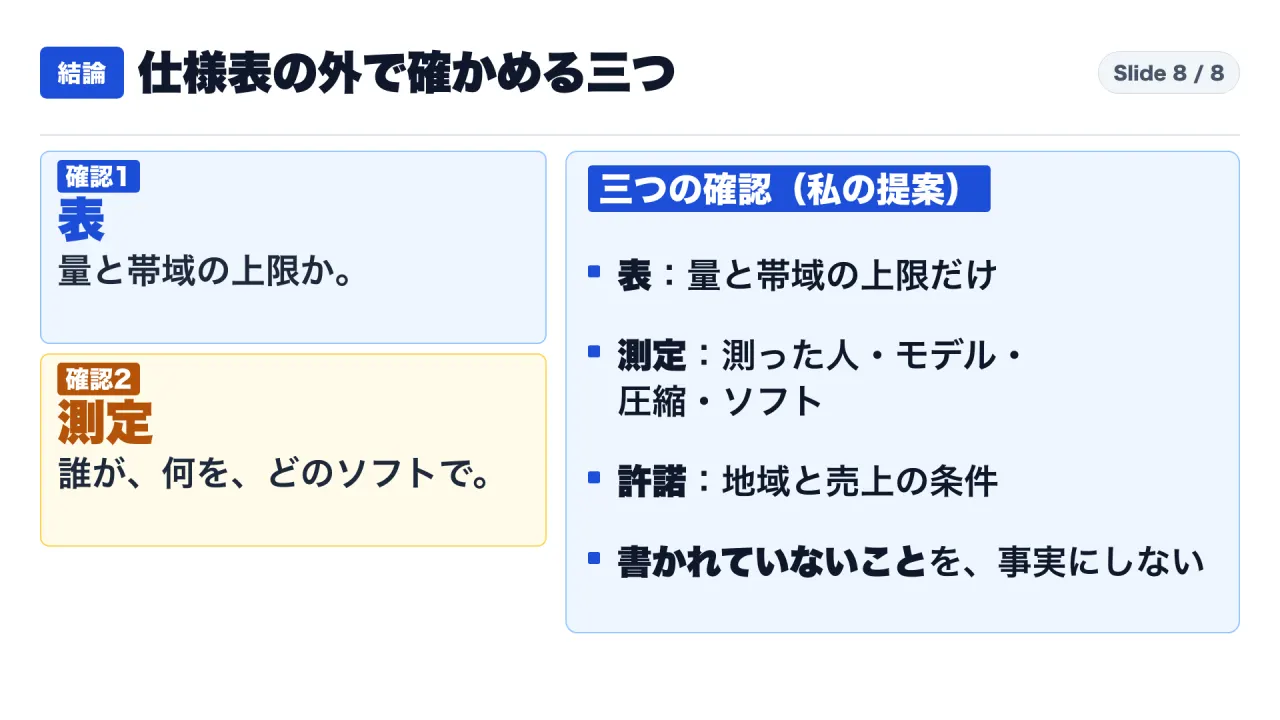
- Audit Hardware Ceilings: Separate spec fields into capacity ceilings (VRAM), bandwidth limits (GB/s), compute ceilings (Peak TOPS), and operational constraints (TBP, PCIe lanes). Confirm the absence of throughput claims.
- Inspect Benchmark Provenance: Mandate disclosure of exact GPU model, host CPU, RAM bandwidth, prompt length, generation length, and quantization format.
- Verify Software Lifecycle Status: Confirm whether target runtime libraries are actively maintained or archived, and identify community fork dependencies.
- Conduct Legal Due Diligence: Review original license text for geographic exclusions, commercial revenue thresholds, UI attribution, and synthetic data restrictions.
- Establish In-House Pilot Baselines: Measure latency, tokens per second, and host power draw under actual enterprise prompt distributions on local hardware before making procurement commitments.
Frequently Asked Questions
Q: Is the Arc Pro B70 guaranteed to deliver faster inference than the B65? A: Not necessarily. The B70 features 32 Xe-cores and 367 Int8 TOPS versus 20 Xe-cores and 197 TOPS on B65, but both cards share identical 32GB GDDR6 memory and 608 GB/s bandwidth. In bandwidth-bound autoregressive decoding, throughput may be equivalent; gains appear primarily in compute-bound prefill.
Q: Can a 144GB model like MiniMax H3 run on a 32GB GPU? A: An unquantized 144GB model cannot fit into 32GB VRAM directly. Execution requires quantization, CPU offloading, or disk streaming across NVMe storage, introducing significant latency trade-offs.
Q: Did Intel discontinue PyTorch support with the archival of IPEX? A: No. Intel archived IPEX-LLM in January 2026 and IPEX Core in March 2026 because GPU optimizations were merged into upstream PyTorch; Intel recommends native PyTorch releases.
Q: Can Japanese corporations legally deploy MiniMax H3 commercially? A: Japan is not among the four excluded jurisdictions (EU, UK, US, South Korea). However, commercial use requires compliance with the 20 million USD revenue threshold, UI attribution, and non-distillation rules.
Primary Sources & Reference Documentation
- S1: Intel Arc Pro B60 Specifications: https://www.intel.com/content/www/us/en/products/sku/243916/intel-arc-pro-b60-graphics/specifications.html
- S2: Intel Arc Pro B65 Specifications: https://www.intel.com/content/www/us/en/products/sku/245796/intel-arc-pro-b65-graphics/specifications.html
- S3: Intel Arc Pro B70 Specifications: https://www.intel.com/content/www/us/en/products/sku/245797/intel-arc-pro-b70-graphics/specifications.html
- S4: Intel Arc Pro B70 Datasheet (March 2026): https://www.intel.com/content/dam/www/central-libraries/us/en/documents/2026-03/datasheet-b70-gpu.pdf
- S5: Intel Arc Pro B-Series Overview: https://www.intel.com/content/www/us/en/products/docs/discrete-gpus/arc/workstations/b-series/overview.html
- S6: XeStrata Architecture Guide: https://raw.githubusercontent.com/MistVVK/XeStrata/main/README.md
- S7: XeStrata Multi-GPU Benchmark Records: https://raw.githubusercontent.com/MistVVK/XeStrata/main/docs/MULTIGPU.md
- S8: XeStrata Hardware Architecture Notes: https://raw.githubusercontent.com/MistVVK/XeStrata/main/docs/DETAILS.md
- S9: XeStrata Repository Overview (GitHub): https://github.com/MistVVK/XeStrata
- S10: Intel llm-scaler Orchestrator (GitHub): https://github.com/intel/llm-scaler
- S11: Intel IPEX-LLM (Archived January 2026): https://github.com/intel/ipex-llm
- S12: Intel Extension for PyTorch (Archived March 2026): https://github.com/intel/intel-extension-for-pytorch
- S13: Canonical Ubuntu 26.04 LTS Release Notes: https://documentation.ubuntu.com/release-notes/26.04/
- S14: MiniMax H3 Model Card (Hugging Face): https://huggingface.co/MiniMaxAI/MiniMax-H3
- S15: MiniMax H3 Community License Agreement (August 2, 2026): https://huggingface.co/MiniMaxAI/MiniMax-H3/raw/main/LICENSE
- S16: MiniMax H3 API Blobs (Hugging Face): https://huggingface.co/api/models/MiniMaxAI/MiniMax-H3?blobs=true
- S17: XeStrata Release Tags (GitHub): https://github.com/MistVVK/XeStrata/releases