Linear CEO's "Internal DDoS" Essay: Forensic Claim vs. Evidence Analysis on Organizational Attention Deficit
A critical examination of Karri Saarinen’s thesis that engineering velocity outpaces organizational review capacity reveals that the essay rests on first-person observations, hypothetical numbers, and a single self-reported operational incident rather than measured empirical data.
Published: November 3, 2026 | Primary Sources: Karri Saarinen Personal Essay (November 2, 2026) | English Edition
Executive Summary & Key Takeaways
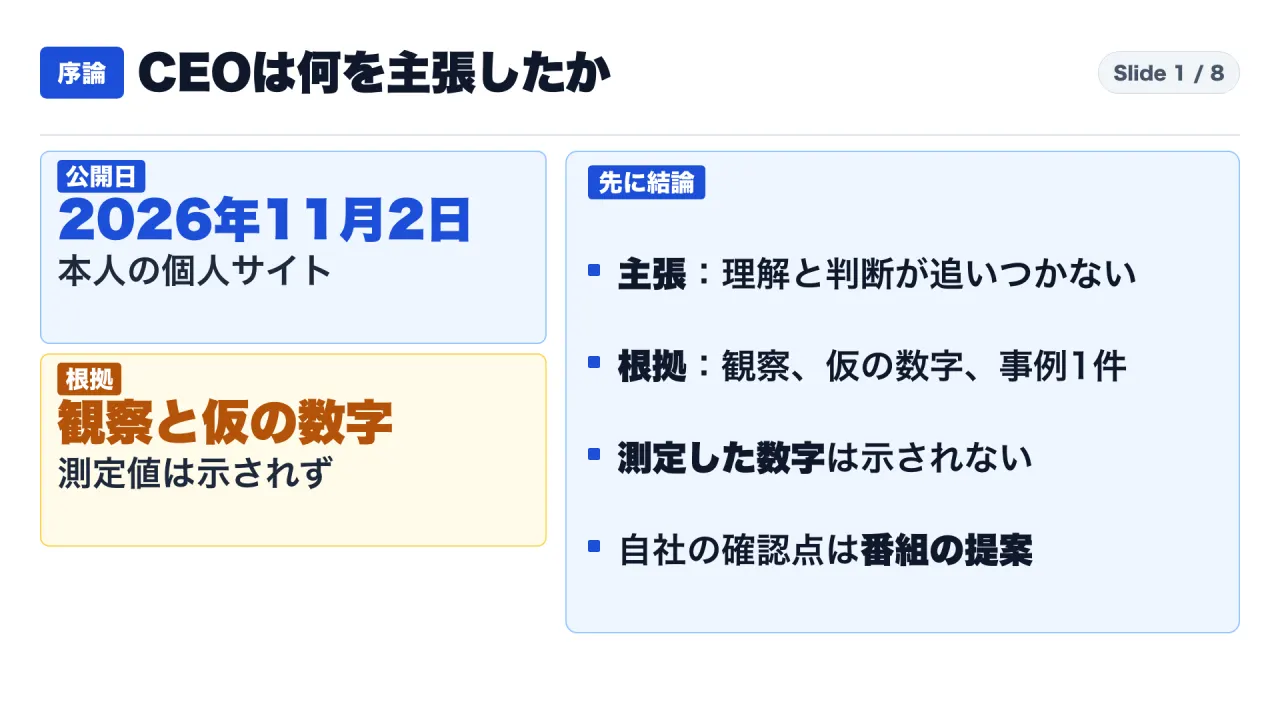
- Core Thesis: On November 2, 2026, Karri Saarinen, CEO of Linear, published an essay titled “Our organizations are being DDoSed from the inside” on his personal website. His core assertion is that software creation velocity has fundamentally outpaced organizational capacity to understand, review, and decide on changes.
- Evidence Breakdown: A forensic classification of the text identifies three distinct forms of evidence: (1) First-person qualitative executive observations; (2) Hypothetical illustrative figures (“twenty minutes” and “1,000 PRs”); and (3) A single self-reported operational incident (locking down an internal release channel). The essay presents zero statistical distributions, telemetry datasets, or before-and-after empirical comparisons.
- Proposed Countermeasures & Unresolved Questions: Saarinen outlines two structural interventions: clarifying strategic intent in advance, and introducing deliberate integration gates before experiments merge into shared production software. Crucially, Saarinen explicitly acknowledges that whether these gates align with long-term strategic direction remains an unresolved operational question.
1. Introduction and Core Conclusion: Claim vs. Empirical Reality
On November 2, 2026, Karri Saarinen, CEO of issue tracking and project management software company Linear, published a widely discussed essay on his personal website titled “Our organizations are being DDoSed from the inside.”
The central thesis of the essay asserts that modern software organizations face a structural bottleneck: the raw speed at which individual engineers and automated software tools generate product modifications has overwhelmed the collective human capacity to understand, evaluate, and steer those changes.
flowchart LR
    A["Velocity of Generation / (Accelerated by Teams & Agents)"] -->|Exceeds| B["Organizational Attention / (Fixed Human Cognitive Capacity)"]
    B --> C["Symptoms:<br>- Directional Drifting<br>- Overlapping Features<br>- Loss of Executive Steering"]
A forensic evaluation of the supporting arguments reveals three distinct evidentiary layers:
- First-Person Qualitative Observations: Descriptions of executive sentiment, where work changes before leadership can comprehend it, and alignment becomes difficult across organizational layers.
- Hypothetical Illustrative Quantities: The essay mentions building an artifact in “twenty minutes” and managing “1,000 PRs the team will open today.” Both figures are rhetorical examples rather than measured operational telemetry.
- A Single Self-Reported Case Study: Saarinen reports that Linear had to lock down its internal release channel because changes were accumulating too rapidly and disparate teams were producing overlapping features.
The essay contains no corporate metrics, controlled experiments, statistical distributions, or longitudinal comparisons before and after the adoption of automated workflows.
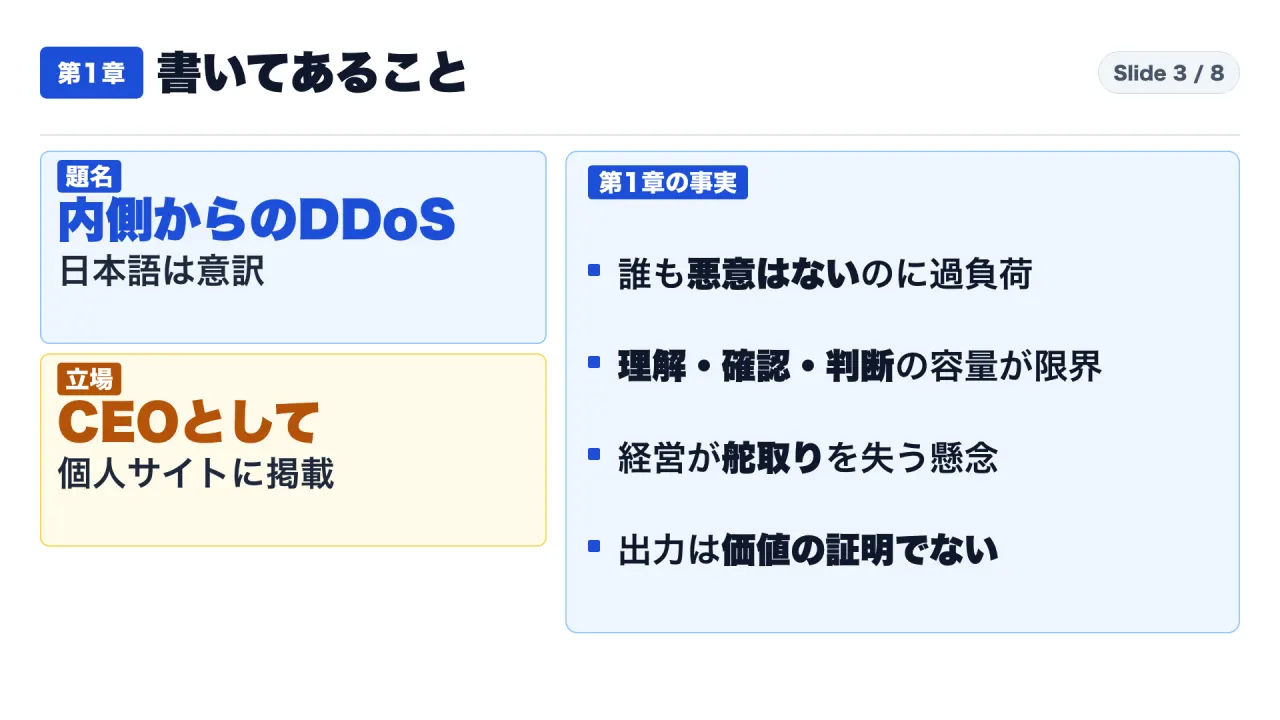
Saarinen proposes two practical remedies: making intent explicit upfront so that contributors and automated agents can self-evaluate, and establishing deliberate integration gates before experimental branches enter the shared product. Yet, Saarinen candidly notes that while gating tracks what is changing, “It doesn’t yet tell us whether all this work adds up to the direction we want to take.” The essay concludes not with a programmatic doctrine, but with an open-ended inquiry directed to engineering leadership: “How are you dealing with this?”
2. Methodology and Analytical Guardrails: Separating Fact, Author Opinion, and Analytical Interpretation
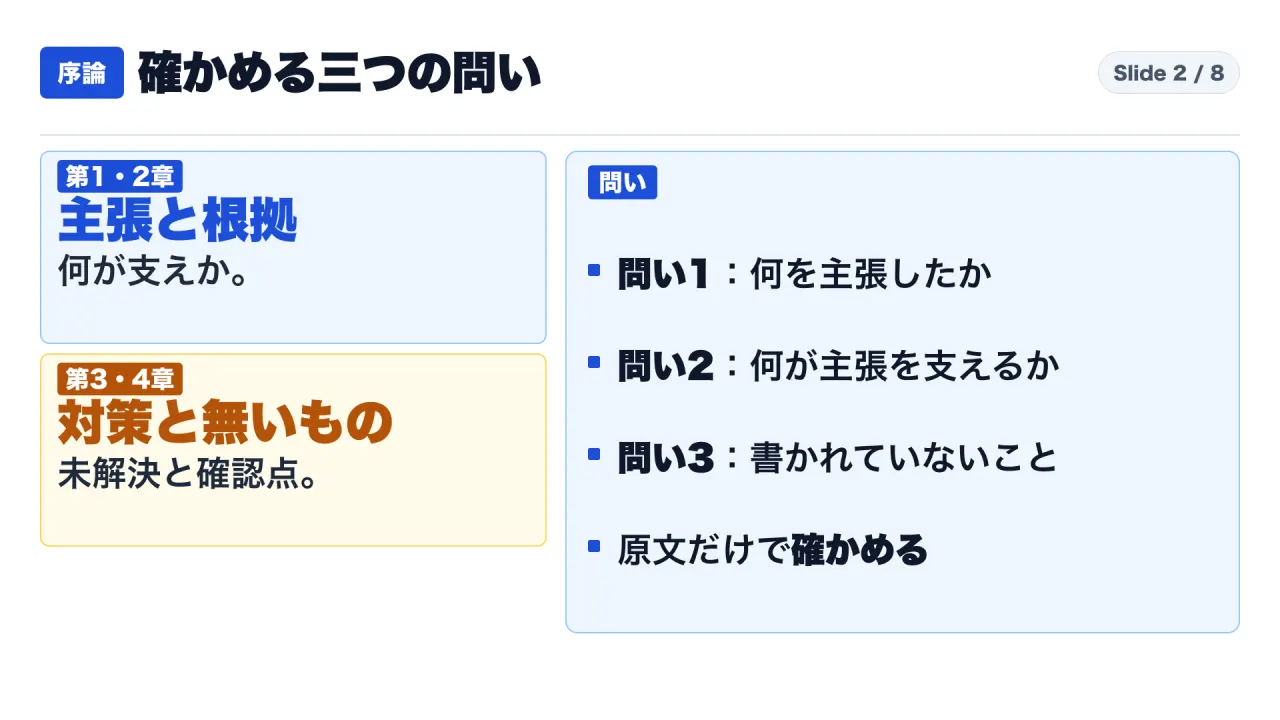
To evaluate this document with rigorous objectivity, our analysis maintains three strict epistemological boundaries:
- Confirmed Facts: Statements directly quoted or verified from the primary source text. Because the original document was written in English, direct textual citations are preserved verbatim.
- Author Opinion: Conceptual models, analogies, and qualitative deductions formulated by Saarinen in the first person. The original text is not a research whitepaper or empirical survey; it is an opinion piece dominated by phrasings such as “I think” and “It feels like.”
- Analytical Interpretation: Independent analytical deductions and methodological proposals developed in this analysis. Proposals regarding how engineering teams can construct internal telemetry metrics are our own frameworks, not recommendations advanced in Saarinen’s essay.
The scope of this investigation relies strictly on two primary artifacts:
- S1: The complete text of Karri Saarinen’s personal essay published on November 2, 2026 (
https://karrisaarinen.com/posts/our-organizations-are-being-ddosed-from-the-inside/). - S2: The index page of Saarinen’s personal website accessed on November 3, 2026 (
https://karrisaarinen.com/index.html).
No external rumors, anonymous secondary commentaries, or unattributed summaries have been incorporated into this factual baseline. Because personal web posts may undergo subsequent revisions, this analysis reflects the verified state of the primary source on November 3, 2026.
3. Operational Terminology and Baseline Definitions
Before dissecting the substantive claims, several domain terms must be calibrated against their precise usage in the primary text:
- Distributed Denial of Service (DDoS): In computing, a DDoS attack involves overwhelming a target system with high volumes of external traffic to induce operational failure. In Saarinen’s essay, the term is employed strictly as an organizational metaphor rather than a malicious cyberattack. As Saarinen explicitly writes: “Nobody is trying to overwhelm the company.” There is no adversarial intent; the saturation is an emergent byproduct of productive individual initiative.
- Pull Request (PR): A standard software version-control workflow wherein an engineer requests that branch modifications be reviewed and merged into a main codebase. The term appears exactly once in the entire essay, solely within a hypothetical numerical example.
- Release Gate: An organizational checkpoint where changes from multiple teams are aggregated and reviewed prior to deployment into the shared production artifact. This corresponds to what Saarinen terms “the gate.”
- Feature Flag: A software engineering mechanism that enables conditional code execution without altering production deployments. Saarinen emphasizes that individual teams remain entirely free to conduct isolated experiments behind feature flags.
4. Section 1: The Core Thesis — Velocity of Creation Outstripping Organizational Attention
The primary essay comprises approximately 970 English words. Published on November 2, 2026, the text is hosted on Saarinen’s personal domain rather than Linear’s official corporate engineering blog. A review of Linear’s public corporate updates conducted on November 3, 2026, showed no mirror of the post. While the author identifies his role (“I live in California and work on Linear” and “As a CEO, I’m finding that harder to live up to”), the publication must be evaluated as an individual executive reflection rather than binding corporate policy.
flowchart TD
    subgraph TraditionalWorkflow["Traditional Software Development Pipeline"]
        direction TB
        T1["Strategic Debates<br>(Roadmaps & Feature Scoping)"] --> T2["Implementation Planning"]
        T2 --> T3["Manual Execution"]
        T3 --> T4["Cross-Functional Alignment"]
    end

    subgraph ModernDecoupledWorkflow["Accelerated Production Dynamic"]
        direction TB
        M1["Instant Idea Prototyping<br>(20-Minute Working Code)"] --> M2["Direct Working Artifact"]
        M2 --> M3["Cognitive Review Gap<br>(Consensus Skipped Due to Speed)"]
        M3 --> M4["Feature Collision & Strategic Drift"]
    end
The Primary Claim
The crux of Saarinen’s argument centers on an imbalance in cognitive capacity:
“It feels like our organizations are being DDoSed from the inside.”
He articulates the mechanism of saturation clearly:
“Nobody is trying to overwhelm the company. People are doing work they believe is helpful, often on problems they were asked to solve. But almost all of that work relies on the same limited capacity to understand, review, and decide. We can generate changes much faster than we can give them that attention.”
Regarding drivers of this acceleration, Saarinen attributes the shift to both human contributors and automated systems:
“Teams and agents are moving faster than any of us can follow.”
Importantly, he does not isolate autonomous agents as the sole culprit; human teams utilizing automated acceleration are jointly responsible.
Observed Symptoms and the Steering Problem
Saarinen identifies specific operational symptoms:
“unclear or changing direction and overlapping or conflicting features”
Crucially, he avoids attributing this dysfunction to human incompetence:
“I don’t think this is a matter of people making poor decisions.”
Rather, the breakdown occurs at the level of executive guidance:
“leadership losing the ability to steer”
He utilizes the metaphor of a vehicle accelerating beyond physical control:
“a car speeding up until it becomes impossible to steer”
He frames this challenge as an emerging systemic hazard:
“I think there’s a pretty big problem looming below the surface in companies”
This phrasing confirms that the author is expressing an exploratory thesis rather than asserting an established empirical fact.
The Inversion of Engineering Workflows
Historically, software teams engaged in protracted deliberations regarding product architecture and functional specifications before writing implementation code:
“Before, we debated plans and roadmaps.”
In modern environments, functional implementations can be produced before external stakeholders are aware of their existence:
“before anyone outside the immediate team knows it exists”
When a fully functional prototype can be constructed rapidly, demanding procedural alignment meetings creates interpersonal and operational friction:
“Saying ‘looks good, let’s go’ is easier than asking everyone to step back”
The Theoretical Anchor
The foundational philosophy of Saarinen’s essay is encapsulated in three interconnected propositions:
“We have to get past treating output as proof of value.”
“A working implementation shows that something can be built, not that it belongs in the product.”
“Some changes have negative value.”
The presence of functional code demonstrates technical feasibility, but provides zero guarantee of commercial or architectural utility.
5. Section 2: Forensic Evidence Audit — Observations, Hypothetical Figures, and a Single Anecdote
To determine the empirical validity of the essay’s core thesis, we categorize all evidence presented in the text into four distinct classifications:
pie title Evidentiary Composition of the Essay
    "Qualitative Personal Impressions" : 55
    "Hypothetical Illustrative Quantities" : 25
    "Self-Reported Operational Incidents" : 20
    "Empirical Datasets & Statistical Telemetry" : 0
1. Subjective Executive Observations
The author describes personal operational strain as CEO:
“By the time I understand something well enough to contribute, the work might have already changed.”
“I’m trying to keep product and marketing aligned while what we’re building changes daily.”
These statements reflect authentic individual sentiment. However, when Saarinen extrapolates this observation to the entire organization:
“I think this is happening at every level of the company”
the phrasing remains explicitly an assumption (“I think”). While personal friction is undeniable to the individual experiencing it, the essay presents no telemetry demonstrating that line engineers, product managers, or customer support leads experience an identical dynamic across other enterprises.
2. Hypothetical Illustrative Quantities
Excluding published calendar dates, the essay contains exactly two numeric references:
- “Twenty Minutes”: Saarinen writes, “When someone can build something in twenty minutes…” This represents a hypothetical baseline for rapid iteration, not an empirical distribution of task completion times at Linear. Furthermore, he asserts that comprehending and directing that work “generally takes a lot longer than 20 minutes,” yet provides no measured duration tracking.
- “1,000 PRs”: Saarinen writes, “You can’t hold an alignment meeting for every one of the 1,000 PRs the team will open today.” This figure serves as a rhetorical device illustrating large-scale impossibility rather than Linear’s verified pull request volume. Treating 1,000 daily PRs as an operational metric of Linear’s team would be a factual misreading.
3. A Single Self-Reported Operational Incident
The essay cites exactly one empirical event from internal operations:
“We recently had to lock down our internal release channel because things were changing too quickly and multiple teams were overlapping.”
Saarinen notes that while external customers experienced no disruption, internal personnel struggled to maintain coherence amidst concurrent modifications. This disclosure represents a self-reported internal incident. The essay provides no quantitative data regarding the duration of the lockdown, the number of colliding features, the labor hours consumed, or external corroboration.
4. The Absence of Empirical Telemetry
A comprehensive automated lexical query across the complete text confirms the total absence of empirical validation:
| Target Query Term | Exact Matches in Text | Analytical Implication |
|---|---|---|
percent / % |
0 | Zero proportional measurements |
data |
0 | No referenced telemetry or databases |
statistic / statistical |
0 | No sampling or statistical distributions |
survey |
0 | No employee or industry polling |
measur* (measure, measurement) |
0 | No measurement methodology defined |
metric* (metric, metrics) |
0 | No operational performance indicators |
Assessment of Evidentiary Weight
Qualitative observations articulate executive perception but do not constitute systemic organizational proof. Hypothetical figures clarify conceptual mechanics but lack empirical grounding. A single self-reported case study demonstrates that internal friction occurred, but does not prove widespread industry prevalence.
Consequently, from a forensic perspective, the evidentiary weight supporting the thesis is low relative to the breadth of its assertions. Low evidentiary weight does not signify that Saarinen’s thesis is false; it demonstrates that the claims remain unvalidated hypotheses awaiting rigorous measurement.

6. Section 3: The Two Proposed Countermeasures and the Admitted Strategic Gap
What Saarinen Explicitly Rejects
Saarinen explicitly rejects reverting to rigid upfront waterfall planning:
“But moving every discussion ahead of implementation doesn’t solve it either.”
Recognizing that heavy upfront bureaucracy paralyzes productivity, he outlines the fundamental tension:
“Companies need to keep the ability to decide what work should be done, without having to discuss every change individually.”
flowchart TD
    subgraph CountermeasureFramework["Linear CEO's Two-Pillar Governance Strategy"]
        direction TB
        Pillar1["Countermeasure 1: Upfront Strategic Intent<br>- Articulate explicit business bets<br>- Define immediate priorities<br>- Explicitly designate out-of-scope territory<br>- Enable self-checking by teams and agents"]
        Pillar2["Countermeasure 2: Deliberate Integration Gates<br>- Keep isolated feature flags free for prototyping<br>- Establish a single integration checkpoint<br>- Evaluate collective product impact prior to release"]
    end
    Pillar1 --> Goal["Maintain Decoupled Execution"]
    Pillar2 --> Goal
    Goal --> Limit["Acknowledged Unresolved Reality:<br>Tracks changes, but does not guarantee<br>strategic alignment with desired destination."]
Countermeasure 1: Clarifying Intent Ahead of Time
The first intervention requires leadership to establish clear contextual guardrails before execution commences:
“making intent clearer ahead of time: what we’re betting on, what matters right now, what’s out of scope.”
By articulating these explicit boundaries, both human engineers and automated software tools acquire an objective standard against which to self-audit:
“People and agents can check their own work against it.”
Countermeasure 2: Deliberate Integration Gates for Shared Product
The second intervention manages the transition from localized experimentation to integrated production software:
“The other part is being more deliberate about when an experiment becomes part of the shared product.”
Saarinen notes that while generating code is “much cheaper now,” incorporating changes into the mainline codebase “creates consequences beyond the person or team that built it.”
At Linear, this principle manifested in the lockdown of the internal release channel. Teams maintain complete freedom to prototype behind feature flags, but merging into shared production requires passing through a centralized evaluation point:
“the gate gives us one place to consider changes together before they land.”
The Acknowledged Strategic Limitation
Crucially, Saarinen does not claim that release gates solve the underlying alignment dilemma:
“That helps us keep track of what’s changing. It doesn’t yet tell us whether all this work adds up to the direction we want to take.”
The author openly concedes that while gating provides visibility into the volume of modifications, it fails to guarantee that the accumulated work advances the firm’s long-term product vision.
Distributed Judgment and the Concluding Dilemma
Saarinen emphasizes that organizational coherence cannot rely exclusively on top-down executive oversight:
“I need to trust the judgement from my leaders, and they need to trust the judgement from their reports.”
Organizational alignment relies on an unbroken chain of discretionary judgment spanning every managerial tier.
The essay concludes with reflective skepticism:
“Are we moving toward something, or just getting better at reacting?”
“I can see more getting done. I’m less sure we share an understanding of where it’s taking us.”
Rather than presenting a dogmatic operational playbook, the essay terminates with an open-ended question:
“How are you dealing with this?”
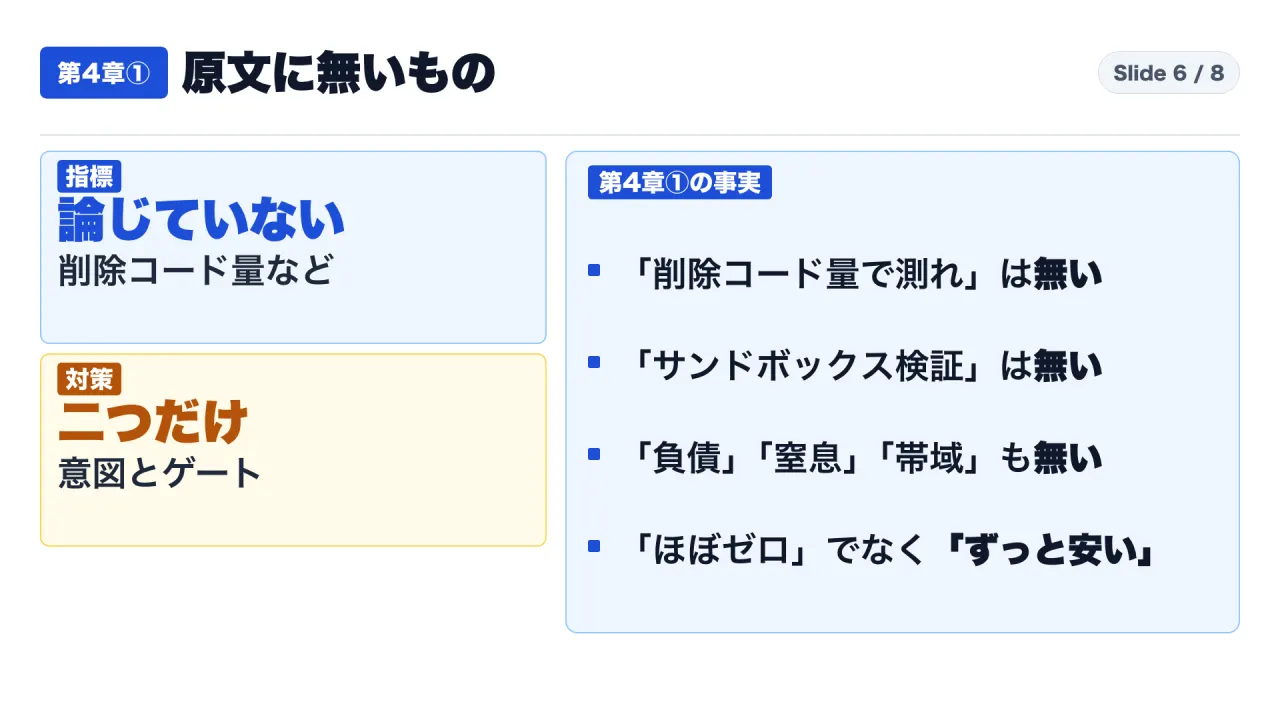
7. Section 4-A: What Was NOT in the Original Text — Debunking Secondary Summary Distortions
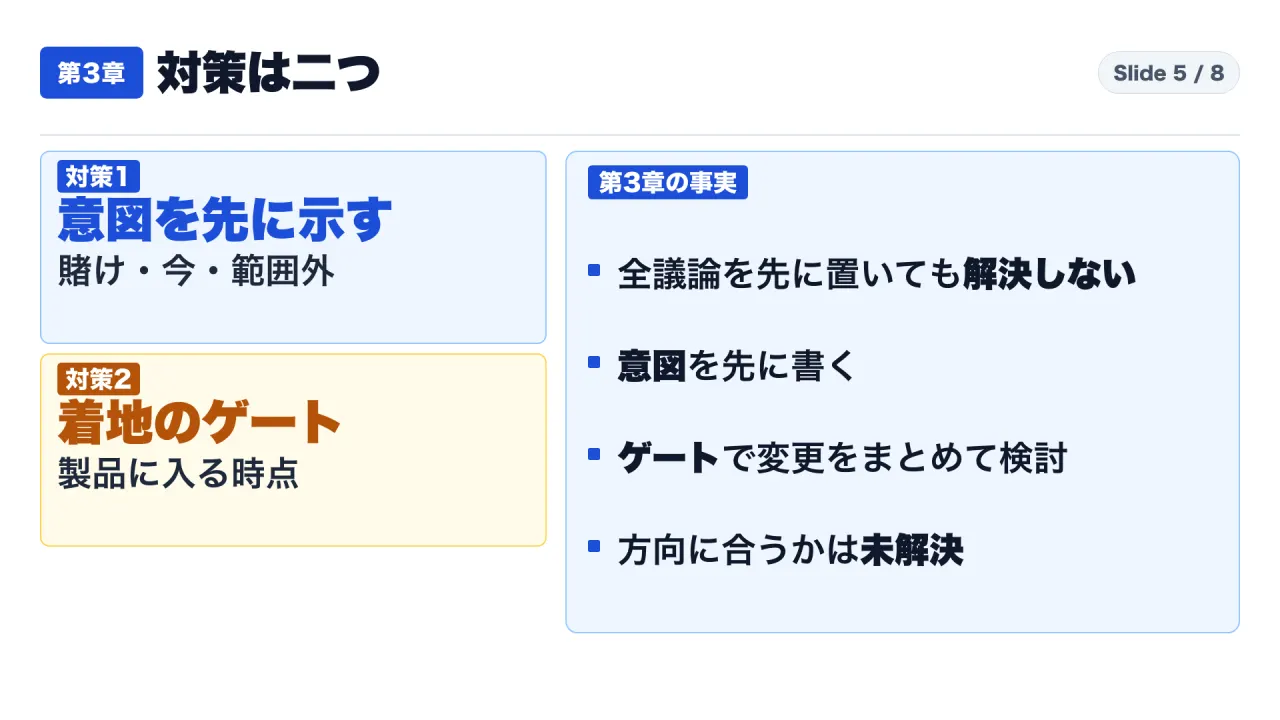
During our forensic baseline audit, a comparative review between primary text and secondary social media summaries revealed substantial narrative distortions. Several commentators attributed specific technical prescriptions to Saarinen that are entirely absent from the primary essay.
flowchart LR
    A["Secondary Social Summaries / (Viral Misinterpretations)"] -->|Distorts| B["Primary Source Text / (Karri Saarinen Essay)"]
    B --> C["Factual Distinctions Confirmed:<br>- No deleted code metrics<br>- No sandbox mandates<br>- 'Negative value' vs 'liability'<br>- Leadership steer vs senior burnout<br>- Single mention of 'review'"]
The table below contrasts widespread secondary claims against the verified textual evidence:
| Secondary Summary Assertion | Verified Primary Text Reality | Forensic Evidence & Textual Discrepancy |
|---|---|---|
| “Measure performance by deleted lines of code and solved problems, not PRs” | Entirely absent from the primary text. | The author never discusses performance appraisal or developer metrics. The term PR appears exactly once as a hypothetical numerical illustration. |
| “Mandate isolated sandboxes for validation” | Entirely absent from the primary text. | The word sandbox appears 0 times. The author discusses feature flags and release gates, not isolated sandbox environments. |
| “Code generation introduces technical liabilities” | The term liability is absent. |
The author employs the economic term “negative value” to describe counterproductive features. |
| “Senior engineering leads are suffocating under review loads” | The term is absent. | The text highlights “leadership losing the ability to steer” and emphasizes distributed judgment between managers and direct reports. |
| “Cognitive bandwidth of review is exhausted” | The term bandwidth is absent. |
The author specifically characterizes the bottleneck as the “capacity to understand, review, and decide.” |
| “The marginal cost of building software is near zero” | Not stated in the text. | The author writes that software creation is “much cheaper now,” explicitly refraining from claiming costs have fallen to zero. |
Furthermore, the word review appears exactly once in the entire essay, positioned alongside understanding and deciding. The text does not provide a treatise on pull request code review mechanics; it addresses macroscopic product governance.
8. Section 4-B: Analytical Interpretation and Proposed Internal Measurement Framework
Moving beyond confirmed facts and author opinions, this section outlines our independent analytical interpretation and provides a pragmatic measurement framework for engineering leaders seeking to evaluate these phenomena within their own organizations.
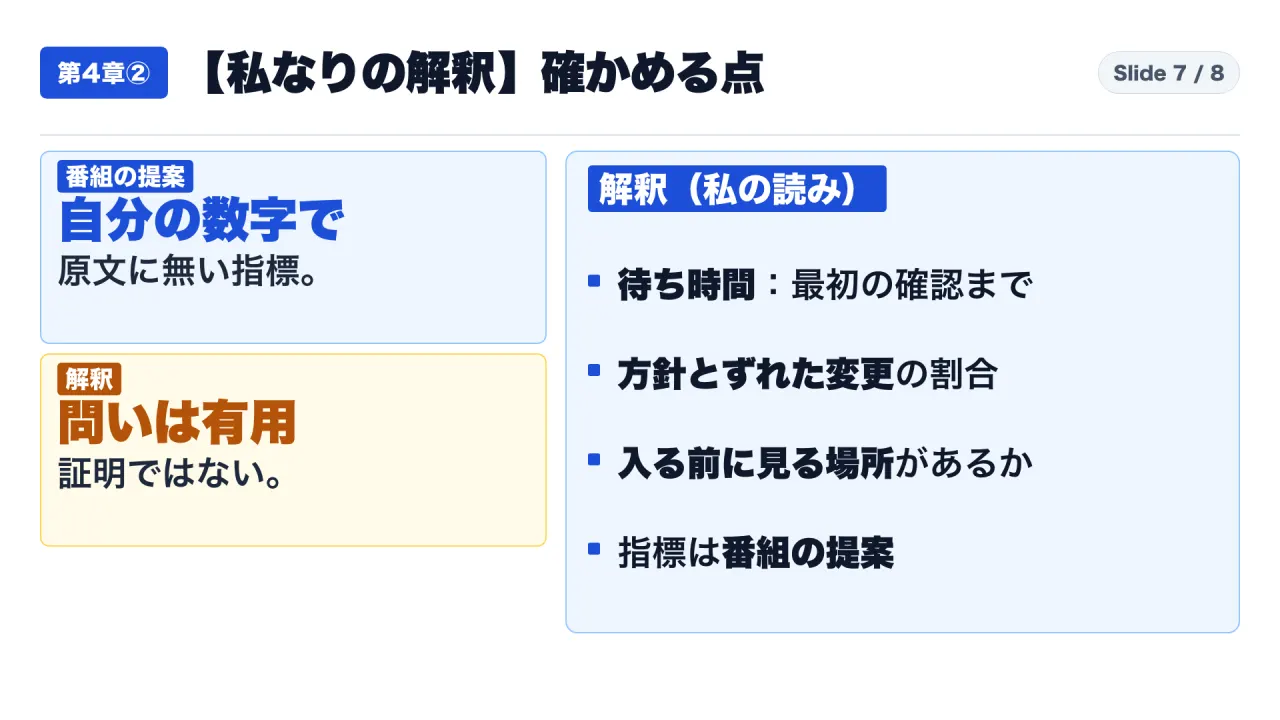
Three Analytical Interpretations
- A Productive Conceptual Lens: The thesis correctly identifies that while generative software tooling dramatically lowers the barrier to code production, human cognitive capacity to assimilate, verify, and govern system architecture remains strictly constrained.
- A Compelling Hypothesis, Not Empirical Proof: A single self-reported operational incident and personal executive reflections do not establish that other technology enterprises experience an identical breakdown.
- Plausible Interventions Requiring Empirical Validation: Defining intent upfront and staging integration gates represent reasonable working hypotheses, yet Saarinen himself admits their efficacy in steering long-term direction remains unproven.
flowchart TD
    subgraph DiagnosticFramework["Proposed Internal Telemetry Framework"]
        M1["Metric 1: Review Queue Latency<br>Measure delta from PR creation to initial review.<br>Track 90th percentile (P90) shifts across monthly cohorts."]
        M2["Metric 2: Strategic Divergence Ratio<br>Audit sample of 10–20 recent mainline commits.<br>Classify alignment against explicit intent documents."]
        M3["Metric 3: Integration Gating & Collision Audit<br>Determine whether multi-team staging gates exist.<br>Quantify retroactively discovered feature conflicts over 6 months."]
    end
Three Internal Verification Points (Independent Analytical Framework)
To determine whether an engineering organization is experiencing cognitive saturation, teams can track three objective indicators:
- Review Queue Latency: Calculate the duration between pull request submission and the initial substantive review across weekly and monthly cohorts. Rather than tracking basic mathematical means, teams should monitor the 90th percentile (P90). A widening P90 tail indicates cognitive congestion in review capacity.
- Strategic Divergence Ratio: Conduct a blind audit of 10 to 20 recently merged mainline changes against documented strategic intent. Classify changes as aligned, partially divergent, or divergent. If written strategic intent does not exist, that organizational void represents the primary finding.
- Integration Gate Integrity and Conflict Frequency: Audit whether an explicit staging mechanism aggregates multi-team modifications prior to general production release. Quantify the historical frequency of overlapping or colliding features discovered retroactively over the preceding six months.
What Cannot Be Concluded
Based on the available evidence, several critical limitations must be recognized:
- It is impossible to conclude that other software enterprises suffer from an identical internal DDoS dynamic based solely on Saarinen’s essay.
- It is impossible to assert that release gates definitively resolve directional drift, as the author explicitly leaves this question open.
- The external public has zero visibility into Linear’s internal engineering turnover, headcount, or exact pull request distributions.
9. Conclusion: Triangulating Claims, Evidentiary Rigor, and Local Metrics
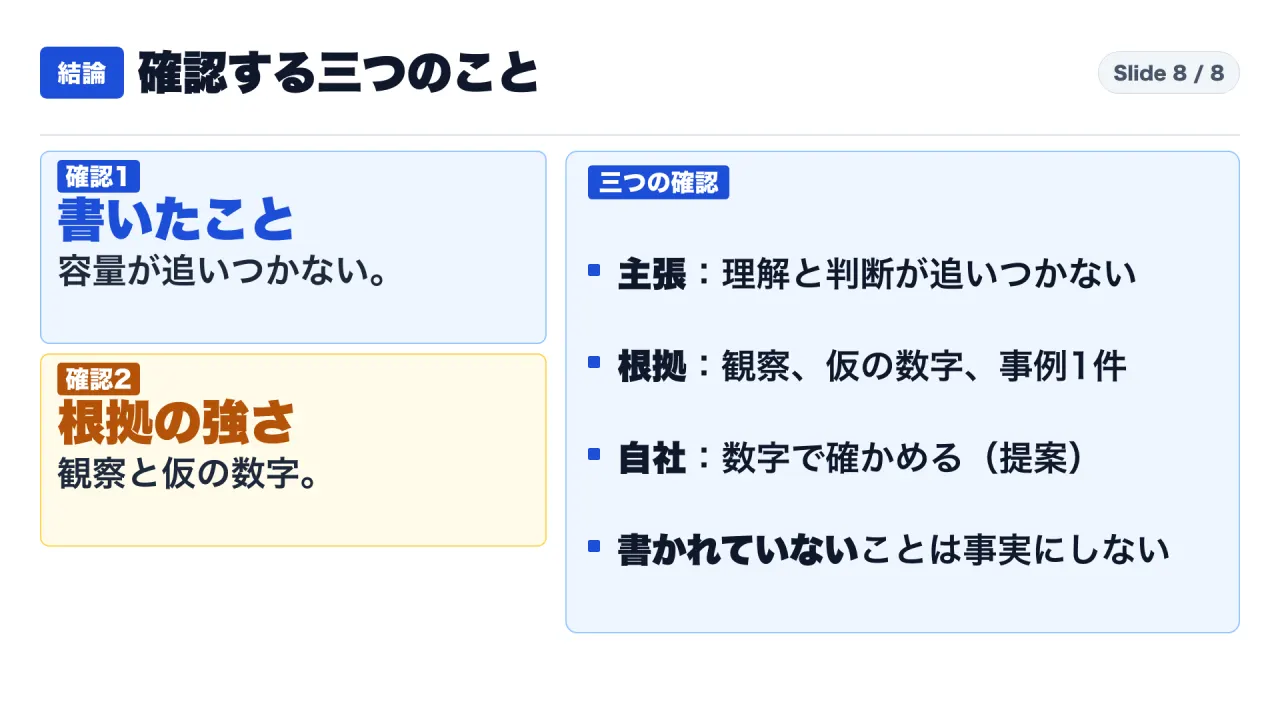
Rigorous technological evaluation requires disentangling three foundational components:
- The Primary Claim: Software generation velocity has exceeded the organizational capacity to understand, review, and decide. Proposed remedies center on articulating strategic intent and staging deliberate release gates.
- The Evidentiary Weight: The argument rests on qualitative executive sentiment, two hypothetical illustrative quantities (“twenty minutes” and “1,000 PRs”), and a single self-reported release channel lockdown. The essay offers zero empirical datasets, statistical tests, or formal measurements.
- Local Organizational Telemetry: Engineering leaders should evaluate their own operational realities by tracking review queue latencies, measuring strategic divergence ratios, and auditing pre-release integration mechanisms.
flowchart LR
    A["The Primary Claim<br>(Velocity vs. Cognitive Capacity)"] --- B["Evidentiary Rigor<br>(Qualitative & Hypothetical vs. Empirical)"]
    B --- C["Local Metrics<br>(P90 Latency, Alignment Audit, Gates)"]
10. Practical Telemetry Implementation Guide (Analytical Proposal)
For engineering organizations seeking to evaluate their operational throughput objectively without succumbing to confirmation bias, we outline a lightweight measurement protocol:
Tracking Review Queue Latencies
- Record the exact timestamp when a branch or pull request is opened, alongside the timestamp of the first substantive human review comment.
- Aggregate metrics weekly, isolating the median (P50) from the tail distribution (P90 and P95).
- If the P90 metric expands significantly across consecutive quarters while median delivery remains static, cognitive saturation among senior personnel is a plausible root cause. However, investigators must rule out external factors such as holiday schedules, time zone shifts, or organizational restructurings before reaching definitive conclusions.
Auditing Strategic Alignment
- Convene key product decision-makers and select a randomized sample of 10 to 20 pull requests merged into production over the preceding thirty days.
- Evaluate each pull request against three simple questions:
- Does this modification directly advance an explicitly stated strategic bet?
- Does it address an immediate core operational priority?
- Does it fall outside defined product scope?
- If reviewers disagree on categorization, the fundamental bottleneck lies not in developer execution speed, but in executive communication of strategic intent.
Evaluating Integration Gating
- Document whether changes from independent functional groups are systematically cross-examined before customer deployment.
- Catalog all production rollbacks and hotfixes deployed over the preceding six months, isolating instances caused by overlapping feature definitions or conflicting architectural assumptions.
- Establish strict numerical thresholds before collecting data to determine what operational criteria will trigger governance adjustments.
11. Frequently Asked Questions (Grounded Strictly in Evidence)
Q1: Does the essay refer exclusively to AI code generation?
No. The primary text explicitly groups contributors as “Teams and agents” moving faster than organizations can follow. The author discusses accelerated production velocity generally and does not restrict his argument solely to artificial intelligence models. The term PR appears only once in a hypothetical context.
Q2: Does “Internal DDoS” imply malicious operational sabotage?
No. The author explicitly disclaims malicious intent: “Nobody is trying to overwhelm the company. People are doing work they believe is helpful.” The terminology functions purely as an operational metaphor.
Q3: Does this essay represent Linear’s official corporate policy?
The essay was published exclusively on Karri Saarinen’s personal website and personal blog index. It was not published on Linear’s corporate updates portal as of November 3, 2026. It reflects individual executive perspectives rather than binding corporate policy.
Q4: Have the two proposed countermeasures proven effective?
The author explicitly notes that while release gates assist in monitoring changes, “It doesn’t yet tell us whether all this work adds up to the direction we want to take.” The effectiveness of these measures remains an active, unverified experiment.
Q5: Did Saarinen advise organizations to evaluate engineers by deleted lines of code?
No. That phrase was introduced by secondary online summaries and commentary. The primary text contains no discussion of developer performance evaluation metrics.
12. Verification Checklist
Before incorporating the insights from this essay into engineering governance policies, verify the following:
- Has the primary claim been clearly defined (creation velocity outstripping comprehension, review, and decision capacity)?
- Has the evidence been cataloged objectively (executive impressions, hypothetical figures, one internal incident, zero empirical datasets)?
- Have secondary summary distortions been eliminated (no references to deleted code metrics or sandbox mandates)?
- Are internal organizational decisions grounded in local operational telemetry rather than external executive sentiment?
For readers new to this publication’s technological analysis, please consult our foundational methodology overview: https://note.com/consuloji_ch/n/n1975ecc3cf48.
Primary Sources
- S1: Karri Saarinen, “Our organizations are being DDoSed from the inside” (Published: November 2, 2026):
https://karrisaarinen.com/posts/our-organizations-are-being-ddosed-from-the-inside/ - S2: Karri Saarinen, Personal Website Index and Archive (Accessed: November 3, 2026):
https://karrisaarinen.com/index.html