Why the 32GB Intel Arc Pro B70 Is 27% Cheaper Than AMD but Cannot Yet Be Crowned a True Value Leader: A Forensic Spec-by-Spec Comparison
A rigorous primary-source teardown of the $949 Intel B70, $1,299 AMD R9700, and unpriced NVIDIA RTX PRO 4500, separating cost per gigabyte from unverified real-world inference throughput.
Japanese Edition: Read the original Japanese article on Substack
Video Episode (Japanese Audio): Watch on YouTube
Executive Summary: Separating Hardware Density from Real-World Value
When machine learning engineers, systems developers, and enterprise IT organizations deploy local artificial intelligence on desktop workstations, 32GB-class graphics cards represent a vital operational threshold. A 32GB video memory (VRAM) buffer fits quantized 30B to 70B parameter models—such as Qwen 2.5 32B in 8-bit precision or Llama 3.3 70B in 4-bit precision—locally on a single desktop without spilling memory allocations across slow system PCIe buses.
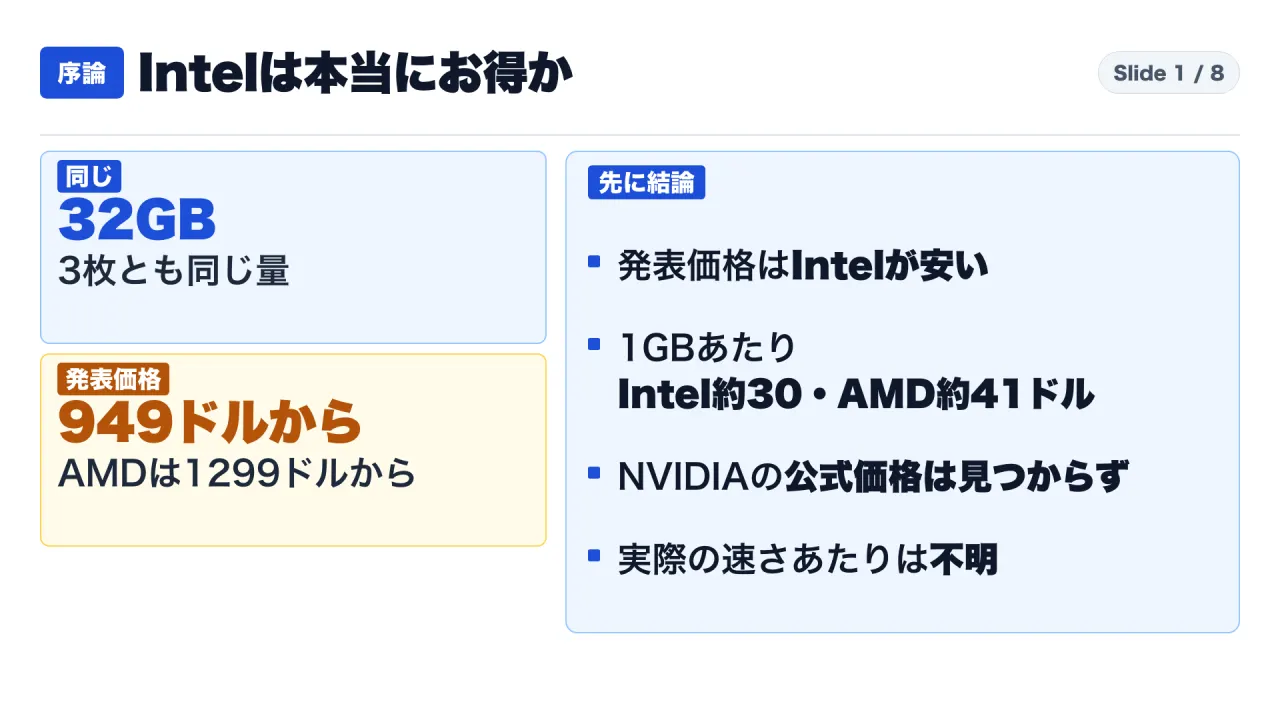
In early 2026, the Intel Arc Pro B70 launched at a suggested price of $949, undercutting AMD’s Radeon AI PRO R9700 ($1,299) by roughly 27% and prompting aggressive marketing claims of unprecedented value against workstation incumbent NVIDIA.
A forensic audit of primary manufacturer documentation, engineering datasheets, and regulatory disclosures reveals four essential findings:
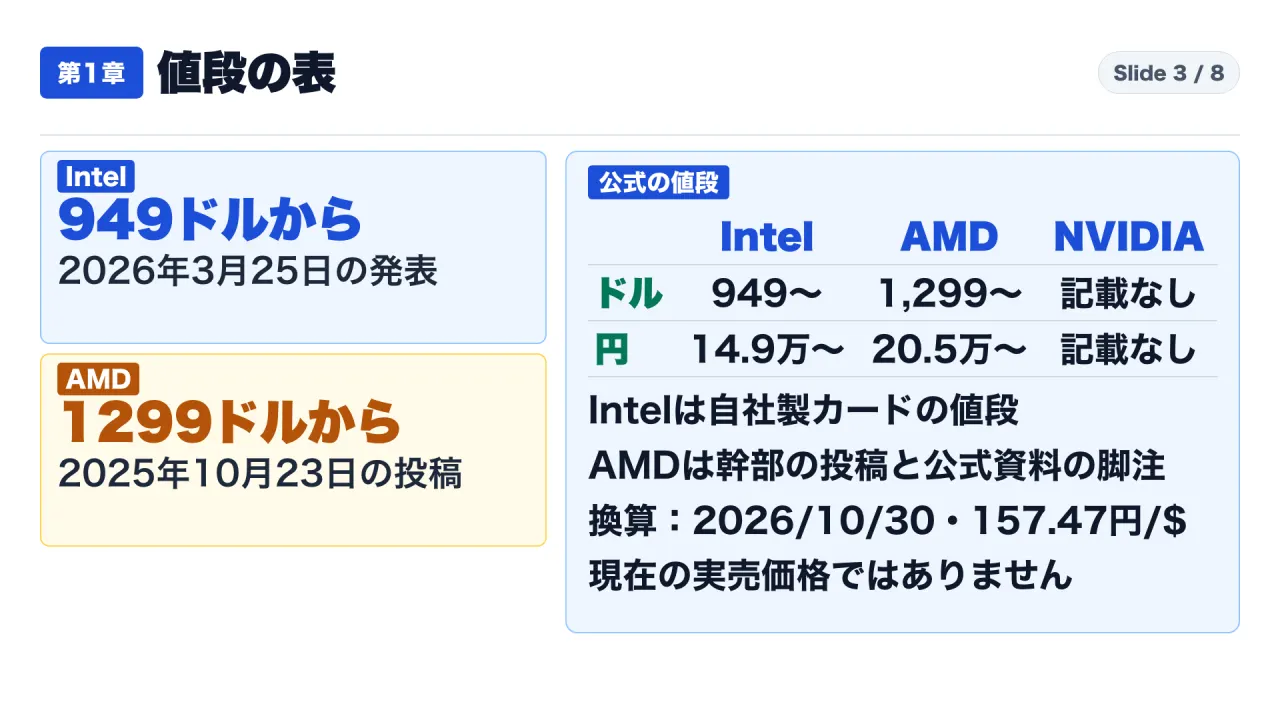
- Official Price Points: Intel’s press announcement sets the Arc Pro B70 suggested starting price at $949 (~149,000 JPY). AMD’s executive disclosures price the Radeon AI PRO R9700 at $1,299 (~205,000 JPY) from select commercial retailers. Intel is approximately 73% of AMD’s price, representing a 26.9% discount.
- Unit Cost Per Capacity and Bandwidth: Intel yields significantly lower hardware unit costs: $29.7/GB of VRAM versus $40.6/GB for AMD, and $1.56 per GB/s of memory bandwidth versus $2.03 per GB/s for AMD.
- The NVIDIA Pricing Gap: NVIDIA omits MSRP figures for the RTX PRO 4500 Blackwell Workstation Edition on its datasheets and partner portals (PNY). Secondary retail prices cannot serve as official manufacturer baselines.
- The Missing Throughput Benchmark: As of November 2026, zero public benchmarks test all three cards under identical models, frameworks, sequence lengths, and quantization levels.
On capacity per dollar and bandwidth per dollar, Intel is demonstrably cheaper than AMD. But whether it delivers better throughput per dollar (tokens per second per dollar) in enterprise production cannot be determined from official documentation.
1. Research Protocol: Establishing Empirical Invariants
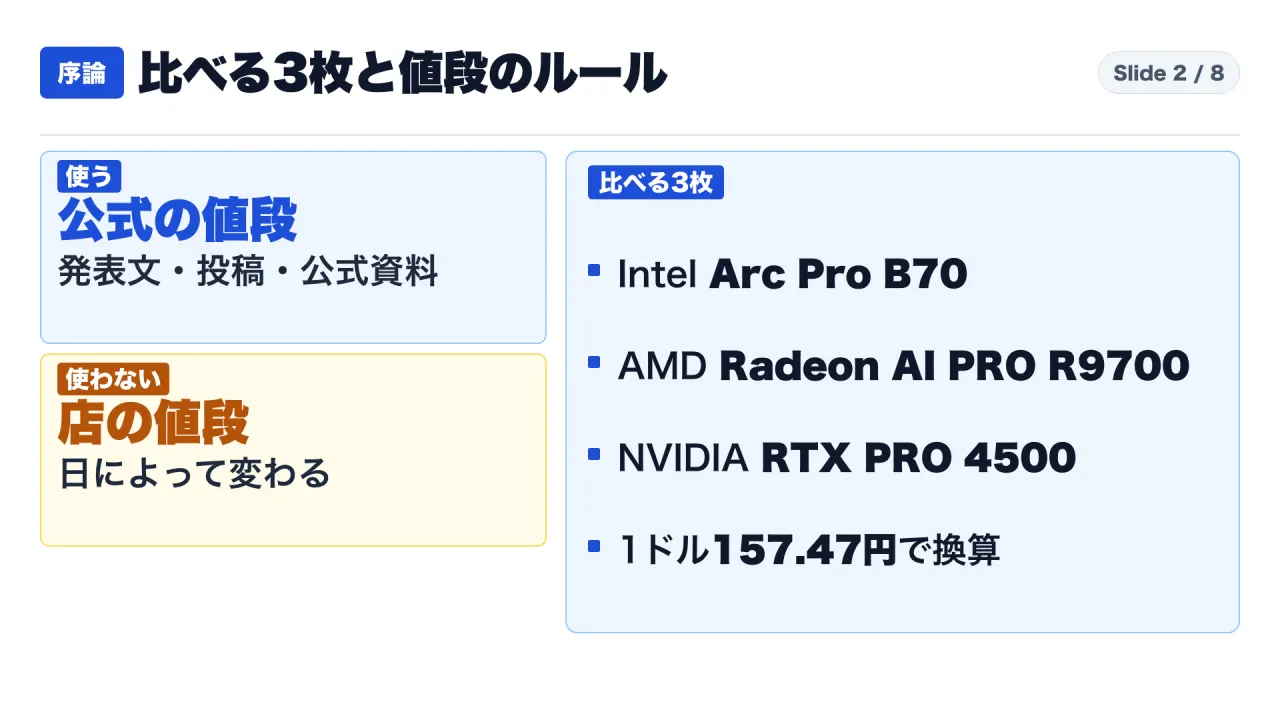
To avoid distorted comparisons from retail volatility, promotional discounts, and secondary market inflation, this review enforces three strict invariants:
- Manufacturer-Originated Pricing Only: We rely solely on formal corporate press releases, official datasheets, or verified corporate executive disclosures. Street retailer listings, price aggregators, and used market scrapers are excluded because they fluctuate daily and incorporate unpredictable distributor markups.
- FX Normalization: Japanese Yen conversions use the Federal Reserve H.10 Statistical Release (published November 2, 2026; spot rate October 30, 2026: 1 USD = 157.47 JPY). (The H.10 also lists Singapore Dollars at 1 USD = 1.2776 SGD, but USD serves as the primary accounting standard).
- Strict Categorization: Verified facts, author calculations, and unverified parameters are strictly distinguished.
For global readers, it is worth understanding the Japanese enterprise context: in Japanese corporate IT and traditional systems integration (SI) environments, hardware selection is rarely governed by raw sticker price alone. Japanese enterprises typically procure workstation fleets through multi-year vendor maintenance contracts, where certified driver stability, vendor hardware compatibility lists (QVL), and domestic distributor warranty support take precedence over minor upfront hardware savings.
2. Chapter 1: The Official Pricing Ledger ── Intel, AMD, and NVIDIA
Intel Arc Pro B70 ($949 Starting Baseline)
In its March 25, 2026 corporate announcement (Intel Core Ultra Series 3 with vPro Powers Next-Gen PCs on 18A), Intel specified:
“The Intel Arc Pro B70 graphics card will be available starting in Q2 2026 with a suggested starting price of $949 for Intel-branded boards. Pricing for custom designs from add-in card partners will vary.”
Intel explicitly noted that board partner designs (such as ARKN, ASRock, Gunnir, Maxsun, and Sparkle) will vary, and regional taxes, import tariffs, and distribution margins affect final street prices.
AMD Radeon AI PRO R9700 ($1,299 Retail Anchor)
AMD provides no standard standalone pricing press release. Instead, pricing originates from two verified sources:
- An October 23, 2025 public statement by David McAfee, AMD Corporate VP, confirming commercial availability from select retailers starting at $1,299.
- Footnote RPW-506 on AMD’s official workstation portal citing an MSRP of $1,299 as of October 1, 2025.
NVIDIA RTX PRO 4500 (Unlisted Baseline)
NVIDIA’s product portal, official Blackwell datasheet (workstation-datasheet-blackwell-rtx-pro-4500-we-nvidia-us-5108623-web.pdf), and distributor PNY list complete technical specifications but omit MSRP. Because reseller bundle quotes fluctuate wildly across enterprise channels, NVIDIA is categorized as unlisted.
| Evaluation Dimension | Intel Arc Pro B70 | AMD Radeon AI PRO R9700 | NVIDIA RTX PRO 4500 Blackwell |
|---|---|---|---|
| Official Price Point | $949 and up (Intel reference) | $1,299 and up (Select retailers) | Unlisted (No official MSRP) |
| Illustrative JPY (157.47 Rate) | ~149,439 JPY (~149,000 JPY) | ~204,554 JPY (~205,000 JPY) | Unlisted |
| Primary Source Baseline | Intel Newsroom (March 25, 2026) | Corporate VP post & Footnote RPW-506 | Datasheet & PNY Portal |
| Timing Horizon | Disclosed March 2026 | Disclosed October 2025 | Launch materials omit MSRP |
3. Chapter 2: Hardware Architecture ── VRAM, Bus Width, Bandwidth, and Power
| Specification Dimension | Intel Arc Pro B70 | AMD Radeon AI PRO R9700 | NVIDIA RTX PRO 4500 Blackwell |
|---|---|---|---|
| Memory Capacity | 32 GB | 32 GB | 32 GB |
| Memory Technology | GDDR6 | GDDR6 | GDDR7 |
| Memory Bus Width | 256-bit | 256-bit | 256-bit |
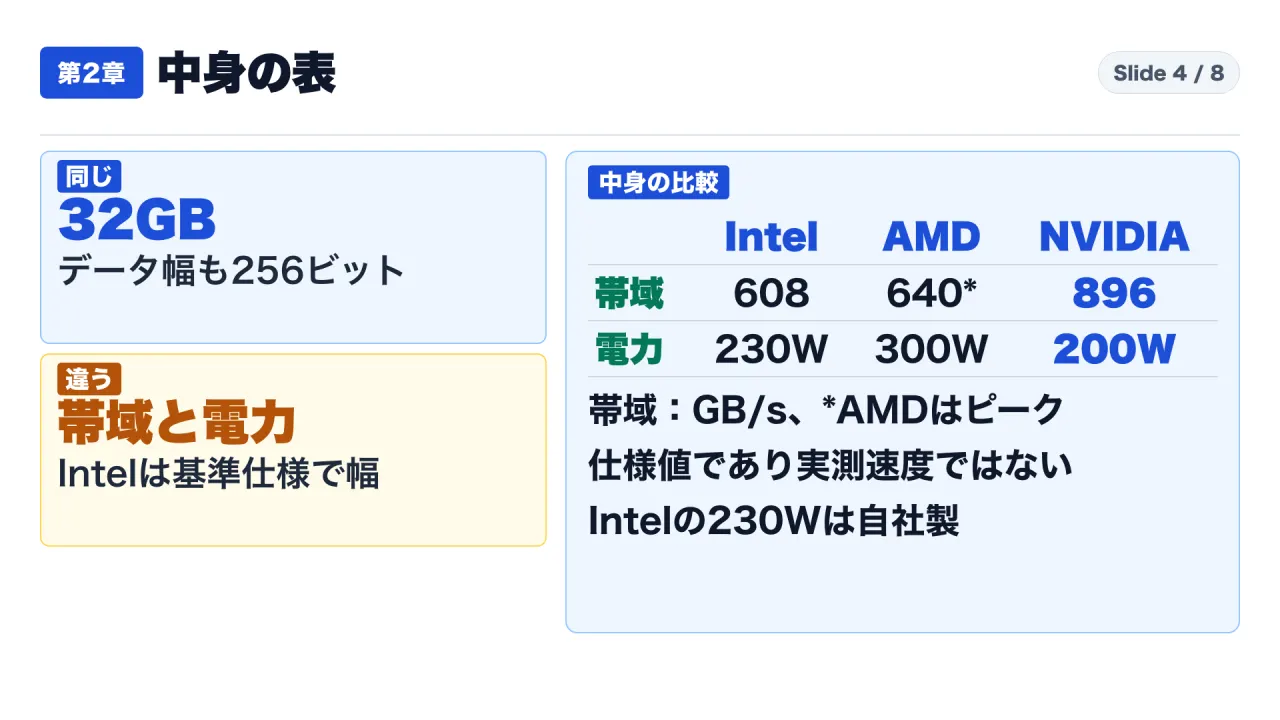
| Peak Memory Bandwidth | 608 GB/s | 640 GB/s (Peak rated) | 896 GB/s |
| Board Power (TBP / TDP) | 230W (Intel card); 160-290W (Base spec) | 300W | 200W |
| AI Compute (INT8 Dense) | 367 TOPS | 383 TOPS | Unlisted under identical criteria |
Key Architectural Distinctions
- Capacity: All three cards feature 32GB on a 256-bit bus, offering equal physical capacity for storing model weights and active KV caches.
- Bandwidth: Intel provides 608 GB/s, AMD reaches 640 GB/s (+5.2%), and NVIDIA reaches 896 GB/s via GDDR7 (+47.4%). In memory-bound token generation (the autoregressive Decode phase), memory bandwidth governs theoretical token generation velocity (Time-Per-Output-Token: TPOT).
- Power: NVIDIA operates at an efficient 200W, Intel specifies 230W for its reference card (with 160W to 290W across partner designs), and AMD requires 300W.
- Compute TOPS: Intel rates at 367 INT8 TOPS and AMD at 383 INT8 TOPS. NVIDIA’s datasheet lists 1,617 TOPS, but that metric measures sparse FP4. Comparing sparse FP4 against dense INT8 violates empirical testing standards, so NVIDIA is excluded from direct TOPS ranking.
4. Chapter 3: Unit Cost Arithmetic ── Pricing Divided by Hardware Metrics
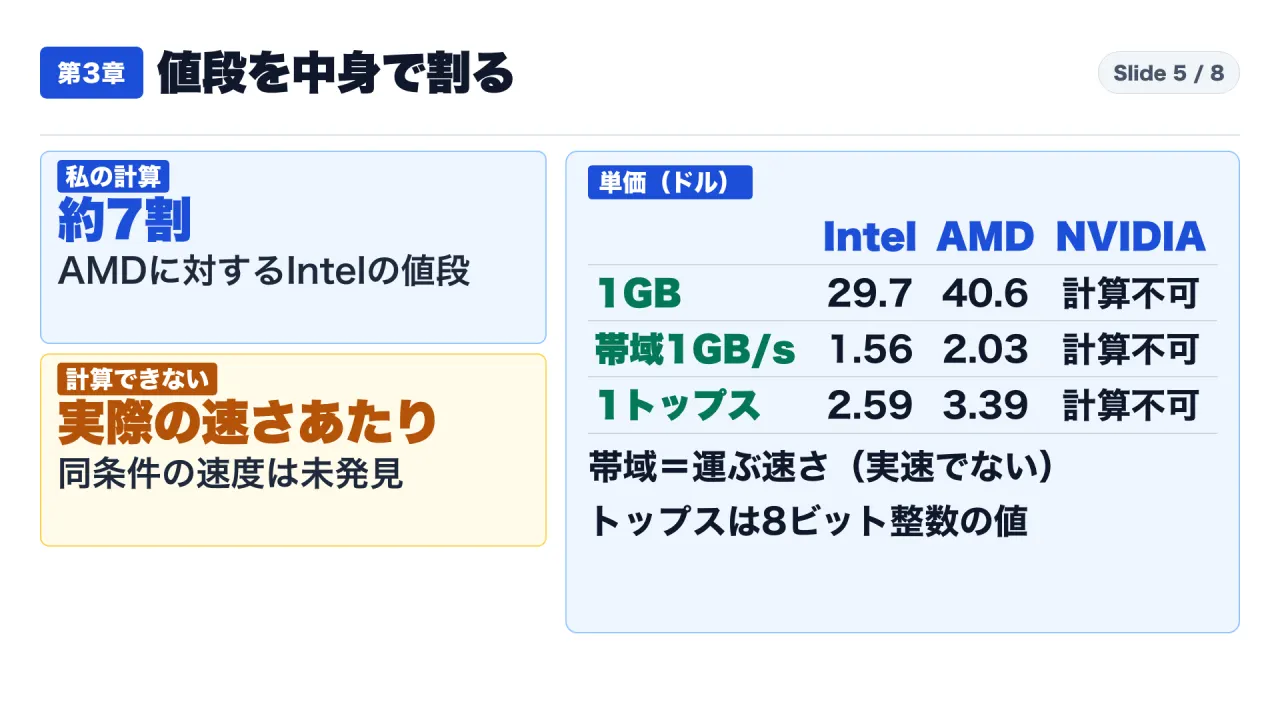
Calculating unit economics for the two priced cards reveals:
| Computed Unit Ratio | Intel Arc Pro B70 | AMD Radeon AI PRO R9700 | Intel vs. AMD Ratio |
|---|---|---|---|
| Official Suggested Price | $949 | $1,299 | 0.731x (26.9% cheaper) |
| Cost per 1GB VRAM | $29.66 / GB (~4,670 JPY) | $40.59 / GB (~6,392 JPY) | 0.731x |
| Cost per 1 GB/s Bandwidth | $1.56 / (GB/s) (~246 JPY) | $2.03 / (GB/s) (~320 JPY) | 0.768x (23.2% cheaper) |
| Cost per 1 Dense INT8 TOPS | $2.59 / TOPS (~408 JPY) | $3.39 / TOPS (~534 JPY) | 0.764x (23.6% cheaper) |
Calculations: $949 / 32 = $29.66; $1,299 / 32 = $40.59; $949 / 608 = $1.561; $1,299 / 640 = $2.030; $949 / 367 = $2.586; $1,299 / 383 = $3.392. 1 USD = 157.47 JPY.
Intel holds a clear hardware density advantage: $29.66/GB of VRAM and $1.56 per GB/s bandwidth. For budget-constrained research teams where fitting larger models into local memory is the primary constraint, Intel offers compelling raw hardware economics.
Deconstructing Intel’s “Tokens Per Dollar” Claim
Intel claimed the Arc Pro B70 achieves up to 2x tokens per dollar versus competition. However, Intel’s footnotes reveal the comparison target was an older RTX PRO 4000 (Ada Generation) using an average retail price of $1,775.94 from February 27, 2026. This marketing claim cannot be generalized across current generation hardware architectures.
5. Chapter 4: What the Spec Sheet Omits ── Software, Power, and Pricing Realities
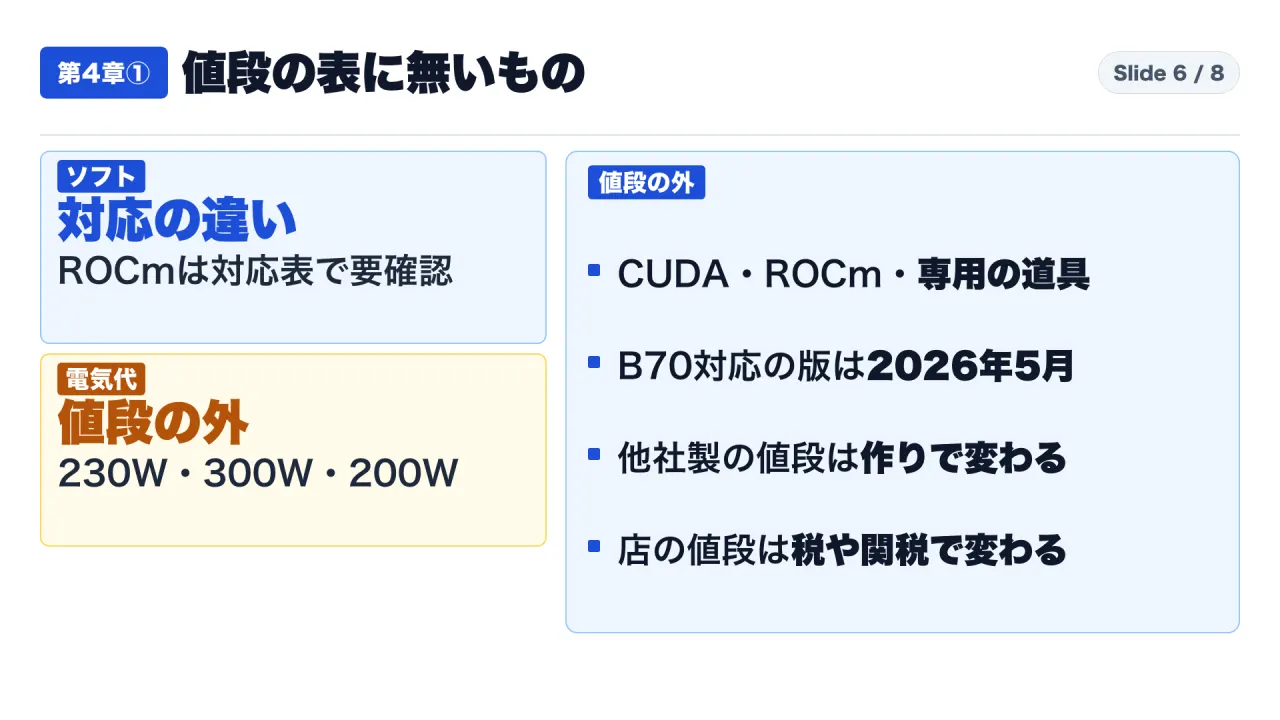
Hardware specifications alone do not determine deployment success:
- Software Stacks and Runtime Engineering:
- NVIDIA (CUDA): CUDA 12.8, TensorRT-LLM, and universal out-of-the-box framework support provide seamless deployment across enterprise software pipelines.
- AMD (ROCm): Supported via ROCm, though distribution compatibility tables (Ubuntu vs RHEL) must be validated. Deploying in corporate IT environments often requires specific kernel revisions.
- Intel (llm-scaler): Accelerated via oneAPI and open-source
llm-scaler(https://github.com/intel/llm-scaler). Notably, official support for the B70 was merged inllm-scaler-vllm 1.4in May 2026 (two months post-launch).
- Electricity & Operating Costs: Rated at 200W (NVIDIA), 230W (Intel), and 300W (AMD), continuous cluster operations diverge meaningfully in power and cooling expenses over a 3-year enterprise depreciation lifecycle.
- Street Availability and Channel Support: Manufacturer suggested prices reflect idealized conditions; local distributor margins, enterprise warranties, and availability govern actual procurement.
6. Synthesis: What Can and Cannot Be Formally Asserted
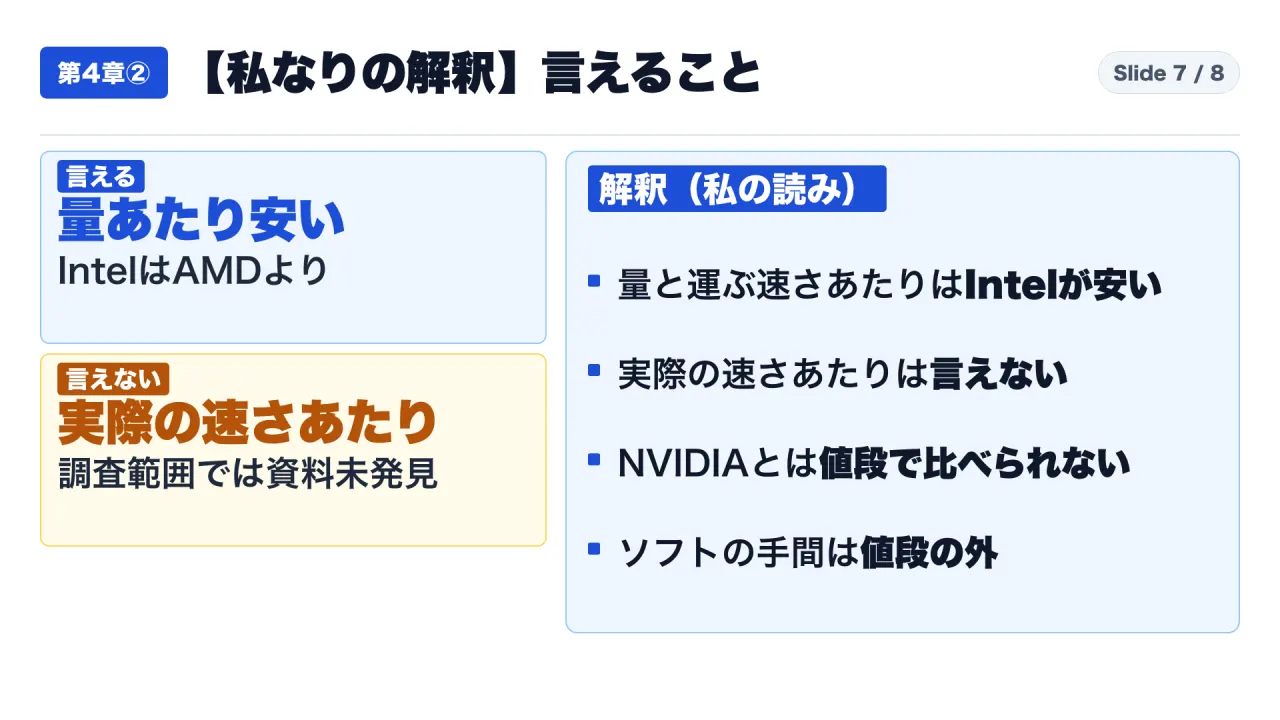
Confirmed Facts:
- Intel’s official suggested price ($949) is 26.9% lower than AMD’s executive retail disclosure ($1,299).
- Intel offers lower unit costs per gigabyte ($29.66 vs $40.59) and per GB/s bandwidth ($1.56 vs $2.03).
- Intel (367 TOPS) and AMD (383 TOPS) share comparable dense INT8 ceilings, while NVIDIA leads in bandwidth (896 GB/s) and efficiency (200W).
Unverified Points:
- Whether Intel is cheaper than NVIDIA (no official NVIDIA MSRP).
- Whether Intel delivers higher real-world token throughput per dollar (zero controlled 3-way benchmarks exist).
- Total cost of ownership inclusive of software configuration overhead and developer troubleshooting time.
7. Actionable Enterprise Procurement Checklist

Before purchasing 32GB workstation cards, engineering teams and IT procurement leads should execute four verification steps:
- Verify Board Model and Power Spec: Clarify whether distributor quotes cover the Intel reference board (230W) or partner designs (which vary between 160W and 290W). Ensure workstation power supplies and thermal airflow accommodate the card.
- Audit Stack Compatibility: Cross-reference target operating system distributions against AMD ROCm matrices or Intel
llm-scalerreleases. - Question Distributors on True Landed Costs: Inquire whether quotes include local value-added taxes (such as Japan’s 10% consumption tax or European VAT), import duties, and vendor replacement guarantees.
- Execute In-House Throughput Benchmarks: Test fixed models (e.g., Qwen 2.5 32B INT4) at identical context lengths, measure tokens/sec, and divide quoted procurement cost by measured speed to calculate true Cost Per Token-Per-Second.
8. Primary Source Documentation
- Intel Official Specifications: Intel Arc Pro B70 Graphics Product Specifications: Intel ARK Product Database
- Intel Official Datasheet: Intel Arc Pro B70 GPU Datasheet Version 1.0 (March 2026): Intel Documentation Library
- Intel Press Release (March 25, 2026): Intel Core Ultra Series 3 with vPro Powers Next-Gen PCs on 18A: Intel Newsroom
- AMD Official Product Portal: AMD Radeon AI PRO R9700 Graphics: AMD Workstation Graphics
- AMD Executive Disclosure (October 23, 2025): David McAfee Statement on X: Verified Corporate Announcement
- NVIDIA Official Datasheet: NVIDIA RTX PRO 4500 Blackwell Workstation Edition: NVIDIA Workstation Solutions
- PNY Commercial Documentation: NVIDIA RTX PRO 4500 Blackwell: PNY Enterprise Portal
- Federal Reserve Statistical Release H.10 (November 2, 2026): Foreign Exchange Rates: Federal Reserve Board