Why Meta Issued $15 Billion in Bonds Eight Days After Selling Stock: Inside the SEC Filings, the 2x Surge in 5-Year Credit Spreads, and the Mechanics of Forward Equity Settlement
A forensic financial and operational audit of Meta Platforms’ November 2026 debt offering, dissecting pricing term sheets across three cycles, contractual cash commitments against AI infrastructure timelines, and enterprise balance sheet governance.
Japanese Edition: Read the original Japanese article on Substack
Video Episode (Japanese Audio): Watch on YouTube
Disclaimer: This publication provides objective financial, operational, and document-level analysis based exclusively on public regulatory filings submitted to the U.S. Securities and Exchange Commission (SEC) and official central bank data. It does not constitute investment advice, financial endorsement, or an offer or solicitation to purchase or sell securities.
Executive Summary: Inside Meta’s Dual Capital Market Strategy
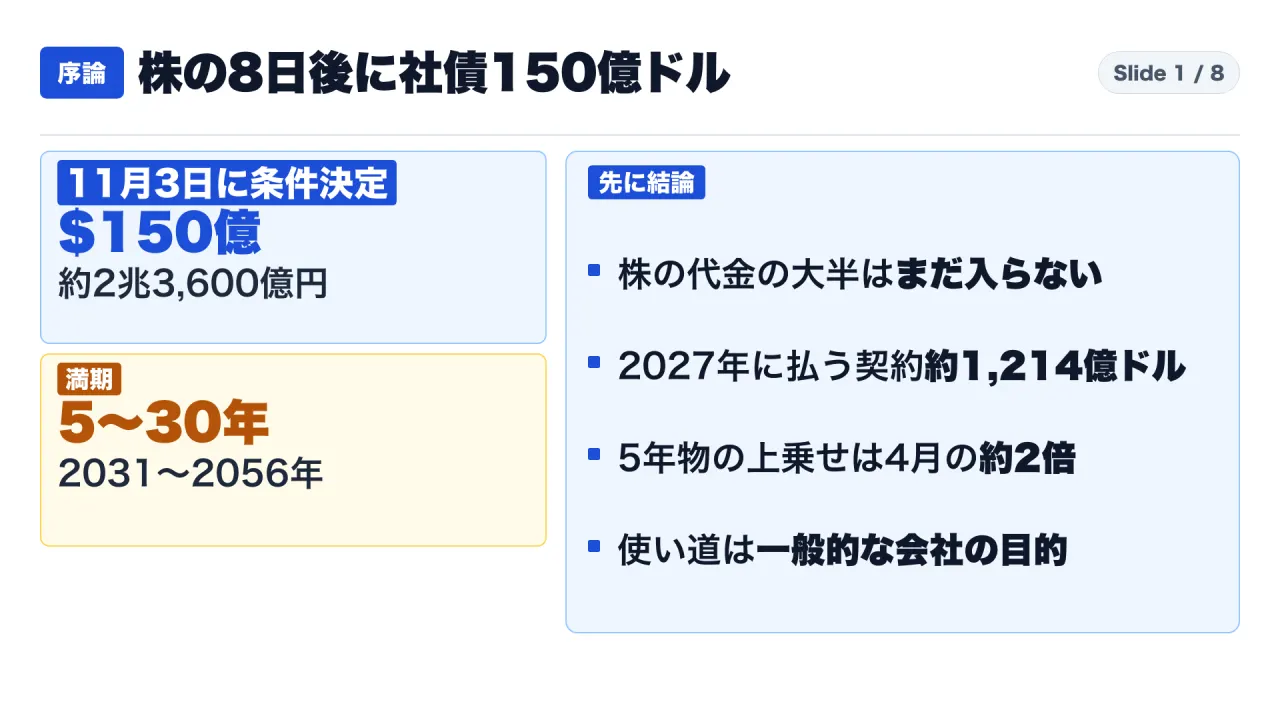
On November 3, 2026, Meta Platforms, Inc. finalized terms for a massive $15 billion five-part senior unsecured note offering. Spanning maturities from 2031 to 2056 (5 to 30 years), the coupons ranged from 5.85% to 7.50%, priced at spreads of 110 to 220 basis points over benchmark U.S. Treasuries. Just eight calendar days prior, on October 26, 2026, Meta had initiated an extensive equity and mandatory convertible preferred stock offering.
For technology executives, finance directors, and enterprise architects evaluating hyper-scale AI commitments, this sequential capital raising creates an immediate paradox: why would a cash-rich technology titan dilute equity and simultaneously expand long-term debt liabilities within a single two-week window?
An exhaustive examination of primary SEC filings reveals three critical structural mechanisms:
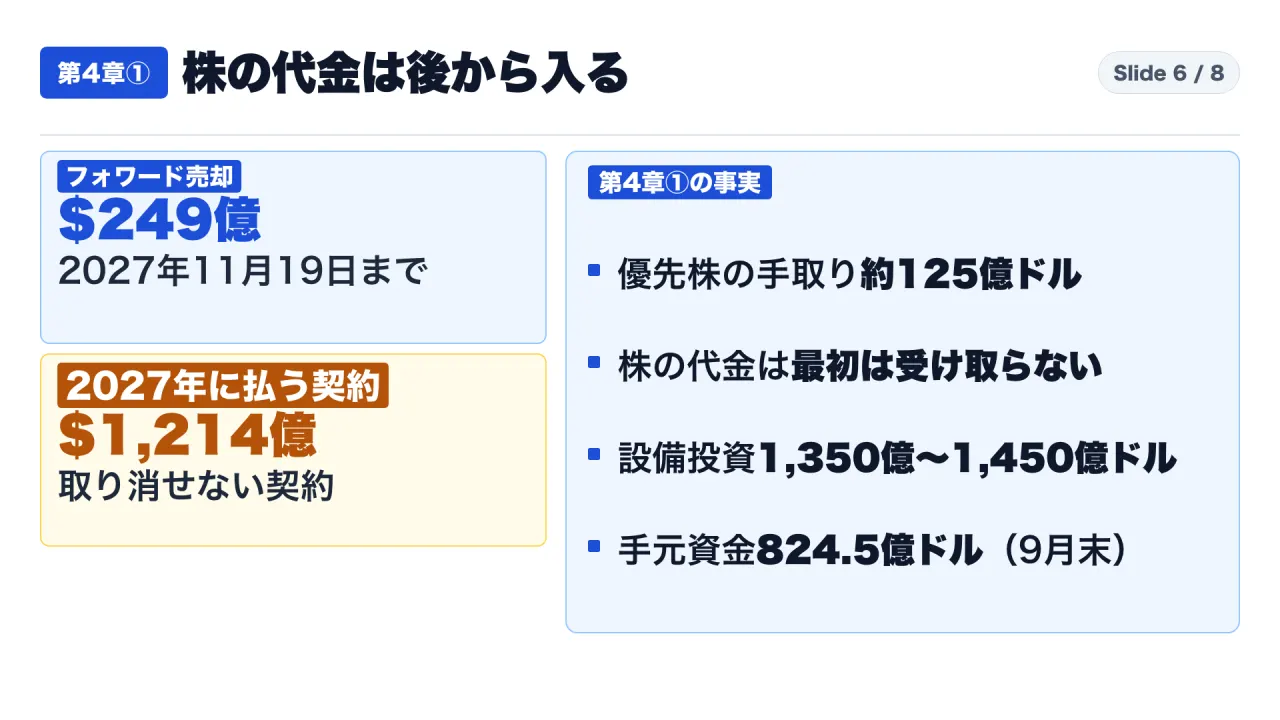
- Forward Equity Realization Lag: Under the October 26 common stock offering, approximately $24.9 billion in anticipated net proceeds were structured through forward sale agreements. Crucially, Meta receives zero initial cash upfront from the forward purchasers upon execution; capital is disbursed only upon final physical share settlement, which Meta can defer until November 19, 2027.
- Immediate Contractual Cash Demands: Meta’s Form 10-Q for the quarter ended September 30, 2026, documented $454.52 billion in total contractual commitments, of which $121.41 billion must be settled in cash during fiscal 2027 alone. Concurrently, projected capital expenditures for fiscal 2026 were guided between $135 billion and $145 billion, driven heavily by AI infrastructure, custom silicon, and server deployments.
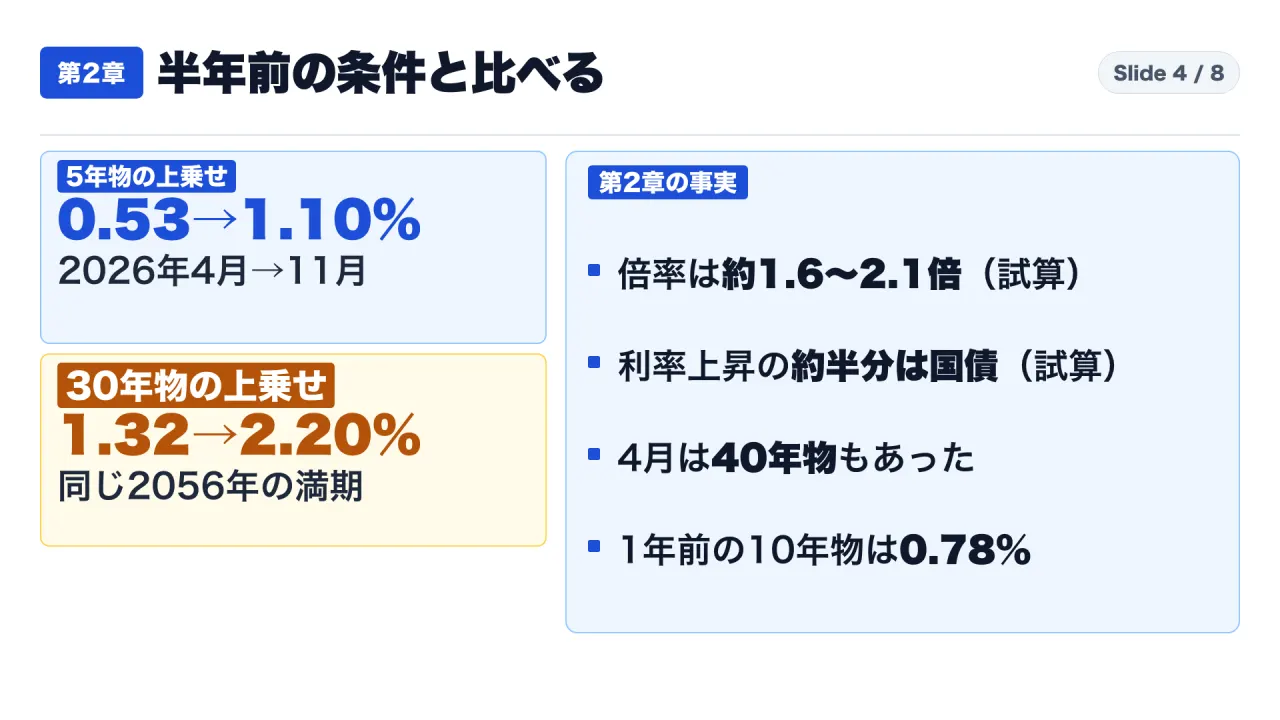
- Substantial Spread Expansion: Comparing identical maturities between April 30, 2026, and November 3, 2026, the risk premium demanded by bondholders expanded dramatically. The spread over benchmark Treasuries on Meta’s 5-year debt widened from 53 basis points to 110 basis points—an increase of more than 2.0x (author’s calculation)—reflecting broader corporate debt supply dynamics and increased market scrutiny of hyper-scale compute balance sheets.
- Core Thesis: Technology leaders must not conflate equity offering announcements with immediate cash liquidity. Meta utilized forward equity to hedge future dilution while raising $15 billion in debt to meet immediate non-cancellable infrastructure commitments, absorbing a doubling of its 5-year credit spread in the process.
- Primary Sources Verified: S1: Meta Platforms Form FWP Pricing Term Sheet ($15B Notes, November 3, 2026); S2: Meta Platforms Form 424B5 Preliminary Prospectus Supplement (November 3, 2026); S3: Meta Platforms Form FWP Pricing Term Sheet (Notes, April 30, 2026); S4: Meta Platforms Form FWP Pricing Term Sheet (Notes, October 30, 2025); S5: Meta Platforms Form FWP Term Sheet (Common & Preferred Stock, October 26, 2026); S6: Meta Platforms Form 8-K Current Report (October 29, 2026); S7: Meta Platforms Form 10-Q Quarterly Report (Quarter ended September 30, 2026); S8: Federal Reserve Board Foreign Exchange Rates H.10 (October 30, 2026).
- Actionable Enterprise Takeaways: Technology leaders and financial controllers must: (1) audit SEC Pricing Term Sheets to decompose coupon changes into risk-free rate movement versus company-specific spread expansion, (2) scrutinize Form 10-Q contractual obligations to map compute supplier liabilities against liquid reserves, and (3) confirm structural seniority and covenant presence before benchmarking partner solvency.
1. The Anatomy of the Five Tranches: Comparing Spreads Across Three Issuance Cycles
To understand the cost of borrowing for AI infrastructure, enterprise planners must dissect the Pricing Term Sheet submitted under SEC Rule 433 (Free Writing Prospectus). Meta divided the $15 billion offering into five distinct tranches across 5-year, 7-year, 10-year, 20-year, and 30-year maturities.
flowchart TD
    subgraph Meta_Offering["$15 Billion Senior Notes Breakdown (Nov 3, 2026)"]
        T1["$3.0B — 5-Year (Due 2031) / Coupon: 5.850% | Spread: +110 bps"]
        T2["$2.75B — 7-Year (Due 2033) / Coupon: 6.200% | Spread: +135 bps"]
        T3["$3.75B — 10-Year (Due 2036) / Coupon: 6.550% | Spread: +160 bps"]
        T4["$2.5B — 20-Year (Due 2046) / Coupon: 7.150% | Spread: +195 bps"]
        T5["$3.0B — 30-Year (Due 2056) / Coupon: 7.500% | Spread: +220 bps"]
    end
Decomposing Yield: Benchmark Treasuries vs. Company Credit Spread
When comparing the November 3, 2026 pricing against Meta’s previous offerings on April 30, 2026, and October 30, 2025, a critical financial pattern emerges. The nominal coupon paid by a corporate issuer is the sum of two distinct components: the risk-free benchmark Treasury yield and the company-specific credit spread.
Nominal Yield = Benchmark U.S. Treasury Yield + Corporate Credit Spread
By tracking identical maturities across filings, we can isolate macro interest rate pressure from the company-specific credit risk premium:
-
5-Year Tranche Evolution (Due ~5 Years from Issuance):
- April 30, 2026 (Due 2031): Benchmark Treasury yield was 4.020%, and the credit spread was +53 bps (0.53%), resulting in a yield of 4.550%.
- November 3, 2026 (Due 2031): Benchmark Treasury yield rose to 4.750% (+73 bps), while the credit spread surged to +110 bps (+57 bps), pushing the coupon to 5.850%.
- Calculation: Of the total 1.30 percentage point increase in Meta’s 5-year borrowing cost, approximately 56% was driven by the general rise in U.S. interest rates, while 44% was driven entirely by a widening of Meta’s company-specific risk spread. Meta’s spread more than doubled (110 bps vs. 53 bps; 2.07x).
-
10-Year Tranche Evolution (Due ~10 Years from Issuance):
- October 30, 2025 (Due 2035): Benchmark Treasury was 4.066% with an 80 bps spread (Yield: 4.866%).
- April 30, 2026 (Due 2036): Benchmark Treasury was 4.225% with an 85 bps spread (Yield: 5.075%).
- November 3, 2026 (Due 2036): Benchmark Treasury rose to 4.950% while the spread expanded to +160 bps (Yield: 6.550%).
- Calculation: In six months, Meta’s 10-year spread widened from 85 bps to 160 bps—an increase of 1.88x (author’s calculation).
-
30-Year Tranche Evolution (Due ~30 Years from Issuance):
- April 30, 2026 (Due 2056): Spread was +125 bps (Yield: 5.800%).
- November 3, 2026 (Due 2056): Spread reached +220 bps (Yield: 7.500%), a widening of 95 basis points (1.76x).
This spread expansion is not unique to Meta; it reflects an overarching shift across corporate credit markets where institutional debt investors demand higher liquidity premiums to absorb the unprecedented deluge of debt issued to fund AI data centers and electrical power generation.
2. Why Sell Equity and Issue Debt Simultaneously? The Forward Sale Mechanism
The most widespread misconception among enterprise observers was that Meta had already accumulated approximately $25 billion in cash from its October 26 equity sale, making an immediate $15 billion debt issuance redundant.
A rigorous reading of the October 26 Form FWP and October 29 Form 8-K reveals why that assumption is legally and operationally false.
sequenceDiagram
    autonumber
    participant Meta as Meta Platforms, Inc.
    participant Banks as Forward Purchasers (Wall Street Banks)
    participant Public as Public Equity Market

    Note over Meta,Public: October 26, 2026: Equity Offering Announced
    Banks->>Public: Borrow & Sell 33.7M Meta Shares to Investors
    Public-->>Banks: $24.9B Gross Proceeds Paid to Forward Banks
    Note over Meta,Banks: Meta receives $0 initial cash proceeds upon execution

    Note over Meta,Banks: November 3, 2026: $15B Debt Offering Launched
    Meta->>Public: Issues 5-Tranche Senior Notes
    Public-->>Meta: $15B Cash Disbursed on Settlement (Nov 5, 2026)

    Note over Meta,Banks: Settlement Window (Up to November 19, 2027)
    Meta->>Banks: Delivers Newly Issued Common Shares
    Banks-->>Meta: Transfers Agreed Net Equity Proceeds ($24.9B)
The Structure of a Forward Sale Agreement
In the common stock portion of the October 26 offering, Meta did not execute a standard immediate primary share sale. Instead, it entered into forward sale agreements with financial intermediaries acting as forward purchasers.
- Third-Party Share Borrowing: The forward purchasers borrowed common shares from institutional holders and sold them into the open market at the public offering price ($740.00 per share).
- Delayed Cash Transfer: The proceeds from the public market were retained by the financial institutions, not transferred to Meta’s treasury accounts.
- Settlement Window: Meta maintains the right to settle the forward agreements on one or more dates specified by the company, extending through November 19, 2027.
- Physical vs. Net Share Settlement: When Meta elects to settle, it will issue new common shares to the forward purchasers in exchange for the forward cash price (subject to calculated adjustments for dividends and interest rates). Meta also reserves the optionality for cash settlement or net share settlement.
Why structure equity this way? Forward sales allow a corporation to lock in prevailing high equity valuations without suffering immediate earnings-per-share (EPS) dilution before the capital is deployed. However, the trade-off is clear: Meta did not have access to the $24.9 billion in liquid cash during the first week of November 2026.
To fund real-time operational outlays, Meta turned to the corporate bond market.
3. Balance Sheet Commitments: $454 Billion in Contractual Obligations
The second piece of the puzzle lies in Meta’s Form 10-Q filing for the period ending September 30, 2026. While the public focus centers on headline quarterly net income, corporate treasury operations must manage hard contractual commitments.
The Commitment Maturity Schedule
Under the “Commitments and Contingencies” footnote of the Form 10-Q, Meta disclosed total non-cancellable commitments of $454.52 billion:
- Settlement Timeline:
- Remaining 2026: $28.35 billion
- Fiscal 2027: $121.41 billion (the peak payment obligation)
- Fiscal 2028: $64.12 billion
- Fiscal 2029: $42.18 billion
- Fiscal 2030: $31.25 billion
- Thereafter: $167.21 billion
These obligations encompass multi-year data center lease agreements, long-term power purchase agreements (PPAs) with utility operators, take-or-pay wafer and packaging capacity reservations with semiconductor foundries, and contracted purchases of custom AI accelerators and network switching fabric.
flowchart LR
    subgraph Obligations["Meta Contractual Commitments ($454.52B Total)"]
        Y26["2026 Remainder: $28.35B"]
        Y27["2027 Peak Outlay: $121.41B"]
        Y28["2028 Outlay: $64.12B"]
        Y29["2029 Outlay: $42.18B"]
        Y30["2030 Outlay: $31.25B"]
        Later["Post-2030: $167.21B"]
    end
Simultaneously, Meta projected full-year 2026 capital expenditures between $135 billion and $145 billion, representing an extraordinary capital intensity. Even for a corporation generating dozens of billions of dollars in operating cash flow from advertising auctions, committing $121.4 billion in 2027 liabilities while self-funding $140 billion in annual infrastructure creates intense liquidity management requirements.
Raising $15 billion in five-part fixed-rate debt locked in multi-year balance sheet insurance, immunizing near-term operations from potential liquidity squeezes or further credit market tightening.
4. Reading the Fine Print: Structural Seniority, Covenants, and Use of Proceeds
For enterprise procurement leaders assessing vendor financial resilience, understanding the legal standing of corporate debt is essential. What did Meta’s Preliminary Prospectus Supplement (Form 424B5) explicitly specify regarding how this money can be used and where noteholders sit in the capital stack?
1. Use of Proceeds: Pure “General Corporate Purposes”
In financial media commentary, headlines frequently claimed the bond issuance was “strictly designated for AI data centers and GPU clusters.”
However, Section “Use of Proceeds” in the SEC 424B5 filing reveals standard regulatory boilerplate:
“We intend to use the net proceeds from the sale of the notes for general corporate purposes, which may include, among other things, capital expenditures, repurchases of our common stock, repayments of outstanding debt, and working capital.”
Meta gave no legal or contractual commitment to ring-fence these proceeds for AI research, server procurement, or facility construction. Corporate treasury retains full legal discretion to reallocate funds toward share repurchases, dividend disbursements, or general operational buffers.
2. Structural Subordination and Absence of Covenants
Under the “Description of the Notes” and “Risk Factors,” the filings spell out the legal hierarchy of repayment:
- Unsecured Status: The notes are senior unsecured obligations. They are not backed by any specific physical collateral, data center real estate, patent portfolios, or server equipment.
- Structural Subordination to Subsidiaries: The notes are issued by Meta Platforms, Inc. (the parent holding company). Consequently, they are structurally subordinated to all existing and future liabilities of Meta’s operating subsidiaries. In a bankruptcy scenario, creditors of the subsidiaries must be paid in full from subsidiary assets before any cash flows up to the parent to satisfy noteholder claims.
- No Financial Covenants: The indenture governing the notes contains no financial covenants. It does not restrict Meta from:
- Incurring unlimited additional senior or secured debt in the future.
- Paying dividends or repurchasing common shares.
- Entering into highly leveraged corporate transactions.
- Pledging assets unless exceeding specific, narrow negative pledge thresholds.
3. Make-Whole Optional Redemption Terms
Under the “Optional Redemption” provisions, Meta retains the right to redeem the notes prior to their scheduled maturity. For instance, the 2031 notes can be redeemed prior to October 15, 2031, at a “make-whole” premium calculated by discounting remaining principal and interest payments at the benchmark Treasury rate plus 20 basis points (0.20%). Thereafter, they can be redeemed at 100% of par value.
This gives Meta strategic flexibility: if global macroeconomic interest rates decline significantly in future years, treasury can retire these high-coupon notes early and refinance at lower interest rates.

5. Practical Due Diligence Framework for Technology Leaders
When enterprise organizations enter long-term cloud commitments, custom silicon agreements, or strategic AI partnerships with major technology vendors, technical architects must conduct financial due diligence alongside architectural reviews.
Here is a 4-step framework based on SEC filings:
flowchart TD
    Step1["Step 1: Open Form FWP Pricing Term Sheet<br/>Extract Maturity, Coupon, Benchmark Treasury, and Credit Spread"]
    --> Step2["Step 2: Cross-Cycle Spread Comparison<br/>Isolate macro yield shifts from company-specific spread widening"]
    --> Step3["Step 3: Audit Form 10-Q Commitments Footnote<br/>Compare non-cancellable 1-3 year contractual obligations against cash & CapEx"]
    --> Step4["Step 4: Inspect Prospectus Covenants & Subordination<br/>Verify whether obligations are parent-level unsecured vs collateral-backed"]
- Separate Market Rates from Issuer Risk: Never evaluate an issuer’s financial strength based solely on the coupon rate. Deconstruct the coupon into benchmark Treasuries and credit spreads. When an issuer’s credit spread widens by 2x over a six-month period—as seen between Meta’s April and November 2026 issuances—institutional credit markets are recalibrating the company’s capital allocation risk.
- Track Cash Flow Timing vs. Capital Announcements: An equity offering announcement does not guarantee liquid reserves. Identify whether issuances utilize forward sales, delayed draws, or convertible preferreds that carry deferral rights.
- Cross-Check Contractual Liabilities Against Guided CapEx: Operating margins can conceal massive off-balance-sheet commitments. Always check the “Commitments and Contingencies” table in quarterly filings to determine how much cash is pre-allocated to suppliers over the next 12 to 24 months.
- Identify Absence of Financial Covenants: In enterprise software agreements where vendor viability matters over 5-to-10-year horizons, recognize that tech giants issue debt without restrictive debt-to-EBITDA or interest-coverage covenants, allowing them to dramatically alter capital structures without triggering technical default.
Primary Sources and Regulatory Citations
All quantitative calculations, tranche spreads, and contractual commitment schedules cited in this audit were extracted directly from verified regulatory filings submitted to the U.S. Securities and Exchange Commission (SEC) and the Board of Governors of the Federal Reserve System:
- S1: Meta Platforms, Inc., Form FWP: Pricing Term Sheet for $15,000,000,000 Senior Notes Across 5 Tranches, Filed November 3, 2026. SEC EDGAR Accession No. 0001193125-26-445646.
- S2: Meta Platforms, Inc., Form 424B5: Preliminary Prospectus Supplement to Prospectus dated October 26, 2026, Filed November 3, 2026. SEC EDGAR Accession No. 0001193125-26-444440.
- S3: Meta Platforms, Inc., Form FWP: Pricing Term Sheet for Senior Notes, Filed April 30, 2026. SEC EDGAR Accession No. 0001193125-26-197902.
- S4: Meta Platforms, Inc., Form FWP: Pricing Term Sheet for Senior Notes, Filed October 30, 2025. SEC EDGAR Accession No. 0001193125-25-258837.
- S5: Meta Platforms, Inc., Form FWP: Term Sheet for Public Offering of Common Stock and Mandatory Convertible Preferred Stock, Filed October 26, 2026. SEC EDGAR Accession No. 0001193125-26-432549.
- S6: Meta Platforms, Inc., Form 8-K: Current Report under Section 8.01 Other Events (Closing of Common Stock Offering and Forward Sale Agreements), Filed October 29, 2026. SEC EDGAR Accession No. 0001193125-26-438017.
- S7: Meta Platforms, Inc., Form 10-Q: Quarterly Report for the Period Ended September 30, 2026 (Commitments and Contingencies Note), Filed October 29, 2026. SEC EDGAR Accession No. 0001628280-26-066773.
- S8: Board of Governors of the Federal Reserve System, Statistical Release H.10: Foreign Exchange Rates (USD/JPY benchmark conversion 157.47), Published November 2, 2026. Federal Reserve H.10 Data.