Does Vercel's AI Inspect Running Apps? An Architectural Deep Dive into Per-Push Security Reviews, AuthZ Boundary Analysis, and the Limits of Code-Only Scanners
A senior architect’s guide to Vercel’s new automated Security Review, dissecting what git-diff analysis captures, why production penetration testing remains non-negotiable, and how to calibrate policy constraints.
Japanese Edition: https://consuloji.substack.com/p/aivercel
YouTube (Japanese audio): https://www.youtube.com/watch?v=ED04wJDbZGQ
Executive Summary & Key Technical Invariants
In November 2026, Vercel released the public beta of Security Review, an automated artificial intelligence capability integrated into the Vercel Agent suite for Pro and Enterprise subscribers. Billed as an autonomous security analyst that inspects code upon every commit, the feature has generated significant interest—and confusion—among engineering leadership regarding whether automated AI review can replace traditional security audits and penetration testing.
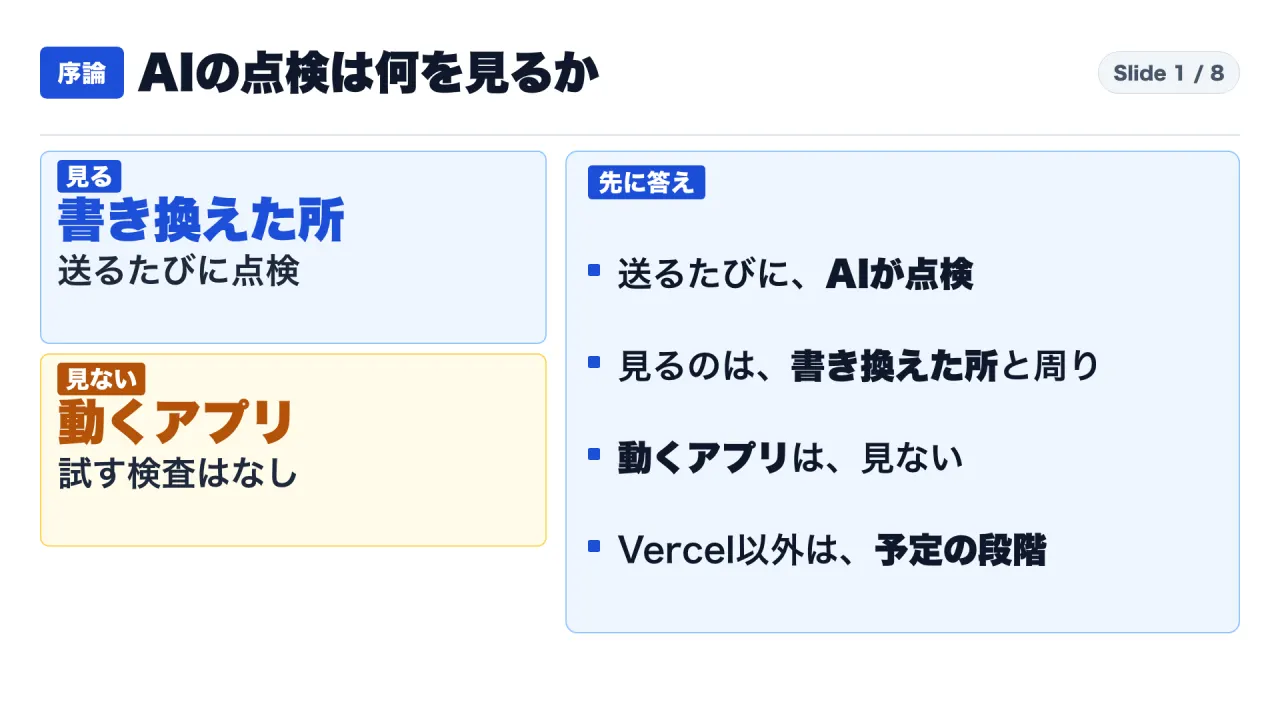
To establish operational clarity, technical leaders must understand the strict architectural boundaries confirmed in Vercel’s official documentation:
- What It Inspects: Security Review evaluates source code diffs pushed to GitHub repositories connected to Vercel projects. It reads changed lines in the context of surrounding files, traces execution paths to determine reachability, evaluates existing defensive controls, and flags structural software flaws such as broken authorization, code injection, and hardcoded secrets.
- What It Explicitly Does Not Do: The service does not inspect running web applications, does not execute dynamic testing (DAST), does not conduct penetration testing, and provides no contractual guarantee that applications are defect-free. In the analogy of building security: Security Review acts as an architectural plan reviewer checking blueprint changes for missing door locks; it is not a physical security patrol inspecting windows at night.
- Git Push Triggering: Unlike standard code review bots that execute only when a developer creates a formal Pull Request (PR), Security Review triggers on every Git push event. Consequently, code pushed directly to production branches or delivered via force-push operations is inspected automatically, eliminating the PR bypass vulnerability.
- Scope and Eligibility Boundaries: Currently, the feature applies strictly to GitHub repositories connected to active Vercel projects under Pro or Enterprise plans. Scanning unlinked repositories or non-Vercel deployments is cataloged in product roadmaps as a future capability.
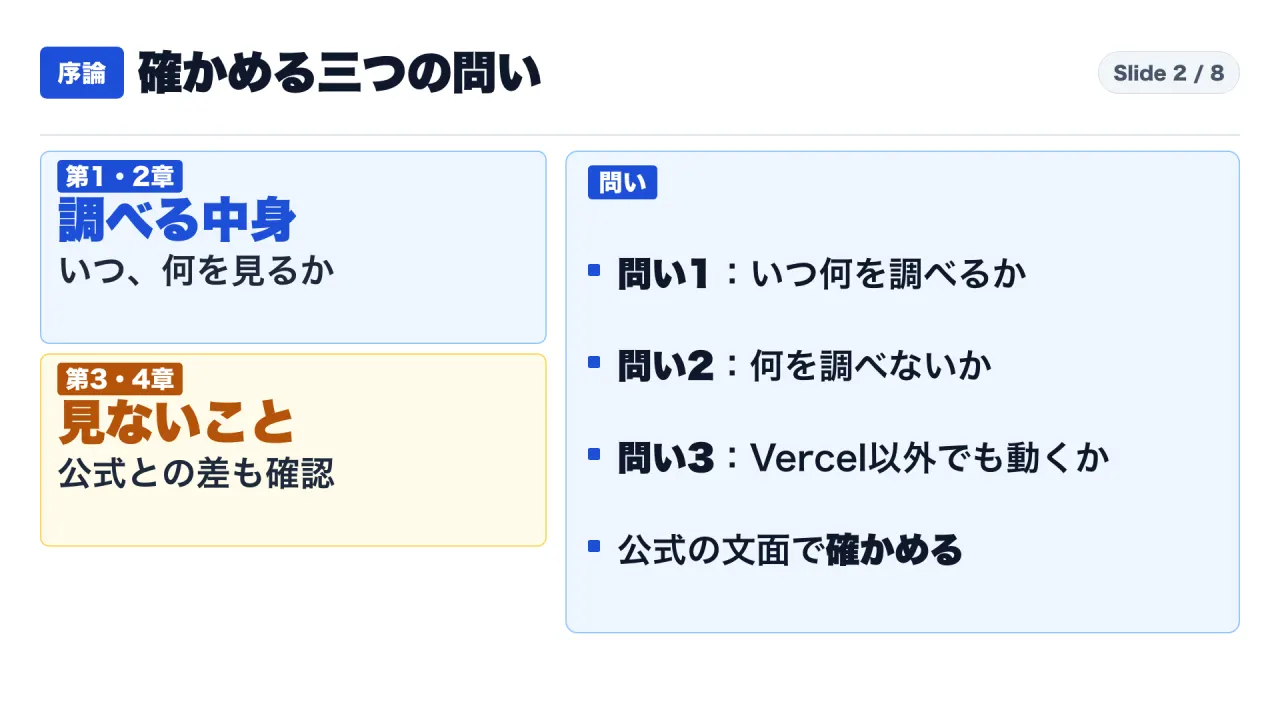
1. Trigger Mechanics: Why Direct and Force Pushes Are Monitored
Most automated developer security tools integrate at the Pull Request layer. While intuitive for standard feature development, PR-based gates introduce a severe operational vulnerability: an authorized engineer with administrator permissions can push emergency hotfixes directly to main, or execute a force push (git push --force), bypassing CI/CD inspection completely.
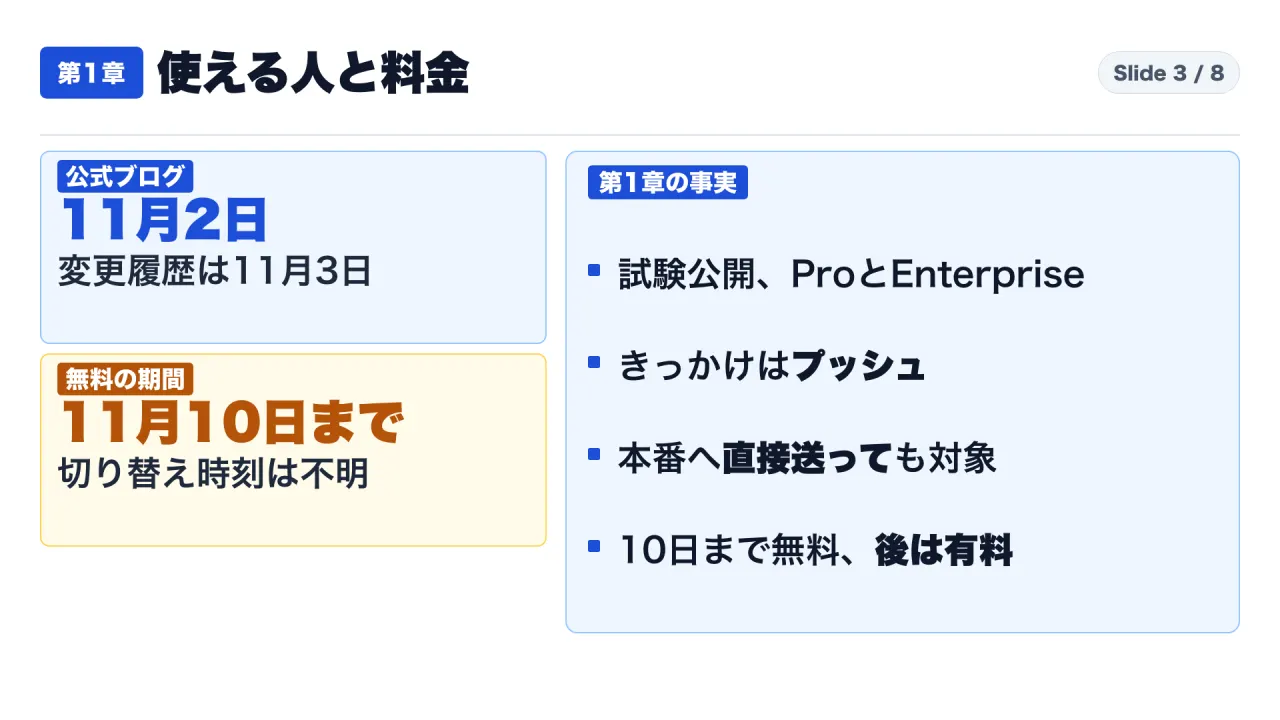
Vercel re-engineered this trigger mechanism:
- Push-Level Invocation: The evaluation begins whenever new commits reach GitHub. Whether a commit arrives via an open PR, a direct push to production, or a branch history rewrite, Vercel’s webhook catches the push event.
- Baseline Diff Determination: For standard deployment builds, the scanner establishes a baseline from the branch’s previous deployment. If no prior deployment exists, it references Git commit ancestry. On initial repository onboarding, the system scans the entire codebase to establish a baseline foundation.
- Incremental Diff Analysis: Subsequent scans evaluate the modified lines and immediately adjacent call sites, keeping inference times within seconds and preventing runaway token expenditure.
2. Eligibility, Governance, and Consumption-Based Pricing
Security Review is managed under Vercel’s administrative Role-Based Access Control (RBAC) framework:
- Plan Availability: Restricted to Pro and Enterprise subscription tiers. Hobby plans are excluded.
- Administrative Privileges: Only team members with the Owner role can enable automated Security Reviews and select target projects (supporting all projects or up to 100 individually selected repositories).
- Consumption-Based Token Pricing:
- The underlying model inference costs are passed through directly at provider API rates without markup.
- Vercel applies a platform compute fee of $0.25 per 1 million tokens.
- Automated reviews were made available without fee during the public beta promotional window through November 10, 2026.
- Automated pull request fixes generated via “Fix with Vercel Agent” are billed under standard agent execution rates.
Because costs scale with push frequency and the volume of changed code, engineering teams should calculate their monthly budget based on historical commit velocity rather than fixed per-seat software licenses.
3. Detection Methodology: Tracing Reachable Paths and AuthZ Boundaries
Traditional static application security testing (SAST) tools rely on pattern-matching regular expressions and Abstract Syntax Tree (AST) rules. These tools frequently produce noise, flagging benign code while missing high-level architectural flaws that depend on business context.
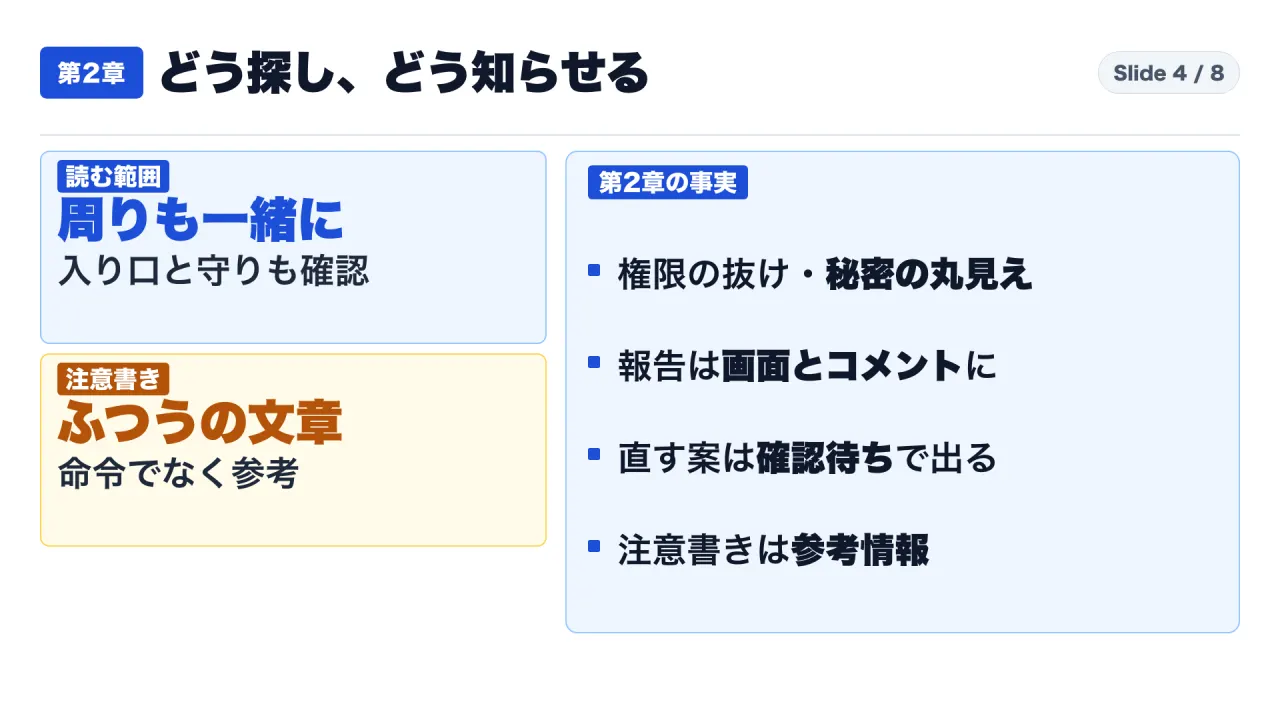
Vercel’s Security Review applies a four-stage cognitive detection workflow:
- Contextual Ingestion: The system reads changed code lines alongside adjacent modules, imported functions, and route handlers.
- Path Reachability Analysis: It traces input vectors from public API routes down to internal database queries, verifying whether external user data can reach sensitive operations.
- Defensive Control Verification: The model audits existing middleware, input sanitization routines, and session validations to determine if adequate guards are in place.
- Pre-Publication Validation: Before publishing an issue, the system re-evaluates the finding to filter out obvious false positives.
Concrete Scenario: Multi-Tenant Authorization Bypass (BOLA / IDOR)
A classic vulnerability that regex scanners miss is Broken Object Level Authorization (BOLA). Consider a Next.js Server Action designed to download customer billing statements:
// Vulnerable Server Action
export async function downloadInvoice(invoiceId: string) {
  const session = await getSession();
  if (!session) throw new Error("Unauthorized");

  // Authenticated, but lacks tenant ownership validation
  const invoice = await db.invoices.findUnique({
    where: { id: invoiceId }
  });
  return invoice;
}
In this implementation, authentication succeeds: the user is logged in. However, the system fails to verify whether the requesting user belongs to the organization owning that specific invoice. Any authenticated customer can increment the invoiceId parameter and download a competitor’s proprietary financial record.
Vercel Security Review traces the execution path, identifies that invoiceId originates from unvalidated client parameters, and flags the absence of organization-level scoping within seconds, providing a tailored code patch.
4. Reporting Channels, Public Repo Safeguards, and Natural-Language Policies
Security findings are routed across three primary developer surfaces:
- Vercel Vulnerability Dashboard: A unified management console displaying affected projects, environments, branches, and commit hashes.
- Pull Request Inline Comments: Line-specific annotations explaining the vulnerability, assessed severity, and remediation diffs.
- Command-Line Interface (CLI): Enables developers to pull vulnerability records directly into terminal workflows or local IDE environments.
The Public Repository Redaction Boundary
A crucial security control governs repository visibility:
- Private & Internal Repositories: Full vulnerability explanations, call-stack traces, and remediation diffs are posted directly into Pull Request discussion threads.
- Public Repositories: To prevent zero-day exposure to external attackers, public pull requests receive only a generic review status indicator. Detailed vulnerability descriptions, affected line numbers, and exploit mechanics are restricted to the authenticated Vercel dashboard.
Calibrating Natural-Language Policies (Up to 32,000 Characters)
Engineering teams can guide the review engine by defining plain-text security policies at the team or project level (up to 32,000 characters). Policies allow organizations to document domain-specific assumptions:
- “All internal admin routes under
/api/adminrequire employee SSO authentication.” - “Verify organization-level scoping on all billing and telemetry queries.”
- “Ignore missing rate-limiting warnings on internal webhook receivers.”
However, technical documentation emphasizes that policies function as guidance rather than strict overrides. The core vulnerability detection engine takes precedence over conflicting policy directives, ensuring that a poorly phrased rule cannot silence critical security alerts.
Automated Remediation via Vercel Agent
Developers can trigger automated fixes directly from the dashboard via “Fix with Vercel Agent.” The agent verifies that the vulnerability remains active, generates a minimal corrective diff, executes local linting and automated test suites, and opens a structured Pull Request for human review.
5. Non-Negotiable Limits: What Per-Push Reviews Explicitly Do Not Cover
To prevent false confidence, security leadership must recognize the technical boundaries explicitly stated in Vercel’s official documentation:
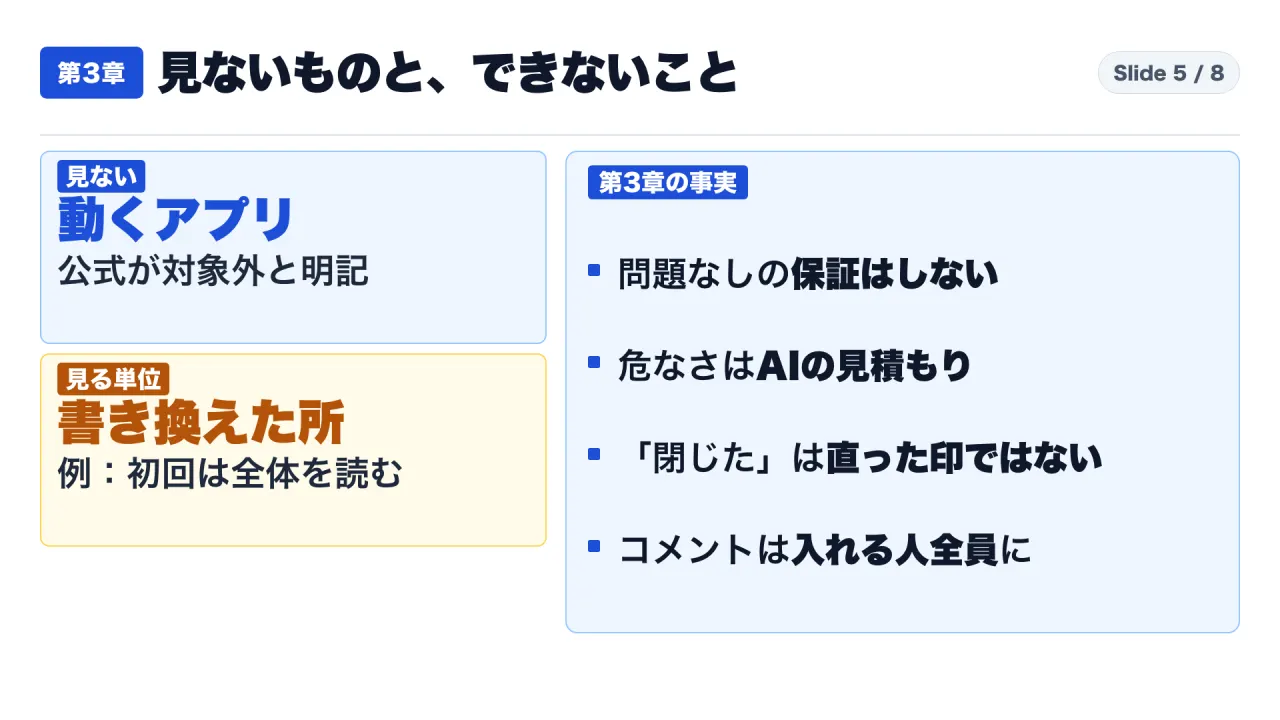
- No Runtime Application Inspection: Security Review evaluates static source code diffs. It does not inspect running serverless functions, does not monitor live memory allocations, and cannot detect runtime configuration drift occurring in cloud infrastructure.
- No Penetration Testing or DAST: The service does not perform dynamic fuzzing, does not send synthetic exploit payloads to live staging or production endpoints, and does not test network-level perimeter firewalls.
- The Unmodified Legacy Code Blind Spot: Because the scanner evaluates code changed between deployments, legacy modules that remain untouched during a release cycle are not re-inspected. Pre-existing vulnerabilities hidden in dormant files will not surface until those specific files are modified.
- Severity Scores Are Heuristic Estimates: Issues receive severity ratings of Critical, High, Medium, or Low. These ratings are heuristic assessments generated by the underlying model, not formal CVSS scores derived from deterministic impact matrices. Engineering teams must evaluate findings against their specific operational risk profile.
- “Closed” Status Does Not Confirm Remediation:
Within the vulnerability dashboard, issues transition between three states:
Open,Dismissed, andClosed. TheClosedstate simply indicates that the issue was no longer detected in subsequent diffs. It does not certify that the underlying architectural flaw was resolved safely; an inadvertent file rename or code restructuring could cause the scanner to lose track of the vulnerability path.
6. Scope Boundaries: Unlinked Repositories, RBAC, and Secret Invalidation
Public commentary regarding Vercel Security Review has occasionally obscured its operational prerequisites:
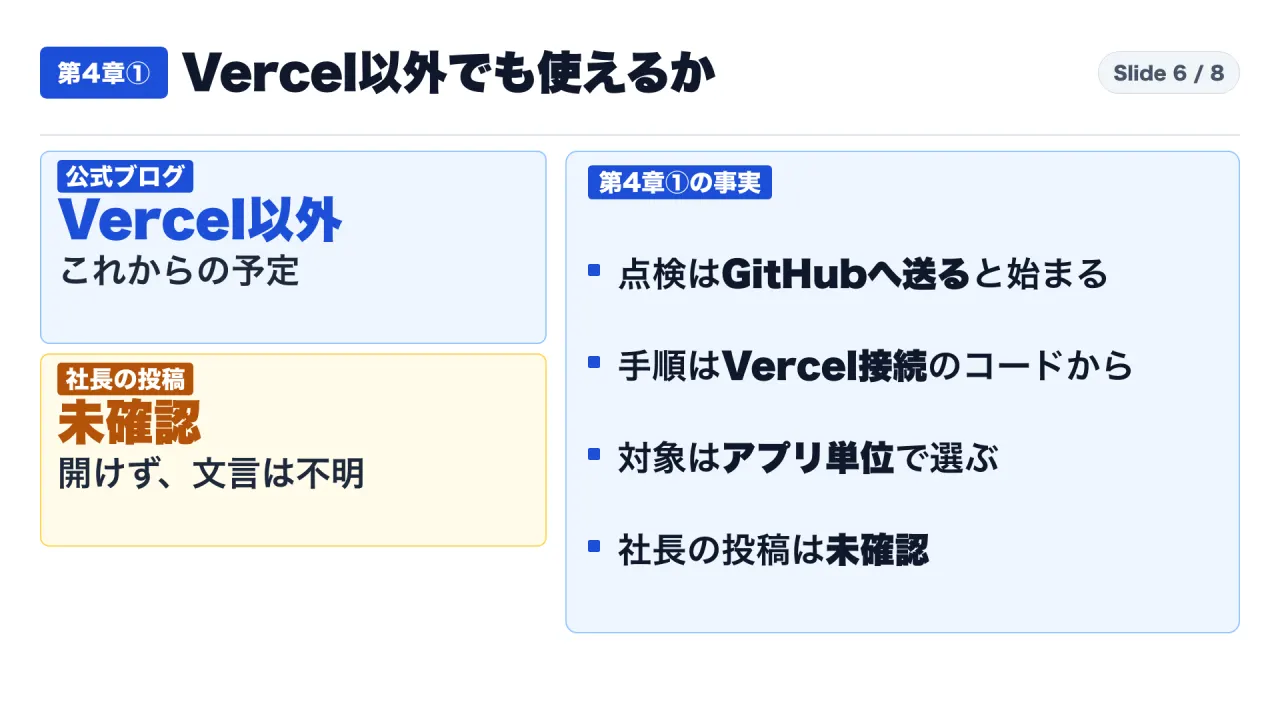
Evaluating Non-Vercel Deployments
Executive commentary across social media suggested that Security Review might eventually operate across arbitrary codebases. However, the verified technical documentation confirms that current functionality is strictly tied to GitHub repositories linked to active Vercel projects. Support for external Git providers (GitLab, Bitbucket) and standalone, unhosted repositories remains a roadmap objective.
Information Exposure Across Collaborators
Because PR comments contain code snippets and vulnerability descriptions, any collaborator with repository access can view reported weaknesses. Organizations employing external contractors or third-party developers must audit repository permissions to prevent internal security findings from being exposed to unauthorized third parties.
The Imperative of Secret Revocation
When Security Review detects an exposed credential (such as an API token, database connection string, or private key), committing a code patch that deletes the secret string is insufficient.
Once an API key is pushed to a remote Git repository, it must be presumed compromised. Security teams must enforce immediate secret revocation and rotation within the upstream service provider. In the analogy of physical security: when a duplicate key is lost, welding the keyhole shut does not protect the building; the lock cylinder itself must be replaced.
7. Practical Implementation Guide: A 6-Step Staged Rollout
Engineering teams adopting Vercel Security Review should follow a structured, six-step deployment roadmap:
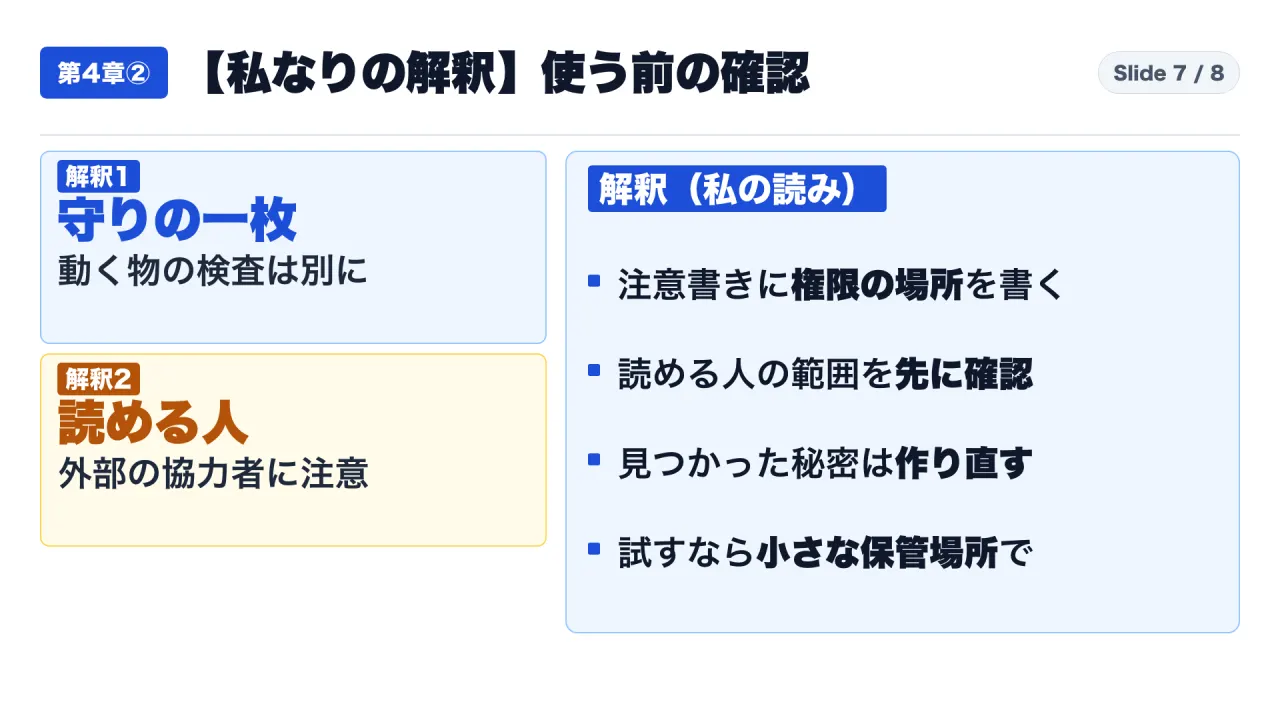
- Verify Prerequisites & Plan Eligibility: Confirm that target applications are hosted on Vercel Pro or Enterprise plans, integrated with GitHub, and configured with appropriate Owner RBAC permissions.
- Audit Repository Collaborators: Review contributor lists across private repositories to verify that individuals authorized to read PR comments have legitimate security clearance.
- Draft Two Baseline Policies: Before turning on reviews, define two fundamental natural-language policies:
- Specific route patterns requiring organization-level authorization scoping.
- Prohibited credential patterns and approved environment variable references.
- Pilot on Low-Risk Repositories: Select one or two internal, non-critical services. Enable automated reviews, observe the signal-to-noise ratio, and refine policy prompts to eliminate recurring false positives.
- Establish Triage Protocol: Instruct development teams that a “Low” severity rating does not warrant dismissal without investigation, and mandate that “Closed” statuses require human code review sign-off.
- Monitor Push Frequency and Token Consumption: Track commit volume and review costs post-beta, evaluating the return on investment against traditional manual code audit cycles.
Concluding Architectural Invariants
Automated AI security scanning represents a powerful evolutionary leap for developer workflows, providing continuous diff-level vigilance that catches authorization oversights before code reaches production. However, it represents only one layer in a defense-in-depth architecture.
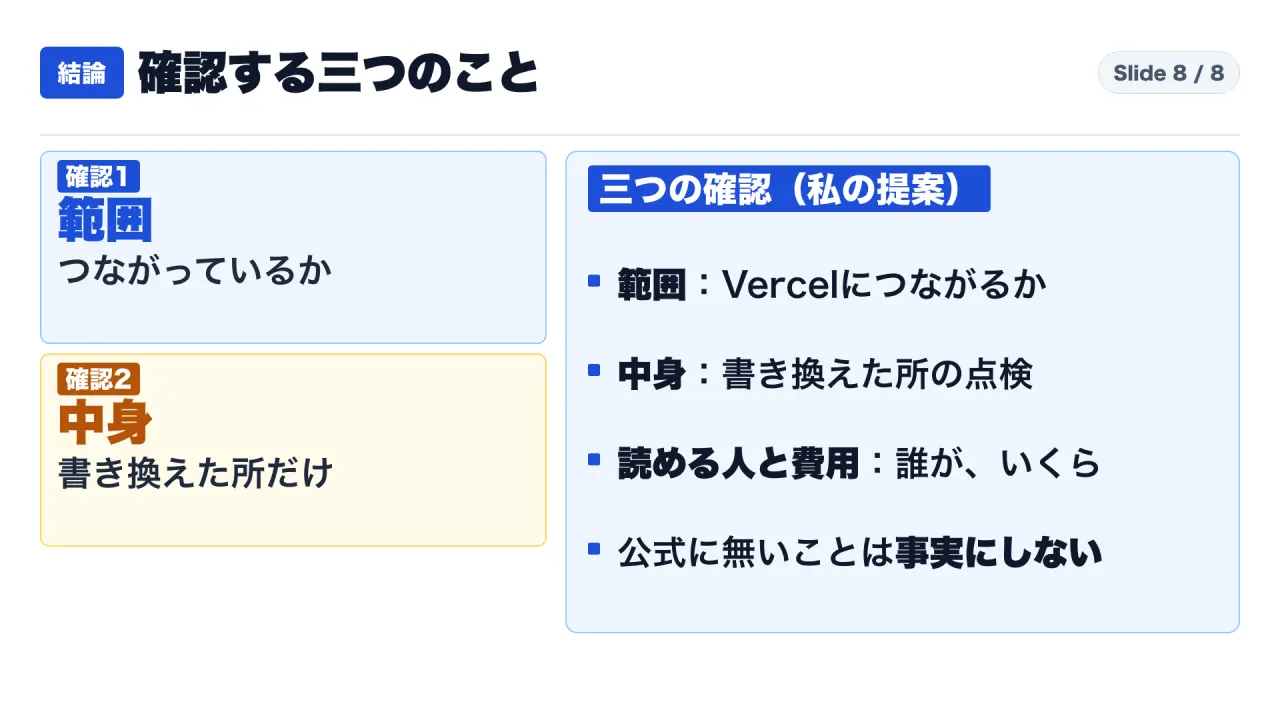
Engineering leaders must anchor their security strategies in three invariant principles:
- Treat per-push AI reviews as code blueprint checks, not runtime penetration testing.
- Maintain independent dynamic application testing and third-party security audits for critical production systems.
- Never rely solely on automated issue closure; enforce human verification and immediate credential rotation whenever secrets are exposed.
Primary Sources
- Vercel Official Blog, “Introducing Vercel Security Review” (2026): https://vercel.com/blog/vercel-security-review
- Vercel Official Changelog, “Vercel Security Review now in public beta” (2026): https://vercel.com/changelog/vercel-security-review-public-beta
- Vercel Technical Documentation, “Security Review Overview and Architecture” (2026): https://vercel.com/docs/agent/security-review
- Vercel Technical Documentation, “Managing Security Reviews and Role-Based Permissions” (2026): https://vercel.com/docs/agent/security-review/usage
- Vercel Technical Documentation, “Vercel Agent Pricing and Token Consumption Mechanics” (2026): https://vercel.com/docs/agent/pricing
Note: This article is for informational purposes only and does not constitute investment advice or a price forecast. Podcast audio is synthesized from the host’s voice.