The $20M Supply Chain Weapon: Inside the Factory-Preloaded XCPE Botnet in 1.3M Android TVs, Shenzhen ODM Subversion, and the Residential Proxy Underworld
How an authorized Google Play Protect manufacturing partner burned backdoors into un-wipeable OEM partitions, bypassed CTS test suites, and monetized 1.47 million living-room appliances as criminal IP proxies.
Japanese Edition: https://consuloji.substack.com/p/android-tv130xcpeoemoemip
YouTube (Japanese audio): https://youtu.be/d3WvBVV_Uzc
Executive Summary & Key Takeaways
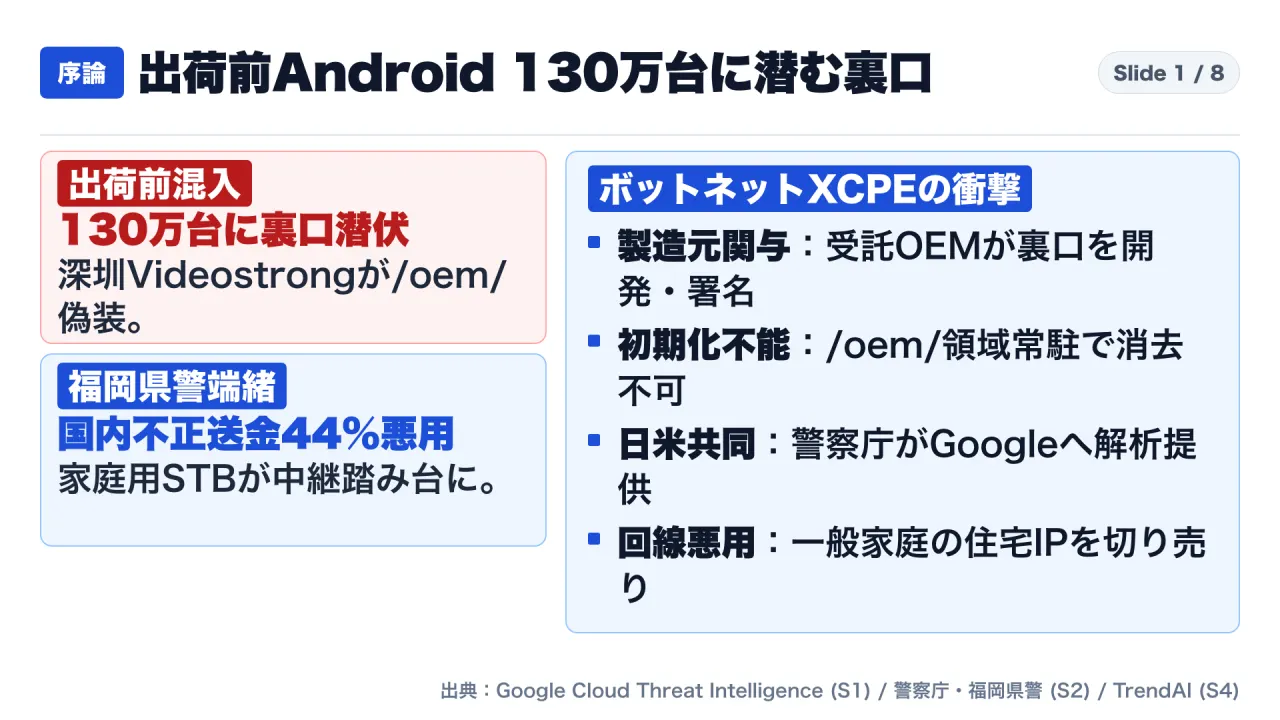
In November 2026, a joint operation by Google Cloud Threat Intelligence, Japan’s National Police Agency (NPA) Cyber Special Investigation Unit, and the Fukuoka Prefectural Police dismantled the infrastructure of XCPE—a botnet encompassing over 1.3 million infected Android TV set-top boxes and smart projectors across 200 countries.
This operation uncovered a profound supply chain compromise:
- Authorized OEM Vendor Subversion:
The implant was created by Videostrong Technology Co. (深圳市慧視通科技), a major original design manufacturer (ODM) based in Shenzhen, China. Videostrong preloaded the backdoor
x.cpedirectly into the factory/oem/partition across 206 device models and 1,472,554 units (spanning MECOOL, YokaTV, and white-label hardware). - Permanent Firmware Persistence & CTS Evasion:
Signed with Videostrong’s platform release keys and executing with root-equivalent privileges (
android.uid.system), performing a factory reset cannot remove the malware. On reboot, Android initialization scripts restorex.cpefrom/oem/. Videostrong evaded Google Play Protect Compatibility Test Suite (CTS) validation via delayed execution, staying dormant during factory testing and activating only after consumer network setup. - The $20M Banking Theft Uncovered in Fukuoka:
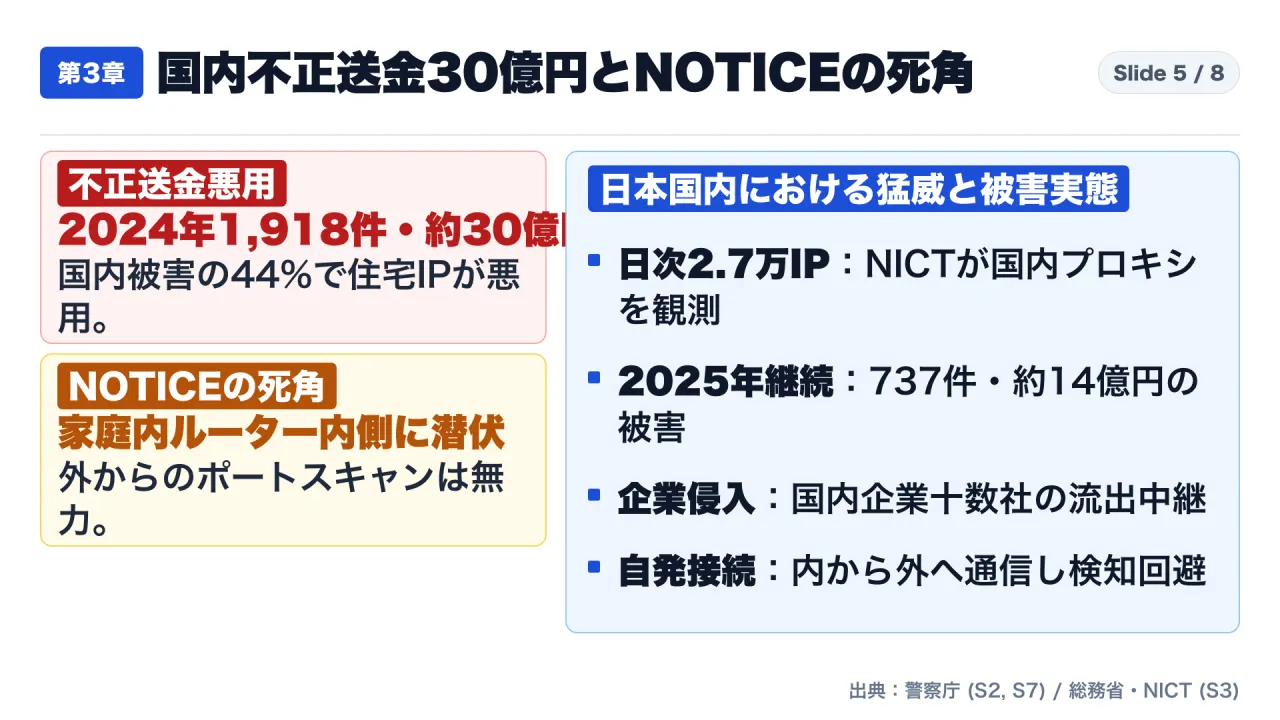
Fukuoka Prefectural Police tracked unauthorized online banking heists back to an ordinary citizen’s streaming box. In 2024, residential proxies powered 1,918 Japanese banking thefts (44% of all domestic incidents), totaling roughly 3.0 billion JPY (~$20 million USD) of 8.69 billion JPY (
$58 million USD) in total losses. In 2025, proxies facilitated 737 incidents totaling 1.4 billion JPY ($9.3 million USD). - The “Botnet-Subsidized Hardware” Economy: Sub-$30 Android TV boxes are sold near cost as a customer acquisition strategy to plant proxy nodes in private living rooms, extracting high-margin revenue through residential proxy resale (Linkfog, AppSalt, NetNut), 24/7 invisible ad fraud, and malware distribution.
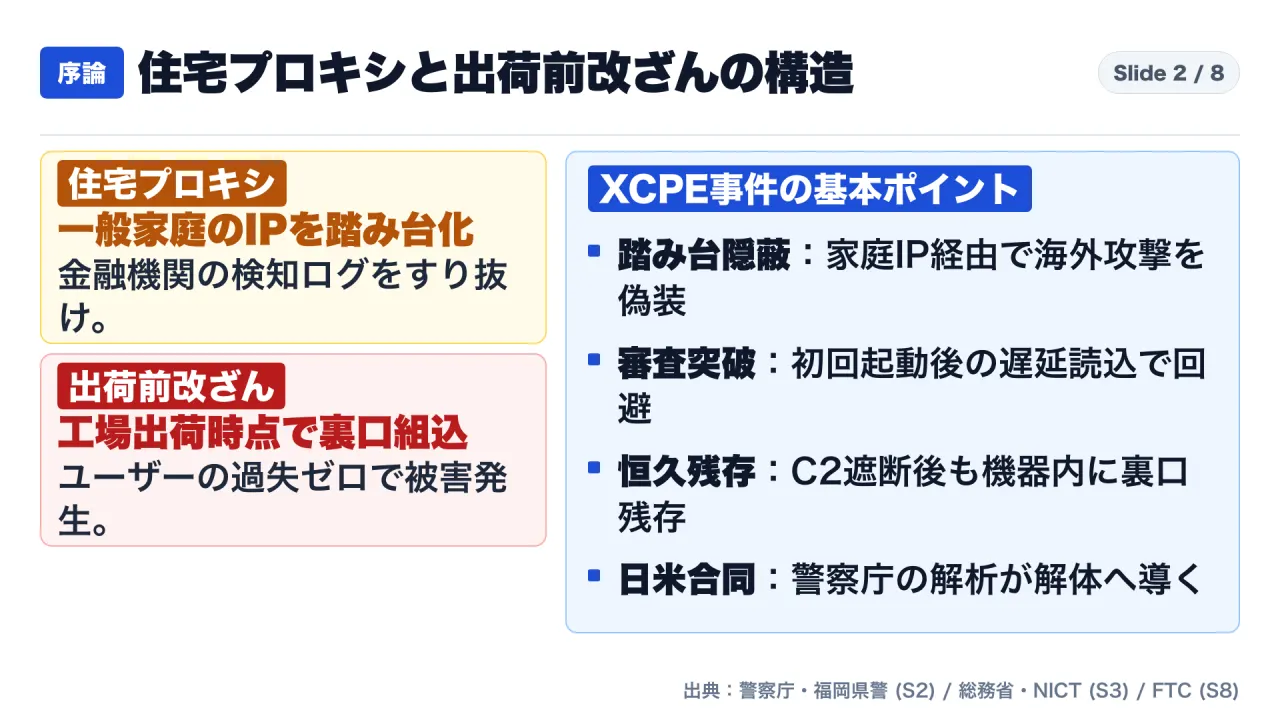
1. The Strategic Value of Residential Proxies in Cybercrime
Financial institutions and corporate portals automatically block or challenge inbound traffic from datacenter IP pools (AWS, GCP, Azure). However, when malicious requests are routed through a home Android TV box, traffic carries the authentic IP address of a residential ISP. To target firewalls, the connection looks identical to genuine domestic browsing.
| Empirical Metric | Observed Volume / Financial Scale | Primary Source & Context |
|---|---|---|
| XCPE Global Infection Scope | 1,300,000+ active devices (200+ nations) | Google Cloud Threat Intelligence telemetry on hardware with x.cpe. |
| Monitored Hardware Models | 206 models / 1,472,554 devices | TrendAI and Synthient firmware analysis across certified and uncertified units. |
| Downstream Disruption Footprint | 10,000,000+ secondary devices | Google infrastructure seizure severing C2 for 10+ secondary malware strains. |
| Active Domestic Japanese Proxies | Up to 27,000 unique IPs daily | NICT & Ministry of Internal Affairs and Communications (MIC) network tracking. |
| 2024 Japan Banking Fraud via Proxies | 1,918 cases (44% of total) / ~3.0B JPY ($20M USD) | National Police Agency (NPA) cybercrime statistics (33% of 8.69B JPY total losses). |
| 2025 Japan Banking Fraud via Proxies | 737 cases (15.5% of total) / ~1.4B JPY ($9.3M USD) | NPA annual report; total banking fraud reached record 10.4B JPY ($69M USD). |
| 2026 Targeted Corporate Intrusions | Over 10 domestic corporate breaches | NPA and Fukuoka Police; household STBs used as intermediate pivots for data theft. |
Beyond evading fraud heuristics, residential proxies make victims into unwitting legal shields: digital forensics trace bank heists back to the living rooms of ordinary citizens.
2. Technical Architecture: Why Factory Resets Cannot Purge /oem/
Standard Android malware resides in user space (/data/app/), where factory resets erase all third-party files. Videostrong bypassed this by exploiting vendor hardware privileges:
Partition-Level Implantation & Privileged Execution
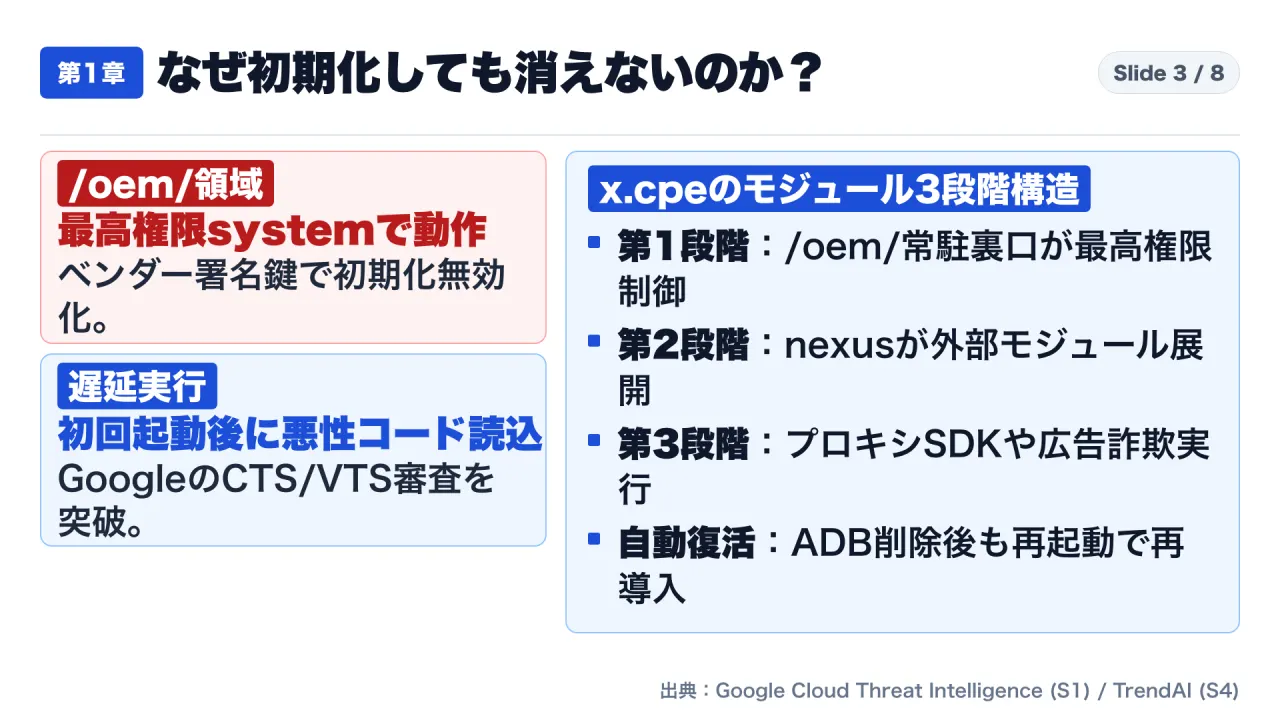
Videostrong placed x.cpe (or com.oemservice) directly into the factory /oem/ partition, signed with the vendor’s platform release key under android.uid.system. Even if removed via ADB, read-only system boundaries prevent permanent deletion. When a user executes a factory reset, the OS clears /data/, but reboot scripts restore x.cpe from /oem/ with full system rights.
Evading Google Compatibility Certification
To sell devices with pre-installed Google services, hardware must pass automated Compatibility Test Suite (CTS) and Vendor Test Suite (VTS) validation. Videostrong programmed x.cpe to remain dormant during testing environments, activating only after a consumer completes initial home Wi-Fi setup.
Three-Stage Modular Architecture
- Stage 1: Primary Backdoor Daemon (
x.cpe): Runs in/oem/underandroid.uid.system. It handles device fingerprinting, establishes C2 channels, and publishes ContentProviders to exchange telemetry with apps like YokaTV Player. - Stage 2: Execution Engine & Loader (
com.abc.nexus): Deployed to user data by Stage 1, this module fetches, decrypts, and executes dynamic payloads in memory, shielding the primary implant from signature scanners. - Stage 3: Monetization Payloads: Dynamic native ELF binaries or proxy SDKs delivered to the device, executing residential proxy routing, ad fraud, or secondary malware staging.
3. Remote Control Protocol: HTTP Bootstrap and MQTT Telemetry
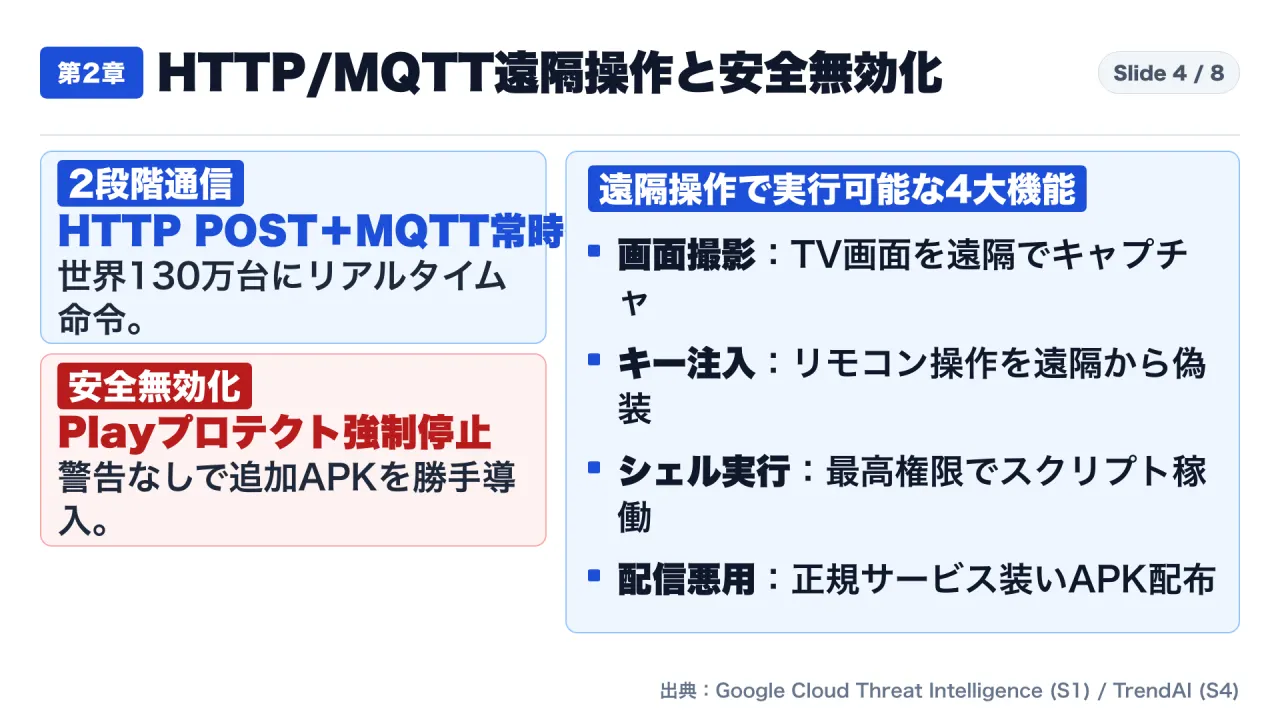
XCPE implements a dual-protocol architecture combining HTTP POST requests with persistent MQTT sockets to control 1.3 million endpoints:
Stage 1: Encrypted HTTP Bootstrap
Upon booting, the client checks the system property ro.mecool.device:
- If
true(MECOOL hardware), it querieshttp://mcstb.anyevonline.com:8000. - If
false(third-party ODM hardware), it contactshttp://stb[AndroidVersion][Type].anyevonline.com:8000.
The client sends an AES-encrypted payload with serial numbers, MAC addresses, and build data, receiving configuration endpoints:
/router/config/mqtt: Broker addresses and credentials./router/config/acs: Endpoints for telemetry uploads (http://ott.szbboys.com:8000/cpe/file/upload)./router/config/app: Manifests of monetization modules to deploy.
Stage 2: Persistent MQTT Duplex Control
The device then establishes a persistent connection to mqtt.szbboys.com. Through this channel, operators issue real-time commands across the fleet:
- Disabling Google Play Protect: Calls
AppUtils.disablePackageVerify()to setpackage_verifier_user_consentto-1, disabling app verification so malicious APKs install silently. - Unauthorized Screen Capture: Uses private internal API
SurfaceControl.screenshotto capture display frames, transmitting television screens or credential inputs to C2 servers. - Remote Keystroke Injection: Injects synthetic key events to dismiss security prompts or grant permissions.
- Root Shell Execution: Uses
x.cpe.util.RunCmdsto execute arbitrary shell scripts under root privileges. - Abuse of Public Cloud Infrastructure: Payloads were hosted on GitHub Pages and Releases to leverage trusted domain reputation.
4. The Fukuoka Forensics and the Limits of Perimeter Scanning
The disruption of XCPE originated from forensic work conducted by Japanese law enforcement:
The Fukuoka Discovery
In September 2025, Fukuoka Prefectural Police investigated an unauthorized online banking theft ring. Tracing the originating IP address led to a private household in Fukuoka. Detectives found an ordinary family streaming box connected to a television.
Transferred to the NPA Cyber Special Investigation Unit, forensic analysis revealed the homeowner had installed no malware; the device arrived from the factory with x.cpe embedded in firmware. The NPA shared this binary intelligence with Google, initiating the international infrastructure seizure.
Structural Blind Spot of Project NOTICE
This case demonstrated the limits of perimeter scanning. Japan’s Ministry of Internal Affairs and Communications (MIC) and NICT operate Project NOTICE, scanning Japanese IPv4 addresses for open ports and default credentials.
However, XCPE devices sit behind consumer NAT routers. They open no inbound ports, instead initiating outbound HTTP and MQTT connections to external servers (anyevonline.com, szbboys.com). Because home firewalls permit outbound traffic, external scanners cannot detect XCPE implants.
5. A Decade of Android Supply Chain Contamination
XCPE is the latest step in a ten-year progression of Android hardware compromises:
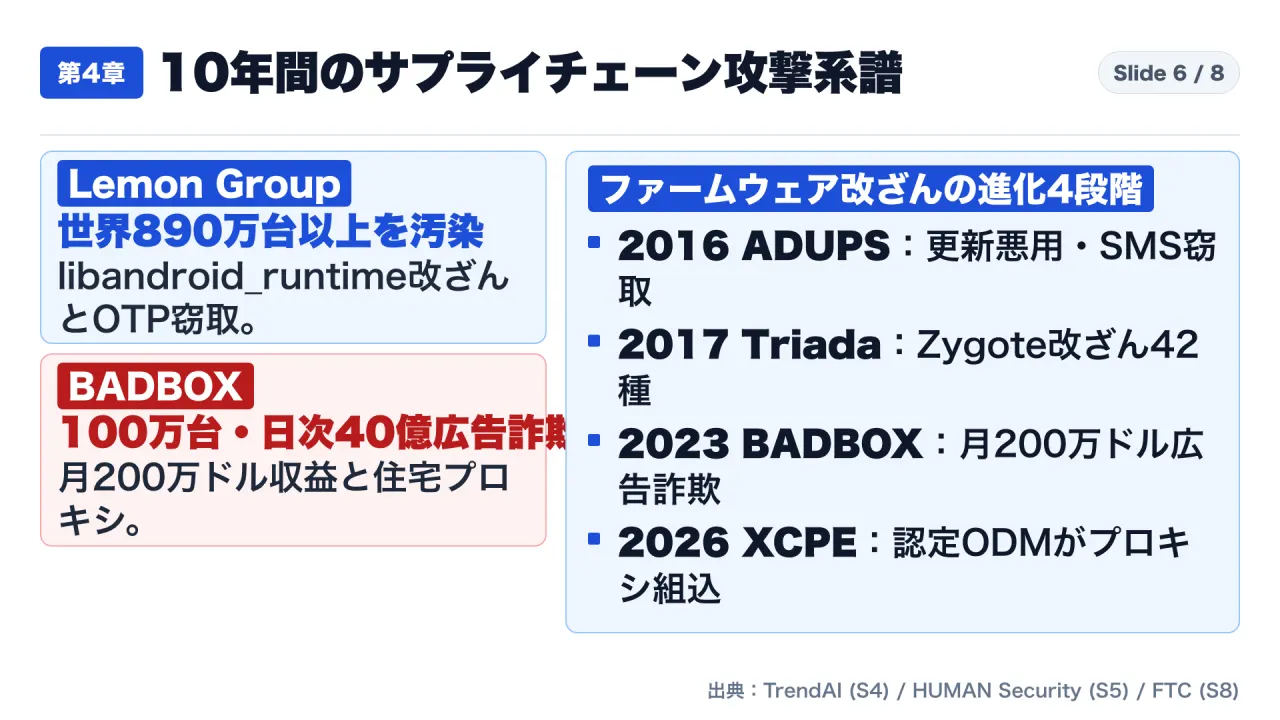
| Campaign | Period | Targets & Actors | Volume | Persistence Layer | Primary Monetization |
|---|---|---|---|---|---|
| ADUPS / BLU | 2016–2018 | Shanghai Adups / BLU Products | 50M+ phones | Pre-installed FOTA firmware update client | Exfiltrating SMS logs and GPS data (FTC 20-year consent order). |
| Triada Preload | 2016–2019 | 42+ low-cost smartphones | Millions of units | Modified Zygote core (libandroid_runtime.so) |
Injected by third-party subcontractors; ad and SMS billing fraud. |
| AllWinner T95 | 2022–2023 | Unbranded AllWinner T95 STBs | Global retail e-commerce | ROM firmware image modifications | Outbound C2 communication and proxy deployment. |
| Lemon Group / Guerilla | 2022–2023 | 50+ budget smartphone & IoT brands | 8,900,000+ units | Hooked println_native in system runtime |
SMS OTP theft (490K numbers), DoveIP proxy resale ($12/3GB). |
| BADBOX / PEACHPIT | 2023–2025 | 200+ uncertified AOSP devices | 1,000,000+ units | Read-only ROM implants in unbranded hardware | Hidden WebView ad fraud (4B daily bids / $2M monthly), proxies. |
| XCPE / Videostrong | November 2026 | Videostrong (MECOOL & OEM hardware) | 1,300,000+ units (10M+ affected) | Factory /oem/ partition with platform vendor keys |
Triple-tier proxying (Linkfog, AppSalt, NetNut), bank theft. |
Earlier attacks involved rogue subcontractors or uncertified AOSP clones (BADBOX). XCPE represents a critical shift: an authorized Google Play Protect partner deliberately signed and pre-installed a permanent backdoor in certified consumer hardware.
6. The Economics of Botnet-Subsidized Hardware
Overseas manufacturers sell 4K Android TV boxes for $20 to $30 because the hardware serves as a subsidized customer acquisition cost (CAC). The goal is to deploy an unmonitored computing node on domestic broadband.
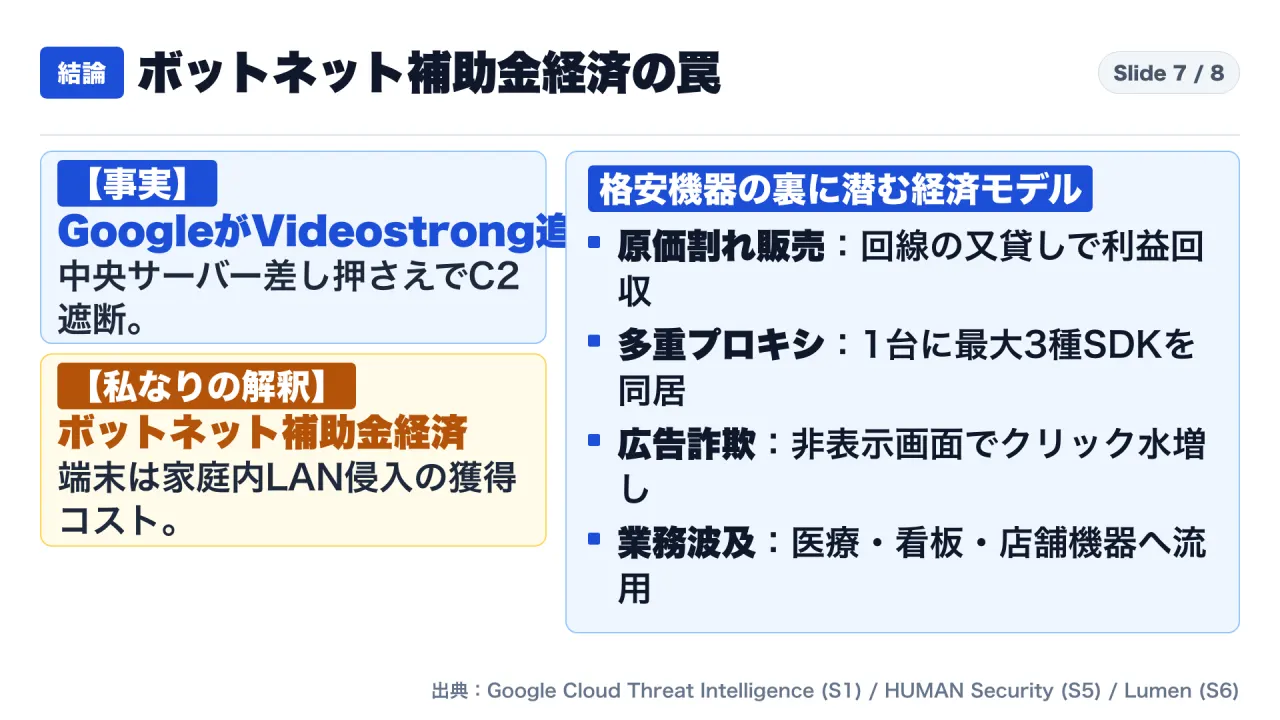
Once connected, operators monetize the unit via three compounding streams:
- Residential Proxy Resale: Running proxy SDKs (Linkfog, AppSalt, NetNut) to lease household bandwidth to criminal groups.
- Invisible Ad Fraud: Running background WebViews 24/7 to generate fraudulent programmatic advertising revenue.
- Malware Access Brokerage: Selling execution access on the infected fleet to external cybercrime syndicates.
Enterprise and Healthcare Spillover
This hardware also enters commercial environments. Healthcare facilities and corporations deploy inexpensive Android boxes for telehealth terminals, digital signage, and conference displays. Connecting these units to corporate LANs gives attackers a foothold under android.uid.system inside internal perimeters, bypassing boundary firewalls.
7. Practical Zero-Trust Defense Guidelines and Operational FAQ
To secure networks against pre-installed supply chain backdoors, technical leaders should implement three directives:
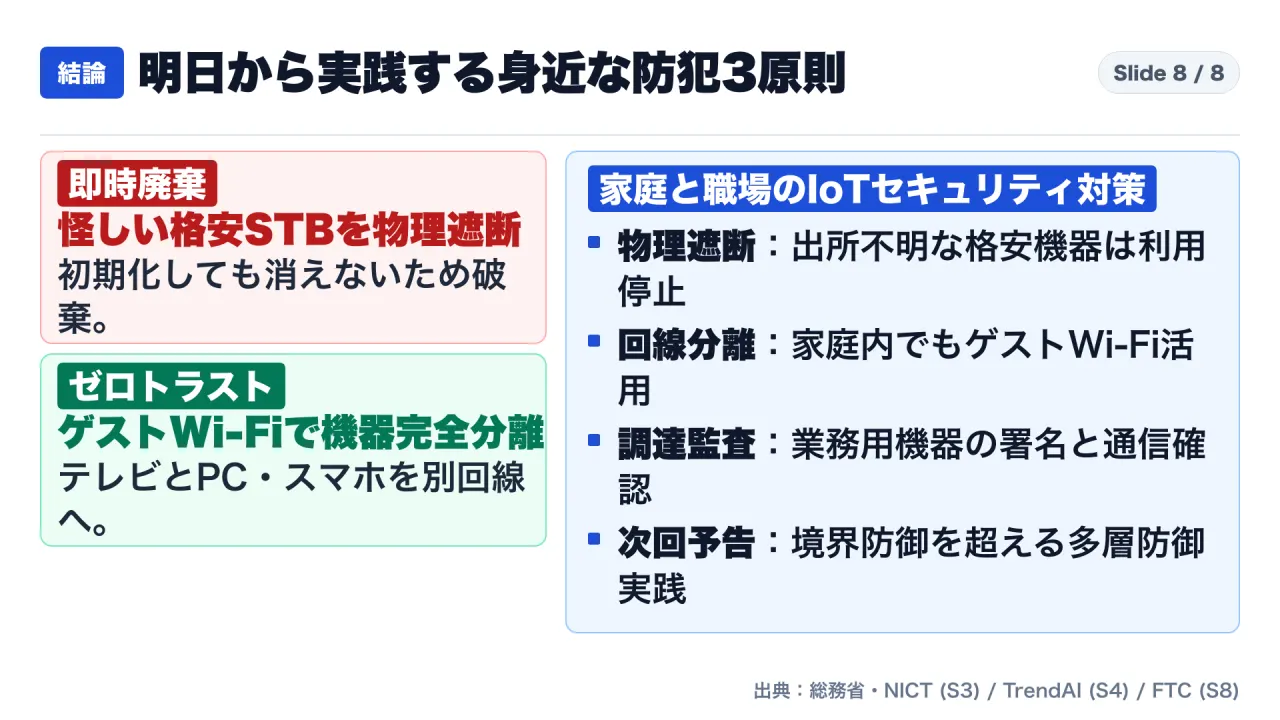
Directive 1: Disconnect and Scrap Unbranded Streaming Hardware
Budget Android streaming boxes (MECOOL, YokaTV, and unbranded Shenzhen hardware) cannot be disinfected. Factory resets leave the /oem/ partition untouched. Users should disconnect these devices from networks and replace them with verified first-party platforms (Apple TV, Google TV Chromecast, Amazon Fire TV). Never enter personal or enterprise credentials into unbranded Android TV hardware.
Directive 2: Enforce Guest-Network IoT Isolation
Isolate all televisions, streaming boxes, and smart home appliances on a separate Guest Wi-Fi network. Enable Access Point (AP) Isolation / Client Isolation to ensure compromised media devices cannot reach computers, smartphones, or network-attached storage on the local network.
Directive 3: Enforce Hardware Procurement Governance
Enterprise teams must prohibit unverified Android hardware for kiosks or displays. Mandate firmware validation, software bills of materials (SBOM), and isolate new IoT units in a sandbox network to inspect outbound DNS queries, HTTP POST (port 8000), and MQTT (port 1883/8883) traffic prior to deployment.
Frequently Asked Questions
Q1: Does a factory reset remove the XCPE backdoor?
No. Factory resets clear only the /data/ partition. Because x.cpe is stored in the read-only /oem/ partition and signed with platform keys, reboot scripts restore the backdoor with full system rights.
Q2: Did Google’s C2 takedown neutralize existing infected devices?
No. Seizing domains like anyevonline.com disrupted active command channels, but the binary remains in /oem/. Modified system settings (such as disabled Play Protect) and secondary malware persist on the device. Physical disconnection is required.
Q3: What are the primary indicators of infection?
- “Google Play Protect” is disabled, grayed out, or missing from system settings.
- Package listings include
x.cpe,com.oemservice, orcom.abc.nexus. - Network logs show outbound connections to port 8000 or MQTT ports (1883/8883) targeting unfamiliar domains.
Primary Sources
- Google Cloud Threat Intelligence, “Disrupting the XCPE Android TV Backdoor and Botnet” (2026): https://cloud.google.com/blog/topics/threat-intelligence/xcpe-android-tv-backdoor-botnet
- National Police Agency Cyber Special Investigation Unit & Fukuoka Prefectural Police, “Security Advisory on Pre-installed Malware (XCPE) in Android Devices” (2026): https://www.npa.go.jp/bureau/cyber/pdf/20261104_xcpe_advisory.pdf
- Ministry of Internal Affairs and Communications (MIC) & NICT, “Observations on Residential Proxy Exploitation in Domestic IoT Networks” (2026): https://www.soumu.go.jp/menu_news/s-news/01cyber01_02000001_00250.html
- TrendAI Research, “Technical Analysis of XCPE Preload Backdoor on Android TV Boxes” (2026): https://www.trendmicro.com/en_us/research/26/k/xcpe-preload-backdoor-android-tv.html
- HUMAN Security Satori Threat Intelligence, “BADBOX 2.0 and the XCPE Supply Chain Ecosystem” (2026): https://www.humansecurity.com/learn/blog/satori-threat-intelligence-badbox-2-0-and-xcpe
- Lumen Black Lotus Labs, “Tracking Residential Proxy Botnets on Consumer IoT Devices” (2026): https://blog.lumen.com/black-lotus-labs-xcpe-residential-proxy-botnet/
- National Police Agency, “White Paper on Cyber Space Threats and Online Banking Fraud Trends” (2026): https://www.npa.go.jp/publications/statistics/cybersecurity/data/R07_cyber_joukyou.pdf
- U.S. Federal Trade Commission (FTC), “Securing the IoT Supply Chain Against Preinstalled Malware” (2026): https://www.ftc.gov/business-guidance/blog/2026/10/securing-iot-supply-chain-preinstalled-malware
Note: This article is for informational purposes only and does not constitute investment advice or a price forecast. Podcast audio is synthesized from the host’s voice.