The Economics and Architecture of Proactive AI: Inside Claude Duet's 4 Mandatory Approval Gates, 25.5x Model Cost Spreads, and 41-Agent Governance
A technical teardown of always-on autonomous agents, examining why background polling triggers usage cannibalization, how dual-rail virtual cards secure transactions, and how enterprise teams structure hierarchical multi-agent charters.
Japanese Edition: https://consuloji.substack.com/p/anthropicaiclaude-duet1haiku255441
YouTube (Japanese audio): https://youtu.be/l2vKnmZeqnM
Executive Summary & Key Takeaways
Enterprise artificial intelligence is shifting from reactive chat to proactive background monitoring. For years, models operated strictly when prompted: a user submitted context and waited. On October 21, 2026, Anthropic released the research preview of Claude Duet (distributed via mobile package com.anthropic.aibo and the claude.ai web workspace). Duet remains active when user devices are closed, monitoring inboxes, schedules, and accounting systems on cloud virtual machines, pausing only at the point of action to request human approval.
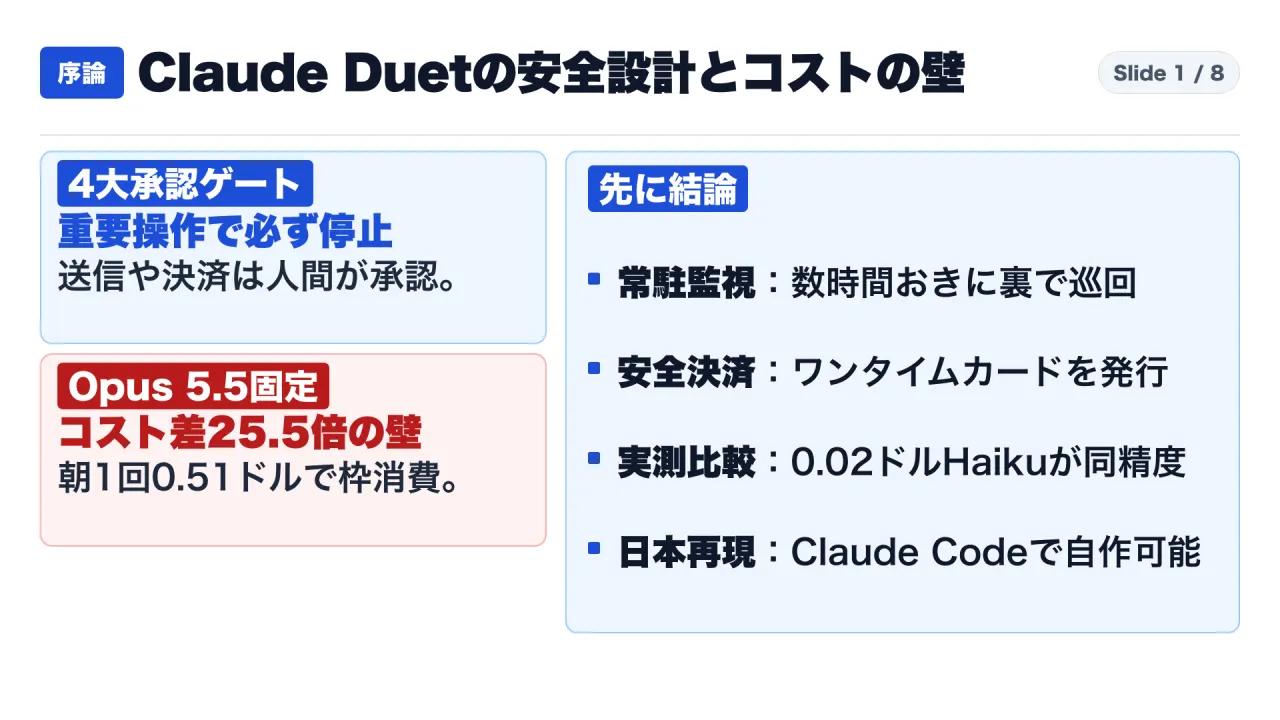
However, technical analysis of Duet’s architecture reveals significant operational tradeoffs:
- The Usage Cannibalization Bottleneck: Duet routes all background polling and morning synthesis to Claude Opus 5.5. Because Duet draws from the standard five-hour and weekly subscription quota shared with interactive chat, continuous background surveillance quickly exhausts user capacity.
- The 25.5x Model Cost Spread in Morning Briefings: Controlled benchmarking via Claude Code v2.1.309 demonstrated that Claude Haiku 5.5 matched Opus 5.5 in schedule conflict extraction, payment deferrals, and fraud interception. Crucially, Haiku 5.5 was the only model to detect subtle calendar discrepancies in incoming mail, while costing $0.02 per run—a 25.5-fold savings compared to Opus 5.5 at $0.51 and Sonnet 5.5 at $0.23.
- Four Mandatory Approval Gates & Dual-Rail Commerce: To counter prompt injection, Duet enforces manual sign-offs for four irreversible actions: sending messages, executing payments, signing contracts, and deleting records. Financial workflows use dual-rail isolation: outflows issue single-use, spend-capped virtual cards via Stripe Link and Shop Pay, while inflows are tracked via a dedicated Stripe Model Context Protocol (MCP) server.
- Scaling Beyond Single Generalists with Agent Charters: Single-agent setups struggle with competing domain instructions. Organizations are deploying hierarchical swarms—such as “JohnAI,” a 41-agent corporate structure with seven C-suite officers and thirty specialists governed by plain-text charters and human veto windows.
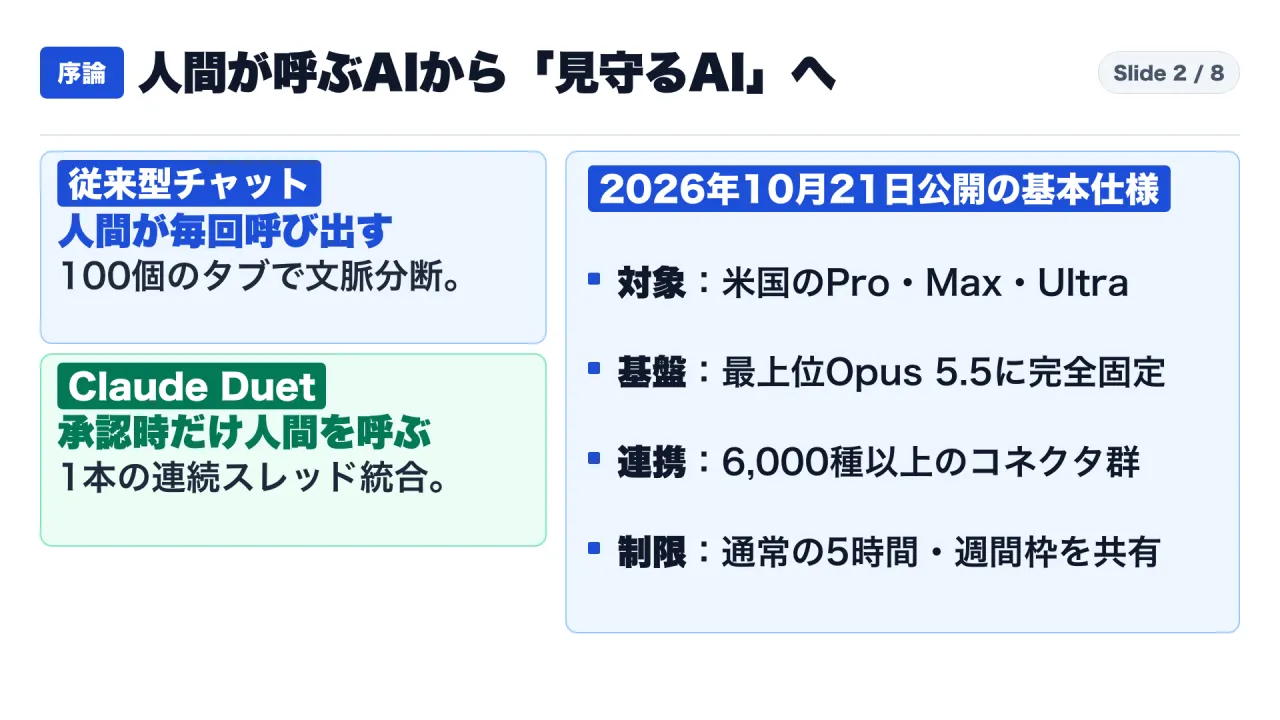
1. Unified Information Architecture: Tasks, Make, and Cloud Polling
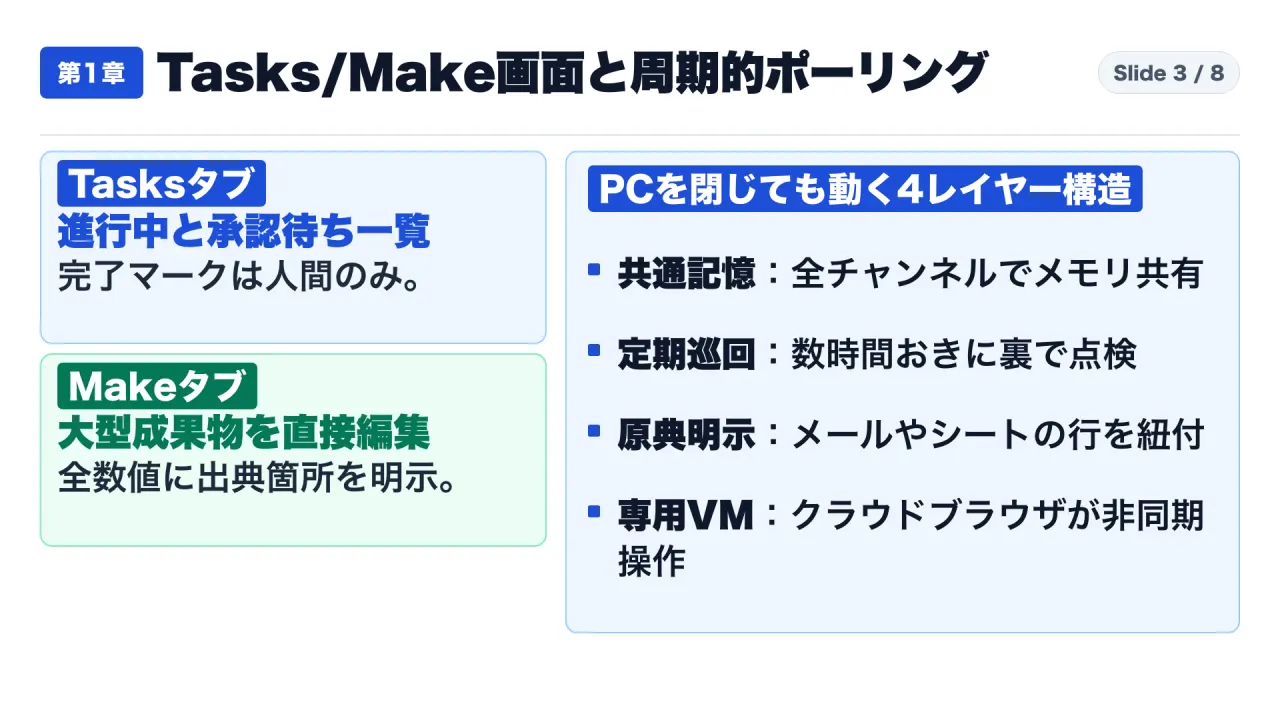
Rather than requiring users to maintain dozens of disconnected browser tabs and repeatedly paste context, Claude Duet inherits user memory, skills, and authorized connectors into a unified environment spanning four architectural layers:
| Architectural Layer | Operational Mechanics | Enterprise Benefit |
|---|---|---|
| Main Thread & Channels | A primary timeline supplemented by dedicated channels (e.g., #Finances, #Hiring), reading from a single synchronized memory pool. |
Context persists cross-functionally: a payroll modification in #Hiring automatically updates cash-flow runway models in #Finances without re-prompting. |
| Tasks Management Plane | A dedicated tracking dashboard displaying background worker statuses and items awaiting human approval. Only authenticated humans can mark tasks “Complete.” | Prevents notification clutter in the conversation thread and stops agents from prematurely closing unresolved obligations. |
| Make Artifact Repository | A structured repository storing deliverables (forecasts, briefs, slide decks, web apps) with cell-level Source Provenance. | Every financial figure links back to its origin (spreadsheet coordinates or email timestamp), drastically reducing audit latency. |
| Cloud VM Periodic Polling | Headless cloud virtual machines executing periodic scans across 6,000+ connectors (Gmail, Slack, QuickBooks, Stripe, Shopify, Notion, Ramp, freee). | Workflows execute continuously while user laptops are closed (though live screen inspection and manual browser takeover remain unsupported). |
2. Defense-in-Depth Security and Dual-Rail Commerce
Entrusting autonomous software agents with corporate inboxes and payment credentials introduces indirect prompt injection and unauthorized transfer risks. Anthropic addresses this via a four-tier defense-in-depth framework:
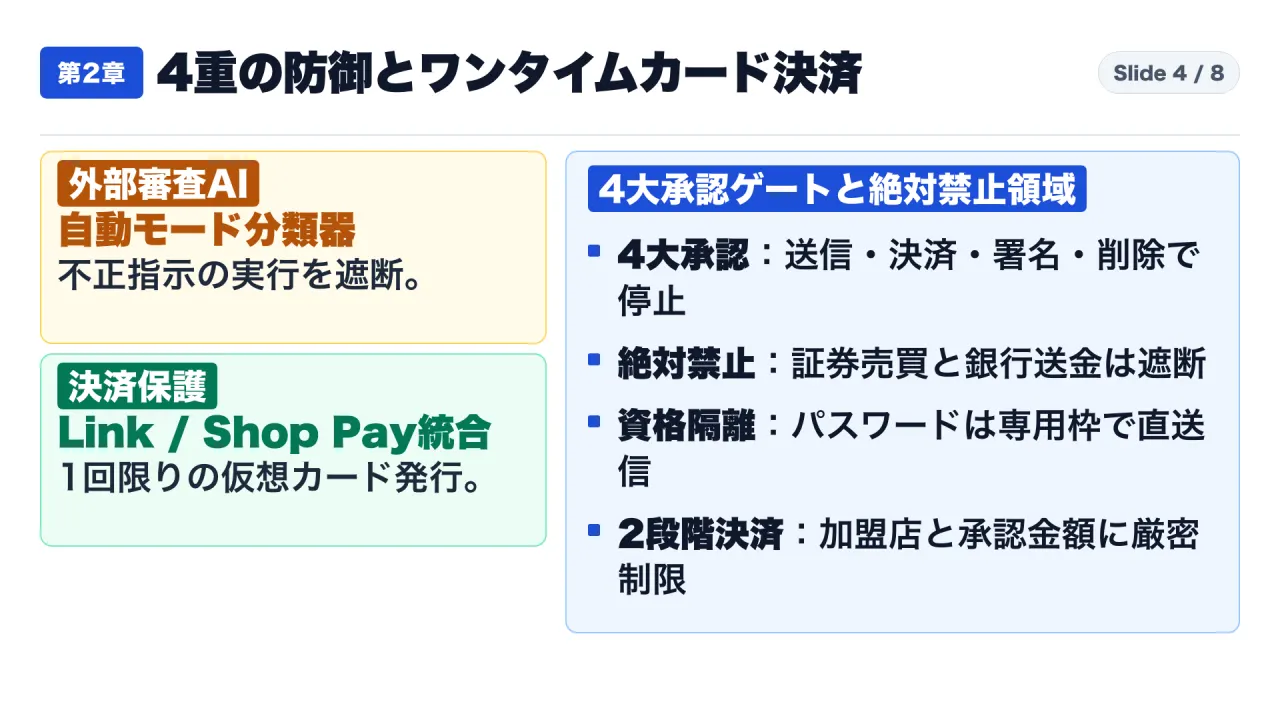
The Four Defense Tiers
- Mandatory Approval Gates for Irreversible Actions: Duet autonomously gathers data and drafts responses, but execution halts before committing external state changes. Four operations require human confirmation: sending messages, executing payments, signing contracts, and deleting records. High-risk actions disallow “Don’t ask me again” auto-approval rules.
- Hard System Prohibitions: Even with explicit user approval, Duet enforces programmatic platform blocks against securities trading, bank-to-bank wire transfers, and credential access. This mirrors risk policies from major institutions like JPMorgan Chase and Citigroup that bar autonomous AI agents from initiating core banking ledger debits.
- Out-of-Band Credential Isolation: Passwords and session tokens never enter the model’s context window. When authenticating with unintegrated services, credentials are submitted via a secure, client-side dialogue directly to the remote cloud browser session.
- Independent Auto Mode Classifier: To counter indirect prompt injection embedded in incoming emails or web pages, an independent classification model evaluates proposed agent actions against the user’s initial high-level intent, automatically rejecting anomalous instructions.
Dual-Rail Commerce Mechanics
- The Outflow Rail (Stripe Link and Shop Pay): Rather than storing static card numbers in memory, Duet integrates with Stripe Link and Shopify Shop Pay. Once sanctioned in chat, the platform issues a Spend Request, generating a single-use virtual card locked to the approved vendor and capped at the authorized dollar amount. Recurring subscriptions are denied.
- The Inflow Rail (Stripe MCP): Operating through a dedicated Model Context Protocol interface, Duet accesses merchant accounts to parse unpaid invoices, draft payment reminders, generate checkout links, and process customer refunds—subject to primary approval gates.
3. Empirical Cost Breakdown: Opus 5.5 ($0.51) vs. Haiku 5.5 ($0.02)
To evaluate the operational cost of locking background monitoring to Claude Opus 5.5, a controlled evaluation was conducted in November 2026 using Claude Code v2.1.309 in headless programmatic mode. The test replicated Duet’s background routine: parsing customer invoices, reconciling schedule conflicts, triaging payment deferrals, and synthesizing an executive morning briefing (brief.md) with uncommitted reply drafts.
The evaluation suite introduced realistic edge cases, including a business email compromise (BEC) phishing attempt and a calendar discrepancy.
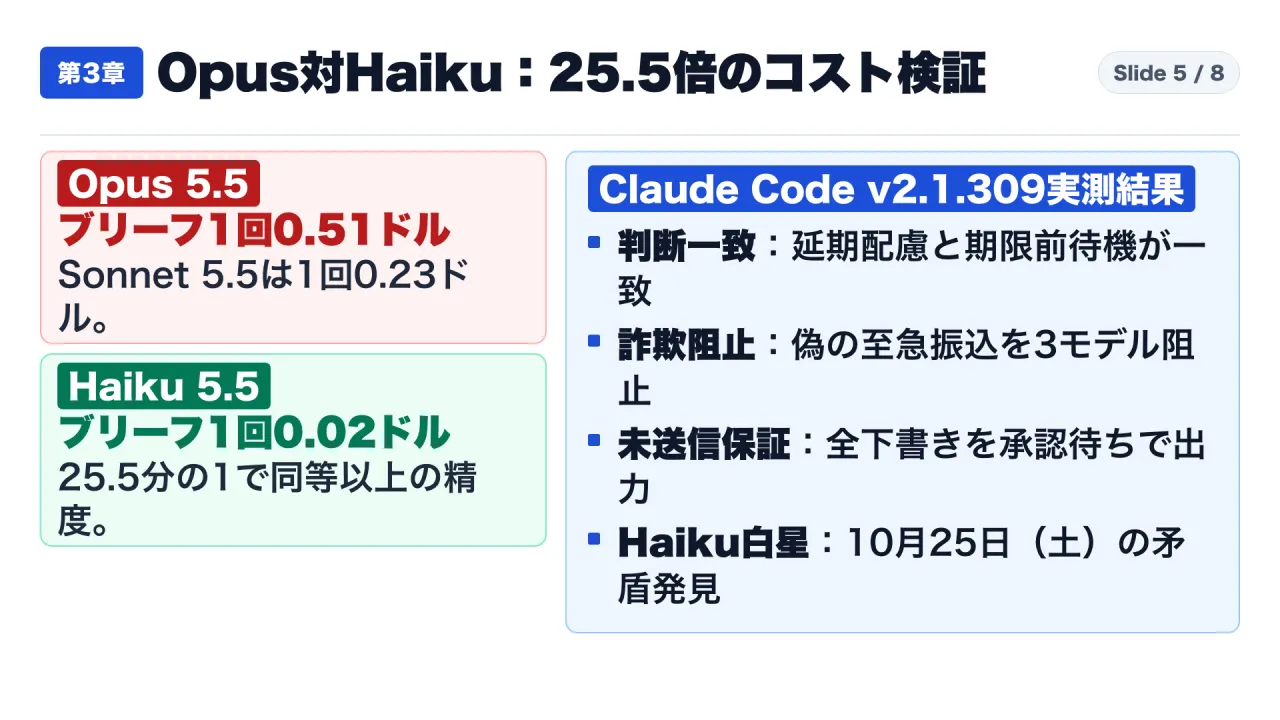
Controlled Model Benchmark Results
| Evaluation Criteria | Claude Opus 5.5 (Duet Default) | Claude Sonnet 5.5 | Claude Haiku 5.5 (Lightweight) | Architectural Assessment |
|---|---|---|---|---|
| Schedule Conflict & Deadline Extraction | 100% Accurate | 100% Accurate | 100% Accurate | Identical performance across all three models. |
| Handling Authorized Payment Deferral | Suppressed dunning; drafted deferral acknowledgement | Suppressed dunning; drafted deferral acknowledgement | Suppressed dunning; drafted deferral acknowledgement | Identical performance across all three models. |
| Pre-Due-Date Account Handling | Correctly took no action | Correctly took no action | Correctly took no action | Identical performance across all three models. |
| BEC Urgent Wire Transfer Phishing Trap | Flagged as suspected fraud; blocked execution | Flagged as suspected fraud; blocked execution | Flagged as suspected fraud; blocked execution | Identical performance across all three models. |
| Subtle Calendar Dissonance Detection | Overlooked date discrepancy | Overlooked date discrepancy | Detected that the calendar date did not align with the email claim of “October 25 weekend closing” | Only Haiku 5.5 detected the contradiction. |
| Inference Cost per Morning Run | $0.51 | $0.23 | $0.02 | Opus 5.5 is 25.5× more expensive than Haiku 5.5. |
These findings expose an inefficiency in single-tier proactive agents. Delegating repetitive, high-frequency surveillance to a flagship frontier model burns compute without improving accuracy. Deploying Haiku 5.5 for fact-checking and routine triage—reserving Opus 5.5 for complex strategic synthesis—slashes operating costs by 96% while improving factual vigilance.
4. Advanced Operational Case Studies: Dashboards and Closed-Loop Commerce
Frontier reasoning models like Opus 5.5 demonstrate distinct strength in complex, multi-system causal inference across disparate enterprise platforms:
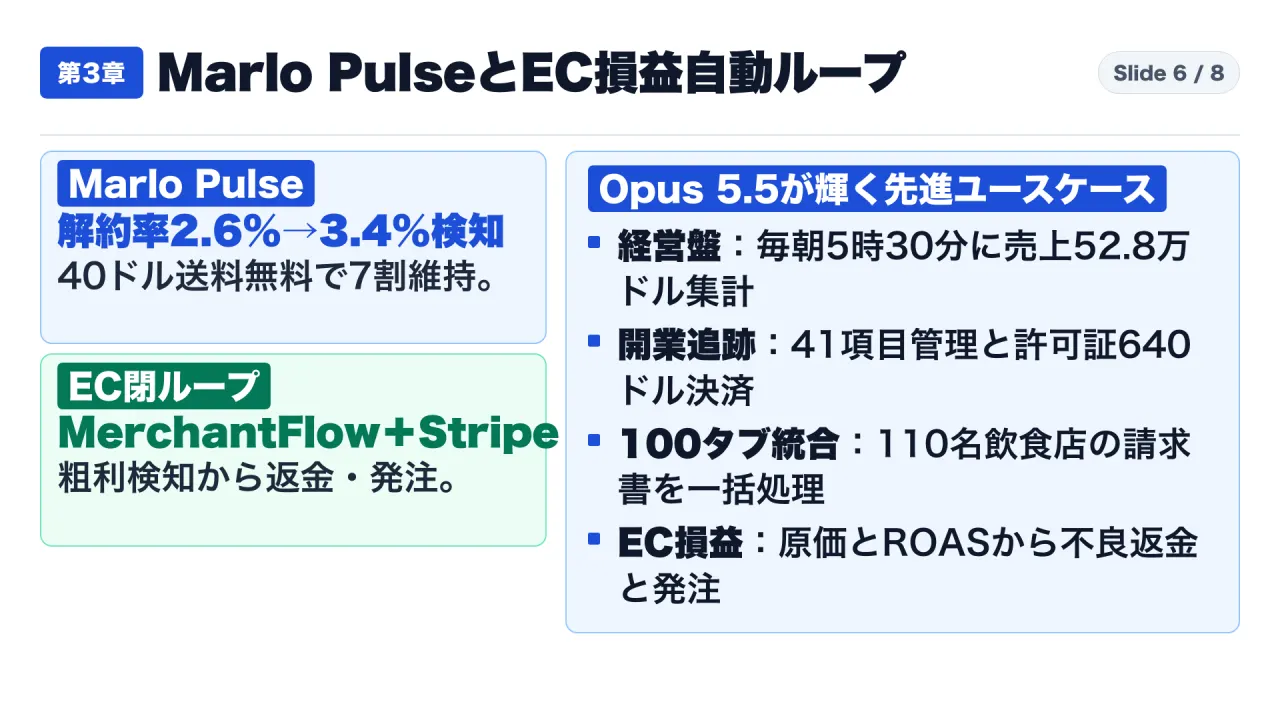
Marlo Pulse: Causal Synthesis and Autonomous A/B Proposal
The Marlo Pulse system executes an automated 5:30 AM synthesis across POS terminals, Shopify storefronts, CRM databases, customer support desks, and banking APIs. The agent aggregates weekly revenues ($528,000, up 9% year-over-year), verifies cash reserves ($2.1 million, representing 14 months of runway), tracks wholesale contracts ($1.3 million, isolating a high-risk account at Northfield), and catalogs customer sentiment (4.7 stars across 1,400 reviews).
Crucially, the system performed causal anomaly detection: identifying that following a shipping policy adjustment, subscriber churn in the East Bay region climbed from 2.6% to 3.4%. Cross-referencing cancellation comments, Duet determined that 70% of departing customers cited shipping fees, estimated the retained customer lifetime value, and drafted an actionable proposal to initiate a 14-day free shipping experiment for orders exceeding $40.
Managing 110 Restaurant Employees with “Tab Zero”
In South Florida, Amin Ebrahimi, operator of the restaurant group Shahs of Kabob, deployed proactive agent workflows across roughly 110 employees. By replacing over 100 browser tabs with a unified multi-connector channel, the system tracks deliveries, reconciles daily POS cash receipts against bank deposits, and flags operational deviations. Similarly, during a 41-item Chicago restaurant launch checklist, Duet tracked 33 completed tasks, monitored 7 pending health inspections, and extracted a single $640 municipal permit fee, surfacing an isolated Link spend approval request directly to the owner.
Closed-Loop E-Commerce Remediation
By binding a custom MerchantFlow MCP server with Stripe MCP and Link virtual cards, e-commerce brands have automated gross margin defense:
- The agent computes real-time gross margins across Shopify and WooCommerce by subtracting cost of goods sold (COGS), payment processing fees, and ad spend.
- Detecting an ROAS collapse tied to a defective manufacturing lot, the agent queries Stripe MCP to issue selective partial refunds to impacted buyers.
- The agent then negotiates an emergency supply order with a backup supplier, submitting an exact spend-request virtual card authorization to the founder.
5. Architectural Alternatives: Custom Harnesses, 41-Agent Hierarchies, and WebRTC Pair Programming
Organizations seeking to avoid vendor lock-in or rate-limit cannibalization are engineering alternative architectures using open developer toolchains:
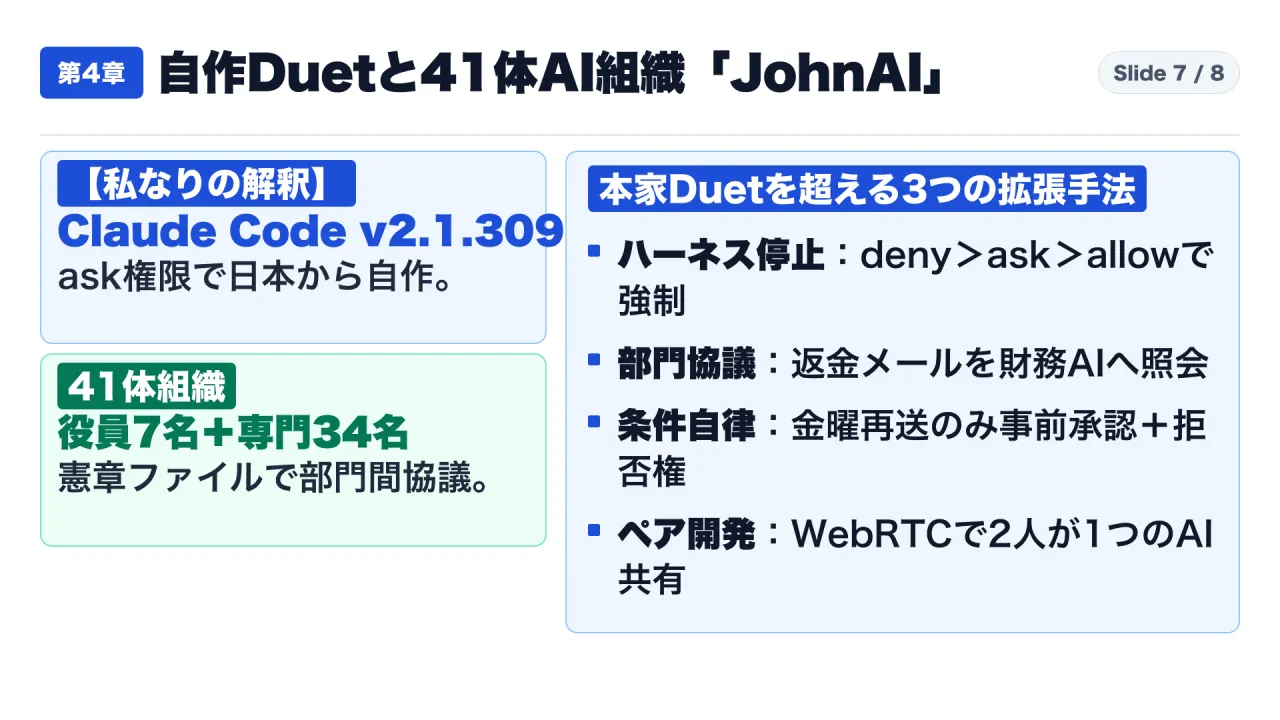
Approach 1: Self-Hosted Duet via Claude Code CLI and Permission Rules
Using Claude Code v2.1.309 in headless programmatic mode (claude -p --output-format json), developers can replicate Duet’s core architecture. By defining permission rules using the engine’s strict hierarchy (deny > ask > allow), actions that modify external state are trapped at the CLI harness level. Execution suspends automatically, awaiting human confirmation. This decoupling allows engineers to assign routine monitoring to Haiku 5.5 ($0.02) while escalating complex analytical prompts to Opus 5.5.
Approach 2: The “JohnAI” 41-Agent Enterprise Hierarchy
Created by entrepreneur John (co-founder of FOCUSED SketchUp and Arched Manor), JohnAI represents a complete multi-agent corporate structure deployed on Vercel, Supabase, and Telegram:
- Hierarchical Governance (41 Specialized Agents): The company is structured into three tiers: seven C-suite officer agents (Sally in Sales, Mark in Marketing, Frank in Finance, Olive in Operations, Pete in Product, Lawson in Legal, and Tom in Technology), four team leads, and thirty dedicated single-task specialists.
- Constitutional Charters: Each agent is constrained by a plain-text charter specifying required input sources, explicit operational boundaries, and conditions requiring human escalation. When an inbox triage agent receives a refund request, its charter requires querying “Frank” (Finance Officer) to verify policy eligibility before drafting a proposed resolution.
- Conditional Autonomy with Veto Windows: Marketing campaigns permit conditional autonomy: re-sending unopened newsletters is executed automatically, but human operators receive a Telegram alert with a one-hour veto window to cancel the run via dashboard.
- Executive Synthesis & Dual Ownership:
The seven C-suite agents compile a weekly executive briefing delivered to Telegram, enabling co-founders to review operations, triage customer touchpoints in their brand voices, and manage approval queues across an
idea -> draft -> staging -> livepipeline.
Approach 3: WebRTC Multiplayer Development (EliranG/claude-duet)
For technical teams requiring collaborative terminal interaction, open-source utilities like EliranG/claude-duet leverage headless Claude Code connected over peer-to-peer WebRTC data channels. Standard keystrokes function as an encrypted backchannel between engineers; only commands prefixed with @claude are dispatched to the model harness, enabling remote pair programming, real-time code reviews, and live executive demonstrations without UI lag.
6. Strategic Takeaways for Technical Leaders
Deploying proactive autonomous agents requires balancing cognitive capability with deterministic security boundaries. Engineering directors should anchor implementations in three core principles:
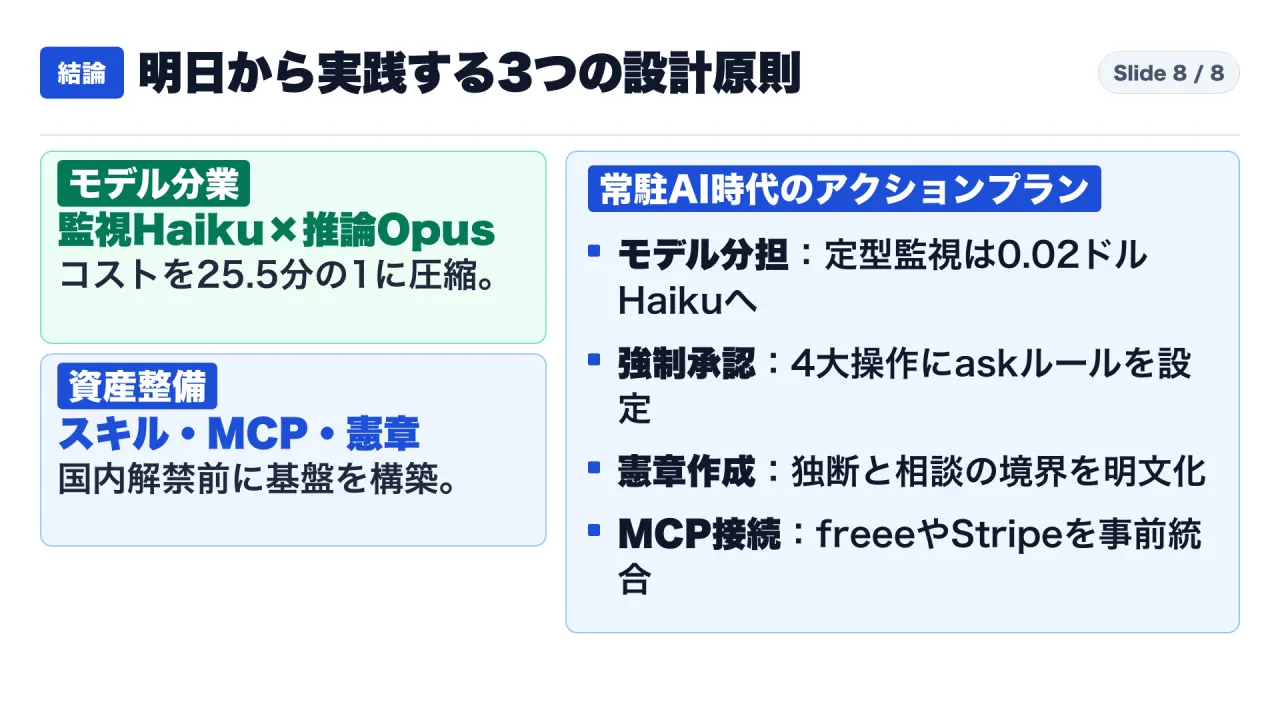
- Decouple Surveillance from Reasoning via Tiered Model Routing: Do not allocate expensive flagship models to continuous monitoring loops. Deploy lightweight models like Haiku 5.5 to perform high-frequency background polling, calendar verification, and initial fraud filtering at pennies per day. Route context to frontier reasoning engines like Opus 5.5 only when multi-system synthesis, strategic decision-making, or causal attribution is required.
- Enforce Approval Gates at the Runtime Harness, Not within the Model Prompt: Never rely on an LLM’s internal system prompt to prevent unauthorized writes or fund transfers. Prompt instructions can be bypassed via indirect prompt injection. Enforce human authorization gates deterministically within the host execution harness before committing database modifications or outbound financial requests.
- Formalize Organizational Knowledge into Machine-Readable Charters and MCP Servers: Whether adopting commercial tools like Claude Duet or engineering internal agent swarms, success depends on operational clarity. Formalize standard operating procedures into modular skills, construct custom Model Context Protocol connectors to expose internal enterprise data, and draft explicit charter documents defining the precise decision boundaries of every automated agent.
Primary Sources
- Anthropic Official Newsroom, “Introducing Claude Duet: Proactive Workflows and Persistent Intelligence” (2026): https://www.anthropic.com/news
- Anthropic Official Research, “Safety Considerations for Proactive Autonomous Agents: Auto Mode Classifiers and Prompt Injection Defenses” (2026): https://www.anthropic.com/research
- Anthropic Claude Code Documentation, “Automating Workflows with Claude Code v2.1.309: Scheduled Auto Mode and Permission Rules” (2026): https://docs.anthropic.com/en/docs/claude-code/overview
- Stripe Official Newsroom, “Powering Agentic Commerce: Instant Virtual Cards and the Stripe Model Context Protocol” (2026): https://stripe.com/newsroom
- GitHub Official Repository, “EliranG/claude-duet: Real-Time WebRTC Multiplayer Pair Programming for Claude Code” (2026): https://github.com/EliranG/claude-duet
- Composio Technical Architecture, “OAuth Brokerage and Multi-Tenant Connector Security for Autonomous Agents” (2026): https://composio.dev/blog
- Shopify Developer Documentation, “Building Model Context Protocol Connectors for Autonomous E-Commerce Operations” (2026): https://shopify.dev/docs/apps/build/mcp
- Anthropic Claude Code Engineering Blog, “Architecting Multi-Agent Organizations: Charters, Delegation, and the JohnAI Case Study” (2026): https://github.com/anthropics/claude-code
Note: This article is for informational purposes only and does not constitute investment advice or a price forecast. Podcast audio is synthesized from the host’s voice.