The Collapse of Perimeter Defense ── Inside Crédit Mutuel Arkéa's €118M Treasury Heist, Tokio Marine's 74-Record Web Shutdown, and the 700-Store European Cooling Sabotage
How attackers bypassed corporate firewalls through compromised B2B contractor endpoints, broken web API object-level authorization, and exposed 4G industrial controllers.
Japanese Edition: https://consuloji.substack.com/p/1187470050ot
YouTube (Japanese audio): https://youtu.be/SZHJaZy2rG8
Executive Summary: The Perimeter Fallacy and the Triple Incident Shock
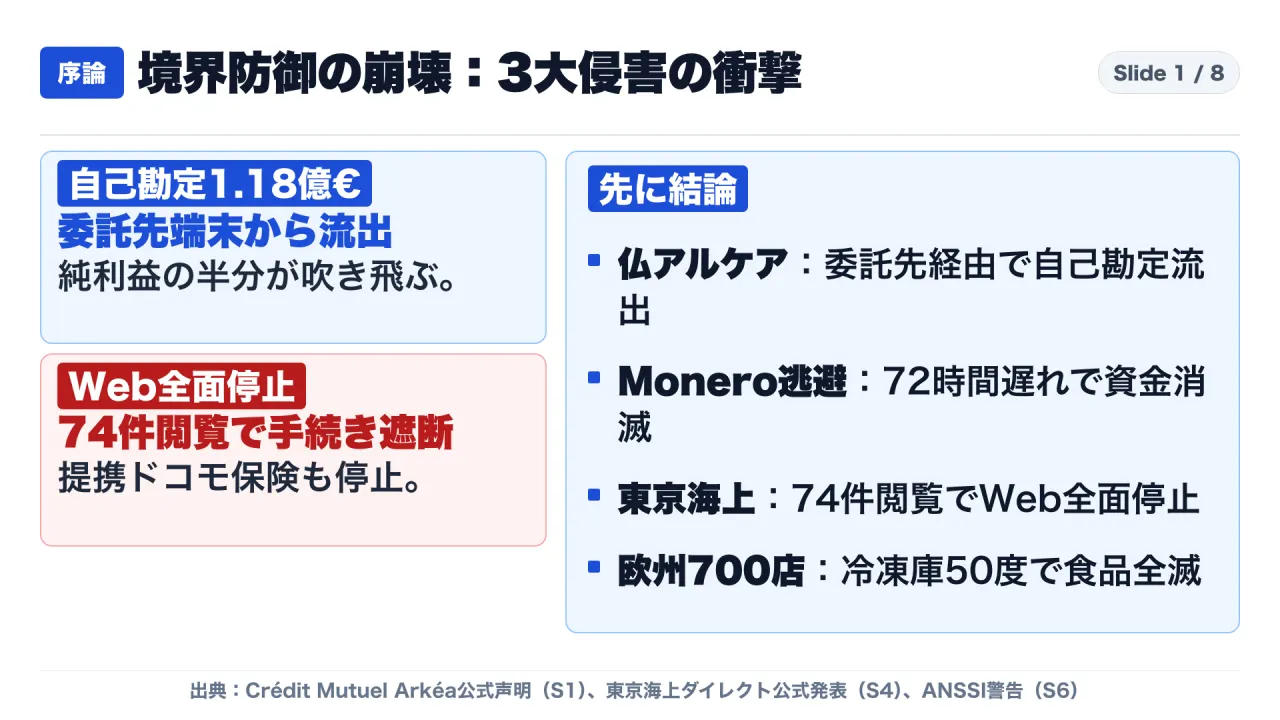
In modern enterprise cybersecurity, adversaries rarely execute frontal assaults against hardened core banking mainframes or centralized corporate data centers. In early November 2026, three major cyber incidents across France, Japan, and pan-European retail demonstrated that perimeter defense has collapsed. Attackers systematically bypassed internal corporate firewalls by exploiting vulnerable assets on the external periphery: compromised B2B vendor workstations, customer-facing web API endpoints, and internet-exposed Operational Technology (OT) controllers.
Across official disclosures, on-chain blockchain intelligence from ZachXBT and Bitquery, and European Union and Japanese regulatory mandates, three distinct failure vectors emerge:
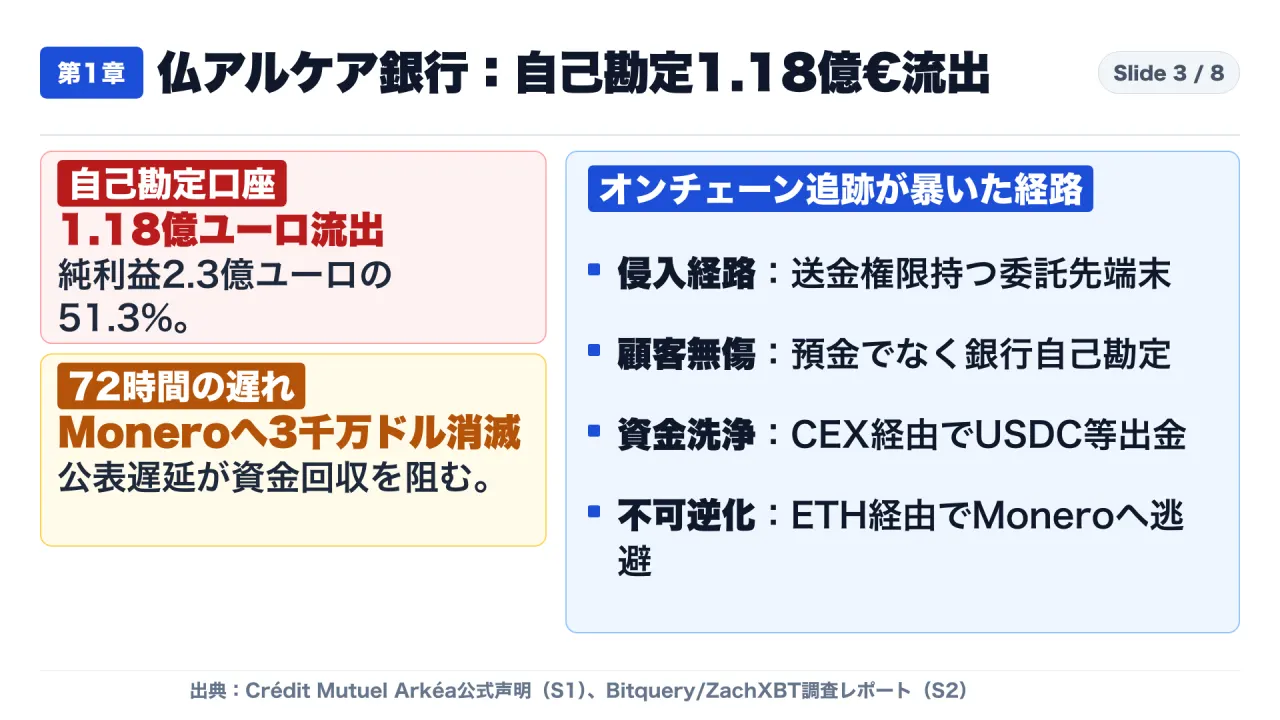
- B2B Contractor Compromise and Proprietary Treasury Drainage (Crédit Mutuel Arkéa): French banking group Crédit Mutuel Arkéa suffered an unauthorized transfer of €100M–€118M ($133M USD / 21B JPY). Attackers hijacked a third-party contractor’s workstation possessing transaction rights, draining the bank’s own proprietary account (compte propre). While customer deposits were untouched, the loss equaled 51.3% of Arkéa’s H1 2026 net profit (€230M). A 72-hour disclosure delay allowed over $30M to escape into untraceable Monero (XMR).
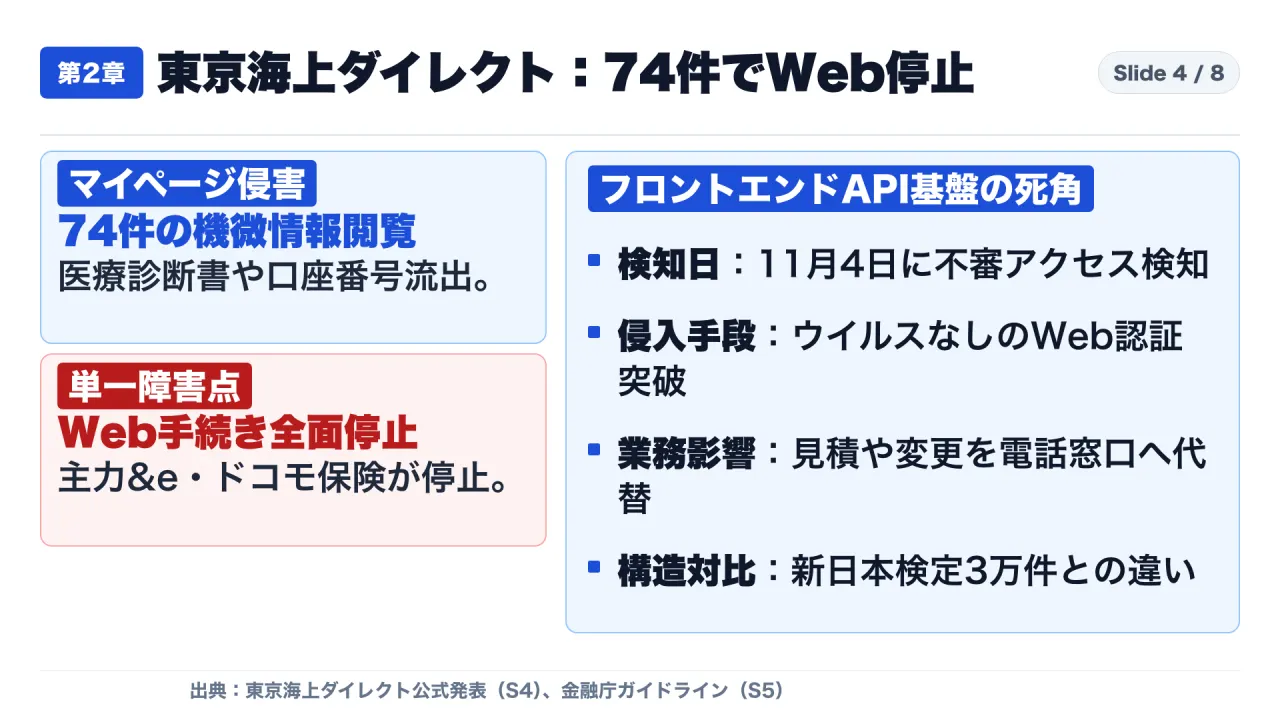
- B2C Object-Level Authorization Bypass and Digital Shutdown (Tokio Marine Direct): In Japan, Tokio Marine Direct detected unauthorized access to 74 customer records within its policyholder portal. Because the compromise involved web application authorization logic rather than malware, the insurer severed web connectivity, completely halting digital operations for its flagship IoT auto insurance “&e” and its NTT Docomo partnership product. A breach of just 74 accounts acted as a single point of failure (SPOF) for an entire digital business.
- Automated AI Reconnaissance and Edge OT Sabotage (700+ European Supermarkets): Exploiting default credentials and unpatched vulnerabilities (CVE-2025-41450 and CVE-2025-41451) in industrial cooling controllers connected directly via 4G modems, attackers altered freezer set-points to 50°C (122°F) across 700+ supermarkets in France, Belgium, and the UK. With zero ransom demanded, the attack ruined $50M in perishable food inventory in France alone, demonstrating physical asset destruction that cannot be restored from backups.
| Incident | Target & Vector | Financial / Operational Impact | Core Vulnerability | Regulatory Exposure |
|---|---|---|---|---|
| Crédit Mutuel Arkéa | B2B contractor workstation; proprietary treasury | €100M–€118M ($133M USD) drained; 51.3% of H1 net profit | Static trust in contractor endpoints; no circuit-breakers | EU DORA Art. 19: Violated 4-hour notification mandate |
| Tokio Marine Direct | B2C web authentication; Broken Object Level Auth (BOLA) | 74 records viewed; complete web shutdown of “&e” | Absence of API microsegmentation; portal acted as SPOF | FSA Guidelines Sec. 1.2.2: Director liability for due care |
| European Supermarkets | Edge OT controllers (Danfoss AK-SM 800A) via 4G modems | $50M food spoiled; 700+ stores impacted; 2-day closure | Default credentials; zero network isolation | UK NCSC & French ANSSI: Mandatory OT device isolation |
1. Crédit Mutuel Arkéa: Forensic Breakdown of a €118M Treasury Heist
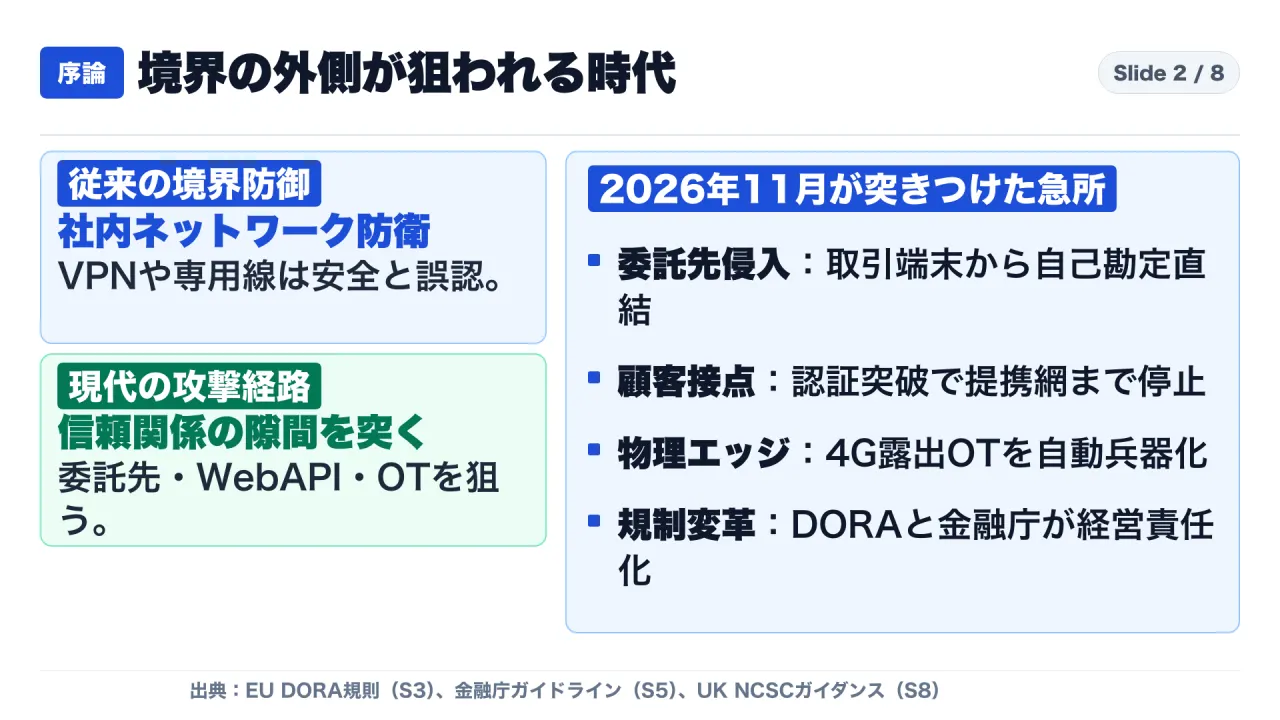
With €211.5 billion in total assets and over 5.8 million clients, cooperative banking giant Crédit Mutuel Arkéa confirmed on November 4, 2026, that it had suffered massive fraudulent transactions.
Penetration Vector: The Vendor Workstation Bypass
Initial media speculation suggested the breach originated within Arkéa’s online retail banking subsidiary, Fortuneo. Executive leadership explicitly refuted this, clarifying that the intrusion entered through an external service provider’s operational platform.
According to reporting by Le Monde, attackers compromised a workstation operated by a third-party vendor entrusted with transaction execution rights. By leveraging this established corporate connection, the attackers injected authenticated payment directives deep into Arkéa’s core settlement network, bypassing exterior firewalls.
The Target: Proprietary Treasury (Compte Propre)
Arkéa reassured the public that retail depositors suffered no financial loss. However, this highlighted a severe balance-sheet vulnerability: the attackers targeted the bank’s own proprietary account (compte propre), used for wholesale treasury and liquidity operations.
The stolen sum of €100 million to €118 million represented 51.3% of the group’s net profit for the first half of 2026 (€230 million). While depositor panic was avoided, the incident dealt a severe financial blow directly to the bank’s equity.
On-Chain Laundering and the 72-Hour Disclosure Failure
Forensic investigations published by on-chain analyst ZachXBT and blockchain intelligence firm Bitquery revealed the laundering mechanism:
- November 1, 2026: Attackers executed an initial withdrawal of $106 million from Arkéa’s accounts.
- November 2, 2026: A secondary outflow of $27 million was completed.
- November 4, 2026 (13:00 CET): Arkéa issued its initial public acknowledgment, followed by an update at 17:30 CET.
Fiat outflows were converted to liquid stablecoins (USDC) via OTC desks and centralized exchanges, bridged to Ethereum (ETH), and swapped into Monero (XMR).
Because approximately 72 hours elapsed between the initial capital flight and public notification, major centralized exchanges (such as Kraken and Crypto.com) were unable to freeze recipient addresses in time. Attackers routed more than $30 million into Monero (XMR), rendering those assets permanently unrecoverable. The asymmetry between traditional corporate disclosure cycles (measured in days) and on-chain asset flight (measured in seconds) ensured the permanent loss of capital.
2. Tokio Marine Direct: 74 Compromised Records and Digital Single Points of Failure
While Arkéa illustrated the danger of B2B contractor privileges, Tokio Marine Direct’s incident on November 4, 2026, exposed the fragility of customer-facing (B2C) web application architectures.
Tokio Marine Direct disclosed that an unauthorized external entity breached its customer portal (“My Page”). The attacker viewed records belonging to 74 policyholders. However, the exposed data was sensitive, encompassing policyholder identities, claims investigation notes, medical diagnosis certificates, injury descriptions, and linked bank account numbers.
The intrusion did not involve malware or credential stuffing. Instead, the attacker exploited a Broken Object Level Authorization (BOLA) flaw in the web API layer, manipulating resource identifiers in authenticated queries to view records belonging to other policyholders.
The Single Point of Failure (SPOF) Domino Effect
The systemic damage lay in the mitigation response. Because the web application lacked microsegmentation, security engineers could not isolate the vulnerable endpoint. To prevent further data leakage, Tokio Marine severed the entire customer portal infrastructure.
This shutdown instantly paralyzed two major business lines:
- The flagship digital auto insurance brand “&e” halted all online quotes, policy adjustments, and claims reporting.
- The “Docomo Auto Insurance” portal, operated in partnership with telecommunications giant NTT Docomo, went offline entirely.
A digitally native insurance brand was forced to revert its entire operation to manual toll-free telephone switchboards, causing widespread customer service paralysis. A flaw compromising just 74 accounts brought an enterprise-scale commercial engine to a standstill.
3. European Retail Sabotage: AI Reconnaissance and 50°C Industrial Cooling Hacks
Simultaneously, a physical cyber attack struck critical supply chain infrastructure across Europe, targeting commercial supermarket refrigeration.
Two Waves of Physical Sabotage
- Wave 1 (October 11, 2026): Hit approximately 700 supermarket locations across France, prompting an urgent national security alert from the French Cybersecurity Agency (ANSSI / CERT-FR Alert
CERTFR-2026-ALE-015). - Wave 2 (November 2, 2026): Expanded across ten European nations, disabling refrigeration at approximately 40 Delhaize supermarkets in Belgium and striking commercial meat processors in the United Kingdom.
The Attack Vector: Exposed 4G Cellular Modems and Known CVEs
The compromised hardware consisted primarily of Danfoss System Manager AK-SM 800A and Copeland XWEB refrigeration controllers. Supermarket operators had connected these devices directly to the public internet via 4G cellular modems to allow off-site vendor maintenance, entirely bypassing enterprise firewalls.
Shodan and Censys scans revealed that over 800 controllers in the UK and more than 6,000 globally were accessible via public IP addresses. Attackers utilized automated AI scanning tools to locate these devices, exploiting:
- Unaltered factory default administrative passwords.
- Unpatched remote vulnerabilities, specifically CVE-2025-41450 (SQL Injection) and CVE-2025-41451 (Authentication Bypass) in Danfoss controllers.
Once authenticated, the attackers did not deploy ransomware. Instead, they executed pure physical sabotage: altering refrigeration parameters to “defrost mode” or overriding target temperatures to 50°C (122°F).
Hot air flooded commercial freezers overnight. In France alone, grocery retailers suffered $50 million in spoiled frozen and fresh food, with affected stores forced into two-day operational closures to sanitize cases and restock inventory. While compromised databases can be restored from offline backups, ruined physical inventory cannot be recovered.
4. Regulatory Reckoning: EU DORA and Japan FSA Cyber Guidelines
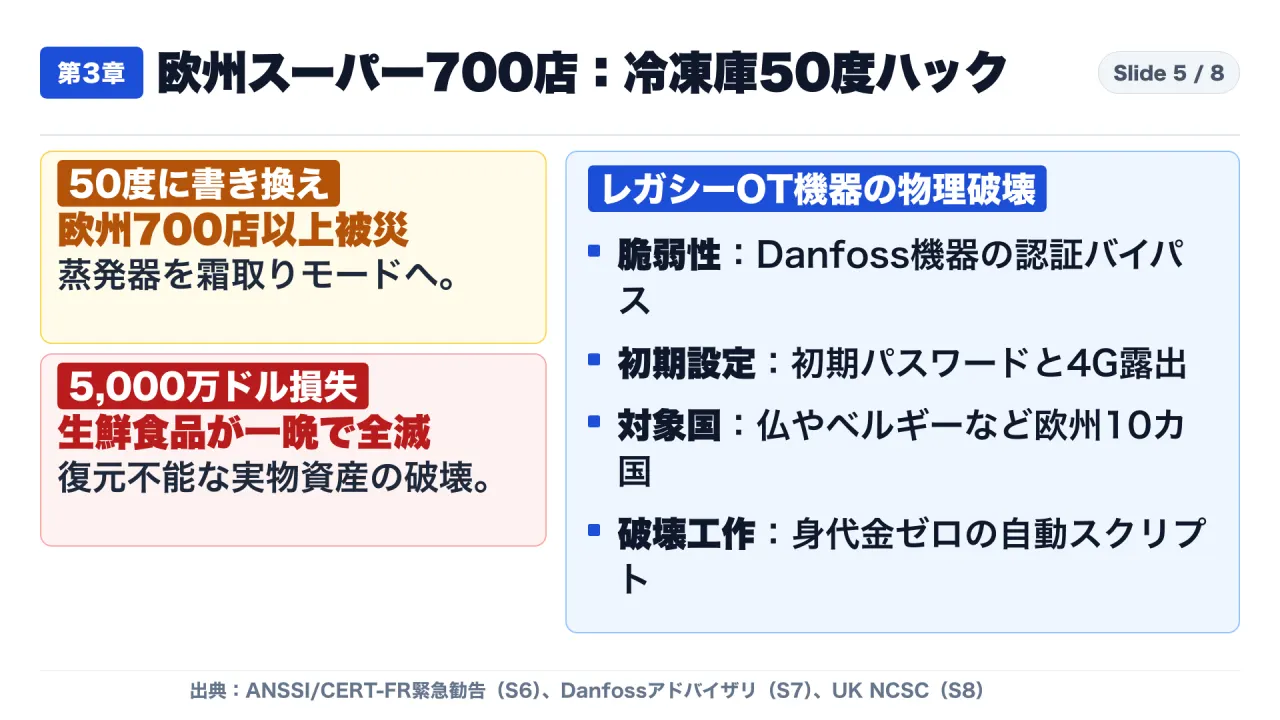
These incidents have activated stringent regulatory enforcement across both the European Union and Japan:
EU DORA: 4-Hour Mandatory Reporting and Turnover Penalties
The Digital Operational Resilience Act (Regulation (EU) 2022/2554), which took effect on January 17, 2025, imposes unprecedented compliance mandates across financial institutions and their ICT third-party providers:
- Mandatory 4-Hour Initial Incident Notification (Article 19): Regulated entities must transmit an initial notification of major ICT-related incidents to competent supervisory authorities within four hours of classification. Arkéa’s 72-hour delay represents a serious regulatory breach.
- Periodic Turnover Penalties (Article 35): Regulators can impose daily fines of up to 1% of average daily worldwide turnover for up to six months on Critical Third-Party ICT Providers (CTPPs) that fail to remediate security deficiencies.
Japan Financial Services Agency: Personal Board Director Liability
Japan’s Financial Services Agency (FSA) updated its “Guidelines for Cybersecurity in the Financial Sector,” emphasizing executive accountability:
- Director Liability for Breach of Due Care (Section 1.2.2): If management fails to establish adequate cybersecurity oversight, corporate directors can be held personally liable for damages resulting from breaches under the Companies Act for breach of duty of due care (善管注意義務違反).
- Comprehensive Supply Chain Inventory (Section 2.2.1): Financial institutions must maintain dynamic asset ledgers and detailed data-flow diagrams mapping all external vendor systems, including secondary and tertiary subcontractors.
This regulatory pressure reflects a harsh threat environment: in 2025, unauthorized online banking transfers in Japan reached a record 4,747 incidents totaling 10.4 billion JPY, heavily driven by attackers routing traffic through residential proxy networks that evade conventional IP reputation filters.
5. Architectural Deconstruction: From Contractual Trust to Programmatic Containment
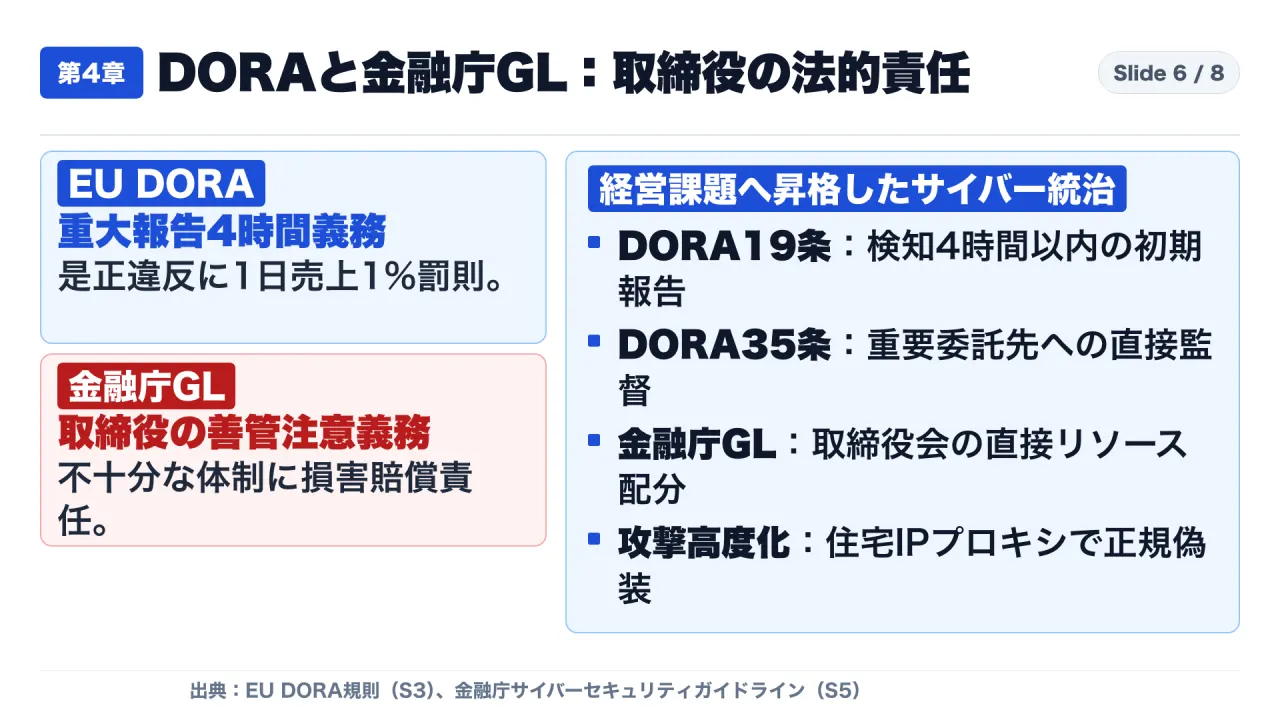
A technical synthesis of these three breaches separates empirical facts from strategic engineering realities:
Empirical Realities
- External Vector Hegemony: Every intrusion originated outside the corporate perimeter: a B2B vendor endpoint at Arkéa, a public web API at Tokio Marine, and 4G-exposed OT modems in European retail.
- Asymmetric Velocity: Fiat-to-crypto laundering occurred within hours, whereas corporate disclosure took multiple days.
- Architectural Fragility: Lack of API microsegmentation converted a 74-record leak into a full business shutdown.
Strategic Engineering Reality
The legacy doctrine of contractual trust—assuming external connections are secure because a vendor signed an agreement—is obsolete. Once an external workstation is compromised, it becomes an attacker beachhead.
Enterprise defense must transition from static agreements to programmatic containment, embedding autonomous circuit-breakers that freeze transaction pipelines and isolate API routes the moment telemetry deviates from baselines.
6. Actionable Implementation Roadmap: 3 Defensive Pillars
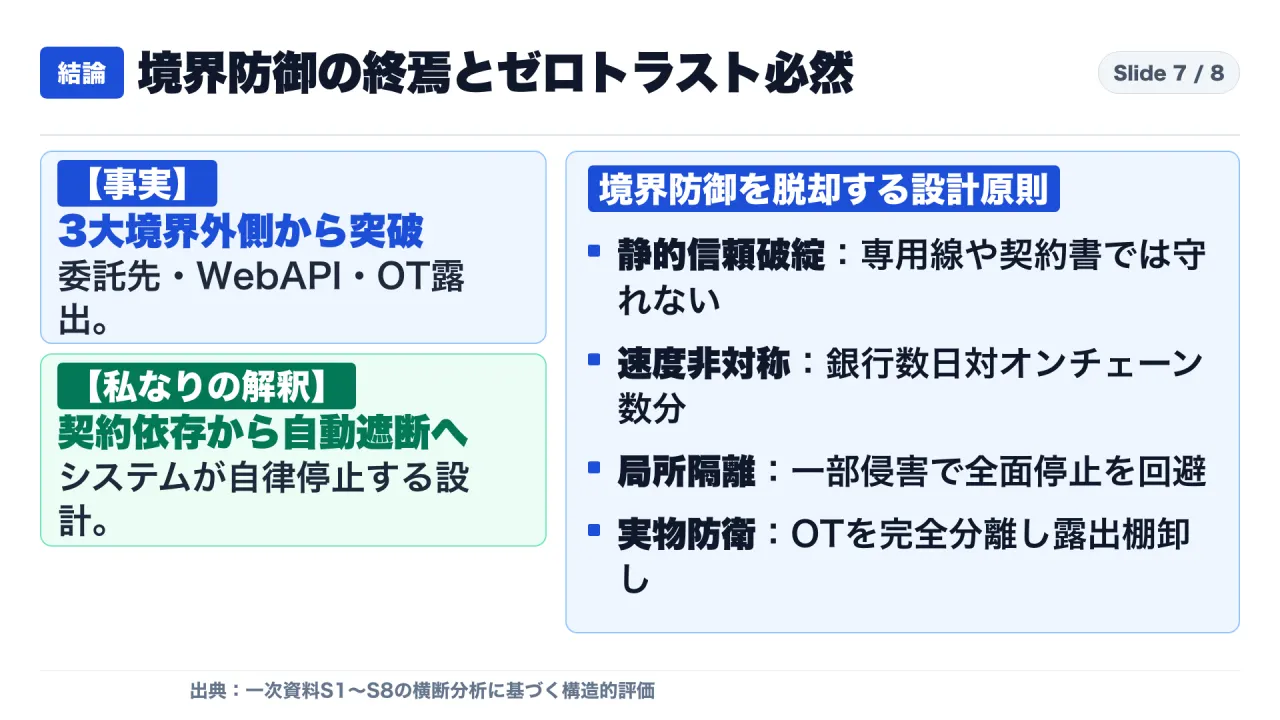
To satisfy DORA and FSA compliance standards while securing enterprise operations, organizations must implement three immediate architectural controls:
| Defensive Domain | Immediate Action (72 Hours to 1 Week) | Tactical Hardening (30 Days) | Strategic Architecture (90 to 180 Days) |
|---|---|---|---|
| 1. B2B Vendor & Treasury Defense | Audit all contractor credentials accessing treasury accounts; revoke dormant access | Implement hard transaction rate limits and automated freezes on crypto transfers | Deploy Zero-Trust Network Access (ZTNA) with dynamic JIT authentication |
| 2. B2C Web & API Hardening | Review API logs for enumeration; block known residential proxy IP ranges | Conduct automated code audits for Broken Object Level Authorization (BOLA) | Implement FIDO2 Passkeys and architectural API microsegmentation |
| 3. Operational Technology (OT) | Scan public IP ranges for exposed 4G modems; immediately air-gap OT controllers | Rotate factory default passwords; patch CVE-2025-41450/41451 on Danfoss units | Isolate OT into segmented VLANs with zero direct internet routability |
Pillar 1: Zero-Trust Third-Party Brokering with Transactional Circuit-Breakers
- Dynamic JIT Authorization: Replace static credentials with Just-In-Time (JIT) short-lived tokens requiring multi-factor authentication for each high-value session.
- Automated Settlement Circuit-Breakers: Implement algorithmic transaction rate-limiters on wholesale treasury accounts. If outgoing transfer velocity exceeds predefined historical bounds, the core ledger must automatically halt settlement APIs.
- Rapid Asset Freeze Playbooks: Establish direct relationships with centralized exchanges and stablecoin issuers (Tether, Circle) to execute asset freeze requests within the 4-hour window mandated by DORA.
Pillar 2: Strict Object-Level Authorization and Adaptive API Throttling
- Rigorous BOLA Enforcement: Enforce server-side authorization checks verifying that the authenticated session identity possesses explicit permissions to view the requested resource ID on every API endpoint.
- Microsegmented API Architectures: Decouple public web applications into independent microservices. Ensure that compromising an administrative or customer profile endpoint does not necessitate severing transactional core engines.
- Residential Proxy Defense: Deploy behavioral device fingerprinting to detect automated credential stuffing and resource enumeration originating from compromised consumer routers.
Pillar 3: External Attack Surface Management (EASM) and Complete OT Isolation
- Identify and Air-Gap Shadow Modems: Utilize EASM tools to discover cellular 4G/5G modems connected to HVAC, refrigeration, and backup generator controllers. Immediately sever public routing, isolating OT devices behind private APNs or ZTNA gateways.
- Enforce Mandatory Credential Rotation: Audit industrial controllers for default factory administrative passwords, mandating complex credentials and disabling unauthenticated diagnostic consoles.
- Accelerate Critical OT Patching: Apply vendor firmware updates addressing remote code execution and authentication bypass vulnerabilities across all legacy hardware controllers.
Primary Sources
- Crédit Mutuel Arkéa Official Press Release: Unauthorized Operations on Proprietary Account
- Bitquery On-Chain Investigation: Forensic Laundering Analysis of Crédit Mutuel Arkéa Heist with ZachXBT
- European Banking Authority: Digital Operational Resilience Act (EU DORA Regulation 2022/2554)
- Tokio Marine Direct Official Announcement: Incident Notification on Web Unauthorized Access
- Japan Financial Services Agency: Guidelines for Cybersecurity in the Financial Sector
- French National Cybersecurity Agency (ANSSI / CERT-FR): Alert CERTFR-2026-ALE-015 on Refrigeration System Attacks
- Danfoss Official Security Advisory: System Manager AK-SM 800A Vulnerabilities (CVE-2025-41450 & CVE-2025-41451)
- UK National Cyber Security Centre (NCSC): Guidance on Securing Internet-Exposed Operational Technology Devices
Note: This article is for informational purposes only and does not constitute investment advice or a price forecast. Podcast audio is synthesized from the host’s voice.