The End of Custom RAG and the 30% AI Layoff Trap ── Inside Google's Gemini Notebook MCP, Snowflake CoWork Bots, and Gartner's Rehire Warning
Why enterprise AI architectures are converging on standardized MCP knowledge pipelines while 93% of corporate rollouts stall and premature headcount cuts trigger catastrophic tacit knowledge loss.
Japanese Edition: https://consuloji.substack.com/p/googlenotebooklmmcpgartnerai30snowflake7
YouTube (Japanese audio): https://youtu.be/8_fatOgs6eU
Executive Summary: Architectural Convergence and the Governance Reckoning
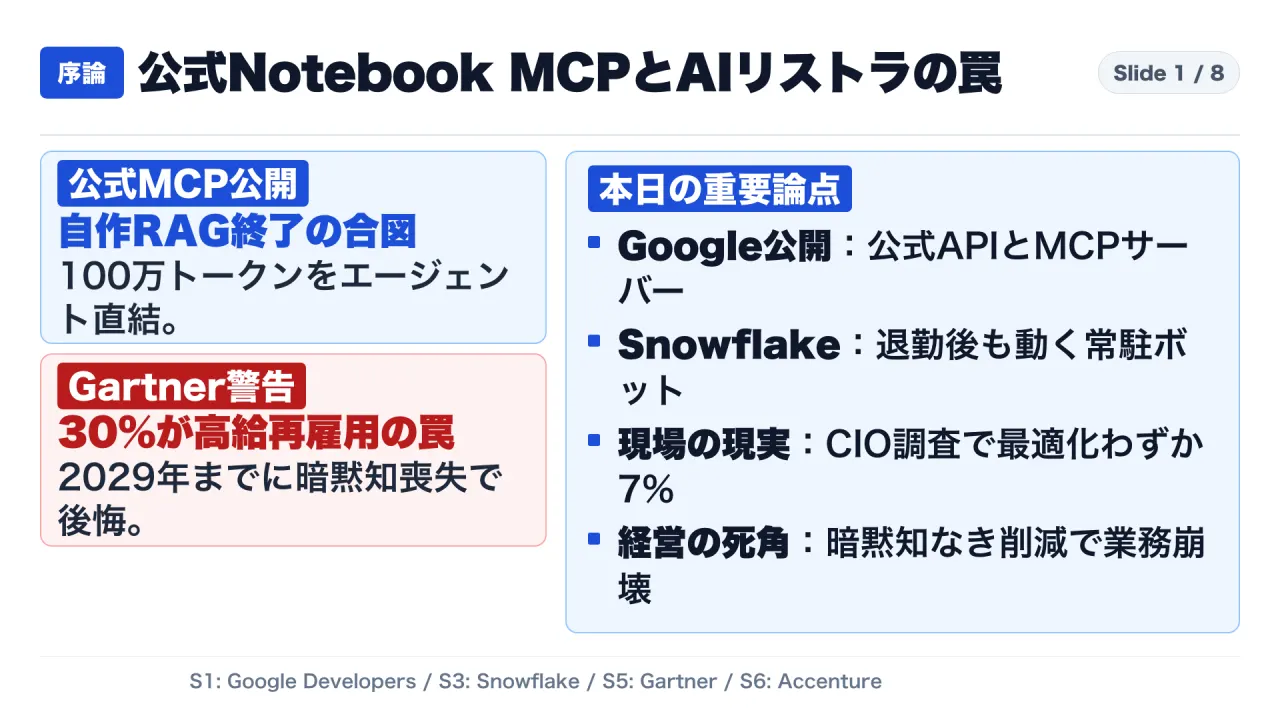
In November 2026, enterprise AI infrastructure crossed an architectural inflection point. Google released the official REST API and Model Context Protocol (MCP) server for Gemini Notebook (formerly NotebookLM), transforming what was once a consumer-facing research notebook into programmable knowledge infrastructure. Simultaneously, cloud data warehousing leader Snowflake announced the General Availability (GA) of CoWork Bots—autonomous background agents operating after human logoff—coupled with Business Ontology, a semantic layer designed to eliminate raw SQL hallucinations, and Cortex AI Gateway for budget governance.
Unstructured knowledge retrieval and structured enterprise data have converged upon a unified protocol: Anthropic’s open-standard Model Context Protocol.
Yet as technical connectivity solidifies, corporate operational outcomes reveal severe dysfunction. A global survey of 300 Chief Information Officers (CIOs) conducted by Accenture revealed that while 64% of enterprises are rapidly expanding AI deployments, a mere 7% have achieved optimized, value-generating scale. The remaining 93% remain trapped in protracted pilot purgatory, escalating token expenses, and organizational friction.
Compounding this operational bottleneck, research firm Gartner issued a stark warning: 30% of employees laid off in hasty AI workforce reductions will be rehired by 2029 at significantly higher compensation. When enterprise leadership mistakes task-level generative automation for full-spectrum operational capability, they inadvertently purge the unwritten “tacit knowledge” required to manage edge-case failures. When rigid AI workflows inevitably stall, organizations face operational paralysis, forcing emergency rehires of former staff as premium-rate consultants.
| Strategic Domain | Emerging Architectural Pattern | Legacy / Anti-Pattern Approach | Measured Business Consequence |
|---|---|---|---|
| Unstructured Retrieval | Gemini Notebook API & Official MCP Server (1M–2M context) | Custom DIY RAG (chunking, embedding, vector DBs, rerankers) | Eliminates infrastructure maintenance; preserves document provenance |
| Structured Data Analytics | Snowflake Business Ontology & Cortex AI Gateway | Raw text-to-SQL generation directly against production tables | Prevents hallucinated metrics and runaway compute billing |
| Enterprise AI Adoption | End-to-end workflow re-engineering with semantic controls (Top 7%) | Surface-level chat overlays on uncurated data silos (Remaining 93%) | 7% capture scalable ROI; 93% stall in cost overruns and PoC fatigue |
| Workforce Governance | Augmenting capacity and formalizing tacit operational heuristics | Headcount reduction based on demo-stage task automation | 30% of laid-off staff rehired by 2029 at premium compensation |
1. The Demise of DIY RAG: Inside the Gemini Notebook REST API and MCP Server
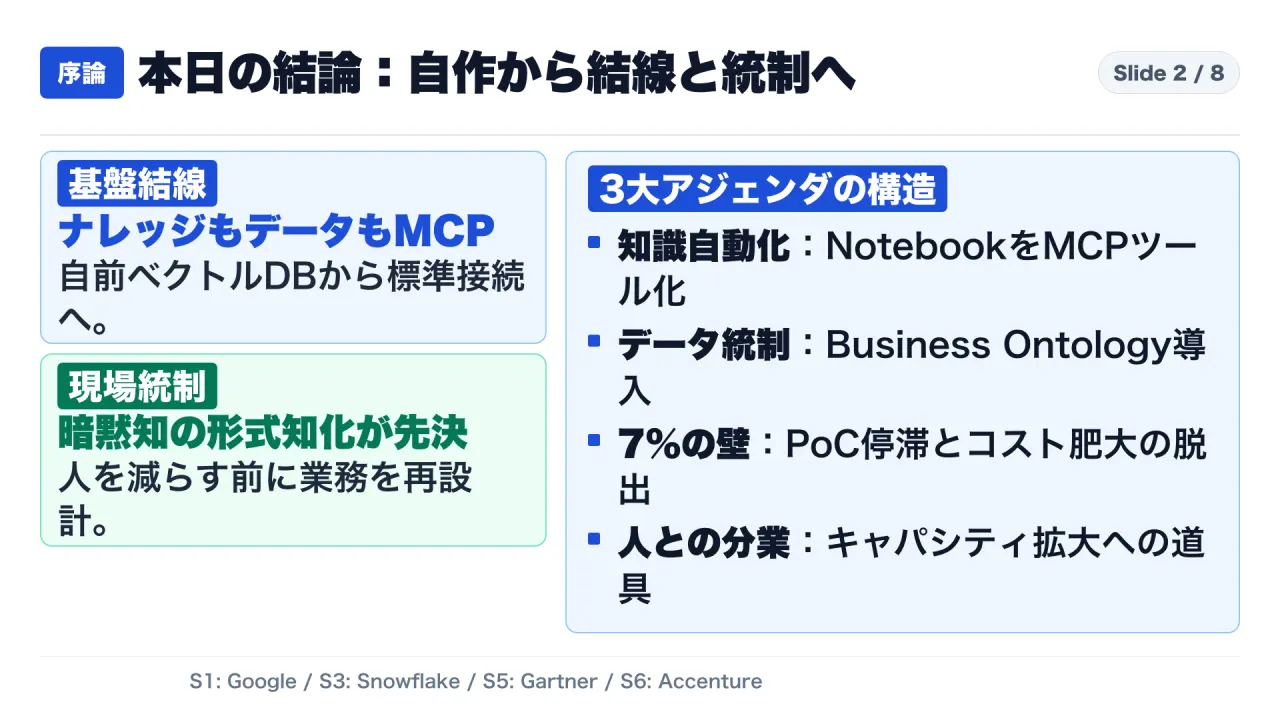
For three years, enterprise software teams invested tens of thousands of engineering hours constructing bespoke Retrieval-Augmented Generation (RAG) pipelines. A standard enterprise RAG stack required maintaining document parsers (PDF, DOCX, HTML), chunking algorithms (semantic, recursive, fixed-token), embedding model pipelines, vector databases (Pinecone, Weaviate, Qdrant), cross-encoder rerankers, and prompt-templating wrappers.
The public preview release of Google’s Gemini Notebook REST API and official MCP server renders this DIY architectural pattern obsolete for standard enterprise knowledge workloads.
Architectural Disruption: Managed Grounding Across Massive Context
The Gemini Notebook API provides programmatic endpoints to create notebooks, dynamically ingest web URLs, YouTube video transcripts, Markdown repositories, and PDF libraries, and execute grounded semantic queries.
The accompanying MCP server enables developer environments (such as Claude Code or Cursor) and autonomous agent frameworks to integrate NotebookLM as a native tool with minimal configuration:
{
  "mcpServers": {
    "gemini-notebook": {
      "command": "npx",
      "args": ["-y", "@google/gemini-notebook-mcp"],
      "env": {
        "GEMINI_API_KEY": "YOUR_API_KEY"
      }
    }
  }
}
This integration fundamentally alters retrieval economics:
| Architectural Component | Custom DIY RAG Architecture | Gemini Notebook Official MCP Architecture |
|---|---|---|
| Pipeline Construction | Requires manual parsing, chunking, vector indexing, and rerankers | Direct connection to Google managed knowledge base via MCP |
| Context Processing | 512-to-1,024 token fragmented chunks; loses macro-document context | Native 1,000,000 to 2,000,000 token context window |
| Source Ingestion | Custom extraction scrapers required per file type and streaming format | Native ingestion of URLs, YouTube transcripts, Markdown, and PDFs |
| Attribution & Grounding | Vector distance heuristics; prone to contextual drift and lost provenance | Explicit citation grounding directly mapping answers to source anchors |
| Operational Overhead | Vector DB hosting, embedding API charges, and index maintenance costs | Zero infrastructure management; available via preview pricing tiers |
By replacing fragmented chunk searches with native million-token context grounding, Gemini Notebook resolves RAG’s most notorious flaw: the inability to answer synthesis queries requiring holistic comprehension across an entire document corpus. Except in specialized environments requiring air-gapped on-premises vector isolation, engineering custom RAG pipelines from scratch has become an expensive anti-pattern.
2. Snowflake CoWork Bots and Business Ontology: Taming Autonomous Agents on Enterprise DWH
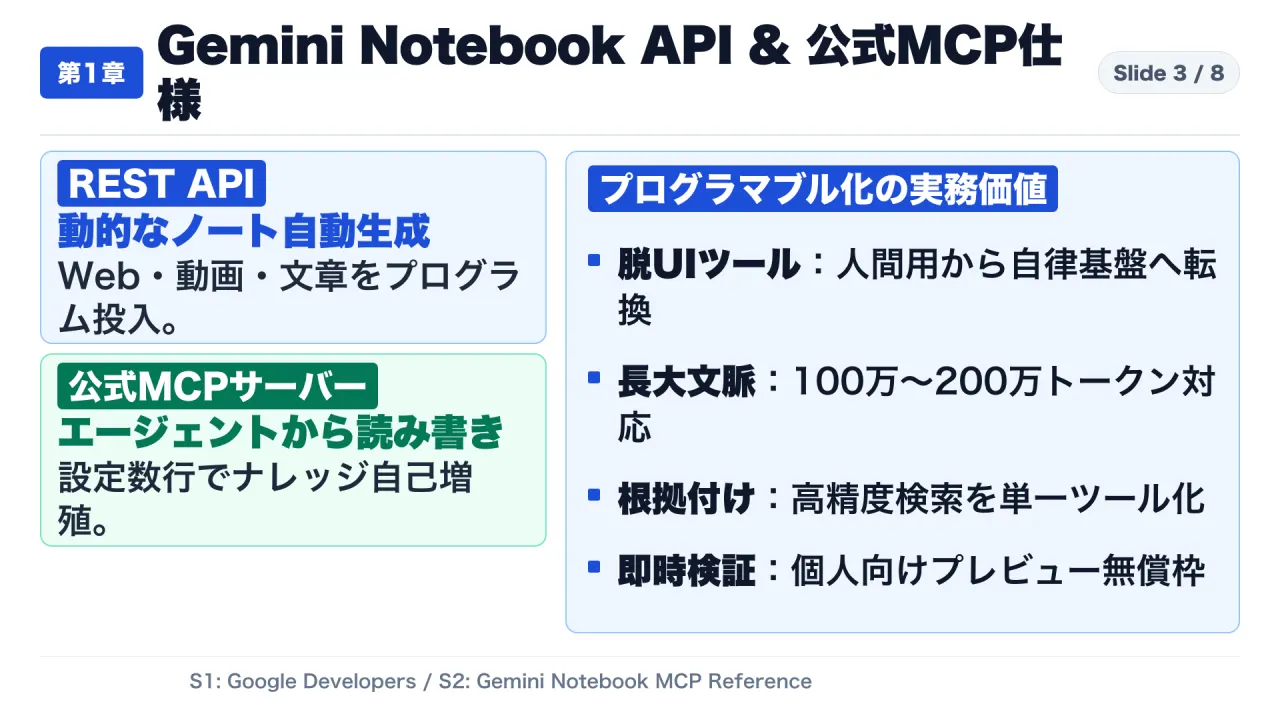
While Google formalized unstructured knowledge retrieval, Snowflake addressed the governance of structured transactional data with the introduction of CoWork Bots and Business Ontology.
Always-On Agents After Human Logoff
CoWork Bots are cloud-resident autonomous agents designed to execute long-running tasks after human operators log off. Operating within the data cloud, these bots continuously monitor incoming revenue pipelines, track warehouse inventory variances, detect telemetry anomalies, and compile morning executive dossiers.
When evaluating potential interventions—such as modifying procurement allocations or flagging suspicious transaction batches—the agent compiles a structured decision card, routing it to designated executives via mobile push notifications or Slack for single-tap human approval.
The Problem of Raw SQL Hallucination
Allowing generative agents to formulate raw SQL queries directly against production databases is inherently dangerous. Models frequently misidentify database join keys, conflate gross revenue with net recognized revenue, or apply contradictory departmental margin definitions.
[ Raw Production Tables: ERP / CRM / Billing ]
                       │
                       ▼
         [ Snowflake Business Ontology ]
     (Semantic Layer: Certified Metrics & Joins)
                       │
                       ▼
          [ Cortex AI Gateway (GA) ]
      (Token Budgets & Rate Limit Enforcement)
                       │
         ┌─────────────┴─────────────┐
         ▼                           ▼
[ CoWork Bots (Always-On) ]   [ External MCP Agents ]
         │                           │
         ▼                           ▼
[ Mobile / Slack Approval ]   [ Morning Executive KPI Dashboards ]
Snowflake’s Business Ontology inserts a deterministic semantic abstraction layer between raw data stores and generative agents. Business metrics (such as EBITDA, Customer Acquisition Cost, or Churn Rate) are codified as governed semantic objects. Agents do not generate unverified SQL text; instead, they request verified semantic measures via MCP.
Complementing this is the Cortex AI Gateway (GA), which enforces hard rate limits, token spending caps, and data residency policies, preventing autonomous background agents from generating runaway compute bills overnight.
3. The Grand Convergence: Unifying Knowledge and Data Under MCP
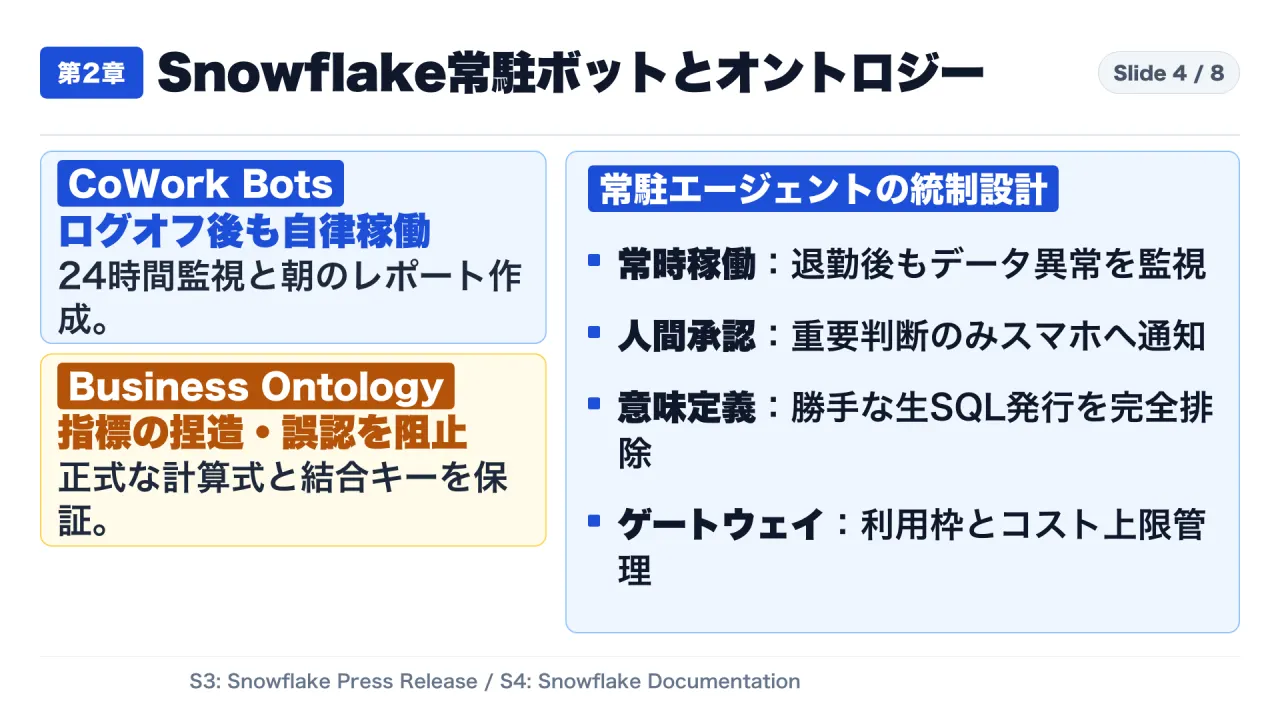
The simultaneous announcements from Google and Snowflake demonstrate a broader industry transition: the primary challenge in AI engineering has shifted from prompt engineering to systems integration and semantic governance.
Enterprise knowledge partitions cleanly into two structural domains:
- Unstructured Knowledge (Technical manuals, policy documents, transcripts): Ingested into Google Gemini Notebook, exposing multi-million-token grounded semantic retrieval via MCP.
- Structured Enterprise Telemetry (Financial ledger records, supply chain metrics, ERP states): Managed within Snowflake, exposing verified semantic definitions via Business Ontology over MCP.
Because both layers adopt the Model Context Protocol, autonomous coding and operational agents can query both knowledge repositories through a standardized interface:
- Agent Fleet via MCP -> Gemini Notebook MCP: Unstructured document synthesis across policy manuals, transcripts, and specifications.
- Agent Fleet via MCP -> Snowflake Ontology MCP: Governed financial and operational metric telemetry.
This standardization eliminates the need for proprietary point-to-point connectors, allowing engineering teams to focus on access permissions, data hygiene, and audit logging.
4. The 7% Optimization Wall: Analyzing Accenture’s 300 CIO Study
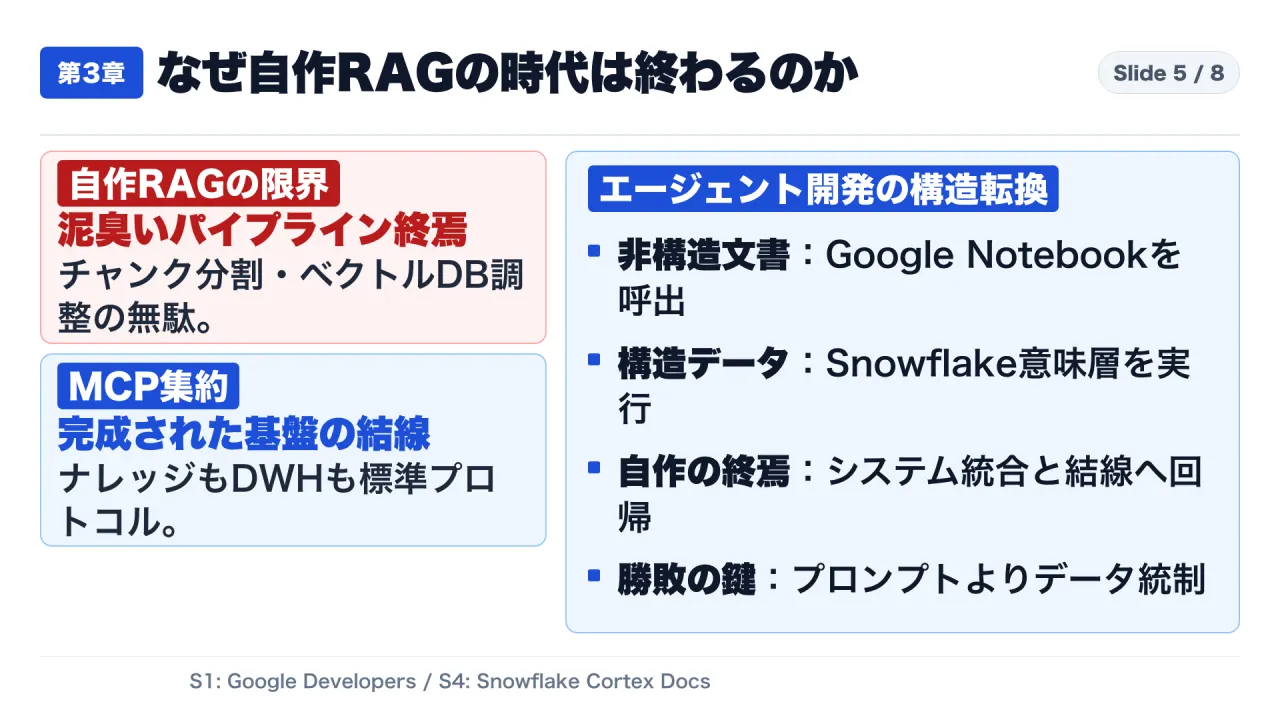
Despite architectural advancements, enterprise deployment data exposes widespread execution failure. A comprehensive survey of 300 global CIOs conducted by Accenture reveals a profound divergence:
- 64% of enterprise leaders report aggressively expanding AI adoption across business units.
- Only 7% of organizations have successfully achieved optimized, value-accretive operational scale.
The remaining 93% of enterprises are caught in “PoC paralysis”—struggling with cost overruns, poor user adoption, and unverified data quality.
Forensic Comparison: Top 7% vs. Stalled 93%
| Evaluation Dimension | Value-Optimized Leaders (Top 7%) | Stalled Implementations (Remaining 93%) |
|---|---|---|
| Operational Methodology | Re-engineer end-to-end business workflows prior to model integration | Layer generic chat interfaces directly over legacy, unchanged processes |
| Data Architecture | Enforce governed semantic layers (Business Ontology) and audit trails | Allow LLMs to issue unconstrained text-to-SQL against raw database schemas |
| Tacit Knowledge Capture | Systematically interview senior staff to codify edge-case heuristics | Rely strictly on surface-level policy manuals, ignoring unwritten workflows |
| Primary Value Metric | Measure cycle-time compression and organizational capacity expansion | Focus exclusively on immediate headcount reduction and payroll cuts |
Organizations achieving scalable returns do not treat AI as a drop-in replacement for human labor. Instead, they restructure operating workflows, decoupling mechanical data aggregation from strategic human sign-offs.
5. The Gartner Warning: The 30% AI Layoff Rehire Trap
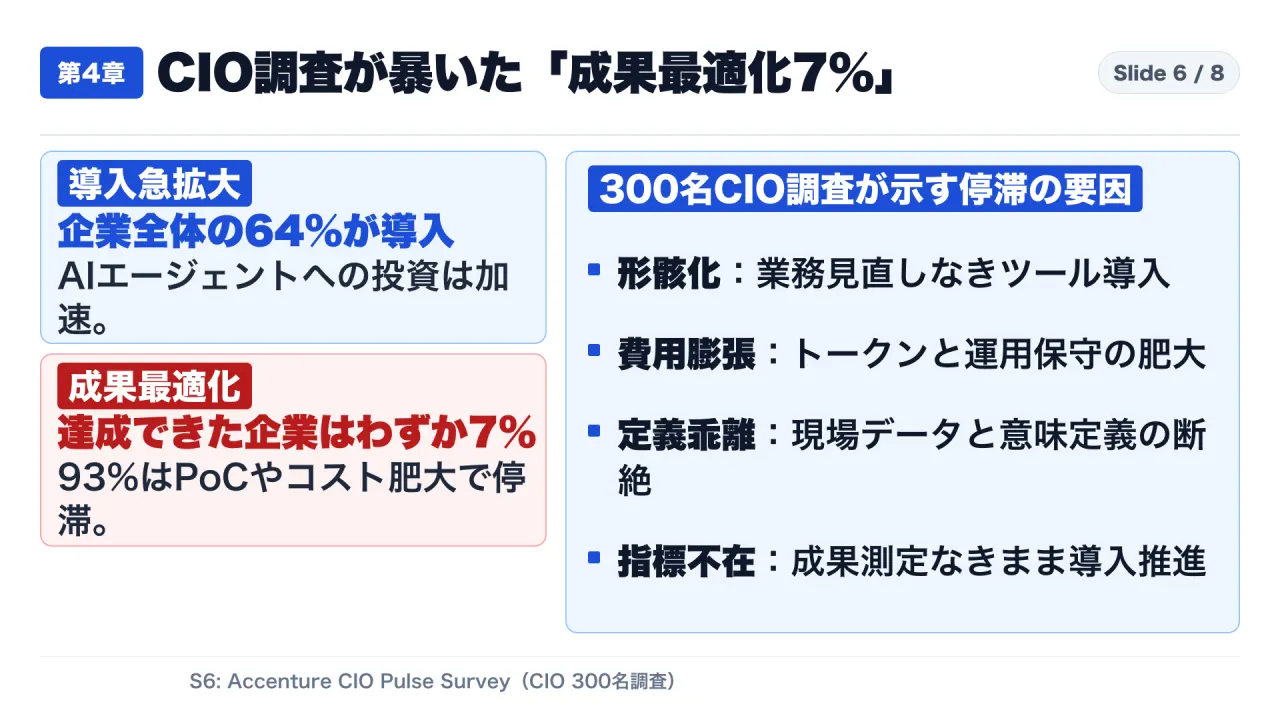
The most urgent finding for corporate leadership comes from research firm Gartner, which issued an extraordinary projection: by 2029, 30% of enterprise employees terminated in AI-driven workforce reductions will be rehired—at significantly higher compensation.
This “Rehire Trap” is driven by executive misunderstanding of operational complexity:
The Fallacy of Surface Automation
Corporate executives observe a generative model draft an insurance claim response, synthesize a legal brief, or generate an API client in thirty seconds. They extrapolate that 40% of administrative or engineering headcount is redundant, enacting broad staff cuts.
However, standard job descriptions capture only visible, procedural steps. They fail to capture tacit knowledge (unwritten institutional expertise):
- Which internal departments to contact when an automated payment batch fails silently.
- How to navigate regulatory ambiguity during high-stakes compliance audits.
- The informal inter-team consensus required to manage supply chain disruptions.
[ Executive Action: Premature Layoffs ] ──> "AI can generate reports; cut 30% headcount"
                     │
                     ▼
[ Loss of Tacit Knowledge ]             ──> Unwritten exception rules and workarounds vanish
                     │
                     ▼
[ Critical Edge-Case Failure ]          ──> Autonomous model hits novel edge case; halts
                     │
                     ▼
[ Operational Paralysis ]               ──> No internal staff understands underlying system
                     │
                     ▼
[ Emergency Rehire (The 30% Trap) ]     ──> Rehire former employees at 2x–3x consulting rates
When organizations replace experienced staff with generative agents without codifying edge-case heuristics, systems function smoothly until an unpredicted anomaly occurs. When the agent inevitably halts or hallucinates, the organization discovers that the institutional memory needed to resolve the crisis was purged during layoffs. The enterprise faces operational paralysis, leaving leadership no alternative but to rehire departed personnel at exorbitant emergency consulting rates.
AI is fundamentally an operational capacity expander, not a crude headcount reduction mechanism. Deploying technology to eliminate corporate memory inevitably creates massive operational liabilities.
6. Actionable Implementation Roadmap: 3 Architectural Mandates
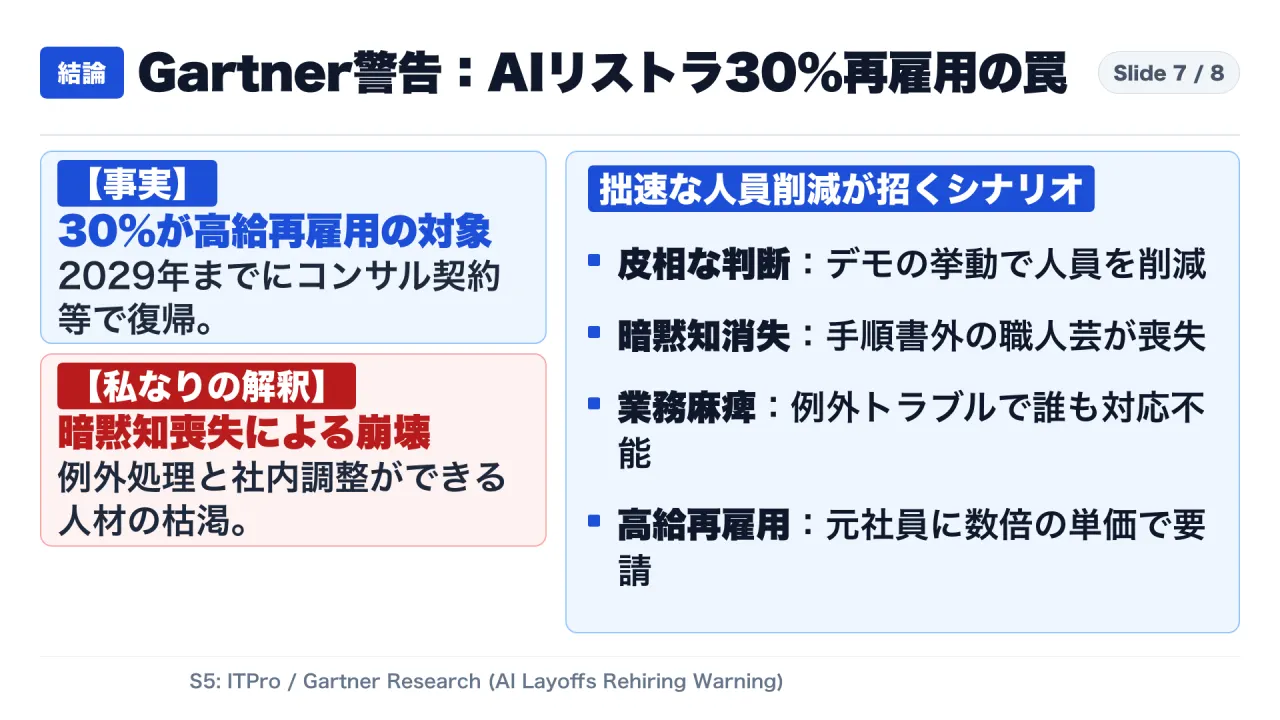
To navigate this landscape effectively, technical and operational leadership should execute three immediate architectural directives:
1. Deprecate Custom Vector RAG in Favor of Standardized MCP Ingestion
Cease allocating engineering resources to bespoke vector databases, recursive chunkers, and manual reranking pipelines. Utilize Google’s official Gemini Notebook API and MCP integration to test managed, million-token context grounding for corporate research, technical documentation, and project archives. Validate whether managed citation grounding satisfies operational requirements before maintaining custom retrieval infrastructure.
2. Implement Semantic Ontologies Before Granting Database Access
Prohibit autonomous agents from executing unconstrained, raw SQL queries against production data warehouses. Implement semantic abstraction layers—such as Snowflake Business Ontology or dbt Semantic Layer—to guarantee that business metric definitions, table join paths, and row-level access rules are governed programmatically. Couple all agentic database access with rate-limiting gateways (like Cortex AI Gateway) to prevent uncontrolled query costs.
3. Formalize Tacit Knowledge Before Restructuring Organizations
Before initiating workforce reorganizations based on AI productivity gains, systematically identify and document the unwritten exception-handling workflows managed by senior staff. Map end-to-end exception pathways, translate undocumented operational heuristics into governed procedural skills (SKILL.md), and evaluate system resilience under deliberate failure injection. Treat AI as a lever to expand team throughput rather than an excuse to dismantle institutional memory.
Primary Sources
- Google for Developers: Gemini Notebook REST API & Official MCP Server Documentation
- Google for Developers: Gemini Notebook MCP Server Reference Architecture
- Snowflake Press Release: Expedition 2026 — CoCo and CoWork Bots Always-On Agents
- Snowflake Documentation: Business Ontology Semantic Layer & Cortex AI Gateway GA
- ITPro / Gartner Research: 30% of Employees Laid Off Due to AI Will Be Rehired by 2029
- Accenture CIO Pulse Survey: Navigating Enterprise AI Deployment from Pilot to Scale
Note: This article is for informational purposes only and does not constitute investment advice or a price forecast. Podcast audio is synthesized from the host’s voice.