What Moonshot AI's 1.56 TB Kimi K3.1 Pro Weights Actually Deliver: Hardware Topologies, Commercial Licensing Thresholds, and Benchmark Caveats
A technical dissection of the 2.8T MoE architecture, the $20 million revenue clause, vLLM deployment requirements on 8x GPU nodes, and the reality behind benchmark claims.
Japanese Edition: https://consuloji.substack.com/p/156tbkimi-k31-pro
YouTube (Japanese audio): https://www.youtube.com/watch?v=VyVWY-lWPmE
Executive Summary & Key Takeaways
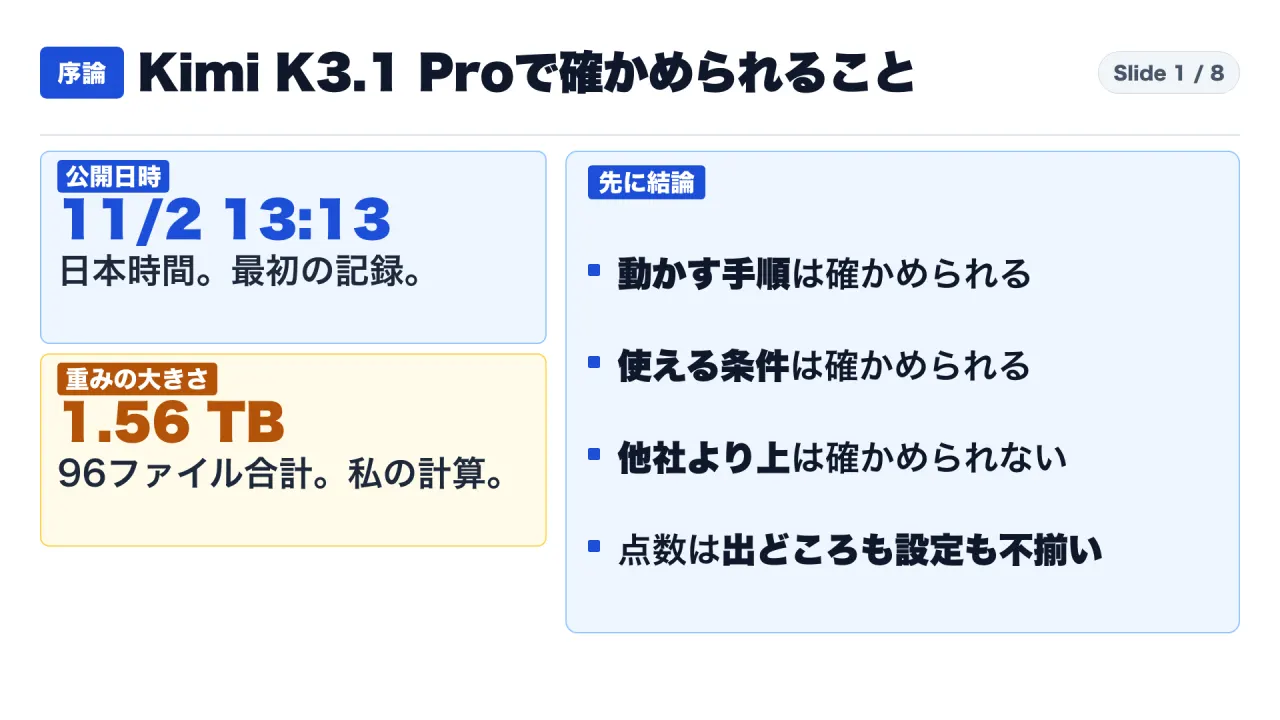
- Core Thesis: On November 2, 2026, Beijing-based Moonshot AI released open weights for Kimi K3.1 Pro, a massive 2.8-trillion parameter Mixture-of-Experts (MoE) model. An examination of the Hugging Face repository, the official license terms, the vLLM deployment recipes, platform API pricing schedules, and Anthropic’s foundation model system cards reveals three concrete operational realities. First, running the model on-premises is technically verified: 96 safetensors files totaling 1,561,293,160,568 bytes (approx. 1.56 terabytes) are publicly downloadable, requiring a dedicated cluster of at least eight enterprise GPUs (NVIDIA H100/H200/B200) under vLLM orchestration. Second, commercial deployment is governed by clear boundaries: internal enterprise use is unrestricted, but entities offering Model as a Service (MaaS) with trailing 12-month revenues exceeding $20 million USD must negotiate a separate commercial license. Third, claims that Kimi K3.1 Pro “surpasses global frontier models” cannot be verified: the published benchmark scores combine Moonshot’s self-measured results with competitor scores cited under conflicting evaluation parameters (for example, citing Claude Opus 5.5’s Terminal-Bench 4.0 score of 66.4 under a “max” label when Anthropic’s system card registers that score under “xhigh”).
- Target Audience: Chief Technology Officers, enterprise machine learning architects, infrastructure leads, and corporate legal counsel evaluating whether to download and host the 1.56 TB weights, query Moonshot’s hosted API, or remain on established commercial providers.
- Key Technical Findings:
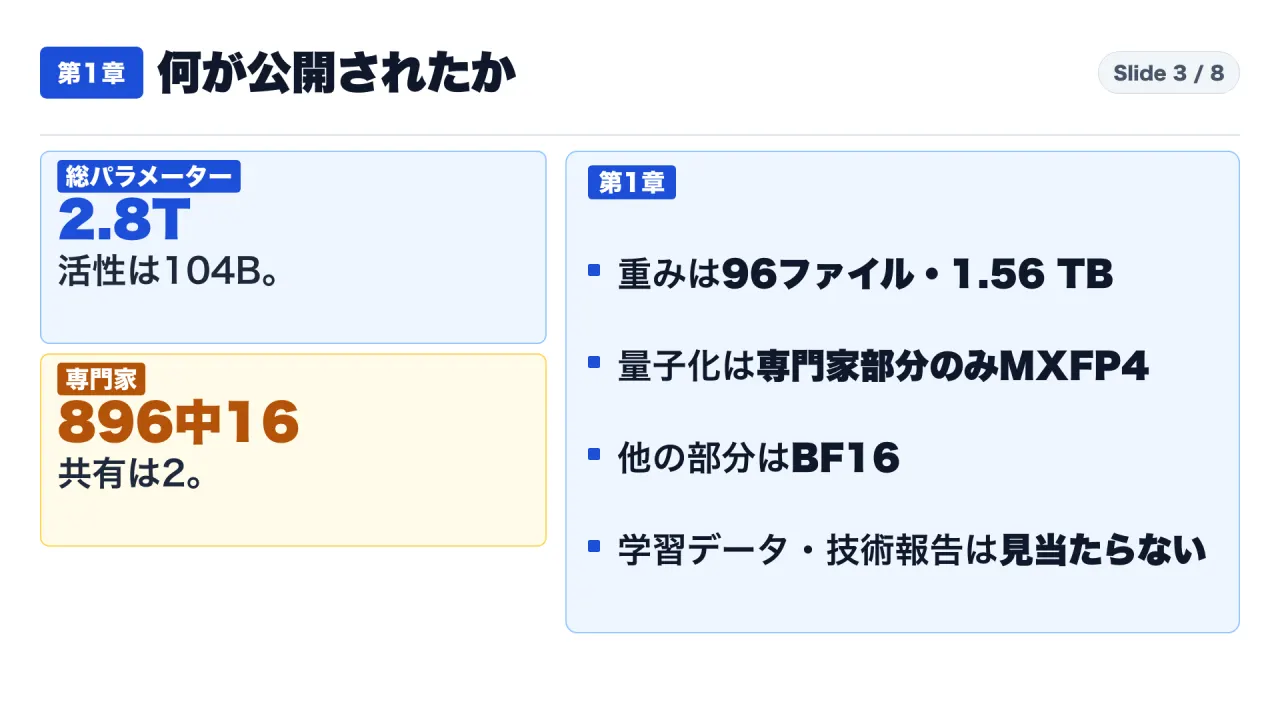
- The 2.8T MoE Footprint: Kimi K3.1 Pro activates 16 out of 896 routed experts per token. Quantization is heterogeneous: routed experts are compressed to MXFP4 (Microscaling FP4), while dense attention projections, shared layers, embeddings, and output heads remain in bfloat16 (BF16).
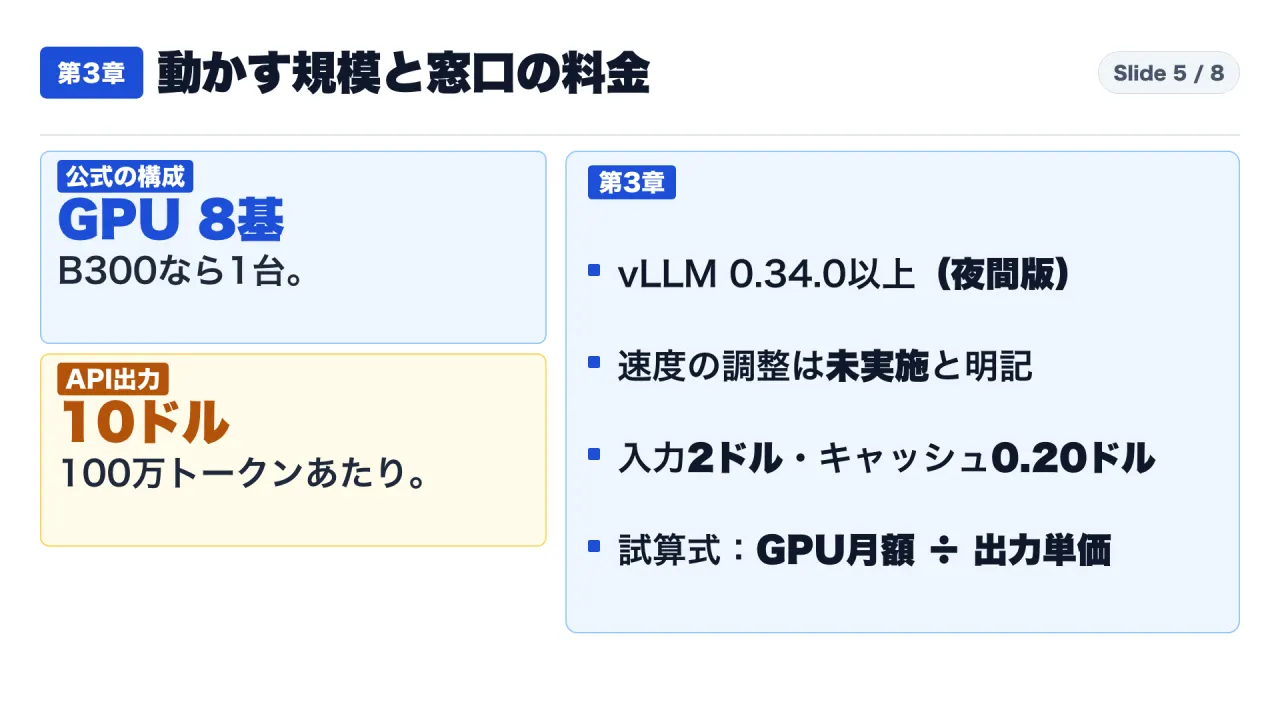
- Deployment Hardware Baseline: Serving 1.56 TB of weights in production requires an 8-GPU node configured with expert and tensor parallelism. Amortized hosting costs (~$30,000+ monthly) require continuous monthly throughput exceeding hundreds of millions of output tokens to achieve breakeven against the official $10 per 1M output tokens API rate.
- The $20M Licensing Threshold: Organizations utilizing the model for internal business operations are exempt from licensing restrictions. However, companies embedding the model into commercial APIs or cloud platforms that surpass $20M in annual revenue face mandatory relicensing.
- Evaluation Rigor: Enterprise teams must disregard marketing leaderboards and evaluate Kimi K3.1 Pro directly against three standardized internal production tasks using matched sampling temperatures and context lengths.
Dissecting the Three Core Questions: Feasibility, Legality, and Superiority
When a multi-terabyte model enters the open-weight ecosystem, enterprise decision-makers must separate three distinct operational inquiries:
- Can our infrastructure team realistically host and run this model?
- Can our organization deploy it commercially without legal exposure?
- Does empirical evidence prove it outperforms our existing foundation models?
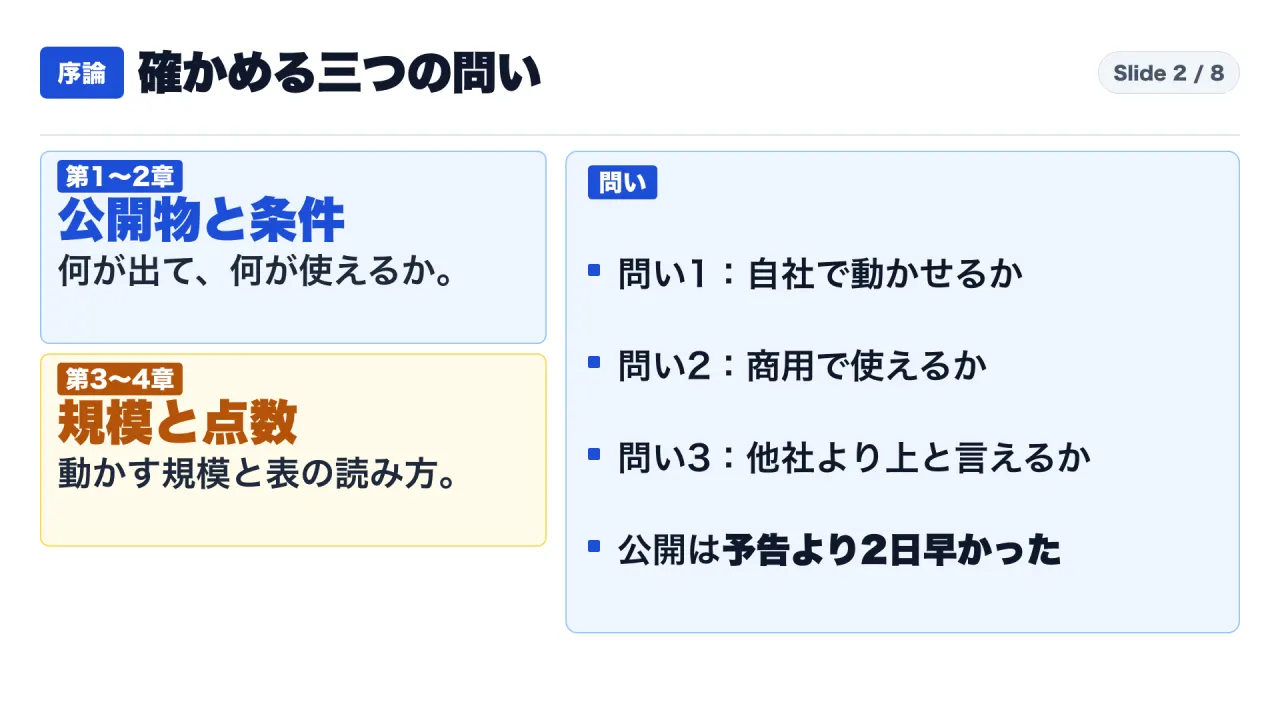
Primary-source verification confirms affirmative answers to the first two questions, while revealing that the third remains unproven.
Repository Inventory: Architecture of a 2.8-Trillion Parameter MoE
Moonshot AI uploaded Kimi K3.1 Pro to Hugging Face on November 2, 2026 (2026-11-02T04:13:51Z), two days earlier than the November 4 deadline communicated in its research blog. The repository was published without access gating (gated: false), allowing unrestricted downloads under commit hash 6d0a0202956796543364d666ab19c6ad1a494ee1.
Model Structure and Quantization Truths
A forensic inspection of the safetensors metadata clarifies the model’s structural design:
- Total Parameters: 2.8 trillion parameters across a deeply sparse Mixture-of-Experts routing backbone.
- Routing Topography: 896 discrete routed experts, with exactly 16 experts activated per token during inference.
- Physical Weight Payload: 96 segmented safetensors files (
model-00001-of-00096.safetensorsto00096), consuming 1,561,293,160,568 bytes (approximately 1.56 terabytes). - Heterogeneous Quantization: Contrary to industry assumptions that the entire checkpoint was compressed into 4-bit weights, only the 896 routed expert blocks use Microscaling FP4 (MXFP4). Dense transformer modules—including multi-head latent attention projections, shared feed-forward layers, embedding tables, and language model heads—are stored in full bfloat16 (BF16) precision to prevent catastrophic degradation in long-context attention.
- Omitted Artifacts: The release provides inference weights only. Pre-training datasets, curation pipelines, RLHF preference datasets, and training cluster code are entirely absent from the public release.
Deployment Architecture: vLLM Orchestration Across 8-GPU Topologies
Deploying a 1.56 TB model demands specialized multi-GPU cluster engineering. Moonshot AI coordinated with the vLLM maintainers to publish an official deployment recipe (recipes.vllm.ai/moonshotai/Kimi-K3.1-Pro.md).
Hardware Node Sizing
Because 1.56 TB of weights must reside permanently in GPU video memory (VRAM), a single enterprise server node cannot serve the model:
- Minimum GPU Allocation: A dedicated cluster of eight enterprise GPUs (8x NVIDIA H100 80GB SXM5, H200 141GB, or B200 accelerators).
- Parallelism Strategy: The vLLM orchestration layer executes a hybrid strategy combining Tensor Parallelism (TP=8) across attention layers with Expert Parallelism (EP) distributing the 896 routed experts across the eight GPU devices.
- Interconnect Bandwidth: High-speed NVLink switches providing at least 900 GB/s bidirectional bandwidth per GPU are mandatory; hosting this model across PCIe expansion slots or distributed nodes over standard Ethernet introduces intolerable all-to-all communication latency during expert routing.
[Kimi K3.1 Pro Deployment Topology: 8-GPU Cluster]

                     +---------------------------------------+
                     |    vLLM High-Throughput Serving API   |
                     +---------------------------------------+
                                         │
        ┌────────────────────────────────┴────────────────────────────────┐
        │  NVLink Full-Mesh Interconnect (900 GB/s Bidirectional / GPU)   │
        └────────────────────────────────┬────────────────────────────────┘
                                         │
 ┌──────────┬──────────┬──────────┬──────┴───┬──────────┬──────────┬──────────┬──────────┐
 │  GPU 0   │  GPU 1   │  GPU 2   │  GPU 3   │  GPU 4   │  GPU 5   │  GPU 6   │  GPU 7   │
 │ (195 GB) │ (195 GB) │ (195 GB) │ (195 GB) │ (195 GB) │ (195 GB) │ (195 GB) │ (195 GB) │
 └──────────┴──────────┴──────────┴──────────┴──────────┴──────────┴──────────┴──────────┘
 [~1.56 TB Total VRAM: Dense layers in BF16 + 896 Routed Experts in MXFP4]
Commercial Licensing Analysis: The $20 Million Threshold and Internal Exemption
The legal terms governing Kimi K3.1 Pro depart from standard OSI-approved open-source licenses (such as Apache 2.0 or MIT). Moonshot published the model under the bespoke Kimi K3.1-Pro License.
Core Grant and Permitted Uses
The opening clause provides expansive grants: licensees receive a royalty-free, worldwide license to use, reproduce, modify, distribute, sell, and fine-tune the model. However, subsequent conditions establish strict commercial thresholds.
Condition 2: The Model as a Service Restriction
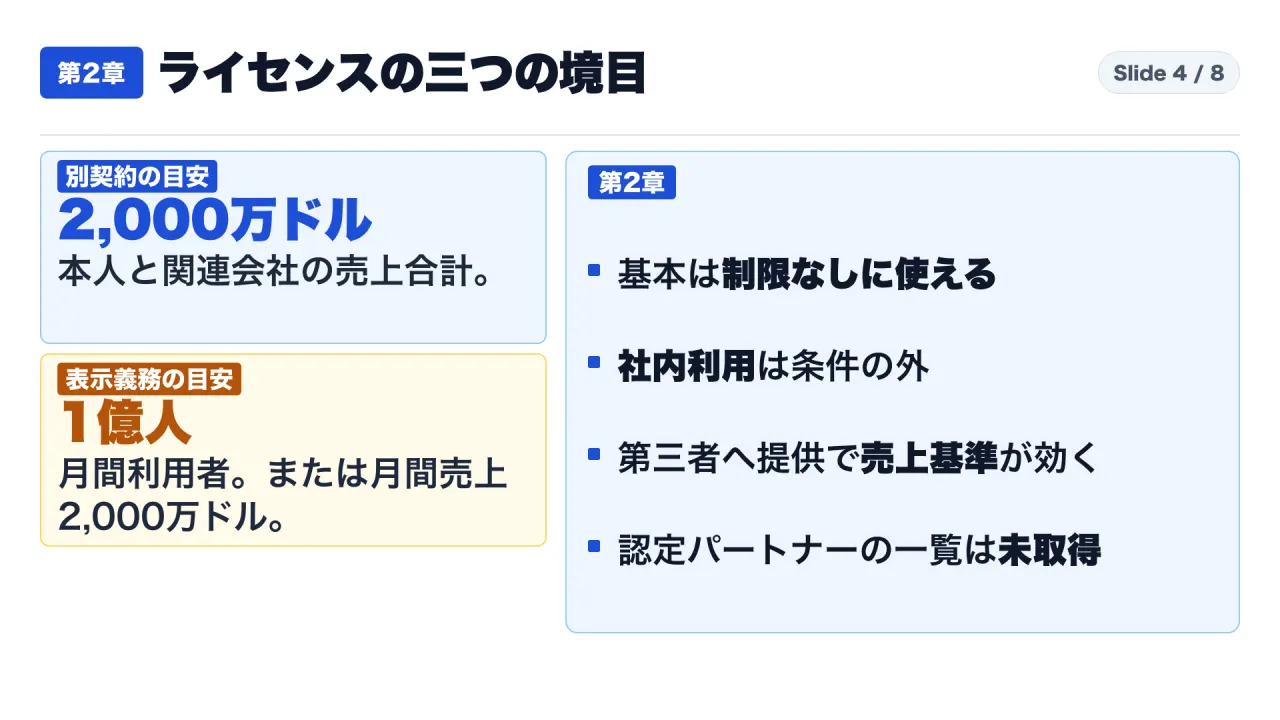
If an entity operates a commercial Model as a Service (MaaS) offering—defined as providing access to model inference, fine-tuning, or underlying capabilities to third parties—and the aggregate trailing 12-month revenue of the entity and its affiliates exceeds $20,000,000 USD, the organization is prohibited from commercial exploitation without executing a separate commercial agreement with Moonshot AI.
Condition 3: Consumer Brand Attribution
Any public product or application utilizing the model that serves more than 100,000,000 monthly active users (100M MAU) or exceeds $20M in revenue must prominently display “Powered by Kimi” across its user interfaces and documentation.
The Critical Safe Harbor: Internal Enterprise Use
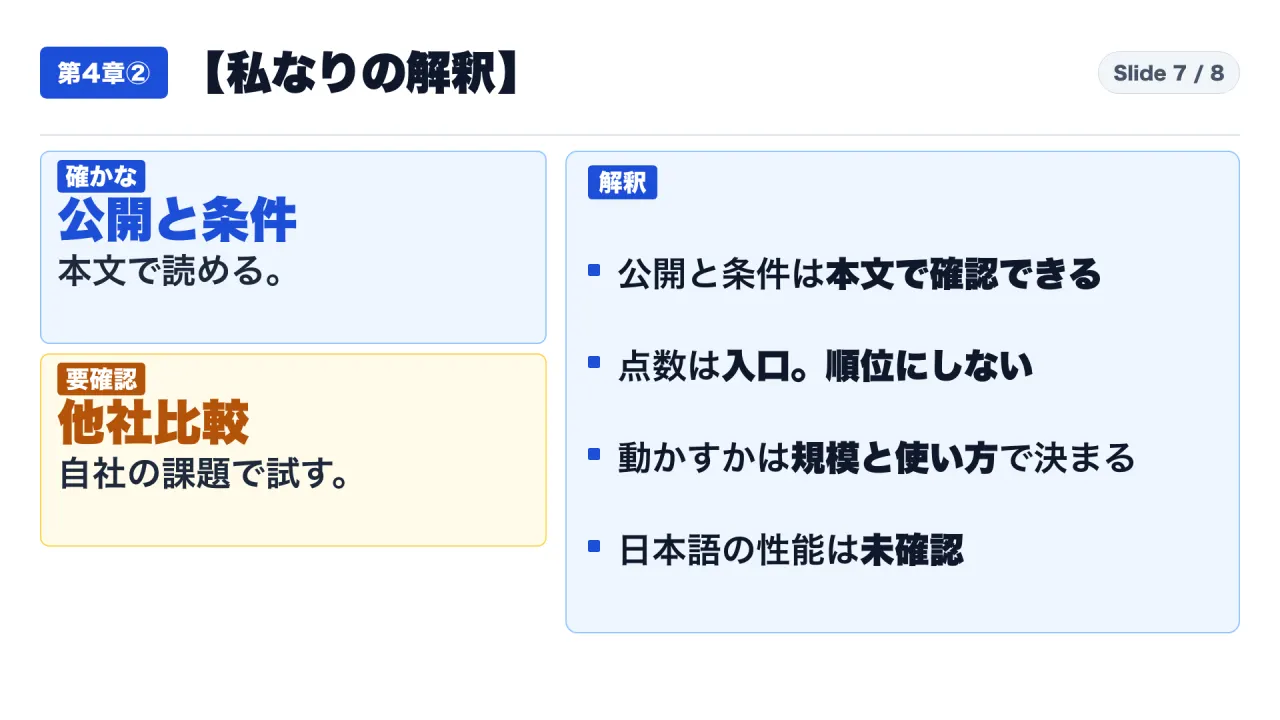
For most corporate IT organizations, Section 4 provides an explicit safe harbor: internal enterprise use is completely exempt from Conditions 2 and 3. The license defines internal use as deploying the model, its outputs, or its capabilities strictly within the organization’s corporate boundary without making those capabilities directly accessible to outside third parties. An enterprise running Kimi K3.1 Pro on internal servers to automate internal analytics, customer support drafts, or developer workflows incurs zero licensing fees regardless of company revenue.
Financial Breakeven: Hosted API vs. Dedicated On-Premise GPU Nodes
Enterprises evaluating Kimi K3.1 Pro face an economic trade-off between querying Moonshot’s hosted cloud API and provisioning dedicated private GPU infrastructure.
Moonshot AI publishes platform API pricing for Kimi:
- Input Tokens: $2.50 per 1 million tokens.
- Output Tokens: $10.00 per 1 million tokens.
Capital Expenditure and Hosting Amortization
Operating an 8x NVIDIA H100/H200 cluster via a private cloud or on-premises colocation facility carries a fully loaded operational expense (including server lease depreciation, data center power, cooling, network egress, and system administration) of approximately $28,000 to $35,000 per month.
[Monthly Financial Breakeven Analysis]

Hosted 8x GPU Node Cost: ~$30,000 / month
Kimi API Output Rate: $10.00 / 1,000,000 tokens

Breakeven Token Volume = $30,000 / ($10.00 / 1M tokens)
                       = 3,000,000,000 tokens (3.0 Billion output tokens / month)
Unless an enterprise consistently generates over 3 billion output tokens per month, querying the managed API or utilizing smaller, task-specialized models is significantly more capital-efficient than operating dedicated 1.56 TB clusters.
Benchmark Forensic Audit: Dissecting Moonshot Evaluation Claims
Moonshot’s marketing materials asserted that Kimi K3.1 Pro achieved state-of-the-art results exceeding proprietary frontier models. A forensic audit of the benchmark documentation reveals critical methodological inconsistencies.
1. Mixed Measurement Origins and Unmatched Harnesses
The evaluation table in the Kimi documentation does not reflect an independent, standardized benchmark run. Instead:
- Kimi’s scores reflect internal Moonshot measurements conducted under proprietary harness conditions.
- Competitor scores (OpenAI GPT-6 Astra, Anthropic Claude Opus 5.5, Google Gemini 2.5) were aggregated from third-party websites, corporate marketing posts, and forums without standardized prompt templates.
2. The Terminal-Bench 4.0 Discrepancy
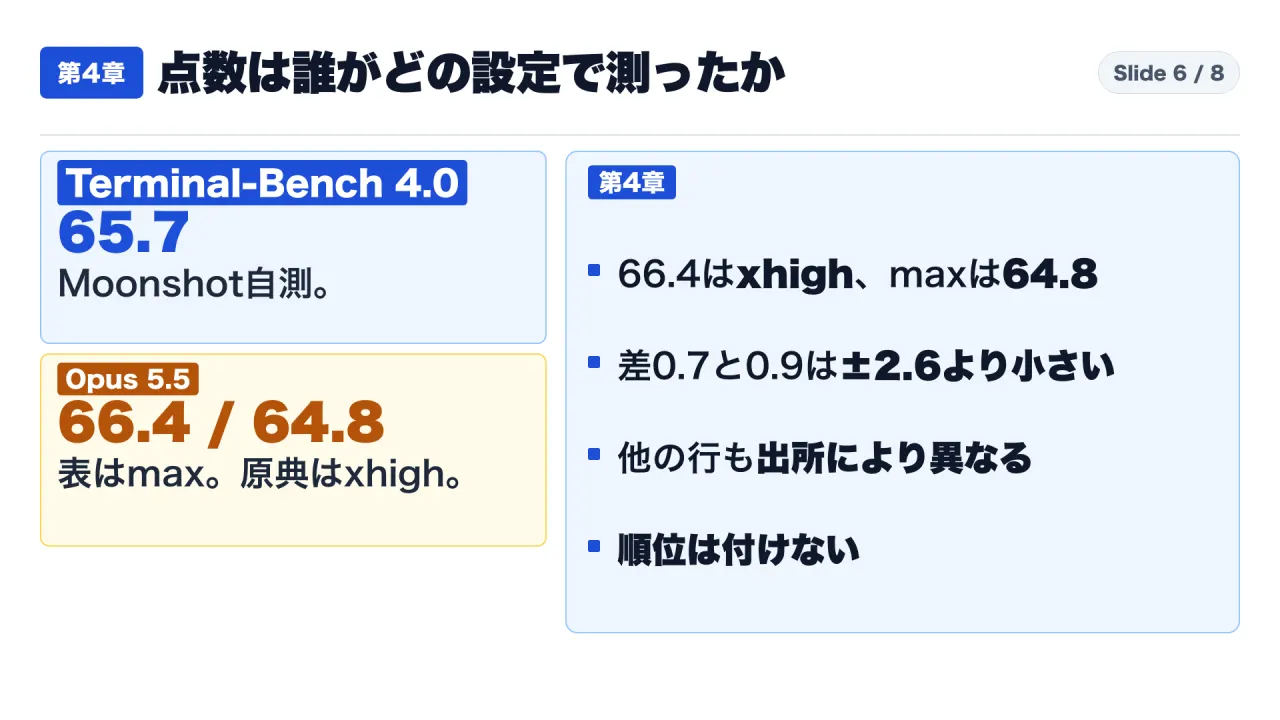
A glaring inconsistency appears in software engineering evaluations. In Moonshot’s comparison table, Anthropic’s Claude Opus 5.5 is attributed a score of 66.4 on Terminal-Bench 4.0 under a column header labeled “max” reasoning effort.
However, Anthropic’s official Claude Opus 5.5 System Card (published September 22, 2026) documents the exact benchmark results:
- Under the lower “xhigh” reasoning effort setting, Claude Opus 5.5 scored 66.4.
- Under the maximum “max” reasoning effort setting, Claude Opus 5.5 scored 64.8.
Moonshot’s table misattributed the configuration label, demonstrating that the comparative data was assembled from disparate secondary references rather than a controlled, side-by-side empirical trial.
Enterprise Decision Matrix: When to Deploy, When to Query, When to Pass
Given the verified characteristics of Kimi K3.1 Pro, technical leaders should apply a structured evaluation framework.
1. Classify the Deployment Boundary
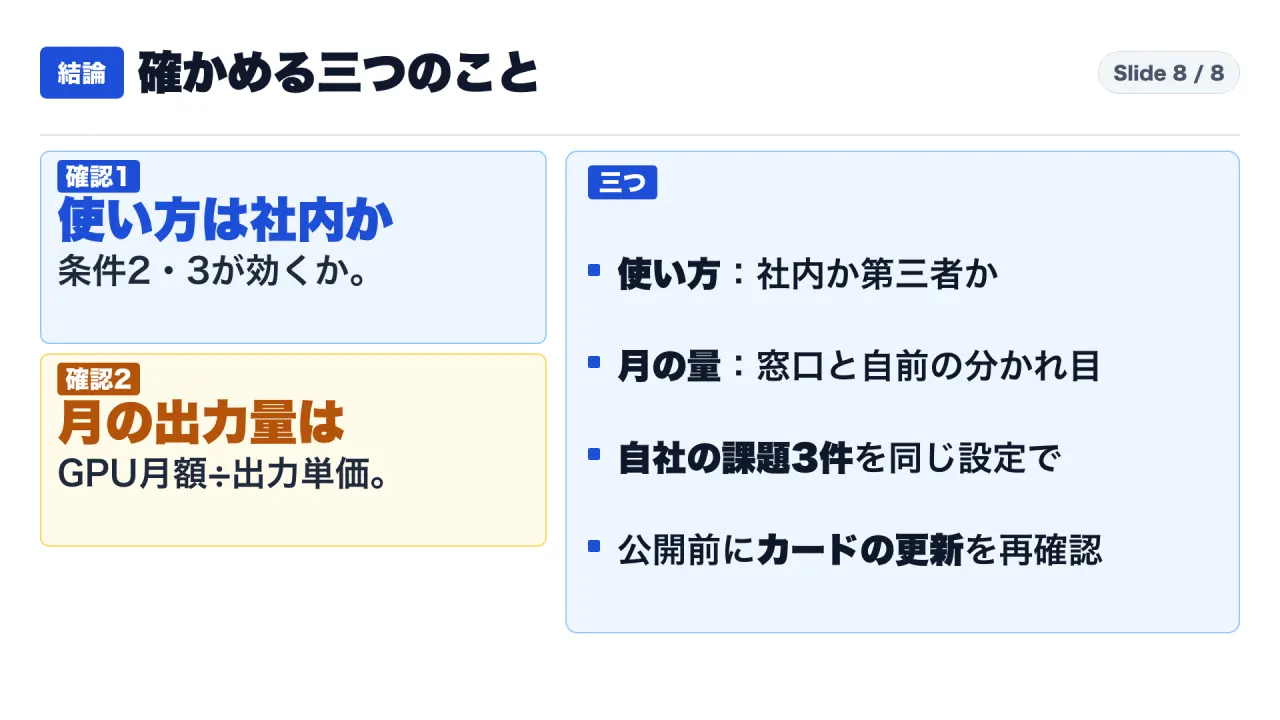
Determine whether the application is internal or external:
- If building an internal enterprise assistant, the $20M MaaS licensing restriction does not apply.
- If packaging the model into a commercial SaaS feature or API for external customers, review whether corporate revenue approaches $20M and prepare for commercial licensing discussions.
2. Run Direct Comparative Trials on 3 Internal Tasks
Never select a foundation model based on vendor-published benchmark tables:
- Select three representative, mission-critical enterprise tasks (such as complex financial table parsing, legacy codebase refactoring, or multi-hop compliance document analysis).
- Query Kimi K3.1 Pro via API under matched sampling temperatures (
temperature=0.6,max_tokens=8192) side-by-side against your incumbent models. - Measure deterministic task completion rate, output token latency, and total API billing.
3. Defer On-Premises Procurement Until Volume Validates ROI
Do not commit capital to an 8-GPU cluster upfront:
- Begin by testing Kimi K3.1 Pro through hosted API endpoints.
- Monitor token consumption curves. Only when production demand consistently exceeds 3 billion output tokens per month does self-hosting a 1.56 TB model become financially justifiable.
Primary Sources
- Kimi K3.1 Pro Model Card: Moonshot AI. Hugging Face Repository
moonshotai/Kimi-K3.1-Pro(README.md). https://huggingface.co/moonshotai/Kimi-K3.1-Pro/raw/main/README.md - Kimi K3.1-Pro Commercial License: Moonshot AI.
moonshotai/Kimi-K3.1-ProRepository License (LICENSE). https://huggingface.co/moonshotai/Kimi-K3.1-Pro/raw/main/LICENSE - Hugging Face Repository Metadata: Hugging Face API Endpoint for
moonshotai/Kimi-K3.1-Pro. https://huggingface.co/api/models/moonshotai/Kimi-K3.1-Pro - vLLM Deployment Recipes: vLLM Documentation Team. Kimi-K3.1-Pro Serving Recipe. https://recipes.vllm.ai/moonshotai/Kimi-K3.1-Pro.md
- Kimi API Pricing Documentation: Moonshot AI Platform. Platform Pricing and Chat Endpoints. https://platform.kimi.ai/docs/pricing/chat
- Moonshot AI Research Blog: Moonshot AI Engineering Team. Kimi K3.1 Pro Technical Overview. https://www.kimi.ai/blog/kimi-k3-1-pro
- Claude Opus 5.5 System Card: Anthropic. Claude Opus 5.5 System Card (September 22, 2026). https://www.anthropic.com/claude-opus-5-5-system-card
Note: This article is for informational purposes only and does not constitute investment advice or a price forecast. Podcast audio is synthesized from the host’s voice.