Inside the Hyperscaler Debt Surge and the Rise of Sovereign AI: What the IMF Report and Mistral Large 4 Reveal About the $650 Billion AI Financing Nexus
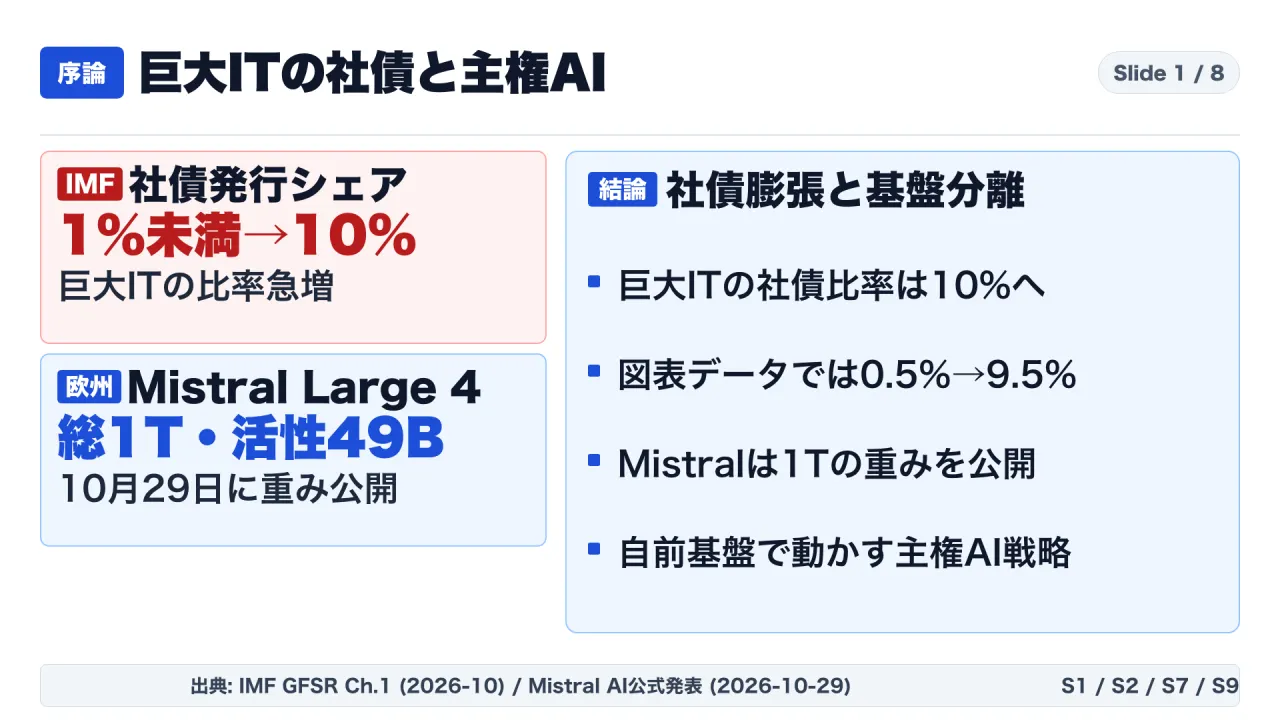
As U.S. cloud giants expand corporate debt to 10% of global investment-grade issuance and circular financing hits $650 billion, Europe’s Mistral AI counters with open-weight sovereign infrastructure under European law.
Japanese Edition: https://consuloji.substack.com/p/itaimistralaiimf
YouTube (Japanese audio): https://youtu.be/J7YuvtiLI-4
Executive Summary & Key Takeaways
- Core Thesis: The global artificial intelligence race is experiencing a structural bifurcation across capital structure, legal jurisdiction, and infrastructure control. An analysis of twelve primary sources—including the International Monetary Fund’s (IMF) October 2026 Global Financial Stability Report (GFSR), Form 10-Q filings from Alphabet and Meta Platforms, and the release documentation of France’s Mistral Large 4—reveals two opposing operating models. On one side, U.S. hyperscalers are funding soaring data center capital expenditures by tapping debt capital markets and orchestrating complex “circular financing” structures: hyperscalers now account for approximately 10% of global investment-grade corporate bond issuance, tied to $650 billion in AI-related debt and $1.4 trillion in future purchase commitments. On the other side, European players led by Mistral AI are countering closed cloud ecosystems with sovereign AI architectures—releasing a 1-trillion parameter native multimodal Mixture-of-Experts (MoE) model trained on European soil under European legal jurisdiction.
- Target Audience: Chief Information Officers, enterprise infrastructure architects, chief risk officers, corporate counsel, and institutional investors evaluating cloud vendor concentration, data residency, and the total cost of ownership of open-weight on-premises deployment versus closed cloud APIs.
- Key Analytical Findings:
- The Debt Shift: Hyperscalers’ share of global investment-grade bond issuance surged from 0.5% at the end of 2024 to 9.5% by July 2026. Cash reserves are no longer sufficient to fund annual capital expenditures that exceed $130 billion per firm.
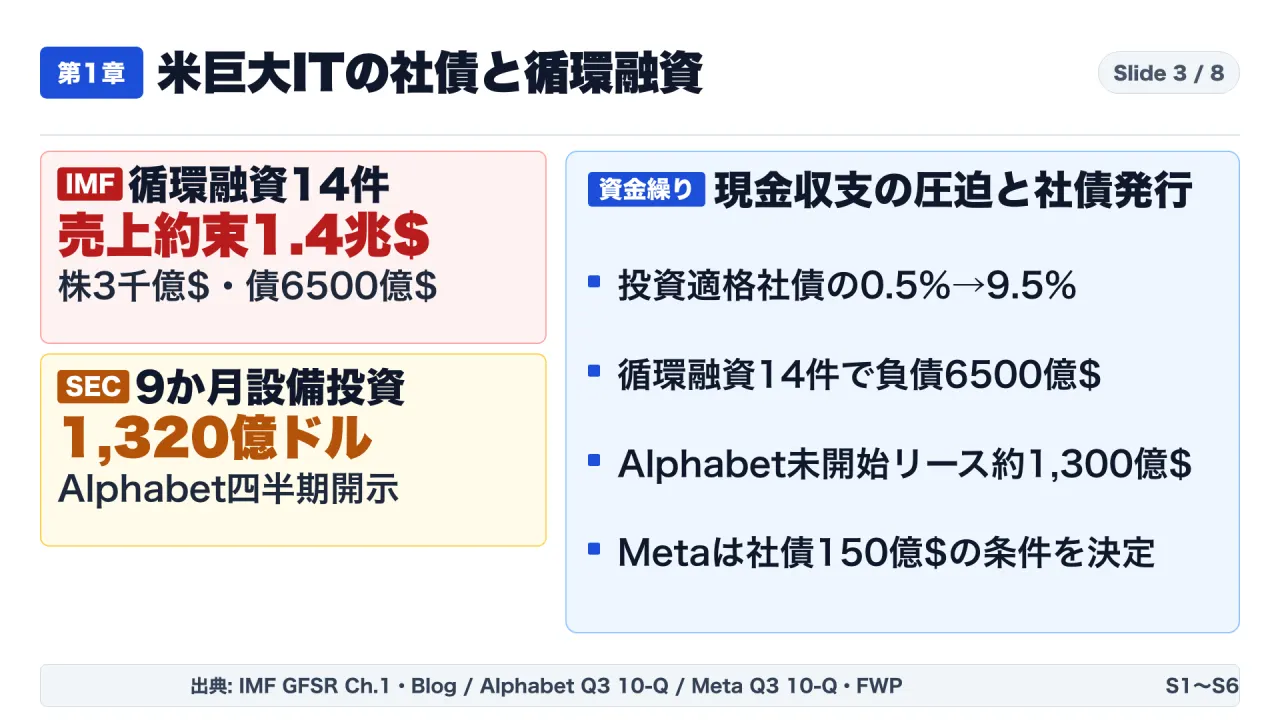
- The $650 Billion Financing Web: Across 14 major transactions tracked by the IMF since 2023, hyperscalers deployed $300 billion in equity into AI startups, paired with $650 billion in accumulated debt ($320 billion carried by recipient entities) and $1.4 trillion in multi-year compute purchasing commitments.
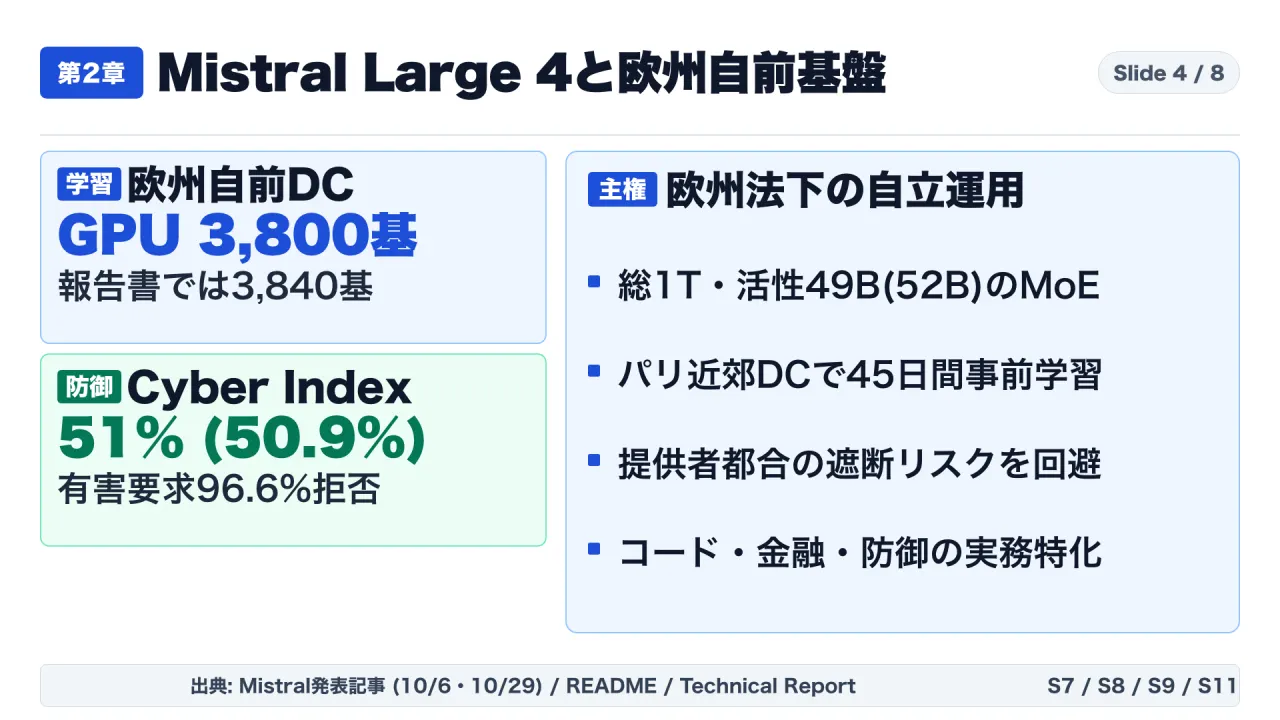
- Mistral Large 4 Technical Specifications: Mistral released weights for a 1-trillion parameter MoE (49 billion active parameters, expanding to 52 billion including embedding and output heads), pre-trained from scratch across 45 days on 3,840 NVIDIA Grace Blackwell (GB200) GPUs (~4.15 million GPU hours) in Paris.
- Separating Fact from Narrative: While regulatory filings confirm 10% bond shares and $454 billion in Meta contractual commitments, broadcast claims citing “a €3 billion fundraising at a €21 billion valuation” or “$345 billion in annual industry-wide AI spend” represent unverified private-company estimates that lack regulatory confirmation.
Disentangling Primary Facts from Broadcast Narratives
Public discussion surrounding AI infrastructure often blurs the boundary between legally audited corporate disclosures and unverified media commentary. In evaluating long-term enterprise commitments, IT leaders must maintain rigorous evidentiary standards.
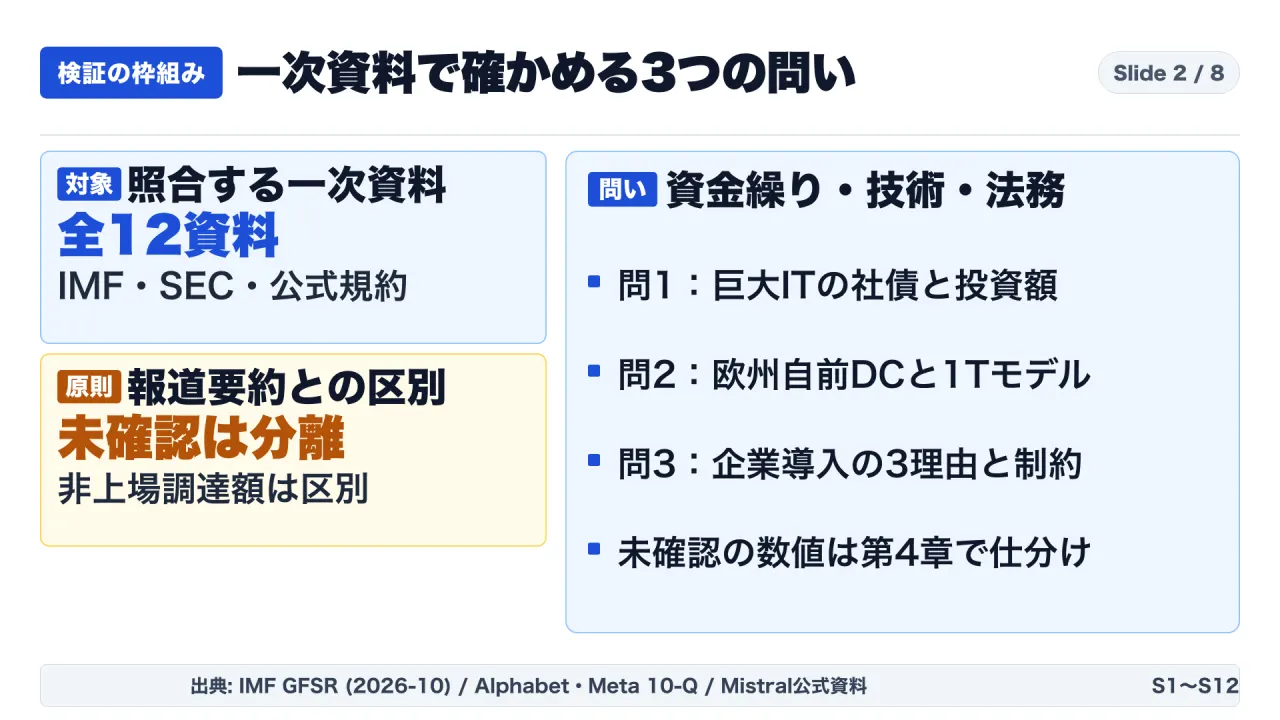
This analysis evaluates three interdependent dimensions:
- Financial Solvency: Are cloud providers funding data centers through organic operating cash flows, or does growing reliance on corporate debt and vendor financing introduce pricing volatility?
- Technical Feasibility: Can an enterprise run an open-weight 1-trillion parameter model within its own data centers, and what are the true hardware prerequisites?
- Legal Governance: What intellectual property and data sovereignty boundaries govern deployment under European versus U.S. regulatory regimes?
| Category | Primary-Source Confirmed Fact | Unverified Commentary / Media Narrative |
|---|---|---|
| Bond Issuance Share | Confirmed: 9.5% (approx. 10%) of global IG bonds (IMF GFSR Ch. 1) | “Tech debt is triggering immediate systemic credit contagion” |
| Circular Financing Scale | Confirmed: $300B equity, $650B debt, $1.4T offtake (IMF GFSR) | Unofficial claims of $1 trillion in circular debt |
| Hyperscaler Capex & Leases | Confirmed: Alphabet capex $132B (Jan-Sep), Meta $135B-$145B guidance | Unaudited third-party estimates of global annual AI capex ($345B) |
| Mistral Large 4 Model | Confirmed: 1T params, 52B active, 1.06 TB storage, Hugging Face repo | “Mistral Large 4 universally outperforms proprietary closed models” |
| Mistral Capitalization | Unconfirmed: Mistral is private; €3B round / €21B valuation unfiled | Repetition of broadcast interview claims as verified financial data |
The Macro Financial Picture: IMF October 2026 GFSR and Hyperscaler Debt Surge
For years, major technology companies operated as net-cash fortresses, financing aggressive research and development out of colossal operating margins. That era has ended. The capital intensity of frontier AI clusters—demanding custom silicon, high-bandwidth memory, gigawatt-scale grid connections, and specialized liquid cooling—exceeds annual free cash flows.
The IMF’s October 2026 Global Financial Stability Report (Chapter 1) highlights this structural shift:
- Tenfold Surge in Bond Market Share: Technology hyperscalers accounted for approximately 0.5% of total global investment-grade corporate bond issuance at the end of 2024. By July 2026, their share reached 9.5%. Technology infrastructure has transformed into one of the largest corporate borrowing sectors in the global capital markets.
- Alphabet SEC Filings (Form 10-Q, September 30, 2026): Alphabet reported capital expenditures of $132 billion for the first nine months of 2026—more than double the $63.6 billion deployed during the same period in 2025. Crucially, Alphabet disclosed $130.5 billion in undiscounted contractual commitments for infrastructure and data center leases that have not yet commenced.
- Meta SEC Filings & Debt Issuance: Meta raised its full-year 2026 capital expenditure guidance to $135 billion to $145 billion. Its unconditional contractual obligations totaled $454.52 billion, including long-term energy and compute purchase agreements. On November 3, 2026, Meta priced a $15.0 billion senior notes offering to finance ongoing capital programs.
Circular AI Financing: The $650 Billion Interlocking Debt and Revenue Web
The IMF’s report detailed an even more delicate development: the proliferation of circular financing structures between hyperscalers and AI foundation model developers.
In standard commercial transactions, cloud infrastructure is purchased with unencumbered operational revenue. In the AI ecosystem, hyperscalers frequently provide substantial equity investments to AI startups, which are then contractually bound to purchase cloud compute credits from the investing hyperscaler.
The IMF aggregated data across 14 major circular arrangements announced since 2023:
- Hyperscaler Equity Contributions: Approximately $300 billion.
- Associated Debt Obligations: $650 billion, of which roughly $320 billion is carried directly on the balance sheets of recipient AI firms (often supported by synthetic vendor financing, equipment leasebacks, or off-balance sheet special purpose vehicles).
- Future Offtake Commitments: $1.4 trillion in contractual promises to purchase future cloud computing capacity over multi-year horizons.
[The Circular Financing Nexus: IMF GFSR Framework]

   +-------------------------------------------------------+
   |              U.S. Hyperscaler Balance Sheet           |
   +-------------------------------------------------------+
          │                                 ▲
          │ $300B Equity Investment         │ $1.4T Contractual Offtake
          │ + Cloud Credit Allocation       │ (Recognized as Cloud Revenue)
          ▼                                 │
   +───────────────────────────────────────────────────────+
   |            AI Foundation Model Startup / SPV          |
   |   (Carries $320B of $650B Total Associated Debt)      |
   +───────────────────────────────────────────────────────+
          │
          ▼
   Infrastructure Debt Financing: $650 Billion Total
   (Secured by GPU collateral, private credit, and vendor guarantees)
This arrangement creates an economic vulnerability: if end-user enterprise monetization fails to meet exponential growth projections, the debt service obligations carried by AI startups could trigger write-downs across hyperscaler equity portfolios and weaken secondary GPU collateral markets.
Mistral Large 4 Architecture: 1-Trillion Parameter Native Multimodal MoE
Against this backdrop of proprietary cloud concentration and escalating leverage, France’s Mistral AI released Mistral Large 4 (internally designated Le Chonk) as an open-weight model on October 29, 2026.
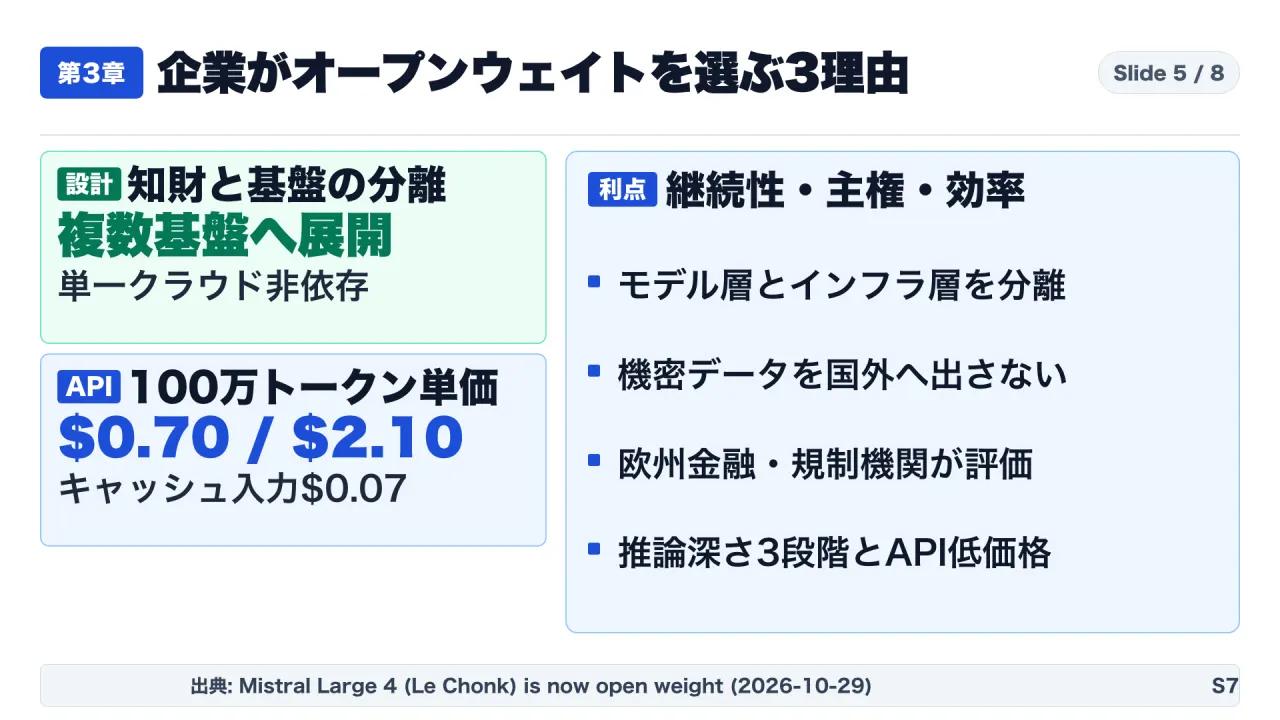
Mistral Large 4 represents an engineering milestone for European open-weight infrastructure:
- Parameter Capacity: 1.0 trillion total parameters in a sparse Mixture-of-Experts architecture. For any individual token forward pass, exactly 49 billion parameters are dynamically routed across active experts. When factoring in shared vocabulary embeddings and output projection heads, total active parameters reach 52 billion.
- Native Multimodality: Unlike architectures that bolt vision encoders onto frozen text backbones via cross-attention adapters, Mistral Large 4 was trained from step zero as an interleaved multimodal model, processing high-resolution visual inputs, document layouts, and code simultaneously.
- Pre-Training Cluster & Compute: The model was trained in Mistral’s data center facility in the Paris metropolitan area using 3,840 NVIDIA Grace Blackwell (GB200) GPUs connected via high-bandwidth NVLink and InfiniBand topologies. The training run lasted 45 days, consuming approximately 4.15 million GPU hours. (Note: The technical report cites 3,840 GB200 GPUs, while marketing announcements referenced 3,800).
- Configurable Reasoning Modes: The inference engine implements three distinct
reasoning_effortmodes (low, medium, high), allowing operators to dynamically throttle test-time compute based on task complexity.
Hardware Footprint and Deployment Economics: 1.06 TB Storage and GPU Topologies
While Mistral Large 4 is published as an open-weight model, downloading and serving a 1-trillion parameter architecture requires substantial on-premises or private-cloud hardware infrastructure.
Storage & Network Transfer
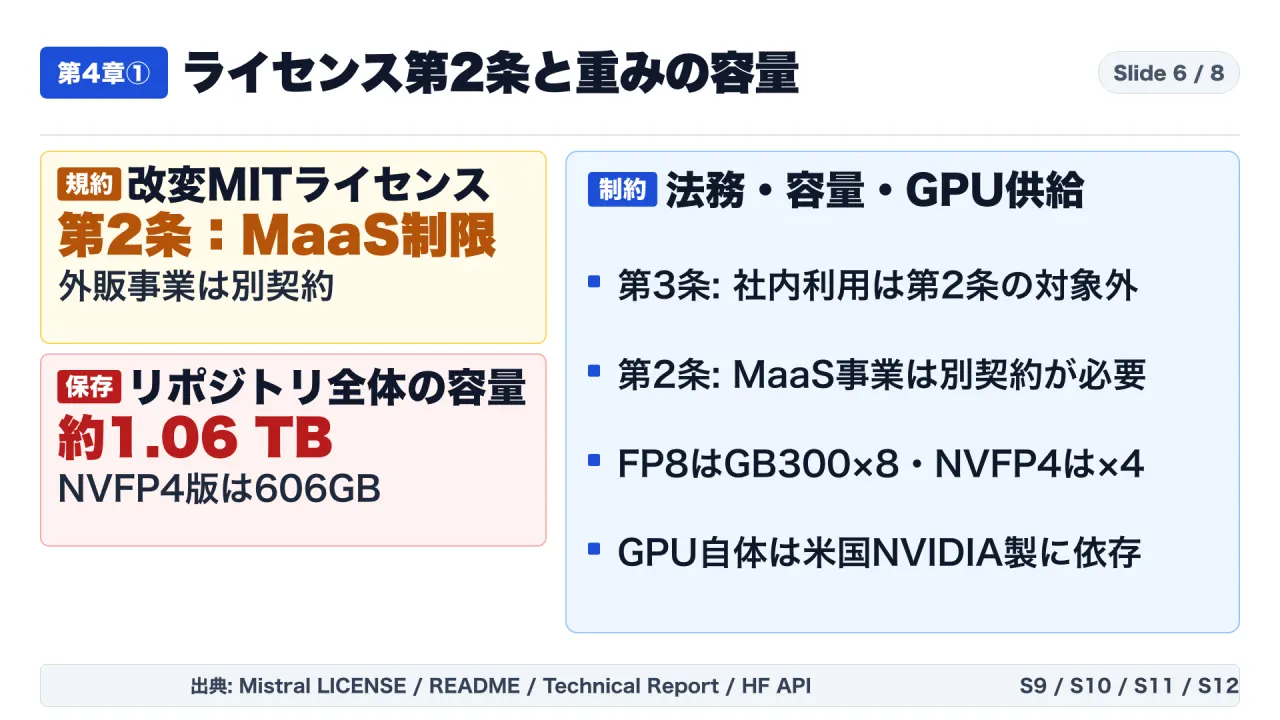
The uncompressed Hugging Face repository (mistralai/Mistral-Large-4-1T-A52B) comprises 96 segmented safetensors files totaling 1,060,619,283,859 bytes (approximately 1.06 terabytes). Moving this asset across corporate networks requires dedicated high-throughput storage pipelines.
Serving Topologies: Full Precision vs. NVFP4 Quantization
Deploying Mistral Large 4 for enterprise inference bifurcates into two hardware configurations:
- Full-Precision (bfloat16) Deployment: Serving the unquantized weights requires a cluster of eight NVIDIA H100, H200, or B200 GPUs (8x 80GB/141GB) utilizing tensor and pipeline parallelism. This delivers uncompromised accuracy and full-context throughput for mission-critical core reasoning.
- NVFP4 Quantized Deployment: Mistral released an officially calibrated NVFP4 quantized checkpoint reducing the storage footprint to 606 gigabytes. This variant fits within a single server node equipped with four NVIDIA H100 (80GB) GPUs, reducing local hardware acquisition and power costs by nearly 50% while preserving over 96% of full-precision benchmark accuracy.
The Sovereign AI Value Proposition and Legal Governance Boundaries
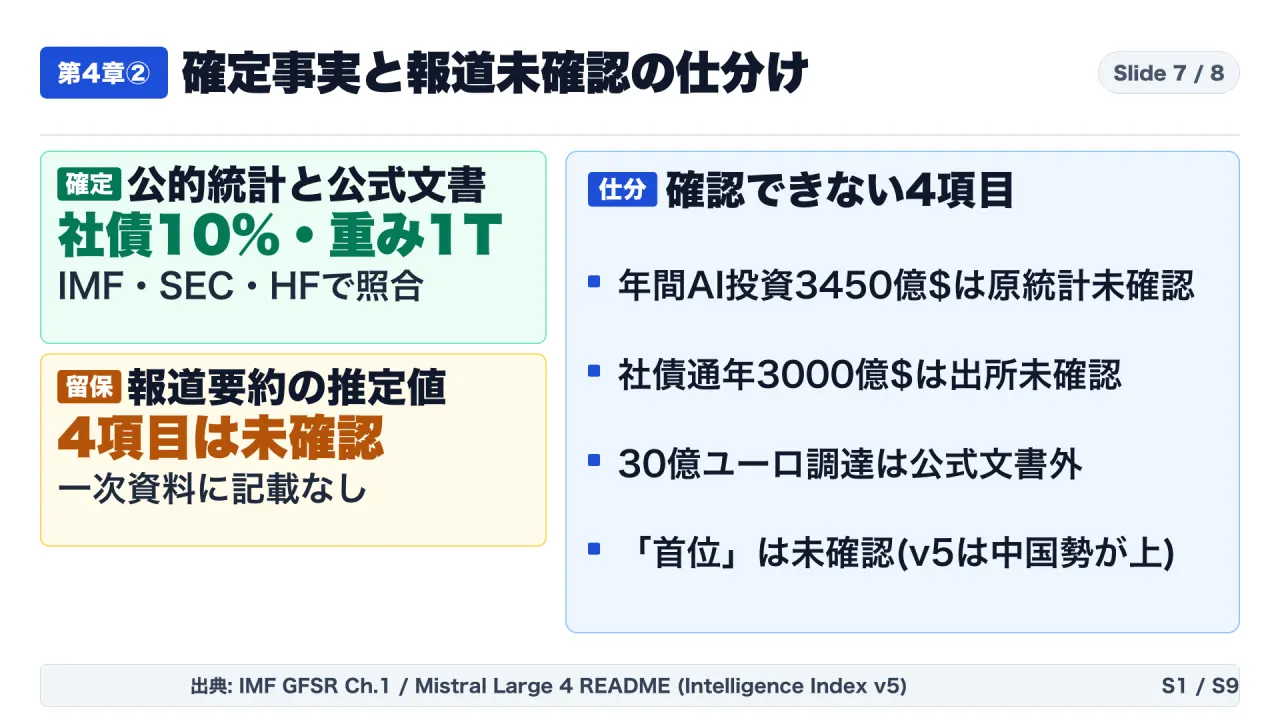
Why would an enterprise incur the hardware expense of self-hosting Mistral Large 4 rather than querying closed hyperscaler APIs? The decision hinges on three sovereign architecture principles.
1. Intellectual Property & Infrastructure Decoupling
In closed cloud ecosystems, an enterprise’s operational workflows are tightly coupled to vendor proprietary endpoints. If the vendor alters API pricing, modifies system prompts, deprecates model versions, or enforces compliance filtering, customer workflows break. With open weights, the model layer is treated as fixed intellectual property decoupled from the underlying hardware provider.
2. European Legal Jurisdiction & Data Sovereignty
For regulated industries in Europe (finance, defense, healthcare, and telecommunications), transmitting proprietary IP or sensitive customer records across foreign-owned cloud networks creates persistent exposure under the U.S. CLOUD Act and GDPR transfer regulations. Mistral provides a complete software stack operated under French and European law.
3. Licensing Boundaries: The Model as a Service Restriction
Enterprises must review the Mistral Ecosystem Open-Weight License carefully before deployment:
- Internal Enterprise Use: Fully permitted. Organizations may deploy, fine-tune, modify, and run the weights internally to power proprietary corporate applications without licensing fees.
- The Model as a Service (MaaS) Restriction: Under Section 2 of the license, any entity that provides access to the model’s functionality or fine-tuned variants as a managed hosted service or paid API to third parties must execute a separate commercial licensing agreement with Mistral AI.
The Hardware Sovereignty Paradox
Corporate leaders must also acknowledge the fundamental limit of current sovereign AI claims: while Mistral’s legal entity, data centers, software algorithms, and weight tensors reside in Europe, the physical compute engines powering them are designed by NVIDIA in California and fabricated by TSMC in Taiwan. Complete silicon sovereignty remains an unresolved long-term challenge for the continent.
Enterprise Strategy: Balancing Cloud Lock-in, Sovereign Control, and Capital Expenditure
Faced with escalating hyperscaler corporate debt and the rise of capable open-weight alternatives, organizations should execute a structured three-step evaluation.
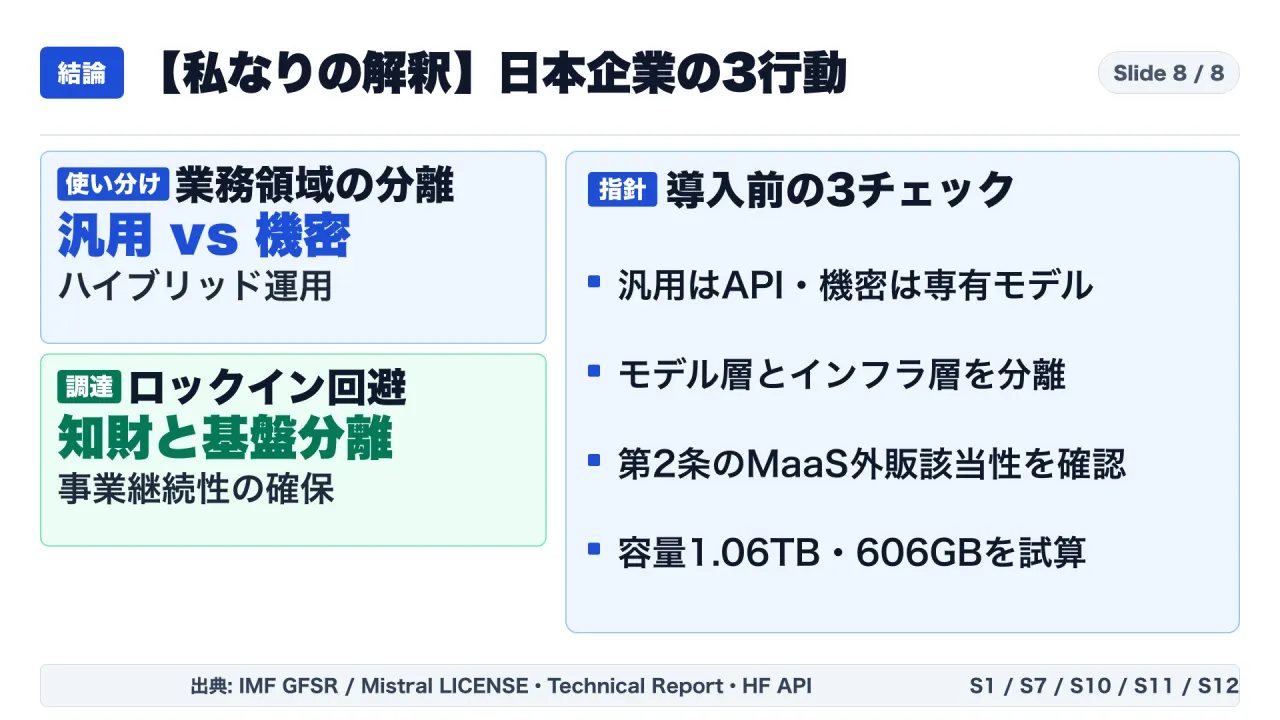
1. Stress-Test Cloud API Exposure
Evaluate corporate dependency on closed AI providers:
- Calculate the total cost of ownership across annual token consumption projections.
- Audit contract terms for price-escalation clauses, data retention policies, and cross-border data transfer liabilities.
- Quantify the operational blast radius if a primary cloud provider deprecates or modifies a core model checkpoint.
2. Profile On-Premises Workload Density
Determine whether self-hosting Mistral Large 4 aligns with workload volume:
- If steady-state inference consumes more than 150 million tokens per month, the amortized cost of an on-premises 4-GPU or 8-GPU node typically undercuts public API pricing.
- For intermittent, bursty experimental workloads, hosted European cloud instances (such as Mistral La Plateforme) offer flexibility without long-term capital lock-in.
3. Conduct Dual Legal Reviews
Ensure enterprise legal teams review both ends of the deployment pipeline:
- Verify that closed cloud contracts comply with internal data classification standards and sovereign privacy laws.
- Confirm that proposed on-premises applications fall cleanly within the internal-use provisions of the Mistral Ecosystem Open-Weight License, avoiding unbudgeted MaaS licensing disputes.
Primary Sources
- IMF GFSR Executive Summary: International Monetary Fund. Global Financial Stability Report, October 2026: Executive Summary (October 2026). https://www.imf.org/-/media/files/publications/gfsr/2026/october/english/execsum.pdf
- IMF GFSR Chapter 1: International Monetary Fund. Global Financial Stability Report, October 2026, Chapter 1: Global Financial Fragilities Set Against Growing Public and Private Debt (October 2026). https://www.imf.org/-/media/files/publications/gfsr/2026/october/english/ch1.pdf
- IMF Research Blog: IMF Financial Counselors. Global Financial Markets Face Rising Risks From AI, Bond Yields, and Cyberattacks (October 12, 2026). https://www.imf.org/en/blogs/articles/2026/10/12/global-financial-markets-face-rising-risks-from-ai-bond-yields-and-cyberattacks
- Alphabet SEC Filing: Alphabet Inc. Form 10-Q for the Quarterly Period Ended September 30, 2026 (U.S. Securities and Exchange Commission). https://www.sec.gov/Archives/edgar/data/1652044/000165204426000084/goog-20260930.htm
- Meta SEC Filing: Meta Platforms, Inc. Form 10-Q for the Quarterly Period Ended September 30, 2026 (U.S. Securities and Exchange Commission). https://www.sec.gov/Archives/edgar/data/1326801/000162828026066773/meta-20260930.htm
- Meta Senior Notes Pricing: Meta Platforms, Inc. Pricing Term Sheet: $15.0 Billion Senior Notes (November 3, 2026, SEC EDGAR). https://www.sec.gov/Archives/edgar/data/1326801/000119312526445646/d186765dfwp.htm
- Mistral Large 4 Announcement: Mistral AI Official Blog. Introducing Mistral Large 4 (October 6, 2026). https://mistral.ai/news/mistral-large-4
- Mistral Large 4 Open Weights: Mistral AI Official Announcement. Mistral Large 4 (Le Chonk) is now open weight (October 29, 2026). https://mistral.ai/news/mistral-large-4-oss/
- Mistral Ecosystem License: Mistral AI.
Mistral-Large-4-1T-A52BLicense Full Text. https://huggingface.co/mistralai/Mistral-Large-4-1T-A52B/raw/main/LICENSE - Mistral Large 4 Model Card: Mistral AI.
Mistral-Large-4-1T-A52BRepository Documentation. https://huggingface.co/mistralai/Mistral-Large-4-1T-A52B/raw/main/README.md - Hugging Face Storage Metadata: Hugging Face API Endpoint for
mistralai/Mistral-Large-4-1T-A52B. https://huggingface.co/api/models/mistralai/Mistral-Large-4-1T-A52B - Mistral Large 4 Technical Report: Mistral AI Engineering Team. Mistral Large 4 Technical Report (
assets/technical_report.pdf). https://huggingface.co/mistralai/Mistral-Large-4-1T-A52B/blob/main/assets/technical_report.pdf
Note: This article is for informational purposes only and does not constitute investment advice or a price forecast. Podcast audio is synthesized from the host’s voice.