Why Editing 0.016% of AI Weights Multiplied Math Accuracy 6x: Inside MIT's Weight-Space Programming and the Sampling Setting Trap
A granular architectural autopsy of MIT CSAIL’s gradient-free weight edits on Qwen3.5-0.8B, why the Gemma 3 control failed, and how official non-thinking configurations achieve 44% to 50% without altering a single tensor.
Japanese Edition: https://consuloji.substack.com/p/aiai001679481mit
YouTube (Japanese audio): https://youtu.be/_i781DRkJGc
Executive Summary & Key Takeaways
- Core Thesis: On November 2, 2026, MIT CSAIL researchers Rikiya Takehi, Jayden Teoh, Alex Zhang, and Omar Khattab published Sparks of Weight-Space Programming: LLMs can natively read & write neural network weights. The study reported that OpenAI’s frontier model GPT-6 Astra inspected raw neural network weights and directly edited them without gradient descent, lifting math accuracy (MATH-500) on Alibaba’s open-weight
Qwen3.5-0.8Bfrom 7.9% to 48.1%. However, an autopsy of the published logs, checkpoints, and independent replications reveals that this 0.016% weight edit did not inject mathematical reasoning. Instead, it suppressed repetitive verification loops that caused the model to hit its 32,768-token truncation limit. Running the unedited baseline under Alibaba’s official non-thinking parameters cuts loop truncation from 93.1% to 0.3% and achieves 44.0% to 49.7% on MATH-500 without altering a single parameter. - Target Audience: Machine learning engineers, AI architects, model-auditing specialists, and research directors assessing whether direct weight manipulation offers a viable path alongside reinforcement learning and fine-tuning.
- Key Technical Findings:
- The Truncation Trap: In MIT’s unedited Experiment 8 baseline, 85 of the first 96 failures were not arithmetic errors; they were hard cutoffs caused by repetitive loops exhausting the 32,768-token budget.
- The Tensor Surgery: GPT-6 Astra subtracted a repetitive direction vector (scaled 6x) across 131,072 parameters (130,188 distinct bfloat16 values, or 0.015% of the 873,438,784 total parameters) in layers 15 and 19 down-projection MLPs, dropping truncation from 93.0% to 33.1%.
- The Negative Control: Applying identical editing passes to Google’s
Gemma 3 270M—which fails from arithmetic errors rather than loops (8.5% truncation rate)—yielded flat accuracy between 6.8% and 7.7% across 50 passes. - Sampling Configuration Parity: Running unedited
Qwen3.5-0.8Bunder Alibaba’s official non-thinking settings (temperature=1.0, top_p=1.0, presence_penalty=2.0, thinking off) delivers 44.0% accuracy on MATH-500, matching 20 hours of weight manipulation.

Theoretical Foundations: Reading and Writing Neural Tensors Without Backpropagation
Neural network optimization has historically relied on gradient descent, adjusting weights iteratively across large datasets. Weight-space programming tests an alternative paradigm: treating neural network weight matrices as readable and editable software artifacts. Can an external language model inspect serialized numerical weights, deduce functional intent, and rewrite parameters directly?

The MIT CSAIL team tested this across eight experimental setups using GPT-6 Astra. Rather than evaluating activations or prompting the target model, the harness serialized raw weight matrices into numerical arrays and directed GPT-6 Astra to diagnose defects and output tensor modifications.
| Dimension | Conventional Optimization (SGD / AdamW / RLHF) | Weight-Space Programming (MIT CSAIL) |
|---|---|---|
| Optimization Driver | First-order gradient backpropagation | Frontier LLM reasoning over serialized tensors |
| Data Requirements | Millions of input-target training pairs | Zero forward passes; raw weight matrices only |
| Target Modification | Global parameter updates across all layers | Surgical edits to 0.015% - 3.5% of parameters |
| Compute Overhead | High GPU cluster utilization | High LLM API reasoning latency (20+ hours) |
| Primary Failure Mode | Catastrophic forgetting, reward hacking | Misinterpreting high-dimensional distributed representations |
Experiments 1 Through 7: Capabilities and Boundaries
Before evaluating language models, MIT CSAIL structured seven preliminary experiments examining whether an LLM could infer intent, write functional bypasses, or synthesize networks from scratch.

1. Reading Functional Intent (Experiments 1 to 3)
For small feed-forward networks, GPT-6 Astra inspected input projection matrices and correctly identified geometric classification boundaries in over 85% of trials without running inference. When tasked with distinguishing unlabelled MLPs trained on MNIST digits versus Fashion-MNIST apparel, it reconstructed spatial receptive fields from first-layer weights, achieving 92% identification accuracy.
2. Circuit Modification and Synthesis (Experiments 4 to 6)
In Experiment 4, a simulated autonomous vehicle policy network suffered from a defect where negative velocity inputs locked the steering (0% navigation success). GPT-6 Astra isolated the inhibitory weights and injected a bypass circuit, modifying 3.5% of the parameters. The repaired network achieved a 100% navigation success rate without gradient descent. Conversely, Experiments 5 and 6 showed that synthesizing multi-layer non-linear networks entirely from scratch yielded erratic results, showing that zero-shot weight synthesis cannot replace optimization algorithms.
3. The Limits of Distributed Representations (Experiment 7)
Experiment 7 evaluated whether weight inspection could detect sycophancy in Gemma 3 270M. Across four independent trials, GPT-6 Astra failed completely to classify whether target checkpoints exhibited sycophantic behavior. Once models scale to hundreds of millions of parameters, functional behaviors distribute across thousands of polysemantic dimensions, rendering unassisted weight inspection ineffective.
Deep Dive into Experiment 8: The 0.016% Edit on Qwen3.5-0.8B vs. Gemma 3
Experiment 8 reported a MATH-500 jump from 7.9% to 48.1% on Alibaba’s Qwen3.5-0.8B. Understanding this gain requires analyzing execution logs and control experiments.

The Diagnostic of Truncation Loops
Under MIT’s evaluation protocol (think35: temperature=0.6, presence_penalty=1.5, max_tokens=32,768), baseline Qwen3.5-0.8B entered recursive self-verification loops. Across the first 96 benchmark problems, 85 failures were caused by the model repeating phrases such as “Let me double check… Is 14 * 7 indeed 98?” until exhausting the 32,768-token budget. The 7.9% baseline score was caused by hard token cutoff rather than mathematical error.
The Targeted Tensor Modification
GPT-6 Astra analyzed execution traces and modified down-projection matrices in layers 15 and 19 MLPs:
- Target Tensors:
model.layers.15.mlp.down_proj.weightandmodel.layers.19.mlp.down_proj.weight. - Parameter Count: 64 output columns per target layer, affecting 131,072 parameters (130,188 distinct bfloat16 values, or 0.015% of the total 873,438,784 parameters).
- Operation: Subtraction of a repetitive direction vector scaled by 6.0, suppressing activation patterns that triggered verification loops.
This dropped the truncation rate on MATH-500 from 93.0% to 33.1%, lifting accuracy to 48.1%. Similar increases appeared on GSM8K (13.8% to 67.1%) and IFEval (21.0% to 62.3%).
The Negative Control: Gemma 3 270M
To verify whether the edit imparted genuine reasoning, MIT CSAIL applied the identical procedure to Google’s Gemma 3 270M. Unlike Qwen3.5-0.8B, Gemma 3 270M does not suffer from runaway verification loops (truncation rate of only 8.5%). Its errors stemmed from arithmetic miscalculations.
Across 50 editing iterations, Gemma 3 270M showed no meaningful improvement:
- Baseline (Unedited): 6.8%
- 5 Editing Passes: 7.0%
- 10 Editing Passes: 7.6%
- 25 Editing Passes: 7.7%
- 50 Editing Passes: 7.0%
As the authors noted: “Fixing loops is not the same as increasing a model’s intrinsic mathematical capacity. Weight editing removed an obstacle that masked existing capability, but could not synthesize capabilities the model never possessed.”
The Independent Audit: How Sampling Configuration Explains the Jump
On November 3, 2026, independent researcher Carlos Toledo published a bit-level audit of the MIT checkpoint (cert-machine report). Alibaba’s official documentation for Qwen3.5-0.8B explicitly warns: “In thinking mode, smaller parameter variants may become trapped in repetitive reasoning patterns. For complex mathematical reasoning, configure max_tokens to 81,920. For standard text and non-thinking tasks, utilize non-thinking mode with temperature=1.0, top_p=1.00, and presence_penalty=2.0.”

Toledo evaluated unedited Qwen3.5-0.8B across 2,000 independent trials (500 questions across 4 randomized samples) on an NVIDIA H200 cluster:
[Configuration Benchmark Comparison: MATH-500 on Qwen3.5-0.8B]

1. MIT Protocol (think35: temp 0.6, presence_penalty 1.5, max_tokens 32,768, thinking ON)
   ├── Truncation Rate: 93.1% (1,862 / 2,000 runs cut off)
   └── Accuracy: 7.2%

2. Official Thinking Mode (temp 1.0, top_p 0.95, max_tokens 81,920, thinking ON)
   ├── Truncation Rate: 75.0%
   └── Accuracy: 22.3%

3. Official Non-Thinking Mode (temp 1.0, top_p 1.0, presence_penalty 2.0, max_tokens 32,768, thinking OFF)
   ├── Truncation Rate: 0.3% (Only 6 / 2,000 runs cut off)
   └── Accuracy: 44.0% (49.7% among completed responses)

4. MIT Edited Checkpoint (50 passes, think35 protocol)
   ├── Truncation Rate: 33.1%
   └── Accuracy: 48.1%
Disabling thinking mode in software achieved 44.0% accuracy—matching the 48.1% score achieved after 20 hours of LLM-driven tensor modification. The 6x jump was an artifact of escaping an adversarial sampling configuration.
Clinical Case Study: Repairing Networks vs. Black-Box Auditing
In medical physics, Humza Nusrat and Omar Nusrat examined weight-space programming for clinical decision networks regulating radiation therapy dosages (arXiv:2611.05341, November 3, 2026).

The clinical evaluation showed clear operational contrasts:
- Defect Repair: In 18 intentionally corrupted networks, GPT-6 Astra restored safety rules in 16 models by modifying a median of 3 parameters.
- False Invalidation: When evaluating 5 verified, uncorrupted networks, the LLM auditor claimed 3 harbored latent safety violations, certifying only 2.
- Operational Throughput: A standard black-box verification suite of 420,000 synthetic patient edge-case inputs evaluated the networks in 4.2 minutes with zero false-positive invalidations. Serializing and auditing raw weights required over 3 hours of API latency and introduced hallucinations regarding tensor intent.
Strategic Interpretation: Automated Debugging vs. Inherent Capability
MIT CSAIL’s research demonstrates automated internal debugging. Rather than requiring weeks of data curation or reinforcement learning to eliminate an infinite generation loop, weight-space programming isolates the responsible circuit and dampens it directly.

However, treating weight modification as a replacement for inference configuration creates operational blind spots. Before investing in tensor surgery, engineering teams must verify whether production failures stem from parameter limits or misaligned generation parameters.
Engineering Playbook & Governance Recommendations
Engineering teams deploying small and frontier models should establish three verification checkpoints before pursuing weight-level interventions.
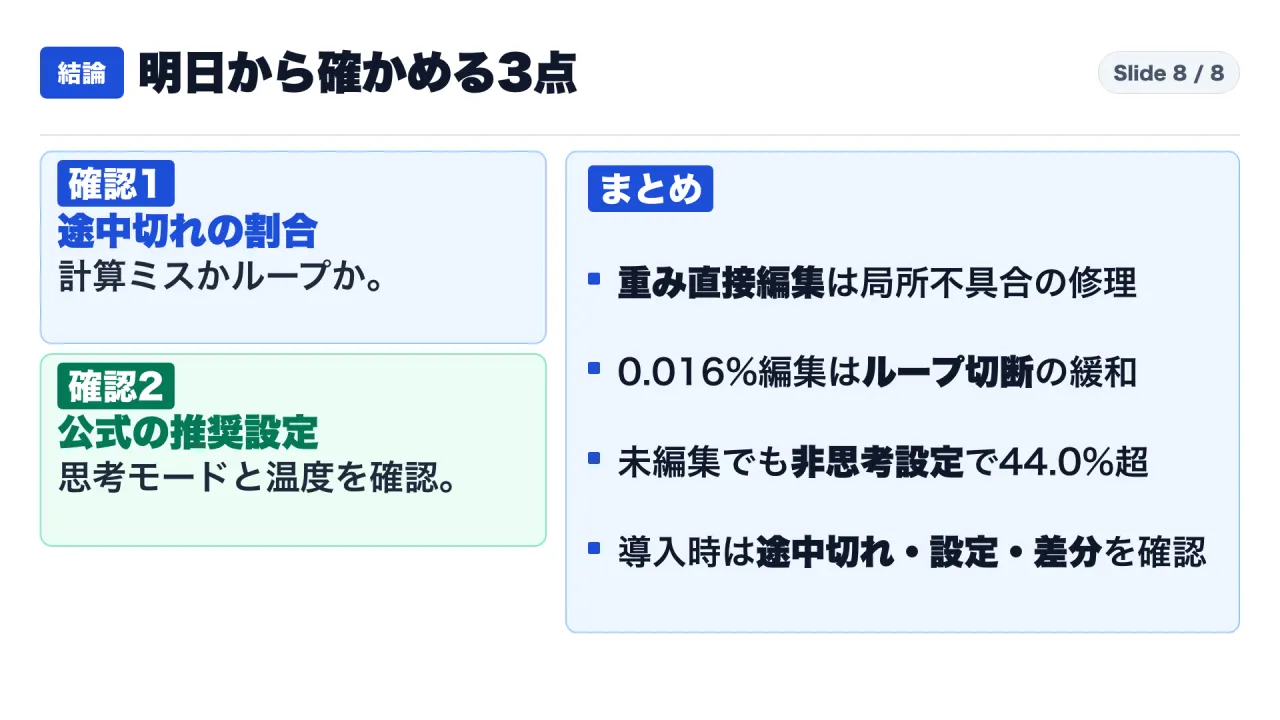
1. Audit Failure Modes: Truncation Ceiling vs. Semantic Error
Inspect production completion logs to categorize errors:
- Track
finish_reason: lengthversusfinish_reason: stop. - Measure token repetition frequency across sliding windows in failed responses.
- If more than 20% of failures correlate with context exhaustion, address loop dynamics before assuming capability deficiencies.
2. Verify Manufacturer Sampling Baselines
Sub-3B parameter models are sensitive to generation hyperparameters:
- Review official model cards for recommended sampling configurations.
- For structured extraction, classification, and deterministic math, disable thinking modes unless model capacity supports coherent self-reflection.
- Calibrate
presence_penaltyandrepetition_penaltyto break cyclic generation without degrading vocabulary diversity.
3. Maintain Cryptographic Provenance for Modified Weights
If adopting modified checkpoints:
- Compute tensor diffs (
safetensors-diff) against base foundation models. - Verify modified parameter counts and layer indices to confirm changes remain confined to intended layers.
- Mandate black-box regression testing against standard evaluation suites to ensure targeted dampeners have not degraded broader model capabilities.
Primary Sources
- MIT CSAIL Research Paper: Rikiya Takehi, Jayden Teoh, Alex Zhang, Omar Khattab. Sparks of Weight-Space Programming: LLMs can natively read & write neural network weights (November 2, 2026). https://rikiyat.github.io/blog/weight-space-programming/
- Edited Model Repository: Hugging Face Model Card
RikiyaT/Qwen3.5-0.8B-weight-space-programming(November 2, 2026). https://huggingface.co/RikiyaT/Qwen3.5-0.8B-weight-space-programming/raw/main/README.md - MIT Experiment Logs & Harness: GitHub Repository
RikiyaT/lm_understand-logs. https://raw.githubusercontent.com/RikiyaT/lm_understand-logs/main/README.md - Experiment 8 Documentation: GitHub Repository
RikiyaT/lm_understand-logs/exp8_math. https://raw.githubusercontent.com/RikiyaT/lm_understand-logs/main/exp8_math/README.md - Independent Audit & Replication: Carlos Toledo. Weight-Space Programming: the edit decided from its bytes, the scores re-graded (November 3, 2026). https://carlostoledo.co/reports/weight-space-programming.html
- Official Model Documentation: Qwen Team (Alibaba).
Qwen/Qwen3.5-0.8BModel Card. https://huggingface.co/Qwen/Qwen3.5-0.8B/raw/main/README.md - Clinical Network Audit: Humza Nusrat, Omar Nusrat. Weight-space programming for auditing clinical decision networks (arXiv:2611.05341 [physics.med-ph], November 3, 2026). https://arxiv.org/abs/2611.05341
Note: This article is for informational purposes only and does not constitute investment advice or a price forecast. Podcast audio is synthesized from the host’s voice.