Why OpenAI Built a Custom Git Backend in 10 Weeks: The 7.38 Billion Monthly Commit Limit, the Pierre Acquisition, and the Next-Generation Forge War
Inside the architectural collapse of traditional Git under autonomous agents, Pando’s causal consistency engine, Pierre’s 32TB multi-tenant storage, and the race to capture developer inline edits.
Japanese Edition: https://consuloji.substack.com/p/openaipierre-computer10gitpando738github
YouTube (Japanese audio): https://youtu.be/D4-bfU8WeGg
Executive Summary & Core Thesis
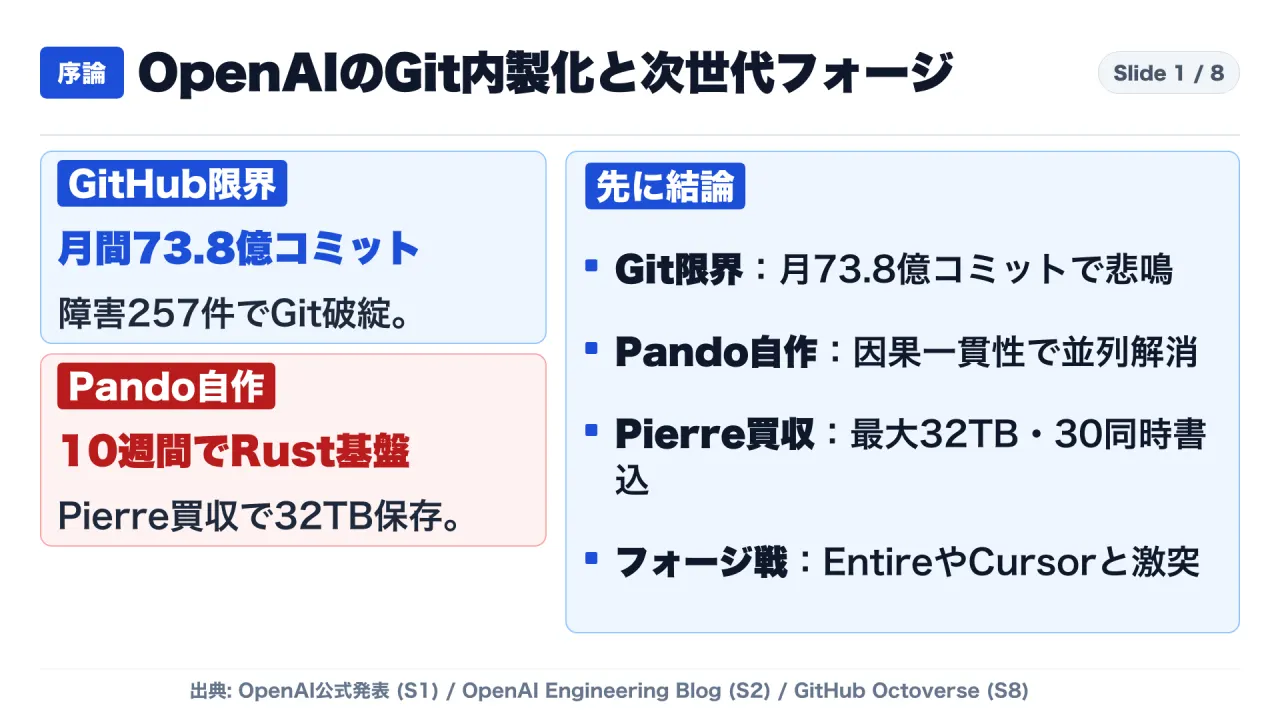
Autonomous software engineering agents operating around the clock have broken the traffic assumptions of distributed version control. When agents generate multi-turn code edits, launch continuous test loops, and push trial branches every few seconds, conventional code-hosting platforms reach structural exhaustion. In September 2026, monthly commits on GitHub reached 7.38 billion, while AI-generated pull requests exceeded 17 million. This surge drove 257 service incidents across GitHub in twelve months, including 48 major outages and a severe global downtime on August 17, 2026.
Inside OpenAI, the same concurrency crisis hit proprietary engineering pipelines. Thousands of engineers and autonomous Codex instances sharing a single monorepo triggered frequent merge failures and lock contention, degrading internal infrastructure reliability below 90%. To break this bottleneck, OpenAI executed a two-step infrastructure overhaul. On November 2, 2026, OpenAI revealed “Pando,” a custom distributed Git backend written in Rust in ten weeks to scale monorepo concurrency through causal consistency. Two days later, on November 4, 2026, OpenAI announced an agreement to acquire Pierre Computer Company, Inc., a developer infrastructure startup providing a high-throughput, multi-tenant Git storage engine supporting 32TB repositories and 15,000 requests per second.
This analysis examines the architectural mechanics and strategic implications across three dimensions:
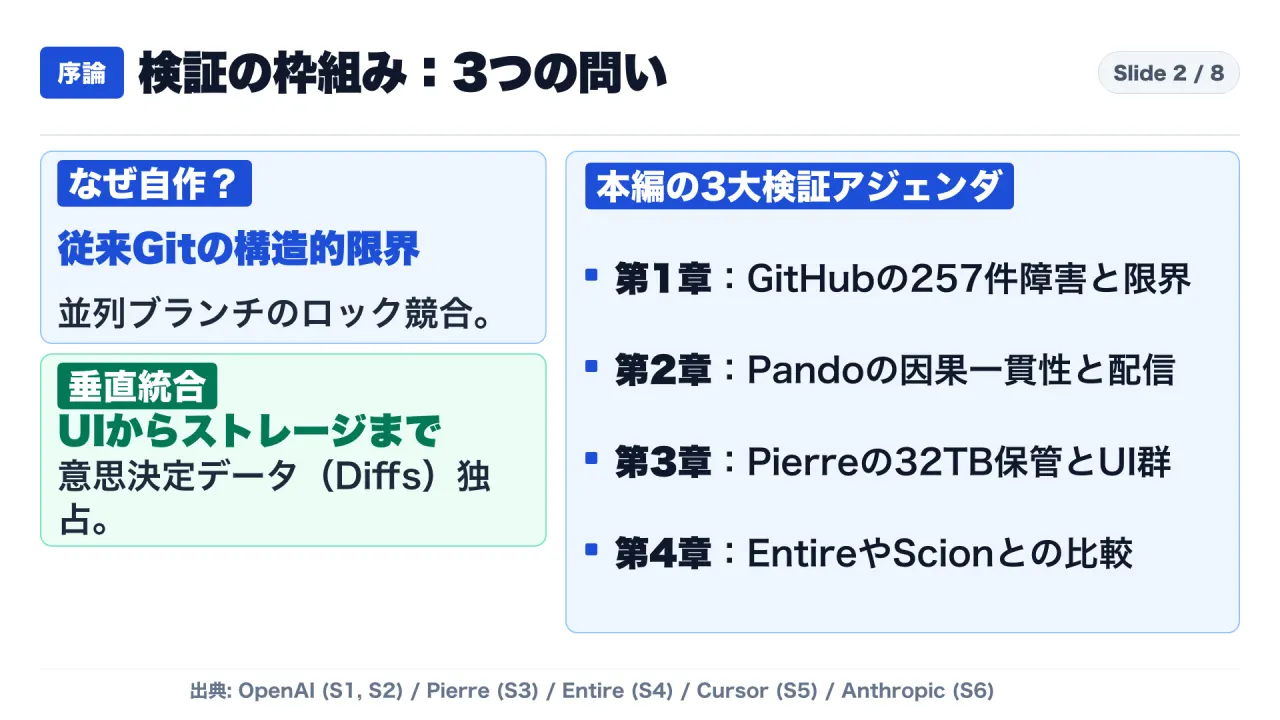
- The Concurrency Failure of Traditional Git: Why monolithic ref manifests, linear Write-Ahead Logs (WAL), and global Compare-and-Swap (CAS) locks fail under parallel agent swarms, and how Pando replaced global ordering with branch-level causal consistency and packfile-uri edge caching with a 99% hit rate.
- The Pierre Computer Stack: How Pierre’s Code Storage combines three-phase commit protocols with spoke-quorum consensus to deliver 32TB single-repository support, 30+ concurrent writes, and automated hot/cold tiering that cuts storage costs from $0.005 to $0.0002 per gigabyte per hour.
- The Strategic Battle for Decision Telemetry: Why frontier AI coding models require high-purity inline edit logs (Record of Work) rather than static public code. By controlling Pierre’s Diffs UI and storage layers, OpenAI captures human modifications to agent drafts while escalating co-opetition with Microsoft.
1. The 7.38 Billion Monthly Commit Ceiling: Why Traditional Git Collapsed Under Parallel Agents
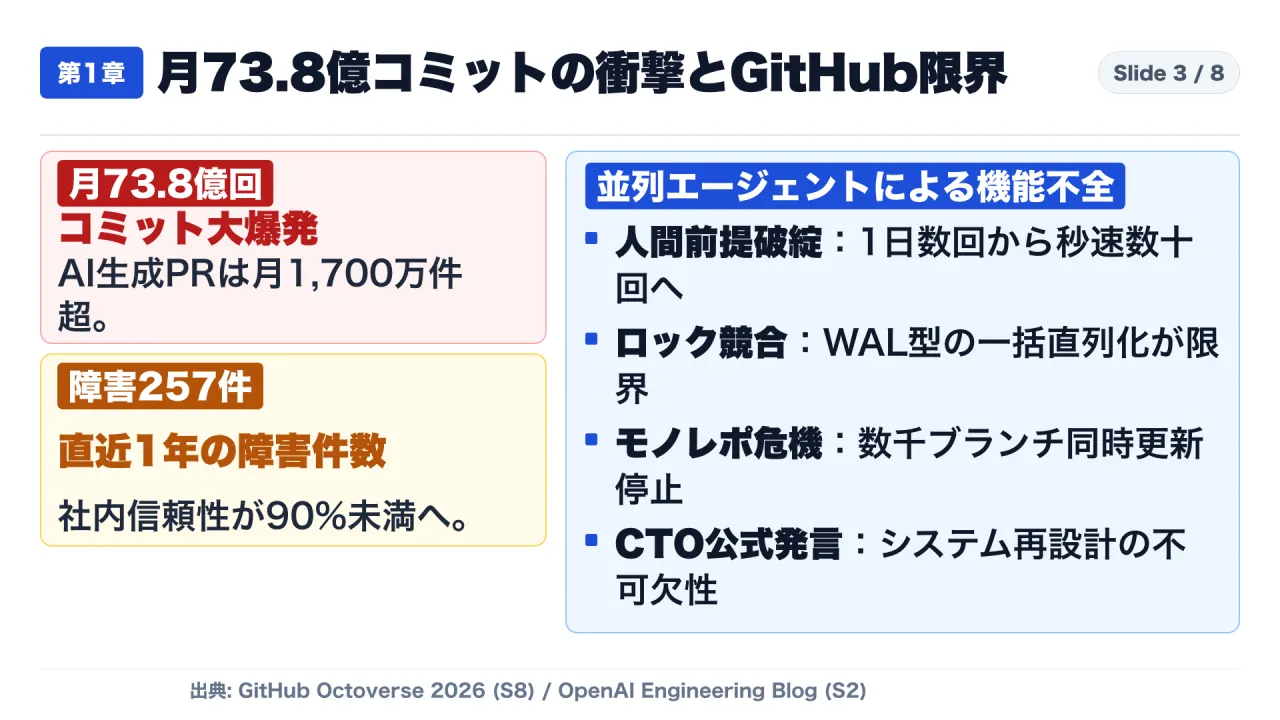
Distributed version control as architected by Linus Torvalds in 2005, and commercialized by GitHub beginning in 2008, assumes software is written by human beings committing code several times per day. Autonomous engineering agents invalidate this premise entirely. An agent branches within seconds, tests hypotheses through trial-and-error commits, triggers continuous integration pipelines, and retries failed assertions in continuous loops.
According to GitHub’s Octoverse telemetry, global commits reached 7.38 billion during September 2026—roughly 170,000 commits per minute around the clock. Furthermore, automated coding agents submitted over 17 million pull requests in that single month. Traditional Git hosting architectures could not absorb this volume. Incident analysis by LeadDev showed that between May 2025 and April 2026, GitHub suffered 257 service disruptions, including 48 major incidents, culminating in a global outage on August 17, 2026. GitHub Chief Technology Officer Vlad Fedorov acknowledged that sustaining availability in the agentic era requires a ground-up architectural redesign.
At OpenAI, this crisis hit its engineering core. In an internal monorepo where thousands of engineers and Codex agent instances operate simultaneously, agent concurrency overwhelmed reference databases. Parallel feature branches collided on central manifest Compare-and-Swap (CAS) operations, spiking merge latency and driving operational reliability below 90%.
2. Pando Architecture: Abandoning Global Ordering for Causal Consistency
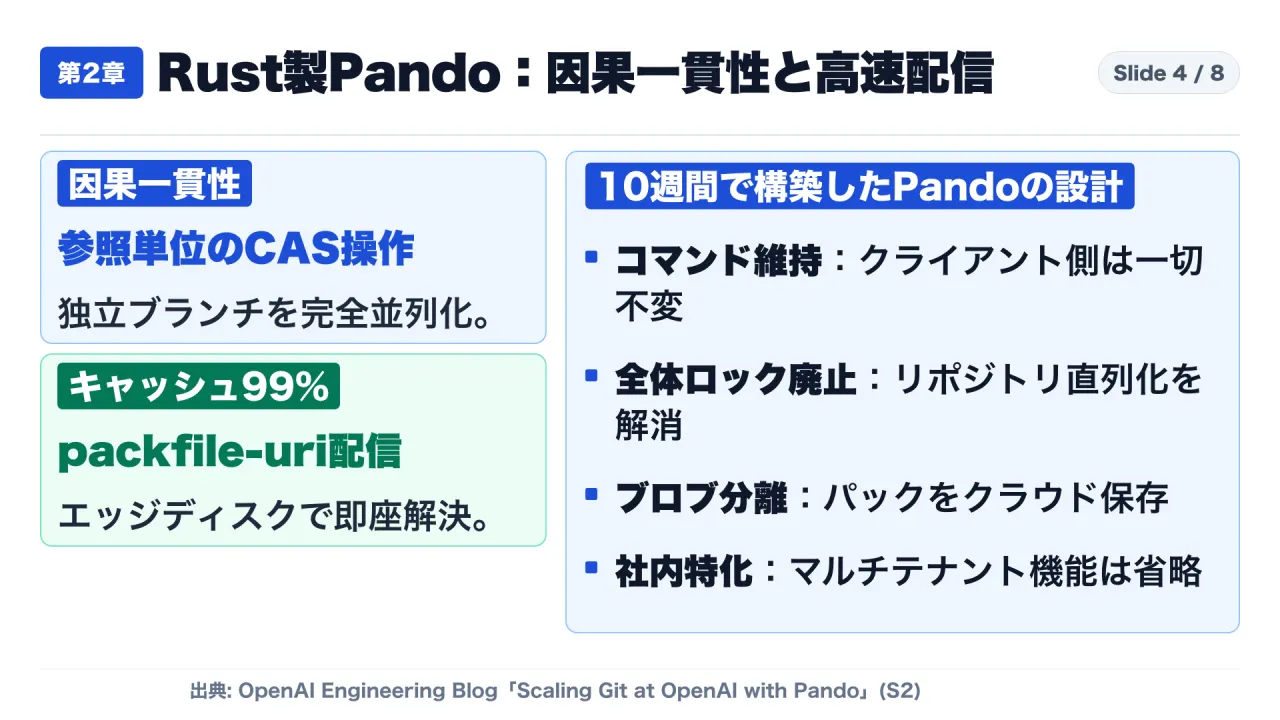
To resolve this crisis, OpenAI deployed Pando, a clean-slate distributed Git storage backend. Architected in Rust with extensive engineering assistance from Codex, Pando was designed, built, and deployed to production within ten weeks. Since April 2026, Pando has processed 100% of the production Git traffic in OpenAI’s internal monorepo.
Pando’s architecture centers on three engineering decisions:
Full Protocol Compatibility with Standard Git Clients
Pando introduces zero proprietary command-line interfaces. Engineers and Codex workers interact with repositories using standard Git commands (git clone, git fetch, git push), eliminating migration friction across existing development workflows.
Causal Consistency Over Global Ordering
Traditional Git hosting solutions enforce strict global linear ordering across all repository mutations. When independent agents push changes to unrelated branches, central manifests serialize operations via atomic CAS checks, generating severe retry storms. Pando resolves this by discarding global linear ordering in favor of causal consistency. The system tracks dependencies strictly between causally related commits, treating disjoint branches as independent events. Conflict detection was localized to branch-specific reference pointers, allowing thousands of agents to push isolated branches with zero lock contention.
Packfile-URI Distribution and Edge Caching
Transferring raw Git object graphs during high-frequency agent checkouts rapidly saturates network bandwidth. Pando stores consolidated Git packfiles in cloud object storage and serves them via standard Git packfile-uri extensions. By positioning local SSD cache tiers directly on workstations and container hosts, Pando achieved a cache hit rate exceeding 99%, dropping checkouts to milliseconds.
Despite its throughput, Pando was purpose-built for an internal single-tenant monorepo. It lacked multi-tenant partitioning, cryptographic isolation, and developer SDKs. To bridge this commercialization gap, OpenAI acquired Pierre Computer.
3. Pierre Computer Acquisition: Code Storage, 32TB Repositories, and the UI Trilogy
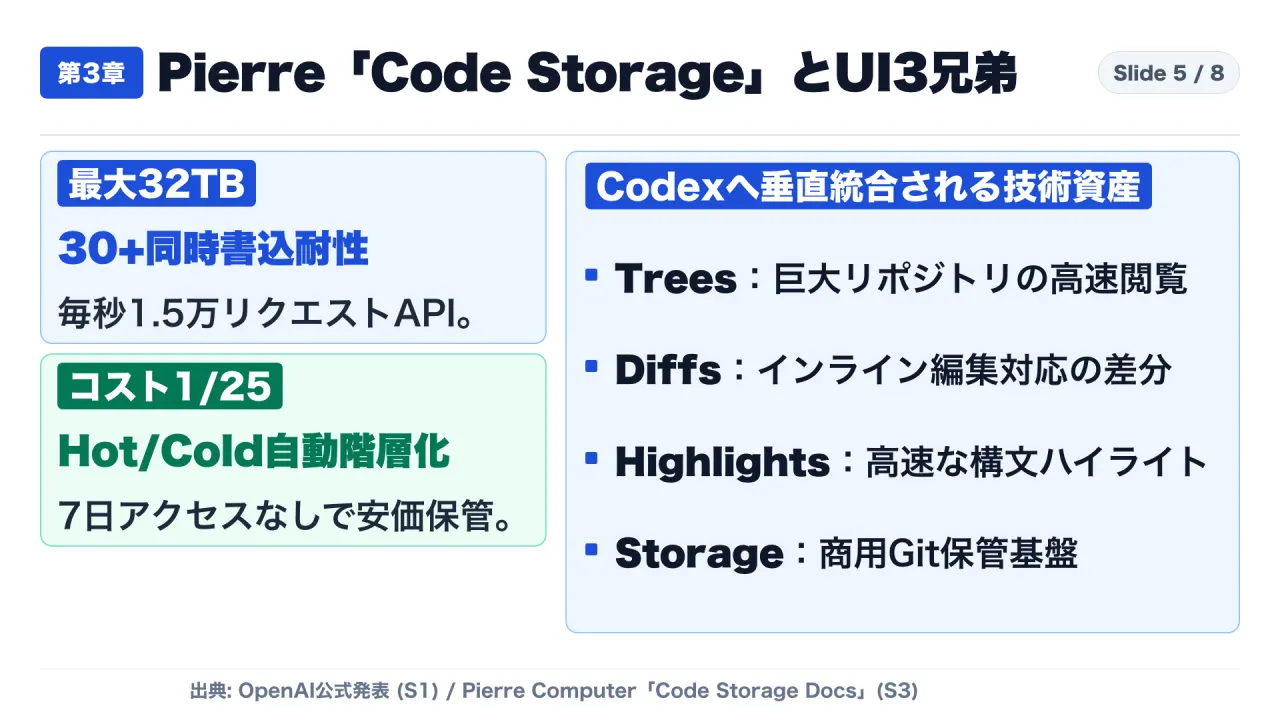
Announced on November 4, 2026, OpenAI’s acquisition of Pierre Computer represents a vertical integration of developer platform infrastructure. Founded in February 2023 within Y Combinator, Pierre assembled a veteran team: CEO Jacob Thornton (co-creator of Bootstrap, early Medium architect), CTO Ian Ownbey (founder of Bumpers, former head of Coinbase product platforms), and distributed systems specialists from Cloudflare, Meta, Stripe, GitHub, and Discord. In November 2025, Pierre completed a $22 million Series A funding round co-led by CRV and 01A.
Pierre’s technical portfolio spans front-end inspection libraries and back-end distributed storage:
| Component | Distribution | Core Capabilities | Role in OpenAI Codex |
|---|---|---|---|
| Trees | Open Source | Virtualized UI navigating hundreds of thousands of files with zero latency. | File-tree navigation within Codex. |
| Diffs | Open Source | Diff rendering engine with built-in “Edit Mode” for inline code modification. | Active within Codex; captures human review edits. |
| Highlights | Open Source | Sub-millisecond syntax highlighting tracking rapid agent token streaming. | Powers Codex live streaming output. |
| Code Storage | Commercial API | Multi-tenant distributed Git storage for machine-generated code and artifacts. | Foundational hosting layer for Codex enterprise workflows. |
Technical Specifications of Pierre Code Storage
Pierre’s Code Storage was designed specifically for machine-generated artifacts rather than human commit cadence:
- Quorum-Based Strong Consistency: Code Storage combines Git’s three-phase commit sequence with spoke-quorum consensus. This guarantees strict read-after-write consistency across distributed nodes, sustaining single repositories up to 32TB in size and supporting more than 30 concurrent write operations per repository.
- High-Throughput API Gateway: During peak operational stress, Code Storage sustains over 500 Git operations per second against a single repository, and handles in excess of 15,000 API requests per second across its aggregate infrastructure.
- Automated Hot/Cold Storage Tiering: Code Storage automatically stratifies data: branches accessed within 7 days reside in high-speed “Hot Storage” ($0.005/GB/hr), while inactive references migrate to “Cold Storage” ($0.0002/GB/hr), cutting retention costs by 25x.
- Agentic Adoption: Before acquisition, Pierre Code Storage served as the persistence layer for AI platforms including Lovable, Bolt, Amp, Poke, and Anything.
4. The Next-Generation Code Forge War: OpenAI vs. Entire, Cursor Origin, and Anthropic Scion
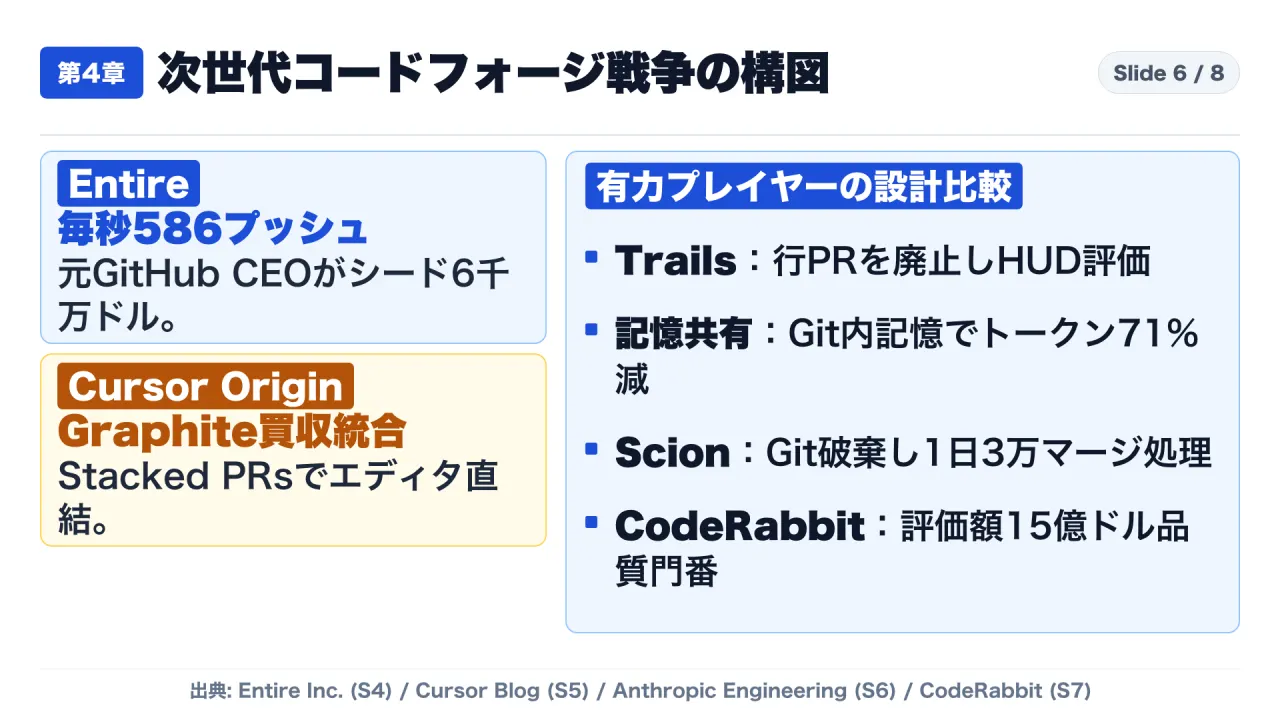
The transformation of code hosting into agent-native storage engines has ignited an intense platform war across frontier AI laboratories:
| Platform | Capitalization | Architectural Approach | Throughput | Strategic Model |
|---|---|---|---|---|
| OpenAI (Codex + Pando + Pierre) | Undisclosed ($22M Series A prior) | Pando causal consistency paired with Pierre 32TB Code Storage and Diffs inline editing UI. | 32TB repo limit, 30+ concurrent writes, 15k req/s API, 99%+ edge cache hit rate. | Vertical integration; human inline edit telemetry fuels Codex reinforcement learning. |
Entire (entire.io) |
$60M seed at $300M valuation (Thomas Dohmke) | Distributed object-store Git architecture; replaces manual PRs with “Trails” HUD; persists “Continuous Memory”. | 586 pushes/sec on ForgeMark (89x faster than GitHub, 6x faster than Cursor Origin). | Free core hosting monetized via agent tokens. In-repo memory cuts token use by up to 71%. |
| Cursor Origin (Anysphere / SpaceXAI) | Graphite acquired for $290M+; Anysphere acquired for $60B | Codebase tab in Cursor editor serves as native Git forge; automates stacked PR queues. | High-speed review pipeline coupled to local language model context. | Bidirectional sync keeps GitHub as central record while shifting active work to Cursor. |
| Anthropic (Scion / Antique) | Internal platform disclosed October 2026 | Completely abandoned Git. Built proprietary VCS “Scion” and review system “Antique” in 5 months. | Over 30,000 merges/day; sub-second checkouts; reduces CPU/RAM overhead by 200x. | Internal monorepo optimization exclusively; zero external commercialization. |
| CodeRabbit | $143M Series C at $1.5B valuation | Multi-layered context aggregation acting as an automated pull-request review quality gate. | Cuts review cycles from 86 hours to 39 minutes; ARR exceeds $15M. | Neutral quality gate across 8,000 organizations; top-ranked app on GitHub Marketplace. |
Entire, founded by Thomas Dohmke with $60 million in seed capital, sustained 586 pushes per second to a single repository on the ForgeMark benchmark—outpacing GitHub by 89x. Entire replaces manual PRs with “Trails” HUDs to evaluate intent drift and uses “Continuous Memory” to cut token consumption by up to 71%.
Cursor Origin executes bidirectional mirroring, maintaining GitHub as the formal record while moving active review and merge execution into Cursor’s Codebase interface. Anthropic pursued a radical break: when internal merge volume reached 30,000 operations daily, it discarded Git entirely, creating Scion and Antique to reduce infrastructure compute overhead by 200x. However, because enterprise software supply chains remain bound to Git protocols, OpenAI, Pierre, and Entire retain lower switching costs by preserving Git client compatibility.
5. Structural Realignment: The Battle for “Record of Work” and Co-opetition with Microsoft
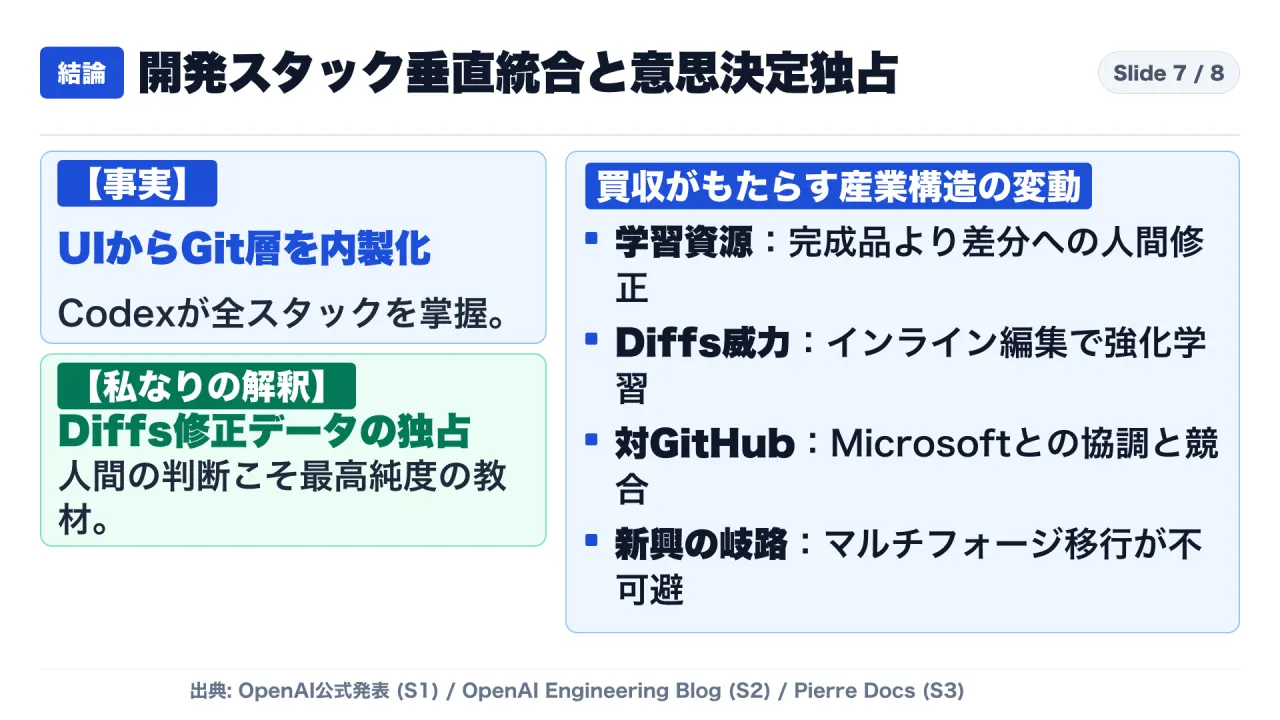
Beyond resolving infrastructure bottlenecks, OpenAI’s absorption of Pierre alters the economic balance of AI software development across two dimensions:
Monopolizing the “Record of Work” for Post-Training Reinforcement Learning
As baseline code generation capabilities commoditize, the primary competitive moat shifts toward model refinement telemetry. Public static code on the open internet is largely exhausted as frontier training material.
The most valuable data asset for training future models is the Record of Work: the precise sequence of inline edits, rejected completions, and structural refinements a human senior engineer applies to an AI-generated draft. Pierre’s “Diffs” architecture incorporates an interactive editor directly within the diff visualization layer. By controlling where developers review and repair code, OpenAI captures real-time correction telemetry, feeding proprietary human modifications directly into Codex training loops.
Escalating Co-Opetition with Microsoft and Ecosystem Fragmentation
The acquisition introduces structural tension into OpenAI’s partnership with Microsoft, its largest cloud provider and ~25% shareholder. As reported by Axios, transforming Codex into a comprehensive hosting, review, and deployment platform encroaches directly upon GitHub’s core business model. While both entities publicly affirm their ongoing collaboration, OpenAI is systematically assembling a proprietary developer platform that reduces its structural dependence on GitHub.
Simultaneously, third-party AI platforms such as Lovable and Bolt face counterparty risk. Having built their application-generation infrastructure on Pierre Code Storage, these startups now find their underlying repository layer owned by their primary competitor, accelerating interest in neutral alternatives like Entire.
6. Actionable Engineering & Governance Takeaways
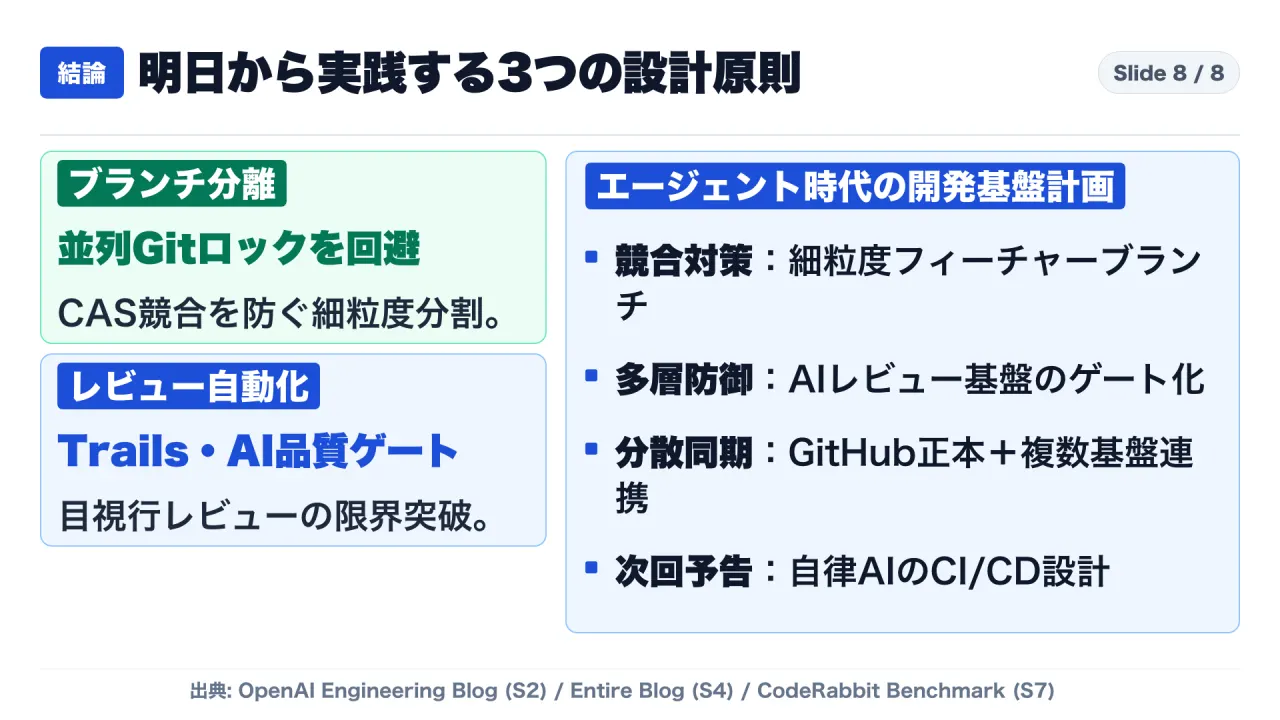
Engineering leaders and enterprise architects scaling autonomous AI agents should extract three operational mandates from OpenAI’s infrastructure pivot:
1. Restructure Git Branching Topologies for Ref-Level Concurrency
Organizations deploying multiple parallel coding agents must abandon workflows pushing concurrent updates to shared branches. Global repository locks cause severe CAS retry storms when more than ten agents operate simultaneously, rapidly degrading continuous integration reliability below 90%. Architects must enforce fine-grained task decomposition, assigning each agent an isolated feature branch mapped to strict module boundaries to prevent pipeline paralysis.
2. Transition from Manual Line Reviews to Automated Multi-Layered Quality Gates
Relying on human engineers to manually inspect thousands of lines of agent-generated code creates dangerous review fatigue. Organizations should adopt automated evaluation platforms like CodeRabbit or Entire Trails to enforce security, architectural conformance, and unit-test coverage prior to human engagement. Capturing internal review diffs preserves proprietary domain knowledge and establishes high-value evaluation benchmarks for enterprise agent tuning.
3. Maintain Vendor-Neutral Git Source-of-Truth Mirroring
Source code represents core enterprise intellectual property. Organizations must avoid locking critical code storage exclusively into proprietary AI vendor ecosystems. The safest architecture preserves standard Git-compliant repositories (such as neutral GitHub or GitLab enterprise instances) as the immutable Source of Truth, utilizing bidirectional synchronization to interface with specialized agent hosting platforms. Prior to adoption, enterprise committees must verify three contractual invariants: (1) seamless webhook integration with existing continuous integration and security tools; (2) ironclad Zero Data Retention agreements preventing external model providers from training on proprietary code diffs; and (3) automated cold-storage tiering policies to prevent exponential cloud storage cost inflation.
Primary Sources
- OpenAI Official Acquisition Announcement, OpenAI acquires Pierre Computer (November 4, 2026): https://openai.com/index/openai-acquires-pierre-computer/
- OpenAI Engineering Blog, Scaling Git at OpenAI with Pando (November 2, 2026): https://openai.com/index/scaling-git-for-agents-with-pando/
- Pierre Computer Technical Architecture, Code Storage Technical Documentation & Product Architecture (October 2026): https://code.storage/docs/architecture
- Entire Inc. Platform Launch, Introducing Entire, Trails, and Continuous Memory (October 28, 2026): https://entire.io/blog/introducing-entire-and-trails
- Cursor Engineering Blog, Origin, Graphite Acquisition, and Stacked PRs (August 17, 2026): https://cursor.com/blog/origin-and-graphite-stacked-prs
- Anthropic Engineering Report, Scion and Antique: Scaling Monorepo without Git (October 15, 2026): https://www.anthropic.com/engineering/scion-and-antique-agent-code-review
- CodeRabbit Benchmark Analysis, CodeRabbit 2.0 and Agent Review Benchmark Report (October 2026): https://www.coderabbit.ai/blog/coderabbit-2-0-and-agent-review-benchmark
- GitHub Infrastructure Insights, Octoverse 2026: AI Agents and Commit Volume (October 2026): https://github.blog/news-insights/octoverse/octoverse-2026-ai-agents-and-commit-volume/
Note: This article is for informational purposes only and does not constitute investment advice or a price forecast. Podcast audio is synthesized from the host’s voice.