Why Deploying a 0.57GB Translation Model On-Premises Still Requires Pre-Registration: Dissecting PLaMo 3 Translate, 4 Sizes, and the 1 Billion Yen Threshold
A forensic architecture review of Preferred Networks’ open-weight release across 0.8B to 31B parameters, quantization degradation curves, license viral traps, and benchmark comparability against TranslateGemma and Hy-MT2.
Japanese Edition: https://consuloji.substack.com/p/057gbplamo-3-translate
YouTube (Japanese audio): https://youtu.be/hodLEGliBIk
Executive Summary & Key Technical Takeaways
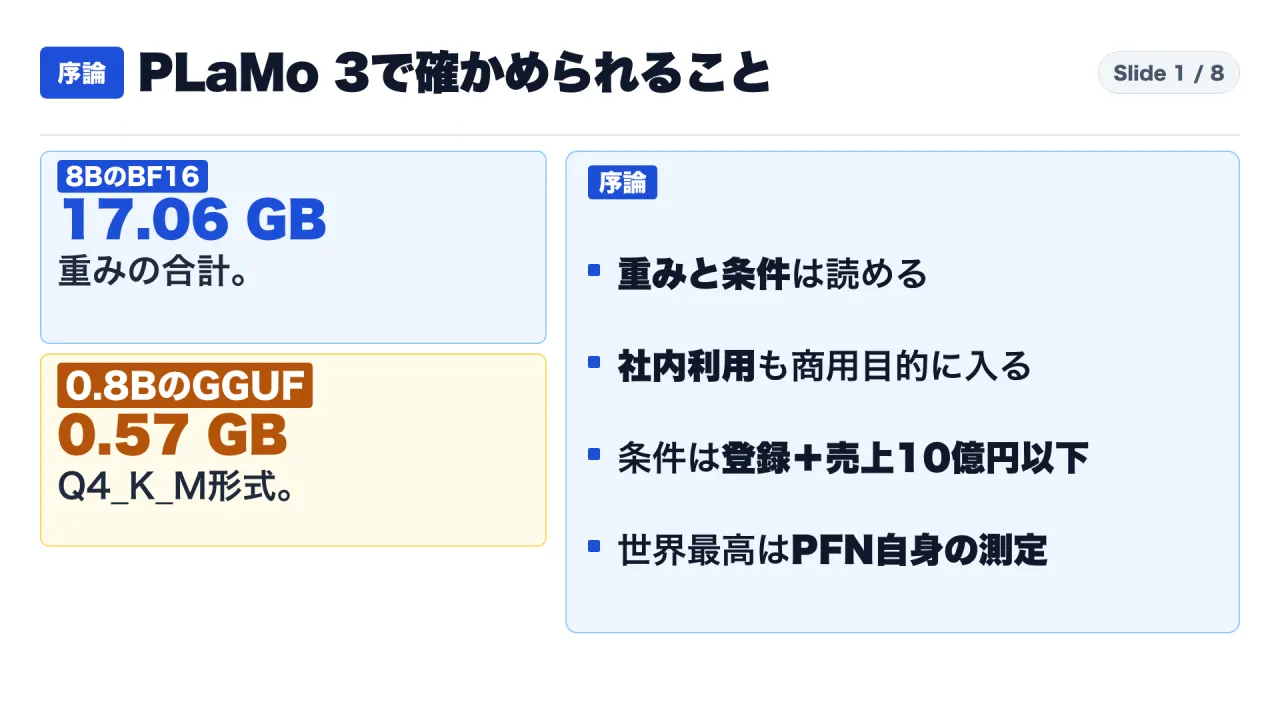
- The Release Architecture: On November 5, 2026, Preferred Networks (PFN) released open weights for PLaMo 3 Translate, a machine translation language model available across four parameter tiers: 0.8B, 2B, 8B, and 31B. Through 4-bit quantization in GGUF format (
Q4_K_M), the 0.8B model achieves an ultra-compact disk footprint of 0.57 GB, enabling offline local execution on laptops, edge devices, and smartphones. - The Internal Enterprise Licensing Barrier: Deploying PLaMo 3 Translate on internal company workstations or private servers is not unrestricted. The PLaMo Community License defines “Commercial Purposes” as any use beyond personal study or academic research, explicitly including internal utilization within an organization. Royalty-free commercial use is restricted to entities whose consolidated annual gross revenue (including corporate affiliates) does not exceed 1 billion Japanese yen (~$6.5 million USD), contingent upon submitting a mandatory pre-registration form.
- Synthetic Data Lineage: Derived from PLaMo 3 NICT (developed jointly with Japan’s NICT), the model was aligned on approximately 37.3 billion tokens of translation data. Crucially, the overwhelming majority of translation pairs were generated synthetically using Google’s Gemma 4 31B IT, filtered via tournament selection, back-translation, and automated preference judging.
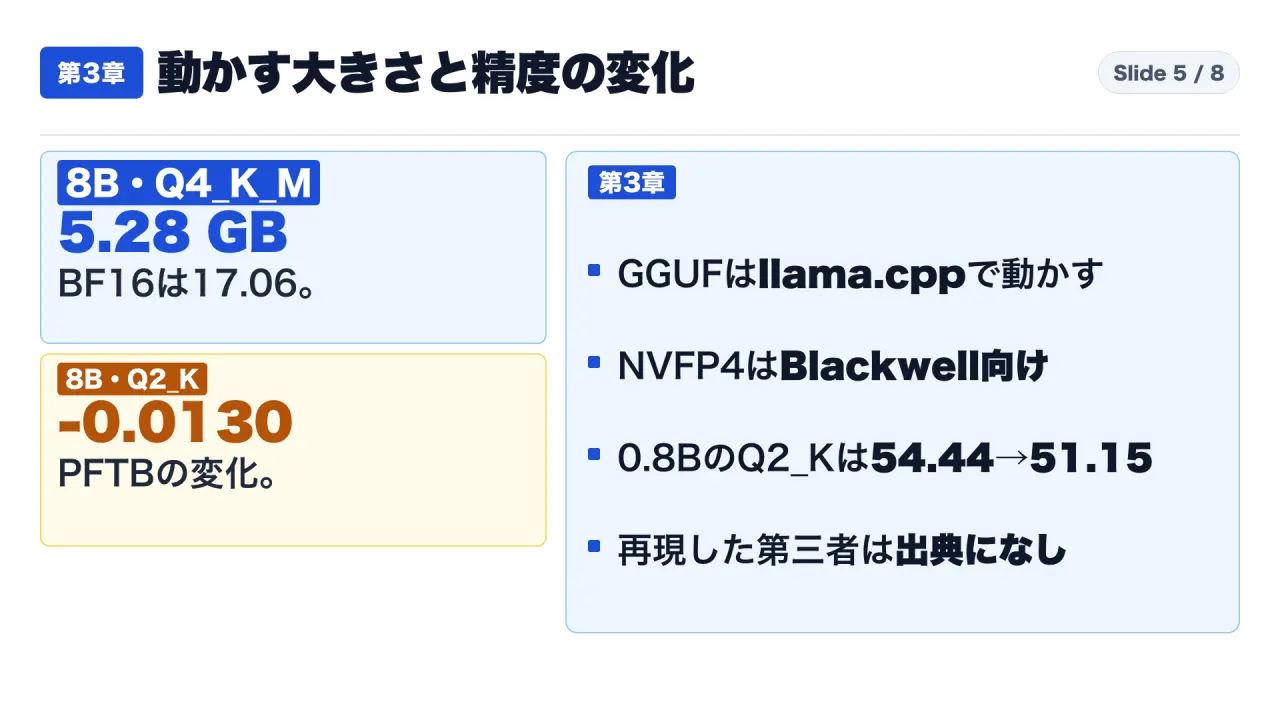
- Quantization Degradation Asymmetry: Quantization curves disclose an asymmetric degradation profile. While compressing the 8B model to 4-bit GGUF (
Q4_K_M, 5.28 GB) results in a negligible quality drop of -0.0019 on PFN’s internal benchmark, compressing the 0.8B model to 2-bit GGUF (Q2_K) degrades chrF++ translation metrics by 3.29 points (from 54.44 to 51.15). - The Benchmark Comparability Gap: PFN’s claims of achieving “world-class performance” and having its “2B model outperform existing models across all metrics” compare strictly against two competitor open models: Google’s TranslateGemma and Tencent’s Hy-MT2. Furthermore, PFN’s advantage appears primarily on its internally constructed benchmarks (PFTB and SaaS), while on public WMT24++ English-to-Japanese, TranslateGemma 27B slightly outscored PLaMo 8B (0.882 vs 0.879).
1. Anatomy of the Release: 4 Parameter Tiers, 7 Formats, and Exact Parameter Counts
Enterprise infrastructure teams evaluating open-weight models must separate parameter marketing from physical memory sizing, runtime engine compatibility, and model architecture.
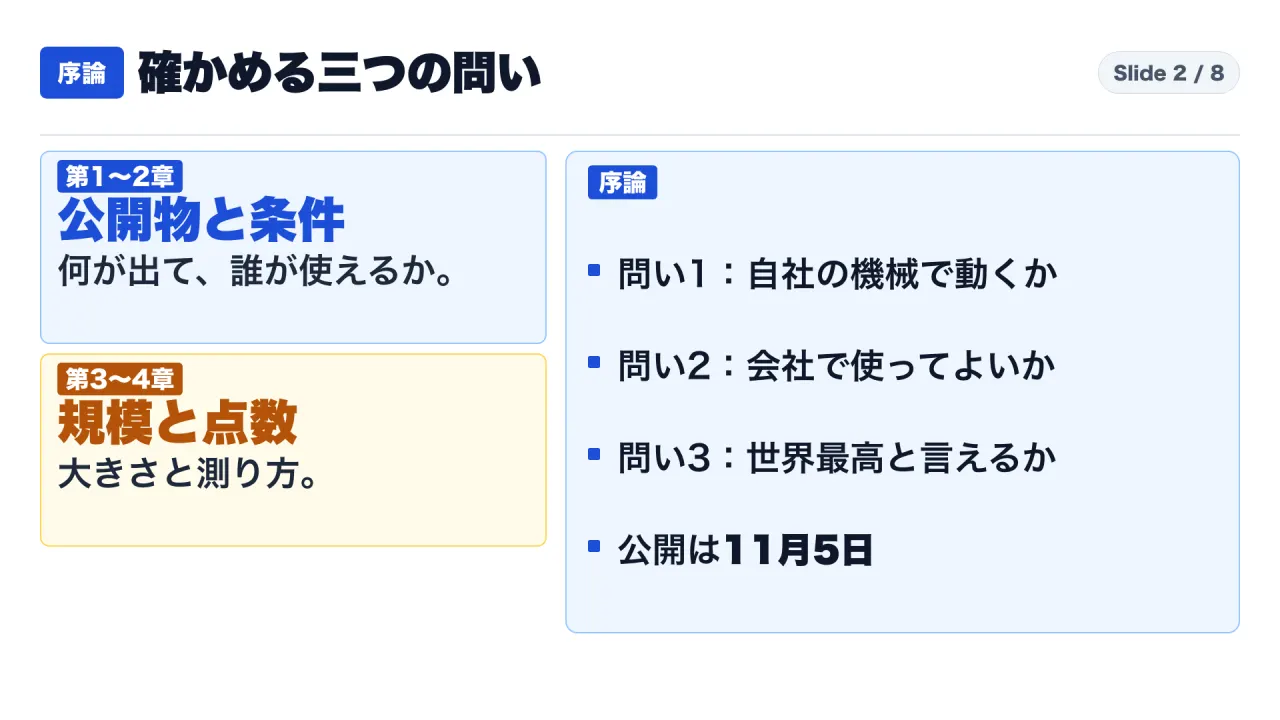
Derived from foundation model PLaMo 3 NICT, PLaMo 3 Translate was structured across four discrete model sizes. Querying repository metadata on Hugging Face establishes the exact parameter accounting:
- PLaMo 3 Translate 0.8B: 890,468,928 parameters (~0.89B total)
- PLaMo 3 Translate 2B: 2,882,043,904 parameters (~2.88B total)
- PLaMo 3 Translate 8B: 8,531,750,912 parameters (~8.53B total)
- PLaMo 3 Translate 31B: 31,758,645,248 parameters (~31.76B total)
1-1. Weight Footprints Across Seven Distribution Formats
To accommodate diverse hardware environments—from consumer laptops and edge devices to enterprise GPU clusters—PFN exported each model tier across seven distribution formats:
| Parameter Tier | Native BF16 Size | GGUF Q4_K_M (4-bit) | GGUF Q2_K (2-bit) | MLX 4-bit (Apple Silicon) | Target Hardware & Runtime Engine |
|---|---|---|---|---|---|
| 0.8B Tier | 1.78 GB | 0.57 GB | 0.38 GB | 0.55 GB | Mobile devices, edge gateways, CPU laptops (llama.cpp) |
| 2B Tier | 5.76 GB | 1.81 GB | 1.14 GB | 1.75 GB | Workstations, Apple M-series Macs, single GPU (llama.cpp, vLLM) |
| 8B Tier | 17.06 GB | 5.28 GB | 3.22 GB | 5.10 GB | Mid-range enterprise GPUs (RTX 4090, A10G, L4) |
| 31B Tier | 63.51 GB | 19.53 GB | 11.85 GB | 18.90 GB | High-end servers (A100 80GB, H100, multi-GPU nodes) |
Additionally, PFN generated optimized FP8 and NVFP4 formats for high-throughput enterprise serving on modern NVIDIA architectures via vLLM.
1-2. Functional Capabilities and Context Window Boundaries
The architecture incorporates three practical control mechanisms for enterprise translation pipelines:
- Dynamic Glossary Injection: Allows developers to supply structured bilingual term dictionaries at inference time, guaranteeing consistent translation of proprietary terminology.
- Multi-Sentence Context Conditioning: Enables passing surrounding paragraph context to resolve ambiguous references and maintain discourse cohesion.
- Japanese Register Switching: Permits programmatic toggling between formal polite style (desu/masu) and direct plain style (da/dearu).
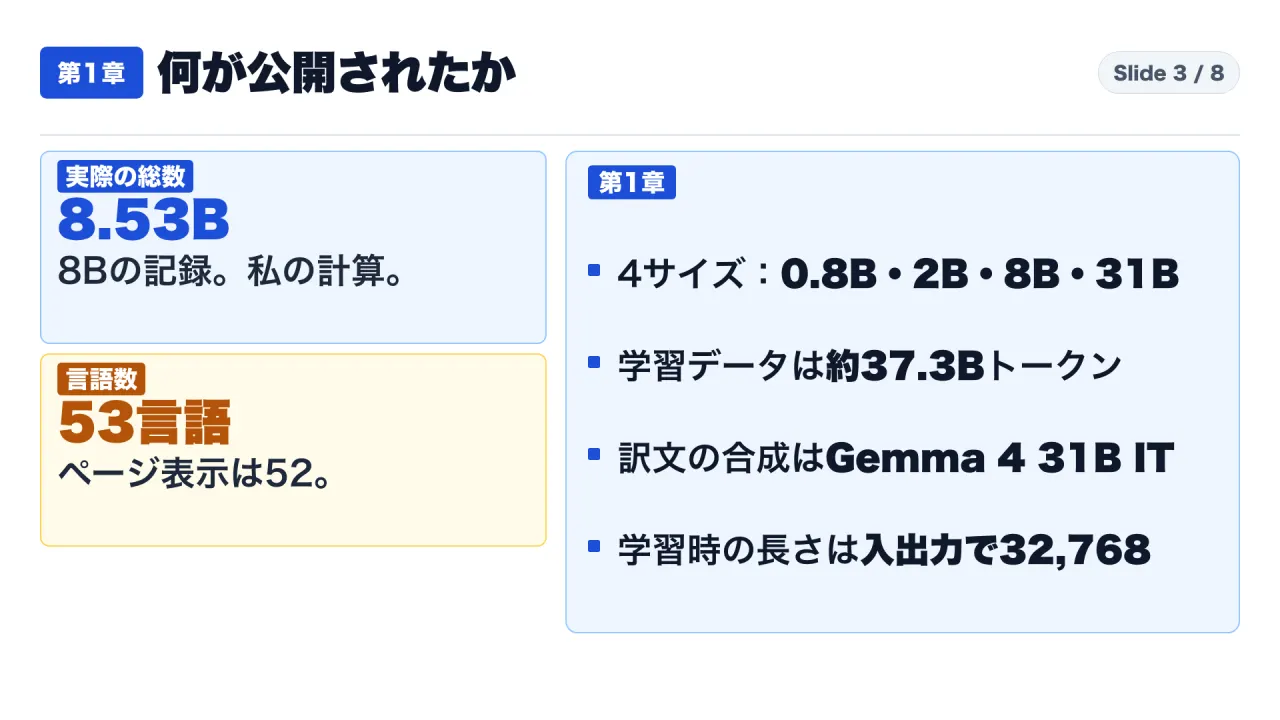
Regarding context boundaries, PFN’s model card specifies that the maximum sequence length during pre-training was 32,768 tokens across prompt and generation combined. While the 8B model’s config.json lists max_position_embeddings: 262144, the model card provides no empirical validation for extrapolation beyond 32,768 tokens. Production pipelines must enforce a 32k token chunking limit to avoid attention degradation.
2. Quantization Footprints and Precision Degradation Curves
A major advantage of PLaMo 3 Translate is accessibility: deploying the 0.57GB 0.8B model or 1.81GB 2B model on local machines without dedicated GPU infrastructure. However, engineering teams must evaluate the mathematical trade-off between quantization compression and translation fidelity.
2-1. Asymmetric Degradation Curves Across Model Sizes
PFN published quantization benchmark measurements on Hugging Face, revealing that susceptibility to quantization damage is inversely proportional to model parameter scale:
- The 8B Model (High Resilience): When quantized from native BF16 (17.06 GB) down to 4-bit GGUF (
Q4_K_M, 5.28 GB), the score on PFN’s internal PFTB English-to-Japanese benchmark dropped from 0.6119 to 0.6100—a negligible decline of just -0.0019 points. Even under aggressive 2-bit quantization (Q2_K, 3.22 GB), the score remained at 0.5989 (-0.0130 drop). - The 0.8B Model (Severe Degradation at Low Bit-Widths): In contrast, the compact 0.8B model exhibits sharp vulnerability to extreme quantization. On the multilingual chrF++ metric (English to other languages), unquantized BF16 achieved 54.44, while 2-bit GGUF (
Q2_K) dropped to 51.15—a severe loss of 3.29 points.
For production edge deployment, 4-bit quantization (Q4_K_M) represents the optimal Pareto boundary, preserving over 99% of benchmark accuracy while slashing memory bandwidth requirements by nearly 70%. Deploying 2-bit quantization on sub-1B parameter models induces severe translation errors and should be avoided in enterprise workflows.
Furthermore, teams must account for runtime memory overhead: while weights require 0.57GB to 5.28GB of disk space, serving concurrent requests requires allocating dynamic VRAM/RAM for key-value (KV) attention caches and context buffers.
3. Legal Mechanics of the PLaMo Community License: The 1 Billion Yen Threshold
Many development teams assume that because weights are hosted on Hugging Face, they can be freely downloaded and embedded into internal enterprise workflows under Apache 2.0 or MIT style terms. This is legally incorrect.
PLaMo 3 Translate is licensed under the proprietary PLaMo Community License (categorized as other on Hugging Face). Reviewing the legal text (LICENSE/en) exposes strict governance boundaries:
3-1. Internal Enterprise Utilization Is Legally “Commercial Use”
The license explicitly defines “Commercial Purposes” to eliminate the assumption that internal enterprise usage is non-commercial:
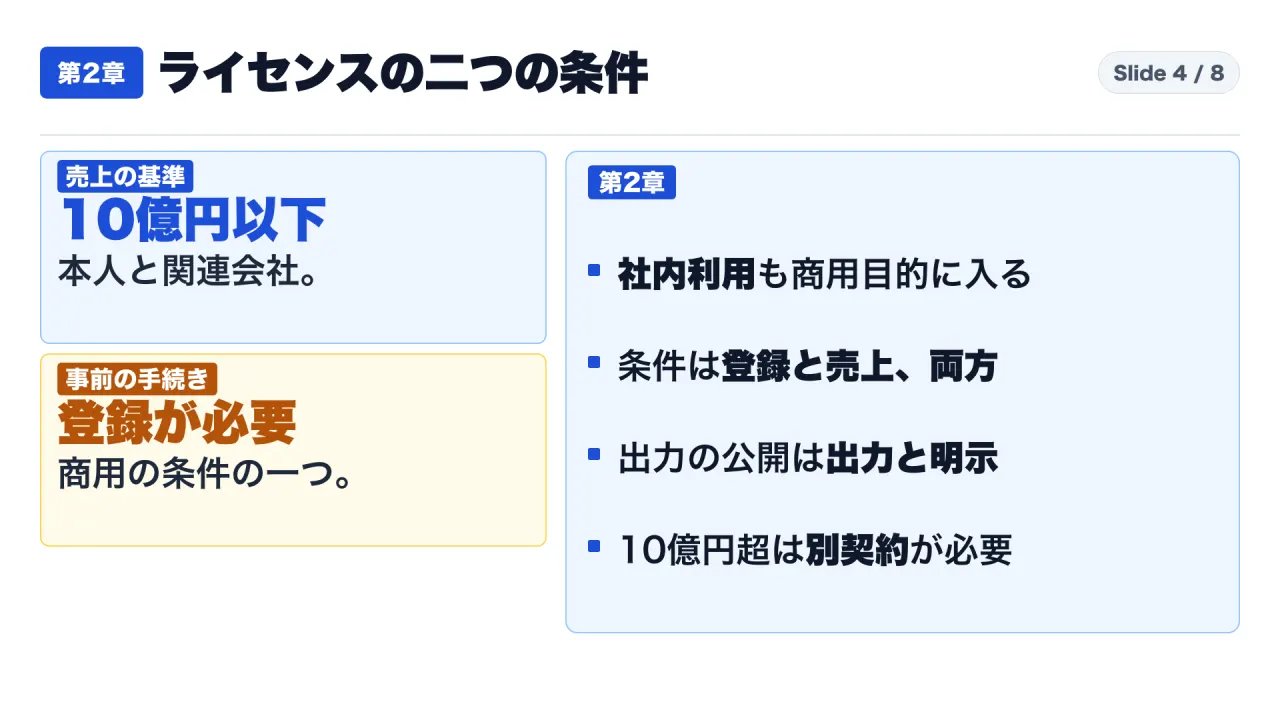
“Commercial Purposes means any use of the Model or Derivatives beyond personal or academic use, including use within the framework of the user’s organization.”
Under this clause, using PLaMo 3 Translate to translate internal engineering wikis, summarize employee correspondence, or run local batch translations inside a company constitutes Commercial Use.
3-2. The Dual Cumulative Conditions for Royalty-Free Commercial Deployment
Under Section 2 of the license, commercial utilization without licensing fees is permitted only if both of the following cumulative conditions are met:
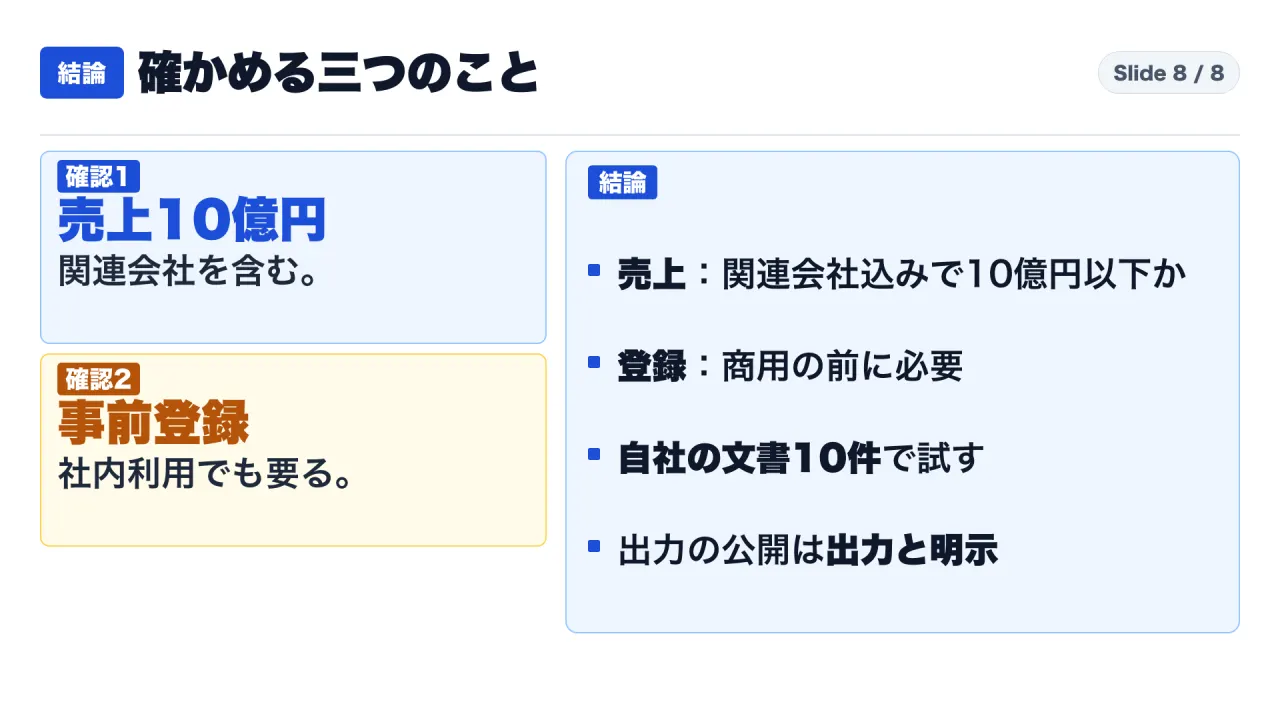
- Mandatory Prior Registration: The user must submit PFN’s official registration form prior to commencing commercial use. The model card clarifies that authorization begins immediately upon form submission.
- The 1 Billion Yen Gross Revenue Ceiling: The gross annual revenue of the user and all affiliated entities (affiliates) for the most recent fiscal year must not exceed 1 billion Japanese yen (~$6.5 million USD).
If an enterprise or its corporate parent generates more than 1 billion yen in annual revenue, royalty-free usage under the community license is invalid. Such organizations are legally required to contact PFN to negotiate a customized enterprise commercial license. If an organization exceeds this revenue threshold during a fiscal year, its commercial rights terminate automatically.
3-3. Attribution, Viral Derivatives, and Liability Limitations
The license imposes additional governance requirements:
- Redistribution Attribution: Any distribution of the model or derivative weights must include a copy of the license, display the notice
"Built with PLaMo", and prefix the derivative model name with"PLaMo". - Public Output Disclosure: When translation outputs are published externally, the user must clearly indicate that the content was generated by PLaMo.
- Viral Derivative Conditioning: If PLaMo outputs are utilized to train, fine-tune, or distill another model, that downstream model is classified as a Derivative Model and inherits the restrictions of the PLaMo Community License.
- Liability Disclaimer and 500-Yen Damage Cap: The model is provided strictly “AS IS.” The license explicitly forbids utilizing PLaMo as the sole basis for legal, medical, or financial decisions. PFN disclaims all liability for commercial operational losses, capping aggregate damages at 500 Japanese yen (~$3.25 USD).
In contrast, competitor models operate under different legal regimes: Tencent’s Hy-MT2 is released under the permissive Apache 2.0 license, while Google’s TranslateGemma operates under the Gemma Terms of Use.
4. Benchmark Deconstruction: Why “Beating All Competitors” Depends on Internal Metrics
PFN prominently asserts that PLaMo 3 Translate achieves “world-class performance” and that its “2B model outperforms existing specialized models across all evaluated metrics.”
A forensic review of the benchmark data reveals critical scope constraints:
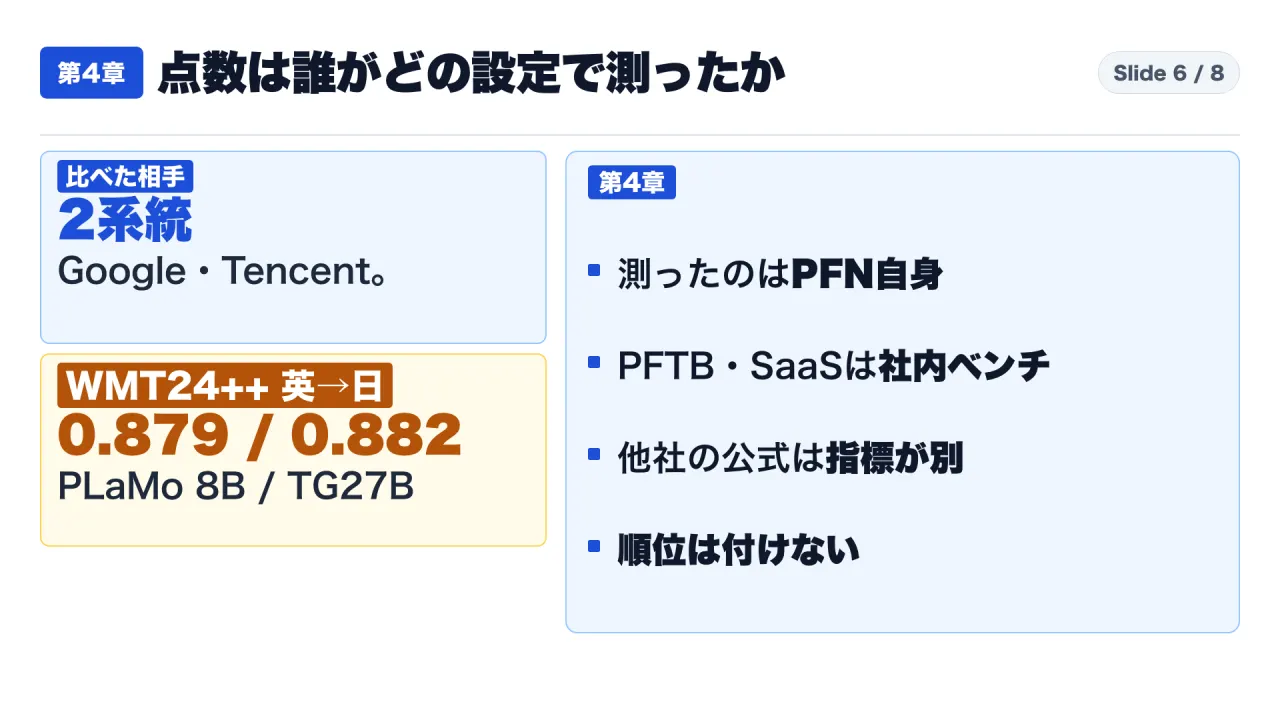
4-1. The Competitor Field Is Limited to Two Model Families
The comparison figures published in PFN’s November 5 release materials evaluate PLaMo strictly against two competitor open-weight translation families:
- Google TranslateGemma: 4B, 12B, and 27B parameter variants.
- Tencent Hy-MT2: 1.8B, 7B, and 30B-A3B (MoE) variants.
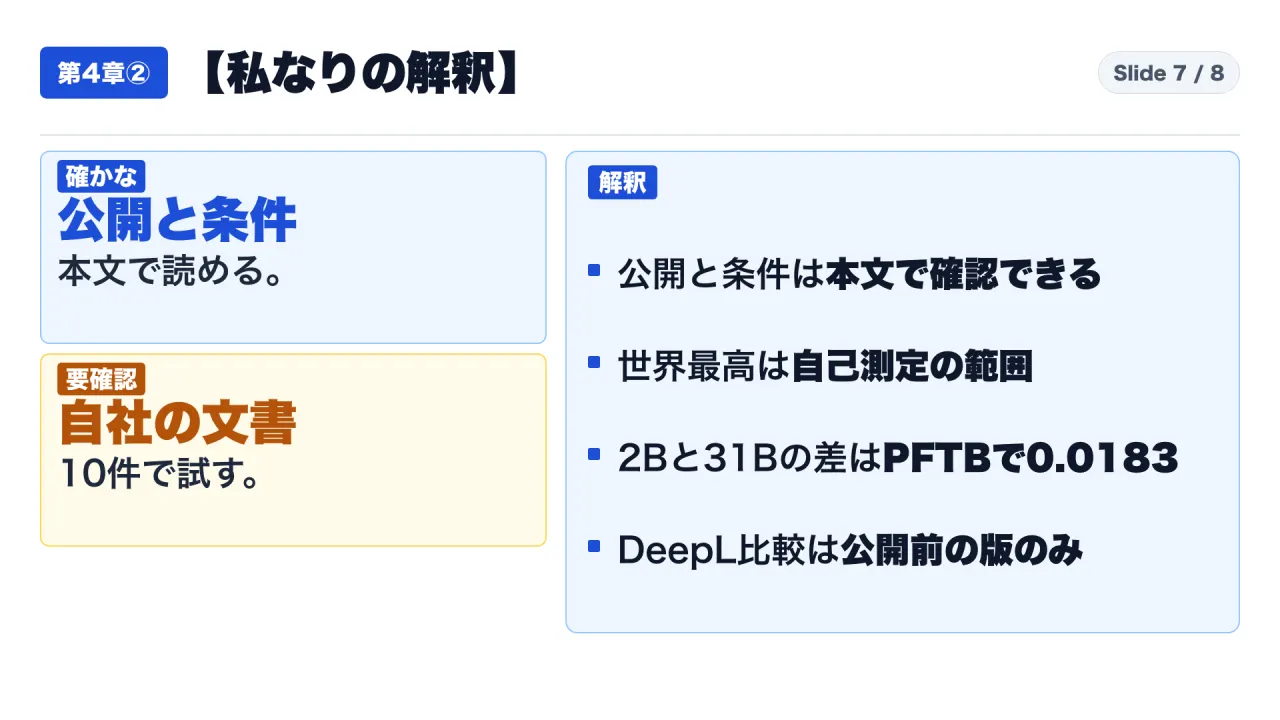
Commercial translation APIs (such as DeepL Pro, Google Cloud Translation, or OpenAI/Anthropic frontier models) are completely absent from the November 5 weight release comparison charts.
4-2. Metric Discrepancies Against Official Academic Literature
Comparing PFN’s reported figures against the official technical reports for TranslateGemma and Hy-MT2 reveals that evaluation metrics and language sets do not align:
- Google’s Technical Report (arXiv:2601.09012): Evaluates TranslateGemma across 55 language pairs on the COMET-22 metric (scaled 0 to 100), reporting 84.4 for 27B, 83.5 for 12B, and 80.1 for 4B. In contrast, PFN evaluates WMT24++ on a 0 to 1 scale exclusively for English-to-Japanese (reporting 0.8780 for PLaMo 2B).
- Tencent’s Technical Report (arXiv:2605.22064): Evaluates Hy-MT2 across 33 languages utilizing XCOMET and BLEU. PFN evaluated English-to-other languages using chrF++.
Because target languages, metric implementations, and normalizations differ, cross-referencing external academic papers against PFN’s charts cannot produce a unified leaderboard.
4-3. The Divergence Between Public and Internal Benchmarks
The critical factor behind PLaMo’s reported lead is the benchmark distribution. In PFN’s October 7 disclosures comparing PLaMo 8B against TranslateGemma 27B:
| Benchmark Suite & Language Direction | PLaMo 3 Translate 8B Score | Google TranslateGemma 27B Score | Performance Delta | Benchmark Origin & Nature |
|---|---|---|---|---|
| WMT24++ (English → Japanese) | 0.879 | 0.882 | TranslateGemma +0.003 | Public academic benchmark |
| PFTB (English → Japanese) | 0.547 | 0.438 | PLaMo +0.109 (+24.9%) | PFN internal benchmark (AI references) |
| SaaS Benchmark (English → Japanese) | 0.571 | 0.395 | PLaMo +0.176 (+44.6%) | PFN internal benchmark (HTML tag preservation) |
On the public academic benchmark WMT24++, Google’s TranslateGemma 27B slightly outperformed PLaMo 8B. PLaMo’s dramatic margins appear exclusively on PFN’s internal PFTB and SaaS benchmarks. Because PLaMo was trained on 37.3 billion tokens of synthetic data generated by Gemma 4 and aligned on PFTB-style distributions, it naturally excels on benchmarks sharing that structure.
Furthermore, within PLaMo’s own family, the score gap on PFTB between the 2B model (0.6061) and the 31B model (0.6244) is just 0.0183 points (<3% relative difference). Deploying the 1.81GB 2B model offers compelling cost-performance compared to provisioning 63.5GB GPU infrastructure for the 31B model.
5. Enterprise Governance Blueprint: 3 Steps Before On-Premises Deployment
PLaMo 3 Translate provides genuine technical utility: a compact, high-quality open-weight model with native glossary conditioning, Japanese register control, and air-gapped on-premises capability.
To deploy PLaMo 3 Translate in compliance with its legal and architectural constraints, enterprise engineering teams should follow a three-step implementation blueprint:
Step 1: Legal Audit of Revenue Ceilings and Registration Obligations
Verify corporate compliance before testing:
- Review consolidated annual revenue across parent, operating subsidiaries, and affiliates.
- If revenue is 1 billion yen or less (~$6.5M USD), submit PFN’s official web registration form prior to downloading weights.
- If revenue exceeds 1 billion yen, contact PFN to negotiate a commercial licensing agreement.
Step 2: In-House Evaluation of the 2B and 8B Checkpoints on Real Documents
Avoid provisioning expensive GPU clusters for the 31B model prematurely:
- Deploy the 2B GGUF Q4_K_M (1.81 GB) or 8B GGUF Q4_K_M (5.28 GB) model on a local workstation using
llama.cpp. - Assemble 10 representative corporate documents (customer emails, API documentation with code tags, compliance drafts).
- Execute parallel translations comparing PLaMo against existing commercial translation endpoints, evaluating proper noun consistency, formatting retention, and numeric accuracy.
Step 3: Establish Operational Output Policies
Formulate operational boundaries governing translated text:
- If translation outputs are published externally, ensure attribution notices credit PLaMo.
- Prohibit routing PLaMo translation outputs into training pipelines for other machine learning models unless the organization accepts the viral derivative licensing conditions of the PLaMo Community License.
- Mandate human-in-the-loop review for high-risk legal, medical, or financial documents in compliance with license disclaimers.
Primary Sources
- PFN Technical Blog (Weight Release): PLaMo 3 Translate Weight Release (November 5, 2026)
- PFN Technical Blog (Product Release): plamo-3-translate Product Release (October 7, 2026)
- PFN Official Press Release: Preferred Networks Releases Weights for PLaMo 3 Translate
- Hugging Face Model Card (8B Base): pfnet/plamo-3-translate-8b
- PLaMo Community License: Official English License Agreement (LICENSE/en)
- Google TranslateGemma Technical Report: arXiv:2601.09012
- Tencent Hy-MT2 Technical Report: arXiv:2605.22064
Note: This article is for informational purposes only and does not constitute investment advice or a price forecast. Podcast audio is synthesized from the host’s voice.