Why a 58% to 87% Win-Rate Over DeepL Fails to Guarantee Production Parity: Inside PFN's PLaMo 3 Translate, 37.3B Synthetic Tokens, and the 1 Billion Yen Enterprise Boundary
A forensic evaluation of Preferred Networks’ open-weight translation suite, analyzing LLM-as-a-judge methodologies, 53-to-15 language evaluation drop-offs, and commercial liability limits.
Japanese Edition: https://consuloji.substack.com/p/preferred-networksaideepl5887
YouTube (Japanese audio): https://youtu.be/SMSBD4Jr9bw
Executive Summary & Key Technical Takeaways
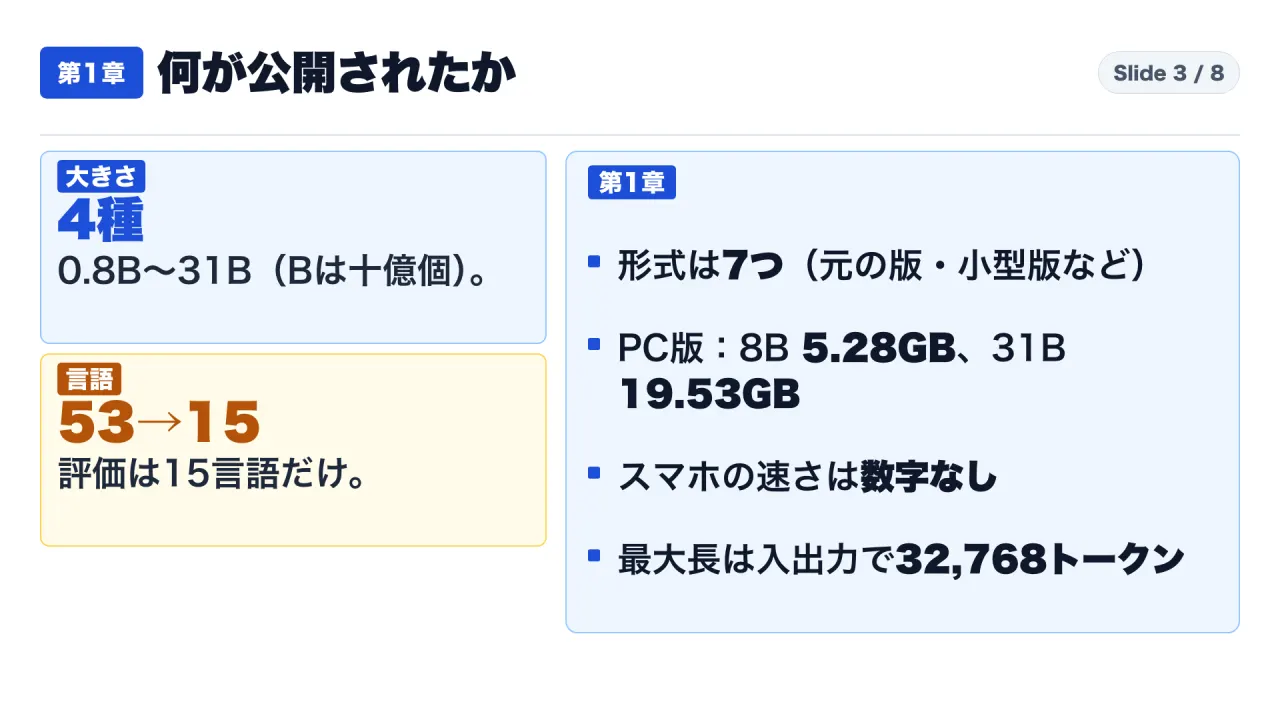
- The Release Context: On November 5, 2026, Japanese AI firm Preferred Networks (PFN) published model weights for PLaMo 3 Translate, an open-weight translation suite available across four parameter sizes (0.8B, 2B, 8B, and 31B) and seven distribution formats (including BF16, FP8, NVFP4, GGUF, and Apple MLX).
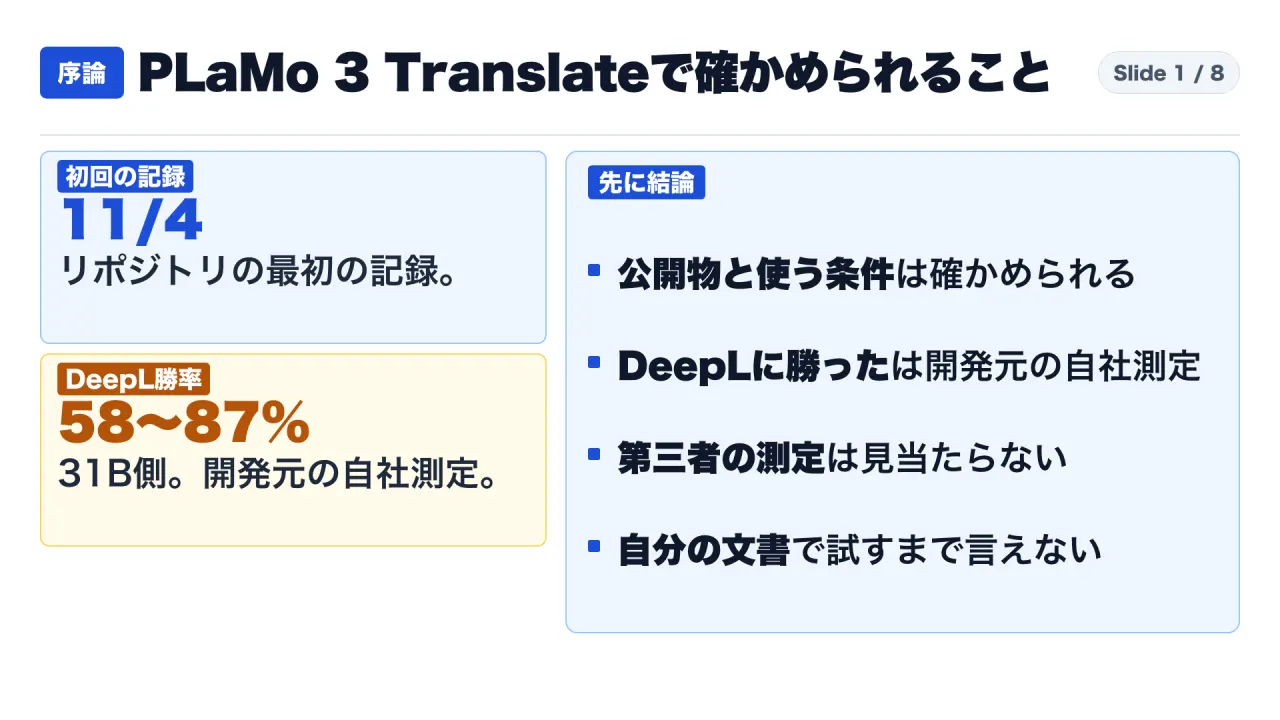
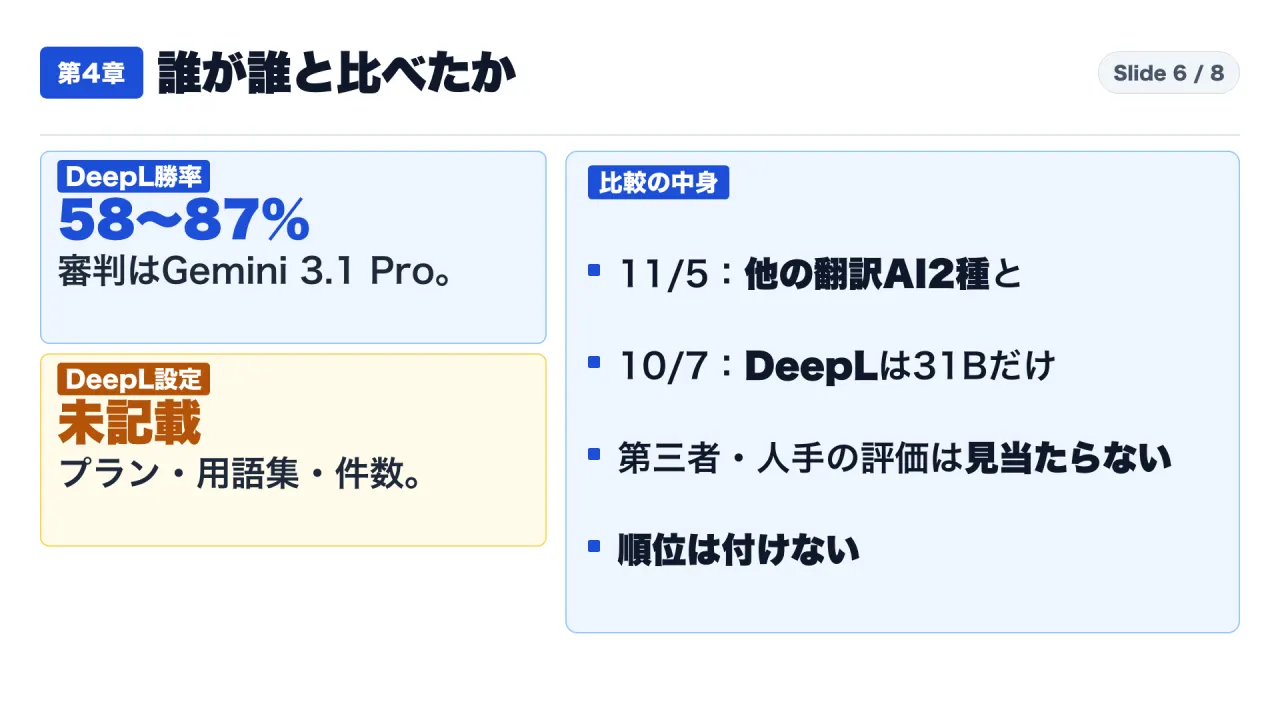
- The Viral DeepL Win-Rate Narrative: Online communities rapidly cited a reported “58% to 87% win-rate against DeepL.” However, primary verification reveals this win-rate originated in an earlier October 7, 2026 technical post for a pre-release 31B model, evaluated solely by an AI judge (Gemini 3.1 Pro) on internal benchmarks without disclosing DeepL’s tier, glossary settings, or sample sizes.
- The 53-to-15 Language Evaluation Boundary: While PFN’s model card cites support for 53 languages (counting Simplified and Traditional Chinese separately), formal benchmark scoring was conducted on only 15 languages, exclusively paired with Japanese or English. Direct translation between the remaining 38 languages was omitted from benchmark releases due to compute limits.
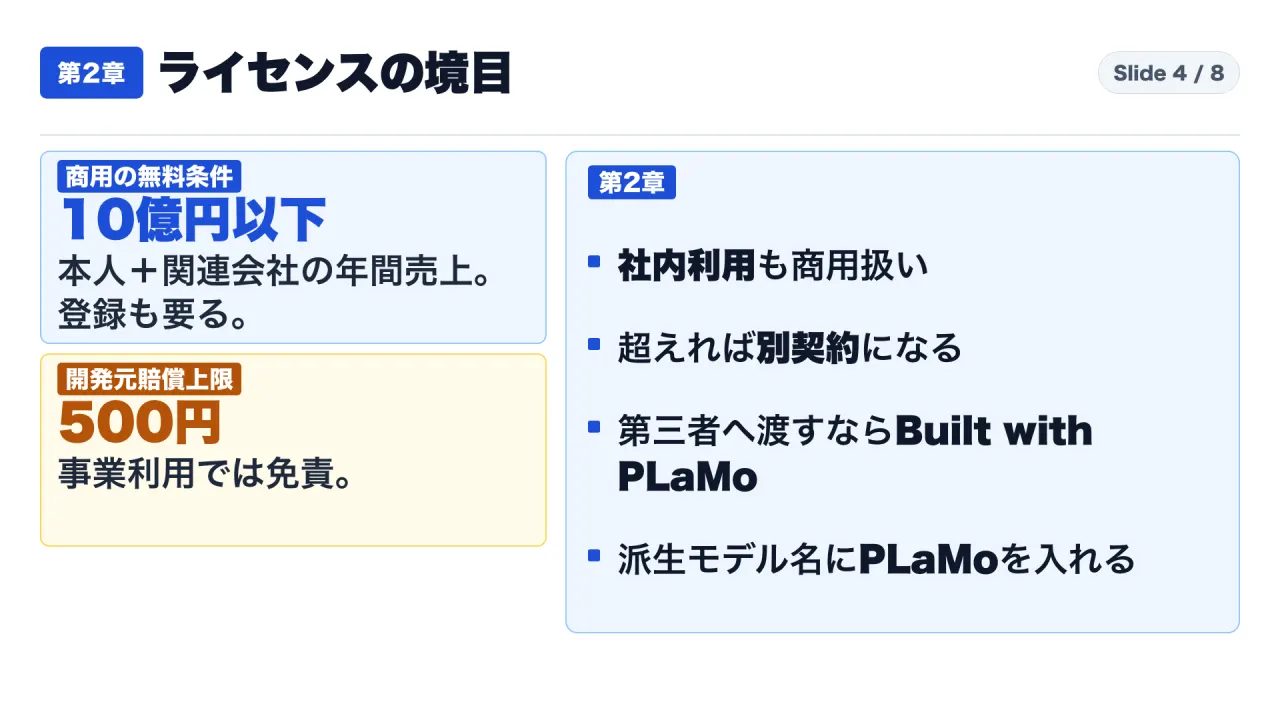
- Internal Use Constitutes “Commercial Use”: Contrary to assumptions that open weights can be freely deployed for internal translation, the PLaMo Community License defines “Commercial Purposes” as any use beyond personal study or academic research, explicitly encompassing internal organizational deployment. Royalty-free commercial use is restricted to entities with annual gross revenues of 1 billion Japanese yen or less (~$6.5 million USD, including affiliates) who submit a mandatory pre-registration form.
- Strict Disclaimers and a 500-Yen Liability Cap: The license prohibits deploying PLaMo 3 Translate as the sole basis for legal, medical, or financial decisions. PFN provides the software “AS IS,” disclaims all operational liability for enterprise deployments, and caps aggregate damages at 500 Japanese yen (~$3.25 USD).
1. Timeline Verification: Tracing the Origins of the “Goodbye DeepL” Narrative
Enterprise translation workflows—spanning contracts, technical specifications, and API documentation—frequently face a dilemma: pay continuous API subscription costs to proprietary services like DeepL Pro, or transition to self-hosted open-weight models.
When PFN released PLaMo 3 Translate, viral social media commentary declared a “Goodbye DeepL” moment. Examining primary release artifacts establishes the chronological record:
- October 7, 2026: PFN published an initial Japanese technical post announcing its commercial translation API (
plamo-3-translate), containing head-to-head win-rate comparisons against DeepL for a development-stage 31B checkpoint. - October 26, 2026: PFN initialized public repository shells on Hugging Face (
pfnet/plamo-3-translate-*). - November 4, 2026: Initial model weights were committed to Hugging Face (0.8B at 07:57 UTC, 31B at 14:13 UTC).
- November 5, 2026: PFN published an English technical blog detailing architecture, synthetic pre-training methodology, and open-weight availability across four tiers.
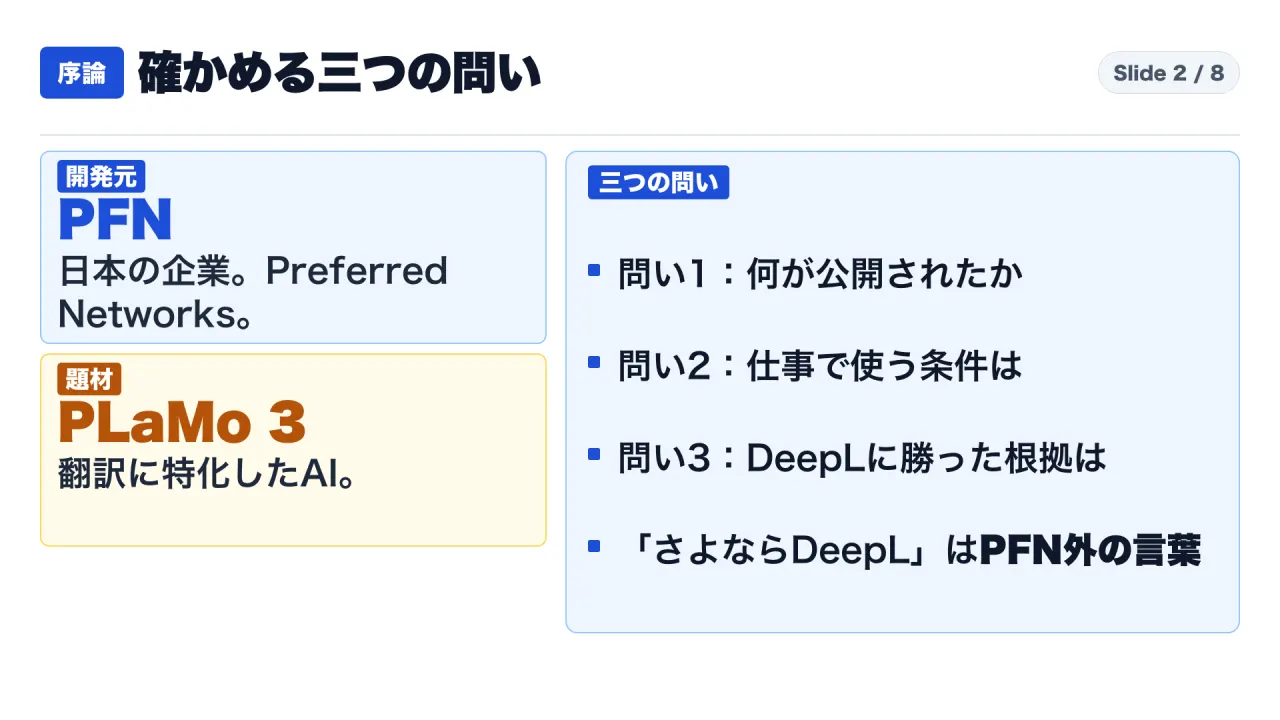
Crucially, neither of PFN’s official publications used phrases like “Goodbye DeepL” or claimed commercial services had been supplanted. That framing was generated by third-party commentary. PFN framed PLaMo 3 Translate as a specialized multilingual translation model designed for controlled, on-premises and edge execution.
2. Model Architecture and Asset Decomposition: 4 Sizes, 7 Formats, and Evaluation Drop-offs
PFN released PLaMo 3 Translate across four parameter scales derived from PLaMo 3 NICT, developed in collaboration with Japan’s National Institute of Information and Communications Technology (NICT).
2-1. Weight Footprints and Compression Ratios
PFN exported each parameter tier across seven distribution formats:
| Parameter Tier | Native BF16 Size | GGUF Q4_K_M Size | GGUF Compression Ratio | Supported Execution Engines | Target Hardware Deployment |
|---|---|---|---|---|---|
| 0.8B Model | 1.78 GB | 0.57 GB | 32.0% | llama.cpp, vLLM, MLX | Mobile devices, edge IoT, CPU laptops |
| 2B Model | 5.76 GB | 1.81 GB | 31.4% | llama.cpp, vLLM, MLX | Workstations, Apple Silicon, single GPUs |
| 8B Model | 17.06 GB | 5.28 GB | 30.9% | llama.cpp, vLLM, MLX | Mid-tier GPUs (RTX 4090, A10G) |
| 31B Model | 63.51 GB | 19.53 GB | 30.7% | llama.cpp, vLLM, MLX | Enterprise servers (A100, H100) |
Quantization from 16-bit (BF16) to 4-bit Medium GGUF (Q4_K_M) compresses memory footprint to approximately 31% of the original size. PFN reported that for 8B and 31B models, 4-bit quantization resulted in negligible quality degradation on internal benchmarks. However, for the ultra-compact 0.8B model, aggressive 2-bit quantization (Q2_K) caused chrF++ metrics to drop by 3.29 points (from 54.44 to 51.15).
While PFN demonstrated an internal prototype running the 0.8B model in airplane mode on a mobile device, no mobile app was released publicly; deployment requires custom integration via llama.cpp or mobile runtime wrappers.
2-2. The 53-to-15 Language Evaluation Boundary
While marketing references support for 53 languages, engineering teams must recognize the boundary between pre-training language coverage and empirical validation:
- Pre-trained Coverage (53 Languages): The tokenizer and vocabulary account for 53 languages, counting Simplified and Traditional Chinese separately.
- Empirically Benchmarked Coverage (15 Languages): Formal benchmark evaluation was conducted on only 15 languages, strictly evaluating pairs involving Japanese or English.
- The 38-Language Unverified Tail: The remaining 38 languages, along with direct non-Japanese/non-English pairs (e.g., Korean to French), were not evaluated in formal benchmark releases due to combinatorial compute costs.
- Operational Features: The model supports practical enterprise features: dynamic glossary conditioning, multi-sentence context conditioning, and Japanese honorific register control (desu/masu vs da/dearu). Context length is capped at 32,768 tokens for input and output combined.
3. Legal and Governance Audit: The PLaMo Community License Constraints
PLaMo 3 Translate is governed by the proprietary PLaMo Community License (published on Hugging Face as other), not a permissive open-source license.
3-1. Internal Enterprise Usage Is Explicitly Classified as “Commercial”
Engineers often assume using an open model on internal laptops to translate employee emails or corporate documentation is non-commercial. The PLaMo Community License explicitly eliminates this loophole:
“Commercial Purposes means any use of the Model or Derivatives beyond personal or academic use, including use within the framework of the user’s organization.”
Translating internal wikis, correspondence, or code comments inside an enterprise constitutes Commercial Use under the license.
3-2. The Dual Prerequisites for Royalty-Free Commercial Deployment
To utilize PLaMo 3 Translate commercially without payment, an organization must satisfy two cumulative conditions:
- Mandatory Pre-Registration: Submit PFN’s official registration form prior to production deployment.
- The 1 Billion Yen Gross Revenue Ceiling: Annual gross revenue of the user and all affiliated entities during the most recent fiscal year must not exceed 1 billion Japanese yen (~$6.5 million USD).
Entities generating over 1 billion yen must contact PFN to negotiate an enterprise commercial license. If an organization exceeds this threshold, the community license automatically terminates.
3-3. Attribution, Viral Derivatives, and Liability Limitations
The license imposes strict operational obligations:
- Attribution: Redistribution must include the license copy, display
"Built with PLaMo", and prefix derivative model names with"PLaMo". - Public Output Disclosure: Published translation outputs must clearly indicate generation by PLaMo.
- Viral Derivative Conditioning: Outputs used to fine-tune other models trigger derivative model classification, inheriting community license conditions.
- Warranty and Liability Cap: Provided strictly “AS IS,” prohibited as the sole basis for legal, medical, or financial decisions, with operational liability disclaimed and aggregate damages capped at 500 Japanese yen (~$3.25 USD).
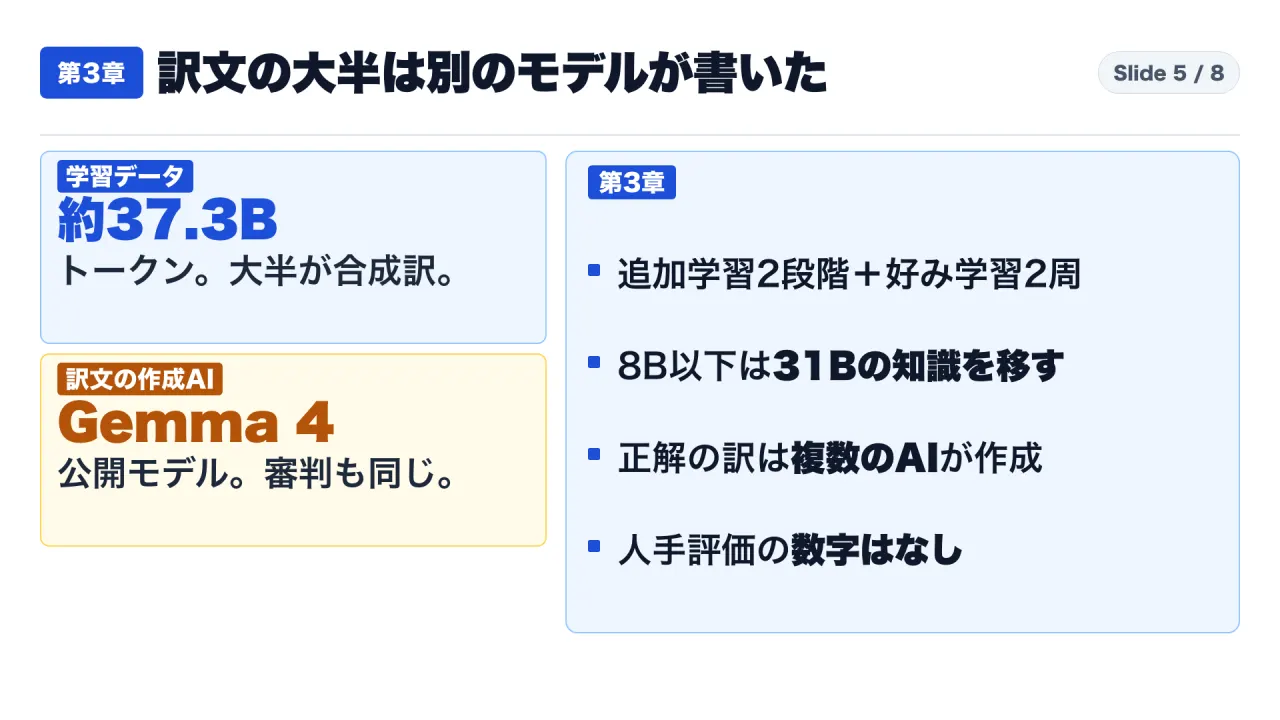
4. Training Architecture: 37.3B Synthetic Tokens via Gemma 4 Distillation
PFN constructed PLaMo 3 Translate by continuing pre-training and alignment on approximately 37.3 billion tokens of translation data, primarily synthesized by models rather than human linguists:
- Synthetic Generation: Raw target-language web texts were paired with synthetic translations generated by Google’s open Gemma 4 31B IT.
- Quality Filtering Pipeline: A three-stage filter eliminated hallucinations: tournament selection across candidates, back-translation verification, and self-refinement using evolving PLaMo checkpoints.
- Alignment and Distillation: Supervised fine-tuning was followed by two cycles of preference learning with Gemma 4 31B IT as automated judge. Knowledge was distilled from the aligned 31B model into the 8B, 2B, and 0.8B tiers.
4-1. Internal Benchmarks vs. External Metrics
PFN evaluated PLaMo 3 Translate primarily against two internal benchmark suites:
- PFTB (PFN Translation Benchmark): Multi-genre passages where reference translations were generated synthetically using frontier foundation models, scored on string and semantic similarity.
- SaaS Benchmark: Enterprise English-to-Japanese software documentation measuring preservation of HTML tags, code snippets, and structured formatting.
While reporting public WMT24++ and FLORES+ scores, PFN noted WMT24++ exhibited quality issues in human references and performance saturation, focusing optimization on internal PFTB and SaaS metrics.
5. Deconstructing the DeepL Win-Rate: The October 7 Data and 6 Critical Unknowns
The narrative that PLaMo 3 Translate outperforms DeepL rests on an evaluation table published in PFN’s October 7, 2026 product blog:
| Benchmark Suite & Translation Direction | PLaMo 3 Translate (31B Checkpoint) Win-Rate vs. DeepL | Evaluation Judge |
|---|---|---|
| PFTB (English → Japanese) | 87.00% | Gemini 3.1 Pro (LLM-as-a-Judge) |
| PFTB (Japanese → English) | 58.00% | Gemini 3.1 Pro (LLM-as-a-Judge) |
| SaaS Benchmark (English → Japanese, Tag Preservation) | 73.82% | Gemini 3.1 Pro (LLM-as-a-Judge) |
| WMT24++ (English → Japanese) | 59.17% | Gemini 3.1 Pro (LLM-as-a-Judge) |
Enterprise architects must recognize six critical unverified variables before treating this data as migration validation:
- Single Evaluator Architecture: Head-to-head win-rates were determined by Gemini 3.1 Pro rather than professional human translators. Automated LLM judges often favor stylistic traits characteristic of large models.
- DeepL Configuration Details Omitted: Publications omit whether the baseline used DeepL Free or DeepL Pro, or if glossary enforcement and formality controls were active.
- Sample Size (N) Undisclosed: PFN omitted total sentence counts evaluated per benchmark, preventing computation of statistical error margins.
- Zero Comparative Data for Smaller Models: The comparison evaluated solely the 31B checkpoint. No comparative win-rate data exists for the 0.8B, 2B, or 8B models most likely to deploy on local workstations.
- Absence of Non-English/Japanese Pairs: No comparative evaluations against DeepL were published for European languages or Chinese.
- Acknowledged Frontier Gaps: PFN acknowledged that on English-to-Japanese translation, Anthropic’s Claude Fable 5.1 achieved higher overall translation quality than PLaMo 31B.
Benchmark choice alters apparent performance. On public WMT24++ English-to-Japanese, PFN’s October 7 data showed Google’s TranslateGemma 27B scored 0.882, slightly outperforming PLaMo 8B’s 0.879. PLaMo 8B’s large lead appeared primarily on PFN’s internal SaaS benchmark (0.571 vs TranslateGemma’s 0.395).
6. The Enterprise Implementation Blueprint: A 3-Step Verification Protocol
The primary operational advantage of PLaMo 3 Translate is data sovereignty: air-gapped on-premises execution eliminates cloud retention risks for confidential legal, technical, and medical data.
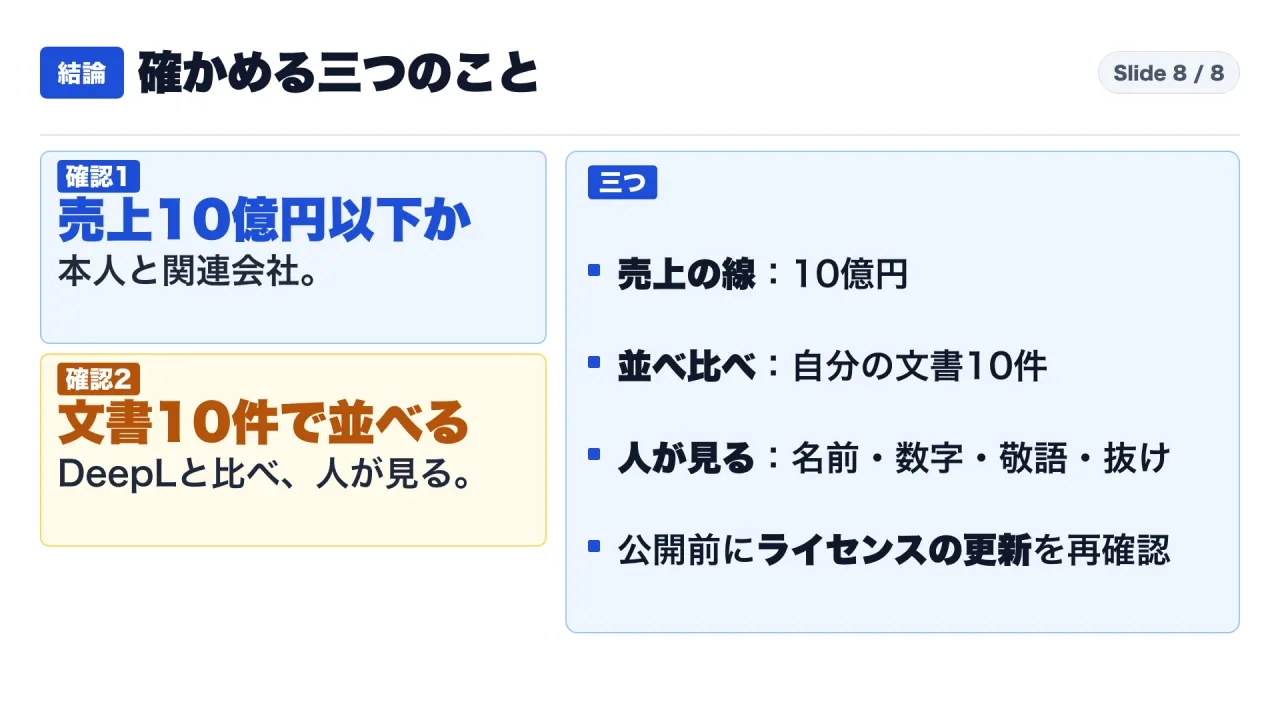
To evaluate whether PLaMo 3 Translate can replace DeepL in production, enterprise teams should execute a three-step protocol:
Step 1: Legal Audit of Revenue Ceilings and Registration Obligations
Verify corporate eligibility under the PLaMo Community License:
- Calculate consolidated gross revenues across parent, operating subsidiaries, and affiliates for the preceding fiscal year.
- If revenue is 1 billion yen or less (~$6.5M USD), submit PFN’s web registration form prior to testing.
- If revenue exceeds 1 billion yen, contact PFN to negotiate a commercial licensing agreement.
Step 2: Establish a 10-Document Internal Evaluation Corpus
Assemble a representative corpus of 10 real-world corporate documents:
- Three customer correspondence emails.
- Three technical architectural specifications containing code blocks and structured markup.
- Two internal compliance documents and two draft commercial contracts.
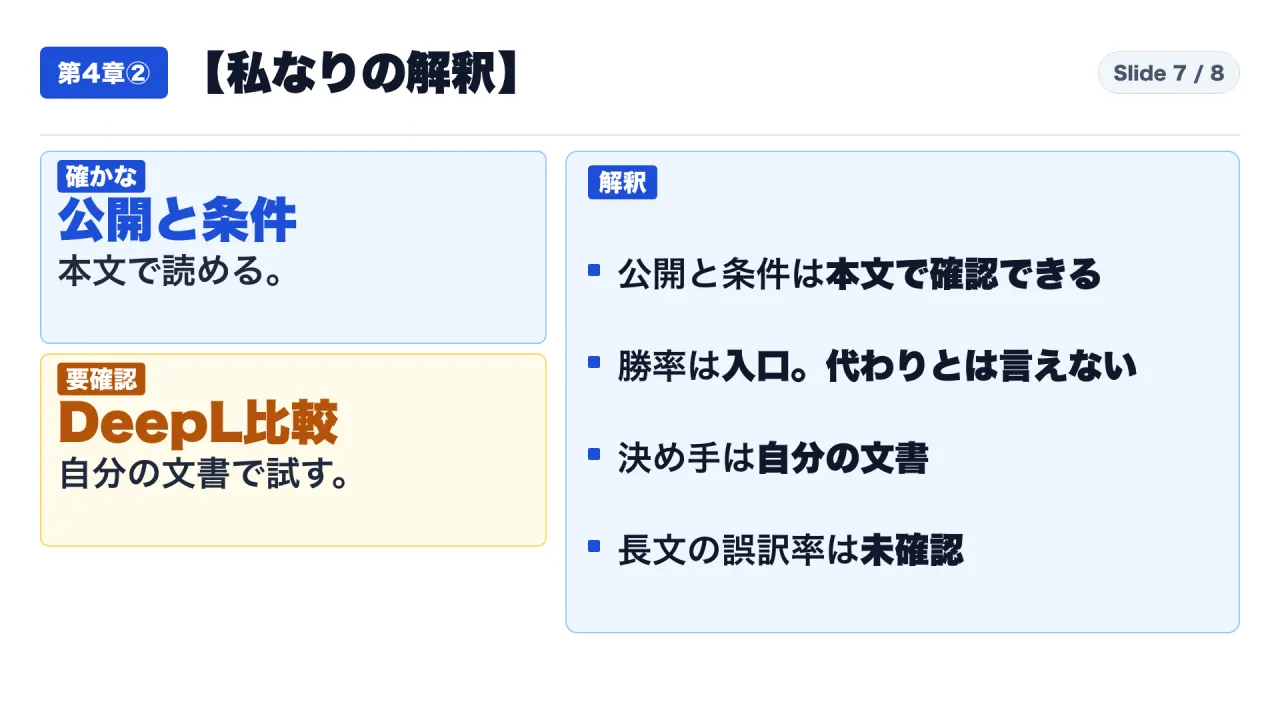
Translate this corpus in parallel across DeepL Pro (configured with corporate glossaries) and target PLaMo checkpoints (evaluating 2B and 8B GGUF models with matching glossary prompts).
Step 3: Human Error-Auditing and Labor Logging
Replace automated scoring with blind evaluation by bilingual domain specialists, logging four defect categories:
- Proper Noun Preservation: Accuracy of project names and technical terminology.
- Numeric and Unit Integrity: Preserving monetary figures, dates, and metrics without corruption.
- Register and Honorific Consistency: Ensuring business correspondence maintains appropriate formal register.
- Omission and Hallucination Rates: Logging dropped clauses or hallucinated text.
Calculate the exact human post-editing time (in minutes per 1,000 words) required to elevate both translations to production standards. If editing PLaMo outputs requires more human labor than DeepL, the economic savings of self-hosting will be negated by human engineering overhead.
Primary Sources
- PFN Technical Blog (Weight Release): PLaMo 3 Translate Weight Release (November 5, 2026)
- PFN Technical Blog (Product Release): plamo-3-translate Product Release (October 7, 2026)
- Hugging Face Model Card (31B Base): pfnet/plamo-3-translate-31b
- Hugging Face Model Card (0.8B GGUF): pfnet/plamo-3-translate-0.8b-GGUF
- PLaMo Community License: Official English License Text
- Hugging Face Repository Telemetry: API Metadata for pfnet/plamo-3-translate-31b
Note: This article is for informational purposes only and does not constitute investment advice or a price forecast. Podcast audio is synthesized from the host’s voice.