Why PostHog Abandoned DuckDB After Five Months at One Trillion Rows While Airbnb Replaced Frontier LLMs with a 2B Model at 1% Cost ── The Hard Physics of Data Scale and Specialized Model Distillation
A dual architectural autopsy on why single-node OLAP engines hit a mathematical wall in multi-tenant cloud storage, and how enterprise domain distillation beats monolithic cloud AI on latency, spend, and precision.
Japanese Edition: https://consuloji.substack.com/p/posthog5duckdbairbnb2b1251
Executive Summary & Key Technical Takeaways
- The Dual Engineering Revelations: In November 2026, two detailed engineering disclosures challenged prevailing industry dogmas regarding big data infrastructure and generative artificial intelligence deployment.
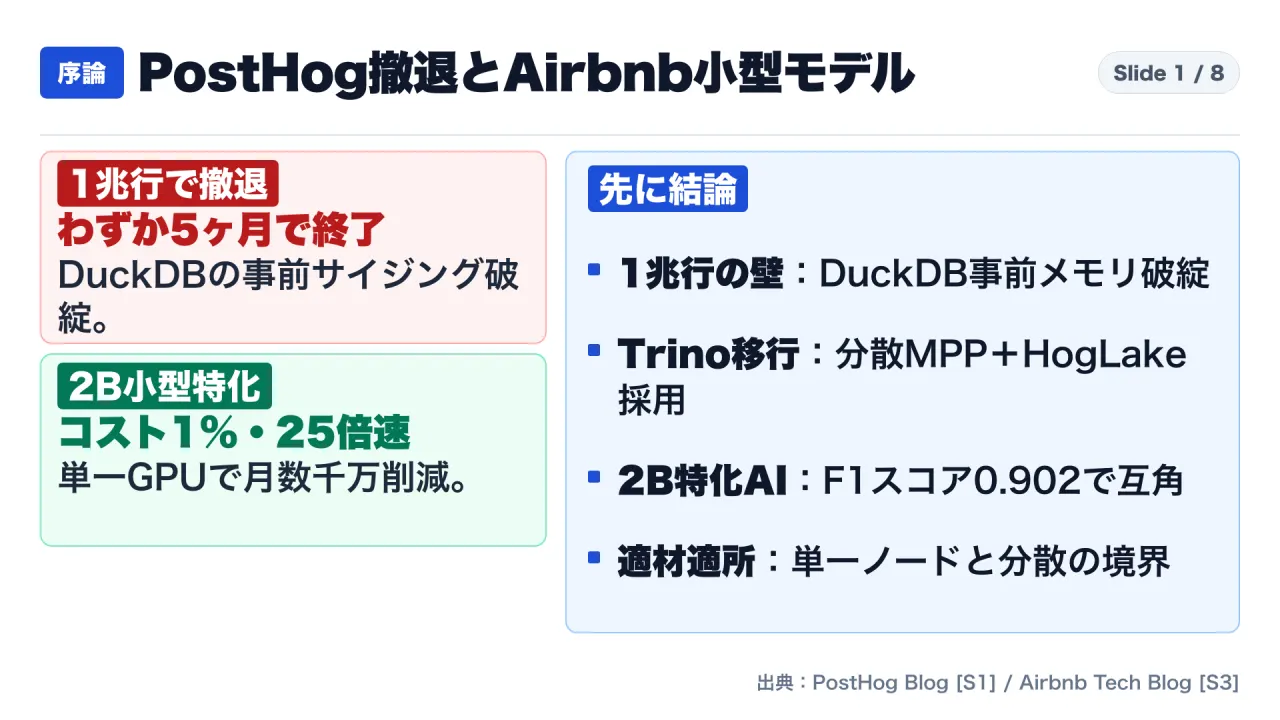
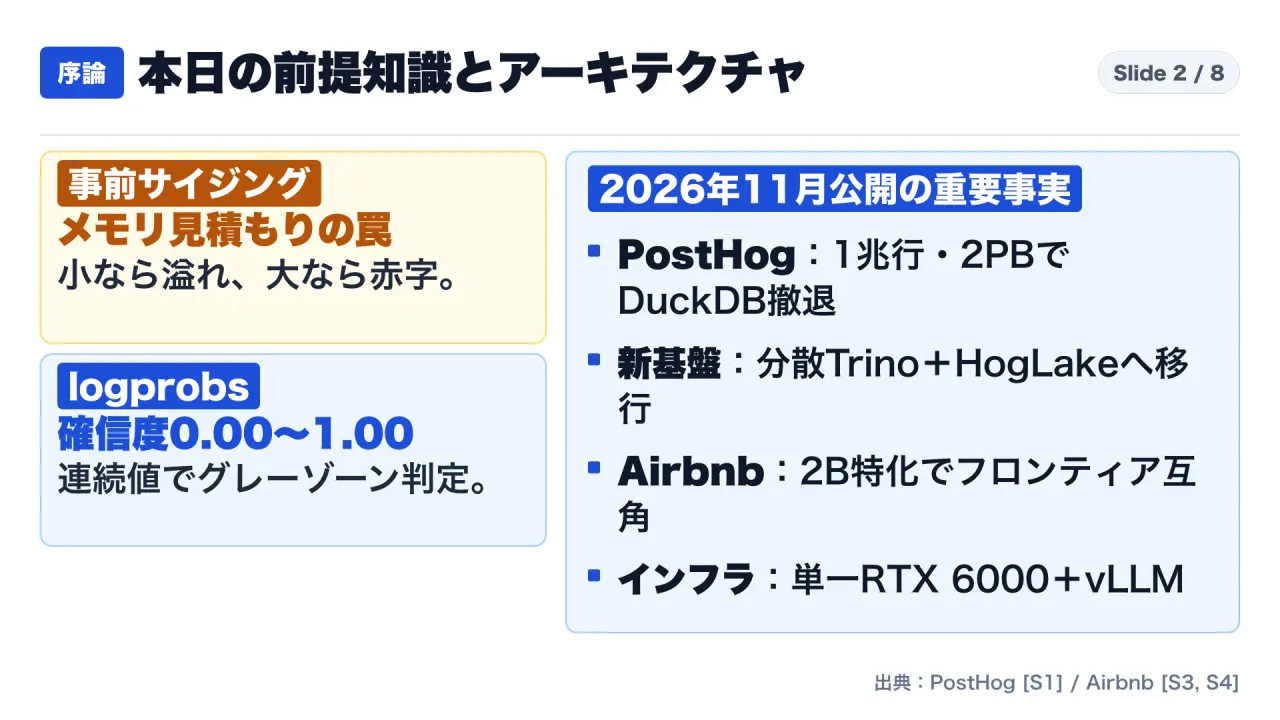
- PostHog’s DuckDB Capitulation: Product analytics platform PostHog abandoned its embedded “DuckLake” analytics engine after five months in production, migrating to distributed Massively Parallel Processing (MPP) engine Trino and custom open table format HogLake after crossing 1 trillion rows (approximately 2 petabytes) of customer events.
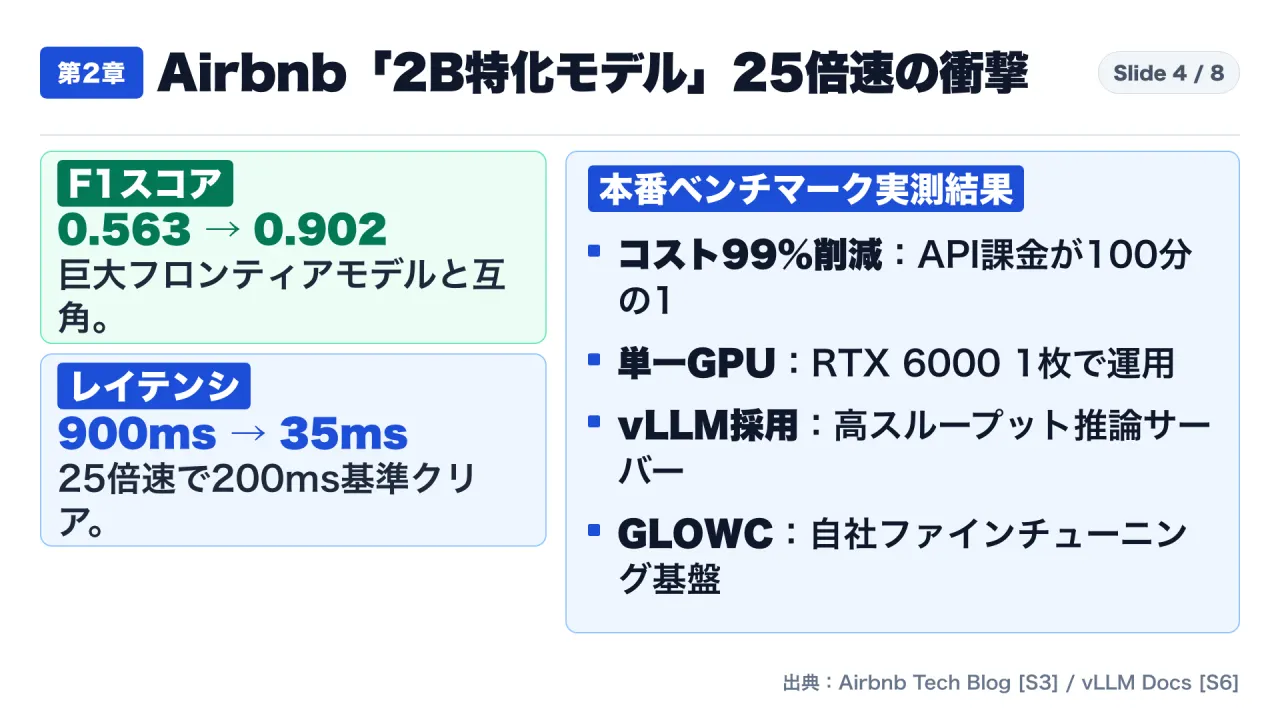
- The Three Walls of Single-Node OLAP: DuckDB’s in-process vectorized engine failed under multi-tenant cloud SaaS workloads due to three structural bottlenecks: the pre-sizing memory dilemma (where unpredictable queries trigger catastrophic spill-to-disk latency), multi-process write-commit locks exceeding three minutes per table, and asynchronous remote object storage (Amazon S3) I/O latency.
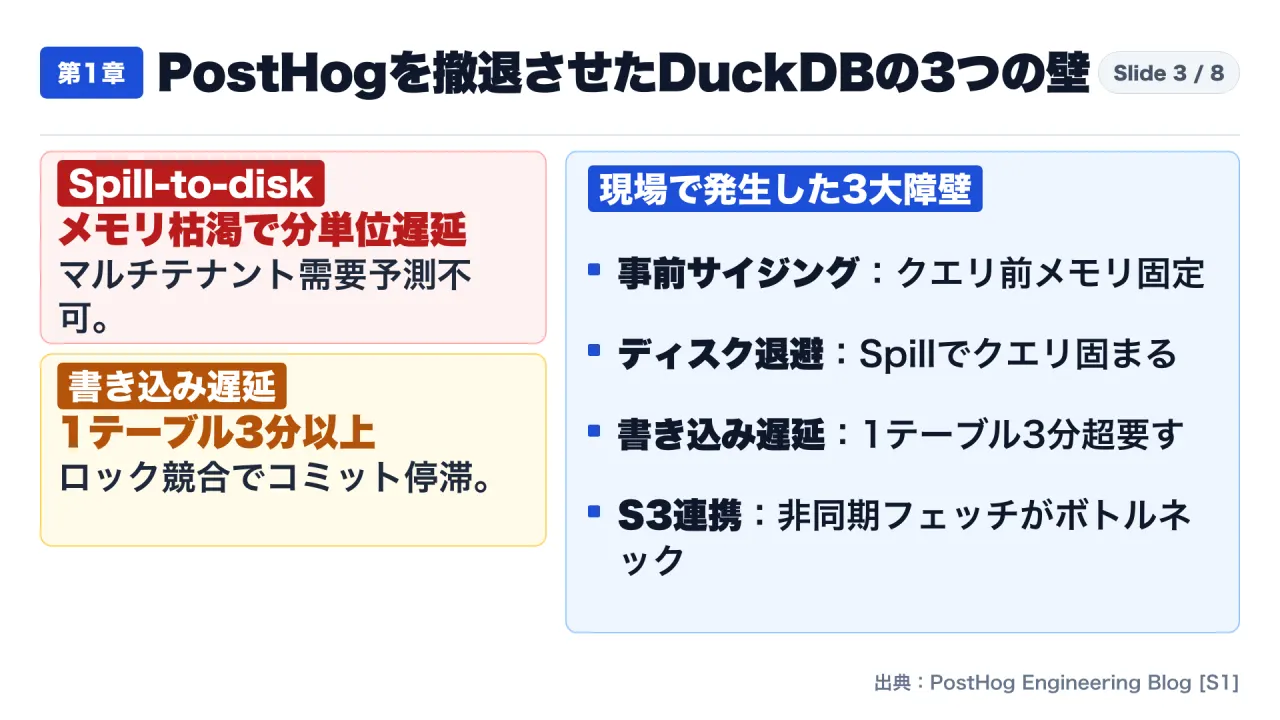
- Airbnb’s 2B Production Triumph: In a parallel breakthrough, Airbnb eliminated multi-million-dollar monthly commercial frontier model API bills for real-time listing policy moderation. By fine-tuning a specialized 2-billion-parameter (2B) open-weights model using its GLOWC framework, Airbnb achieved parity in classification accuracy (F1 score of 0.902), slashed median inference latency by 25x (from 900ms to 35ms), and reduced operational infrastructure costs by 99% (a 100x compression), serving entire global traffic on a single NVIDIA RTX 6000 Ada GPU via vLLM.
- Deterministic Risk Governance via logprobs: Airbnb replaced unstructured natural language outputs with continuous confidence scores (0.00 to 1.00) derived from token log-probabilities (logprobs). This enabled a three-tier automated triage pipeline: auto-blocking explicit violations (confidence >= 0.85), routing ambiguous edge cases (0.60 <= confidence < 0.85) to specialized human reviewers, and instantly approving compliant listings (confidence < 0.60).
- Ending the “Frontier-for-Everything” Anti-Pattern: Routing high-frequency classification, entity extraction, or structured tagging tasks to monolithic cloud frontier models represents an architectural anti-pattern equivalent to driving a rocket engine to the grocery store. High-frequency enterprise endpoints belong on distilled, domain-specialized small models.
1. The Architectural Divide: Single-Node Limits vs. Frontier Model Economics
Modern software engineering frequently falls victim to technological monoculture: the belief that a single breakthrough tool can solve every operational requirement across all scales.
The Twin Infrastructure Misconceptions:
┌────────────────────────────────────────────────────────────────────────┐
│ MISCONCEPTION 1: "Embedded In-Memory Engines Scale to the Cloud"       │
│ Assumption: If DuckDB processes Parquet locally at lightning speed,    │
│             it can power a multi-tenant cloud data warehouse.          │
│ Reality:    Pre-sizing limits, lock contention, and remote object I/O  │
│             break single-node engines at petabyte scale.               │
├────────────────────────────────────────────────────────────────────────┤
│ MISCONCEPTION 2: "Frontier Commercial Models Are Required for Quality" │
│ Assumption: Complex policy moderation requires paying hyper-scaler     │
│             frontier model APIs for every production request.          │
│ Reality:    Domain-specific distillation into 2B parameters achieves   │
│             identical accuracy at 1% of the cost and 25x the speed.    │
└────────────────────────────────────────────────────────────────────────┘
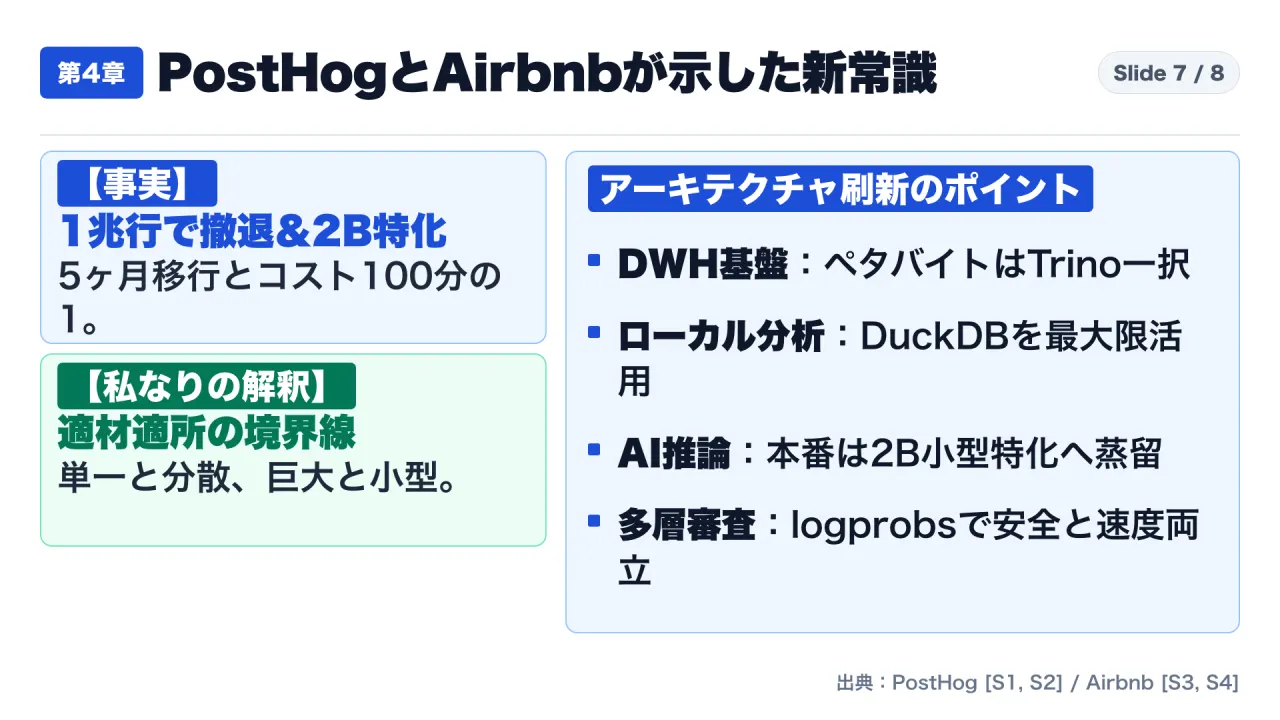
The disclosures from PostHog and Airbnb establish the hard physical boundaries of data infrastructure. PostHog proved that single-node efficiency cannot overcome the distributed synchronization requirements of multi-tenant cloud storage. Simultaneously, Airbnb proved that monolithic general-purpose language models are economically and operationally unviable for high-frequency production tasks.
2. PostHog’s DuckDB Retreat: The Three Walls of 1 Trillion Rows (2PB)
In early 2026, PostHog introduced “DuckLake,” an analytics warehouse architecture powered by DuckDB. The team sought to leverage DuckDB’s in-process vectorized execution to run analytical queries directly over Parquet files, bypassing the operational overhead of traditional distributed clusters.
However, as production volume reached 1 trillion rows (2 petabytes), the engineering team ran into three structural barriers.
Wall 1: The Pre-Sizing Dilemma and Spill-to-Disk Latency
DuckDB operates as an in-process, single-node engine. When deploying worker nodes in cloud environments, infrastructure teams must determine instance memory allocations in advance.
In a multi-tenant SaaS environment, predicting query complexity is impossible. Clients execute unpredictable ad-hoc queries spanning wildly different time windows:
- Under-Provisioned Memory: When an analytical query requires more working memory than the instance provides, DuckDB prevents process crashes by spilling intermediate state to disk (Spill-to-disk). Switching from memory execution to disk I/O introduces a massive performance degradation: query durations jump from seconds to several minutes, leading to gateway timeouts and frozen user interfaces.
- Over-Provisioned Memory: To prevent disk spills, engineering could provision massive compute instances (such as 256GB or 512GB RAM workers). However, because the vast majority of consumer queries are lightweight, paying for high-memory instances 24/7 made the warehouse product financially unsustainable.
Wall 2: Three-Minute Commit Lock Contention
Analytical platforms must support continuous ingestion alongside interactive queries. In PostHog’s multi-tenant architecture, concurrent background processes continuously append and compact event streams. When multiple writers execute concurrent writes or metadata commits against the same table, write locks create severe queuing contention. PostHog measured table update commit latencies exceeding three minutes, breaking real-time event availability.
Wall 3: Amazon S3 Asynchronous Fetch Bottlenecks
DuckDB delivers extraordinary performance when reading data from local NVMe solid-state drives. However, storing petabytes of analytical data requires cloud object storage such as Amazon S3. At petabyte scale, query performance is dictated by parallel asynchronous HTTP range requests. DuckDB’s remote storage handlers struggled with high-concurrency S3 fetching, turning network round-trip latency into the primary execution bottleneck.
3. Airbnb’s 2B Revolution: Achieving Frontier Accuracy at 1% Cost and 35ms Latency
While PostHog hit the scaling limits of small data engines, Airbnb tackled the opposite extreme: the crippling operational inefficiency of massive generative models.
Production Constraints in Listing Policy Enforcement
Airbnb hosts register and update hundreds of thousands of listing descriptions daily. Content must be screened in real time for policy violations, including off-platform payment solicitation, phone number obfuscation, and unauthorized extra fees.
The production requirements were uncompromising:
- Throughput: Sustaining thousands of candidate reviews per minute globally.
- Strict Latency Budget: Executing moderation checks within 200 milliseconds end-to-end to avoid blocking host publishing workflows.
- Contextual Nuance: Accurately distinguishing benign host commentary from deceptive attempts to bypass platform fees.
The Breakdown of Frontier API Economics
Airbnb initially deployed industry-leading commercial frontier models via cloud APIs. While prompt engineering achieved strong classification performance, production realities quickly made the approach unviable:
- Unsustainable Spend: Processing global listing volume through commercial frontier APIs generated bills in the millions of dollars per month.
- Unacceptable Latency: Network round-trip delays combined with massive model autoregression resulted in a median latency of 900 milliseconds—4.5x over the 200ms production budget.
GLOWC Framework and Domain-Specific Distillation
To solve this crisis, Airbnb developed GLOWC, an internal fine-tuning framework designed to distill domain knowledge into open-weights small models. The team trained a compact 2-billion-parameter (2B) model on curated moderation datasets.
| System Architecture | Base 2B Model (Un-Tuned) | Commercial Frontier Model API | GLOWC Fine-Tuned 2B Model | Operational Achievement |
|---|---|---|---|---|
| F1 Classification Score | 0.563 | ~0.90 | 0.902 | Parity with Frontier Giants |
| Median Inference Latency | ~40ms | ~900ms | 35ms | 25x Speedup (Sub-200ms Budget) |
| Monthly Compute Cost | Baseline | 100% ($Millions/mo) | 1% ($Thousands/mo) | 99% Cost Reduction (1/100th) |
| Hosting Footprint | Local | Multi-Tenant Cloud API | Single RTX 6000 Ada GPU (vLLM) | Fully Autonomous On-Premise |
The fine-tuned 2B model matched the precision of commercial frontier models (F1 of 0.902), reduced response latency to 35 milliseconds, and cut operational costs by 99%, running on a single enterprise workstation GPU (NVIDIA RTX 6000 Ada) via vLLM.
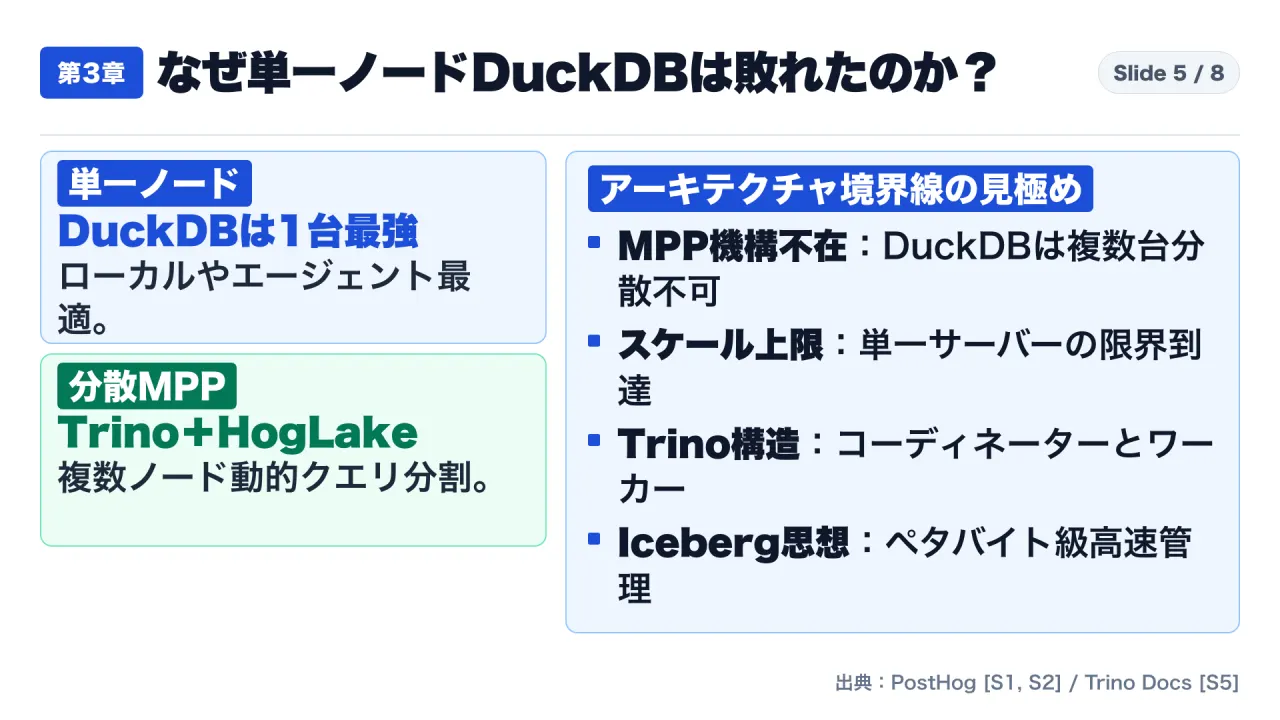
4. Architectural Deep Dive: Single-Node OLAP vs. Distributed MPP (Trino + HogLake)
To overcome DuckDB’s scaling limits, PostHog transitioned its data warehouse backend to the distributed Massively Parallel Processing (MPP) engine Trino, complemented by a custom open table format named HogLake.
| Engineering Metric | DuckDB (Embedded Vectorized OLAP) | Trino + HogLake (Distributed MPP) |
|---|---|---|
| Execution Topology | Single process, multi-threaded inside local memory | Distributed coordinator-worker cluster architecture |
| Horizontal Scaling | Scale-up only (Adding CPU/RAM to single node) | Linear scale-out (Adding worker nodes dynamically) |
| Memory Allocation | Static pre-sizing required per instance | Dynamic stage-level allocation across distributed pools |
| Data Volume Limit | Hundreds of Gigabytes to low Terabytes | Petabytes to Exabytes across distributed storage |
| Object Storage I/O | Single-node HTTP fetches; latency sensitive | Massive parallel asynchronous S3 reads across workers |
| Concurrency & ACID | Process-level write locks; contention at scale | Decoupled metadata layer; concurrent ACID writes |
| Target Use Cases | Local CLI, CI pipelines, Agent scratchpads | Enterprise multi-tenant lakes, large-scale warehouses |
Distributed Stage Decomposition and HogLake Table Management
Trino’s architectural advantage lies in its query planner. When a query arrives, the coordinator breaks execution into distributed stages and tasks, dynamically assigning them across worker nodes. If a particular worker experiences memory pressure, Trino pipelines intermediate buffers or reschedules tasks, eliminating catastrophic failure modes.
PostHog paired Trino with HogLake, an open table format inspired by Apache Iceberg. HogLake resolves write contention by decoupling data files from transactional metadata. Writes occur as isolated atomic operations, while background routines compact small Parquet chunks and prune partitions, ensuring stable sub-second query performance across one trillion rows.
5. Deterministic Decisioning: logprobs Threshold Control and the 3-Tier Pipeline
A vital technical contribution of Airbnb’s deployment was abandoning unstructured text outputs in favor of token log-probabilities (logprobs) for deterministic policy enforcement.
The Pitfall of Binary Natural Language Classification
Calling a commercial frontier model via conversational prompts yields unstructured text or rigid JSON booleans ({"violation": true}). This introduces two severe operational vulnerabilities:
- Opaque Confidence: The system cannot communicate whether its determination is borderline (51% certainty) or definitive (99.9% certainty).
- False Positive Disruption: Machine errors inevitably ban legitimate host accounts, triggering customer support friction and reputation loss.
Continuous Scoring via Token Log-Probabilities
Because Airbnb hosts its 2B model directly on vLLM, the engineering team extracts token logprobs during generation. By measuring the relative log-probability of target classification tokens (VIOLATION vs. COMPLIANT), the system produces a continuous confidence score ranging from 0.00 to 1.00.
This three-tier pipeline transformed business risk into an operational dial:
- Zero Host Friction for Compliant Content: Over 95% of listings score below 0.60 and receive instant publication approval in 35ms.
- Automated Enforcement on Blatant Abuse: Content scoring 0.85 or higher is automatically rejected with clear correction guidance, requiring zero manual human review.
- Targeted Human Triage: Human moderation staff review only the narrow gray zone (0.60 to 0.84), dramatically reducing staffing expenses while eliminating false-positive account suspensions.
- Dynamic Policy Tuning: If fraud patterns surge during holidays, operations teams adjust the threshold slider from 0.85 to 0.80 instantly without modifying model weights.

6. The Paradigm Shift: Ending the ‘Frontier-for-Everything’ Anti-Pattern
The engineering post-mortems from PostHog and Airbnb illustrate the same foundational lesson: software systems fail when tools are decoupled from the physics of their operational scale.
The “Rocket Engine to the Grocery Store” Fallacy
Enterprise software is currently saturated with architectural over-engineering. Development teams routinely route elementary tasks—such as routing support tickets, extracting JSON entities, or checking compliance rules—to multi-hundred-billion parameter frontier models.
Frontier foundation models are marvels of general intelligence, possessing comprehensive knowledge spanning advanced astrophysics, legal jurisprudence, and creative literature. However, an enterprise classification task requires only a tiny sliver of that capability. Using a frontier model for simple classification is the architectural equivalent of igniting a Saturn V rocket engine to drive two blocks to the grocery store. It is slow, extraordinarily expensive, and operationally fragile.
Two Immutable Architectural Laws
From these November 2026 benchmarks, two engineering laws emerge:
- The Law of Data Substrates:
- For local developer tooling, single-user data science, CI/CD pipelines, and autonomous agent scratchpads, DuckDB remains the premier analytical tool.
- For multi-tenant cloud storage exceeding terabyte scales with unpredictable concurrency, engineering teams must deploy distributed MPP engines (Trino, ClickHouse) paired with open table formats (Iceberg, HogLake).
- The Law of Model Distillation:
- Utilize commercial frontier models during early prototyping to explore problem boundaries and generate verified training sets.
- Once task boundaries are defined and transaction volume scales, distill the workflow into a domain-specialized 2B to 7B model hosted on self-managed infrastructure. This delivers a 100x cost reduction, 25x latency improvement, and deterministic logprobs control.
7. Actionable Implementation Playbook: Three Directives for Modern Infrastructure
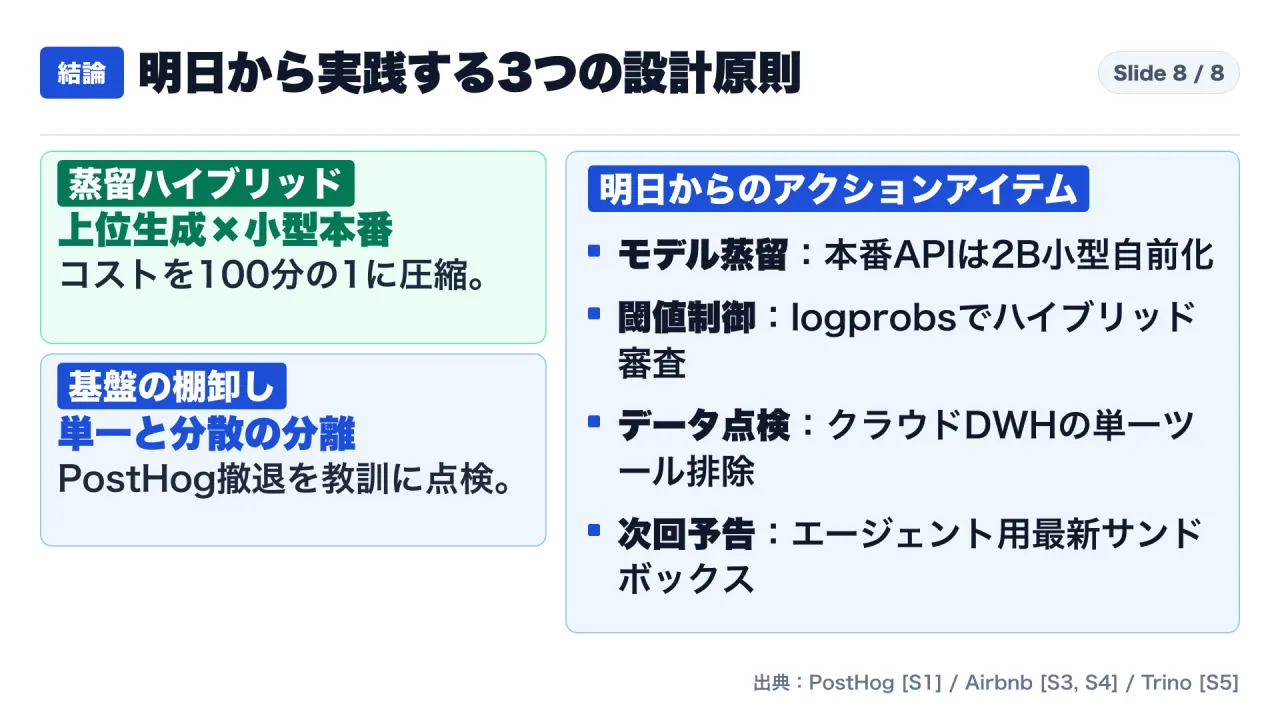
To apply these architectural lessons within your engineering organization, execute three tactical directives:
- Audit Enterprise LLM Invoices for High-Frequency Classification Tasks: Review cloud billing logs to identify endpoints where expensive frontier models process repetitive tasks such as classification, intent routing, or entity extraction. Flag every endpoint exceeding 50,000 requests monthly as an immediate candidate for small model distillation.
- Build a Distillation Pipeline and Deploy vLLM with logprobs Extraction: Use frontier model outputs to build a curated golden dataset of 5,000 to 20,000 verified examples. Fine-tune an open-weight 2B or 3B base model (such as Llama-3.2-3B or Qwen-2.5-3B). Deploy the distilled checkpoint on a single workstation GPU using vLLM, configuring the API client to extract token logprobs for three-tier threshold decisioning.
- Establish Clear Boundaries Between Embedded and Distributed OLAP: Audit internal data warehouse projects to ensure single-node engines like DuckDB are restricted to their proper domains: developer laptops, data ingestion workers, and temporary scratchpads. If multi-tenant SaaS data approaches petabyte scale, migrate storage to Apache Iceberg or HogLake backed by Trino or ClickHouse.
Primary Sources & Verified References
- PostHog Official Engineering Blog: Why We’re Moving Our Warehouse Product Off DuckDB (https://posthog.com/blog/moving-off-duckdb)
- GitHub Repository:
PostHog/hoglake: Petabyte-Scale Open Table Format Specification (https://github.com/PostHog/hoglake) - Airbnb Technology Blog: Frontier Quality at 1% of the Cost: A Production Benchmark of LLM Classifiers (https://airbnb.tech/ai-ml/frontier-quality-at-1-of-the-cost-a-production-benchmark-of-llm-classifiers/)
- Airbnb Engineering Documentation: GLOWC Fine-Tuning Framework and logprobs Thresholding Architecture (https://airbnb.tech/ai-ml/glowc-fine-tuning-and-logprobs-thresholding/)
- Trino Project Architectural Documentation: Distributed MPP Execution Engine Concepts and Worker Topology (https://trino.io/docs/current/overview/concepts.html)
- vLLM Project Official Documentation: High-Throughput Serving and Token Log-Probability Extraction (https://docs.vllm.ai/en/latest/serving/openai_compatible_server.html)
This article analyzes primary technical and financial disclosures for informational purposes only and does not constitute investment advice.