Why Crédit Mutuel Arkéa Lost $30M to Monero Laundering in a 72-Hour Reporting Delay Under EU DORA ── The Japanese FSA Director Liability Doctrine, $70M Net Banking Fraud, and the BOLA Perimeter Collapse
An architectural autopsy of how external vendor workstations, customer-facing API vulnerabilities, and exposed industrial cooling controllers shattered traditional enterprise security perimeters across Europe and Japan.
Japanese Edition: https://consuloji.substack.com/p/eudora723000monero104bola
Executive Summary & Key Technical Takeaways
- The Perimeter Collapse: In early November 2026, three major breaches demonstrated that attackers no longer prioritize penetrating core banking mainframes. Instead, intrusions target unmonitored perimeters: third-party service provider workstations, customer-facing web application programming interfaces (APIs), and exposed cellular industrial Internet of Things (IoT) controllers.
- The Arkéa Treasury Heist: French cooperative banking giant Crédit Mutuel Arkéa suffered a €118 million ($133 million / ¥21 billion) fraudulent transfer originating from its own proprietary settlement treasury (“compte propre”) via a compromised external partner workstation. The loss erased 51.3% of the banking group’s first-half 2026 net profit (€230 million).
- The 72-Hour Monero Flight: A 72-hour delay between initial outflows on November 1-2 and Arkéa’s public disclosure on November 4 enabled attackers to swap stolen fiat into stablecoins, bridge to Ethereum, and convert over $30 million into Monero (XMR), rendering the funds permanently untraceable before exchange blacklists activated.
- EU DORA Enforcement Exposure: Under the European Union Digital Operational Resilience Act (DORA - Regulation EU 2022/2554), major financial institutions face strict 4-hour initial incident notification rules (Article 19). Non-compliant Critical Third-Party Providers (CTPPs) face periodic penalties up to 1% of average daily global turnover per day for up to 180 days (Article 35).
- Japan FSA Director Personal Liability: Japan’s Financial Services Agency (FSA) updated its Cybersecurity Guidelines to establish that corporate directors face personal civil damage liability under the Companies Act for breaches of their fiduciary duty of care (善管注意義務) if security governance is deficient, as annual domestic online banking fraud reached an all-time record of ¥10.397 billion ($70 million) driven by residential IP proxy networks.
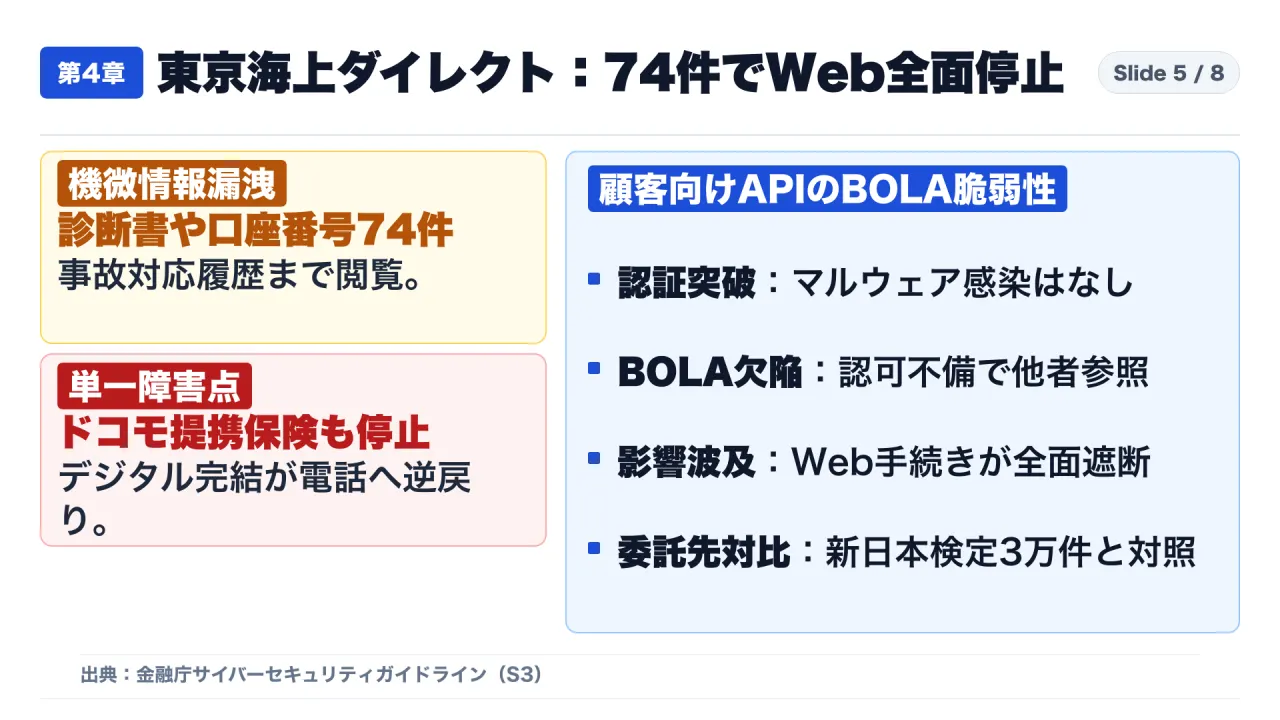
- Customer API Single Points of Failure: Tokio Marine Direct had its web claims processing completely halted for its flagship “&e” product and NTT docomo auto insurance after unauthorized scraping compromised 74 sensitive medical and banking records via Broken Object Level Authorization (BOLA), turning a customer interface into an operational single point of failure (SPOF).
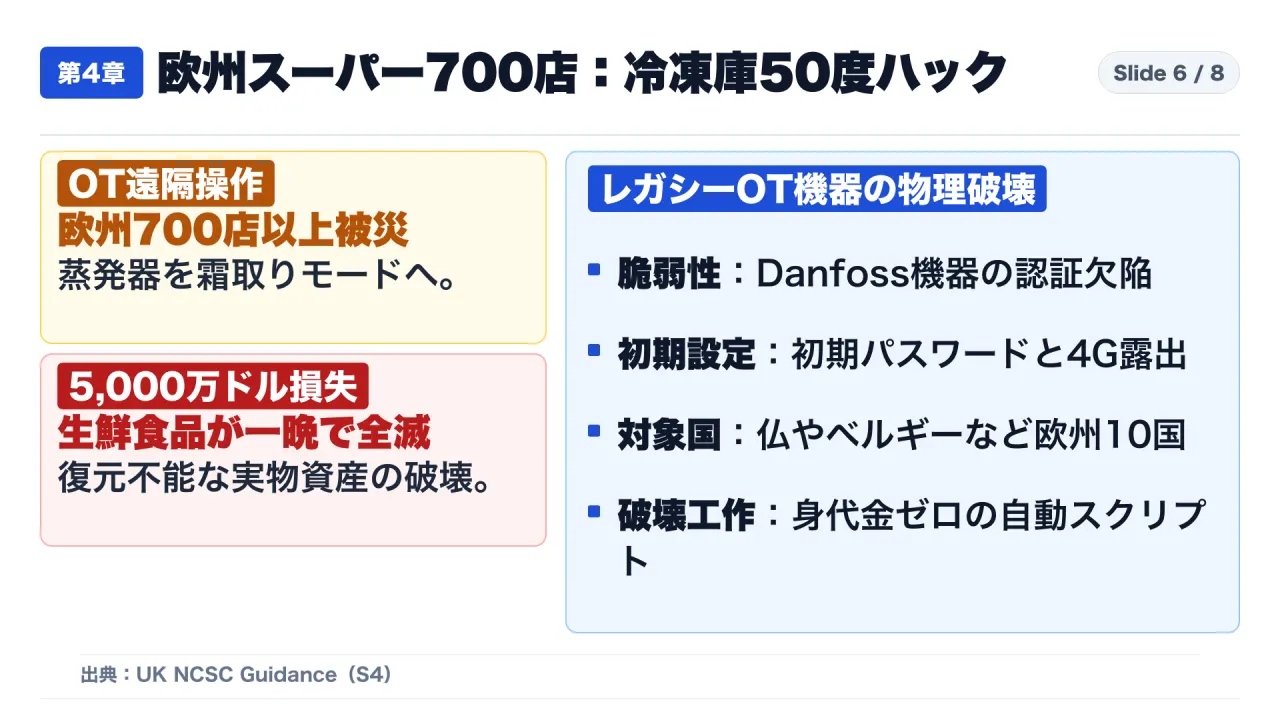
- Physical Sabotage via Legacy OT: Across Europe, automated artificial intelligence scans compromised over 700 supermarket refrigeration controllers (Danfoss AK-SM 800A) left exposed on public 4G links with factory default credentials, overriding setpoints to 50°C and destroying $50 million in fresh inventory overnight without any extortion demand.
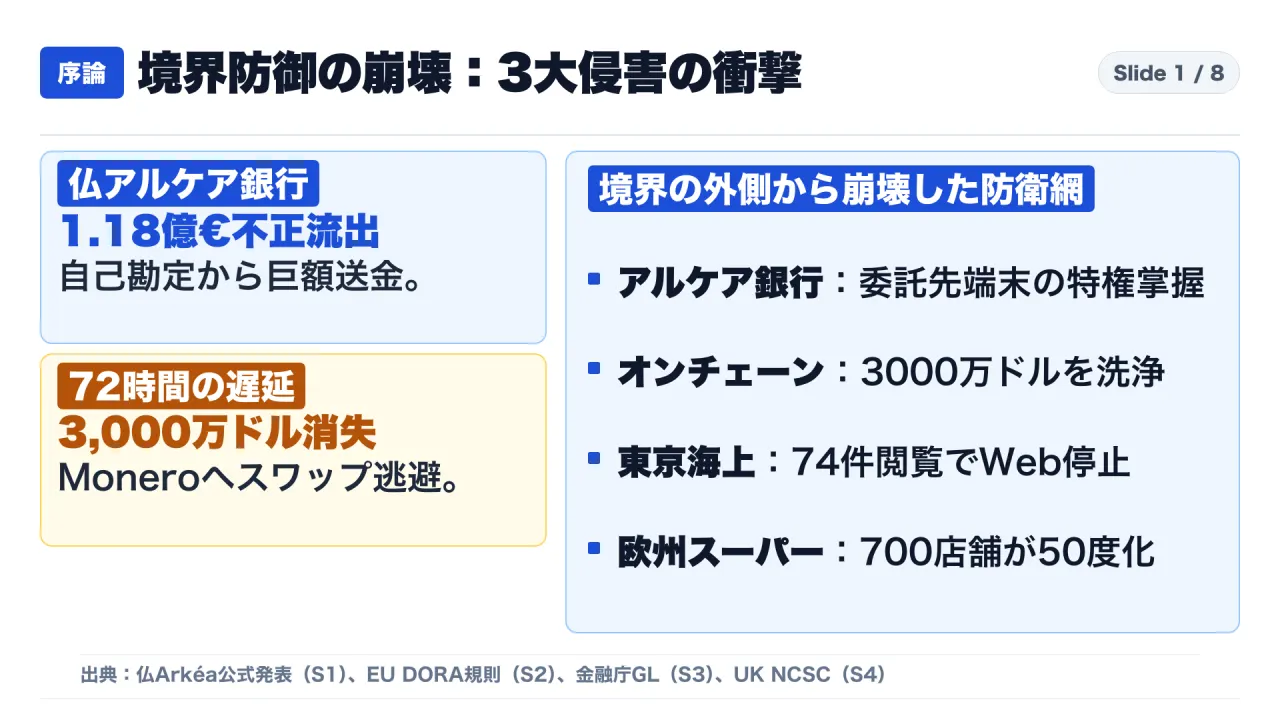
1. The Breakdown of the Perimeter: Three Simultaneous Outer-Boundary Breaches
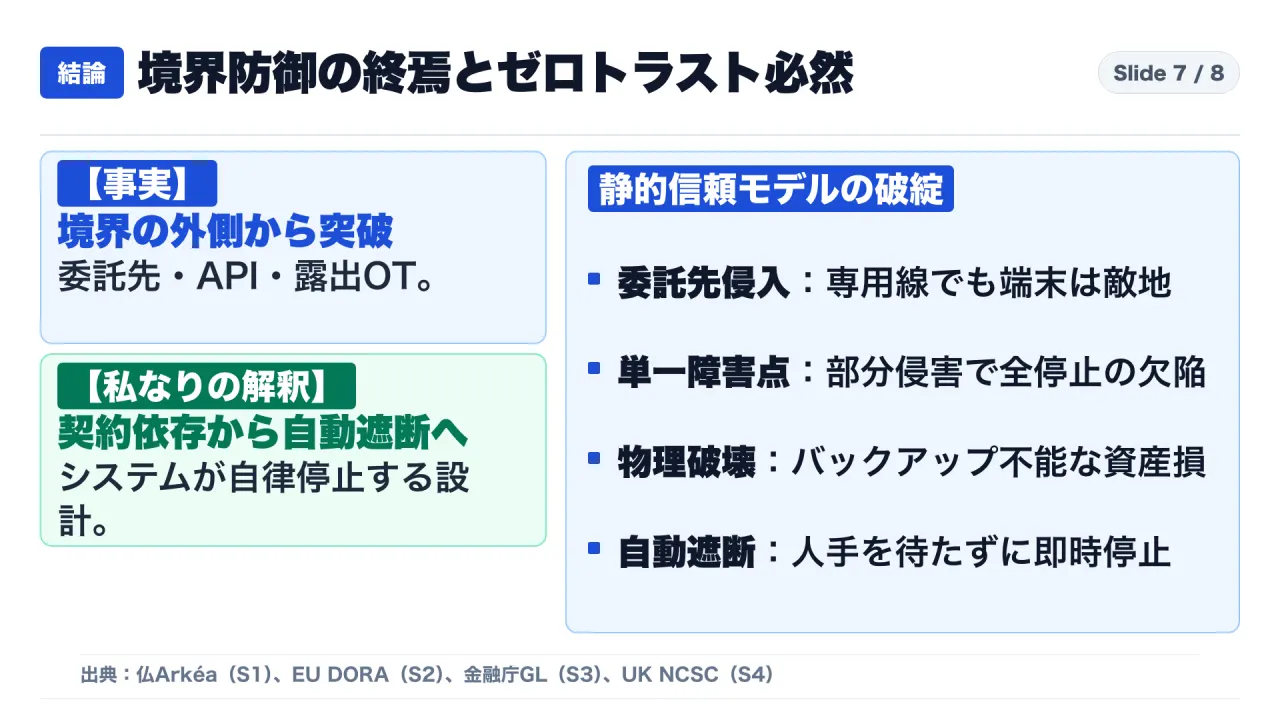
The classic enterprise security model—assuming critical systems remain safe behind internal network boundaries—has collapsed against modern attack methodologies. In early November 2026, three major incidents illustrated how attackers exploit implicit trust placed in external communication channels:
- Privileged Partner Compromise (Crédit Mutuel Arkéa): Attackers compromised an external service provider’s operational workstation holding valid execution credentials, draining the bank’s proprietary treasury accounts directly and bypassing retail fraud heuristics.
- Customer Interface Authorization Collapse (Tokio Marine Direct): Rather than deploying malware, attackers bypassed authorization checks on web application endpoints, viewing sensitive policyholder claims. Severing the vulnerable endpoints forced the complete shutdown of digital customer onboarding.
- Automated Physical Sabotage (European Supermarket Refrigeration): Threat actors scanned public internet ranges for industrial control systems, bypassing nonexistent authentication on legacy cooling controllers to heat food distribution warehouses to 50°C, causing irreversible physical inventory destruction.
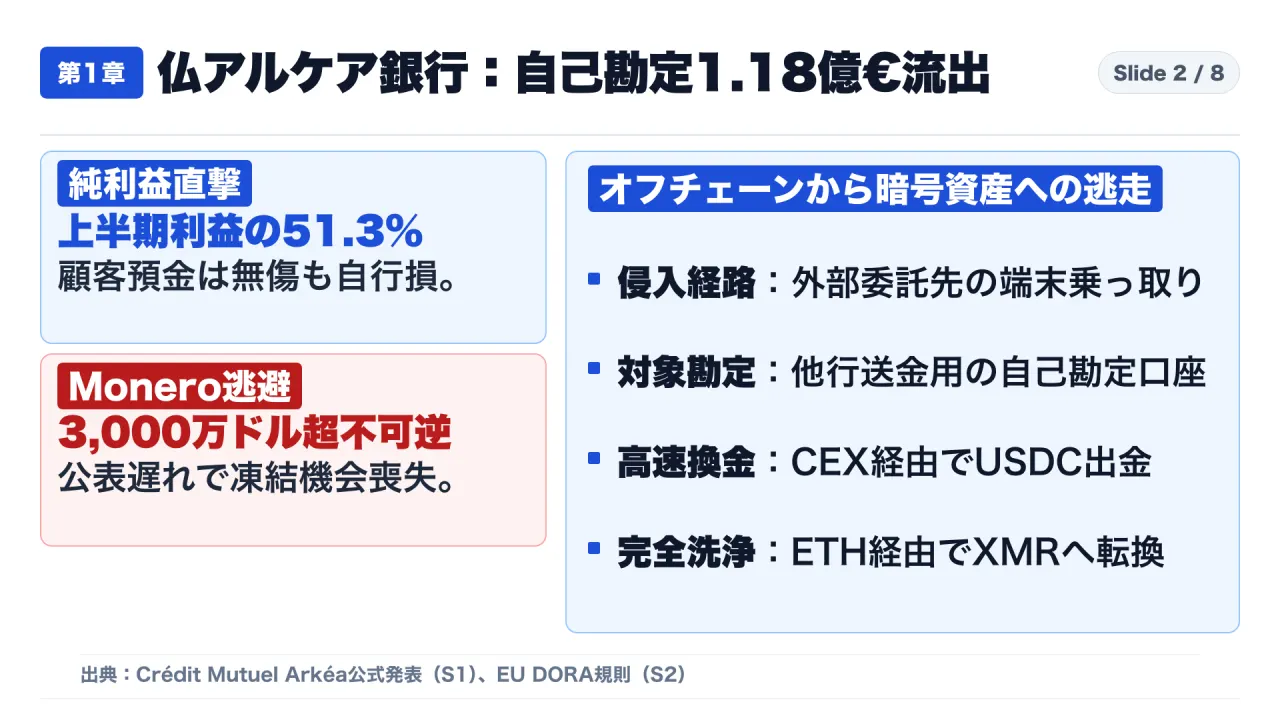
2. Anatomizing the Arkéa Bank Heist: Vendor Compromise and the 72-Hour Monero Flight
Crédit Mutuel Arkéa (assets of €211.5 billion, 5.8 million clients) confirmed on November 4, 2026, that it suffered massive fraudulent electronic transfers.
Ingress Vector: The Outsourced Workstation Pivot
Early public speculation attributed the breach to Arkéa’s online retail banking subsidiary, Fortuneo. Arkéa refuted this hypothesis, clarifying that the intrusion originated from an external service provider platform. Attackers compromised an administrative workstation at a third-party vendor, injecting unauthorized wire instructions directly into Arkéa’s wholesale payment settlement engine.
Targeting Wholesale Treasury Assets (“Compte Propre”)
Arkéa assured the public that “no customer funds suffered financial loss.” However, the funds were stolen directly from the bank’s own treasury account (compte propre), used for interbank settlement and operational liquidity. Drained capital reached approximately €118 million ($133 million / ¥21 billion). While retail depositors were unharmed, the loss represents 51.3% of Arkéa’s first-half 2026 consolidated net profit (€230 million), delivering a direct blow to capital reserves.
On-Chain Forensics: The Cost of a 72-Hour Disclosure Lag
On-chain blockchain forensic analyses conducted by ZachXBT and Bitquery exposed the rapid conversion of stolen fiat capital into immutable cryptocurrency assets.
| Investigation Dimension | Official Disclosures (Arkéa & Authorities) | On-Chain Forensics (ZachXBT & Bitquery) | Architectural & Financial Assessment |
|---|---|---|---|
| Timeline | First public advisory November 4, 13:00 CET; update at 17:30 CET. | Outflows initiated November 1 ($106M); second wave November 2 ($27M). | 72-hour delay between fund drainage and disclosure crippled rapid asset freezing. |
| Ingress Vector | Third-party vendor technology platform. | Legitimate business workstation hijacked with execution rights. | Perimeter firewalls bypassed via static trust granted to an external supplier. |
| Account Type | Proprietary treasury account (compte propre). | Zero retail accounts breached; loss sustained directly on balance sheet. | Wholesale treasury theft avoided bank runs but eliminated half-year profits. |
| Volume | Estimated at “approximately €100 million.” | Verified at $133 million (€118 million / ¥21 billion). | Discrepancy between early bank estimates and total on-chain extracted capital. |
| Laundering Path | Stated potential conversion into crypto-assets. | Fiat routed to OTC/CEX into USDC, bridged to ETH, swapped to Monero. | Over $30 million shielded into untraceable privacy coins before exchange freezes. |
Because Arkéa failed to detect and report the unauthorized transfers immediately, attackers executed complex cross-chain laundering maneuvers. Fiat wire transfers were routed to OTC desks and centralized exchanges to mint USD Coin (USDC). The USDC was bridged to Ethereum and swapped into Monero (XMR). By the time exchanges received blacklisting alerts, over $30 million in capital had been converted into Monero, rendering recovery impossible.
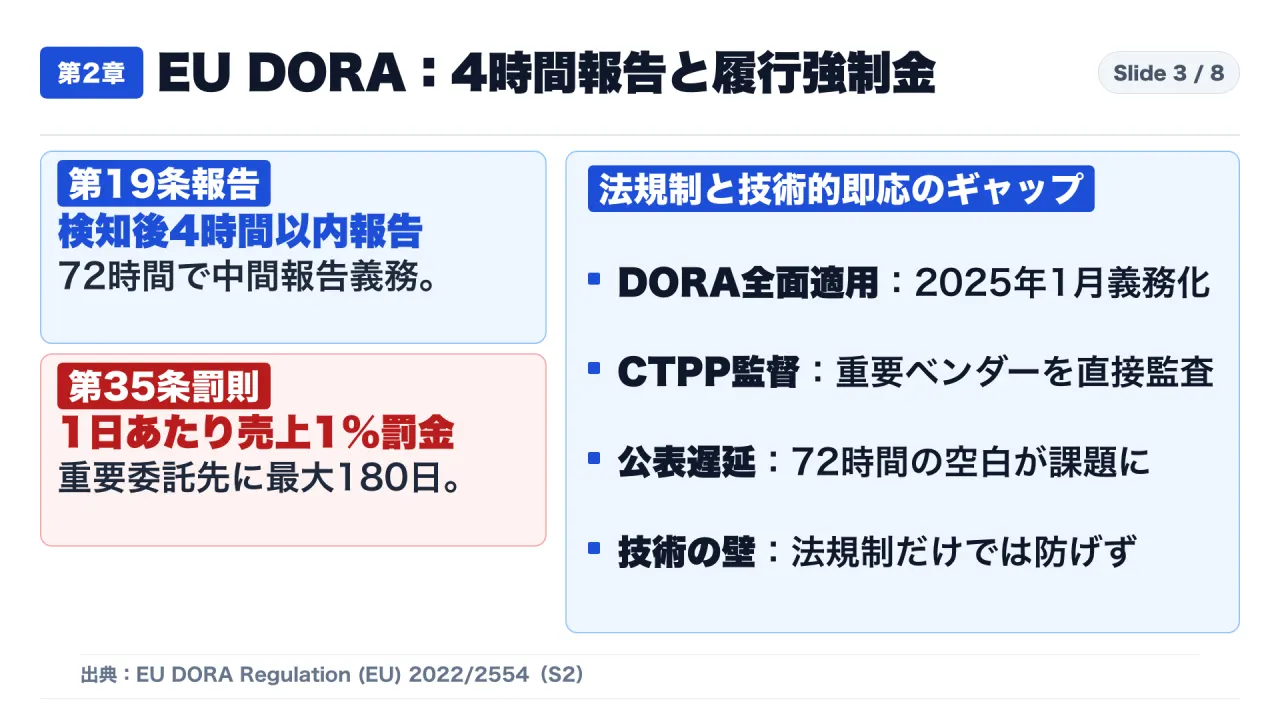
3. Regulatory Teeth: EU DORA Article 19 4-Hour Rules and Article 35 Daily Penalties
The Arkéa breach occurred under the European Union Digital Operational Resilience Act (DORA - Regulation EU 2022/2554), applicable across all member states since January 17, 2025.
Mandatory 4-Hour Incident Escalation (Article 19)
DORA Article 19 overhauled incident reporting across the European financial sector. When an entity detects a major ICT incident, it must adhere to a strict schedule:
- Initial Notification: Submitted within 4 hours of incident classification (and no later than 24 hours from detection).
- Intermediate Report: Required within 72 hours, detailing technical containment progress.
- Final Report: Required within 1 month, providing root-cause analysis and definitive loss metrics.
Arkéa’s 72-hour latency between initial transfers and public acknowledgement places its incident response under intense regulatory examination by the European Central Bank (ECB) and the ACPR.
Direct Supervisory Sanctions on Critical Third-Party Providers (Article 35)
DORA empowers European supervisory authorities to directly oversee designated Critical ICT Third-Party Providers (CTPPs). Under Article 35, if a designated CTPP fails to remediate security defects, authorities can impose periodic penalty payments up to 1% of average daily worldwide turnover for each day of non-compliance, assessed daily for up to six months (180 days). Without automated payment circuit breakers, however, statutory fines fail to stop capital from vanishing into privacy coins.
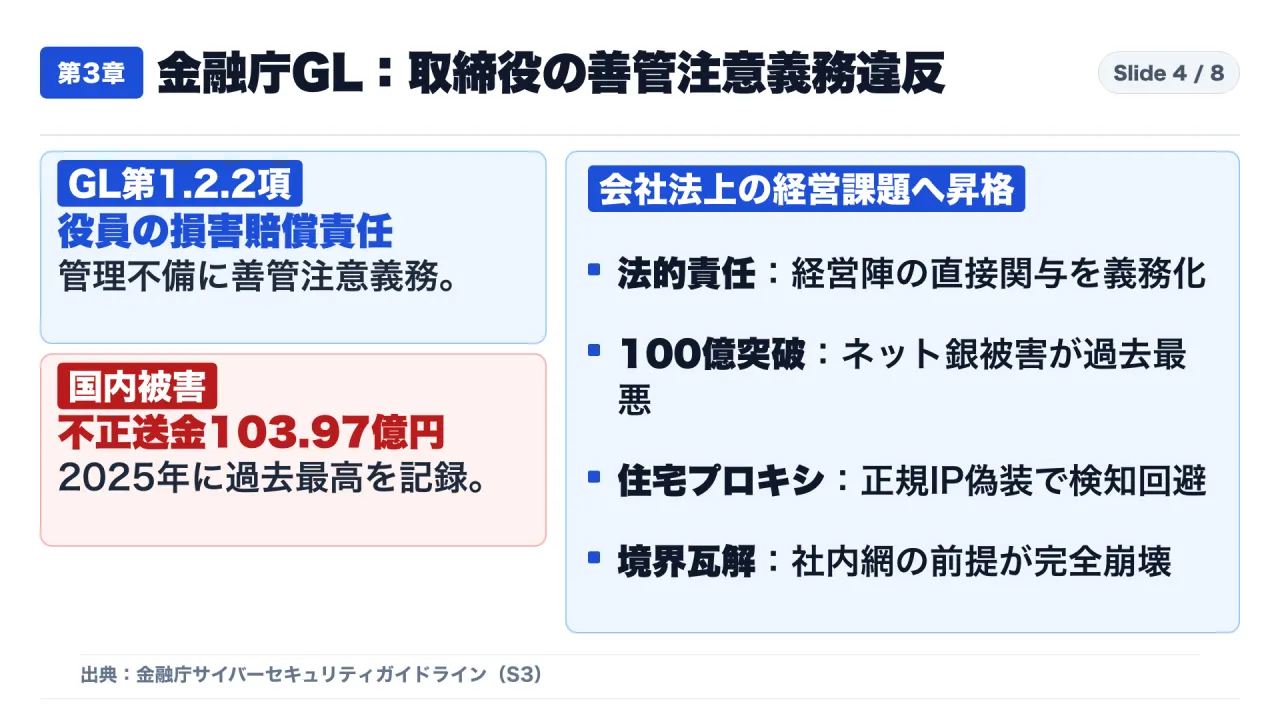
4. Japan FSA Guidelines Section 1.2.2: Director Fiduciary Liability and ¥10.4B Cyber Fraud
In Japan, financial institutions face parallel regulatory escalation driven by the Financial Services Agency’s “Cybersecurity Guidelines in the Financial Sector.”
Board Level Civil Liability for Fiduciary Breach (Section 1.2.2)
Section 1.2.2 of the FSA Guidelines codifies the personal legal liability of executive directors:
“Executive directors and corporate officers bear statutory obligations under the Civil Code, the Companies Act, and sector-specific financial statutes. In the event that an organization or third parties suffer damages resulting from inadequate cybersecurity management frameworks relative to the entity’s scale, organizational attributes, or risk profile, directors may be held personally liable for damages arising from a breach of the duty of care (善管注意義務違反) or neglect of official duties (任務懈怠).”
This provision elevates cybersecurity governance from an internal IT concern into an active corporate governance risk under Japanese corporate law. In the event of a material compromise, board members who neglected supply chain oversight can be personally sued for corporate damages by shareholders.
Record Domestic Internet Banking Fraud: ¥10.397 Billion
The urgency of the FSA’s stance is underscored by National Police Agency (NPA) crime statistics. Unauthorized fund transfers targeting domestic internet banking escalated from ¥8.69 billion in 2024 to an all-time record of ¥10.397 billion ($70 million) across 4,747 cases in 2025.
The primary technical driver is the utilization of residential IP proxy networks. Cybercriminals route automated credential stuffing attacks through compromised consumer Wi-Fi routers located within Japanese residential ISPs. Because incoming traffic originates from authentic domestic consumer IP ranges, traditional geographic IP reputation scoring and legacy network firewalls fail completely.
5. Front-End Vulnerability: Tokio Marine Direct’s BOLA Incident and Total Service Halt
On November 5, 2026, Tokio Marine Direct General Insurance disclosed a frontend breach that highlights the fragility of digital customer onboarding.
Broken Object Level Authorization (BOLA) and Sensitive Data Exposure
An internal investigation confirmed unauthorized access targeting customer “My Page” portals. Threat actors exploited Broken Object Level Authorization (BOLA / OWASP API Security Top 10) vulnerabilities on customer web endpoints. By manipulating identifier parameters in API request payloads, attackers accessed 74 policyholder files without triggering credential rejection. The accessed data contained highly sensitive personal records: detailed automobile collision investigation and accident negotiation histories, medical diagnosis certificates, injury classifications, and settlement bank account details.
The Single Point of Failure: Complete Digital Service Shutdown
To isolate vulnerable API pathways, Tokio Marine Direct terminated digital services across its ecosystem. The shutdown crippled the “&e” direct automobile insurance platform as well as co-branded platforms operated with corporate partners, including “docomo Car Insurance” distributed by NTT docomo. All online policy amendments and accident notifications ceased instantly, forcing all digital traffic to manual telephone call centers. This incident illustrates the Single Point of Failure (SPOF) paradox: an authorization flaw in customer-facing APIs can paralyze entire business operations.
6. Physical Sabotage at Scale: 700 European Supermarket Freezers Heated to 50°C
Coinciding with the financial sector attacks, European retail logistics suffered a widespread operational technology (OT) cyber offensive targeting commercial refrigeration controllers.
Coordinated Physical Disruption
Wave 1 on October 11, 2026 targeted approximately 700 supermarkets across France, prompting emergency operational advisories from ANSSI. Wave 2 on November 2, 2026 expanded across ten European nations, disrupting over 40 stores belonging to Belgian supermarket chain Delhaize and commercial meat cold-storage facilities in the United Kingdom.
Exploitation of Internet-Exposed Controllers
Threat actors scanned public IPv4 space for exposed industrial controllers, specifically Danfoss AK-SM 800A refrigeration managers and Copeland XWEB appliances. Security audits revealed that over 800 controllers in the United Kingdom and more than 6,000 units globally were connected directly to public internet routers via cellular 4G modems with factory-default administrative passwords.
Attackers authenticated directly into management web consoles, overriding operational parameters to force cooling units into continuous “defrost mode” or setting target temperatures to +50°C. In France alone, spoiled perishable food generated $50 million in direct disposal losses, alongside widespread two-day store closures. The incident represented pure sabotage: attackers issued zero ransom notes and demanded zero extortion payments, proving that automated artificial intelligence scanning tools can locate and destroy physical inventory across a continent in hours.
7. The End of Perimeter Security: Programmatic Circuit Breakers and Implementation Playbook
Evaluating these November 2026 incidents reveals an undeniable architectural reality: contractual vendor agreements and perimeter firewalls cannot defend against modern automated threat vectors. Organizations must transition from static trust assumptions to real-time programmatic controls.
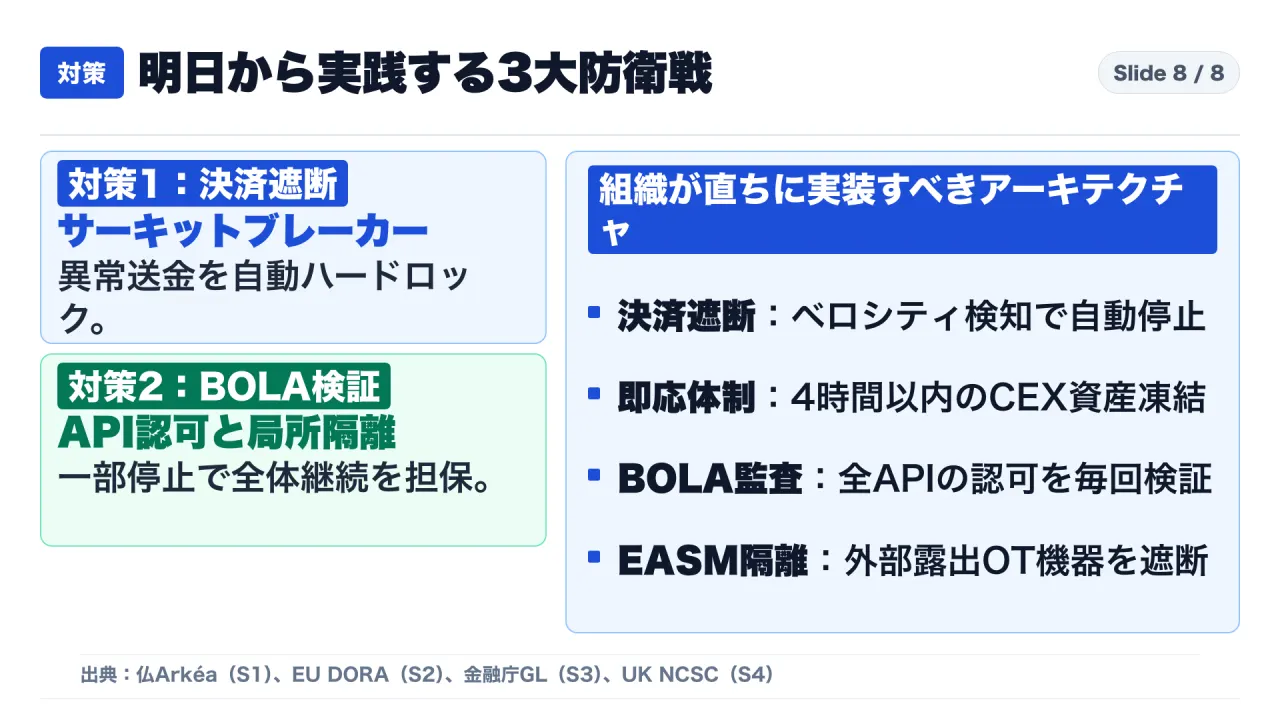
| Tactical Defense Layer | Emergency Response (72 Hours to 1 Week) | Short-Term Implementation (30 Days) | Strategic Architecture (90 to 180 Days) |
|---|---|---|---|
| Front 1: Third-Party & Settlement Controls | Revoke stale administrative credentials; enforce multi-factor authentication on all vendor links. | Implement velocity-based hard caps on external transactions; block automated wires to crypto desks. | Transition to Just-In-Time dynamic authorization; establish automated on-chain exchange hotlines. |
| Front 2: Customer Web & API Endpoints | Analyze web logs for credential stuffing and residential proxy traffic; patch exposed API parameter paths. | Implement comprehensive BOLA authorization validation on all endpoints; deploy adaptive rate limiting. | Transition authentication to FIDO2 passkeys; decouple partner endpoints to eliminate systemic SPOFs. |
| Front 3: Operational Technology Assets | Run EASM scans to identify and isolate public 4G/cellular controllers. | Rotate all factory default passwords across industrial controllers; apply critical firmware patches. | Physically air-gap industrial networks; mandate private APNs for all remote IoT monitoring. |
- Automated Payment Circuit Breakers: Financial institutions must strip external partner workstations of autonomous execution rights. High-value treasury settlement instructions must pass through an automated programmatic circuit breaker that evaluates transaction velocity and recipient classifications. If anomalous capital transfers are detected, the API must lock execution autonomously, requiring multi-signature internal authorization.
- Object-Level Authorization and Microsegmentation: Web engineering teams must implement strict object-level authorization across every API route, verifying that authenticated session tokens possess explicit rights to access requested database identifiers. Furthermore, core web properties must be architecturally isolated so that vulnerabilities in partner integrations can be quarantined without halting the core business engine.
- Air-Gapping and Attack Surface Management: Industrial and commercial facilities must mandate that heating, ventilation, air conditioning, and refrigeration (HVAC/R) controllers never face the public internet directly. Cellular 4G modems must operate through private Access Point Names (APNs) and encrypted overlay networks, backed by automated External Attack Surface Management (EASM) tooling that continuously scans corporate IP spaces.
Primary Sources & Verified References
- Crédit Mutuel Arkéa Corporate Communications: Official Statement on Fraudulent Transaction Detection and Treasury Impact (https://www.cm-arkea.com/banque/assurance/credit/mutuel/ecb_5038/fr/communiques-de-presse)
- European Union Official Journal: Digital Operational Resilience Act (DORA - Regulation (EU) 2022/2554) (https://eur-lex.europa.eu/eli/reg/2022/2554/oj)
- Japan Financial Services Agency (FSA): Cybersecurity Guidelines in the Financial Sector (Codification of Executive Liability) (https://www.fsa.go.jp/news/r6/sonota/20241004/20241004.html)
- National Police Agency of Japan (NPA): Statistical Report on Unauthorized Internet Banking Remittances and Cybercrime Trends (https://www.npa.go.jp/)
- Tokio Marine Direct General Insurance: Official Incident Report on Unauthorized Web Account Access and Service Impact (https://www.tokiomarine-direct.jp/)
- French National Cybersecurity Agency (ANSSI): Urgent Operational Threat Advisory on Industrial Refrigeration Compromise (https://cyber.gouv.fr/)
- United Kingdom National Cyber Security Centre (NCSC): Securing Internet-Exposed Operational Technology Devices Guidance (https://www.ncsc.gov.uk/news/ncsc-annual-review-2026)
This article analyzes primary technical and financial disclosures for informational purposes only and does not constitute investment advice.