Why US Claude Personal Finance Shields Portfolio Holdings at $20/Month While Japan's Moneytree MCP Analyzes 2,500 Banks and 3-Year Stock Yields for Free ── The Three Structural Flaws of Read-Only Aggregation and the Headless PFM Paradigm
A technical teardown of read-only bank API synchronization latency, intentional regulatory data shielding, and how the open Model Context Protocol transforms personal finance management from front-end dashboards into headless data infrastructure.
Japanese Edition: https://consuloji.substack.com/p/claude-personal-finance20moneytree
Executive Summary & Key Technical Takeaways
- The Core Divergence: On November 5, 2026, Anthropic released the United States beta of “Personal Finance in Claude” across paid tiers (Pro at $20/month, Max at $100/month, Ultra at $200/month), connecting up to 16 financial institutions via Plaid’s read-only OAuth aggregation pipeline.
- The Free Japanese Contrast: On October 29, 2026, Tokyo-based aggregator Moneytree announced its official Model Context Protocol (MCP) server for Claude. Japanese users can connect over 2,500 domestic institutions directly from Claude’s free tier ($0/month), enabling multi-account tracking, 3-year historical stock yield calculations, and 10-year retirement compounding simulations.
- Intentional Regulatory Shielding: United States Claude Personal Finance intentionally blocks holding-level equity positions, securities trades, and loan interest rates at the system boundary to avoid triggering Securities and Exchange Commission (SEC) and Financial Industry Regulatory Authority (FINRA) registered investment advisor (RIA) fiduciary liabilities.
- Three Structural Data Distortions: Relying on “read-only” status does not ensure calculation integrity. Systems face 1-to-2-day balance synchronization delays that create overdraft risks, duplicate entries from multiple logins (“Keep Both”), and omission bias from unlinked accounts that project false budgetary confidence.
- The Data Persistence Trap: Unlinking accounts resets the Claude Personal Finance dashboard, but historical chat sessions, generated Artifacts, and shared web links retain confidential financial figures indefinitely unless manually purged.
- The Headless Infrastructure Pivot: Standalone personal finance management (PFM) applications are declining as consumer interfaces. Aggregators are pivoting into headless data infrastructure, normalizing billions of messy banking records for consumption by large language model reasoning engines.
- The Three-Tier Advisory Division: Large language models can automate quantitative expense audits and mediate household budget disputes, but licensed human financial planners remain indispensable for complex tax, estate, real estate, and legal determinations.
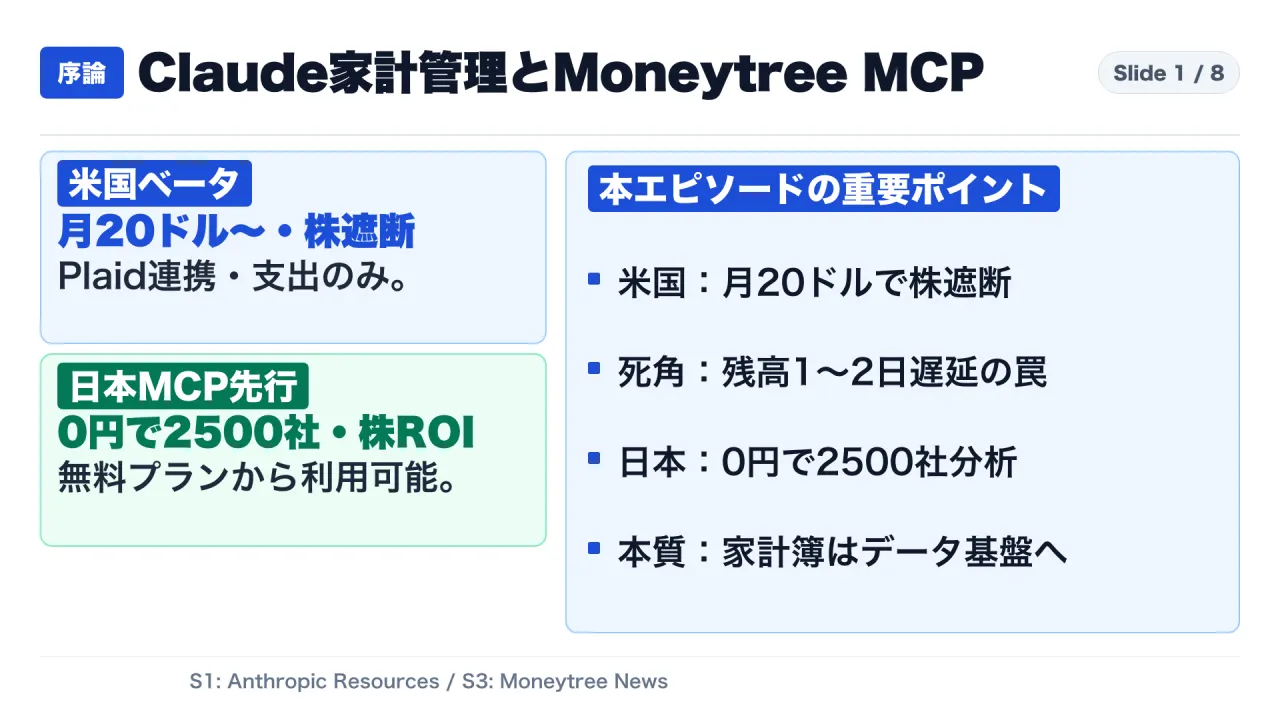
1. System Overview: Transatlantic Divergence in Financial AI
The integration of personal financial data into generative artificial intelligence assistants represents a fundamental shift in retail banking. However, technical implementations in the United States and Japan have diverged sharply due to contrasting regulatory frameworks and architectural choices.
| Architectural Dimension | United States: Claude Personal Finance (Beta) | Japan: Moneytree MCP on Claude | Japan: Money Forward Cloud Accounting MCP |
|---|---|---|---|
| Launch Timeline | November 5, 2026 (US Beta) | October 29, 2026 (General Availability) | Spring 2026 Rollout |
| Required Claude Tier | Paid Tiers Only (Pro $20/mo, Max $100/mo, Ultra $200/mo) | Claude Free Tier ($0/mo) and Above | Commercial Business Tiers (CSV on all) |
| Aggregator Fee | Bundled in Claude Subscription | Free Plan ($0) or Paid Grow (from ¥325/mo) | Included in Corporate Cloud Accounting Plan |
| Institutional Coverage | Up to 16 US Financial Institutions | 2,500+ Japanese Banks, Cards, and Brokerages | Comprehensive Japanese Financial Network |
| Historical Data Depth | Maximum 24 Months of Transactions | All-time history through January 28, 2027; then 12 mo (Unlimited on Grow) | Full Historical Range of Connected Tenant |
| Investment Data Scope | Aggregate Balance Only; Equities and Trades Blocked | Full Holdings, Realized Gains, 3-Year Dividends | Balance Sheet Assets and Journal Entries |
| Execution Privileges | Strict Read-Only Access | Strict Read-Only Access | Read and Write (Two-Step Journal Entry) |
The United States beta operates as a closed, proprietary integration tied to Plaid and premium subscriptions. In Japan, open protocol architecture allows third-party regulated aggregators to deliver superior functional depth at zero software cost.
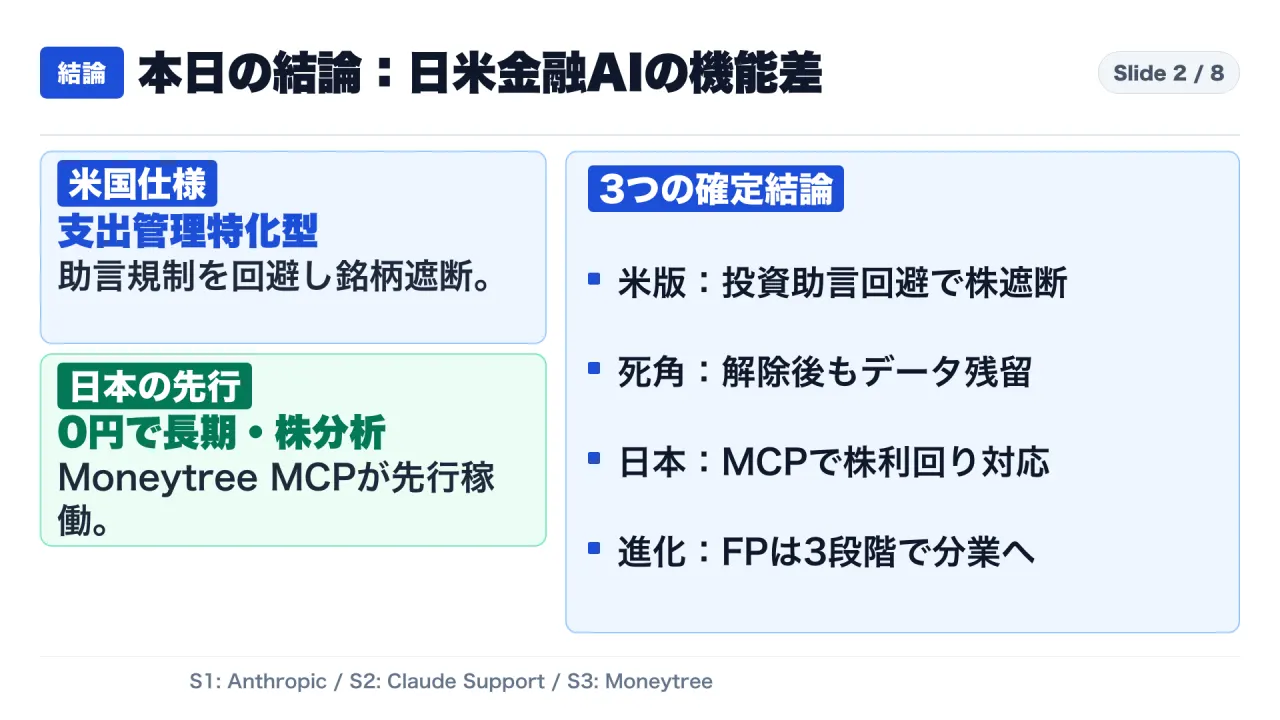
2. Technical Architecture of Claude Personal Finance and Intentional System Blindspots
Anthropic designed the United States Personal Finance feature around two strict architectural constraints: protecting user banking credentials and avoiding regulated investment advisory activities.
Authentication Isolation and Data Ingestion
When a user connects an institution, authentication occurs entirely within Plaid’s hosted OAuth modal. Anthropic’s application servers never ingest, handle, or store plain-text banking passwords or multi-factor authentication codes. Upon token exchange, the system ingests current cleared account balances, available credit limits, and up to 24 months of settled transaction records, including posted date, raw merchant description, numerical amount, and category classifications.
Intentional Regulatory Shielding
The most critical technical characteristic of the United States beta is what it deliberately refuses to ingest. While users can connect brokerage and loan accounts, the integration ingests only the top-level cash balance and credit ceiling.
The following data categories are programmatically intercepted and dropped:
- Individual Equity Holdings: Stock ticker symbols, mutual fund allocations, and exchange-traded fund positions.
- Transaction Histories in Securities: Stock purchase prices, cost basis, sale dates, and realized capital gains.
- Lending Terms: Mortgage and auto loan interest rates (APR), amortized fee structures, and covenant conditions.
This censorship is not an engineering limitation of Plaid’s API, which routinely extracts investment holdings via its /investments/holdings/get endpoint. Instead, it is an intentional legal defense. Under United States securities law, parsing individual stock holdings and generating portfolio commentary creates severe regulatory exposure under the Investment Advisers Act of 1940. By blinding the model to portfolio constituents, Anthropic prevents the system from functioning as an uncertified investment advisor.
Defensive Sandboxing
To eliminate external data leakage and prompt injection vectors, Anthropic isolated the Personal Finance engine within strict sandbox parameters:
- Feature Exclusion: Personal Finance is disabled within Scheduled Tasks, Cowork collaborative workspaces, Claude Code command-line interfaces, and multi-user Projects.
- Memory Erasure: Financial chat sessions are barred from updating Claude’s persistent user memory store and are excluded from global conversational search indexing.
- Tool Deprivation: Within a financial conversation, the model cannot invoke arbitrary Python code execution environments, nor can it generate downloadable Word, Excel, PowerPoint, or PDF documents. This eliminates attacks where malicious transaction payloads induce the model to exfiltrate bank statements to external endpoints.
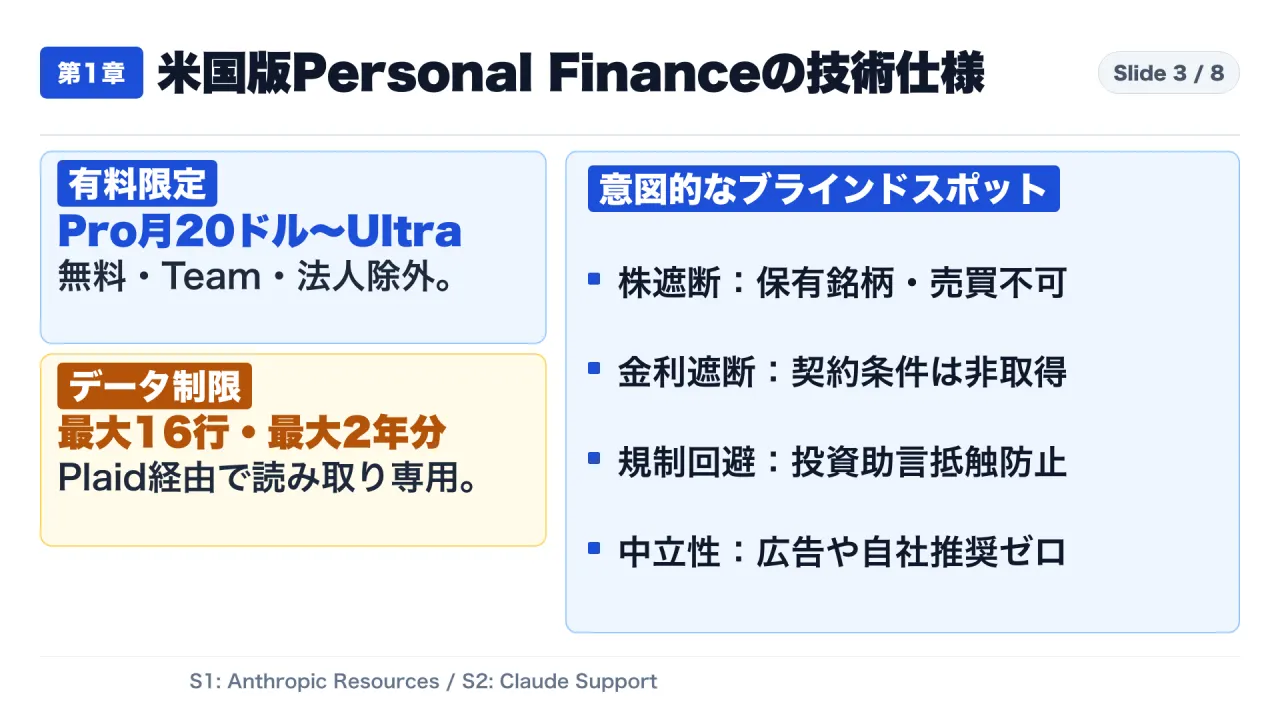
3. The Fallacy of Read-Only Safety: Three Structural Data Distortions
A widespread misconception among software engineers and retail consumers is that read-only API access guarantees mathematical precision and operational safety. While read-only access prevents unauthorized fund transfers, it introduces three severe data distortion risks.
Distortion 1: Synchronization Latency and Overdraft Exposure
Anthropic’s documentation acknowledges that account balances presented by the model may lag actual financial institutions by one to two calendar days. Pending debit authorizations (such as gas station pre-authorizations, hotel incidentals, or weekend credit card charges) take 24 to 72 hours to settle into posted ledger records. If a user asks the model whether they can afford a $600 purchase before payday, the model evaluates stale cache snapshots. It may calculate an apparent $750 surplus when pending transactions have already depleted available funds to $150, directly triggering overdraft fees.
Distortion 2: Duplicate Account Aggregation
When users re-authenticate banking credentials following expired sessions, Plaid presents options to merge or separate connections. If a user selects “Keep Both,” the underlying identity resolution engine fails to deduplicate accounts sharing identical account numbers. The model ingests two identical streams of ledger events. As a consequence, recurring salary credits, liquid savings balances, and credit card payments are counted twice, creating an illusion of doubled solvency.
Distortion 3: Omission Bias and Synthetic Mathematical Certainty
Plaid’s beta integration caps connected institutions at 16 entities and excludes regional credit unions, specialized auto lenders, and offline debt obligations. When an incomplete financial ledger is ingested, the language model does not warn the user regarding missing accounts. Instead, it processes the partial dataset with complete mathematical confidence, generating clean charts that state operating expenses remain within recommended limits, completely oblivious to an unlinked $1,200 monthly debt payment.
The Residual Data Persistence Problem
A major data governance vulnerability involves connection termination. If a user unlinks all banking partners, the Personal Finance dashboard immediately clears its visualization widgets. However, historical conversational transcripts, generated Markdown Artifacts, and public web sharing links created during prior sessions remain active within the user’s account. Any link shared with colleagues continues to host exposed banking ledger items. Furthermore, cancelling a paid subscription merely pauses the account; renewing months later instantly restores background API associations and historical context.
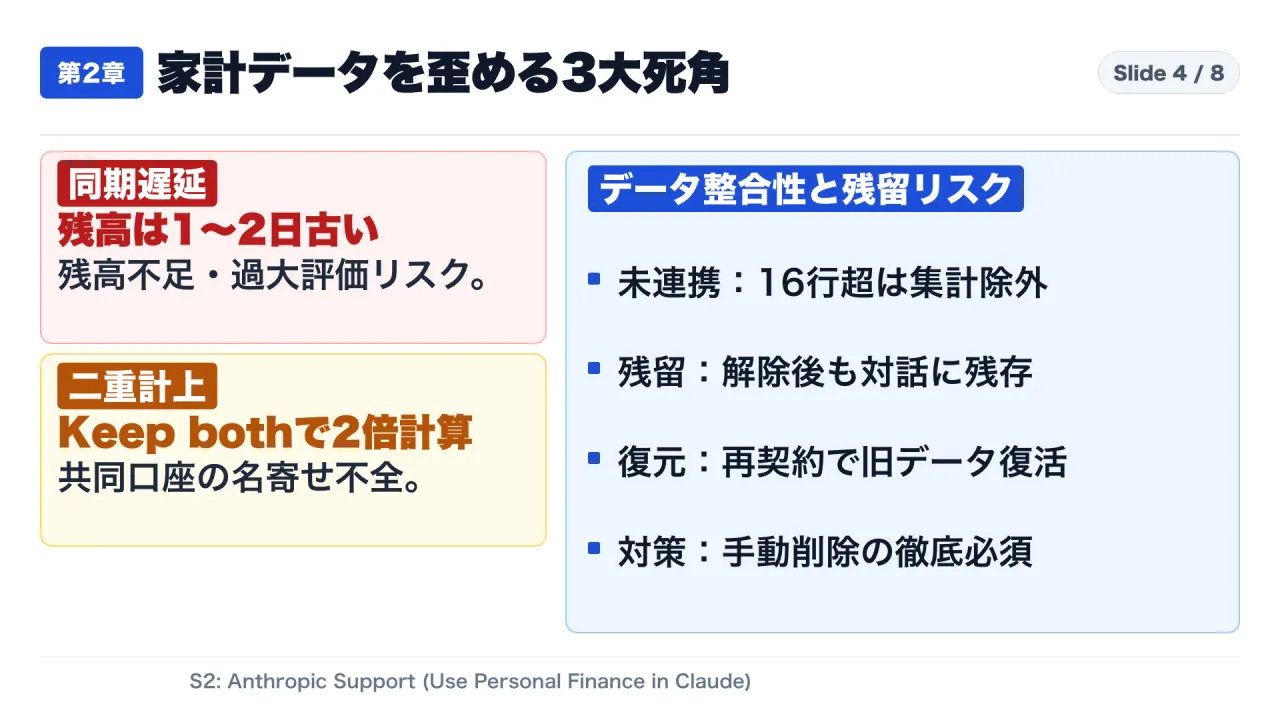
4. Japan’s Open Architecture: How Moneytree MCP Delivers Advanced Analytics for Free
While United States consumers pay $20 to $200 per month for restricted expenditure tracking, users in Japan have access to an open, high-performance financial intelligence stack without paying platform fees.
The Japanese Legal Moat: Revised Banking Act of 2018
The reason Anthropic cannot easily launch native bank aggregation in Japan is regulatory. Under Japan’s 2018 Revised Banking Act, any software entity aggregating bank data must register as an Electronic Payment Service Provider (電子決済等代行業) with the Financial Services Agency (FSA). Registration requires formal legal vetting of cybersecurity postures, bilateral API connection agreements with each individual bank, and statutory customer liability compensation standards. Global cloud providers rarely undertake the complex process of negotiating individual contracts with hundreds of Japanese regional banks.
The Model Context Protocol Bridge
The technological breakthrough arrived through Anthropic’s open-source Model Context Protocol (MCP). Instead of Anthropic building custom banking integrations, registered domestic aggregators package their existing compliant data pipes into MCP servers.
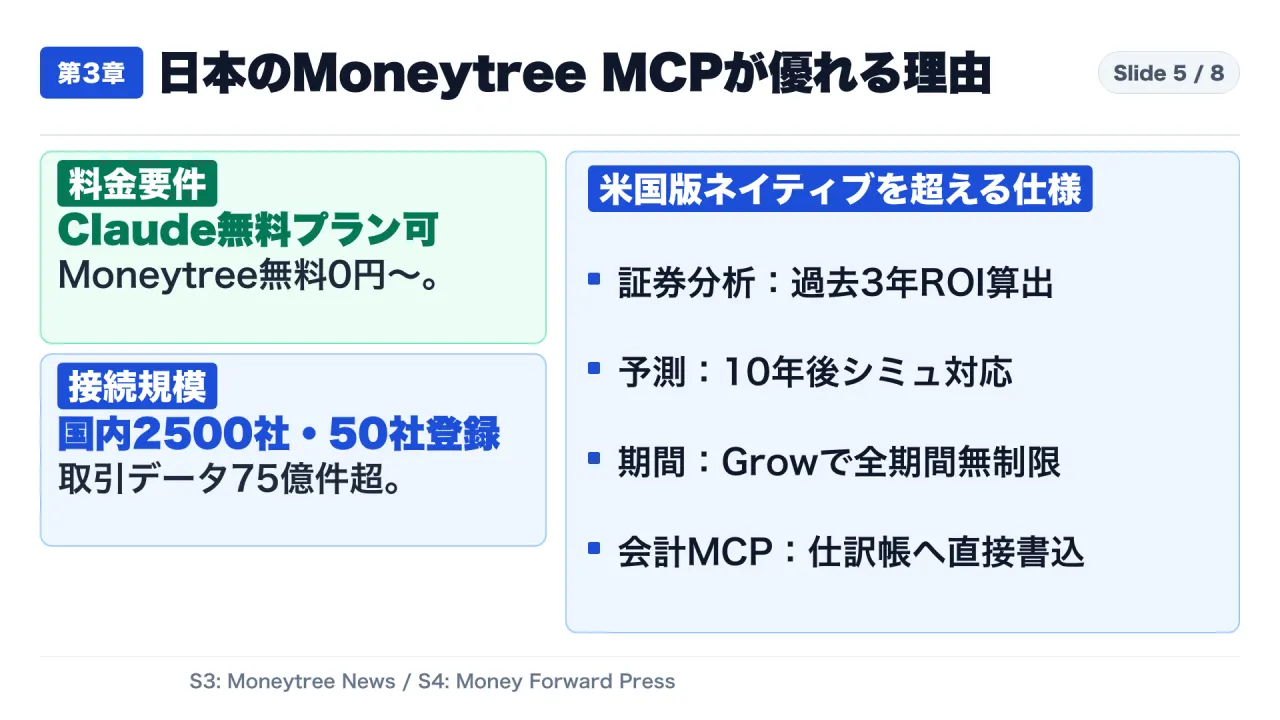
On October 29, 2026, Moneytree launched its official Claude MCP connector. By simply authenticating via OAuth inside Claude’s connector settings, users connect their existing Moneytree LINK accounts directly to Claude’s reasoning loop.
This architecture delivers three distinct advantages over the United States native integration:
- Zero Entry Cost: Functional on Claude’s Free tier ($0/month), compared to the $20/month minimum in the United States.
- True Investment Intelligence: Moneytree extracts verified stock holdings, purchase costs, mutual fund balances, and dividend credits across major brokerages (SBI Securities, Rakuten Securities, Monex, and Nomura). Claude computes annualized returns, sector concentration risks, and projected 10-year compounding trajectories.
- Institutional Breadth: Covers over 2,500 domestic Japanese institutions, including agricultural cooperatives (JA Bank), credit unions (Shinkin banks), highway electronic toll collection (ETC) cards, and prepaid railway passes (Suica/Pasmo).
5. The Evolution of Personal Finance: UI Deprecation and Headless Data Infrastructure
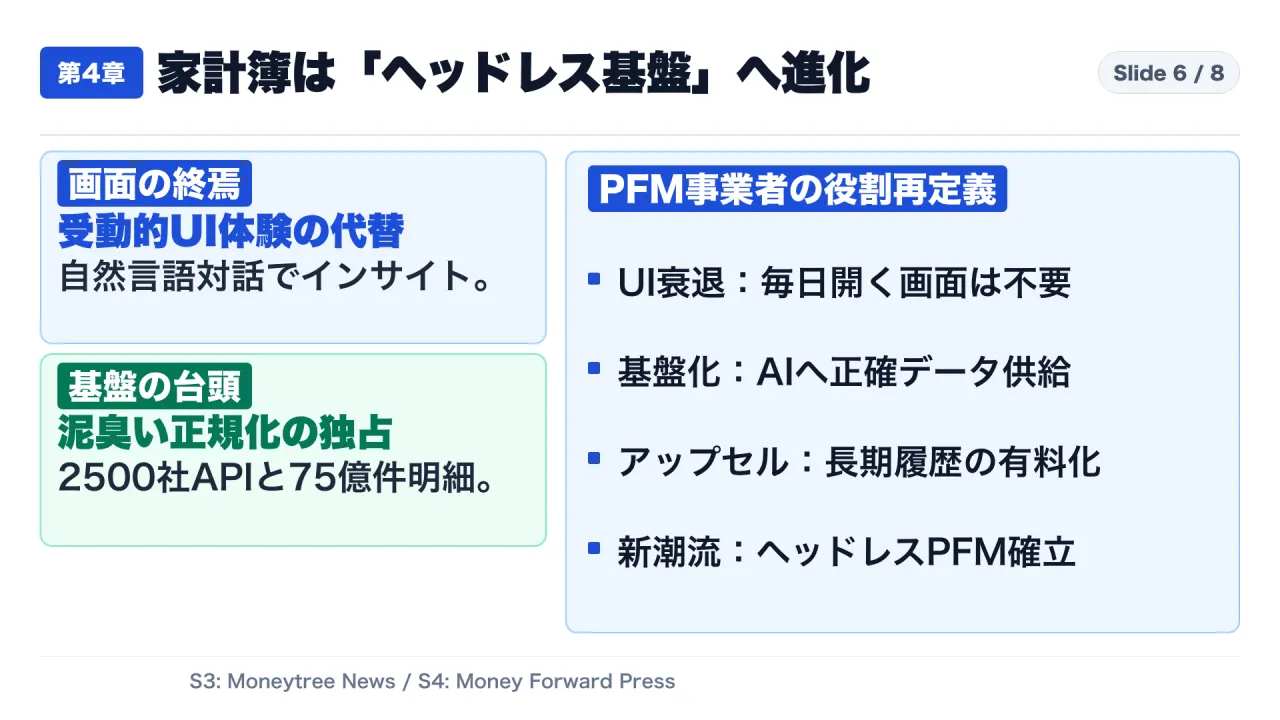
A common narrative circulating in software circles asserts that generative AI assistants will render traditional personal finance management applications completely obsolete. This perspective confuses the presentation layer with the infrastructure layer.
The consumer habit of opening a standalone mobile application to gaze at static monthly pie charts is disappearing. A user gains deeper insights by asking Claude: “Why did my discretionary dining expenditure rise 34% this month compared to my rolling six-month average?” The assistant parses raw transaction notes, identifies specific high-ticket dinners, and formats a customized budget strategy.
However, the large language model cannot perform this reasoning without the underlying aggregation pipeline. A language model cannot maintain 2,500 bespoke bank API adapters, handle periodic credential rotation across regional credit unions, or parse cryptic transaction codes into clean merchant identities. Aggregators like Moneytree and Money Forward are undergoing a transition into headless financial data infrastructure, supplying scrubbed, schema-compliant contextual streams to AI reasoning engines.
6. Financial Advisors vs. Generative AI: The Three-Tier Advisory Boundary
Can Claude Personal Finance or Moneytree MCP replace human Financial Planners (FPs)? A rigorous analysis requires separating established empirical facts from structural industry evolution.
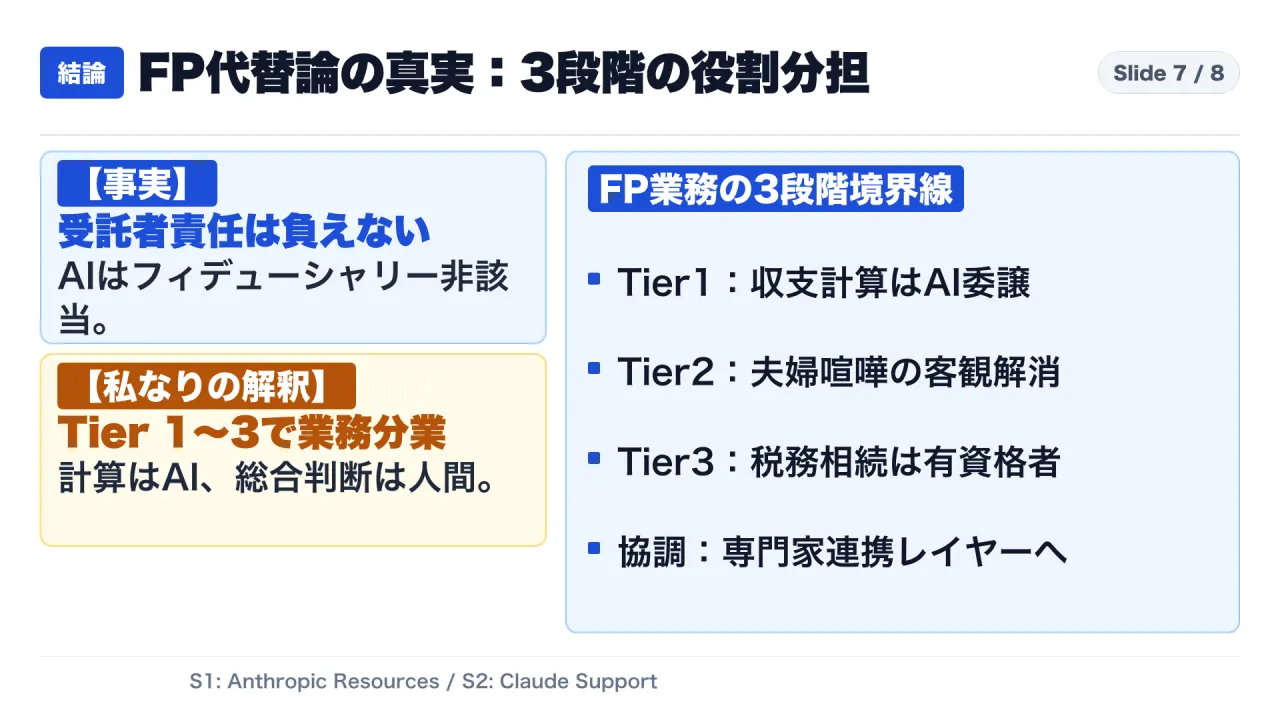
Anthropic’s official support documentation states clearly: Claude is not a registered investment advisor, does not possess fiduciary responsibilities, and cannot provide certified financial guidance. The terms explicitly instruct users to consult certified human professionals before executing significant financial decisions.
In practice, personal financial advisory divides into three distinct operational tiers:
- Tier 1: Quantitative Auditing and Ledger Reconciliation (Fully Automated by AI): Identifying recurring subscription fees, auditing foreign transaction charges, calculating aggregate interest payments, and running numerical savings models are tasks where generative AI completely outperforms human advisors. Unencumbered by commercial product placement or sales commissions, an objective model extracts hidden fees in seconds.
- Tier 2: Household Communication and Emotional Mediation (AI as Impartial Buffer): Financial planning within families frequently collapses due to emotional friction. When one partner monitors household spending, budget conversations often trigger defensive behavioral reactions. An artificial intelligence assistant serves as an impartial, emotionally neutral third party. Instead of a spouse alleging reckless expenditure, the assistant presents unvarnished objective observations: “Discretionary entertainment expenses exceeded the agreed budget allocation by ¥24,000 this cycle.” This neutral framing defuses interpersonal tension, allowing families to collaborate rationally.
- Tier 3: Fiduciary, Tax, and Estate Planning (Human Expertise Indispensable): The information necessary for comprehensive wealth management does not exist within retail bank APIs. Banking APIs do not track off-balance-sheet real estate valuations, specialized corporate pension vesting schedules, complex gift tax exemptions, or familial inheritance dynamics. Navigating estate law, corporate business transitions, and multi-generational tax optimization requires certified professionals who assume legal fiduciary liability for their counsel. The future of financial planning is a hybrid model: AI manages real-time Tier 1 bookkeeping and Tier 2 tracking, while human advisors focus on high-value Tier 3 strategic architecture.
7. Actionable Implementation Playbook: Three Directives for Users and Architects
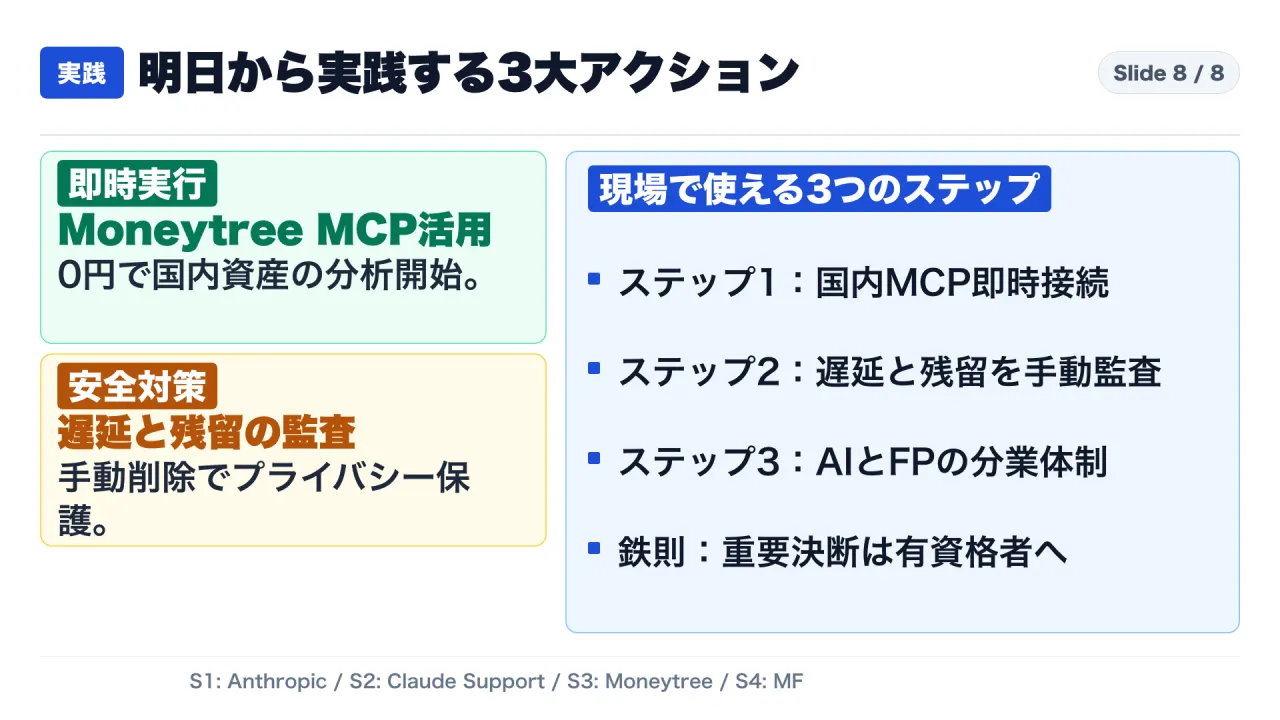
For software engineers building financial integrations and individuals optimizing personal capital, the November 2026 releases dictate three concrete operational practices:
- Leverage Open MCP Connectors Immediately in Japan: Users managing Japanese bank accounts should not wait for international platform providers to localize closed proprietary tools. Configure Moneytree MCP within Claude’s connector settings to establish an air-gapped, read-only analytics pipeline across personal accounts, unlocking full dividend and multi-year asset tracking at zero software cost.
- Implement Rigorous Verification and Data Sanitation Disciplines: Never base time-sensitive capital allocations solely on language model calculations. Verify liquid checking balances directly through official banking applications prior to executing major wire transfers to eliminate synchronization latency risks. Furthermore, establish a strict operational routine: manually purge confidential financial chat transcripts, delete temporary Artifacts, and audit active public sharing links every 30 days.
- Build a Hybrid Architecture for Household Wealth: Delegate mechanical transaction tagging, monthly category auditing, and cash-flow scenario modeling to generative assistants. Concurrently, retain licensed financial planners, tax accountants, and legal counsel for major life events, including real estate acquisitions, corporate structure shifts, and estate planning.
Primary Sources & Verified References
- Anthropic Official Announcement: Introducing Personal Finance in Claude (https://claude.com/resources/articles/introducing-personal-finance-in-claude)
- Anthropic Help Center & Support Documentation: Use Personal Finance in Claude: Operational Constraints and Security (https://support.claude.com/en/articles/18185620-use-personal-finance-in-claude)
- Moneytree KK Official Press Release: Moneytree MCP Official Launch for Claude AI Integration (https://www.moneytree.jp/company/news/moneytree-mcp-claude)
- Money Forward Inc. Corporate Disclosure: Money Forward Cloud Accounting MCP Server Availability and Enterprise Workflows (https://corp.moneyforward.com/news/release/service/20260401-mf-press/)
- Japan Financial Services Agency (FSA): Regulatory Framework and Guidelines for Electronic Payment Service Providers (https://www.fsa.go.jp/)
This article analyzes primary technical and financial disclosures for informational purposes only and does not constitute investment advice.