Why the Texas Data Center Freeze Triggered a 12% SOX Collapse: Local Utility Politics, Kioxia's Plunge, and the Limits of Presidential Power
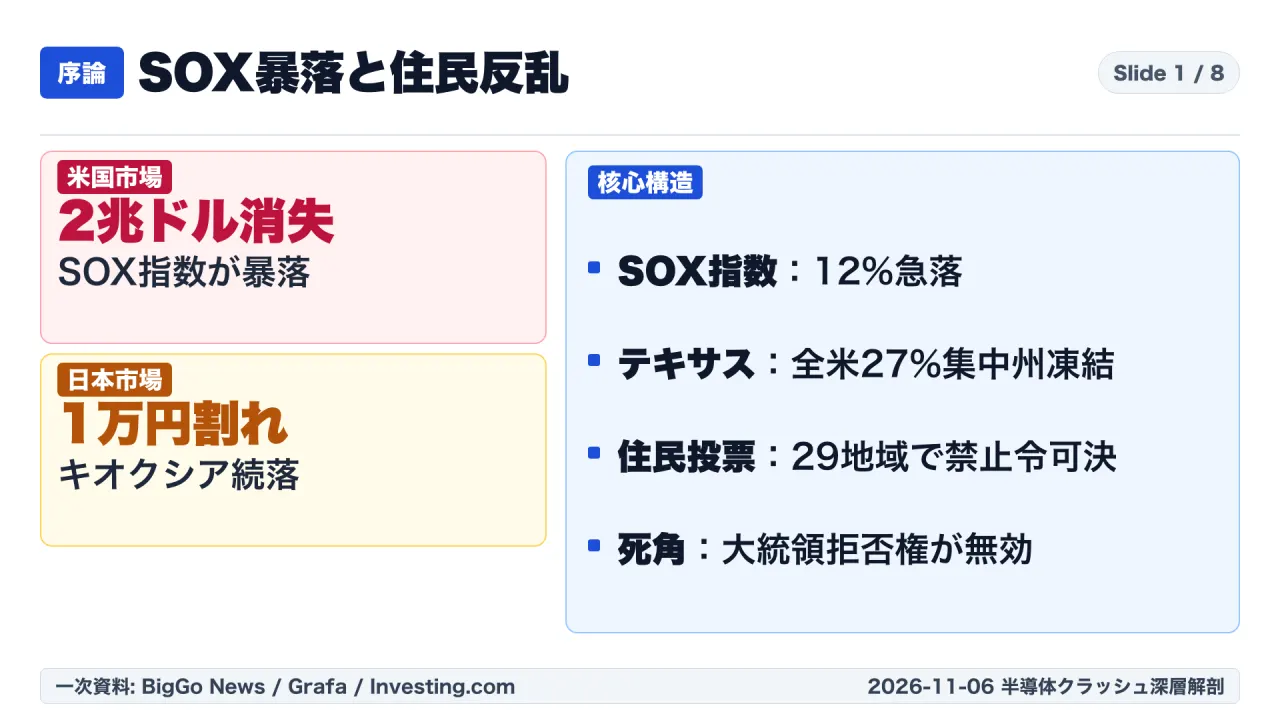
When Texas elected a governor pledged to pause approvals in a state hosting 27% of U.S. data center capacity, semiconductor markets lost $2 trillion in fifty minutes because state police powers and local zoning bypass presidential vetoes entirely.
Japanese Edition: https://consuloji.substack.com/p/dcsox121
Executive Summary & Key Takeaways
- Core Analytical Thesis: On November 5, 2026, the Philadelphia Semiconductor Index (SOX) plunged up to 12.25% in a single session, shedding approximately $2 trillion in market value during the opening fifty minutes of trading. Nvidia breached its 200-day moving average as its trailing twelve-month price-to-earnings (P/E) multiple contracted from 68.4x to 39.2x. The contagion quickly crossed the Pacific to Tokyo, where memory maker Kioxia Holdings (285A) fell for four consecutive sessions below the 10,000-yen threshold despite having posted record half-year results (net income of 2.2 trillion yen and an operating margin of 80%). Cross-examining disclosures from AP News, The Guardian, Data Center Dynamics, Wells Fargo, and Texas regulatory filings reveals that the selloff was not sparked by ideological AI regulation in Congress. Rather, it was triggered by a physical infrastructure revolt: the election of a Democratic governor in Texas who campaigned on freezing data center approvals in a state hosting 27% of all planned U.S. compute capacity. Wall Street’s operating thesis—that a Republican presidential veto would shield the tech sector from regulatory disruption—failed because state environmental permitting and municipal zoning are governed by state police powers that no U.S. president can override.
- Key Takeaways:
- Local electricity price spikes (cited by 77% of voters) and water depletion triggered a grassroots political revolt.
- Texas concentrated 27% of planned U.S. data center gigawatts, turning a single state’s regulatory pause into a global hardware shock.
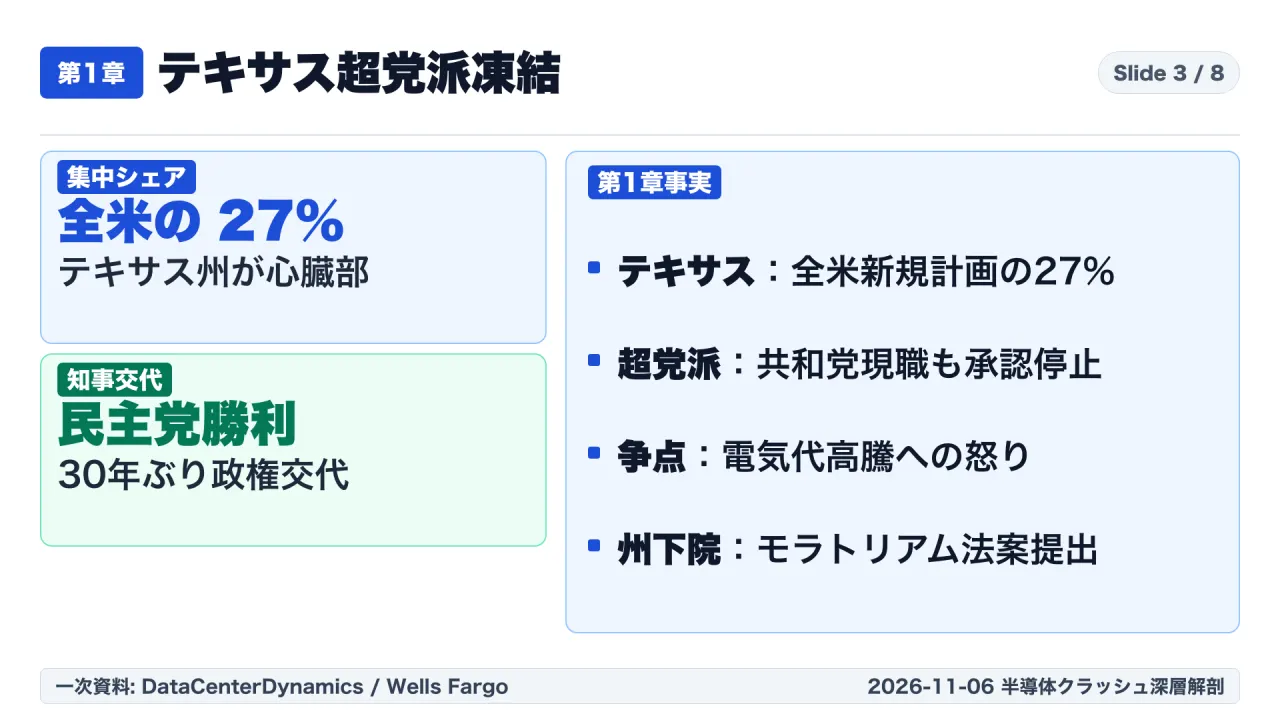
- The economic asymmetry of hyperscale facilities: multi-billion-dollar investments generate only 5 to 30 permanent local jobs while burdening regional grids.
- Constitutional federalism created a blind spot for equity markets, leaving hyperscalers vulnerable to state-level administrative moratoria.
- The three-part equilibrium path: hyperscalers underwriting local grid expansions, rising scarcity values for operational facilities, and capital reallocation toward supportive legal jurisdictions such as Japan.
1. The Anatomy of a Crash: When Physical Limits Shatter Financial Multiples
The drawdown on November 5, 2026, caught market participants off guard because it contradicted expectations of a post-election relief rally. Just twenty-four hours earlier, equity indices had surged on news of divided government. Yet on November 5, selling concentrated aggressively in semiconductor and cloud infrastructure equities.
The nature of this selloff was structural rather than ideological:
- Grassroots Voter Backlash Over Utility Bills:
- Midterm exit polling revealed that 77% of voters expressed serious concern over escalating residential electricity bills, and 56% explicitly cited data center expansion as an influential factor in their voting decisions. Expanding AI compute clusters had strained regional grids, prompting utility commissions to socialize transmission upgrade costs across household rate bases.
- The Texas Political Tipping Point:
- In Texas, which represents 27% of planned data center capacity in the United States, voters broke a thirty-year Republican gubernatorial monopoly by electing Democrat Gina Hinojosa, who campaigned on freezing new commercial data center grid connections.
- The Failure of the Veto Defense:
- Equity analysts had argued that aggressive technology regulation would be vetoed by the White House. However, that thesis ignored American federalism: the Tenth Amendment reserves land-use, environmental permitting, and intra-state electrical grid governance to state and municipal authorities, rendering presidential veto authority irrelevant.
2. Texas at the Epicenter: 27% of National Capacity and Bipartisan Freezes
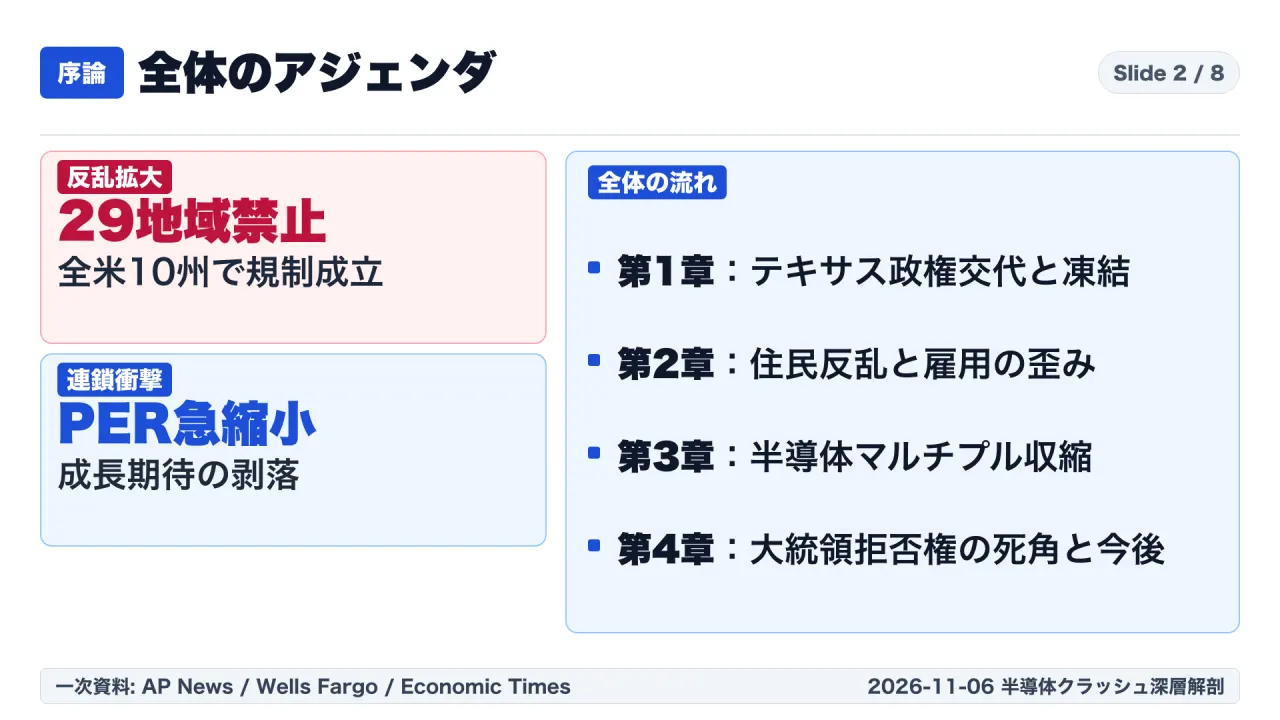
According to research from Wells Fargo, planned U.S. data center power demand is exceptionally concentrated. Texas accounts for approximately 27% of all planned new data center capacity (measured in gigawatts), far outpacing Georgia (7%), Ohio (5%), and Pennsylvania (5%). This concentration made the Texas gubernatorial election a systemic macro event.
The Historic Texas Realignment
In the November 3 election, Democratic State Representative Gina Hinojosa secured 52.82% of the vote, defeating three-term incumbent Republican Governor Greg Abbott (45.69%). Hinojosa’s victory marked the first Democratic gubernatorial win in Texas in more than three decades, accompanied by Democrats securing a majority in the Texas House of Representatives.
Hinojosa characterized the state’s unregulated data center boom as an extractive “Wild West” that consumed public water reserves and strained the ERCOT grid while delivering negligible benefits to local communities. Her central pledge was clear: an executive moratorium halting new data center approvals until the Texas Legislature convenes in January 2027 to enact binding community-protection statutes.
The Overlooked Bipartisan Consensus
A critical fact obscured by national headlines is that the data center freeze was not purely a progressive Democratic initiative. Resistance had already been mounting across deeply conservative rural and suburban counties.
Faced with pushback from rural Republican constituents over substation noise, water table drawdown, and rising electric rates, incumbent Governor Greg Abbott had already instructed the Texas Commission on Environmental Quality (TCEQ) in September 2026 to pause new air and water permits for commercial compute facilities. In October 2026, the state’s online application portal was quietly taken offline.
However, Abbott’s campaign had accepted substantial contributions from tech executives, including $500,000 from Elon Musk. Hinojosa framed the race as local taxpayers versus subsidized tech billionaires. Conservative homeowners in rural counties crossed party lines or abstained, delivering Hinojosa her victory.
3. The Economic Asymmetry: Five to Thirty Permanent Jobs vs. Billions in Subsidies
The political backlash in Texas mirrored a nationwide pattern. Alongside federal elections, 41 municipal ballot referendums were held across ten states on November 3. Voters in at least 29 local communities approved binding restrictions or outright bans on new data center construction. In Ohio alone, 14 municipalities passed zoning caps, derailing a planned 1,000 MW (1 GW) campus proposed by Amazon.
To understand why communities revolted, one must examine the economic asymmetry documented by the Brookings Institution across 1,584 operating data center facilities.
| Economic Dimension | Empirical Finding Across 1,584 Facilities | Impact on Host Municipalities |
|---|---|---|
| Permanent On-Site Staffing | 5 to 30 employees per facility | Negligible ongoing employment relative to multi-billion-dollar capital expenditure. |
| Post-Construction Job Multiplier | Near 0% change in non-construction employment | Once construction concludes, ongoing local job creation stalls. |
| Regional Wage Growth | 0% statistically significant wage gain | Local median household incomes do not rise as a result of hosting server halls. |
| Surrounding Residential Home Prices | +2% to +5% localized inflation | Speculative land purchases increase property taxes and reduce housing affordability. |
| State and Local Tax Forgiveness | $1.6 billion annually in Virginia alone | Massive public revenue surrendered without influencing final corporate site selection. |
For host communities, the perceived bargain had collapsed: facilities created only a handful of security and facilities jobs once operational. In return, residents saw residential electric rates climb by double digits, experienced local water rationing during summer months, and watched acreage replaced by windowless concrete enclosures humming with industrial chillers. This reality catalyzed the voter backlash that stalled over 145 commercial projects nationwide.
4. Semiconductor Multiple Contraction: Nvidia, Qualcomm, Interest Rates, and Kioxia
The realization that physical server halls could not be built at projected speeds triggered an immediate valuation reset. Semiconductor revenue projections had assumed unconstrained hardware absorption by hyperscalers. When construction paused, hardware procurement timelines were pushed back.
The Liquidation of Nvidia’s Valuation Premium
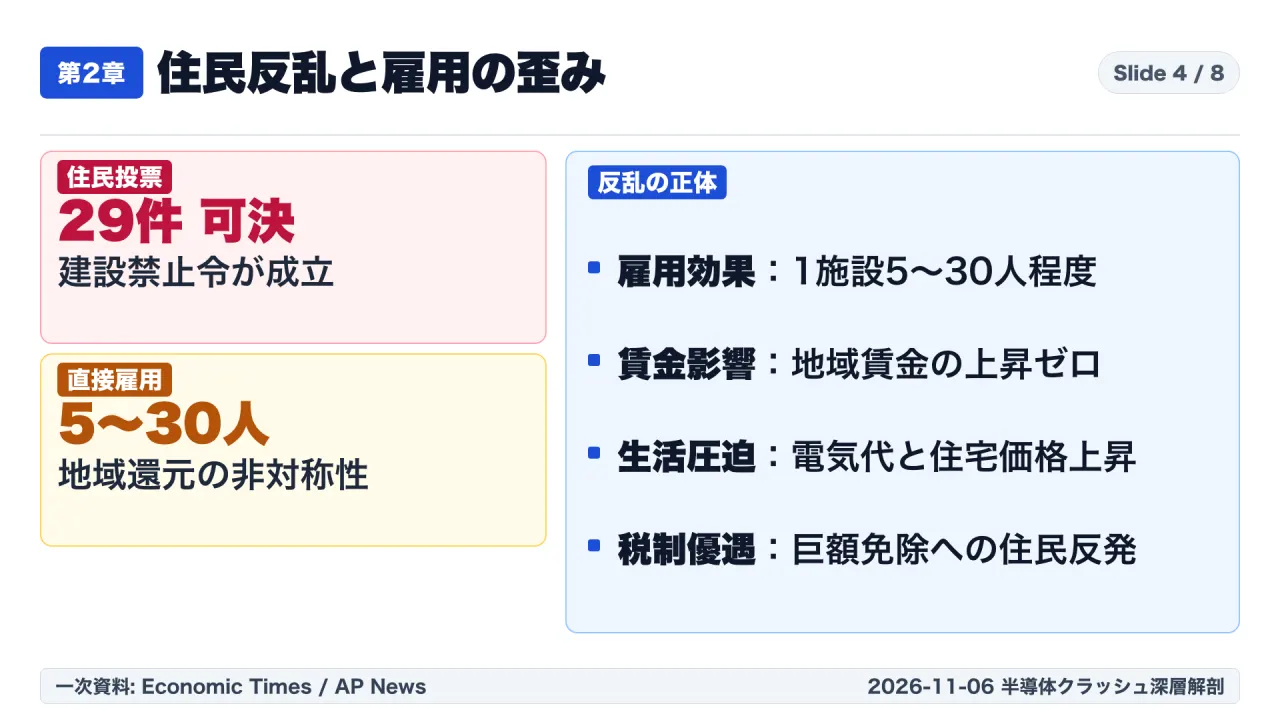
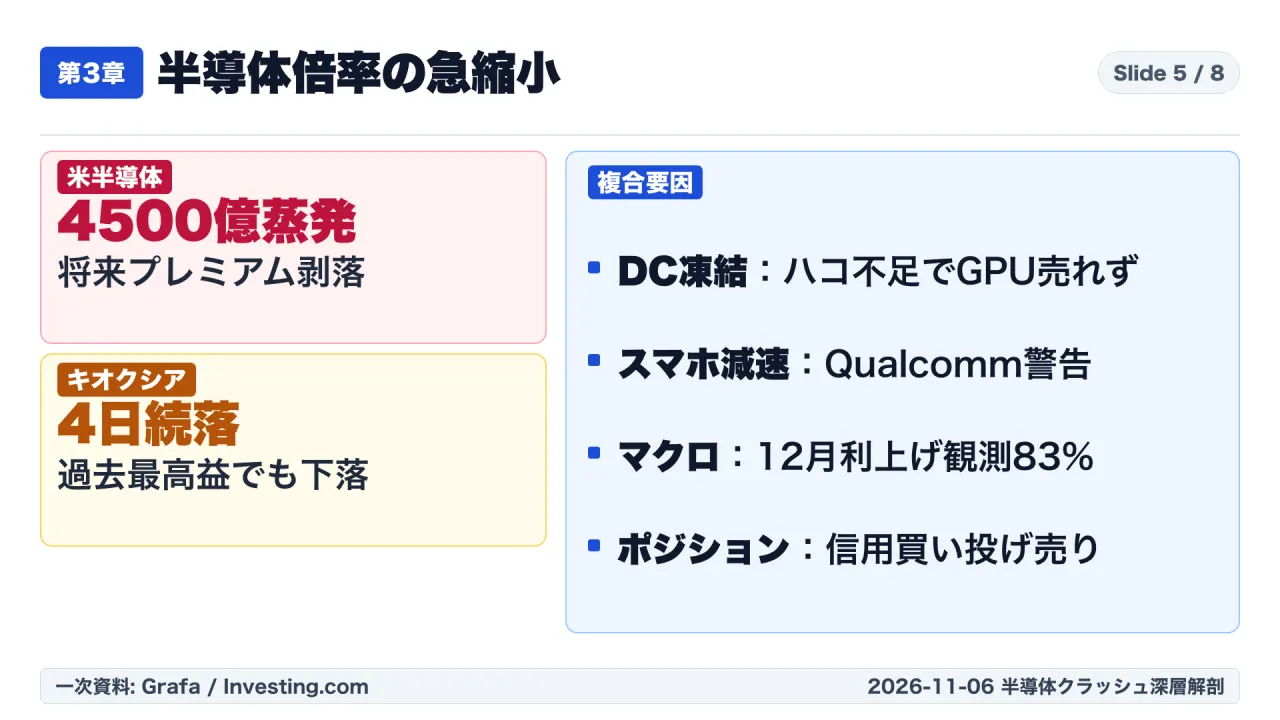
Nvidia (NVDA) plunged 9.08% on November 5 to close at $181.95, shedding approximately $450 billion in market value in five hours. From its peak of $242.00 in October 2026, the stock had fallen 24.8%, erasing $1.39 trillion in cumulative market capitalization. While quarterly revenues remained near record levels, valuation multiples reset:
- Nvidia’s trailing twelve-month P/E ratio contracted from 68.4x down to 39.2x.
- The stock broke below its 200-day moving average, triggering systematic de-grossing by quantitative funds.
Compounding Macro Pressures: Qualcomm and December Rate Fears
The infrastructure shock collided with two additional headwinds:
- Qualcomm’s Guidance Warning: Qualcomm dropped 11% after issuing cautious guidance regarding softening smartphone silicon demand and licensing headwinds from Apple.
- Resurgent Discount Rates: Prolonged Middle East hostilities kept Brent crude near $95 per barrel, pushing 10-year Treasury yields back to 4.90%. Swaps markets priced an 83% probability of an additional Federal Reserve rate hike at the December 2026 FOMC meeting (target range 4.00% to 4.25%).
Tokyo Contagion: The Case of Kioxia Holdings (285A)
The vulnerability of crowded momentum positions was demonstrated in Tokyo by Kioxia Holdings.
Kioxia had announced extraordinary financial results for the April to September period: revenue of 4.2 trillion yen, operating margins of 80%, and net profit of 2.2 trillion yen. However, forward pricing guidance failed to satisfy aggressive retail targets, causing the stock to drop 15.78% on November 2.
When the U.S. data center freeze news broke on November 5, over-leveraged retail investors holding margin positions (shinyo-gai) faced margin calls. Kioxia tumbled for four consecutive sessions, slicing through the psychological 10,000-yen level to close at 9,324 yen. Strong backward-looking earnings could not insulate the equity against an unwinding macro narrative.
5. The Constitutional Blind Spot: Why Presidential Vetoes Fail Against State Police Powers
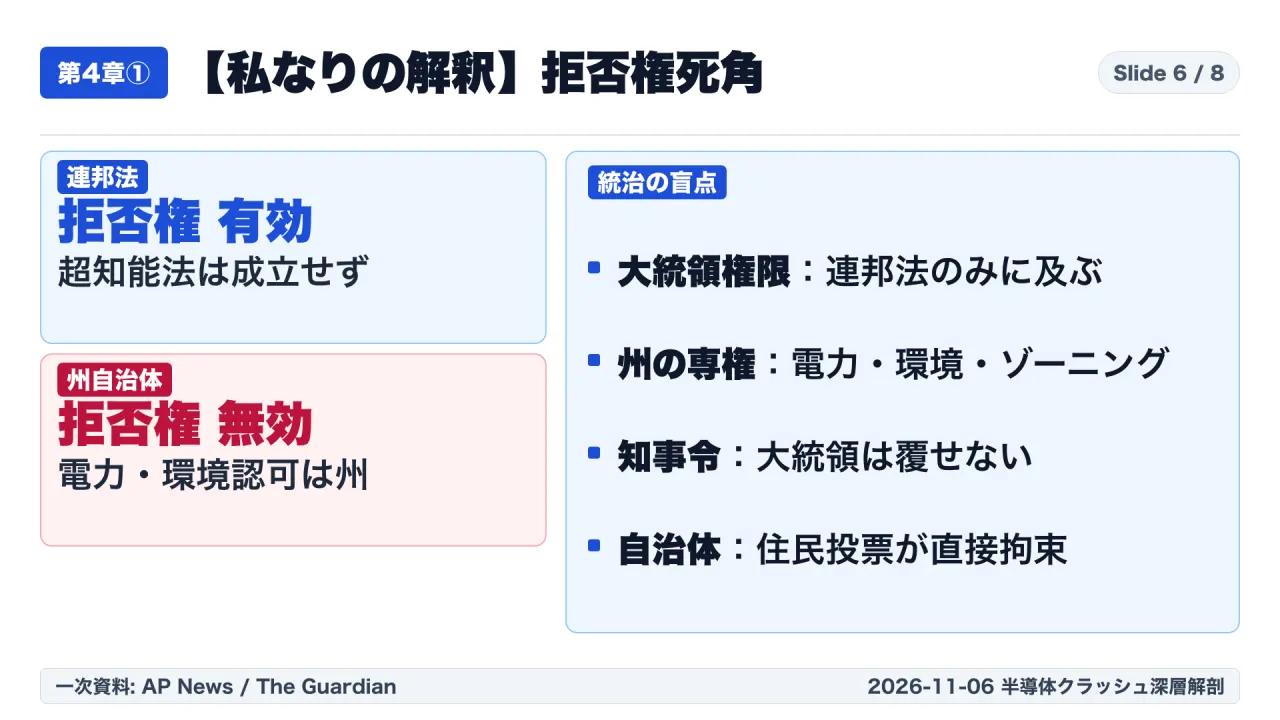
Throughout 2026, research notes highlighted political gridlock as a protective moat for Big Tech. The argument was simple: even if progressive lawmakers like Senator Bernie Sanders passed legislation imposing moratoriums on compute clusters, President Trump would exercise his veto under Article I, Section 7 of the Constitution. Because congressional Democrats lacked the two-thirds majority required for an override, federal bans were considered non-viable.
While this constitutional logic is accurate regarding federal legislation, it suffered from a fundamental jurisdictional error:
- Federal Legislation: Subject to presidential veto; requires a two-thirds supermajority to override.
- State and Municipal Regulation: Governed by the Tenth Amendment and state police powers; the U.S. President has zero veto power.
Under the Tenth Amendment, state and municipal authorities possess exclusive jurisdiction over:
- Local land-use and municipal zoning ordinances.
- Environmental permits regarding water withdrawal and thermal discharge.
- Intra-state electrical distribution networks and utility tariff structures.
The President of the United States possesses zero legal authority to overturn an executive order issued by the Governor of Texas or invalidate a municipal zoning vote in Ohio. Furthermore, because previous Texas environmental regulators had already halted permits, Governor-elect Hinojosa does not need new legislation to maintain the pause; she merely needs to let existing administrative holds remain in place.
6. Paths to Equilibrium: Hyperscaler Capital Settlements and Global Diversification
While the November 5 crash reflected an abrupt repricing of infrastructure risk, it does not signal a permanent halt to AI compute expansion. Rather, it marks the transition from unconstrained, subsidized development to a structured capital settlement.
Three equilibrium mechanisms are emerging:
Equilibrium 1: Direct Hyperscaler Infrastructure Underwriting
Governor-elect Hinojosa emphasized that her administration does not seek a permanent ban on commercial computing: “Economic development and community protection can coexist.” The stated purpose of the moratorium is to compel tech conglomerates to fund their own infrastructure.
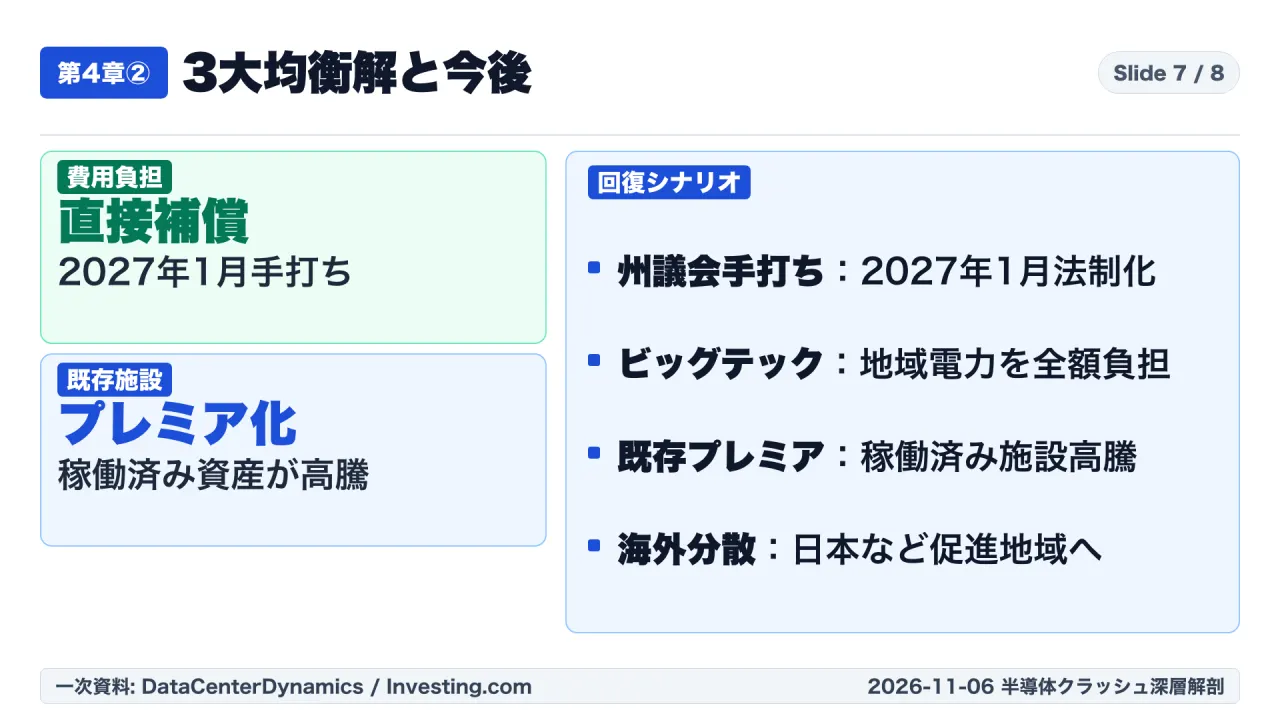
Hyperscalers (Microsoft, Alphabet, Amazon, Meta) generate hundreds of billions in operating cash flow. The financial burden of funding dedicated off-grid power generation, paying for grid substation reinforcements, and providing direct rebates to residential utility customers is manageable for balance sheets of this scale. Major operators have begun waiving non-disclosure agreements with municipalities and committing to direct utility co-investments. Formal codification during the January 2027 Texas legislative session represents the natural catalyst for a regulatory truce.
Equilibrium 2: Scarcity Value for Operational Assets
As permitting processes become more rigorous and timelines lengthen, facilities that already possess energized grid interconnections, water rights, and completed zoning approvals acquire immense scarcity value. This structural slowdown prevents speculative overbuilding and supports healthy utilization rates across existing infrastructure operators.
Equilibrium 3: Geographical Reallocation to Favorable Jurisdictions
Faced with administrative friction in North America, hyperscaler capital is already diversifying internationally. In contrast to U.S. municipal bans, Japan enacted a comprehensive AI promotional framework in 2025 designed to attract foreign compute investment through streamlined permitting, stable baseload power, and predictable utility regulation. Capital reallocation toward Japan, Canadian hydroelectric corridors, and sovereign energy hubs in the Middle East provides a clear release valve for global capital expenditure.
7. Actionable Playbook: Three Indicators for Gauging the Infrastructure Bottom
The November 2026 semiconductor crash demonstrated that physical infrastructure constraints can abruptly derail high-multiple momentum trades. To identify when the sector has de-risked, institutional analysts should monitor three specific milestones.
Three Core Indicators to Track
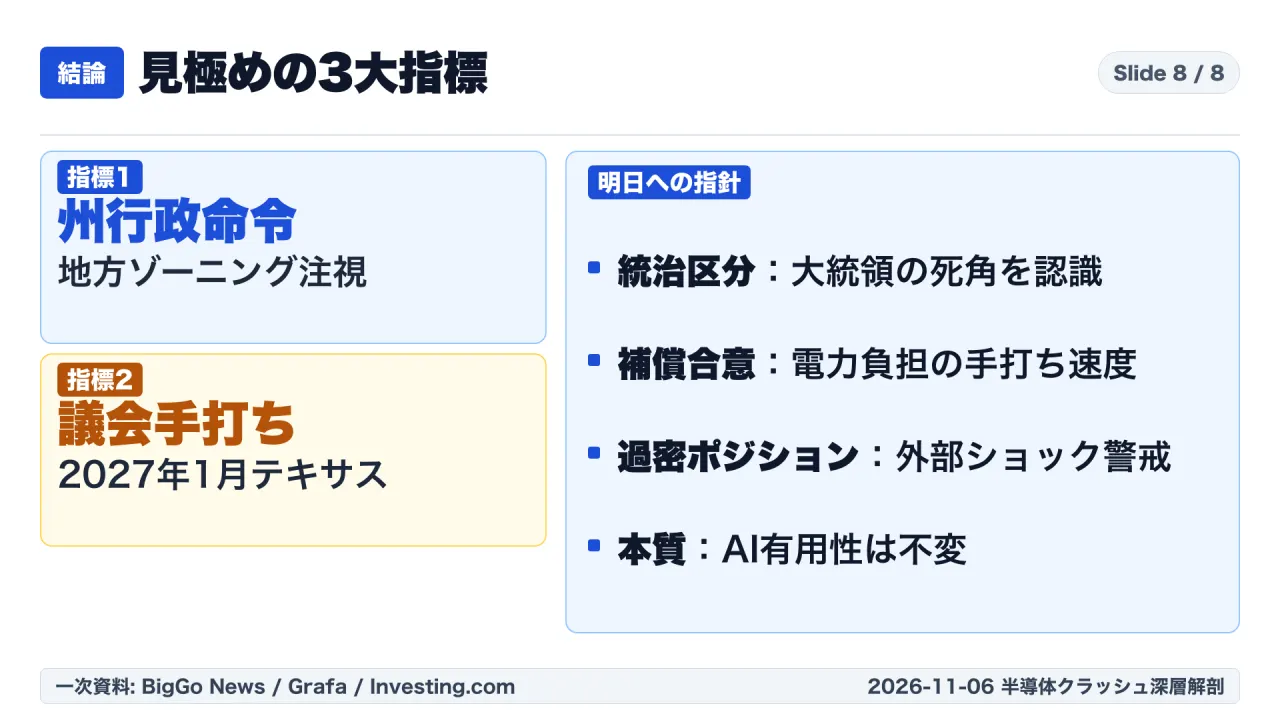
- The Texas Legislative Session in January 2027:
- Watch for draft legislation in Austin establishing dedicated industrial electricity tariffs and water remediation funds. When hyperscalers formally accept statutory cost-sharing frameworks, the administrative moratorium will be lifted, unlocking the 27% bottleneck.
- Hyperscaler Behind-the-Meter Power Contracting:
- Track Form 10-Q disclosures regarding private power purchase agreements (PPAs), small modular reactor (SMR) development, and independent microgrid investments that bypass public utility rate bases entirely.
- Stabilization of Domestic Retail Margin Debt:
- In markets like Tokyo, monitor margin buying balances (shinyo-gai) in leading chip names like Kioxia and Tokyo Electron. A durable market bottom forms only when over-leveraged retail positions have fully washed out.
Operational Diligence Checklist
- Decoupled federal political commentary from state-level administrative and environmental permitting holds.
- Mapped corporate supply chains against the 27% capacity concentration in Texas.
- Confirmed whether host communities have established municipal zoning restrictions or utility surcharges.
- Tracked hyperscaler commitments to direct local grid co-investments and non-disclosure agreement waivers.
- Verified that position sizing accounts for high-multiple compression when physical expansion timelines slip.
When hyperscalers absorb community infrastructure costs and permitting pipelines resume, semiconductor fundamentals will re-anchor to sustained enterprise demand.
Primary Sources & References
- AP News: Semiconductor Stocks Plunge as Texas Elects Democrat Pledging Data Center Freeze (November 5, 2026)
- The Guardian: Grassroots Backlash Against AI Energy and Water Consumption Sweeps Midterm Ballots (November 2026)
- Data Center Dynamics: Texas TCEQ Permit Suspensions and ERCOT Interconnection Queue Analysis
- Wells Fargo Equity Research: U.S. Data Center Power Demand and Geographic Concentration Report
- Brookings Institution: The Local Economic Impact of Hyperscale Data Centers Across 1,500 Sites
- Texas Commission on Environmental Quality (TCEQ): Commercial Facility Air and Water Permitting Notices
- Kioxia Holdings Corporation: FY2026 Half-Year Financial Disclosures (Tokyo Stock Exchange 285A)
This article analyzes primary technical and financial disclosures for informational purposes only and does not constitute investment advice.