Why Chubu Electric Booked a ¥370B Loss While JERA Builds a $15B Campus AI Datacenter ── Inside Japan 10-Year Grid Backlog, Nuclear Frequency Divides, and Co-Located Gas Power
How Japan 50Hz/60Hz frequency partition and regulatory gridlock created a 10-year interconnection queue, forcing JERA into on-site thermal generation and private enterprise orchestration.
Japanese Edition: https://consuloji.substack.com/p/3703jera23ai11000510abeja
Executive Summary & Key Analytical Takeaways
- Core Thesis: In the fiscal 2026 interim financial reports, Japan’s energy and artificial intelligence infrastructure reached a historic structural divergence. While Western Japanese utilities operating Pressurized Water Reactors (PWRs) posted robust operational profits—Kyushu Electric running all 4 units at an ~88% capacity factor and Kansai Electric operating 5 of 7 units—Chubu Electric withdrew its Hamaoka Nuclear Power Station safety application following seismic data irregularities. This forced a ¥370.3 billion ($2.4B) extraordinary loss (¥304.9 billion fixed asset impairment plus ¥65.3 billion nuclear fuel write-down), flipping Chubu Electric from a projected ¥160 billion profit to a ¥215 billion net loss.
- The Financial Stakes of Nuclear Baseload: A single 1,000 MW nuclear reactor provides an estimated annual fossil fuel replacement benefit of ¥80 billion to ¥100 billion ($500M–$650M) by offsetting imported liquefied natural gas (LNG) and coal. The regulatory divide between Western Japan’s PWRs and Eastern Japan’s Boiling Water Reactors (BWRs) has entrenched a multi-billion-dollar regional earnings divide.
- The Transmission Infrastructure Wall: Datacenter power consumption is projected by the Central Research Institute of Electric Power Industry (CRIEPI) to consume ~20% of Japan’s total electricity demand by 2050. However, commercial operators seeking extra-high-voltage grid connections face a grueling 5-to-10-year queue across regional utilities.
- JERA’s Behind-the-Meter Breakthrough: Bypassing public transmission lines, JERA—Japan’s largest power producer generating ~30% of domestic electricity—launched a 400 MW, ¥2.3 trillion ($15B) AI datacenter directly adjacent to its 4.38 GW Chiba Thermal Power Station. Using dedicated private lines (“Behind-the-Meter”), JERA avoids grid delays and wheeling tariffs, creating a vertically integrated “Molecule to Token” energy model.
- Software Grid Life-Extension: Because expanding physical frequency converter capacity across Japan’s 50Hz/60Hz divide (capped at 3 GW) requires decades and trillions of yen, enterprise AI vendor ABEJA is orchestrating digital twin transmission control, time-series load forecasting, and demand response to unlock virtual grid capacity.
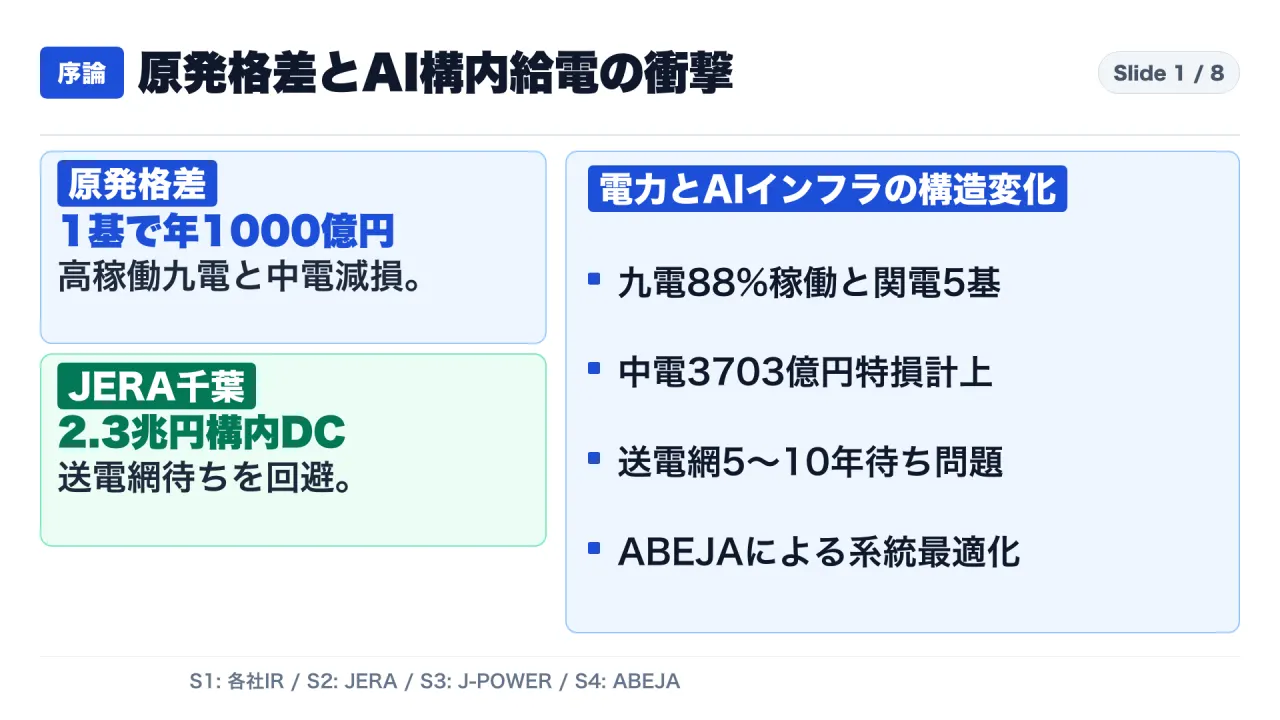
1. The Nuclear Divide: The ¥100 Billion Annual Swing Factor per Reactor
Power utilities are capital-intensive process industries where operational margins depend directly on baseload capacity factor to offset volatile, dollar-denominated fossil fuel imports.
In Japan, operating a standard 1,000 MW nuclear unit displaces roughly 1 million metric tons of imported LNG per year. Depending on foreign exchange and spot commodity prices, operating versus idling a single reactor produces an annual cash flow swing of ¥80 billion to ¥100 billion.
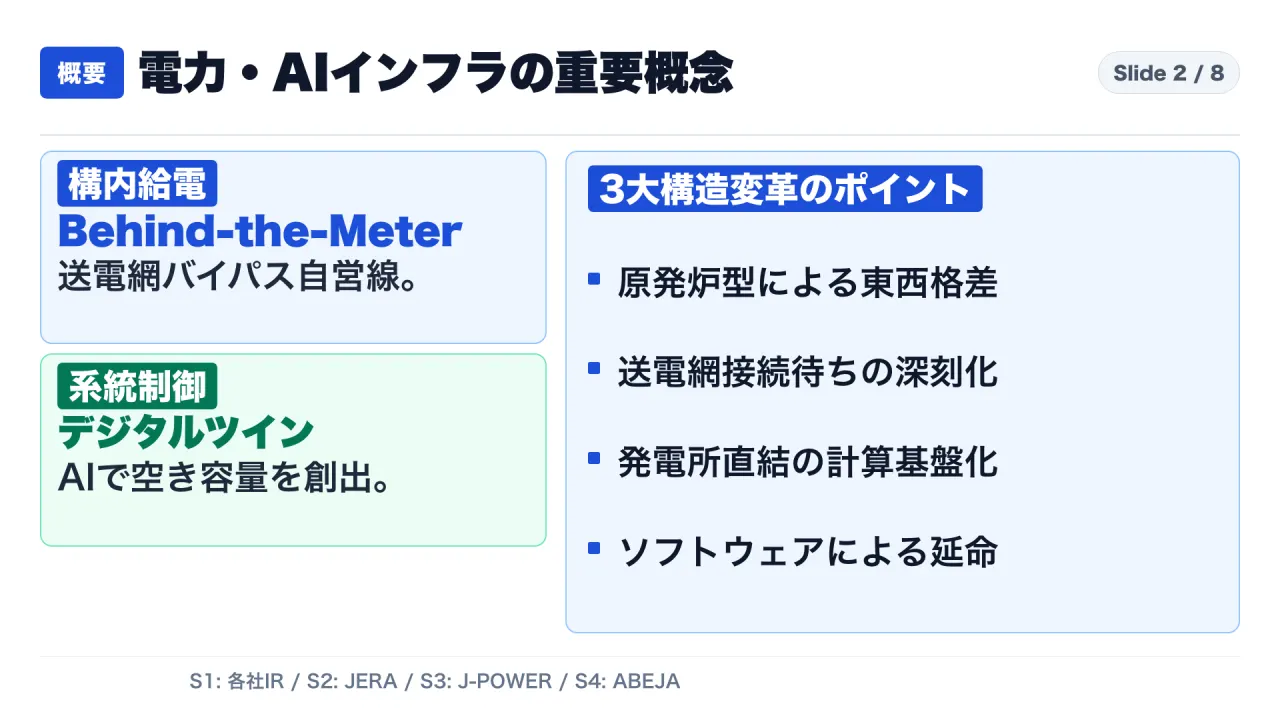
The Structural BWR vs. PWR Regulatory Barrier
Japan’s commercial nuclear fleet is divided technologically and geographically into Pressurized Water Reactors (PWRs) in Western Japan and Boiling Water Reactors (BWRs) in Eastern Japan.
| Electric Utility | Reactor Type | Fleet Status & Utilization | FY2026 Interim Financial Results | Structural Risks & Strategic Challenges |
|---|---|---|---|---|
| Kyushu Electric | PWR | 4 of 4 units operational (Genkai 3 & 4, Sendai 1 & 2) / ~88% capacity factor | Solid operating profit; strong resilience against elevated LNG and coal import prices | Solar PV curtailment routine; managing non-firm datacenter grid interconnections |
| Kansai Electric | PWR | 5 of 7 units operational (Ohi 3 trip, Takahama 3 maintenance, Mihama 3 pipe wear) | High recurring operating profits; anchoring price competitiveness across Western Japan | Aging fleet management for 40+ year units; replacement fuel expenses during maintenance |
| Chubu Electric | BWR | 0 units operational (Hamaoka 3 & 4 safety applications withdrawn) | ¥370.3 billion extraordinary loss booked; full-year guidance revised to a ¥215 billion net loss | Loss of foreseeable commercial restart timeline; heavy fixed cost overhead |
| Tokyo Electric (TEPCO) | BWR | Kashiwazaki-Kariwa Unit 6 in commercial restart process | ~¥100B interim improvement offset by rising group-wide power generation costs | Fukushima Daiichi decommissioning costs (~¥8T of ¥21.5T total); local consent process |
| J-POWER | Thermal, Hydro, ABWR | Domestic thermal and hydro fleets; Ohma Nuclear Project under construction | Interim operating profit ¥81.6B (+52.4% YoY); full-year net profit ¥81.0B | Indefinite regulatory review delays at Ohma; long-term stranding risk for coal assets |
Following the 2011 Fukushima Daiichi disaster, Nuclear Regulation Authority (NRA) reviews placed intense scrutiny on BWR containment venting and emergency cooling. Because PWR designs isolate radioactive coolant from turbine steam loops, Western Japan utilities cleared regulatory hurdles and secured local municipal consent years ahead of eastern BWR operators.
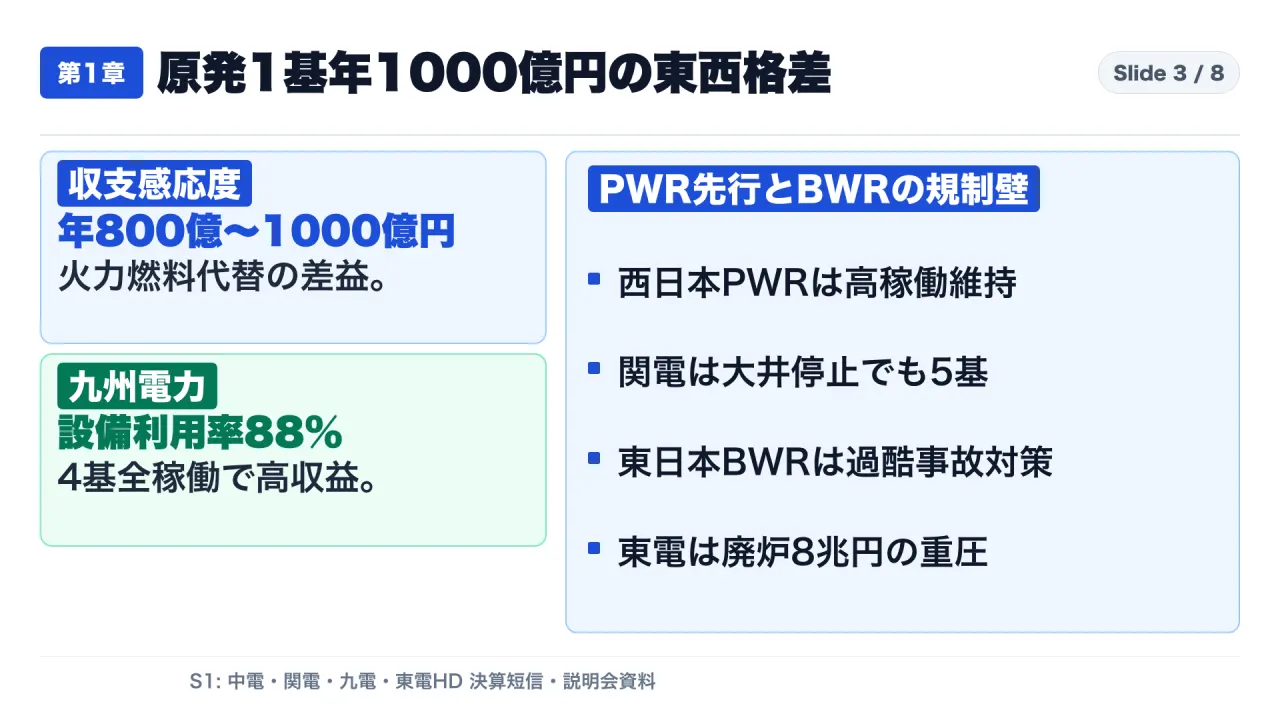
2. Anatomy of Chubu Electric’s ¥370.3 Billion Collapse: Compliance Failures in Asset-Heavy Industries
Chubu Electric’s interim fiscal 2026 impairment illustrated how compliance failures can abruptly decimate a regulated utility’s balance sheet.
- Seismic Base Data Inconsistencies: Regulators identified improper data handling in the standard earthquake ground motion calculations for Hamaoka Units 3 and 4.
- Application Withdrawal: Following formal NRA reprimands, Chubu Electric withdrew its safety screening application in September 2026.
- Cash Flow Evaporation: The withdrawal eliminated foreseeable operational cash flows required to amortize past capital investments under accounting standards.
- Extraordinary Loss Recognition: Chubu Electric booked a ¥304.9 billion fixed asset impairment loss and a ¥65.3 billion nuclear fuel valuation loss, totaling ¥370.3 billion ($2.4B).
- Earnings Revision: Full-year guidance swung from a ¥160 billion net profit to a ¥215 billion net loss.
Nuclear facilities incur vast fixed costs even in cold shutdown. Security, maintenance, engineering, and depreciation drain tens of billions of yen annually without delivering the ¥100 billion annual fuel cost offset of an operating unit.
3. The 10-Year Interconnection Bottleneck and JERA’s Behind-the-Meter Architecture
While nuclear restarts face regulatory headwinds, Japanese power demand is expanding rapidly. After decades of flat demand, generative AI datacenter buildouts have reversed the trend. CRIEPI projects datacenters alone will account for ~20% of domestic power demand by 2050.
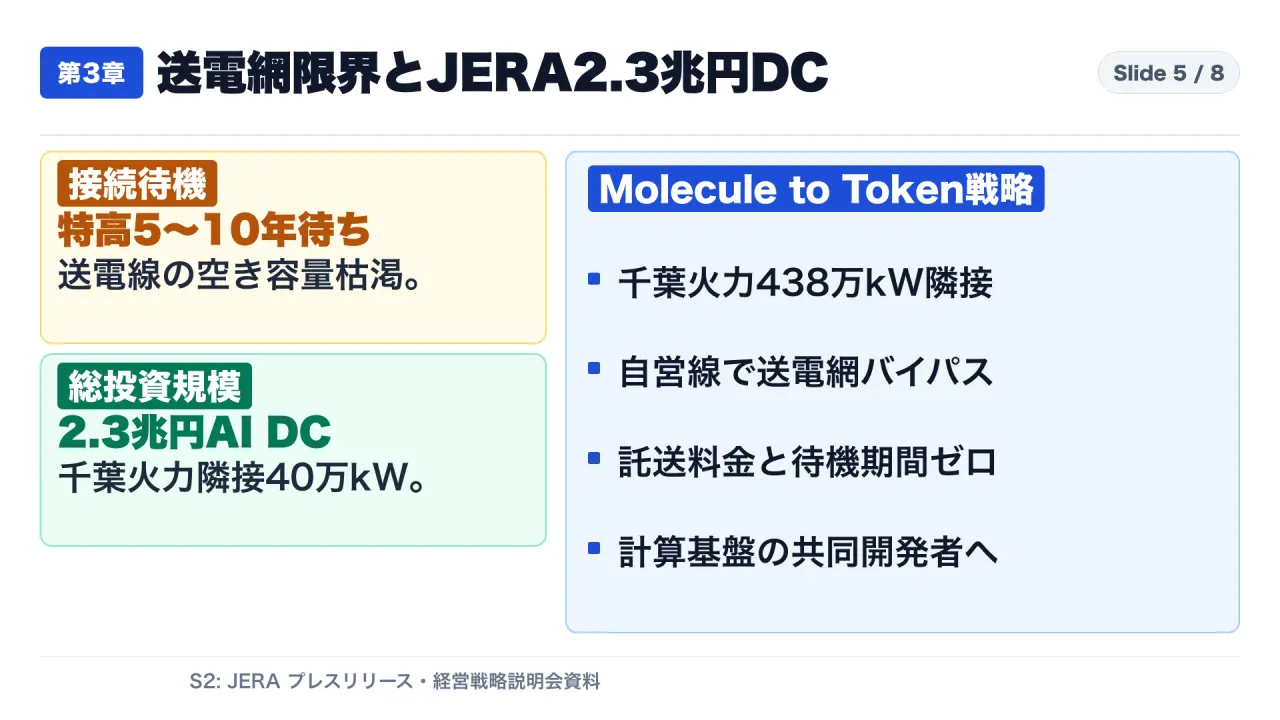
However, developers seeking extra-high-voltage (154 kV to 500 kV) grid connections face a 5-to-10-year interconnection backlog across general transmission networks.
| Entity / Project | Core Energy & Grid Infrastructure | Fiscal 2026 Operational Metrics | AI Datacenter Strategy & Transmission Topology | Structural Challenges & Downside Risks |
|---|---|---|---|---|
| JERA Co., Inc. | Domestic thermal fleet (LNG/coal); ~35M tons/year global LNG procurement | Interim net profit ¥301.1B; full-year net profit projected at ¥480.0B | Developing up to 400 MW AI datacenter at Chiba Thermal Station (¥2.3T investment); direct Behind-the-Meter campus power | Scope 2 carbon intensity conflicts with hyperscaler carbon-free goals; LNG price volatility |
| J-POWER | Coal thermal, hydro, frequency converter stations, Ohma Nuclear Project | Interim operating profit ¥81.6B (+52.4% YoY); full-year net profit ¥81.0B | Long-term decarbonized power auction participant; managing inter-regional lines | Extended safety screening timeline for Ohma ABWR; long-term stranding risk for coal |
| ABEJA, Inc. | ABEJA Platform, time-series load forecasting, digital twin systems | Full-year revenue ¥4.58B (+27.7% YoY); operating profit ¥710M (+59.4% YoY) | Regional DX alliance with Chubu Electric; LLM development on NVIDIA B200 at Sakura Ishikari; digital twin grid control | Public-sector grant dependency (~24% of revenue); deployment pace across utility operations |
JERA Chiba: Vertical “Molecule to Token” Integration
To bypass the 10-year grid queue, JERA adopted a direct physical integration model. At its 4,380 MW Chiba Thermal Power Station on Tokyo Bay, JERA allocated adjacent industrial land for a 400 MW AI datacenter campus representing a ¥2.3 trillion ($15B) investment.
Connecting via private on-site lines (“Behind-the-Meter”) provides two structural benefits:
- Wheeling Charge Exemption: Direct private distribution avoids regional transmission grid surcharges (takuso-ryo), substantially reducing unit electricity costs.
- Immediate Timeline Realization: Bypassing public transmission queues collapses power delivery lead times from a decade down to datacenter and transformer installation schedules.
This creates a vertically integrated “Molecule to Token” supply chain: importing LNG via global shipping fleets, burning it in combined-cycle turbines, and feeding electricity directly into GPU racks. The remaining challenge is emissions accounting, as global hyperscalers demand 24/7 carbon-free energy that unabated fossil generation cannot satisfy.
4. Physical Frequency Boundaries vs. Software Grid Optimization: J-POWER and ABEJA
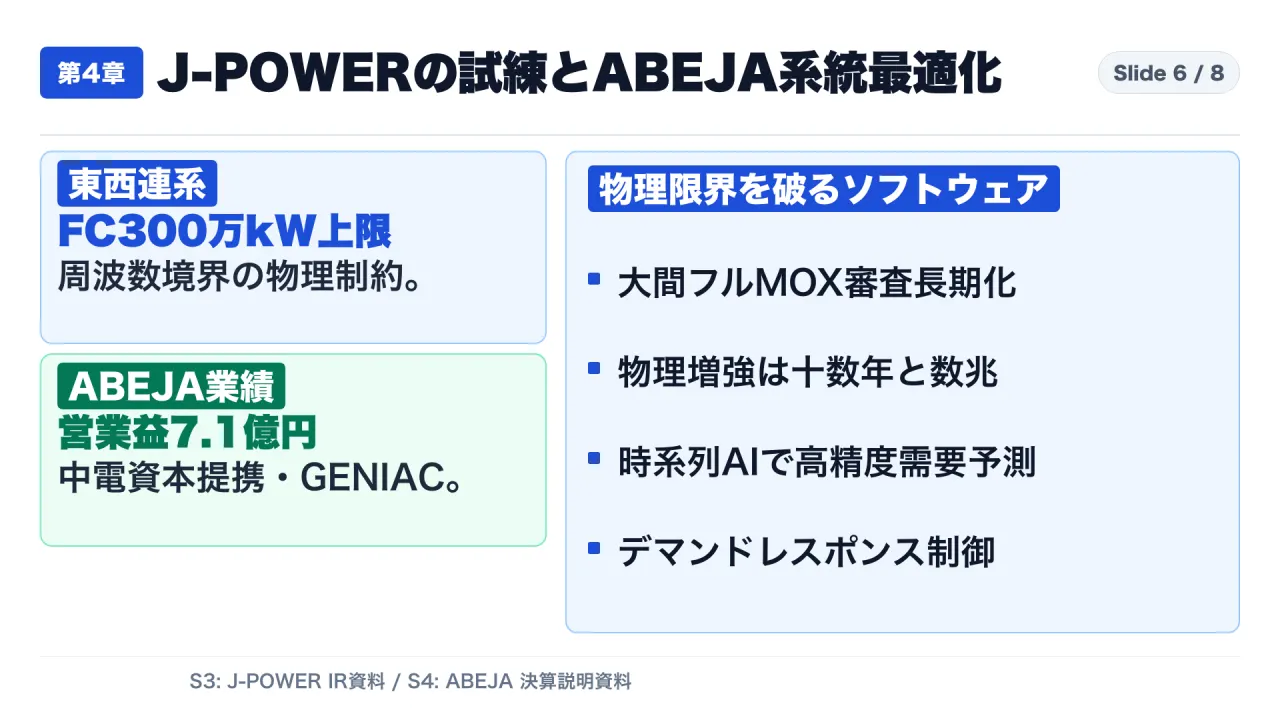
Japan’s grid remains split between Eastern Japan (50Hz) and Western Japan (60Hz). Linking these systems requires Frequency Converter (FC) stations (Sakuma, Shin-Shinano, Higashi-Shimizu), whose aggregate capacity is capped at 3,000 MW (3 GW).
This ceiling prevents surplus nuclear power in Western Japan from being wheeled east in volume to support Tokyo AI clusters. Furthermore, J-POWER’s 1,383 MW Ohma Nuclear Project (the world’s first commercial full-MOX ABWR) faces ongoing safety reviews that jeopardize its 2030 operational target.
ABEJA’s Algorithmic Transmission Optimization
Building new physical transmission lines or converter stations requires decades and trillions of yen. Enterprise software vendor ABEJA is addressing this limitation via algorithmic capacity management.
Collaborating with Chubu Electric and participating in Japan’s METI GENIAC initiative (using NVIDIA B200 GPUs at Sakura Internet’s Ishikari Datacenter), ABEJA deploys digital twin grid models. By processing telemetry from industrial facilities, battery energy storage systems (BESS), and compute clusters, ABEJA forecasts localized congestion. Automated demand response (DR) throttles flexible batch compute loads or discharges batteries during peak periods, creating virtual transmission headroom on existing lines.
5. The Three-Tier AI Infrastructure Topology in Japan: Facts vs. Analytical Interpretation
Verified Physical Facts
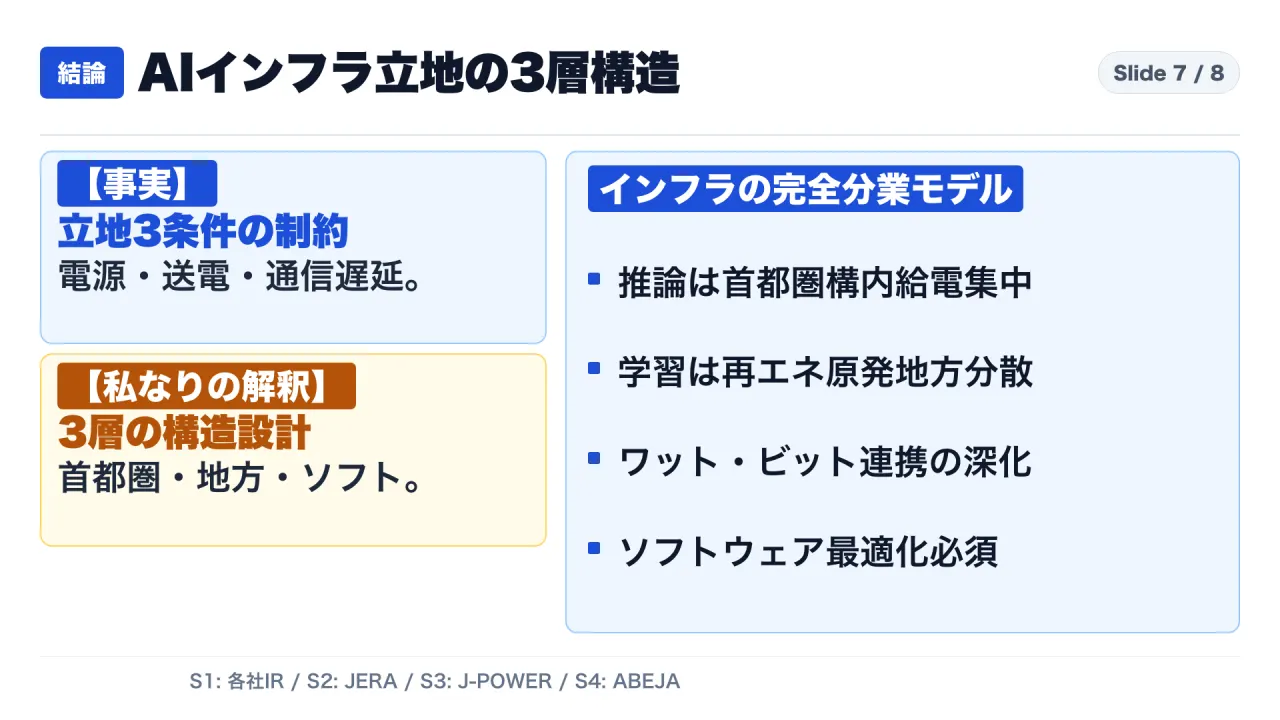
- Datacenter site selection requires the simultaneous presence of power availability, transmission capacity, and low-latency fiber.
- Tokyo enterprise and financial applications require sub-millisecond round-trip network latency, precluding remote rural siting for real-time inference.
- Western Japan holds low-cost nuclear baseload but cannot transmit more than 3 GW east across the 50Hz/60Hz frequency partition.
Strategic Analytical Interpretation: The Emerging Three-Tier Model
This physical landscape establishes a three-tier division of computing infrastructure across Japan:
- Tier 1: Metropolitan Behind-the-Meter Clusters (Low-Latency Inference)
- Located along Tokyo Bay (such as JERA Chiba), powered by on-site gas generation via private lines to bypass the 10-year grid queue and serve real-time enterprise APIs.
- Tier 2: Distributed Regional Clean Energy Hubs (Pre-Training & Batch Compute)
- Located in Hokkaido (exploiting wind, solar, and ambient cooling at Sakura Ishikari) and Kyushu (leveraging surplus nuclear generation during solar curtailment), accepting 10-to-20ms latencies to minimize power costs.
- Tier 3: Software-Defined Grid Orchestration (Virtual Transmission Expansion)
- Algorithmic orchestration layers (exemplified by ABEJA’s digital twins) dynamically balancing batteries, industrial loads, and compute clusters to prevent grid overloads.
6. Engineering & Capital Allocation Takeaways for Enterprise Leaders
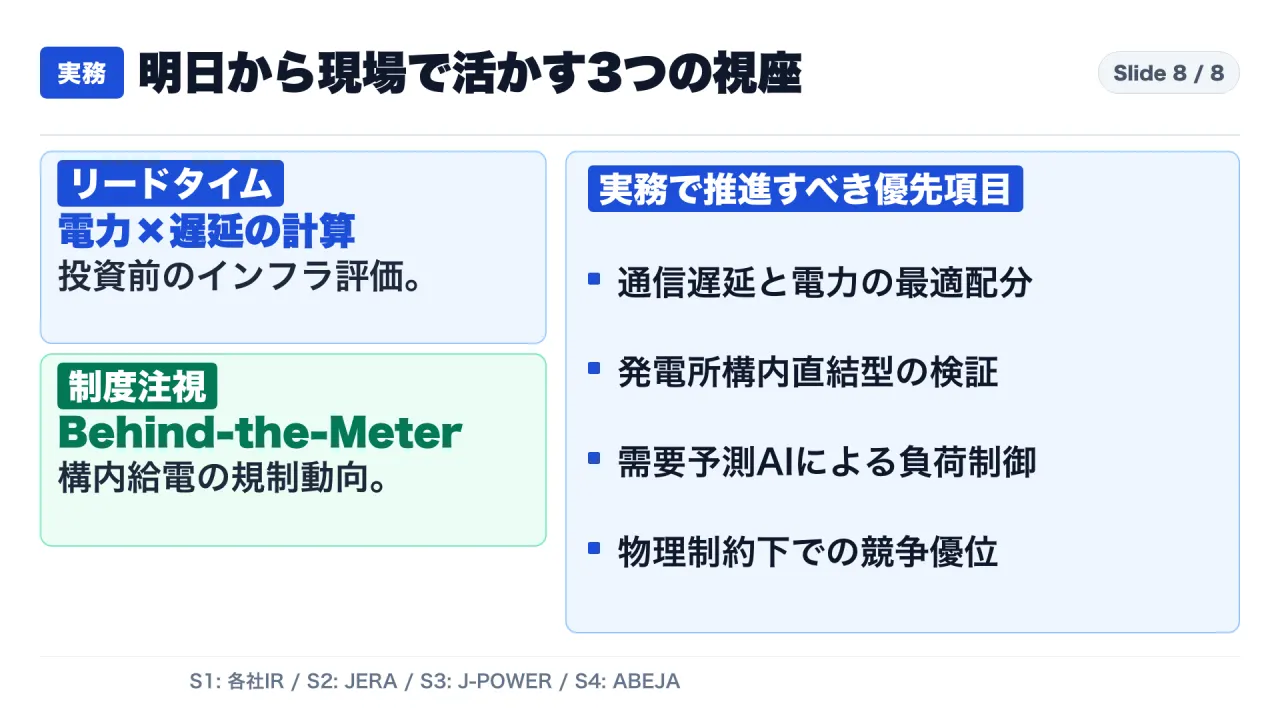
- Evaluate Power Procurement Lead Times Against Latency Requirements: Assess substation interconnection queues before committing GPU capital. Real-time Tokyo inference commands a premium for Behind-the-Meter siting, whereas batch pre-training should be routed to Hokkaido or Kyushu clean-power hubs.
- Monitor Behind-the-Meter Regulatory Policies: As large industrial users adopt private generation to bypass transmission queues, monitor Ministry of Economy, Trade and Industry (METI) policy discussions regarding whether private microgrids must contribute to national grid maintenance costs under the Electricity Business Act.
- Incorporate Dynamic Demand Response into Infrastructure Plans: Deploying workload-shifting software and battery storage enables operators to negotiate non-firm grid interconnection contracts, bypassing static grid capacity limits and shortening deployment schedules.
Primary Sources & Verified References
- Chubu Electric Power Co., Inc.: Fiscal 2026 Interim Financial Results and Extraordinary Loss Disclosures (https://www.chuden.co.jp/corporate/ir/library/earning/)
- JERA Co., Inc.: Official Disclosure on AI Datacenter Joint Development at Chiba Thermal Power Station (https://www.jera.co.jp/information/202611)
- Electric Power Development Co., Ltd. (J-POWER): Financial Results Presentation and Nuclear Safety Review Updates (https://www.jpower.co.jp/ir/library/)
- ABEJA, Inc.: Fiscal Year Financial Briefing and METI GENIAC Project Documentation (https://www.abejainc.com/ir/)
- Nuclear Regulation Authority (NRA) Japan: Safety Review Screening Minutes and Standard Earthquake Ground Motion Directives (https://www.nsr.go.jp/)
- Central Research Institute of Electric Power Industry (CRIEPI): Long-Term Outlook for Datacenter Power Demand in Japan (https://criepi.denken.or.jp/)
This article analyzes primary technical and financial disclosures for informational purposes only and does not constitute investment advice.