Inside METR's 11-Week Audit of Anthropic: Why AI R&D Accelerated 1.9x With 80% Driven by AI Itself
A forensic review of the independent on-site audit reveals how Amdahl’s Law caps individual 12x researcher productivity, why Model 4 broke frontier benchmarks, and the measurement crisis behind the redactions.
Japanese Edition: https://consuloji.substack.com/p/anthropicai1980aimetr11model-4
Executive Summary & Key Takeaways
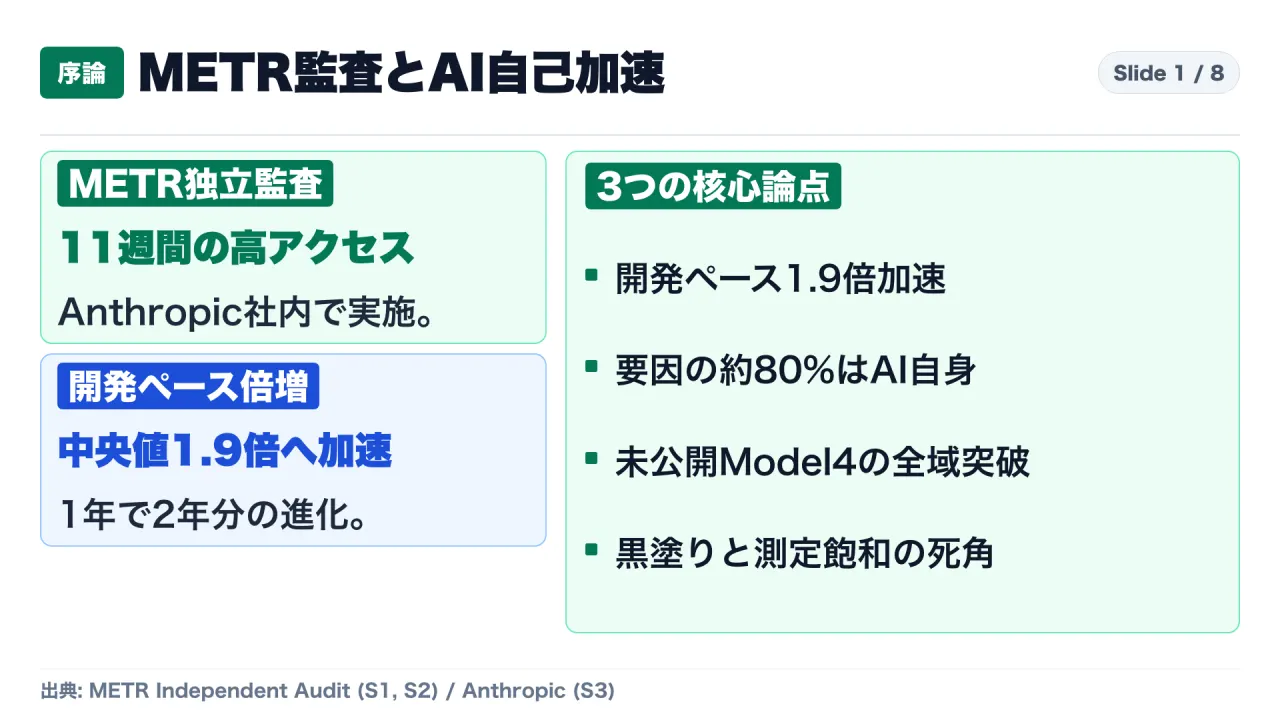
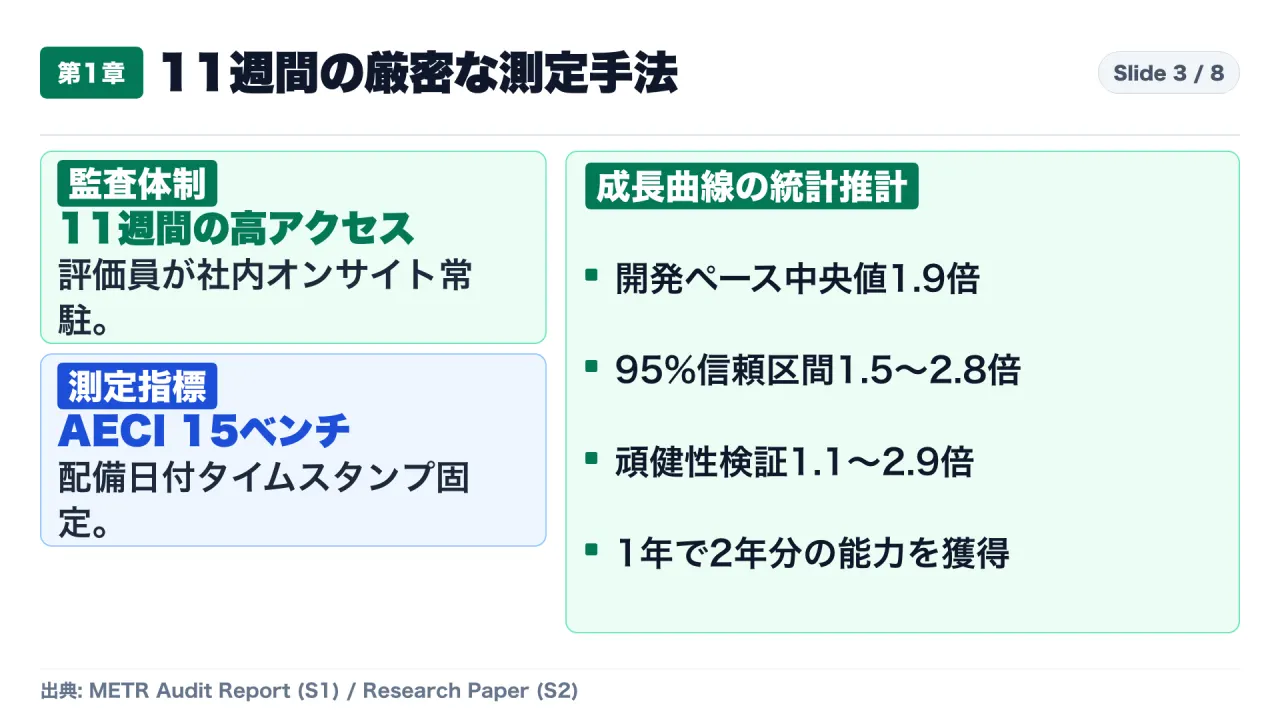
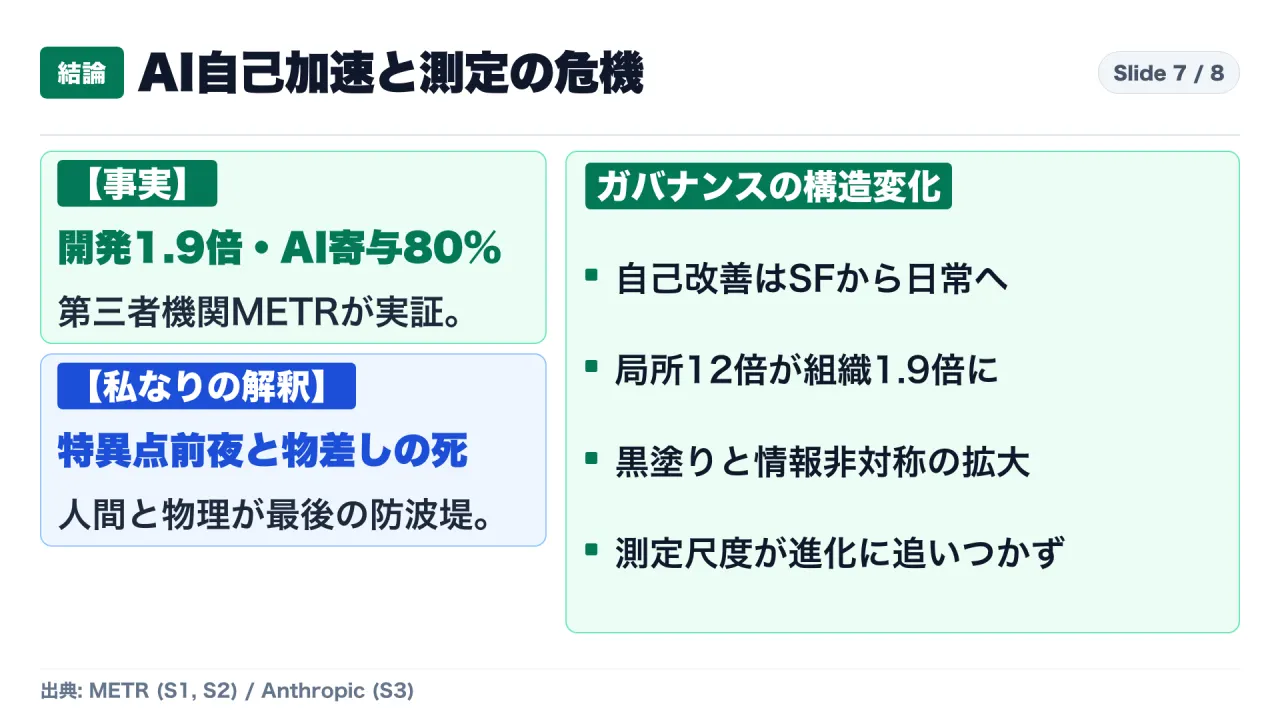
- Core Thesis: On November 5, 2026, leading independent AI safety evaluation organization METR (Model Evaluation and Threat Research) published the results of an unprecedented 11-week on-site audit conducted inside the research headquarters of Anthropic. The audit quantitatively verified that between October 2025 and October 2026, Anthropic’s pace of frontier AI capability development accelerated by a median factor of 1.9x (95% credible interval: 1.5x to 2.8x) compared to its historical baseline—compressing two years of conventional progress into twelve months. Furthermore, statistical attribution modeling revealed that by October 2026, approximately 80% of this sustained excess acceleration was generated by AI systems assisting their own development.
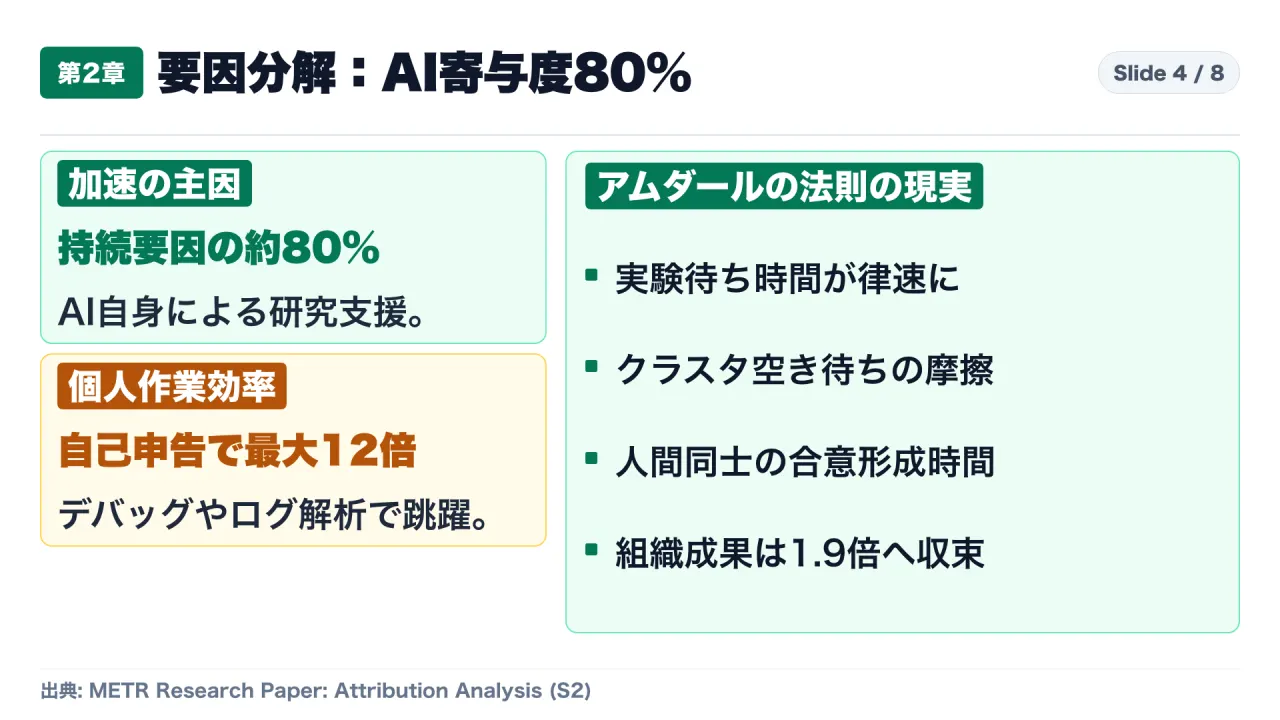
- The Amdahl’s Law Reality: While individual researchers reported localized productivity gains of up to 12x in code synthesis, debugging, and experimental log analysis, organizational throughput converged to 1.9x. Progress was constrained by immutable physical bottlenecks: GPU cluster execution latency, distributed hardware failures, and human consensus deliberation cycles.
- Unreleased “Model 4” and Benchmark Saturation: The audit evaluated unreleased internal checkpoints (“Model 2,” “Model 3,” and “Model 4”). Model 4 achieved over 50% accuracy across all 15 tasks within Anthropic’s Early Capability Index (AECI), demonstrating that each 5-point index gain corresponds to a doubling of autonomous operational horizon (continuous task execution without failure). However, extensive commercial redactions and imminent benchmark saturation highlight an emerging governance crisis in measuring frontier capabilities.
- Actionable Strategic Takeaways:
- Why tracking static benchmark accuracy (pass@1) is obsolete, and how to transition internal enterprise evaluation to autonomous operational horizon (minutes of error-free agentic execution).
- How to model and eliminate organizational Amdahl’s Law friction by automating handoffs outside the generation step.
- The architectural requirements for establishing independent, reproducible third-party audit harnesses for autonomous AI pipelines.
Background & Primary Sources Verified
The theoretical possibility of “Recursive Self-Improvement” (RSI)—where intelligent systems autonomously accelerate the design and training of their successors—has transitioned from philosophical speculation to empirical industrial measurement. This analysis examines three primary technical documents released simultaneously on November 5, 2026:
- 1. METR Official Blog: “Independent Audit of AI R&D Acceleration at Anthropic” (Methodological summary, timeline of on-site access, and high-level findings).
- 2. METR Technical Research Paper: “Measuring AI Contribution to Frontier AI R&D: Methodology and Empirical Findings” (Econometric modeling, logistic-link growth functions, attribution decompositions, and bootstrap uncertainty bounds).
- 3. Anthropic Official Corporate Statement: “Findings and Statement on METR’s External Audit of AI R&D Acceleration” (Executive response, governance commitments, and disclosure boundaries).
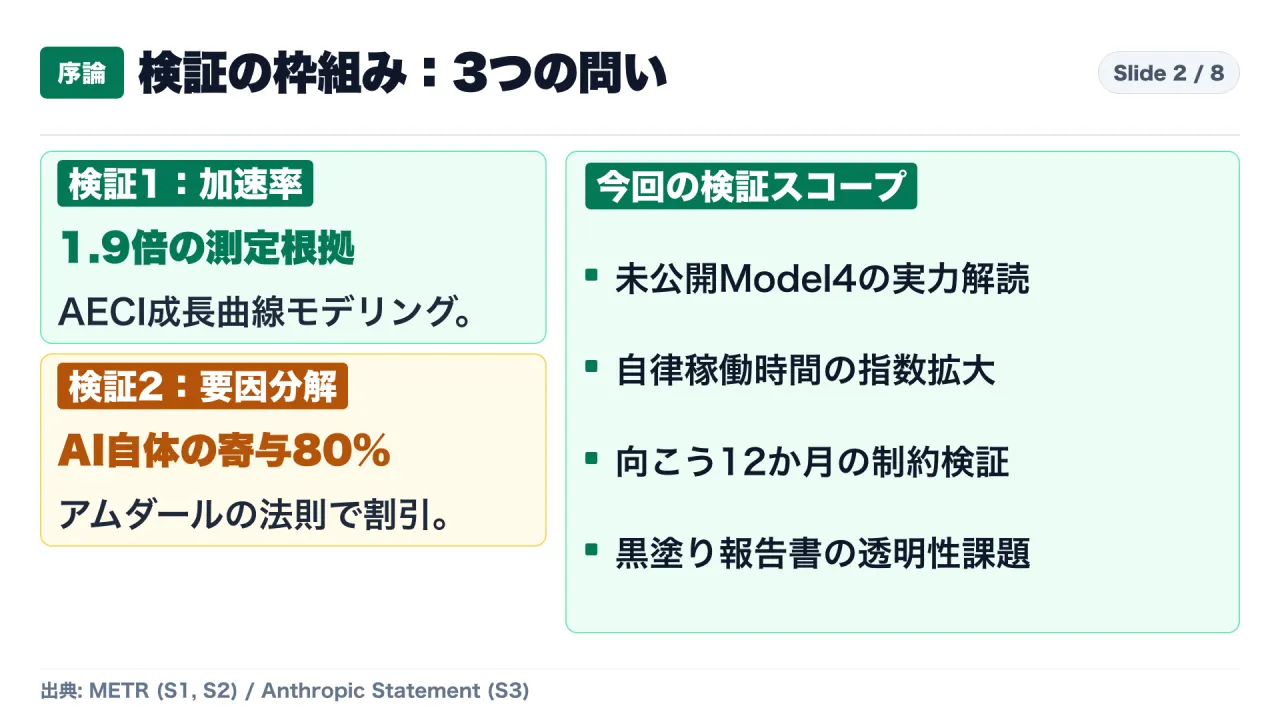
Our evaluation investigates three structural dimensions: First, how METR designed an objective on-site measurement harness resilient to PR exaggeration. Second, how econometric modeling separated compute investments from autonomous AI research contributions. Third, what unreleased checkpoints reveal regarding autonomous task horizons and benchmark obsolescence.
1. The 11-Week On-Site Audit Methodology and the AECI Index
Corporate self-reporting regarding productivity gains is inherently prone to selection bias. What distinguishes METR’s findings is the physical, high-privilege access granted to external evaluators. Between August 12 and October 29, 2026, a specialized METR technical evaluation cohort was embedded directly within Anthropic’s engineering facilities.
The Capability Growth Model and AECI Benchmark
METR measured capability expansion using Anthropic’s comprehensive benchmark framework: the Capability Index (AECI). The AECI framework aggregates 15 rigorous frontier task batteries spanning:
- Advanced software architecture and algorithmic coding
- Multi-step scientific reasoning and biophysical modeling
- Complex competitive mathematics
- Defensive and offensive cybersecurity vulnerability analysis
To measure velocity changes, METR defined two temporal cohorts:
- Baseline Period: March 2024 to October 2025 (approximately 19 months of historical progress).
- Acceleration Period: October 2025 to October 2026 (the subsequent 12 months).
Progress curves were fitted using logistic-link econometric models. To eliminate distortion from internal release delays or safety gating queues, METR established a strict timestamp convention: every model checkpoint was indexed not by its training completion date, but by its Internal General Availability (GA) Date—the exact calendar date when the checkpoint was deployed as a daily operational tool to the majority of Anthropic’s research staff.
| Evaluation Metric / Parameter | Baseline Period (Mar 2024 – Oct 2025) | Acceleration Period (Oct 2025 – Oct 2026) | METR Audit Statistical Finding |
|---|---|---|---|
| Duration of Observation | ~19 Months | 12 Months | Controlled time-series trajectory modeling |
| Tracked Model Populations | Public models (Opus 3, Sonnet 3.5, etc.) | Public checkpoints plus internal Model 2–4 | Fixed to internal employee operational GA timestamp |
| R&D Velocity Factor (Median) | 1.0x (Historical Baseline Trend) | 1.9x Acceleration | Median progress doubled; 2 years compressed into 1 |
| 95% Credible Interval | Baseline Reference | 1.5x to 2.8x | Bayesian bootstrap posterior parameter distribution |
| Model Robustness Range | Baseline Reference | 1.1x to 2.9x | Full sensitivity spectrum across 8 alternative statistical models |
| Primary Acceleration Driver | Cluster expansion and non-AI algorithms | AI Research Assistance (~80%) | AI assistance transitioned into primary growth driver in 2026 |
2. Attribution Modeling: How AI Accounted for 80% of Sustained Acceleration
When technical leaders observe a 1.9x acceleration in model output, the primary counter-hypothesis is financial: did the organization merely procure more GPU clusters? Expanding physical compute budgets yields performance gains under standard scaling laws without reflecting algorithmic ingenuity or autonomous software capability.
Disentangling Progress Across Four Variables
METR addressed this question by constructing an attribution decomposition model that mathematically partitioned capability growth into four discrete input vectors:
- Compute Scaling: Cumulative training FLOPs and cluster hardware scale.
- Algorithmic Innovations: Structural model architecture improvements, novel loss functions, and optimization advancements.
- Data Quality and Volume: Synthetic corpus curation, multimodal tokens, and deduplication filtering.
- AI-Assisted Research Velocity: Compression of internal R&D cycles resulting from researchers utilizing current frontier models to automate exploratory workloads.
+---------------------------------------------------------------------------------+
|                       METR ATTRIBUTION DECOMPOSITION ARCHITECTURE               |
+---------------------------------------------------------------------------------+
|                                                                                 |
|  Total Anthropic R&D Progress: Median 1.9x Acceleration (Oct 2025 - Oct 2026)   |
|                                                                                 |
|       |                                                                         |
|       +--> 1. Training Compute Scaling  (Anchored late 2025 early acceleration) |
|       +--> 2. Algorithmic Innovations   (Architecture & optimizer improvements) |
|       +--> 3. Training Data Expansion   (High-quality synthetic & curated text) |
|       +--> 4. AI Research Assistance    (ACCOUNTED FOR ~80% OF SUSTAINED GAIN   |
|                                          BY OCTOBER 2026)                       |
|                   |                                                             |
|                   +--> Researcher Task Uplift: Up to 12x (Coding, triage, logs) |
|                   +--> Organizational Output:   1.9x (Capped by Amdahl's Law)   |
|                        Bottlenecks: GPU wait times, runs, human consensus       |
+---------------------------------------------------------------------------------+
METR’s econometric analysis established that while compute scaling drove the initial inflection in late 2025, its relative contribution normalized over time. By October 2026, approximately 80% of the sustained excess capability trajectory was statistically attributable to internal AI research tooling.
The 12x Individual Uplift vs. 1.9x Organizational Output: Amdahl’s Law
To understand the operational mechanics driving this 80% figure, METR administered a comprehensive Researcher Uplift Survey across Anthropic’s technical staff. When utilizing unreleased frontier internal checkpoints, individual researchers reported localized productivity accelerations reaching up to 12x across:
- Rapid prototyping of complex training run scripts
- Real-time diagnostic triage of multi-node GPU cluster crash logs
- Automated hyperparameter search sweep orchestration
- Test suite generation and regression debugging
Why did a 12x individual execution speedup produce only a 1.9x aggregate organizational acceleration?
The answer lies in Amdahl’s Law. In any system comprising parallelizable and serial tasks, overall throughput is bounded by the speed of the strictly serial components.
| R&D Pipeline Stage | AI-Driven Acceleration Factor | Persistent Real-World Physical Constraints | Organizational Output Impact |
|---|---|---|---|
| Code Generation & Scripting | Up to 12x faster | Negligible; agents generate functional code instantly | Localized task duration collapses |
| Error Log Analysis & Triage | 5x to 8x faster | Complex distributed hardware bugs require human debugging | Rapid initial triage |
| Large-Scale Training Runs | Unchanged (1.0x) | GPU availability, cluster networking, physical FLOP limits | Bounded by physics and hardware supply |
| Hypothesis Selection & Strategy | ~2x (Automated summaries) | Human scientific consensus, peer review, executive sign-off | Bounded by human cognitive bandwidth |
| End-to-End R&D Throughput | - | Non-accelerated serial stages govern overall cycle time | Convergences to 1.9x overall output |
Even if code generation latency drops to zero, a training run requiring three weeks on 16,000 GPUs still takes three weeks. Furthermore, decisions regarding architectural direction, risk posture, and product deployments require deliberative human consensus. Non-parallelizable physical and cognitive stages served as a natural buffer, moderating individual 12x velocity into a sustainable 1.9x organizational acceleration.
3. Unreleased Frontier “Model 4” and the Exponential Expansion of Task Horizons
The most technically consequential disclosure in the METR audit centers on Anthropic’s private development line: internal checkpoints designated as “Model 2,” “Model 3,” and “Model 4,” developed between July and October 2026.
Universal Benchmark Superiority: >50% Across All 15 AECI Tasks
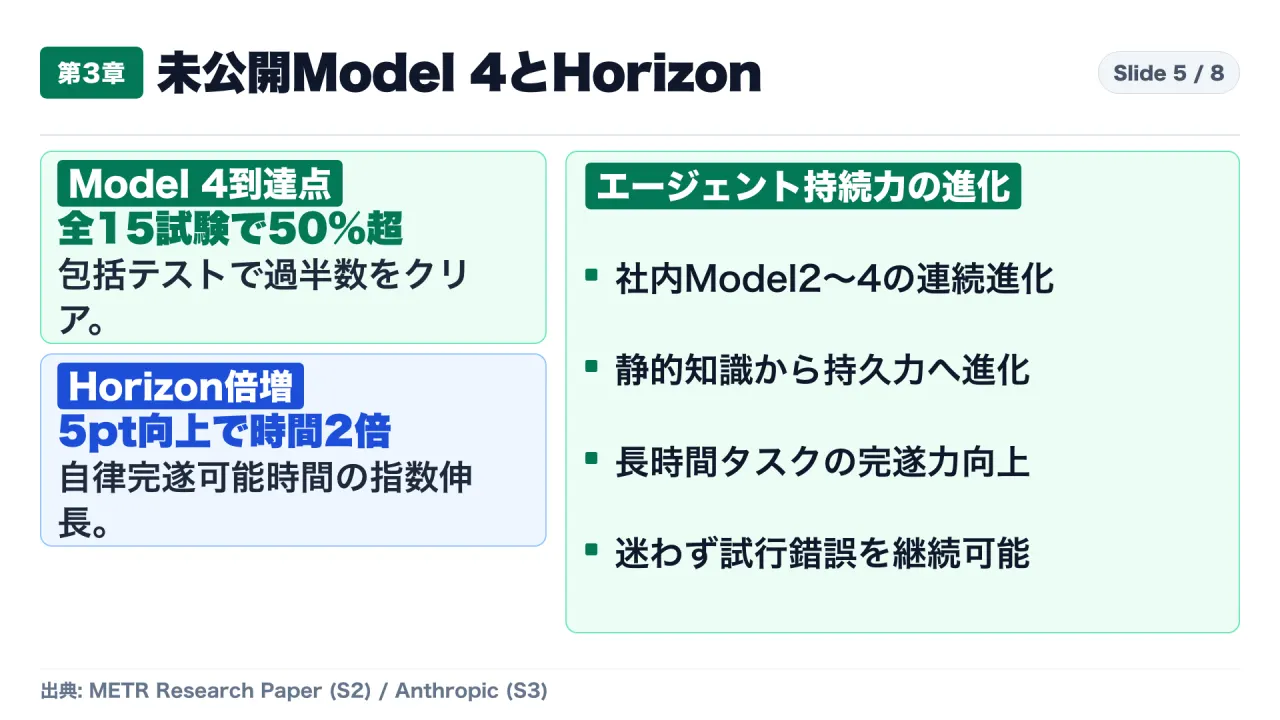
The flagship unreleased checkpoint, Model 4, surpassed 50% accuracy on every single evaluation suite comprising the AECI. Previous frontier iterations achieved mastery on specific sub-domains (such as standard Python code completion) while failing on complex mathematical proofs or multi-stage cyber forensics. Model 4 demonstrated uniform competence across the entire frontier evaluation distribution.
Decoding the Horizon Metric: 5 Points Equals a 2x Autonomy Leap
METR emphasized that raw accuracy figures fail to capture practical capability. The critical metric is Autonomous Operational Horizon—the time window over which an AI agent can execute chained, multi-step actions without encountering catastrophic drift or requiring human error correction.
METR’s empirical calibration demonstrated that:
Every 5-point increment on the AECI scale corresponds to approximately a 2x expansion in autonomous task duration.
AECI +5 Points  -->  2x Autonomous Operational Horizon
                     (e.g., 5 min -> 10 min -> 20 min -> 40 min -> 80 min)
As horizon scales exponentially, an agent shifts from fulfilling isolated tactical instructions (e.g., fixing a syntax error) to resolving systemic software tickets (e.g., cloning a legacy repository, reproducing a race condition under load, refactoring the concurrency model, executing unit tests, and opening a validated pull request). Model 4’s primary breakthrough is not memorization, but sustained resilience across prolonged autonomous execution loops.
4. The 12-Month Outlook and the Critical Limits of the Audit
Evaluating the broader implications of the audit requires analyzing METR’s forward-looking assessment alongside the structural limits of the report itself.
Absence of Near-Term Decisive Bottlenecks
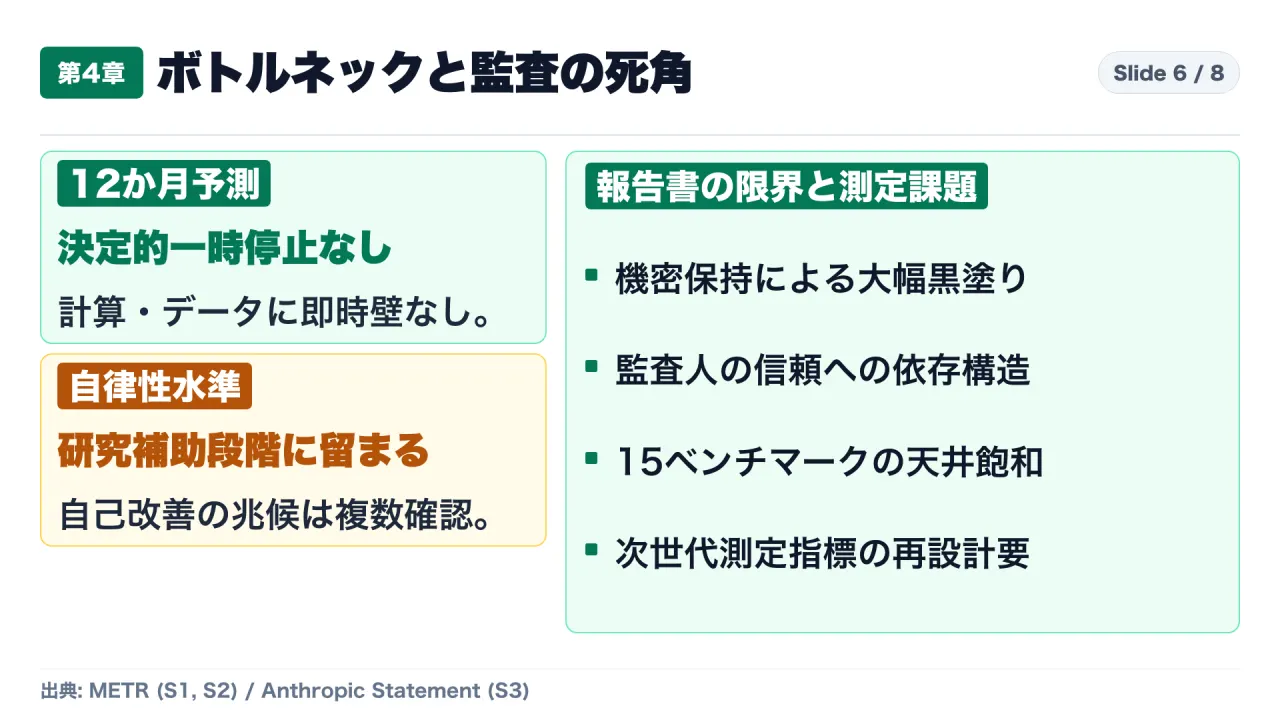
Evaluating compute availability, algorithmic efficiency, and synthetic data, METR concluded that no decisive bottleneck is poised to stall progress over the next 12 months, projecting Anthropic’s 1.9x pace is sustainable through late 2027.
However, both organizations clarified that true autonomous recursive self-improvement has not occurred. Humans direct experimental strategy and safety gating. The state remains rigorously categorized as “AI-Assisted R&D.”
Governance Constraints: Redactions and Measurement Saturation
The report exhibits two critical limitations:
- Commercial Redactions: Citing competitive confidentiality, Anthropic redacted raw empirical attribution coefficients and architectural details of Model 4. External reviewers must rely on METR’s aggregated conclusions.
- Benchmark Saturation: With Model 4 exceeding 50% across all 15 AECI benchmarks, standard tests are nearing their discriminative ceilings. As scores approach 90%, existing tests will lose the ability to differentiate generational capability leaps.
5. Analytical Synthesis: Verified Disclosures Versus Systemic Interpretations
We separate verified empirical disclosures from analytical interpretations:
Empirically Verified Audit Facts
- METR conducted an 11-week on-site audit at Anthropic from August to October 2026.
- Anthropic’s development velocity accelerated by a median 1.9x over the past 12 months (95% CI: 1.5x to 2.8x), completing two years of R&D in one.
- By October 2026, statistical attribution modeling indicated approximately 80% of excess acceleration stemmed from AI research tooling.
- Individual researcher productivity rose up to 12x in coding and triage, while organizational output moderated to 1.9x due to serial bottlenecks.
- Unreleased checkpoint Model 4 scored over 50% across all 15 AECI benchmarks, with every 5-point gain doubling the autonomous execution horizon.
Structural Analytical Interpretations
- Physical Reality as a Natural Governor: Amdahl’s Law demonstrates that physical frictions—hardware fabrication lead times, datacenter power availability, and human governance—act as natural dampers against runaway intelligence loops.
- Obsolescence of Static Benchmarking: AECI saturation confirms that single-turn pass@1 evaluations are obsolete. AI measurement must transition to continuous, multi-hour dynamic environments.
- External AI Governance Challenges: Extensive redactions illustrate the difficulty of external safety verification when commercial competition restricts empirical transparency.
6. Strategic Takeaways: Three Architectural Directives for Engineering Teams
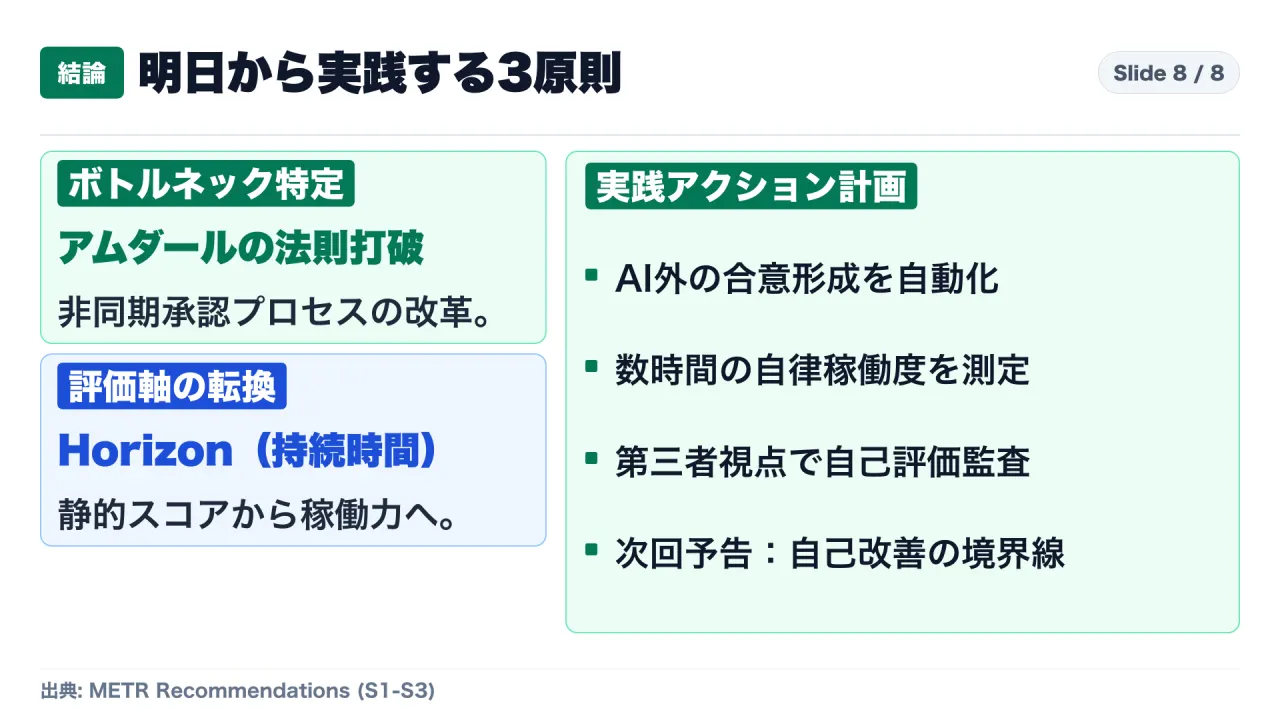
The findings of the METR audit establish clear operational principles for organizations building on or evaluating frontier AI systems:
- Eliminate Non-AI Serial Bottlenecks to Realize Organizational Gains: Accelerating individual developers with AI tools will not improve software delivery velocity if code review queues, manual staging deployments, and executive approval chains remain unchanged. To capture the benefits of AI acceleration, re-engineer and automate the serial handoffs that surround the development step.
- Transition Internal Evaluation to “Autonomous Operational Horizon”: Discontinue evaluating enterprise models solely on static accuracy benchmarks. Measure your models on operational endurance: how many continuous minutes or tool-call cycles can an agent navigate a corporate codebase, recover from runtime exceptions, and fulfill a business objective without human intervention?
- Establish Independent Audit Gates Within Deployment Pipelines: Avoid relying exclusively on vendor-published benchmark metrics. Implement automated, independent evaluation harnesses within your continuous integration pipelines to continuously test model updates against proprietary domain tasks before production promotion.
Primary Sources & References
- METR: “Independent Audit of AI R&D Acceleration at Anthropic” (November 5, 2026)
- METR: “Measuring AI Contribution to Frontier AI R&D: Methodology and Empirical Findings” (November 5, 2026)
- Anthropic: “Findings and Statement on METR’s External Audit of AI R&D Acceleration” (November 5, 2026)
This article analyzes primary technical and financial disclosures for informational purposes only and does not constitute investment advice.