Why Semiconductor Stocks Dropped 12% as OpenAI Reached $1.25 Trillion: Inside the Post-Midterm Grid Lock, Memory Crunch, and the AEO Shift
How Microsoft’s $3 billion neo-cloud retreat, 71% voter pushback across three states, and holiday shoppers moving to AI search expose the divergence between hardware constraints and software demand.
Japanese Edition: https://consuloji.substack.com/p/12microsoftopenai125
Executive Summary & Key Takeaways
- Core Thesis: In early November 2026, technology markets displayed two divergent signals. In public markets, semiconductor and AI infrastructure equities liquidated: the Philadelphia Semiconductor Index (SOX) dropped 12.25% in a single day, while Microsoft initiated a review of third-party neo-cloud GPU contracts, canceling a $3.0 billion deployment option with Nscale, trimming $5.0 billion from projected capex, and phasing out legacy GPU leases from Oracle Cloud. Conversely, private market valuations and consumer metrics accelerated: OpenAI completed the first tranche ($11.0 billion) of its financing round at a $1.25 trillion valuation, Anthropic advanced Form S-1 IPO preparations, and Bain & Company projected US holiday retail spending to exceed $1.0 trillion for the first time, with 24% of online shoppers (up from 17% in 2025) starting product research directly inside conversational AI engines. This divergence is driven by three physical and macroeconomic barriers: (1) The Siting & Grid Wall, where 50% of planned US data centers are concentrated in three states (Texas, Georgia, Ohio), where local opposition reached 71% and post-midterm shifts tightened zoning and utility rules; (2) The Memory Cannibalization Wall, where memory foundries allocated 70% to 80% of advanced wafer capacity to High Bandwidth Memory (HBM3E/HBM4), pushing legacy commodity DRAM spot prices up 30% to 50% and extending automotive memory lead times past 58 weeks; and (3) The Macro Interest Rate Wall, where robust US October payrolls (+165,000) and sticky inflation held 10-year Treasury yields at 4.85%, increasing the carrying cost of debt-financed GPU infrastructure. Consequently, enterprise strategy is pivoting: hyperscalers are enforcing internal capital discipline, IT teams are securing legacy DRAM components, and commercial brands are shifting from traditional Search Engine Optimization (SEO) to AI Engine Optimization (AEO).
- Primary Sources Verified: Bloomberg market telemetry, corporate contract audits, and prime brokerage data; Gallup and NBC News national public opinion surveys on data center opposition; Baird Strategies geographic infrastructure analysis; AllianceBernstein equity research on memory wafer allocation; US Bureau of Labor Statistics (BLS) October 2026 Employment Situation Summary; Reuters private equity funding dispatches; and Bain & Company 2026 US Holiday Shopping Season Forecast.
- Actionable Engineering & Governance Takeaways:
- Prepare for commodity DRAM supply crunches: enterprise IT procurement must secure 2027 hardware allocations early; wafer reallocation toward high-margin HBM will inflate server, PC, and embedded automotive component costs throughout 2027.
- Audit cloud vendor power autonomy: transition enterprise workloads away from speculative neo-cloud intermediaries reliant on third-party co-location in congested utility zones (Texas, Georgia, Ohio) toward operators with dedicated first-party power rights.
- Re-engineer corporate web assets for AEO (AI Engine Optimization): with roughly one in four shoppers initiating product discovery via LLMs, replace image-only marketing copy with semantically rich JSON-LD (Schema.org), machine-readable specifications, and structured comparison tables designed for direct citation by AI agents.
- Limits of the Evidence: Commercial negotiations regarding Microsoft’s private contract adjustments with neo-cloud vendors reflect verified industry reporting rather than public SEC filings. Long-term consumer purchasing conversion rates driven by conversational AI shopping agents remain subject to empirical measurement across the active November–December 2026 holiday shopping cycle.
1. The Public-Private Divergence: Market Pullback versus Frontier Capital Concentration
Financial and technology analysts tracking generative artificial intelligence in November 2026 observed a pronounced split between public capital markets and private enterprise valuation.
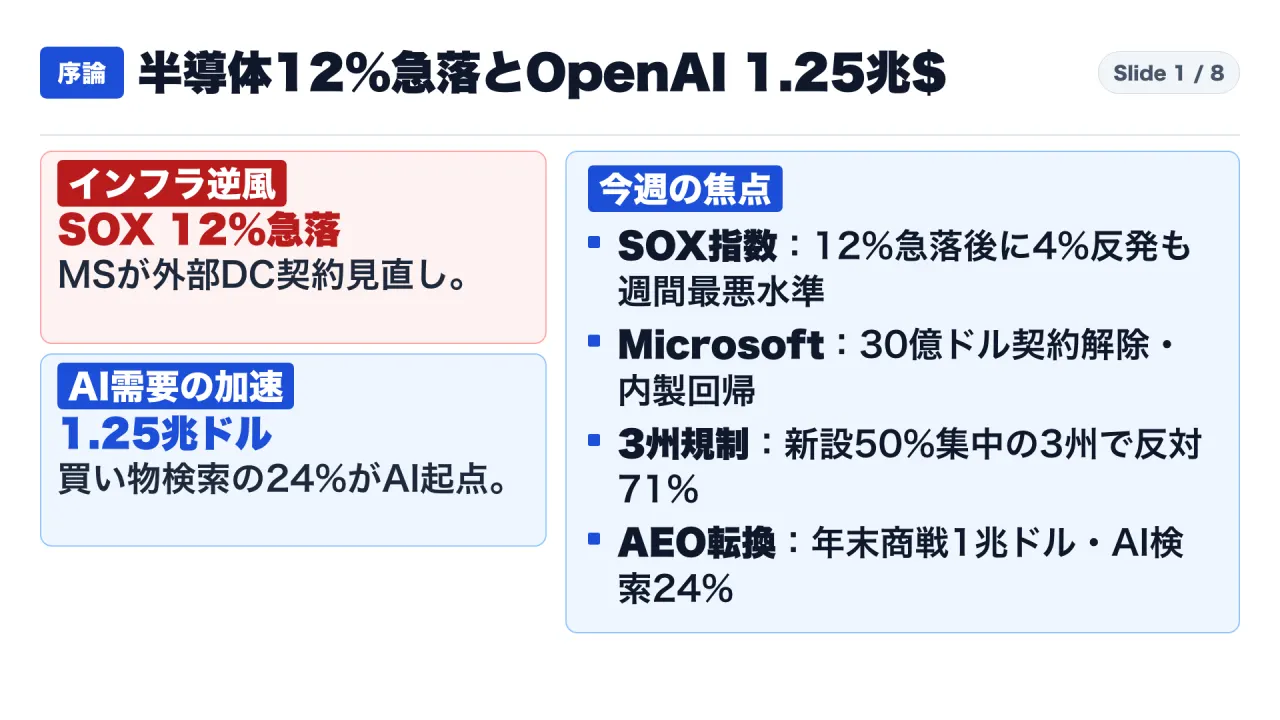
On one side, public markets experienced their most volatile contraction since the global tariff adjustments of April 2025. The SOX Index plunged 12.25% in a single session before mounting a 4% rebound, leaving the S&P 500 down 2.6% on the week and the Nasdaq 100 down 5.0%. Trading volume reached historic highs as volatility measures spiked, with the CBOE Volatility Index (VIX) reaching 28 before settling in the 24–25 range.
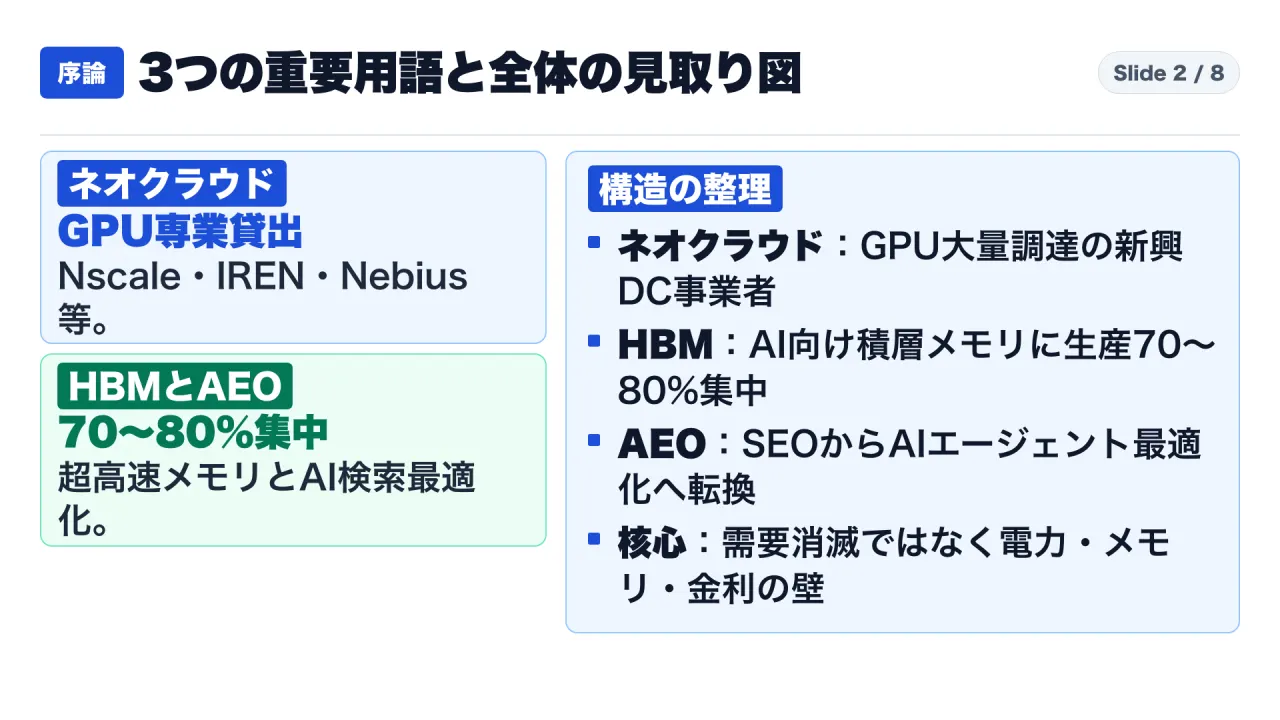
On the other side, private capital continued to concentrate into market-leading foundation model labs:
- OpenAI Capital Influx: OpenAI closed the initial $11.0 billion tranche of its latest funding round at a post-money valuation of $1.25 trillion ($1,250 billion). While adjusted downward from earlier speculative targets of $1.4 trillion, the round represents one of the largest private equity commitments in corporate history.
- Anthropic Public Listing: Concurrently, Anthropic filed its Form S-1 registration statement with the US SEC, positioning for a public listing under ticker
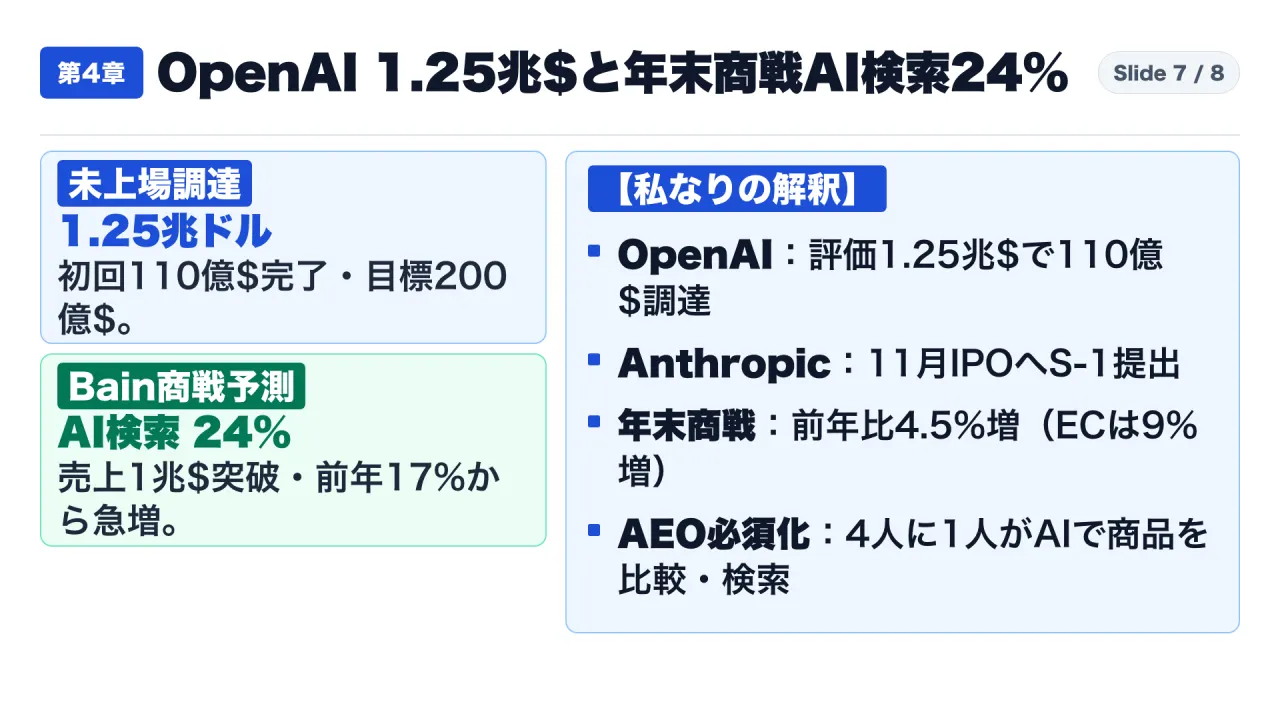
ANTtargeting an enterprise valuation between $1.1 trillion and $1.75 trillion. - Consumer Adoption in Commerce: Consumer utilization metrics expanded in parallel. Bain & Company’s annual holiday retail study projected that US holiday retail sales will surpass $1.0 trillion for the first time (+4.5% year-over-year). Crucially, 24% of digital shoppers—nearly one in four consumers—reported beginning product research and gift comparisons inside conversational AI tools, up from 17% in 2025.
2. Wall 1: The Silicon & Supply Chain Squeeze (SOX -12.25%, Microsoft Neo-Cloud Discipline, HBM 80% Cannibalization)
The sharp liquidation in public equities was initiated by institutional portfolio repositioning and corporate procurement adjustments from Microsoft.
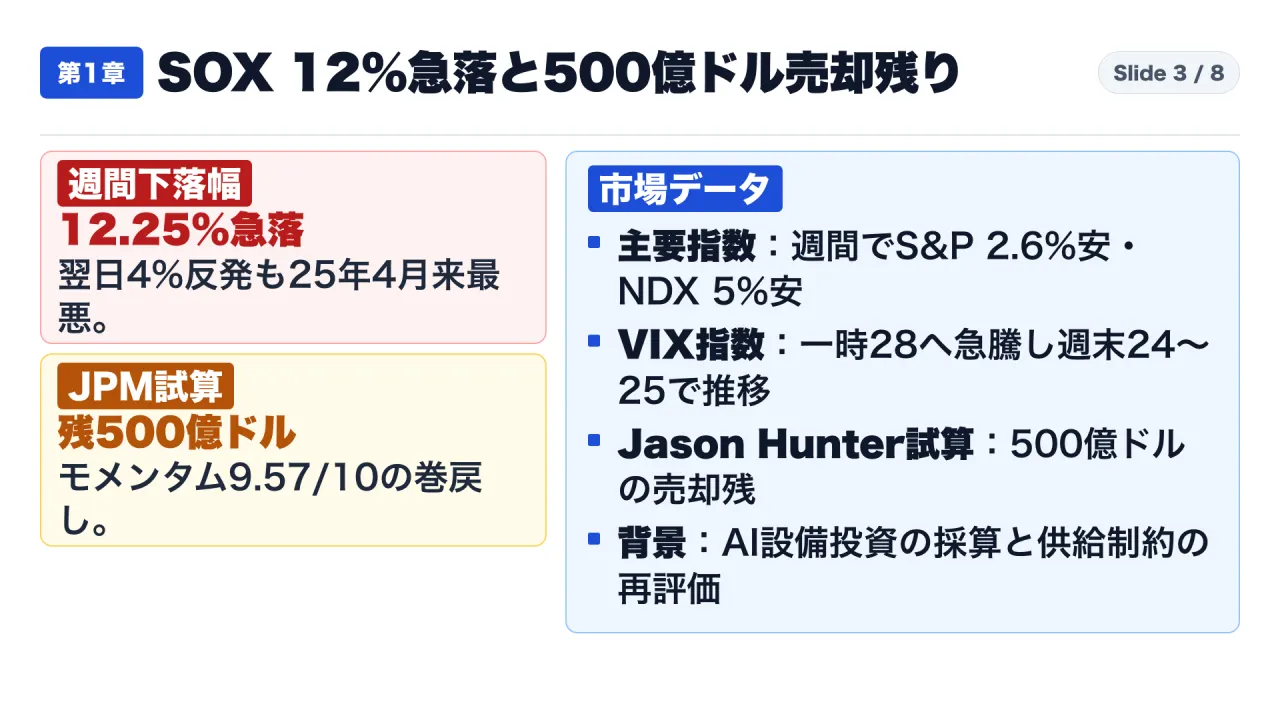
The $50 Billion Momentum Overhang
According to institutional positioning models from JPMorgan technical strategist Jason Hunter, quantitative momentum indicators tracking AI infrastructure equities reached an extreme reading of 9.57 out of 10.0 immediately prior to the liquidation. As macroeconomic indicators reduced expectations for aggressive Federal Reserve interest rate cuts, systematic trend-following strategies and multi-strategy hedge funds began mechanical risk reductions. Prime brokerage models estimated that institutional funds carried approximately $50.0 billion in remaining equity overhang slated for phased liquidation across market rallies.
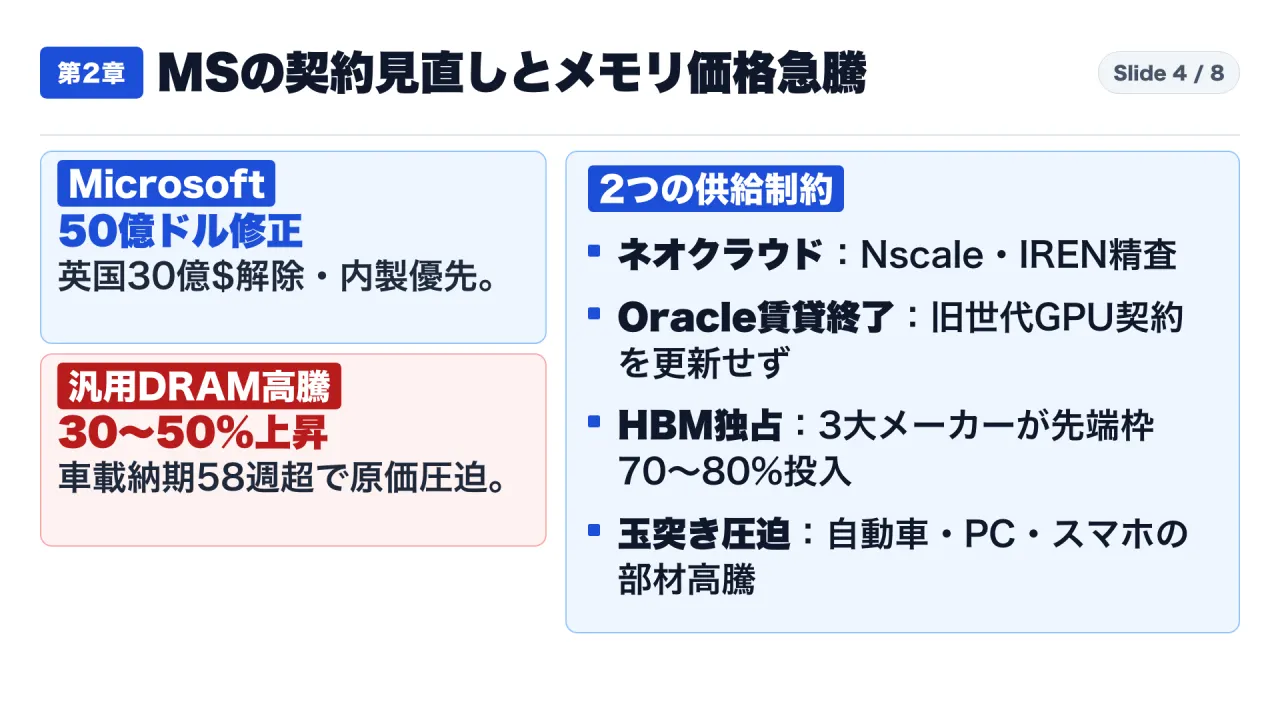
Microsoft’s Neo-Cloud Procurement Audit
The catalyst converting systematic market weakness into sector-wide repricing was Microsoft’s operational shift regarding specialized third-party GPU cloud providers (“neo-clouds”):
- Nscale Contract Termination: Microsoft stepped away from a planned $3.0 billion GPU capacity agreement with UK-based operator Nscale, declining options to double capacity in Texas due to construction timeline slippage, grid interconnection delays, and uncompetitive pricing terms.
- Capex Downward Adjustment: Microsoft trimmed $5.0 billion from its forward capital expenditure budget, signaling that unconstrained external leasing of GPU capacity had ended in favor of strict capital discipline.
- Phasing Out Legacy Leases: Microsoft opted not to renew long-term leases on Oracle Cloud infrastructure utilized since 2023, which relied on older-generation NVIDIA accelerators that no longer satisfied current efficiency and throughput standards.
This was not a reduction in Microsoft’s internal AI ambitions, but a transition toward internal manufacturing and infrastructure control: shifting capital into dedicated first-party campuses and proprietary silicon (such as the Maia accelerator series).
The 80% HBM Allocation and the Non-AI Memory Shock
Simultaneously, the semiconductor hardware supply chain experienced severe cross-industry distortion. Analysis from AllianceBernstein equity strategist Nelson Yu demonstrated that the memory industry’s singular focus on AI accelerators is destabilizing non-AI manufacturing:
| Memory Category | Primary Applications | Market Conditions (November 2026) | Industrial Supply Chain Impact |
|---|---|---|---|
| High Bandwidth Memory (HBM3E / HBM4) & Server DDR5 | AI training and inference accelerators (NVIDIA Blackwell, AMD MI350) | SK Hynix, Samsung, and Micron allocated 70% to 80% of advanced wafer capacity to HBM. Production capacity is effectively sold out through 2027 under long-term agreements (LTAs). | Hyperscalers and tier-1 accelerator manufacturers absorb nearly all advanced production output. |
| Standard Commodity DRAM (DDR4 / LPDDR4 / Legacy DDR5) | Automotive systems (ADAS, digital cockpits), commercial PCs, industrial controls | Production capacity de-prioritized to retool cleanrooms for HBM packaging. Spot market prices rose 30% to 50% above contract rates. | Automotive memory lead times extended past 58 weeks, compressing profit margins for automotive suppliers and consumer hardware manufacturers. |
3. Wall 2 & 3: Electoral Backlash and Macro Interest Rates (3 States Holding 50% of Buildout, 71% Public Opposition, 4.85% Treasury Yield)
The second and third structural barriers limiting AI expansion center on physical geography and the macroeconomic cost of capital.
Geographic Concentration in Three States
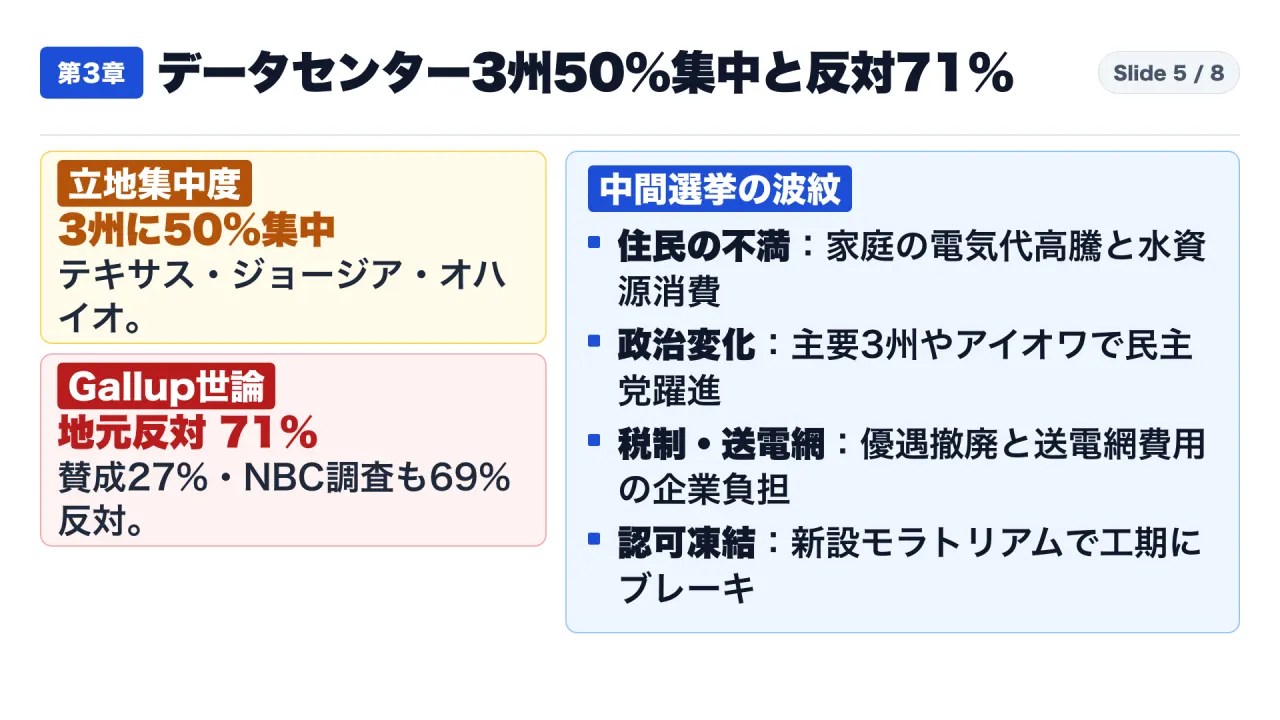
Research from Baird Strategies established that physical data center construction in the United States is dangerously concentrated: 50% of all newly planned data center facilities (and approximately 39% to 40% of planned power capacity) are located in just three states: Texas, Georgia, and Ohio.
Developers clustered in these regions to leverage historically low electricity tariffs, fast-track permitting, and municipal property tax incentives. However, this hyper-concentration triggered severe local political resistance:
- 71% National Opposition: A national opinion survey conducted by Gallup (corroborated by NBC News at 69%) found that 71% of American adults oppose the construction of AI data centers in their local communities, while only 27% expressed support.
- Root Drivers of Resistance: Opposition is driven by immediate quality-of-life concerns: residential electricity bills increasing as utilities pass transmission upgrade costs onto the rate base; heavy water withdrawal for evaporative cooling towers in drought-prone regions; and continuous low-frequency acoustic noise from cooling equipment and diesel backup generators.
- Midterm Electoral Repercussions: In the November 2026 midterm elections, voters across key data center corridors in Texas, Georgia, Ohio, and Iowa elected state and municipal officials who campaigned on utility rate protection and data center moratoriums. Consequently, legislative proposals emerged targeting the elimination of tax incentives, imposing mandatory water recycling, and requiring technology operators to fund 100% of grid interconnection costs.
The Macroeconomic Hurdle: 10-Year Yields at 4.85%
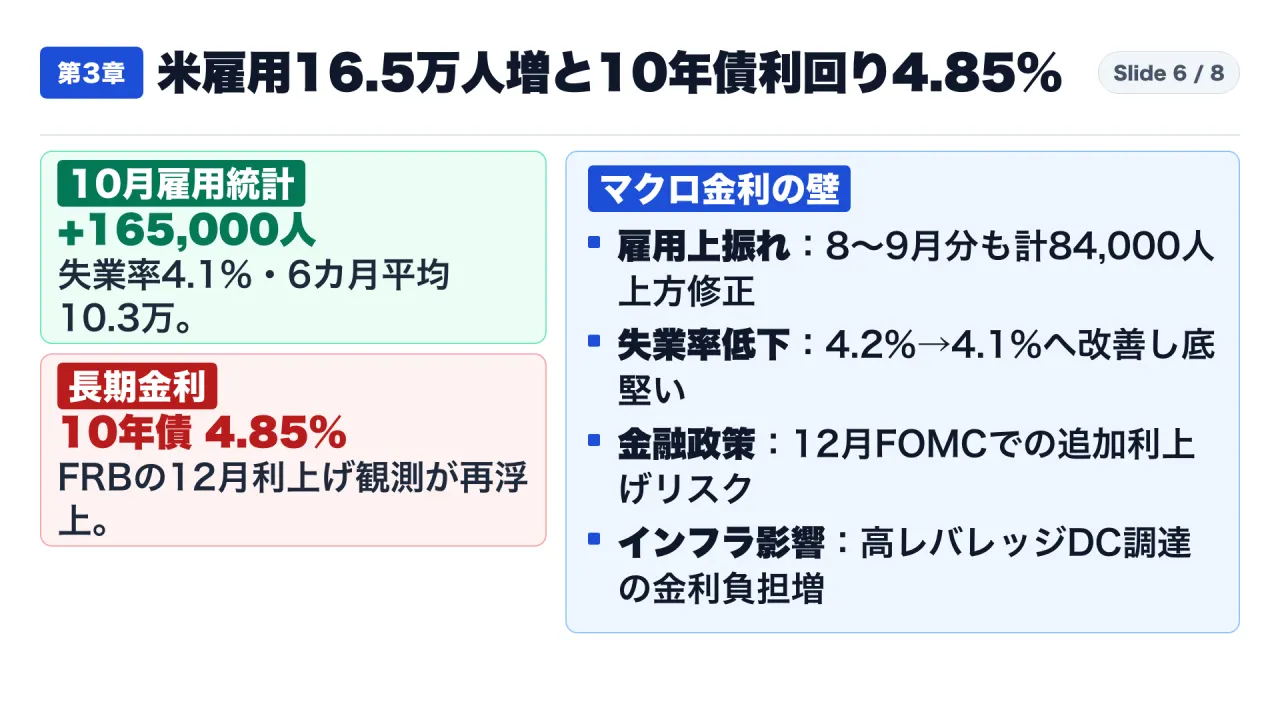
Compounding infrastructure friction is the macroeconomic interest rate environment. On November 6, 2026, the US Bureau of Labor Statistics released its October employment report, showing an unexpectedly robust economy:
- Nonfarm Payrolls: Expanded by +165,000 jobs, far exceeding the six-month average of 103,000, accompanied by net upward revisions of 84,000 jobs for August and September.
- Unemployment Rate: Edged down to 4.1% (from 4.2%).
- Benchmark Yields: Persistent labor market strength and sticky underlying inflation kept benchmark 10-year US Treasury yields anchored near 4.85%.
Sustained high interest rates significantly increase debt financing costs for capital-intensive neo-cloud providers. Building a multi-gigawatt data center requires billions in upfront debt financing; at a 4.85% risk-free rate, debt service costs compound, eliminating operating margins for providers that leased hardware at peak market rates.
4. The Consumer Pivot: The $1 Trillion Holiday Shopping Season and the Rise of AEO (AI Engine Optimization)
While physical infrastructure providers navigate grid delays and financing hurdles, consumer behavior is executing a rapid transition that is reshaping enterprise digital commerce.
Bain & Company Holiday Retail Projections
Bain & Company’s forecast for the 2026 US holiday retail season (November through December) provides quantitative proof of this operational shift:
| Holiday Retail Metric | 2026 Projected Performance | Context & Strategic Implications |
|---|---|---|
| Total US Holiday Retail Sales | Exceeds $1.0 Trillion (Historic Record) | Up +4.5% year-over-year. More than half of nominal sales growth is driven by retail price inflation, with physical unit volumes remaining roughly flat. |
| Cyber Week Four-Day Peak Digital Sales | +9.0% year-over-year | Significantly outpaces physical brick-and-mortar store sales growth (+2.5%), with digital channels driving approximately 60% of total holiday growth. |
| Share of Online Shoppers Initiating via Conversational AI | 24% of all online consumers | Up from 17% in 2025 (a 7-percentage-point expansion in 12 months). An additional 13% of shoppers plan to utilize retailer-specific autonomous shopping agents. |
The Collapse of Traditional Search Engine Optimization (SEO)
For three decades, commercial customer acquisition relied on Search Engine Optimization (SEO): designing web pages to capture algorithmic search rankings across a page of ten blue links.
The Bain findings prove that traditional SEO is losing its gatekeeper status. When 24% of online consumers begin product exploration by querying a conversational AI engine—such as ChatGPT, Claude, or Perplexity—the consumer does not see a search results page. Instead, the language model synthesizes an authoritative summary, directly recommending three specific products while citing source documents. A brand relying on decorative marketing graphics, unstructured promotional text, or paid ad placements is effectively invisible to the underlying AI agent.
This transition demands AI Engine Optimization (AEO): structuring enterprise content so that large language models and autonomous purchasing agents can parse, verify, and cite products accurately.
5. Strategic Action Plan for Technical & Business Leaders
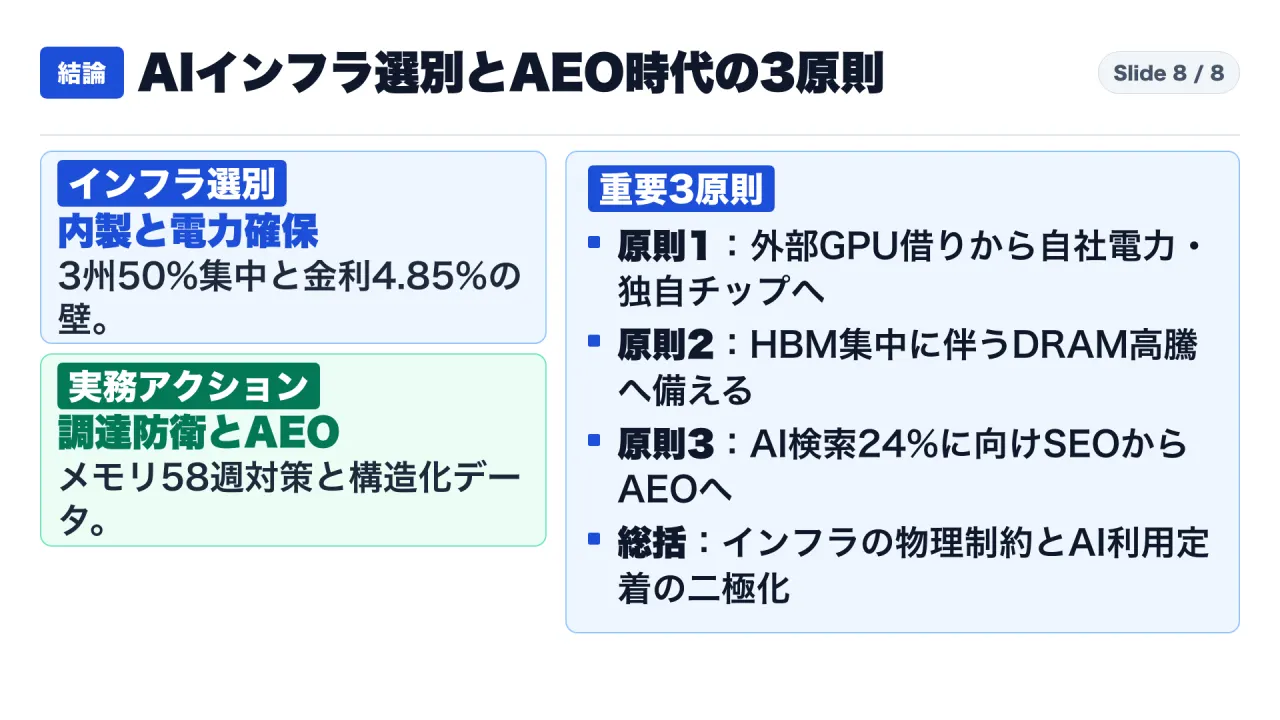
The divergence between public infrastructure equities and software adoption requires technology leaders and corporate strategists to execute three operational countermeasures:
1. Re-Evaluate Cloud Architecture Counterparties
Do not treat compute capacity as an undifferentiated commodity:
- Audit the underlying power and physical site delivery schedules of secondary neo-cloud vendors. A vendor advertising thousands of GPUs cannot deliver services if their data center in Texas or Ohio lacks energized utility connections.
- Shift mission-critical enterprise workloads toward hyperscalers that maintain dedicated, first-party infrastructure and secured power agreements, minimizing operational dependency on leveraged intermediaries.
2. Implement Hardware and Memory Procurement Defenses
Anticipate structural cost inflation across enterprise IT hardware throughout 2027:
- As memory foundries allocate 70% to 80% of cleanroom capacity to HBM, standard DRAM and NAND pricing will remain elevated.
- Corporate procurement officers must lock in forward component supply contracts for enterprise laptops, on-premise servers, and embedded hardware, mitigating lead times that currently stretch past 58 weeks in automotive and industrial sectors.
3. Transition Digital Presence from SEO to AEO (AI Engine Optimization)
With roughly one-quarter of digital consumers utilizing AI agents for commercial discovery, commercial enterprises must re-architect their public web footprint:
- Deploy Machine-Readable Schemas: Ensure all product specifications, pricing models, inventory levels, compatibility requirements, and warranty terms are encoded using standard JSON-LD and Schema.org semantic metadata.
- Publish Objective Comparison Tables: AI agents prioritize structured tabular data when synthesizing recommendations. Provide explicit comparison matrices detailing technical dimensions, operational limitations, and verified benchmark scores.
- Eliminate Text-as-Image Assets: Replace promotional image banners with clean, semantic Markdown and HTML text that web-scraping AI agents can index and cite directly.
Sources
- Bloomberg Market Analysis, “SOX Rebounds 4% After 12.25% Plunge as Microsoft Reviews Neocloud Contracts and JPMorgan Warns of $50B Overhang”: https://www.bloomberg.com/news/articles/2026-11-07/sox-rebounds-4-percent-after-12-percent-plunge-microsoft-neocloud-review
- Gallup & Baird Strategies, “71% Local Opposition to AI Data Centers and Texas, Georgia, Ohio 50% Buildout Bottleneck Post-2026 Midterms”: https://news.gallup.com/poll/2026/americans-oppose-local-ai-data-centers-midterm-impact.aspx
- AllianceBernstein Equity Research, “Memory Price Surge: How the 70-80% HBM Shift Squeezes Automotive and Consumer Supply Chains”: https://www.alliancebernstein.com/corporate/en/insights/2026/11/memory-price-surge-hbm-shift-squeezes-auto-consumer-supply-chains.html
- US Bureau of Labor Statistics (BLS), “The Employment Situation — October 2026”: https://www.bls.gov/news.release/empsit.nr0.htm
- Reuters Business News, “OpenAI Closes Initial $11B Tranche at $1.25 Trillion Valuation as Anthropic Prepares November IPO”: https://www.reuters.com/technology/artificial-intelligence/openai-1-25-trillion-valuation-first-close-anthropic-ipo-2026-11-07/
- Bain & Company, “U.S. Holiday Retail Sales to Top $1 Trillion (+4.5% YoY) as 24% of Online Shoppers Start Searches on AI Platforms”: https://www.bain.com/about/media-center/press-releases/2026/us-holiday-retail-sales-to-top-1-trillion-ai-shopping-surges/
This article analyzes primary technical and financial disclosures for informational purposes only and does not constitute investment advice.