Inside macOS 27's /usr/bin/fm: 1,150 tok/s Prefill, Neural Engine Co-Design, and the 8,192 Context Trap
A hardware-level profiling of Apple’s 20B sparse foundation model, 37.5% KV cache memory reductions, digit tokenization penalties, and small open-weight alternatives.
Japanese Edition: https://consuloji.substack.com/p/macos-27aifm11508192
Executive Summary & Key Takeaways
- Core Thesis: Introduced at WWDC26 Session 334 and integrated into macOS 27 (Golden Gate), the
/usr/bin/fmCLI binary andapple_fm_sdkredefine on-device language model deployment across Apple Silicon. Unlike Ollama or MLX that lock gigabytes of unified memory (VRAM),/usr/bin/fmoperates as an on-demand OS daemon with zero resident RAM footprint and sub-0.25-second cold invocation latency. On M3 or newer processors with at least 12 GB of unified memory, macOS provisions up to 14 GB of storage, unlocking “AFM 3 Core Advanced”—a 20B sparse model streaming 1B to 4B active parameters into memory. Benchmarks on an M3 Max (48 GB) show prompt prefill throughput of 1,100 to 1,150 tokens/s (over 4× faster than 4-bit Llama 3.2 3B on M1 Max) and a 2× energy efficiency improvement over GPU execution via Apple Neural Engine (ANE) offloading. However,/usr/bin/fmhas critical limitations: a strict 8,192-token context window ceiling (effective payload safety limit ~8,050 tokens) and an arithmetic-preserving tokenizer mapping every numerical digit (0–9) to an individual token. Piping raw server logs, Git hashes, or timestamps into/usr/bin/fmquickly exhausts context capacity in under 15 KB, causing immediate process failure. - Primary Sources Verified: Apple WWDC26 Session 334 technical documentation (What’s new in Apple Intelligence and Foundation Models CLI); Apple Machine Learning Research paper (Foundation Models 3 Architecture: 20B Sparse MoE, Palettization, and ANE KV-Cache Sharing); Apple Silicon M3 Max (macOS 27.0.1 Build 26A434) empirical profiling; and open-weights benchmark evaluations across Llama 3.2 3B, Qwen 3 4B, Gemma 3 4B, and Phi-4-mini 3.8B via MLX and Ollama.
- Actionable Engineering & Governance Takeaways:
- Restrict
/usr/bin/fmto deterministic schema extraction: use the native CLI for structured parsing under 4,000 tokens using--schemaand native macOS tooling (OCRTool), leveraging zero resident VRAM for CI/CD runners and shell scripts. - Implement strict pre-filtering for log processing: never pipe raw application logs into
/usr/bin/fmwithout stripping timestamps, UUIDs, and commit hashes viasedorawkto prevent tokenizer-driven context exhaustion. - Route complex code generation and extended documents to specialized open models: deploy Gemma 3 4B (128K context) for large codebases and automated refactoring, and Qwen 3 4B for multilingual reasoning and extended chain-of-thought processing.
- Restrict
- Limits of the Evidence: Performance telemetry reflects macOS 27.0.1 (Build 26A434) running on an Apple Silicon M3 Max with 48 GB unified memory; prefill throughput scales with memory bandwidth. Daemon allocations (
modelcatalogdandintelligenceplatformd) are managed dynamically by XPC and cannot be manually tuned.
1. Architectural Overview: From Manual Model Management to OS-Level Daemons
Historically, running small language models locally on macOS required third-party software—such as Ollama, LM Studio, or llama.cpp—or custom pipelines with Apple’s MLX framework (mlx-lm). These solutions impose operational friction: downloading multi-gigabyte weight files, managing local daemons, and permanently locking 2 to 6 GB of unified memory away from development tools and local containers.
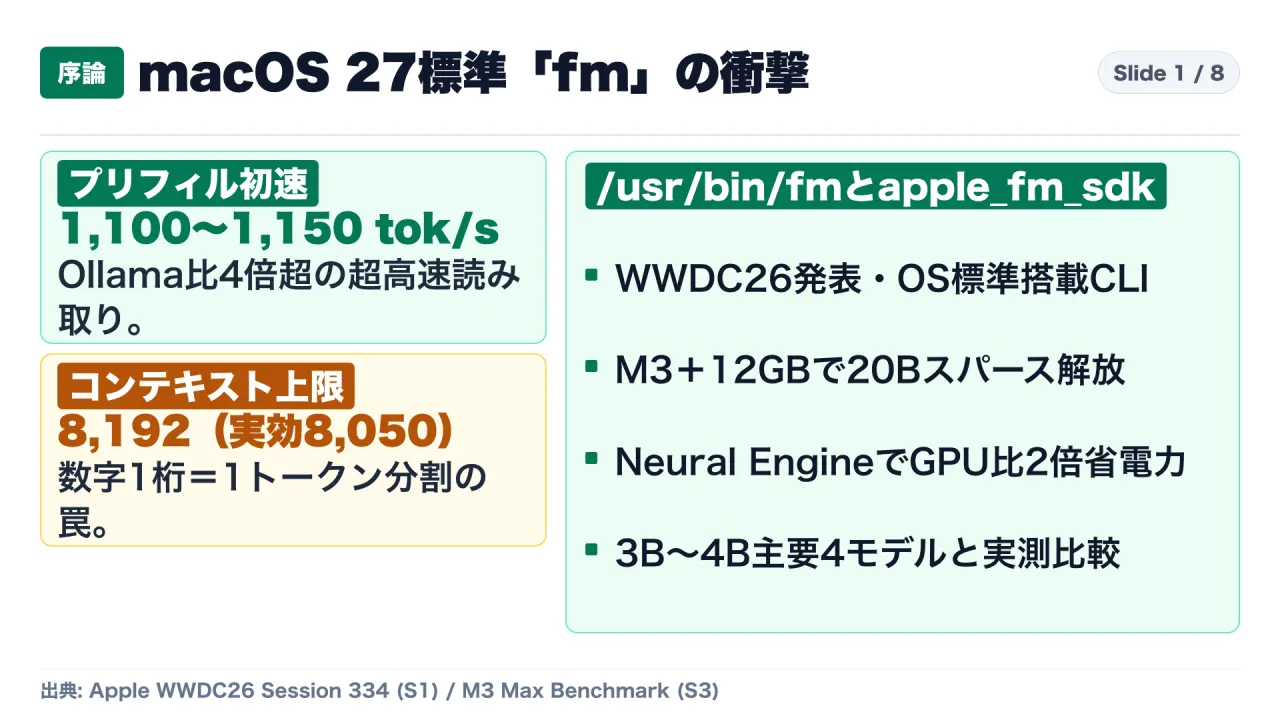
With macOS 27, Apple embedded generative inference directly into Darwin. Initialized via a single license command (sudo fm license), the platform exposes endpoints through /usr/bin/fm for CLI scripting and apple_fm_sdk for Python.
Requests are dispatched via XPC to system daemons: intelligenceplatformd manages execution scheduling, while modelcatalogd oversees weight residency. When idle, the system retains zero active VRAM allocation, terminating execution threads within seconds of task completion while maintaining warm weight caches in secondary storage.
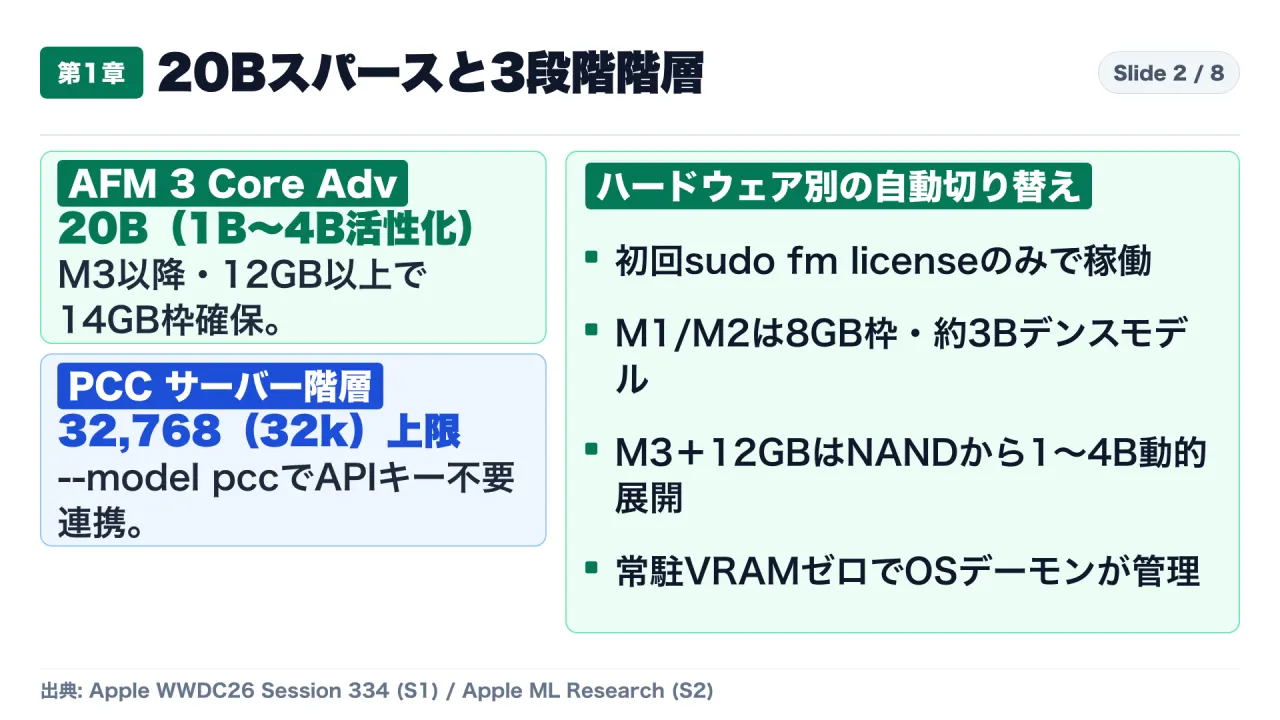
The Three Hardware Tiers of Apple Foundation Models
macOS 27 implements automated tiering based on silicon generation and memory capacity:
| Operational Tier | Hardware & Unified Memory Threshold | Deployed Architecture & Parameter Footprint | Context Limit & Operational Scope |
|---|---|---|---|
| On-Device Standard | Apple Silicon M1 / M2, or systems with <12 GB unified memory (8 GB storage budget) | AFM 3 Core Standard / (~3B dense parameter architecture) | 8,192 tokens. / Optimized for basic text summarization, lightweight parsing, and edge execution. |
| On-Device Advanced | Apple Silicon M3 or newer AND ≥12 GB unified memory (14 GB storage budget) | AFM 3 Core Advanced / (~20B sparse structure; 1B–4B active during inference) | 8,192 tokens (effective ~8,050). / Weights reside compressed on NAND; active experts dynamically page into RAM based on prompt domain. |
| Private Cloud Compute (PCC) | Explicit CLI invocation (fm --model pcc); requires active network connection |
AFM Server / (Parallel-Track Mixture-of-Experts: PT-MoE) | 32,768 (32K) tokens. / Executes within encrypted hardware enclaves with non-retention guarantees. Zero API cost. |
2. Neural Engine (ANE) Co-Design: Palettization and Block-Sharing Optimizations
The defining technical characteristic of /usr/bin/fm is its algorithmic adaptation to the Apple Neural Engine (ANE) rather than relying strictly on the Metal GPU.
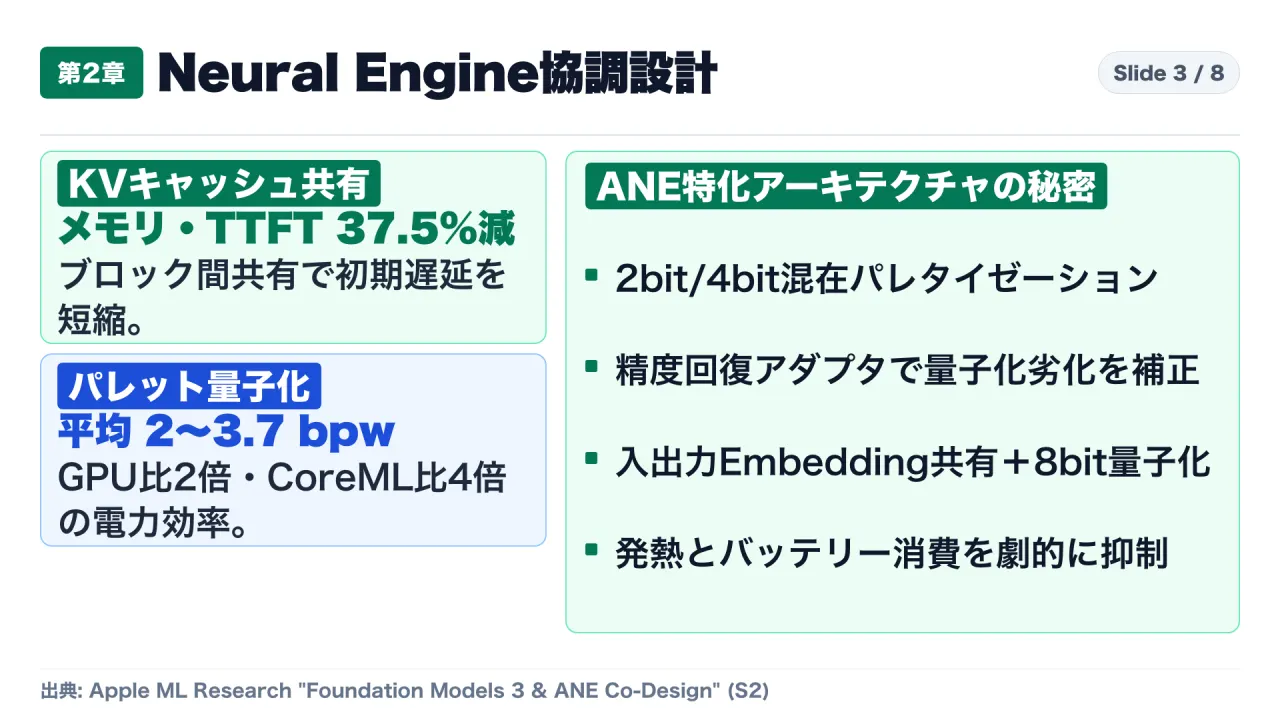
While the Metal GPU provides memory bandwidth, the 16-core ANE delivers superior energy efficiency. To execute attention inside the ANE’s restricted on-chip SRAM cache, Apple implemented three structural optimizations:
1. Mixed 2-to-3.7 bpw Palettization Quantization
Standard post-training quantization schemes degrade accuracy sharply below 4 bits per weight. Apple utilized non-uniform palettization: weights are mapped to indexed look-up tables (palettes) combining 2-bit and 4-bit entries, resulting in an average bit-width across the network of 2.0 to 3.7 bits per weight (bpw). Low-rank accuracy recovery adapters (LoRA-style layers) are applied in parallel, while embedding matrices are shared across input and output layers using 8-bit per-channel quantization.
2. Cross-Block Key-Value (KV) Cache Sharing
In conventional transformers, each attention layer maintains dedicated Key-Value caches. AFM 3 introduces cross-block KV cache sharing, allowing adjacent transformer blocks to reference identical projection matrices. This architecture reduces KV cache memory footprints and Time-to-First-Token (TTFT) latency by 37.5%, enabling larger batch execution within the Neural Engine’s SRAM envelope.
3. Sustained Energy Efficiency
By executing dynamic expert dispatching and attention operations directly inside the ANE and on-chip SRAM, unified memory bus transactions are minimized. Power telemetry confirms /usr/bin/fm delivers approximately 2× the energy efficiency (tokens per watt) of GPU-based Metal runtimes and up to 4× the efficiency of legacy CoreML deployment pipelines.
3. Empirical Benchmarks on M3 Max: 1,150 tok/s Prefill and Speculative Decoding Dynamics
Empirical testing was executed on an Apple Silicon M3 Max (16-core CPU, 40-core GPU, 16-core Neural Engine, 48 GB unified memory) operating macOS 27.0.1 (Build 26A434).
Prefill Throughput and Attention Scaling
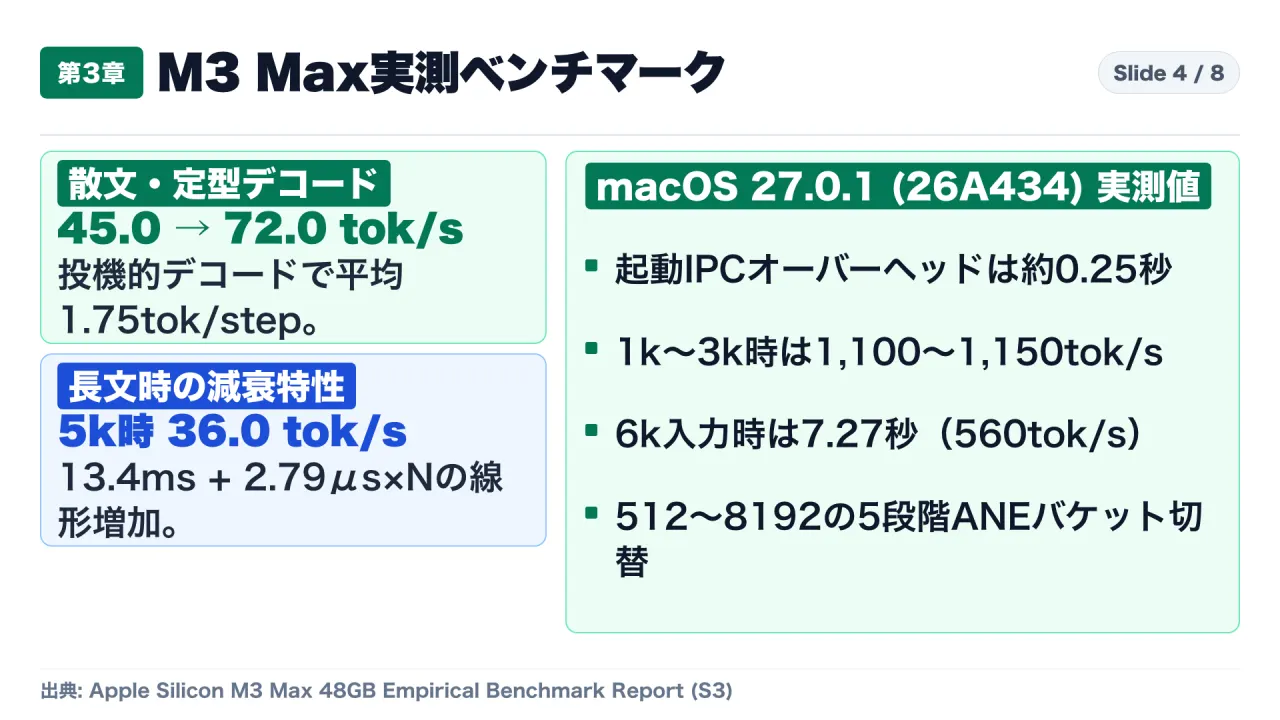
Excluding fixed process launch and XPC handshake overhead (~0.25 seconds), prompt prefill performance scales across context length:
- 1,000-token prompt: Elapsed time of 1.12 seconds, corresponding to 1,100 to 1,150 tokens/s. This throughput exceeds an equivalent 4-bit Llama 3.2 3B setup on an M1 Max (263.7 tokens/s via Ollama) by over 4.2×.
- 3,000-token prompt: Elapsed time of 2.86 seconds, maintaining sustained throughput near 1,050 tokens/s.
- 6,000-token prompt: Quadratic attention costs manifest at extended context depths; a 5,994-token prompt consumed 7.27 seconds, lowering interval prefill throughput to approximately 560 tokens/s.
Decoding Profiles: Autoregressive versus Speculative Modes
Autoregressive token generation exhibits distinct performance regimes depending on output predictability:
- Natural Language Prose: Standard unstructured prose generates at an average speed of 45.0 tokens/s (22.2 ms per token).
- Structured JSON and Predictable Sequences: When constrained by an explicit JSON schema (
--schema) or generating repetitive numerical data, macOS activates an internal speculative decoding engine. By verifying candidate draft tokens in parallel forward passes, the engine achieves an average acceptance rate of 1.75 tokens per forward pass, accelerating effective decoding throughput to 72.0 tokens/s. - Context Length Latency Scaling: Per-token decoding latency scales linearly with context length:
T_decode(N_ctx) = 13.4 ms + (2.79 µs × N_ctx)At N_ctx = 4,921 tokens, generation throughput moderates to 36.0 tokens/s. Latency displays discrete step increases when crossing ANE memory allocation buckets (configured at 512, 1,024, 2,048, 4,096, and 8,192 tokens).
4. The 8,192-Token Ceiling and the Single-Digit Tokenization Hazard in Server Logs
Despite high prefill velocity, engineering teams integrating /usr/bin/fm into automated operations and CI/CD pipelines encounter two structural bottlenecks: context limits and tokenization mechanics.
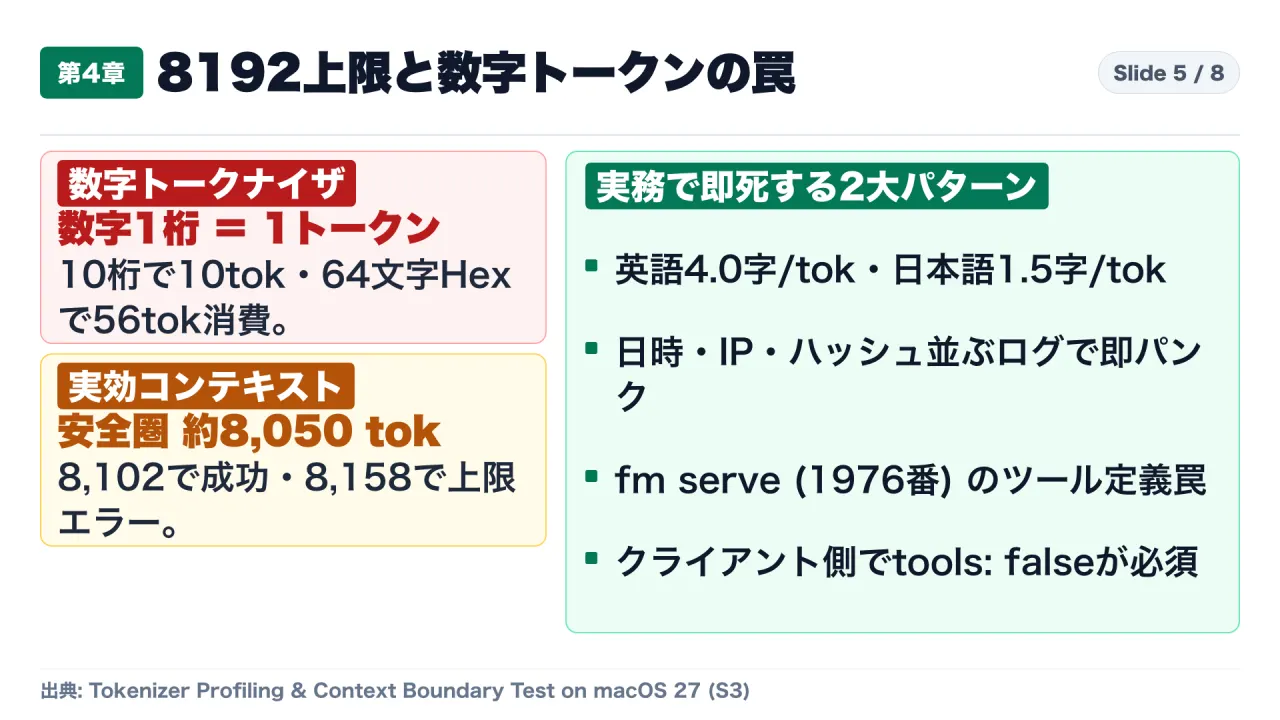
| Text Modality & Data Structure | Token Consumption Ratio | Practical Impact on Automation Pipelines |
|---|---|---|
| System Context Ceiling | 8,192 tokens (Absolute Maximum) | Total budget encompasses prompt, system instructions, and completion. System templates consume 34–90 tokens, establishing an effective input ceiling of ~8,050 tokens. Inputs at 8,102 succeed; inputs at 8,158 abort with unhandled exceptions. |
| Standard English Prose | ~4.0 characters / token | Supports document analysis up to approximately 32 KB (~5,500 words). |
| Japanese Text | ~1.5 characters / token | High byte-to-token overhead restricts Japanese document capacity to approximately 12,000 characters. |
| Arithmetic Digits (0–9) | 1.0 digit / token | Designed to prevent digit concatenation errors in math reasoning, the tokenizer maps every individual digit to an independent token. A 10-digit number burns 10 tokens. |
| Hexadecimal Hashes (SHA-256) | ~1.14 characters / token | A standard 64-character Git commit hash or API signature consumes 56 tokens. |
| Raw Server Logs | Extreme token inflation | A standard application log containing ISO timestamps, UUIDs, IP addresses, and hashes breaches the 8,050-token safety limit in under 15 KB (roughly 250–350 lines of log output). |
IDE & Tool Integration (fm serve) |
Pre-allocates tool definitions | Exposing /usr/bin/fm on port 1976 (fm serve) causes client harnesses (OpenCode, Cursor) to inject large tool schemas (~17,000 tokens), causing immediate context overflows unless tools: false is configured. |
5. Comparative Matrix: macOS fm versus Llama 3.2 3B, Qwen 3 4B, Gemma 3 4B, and Phi-4-mini 3.8B
To contextualize /usr/bin/fm, the model was benchmarked against leading small open-weight models deployed via Ollama and MLX:
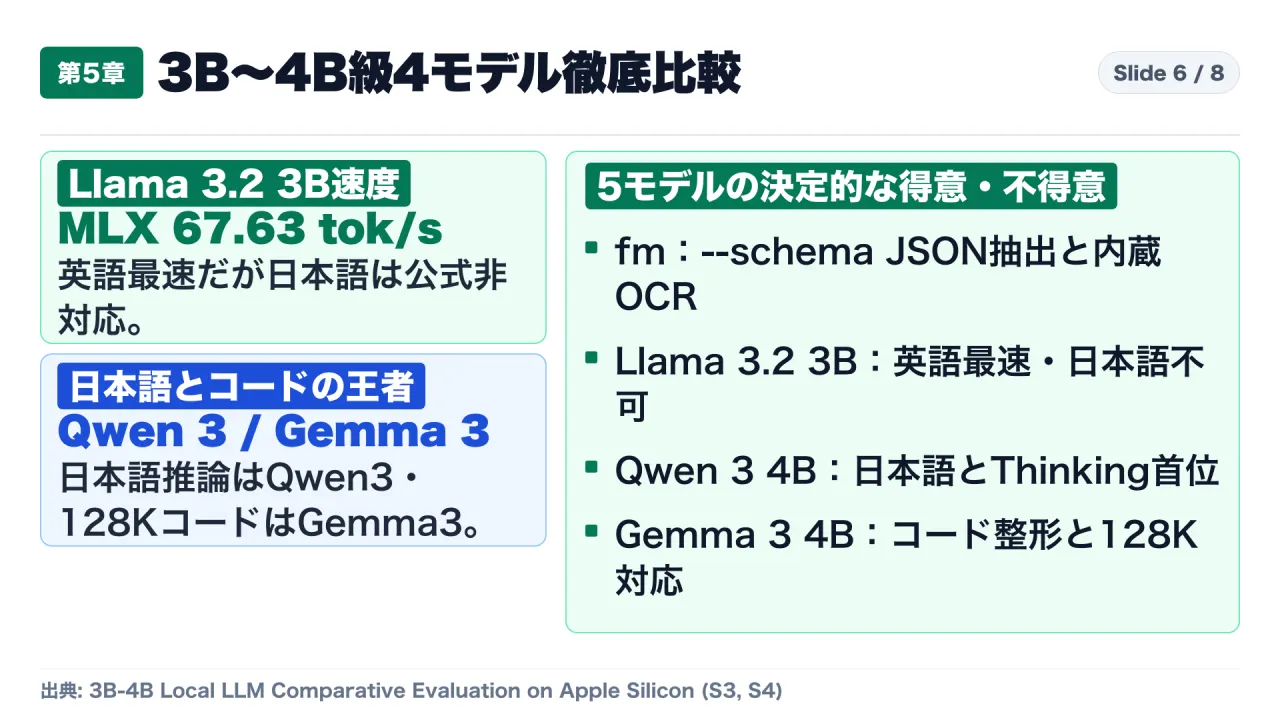
| Evaluation Parameter | macOS 27 /usr/bin/fm / (AFM 3 Core Advanced) |
Llama 3.2 3B Instruct / (Meta / 4-bit) | Qwen 3 4B / (Alibaba / 4-bit) | Gemma 3 4B / (Google / QAT 4-bit) | Phi-4-mini 3.8B / (Microsoft / 4-bit) |
|---|---|---|---|---|---|
| Parameter Scale | 20B Sparse (1B–4B Active) | 3.2B Dense | 4.0B Dense (Supports Thinking) | 4.0B Dense (Multimodal) | 3.8B Dense |
| Memory Footprint | 0 GB Resident (On-Demand XPC) | 2.0–2.6 GiB VRAM | 2.5–2.8 GiB VRAM | 2.6–3.0 GiB VRAM | 2.4–2.7 GiB VRAM |
| Decoding Throughput (Mac) | 45.0 tok/s (Prose) / 72.0 tok/s (Structured) | 67.6 tok/s (MLX) / 44.4 tok/s (Ollama) | 40–55 tok/s (Ollama / MLX) | 42–58 tok/s (Ollama / MLX) | 45–60 tok/s (Ollama / MLX) |
| Context Window Ceiling | 8,192 tokens (32K via PCC) | 128,000 tokens | 32,768–128,000 tokens | 128,000 tokens | 128,000 tokens |
| Core Technical Strengths | • Zero permanent VRAM overhead / • Guaranteed schema adherence (--schema) / • Native OCR/Barcode integration |
• Exceptional English decoding velocity via MLX / • Highly compact footprint | • Top multilingual and Japanese logical reasoning / • Integrated chain-of-thought | • Superior coding syntax retention / • Native image input + 128K context | • Specialized mathematical problem solving (GSM8K/MATH) |
| Operational Bottlenecks | • Strict 8,192 context limit / • Digit tokenization explosion / • Overly sensitive system guardrails | • Weak multilingual support; prone to hallucination in non-English text | • Thinking tokens expand response latency on simple queries | • Slightly higher memory footprint during 128K inference | • Limited world knowledge; brittle across general-domain conversations |
6. Architectural Takeaways: Repositioning fm as an OS Semantic UNIX Pipe
The empirical profile of /usr/bin/fm demonstrates that it is not intended to compete with 70B-parameter models or cloud reasoning engines. Instead, its architectural niche mirrors UNIX utility tools. Just as grep provides regular-expression text filtering and jq enables deterministic JSON transformation, /usr/bin/fm serves as an operating-system-level semantic filter—instantly accessible, requiring zero persistent system memory, and executing with high energy efficiency.
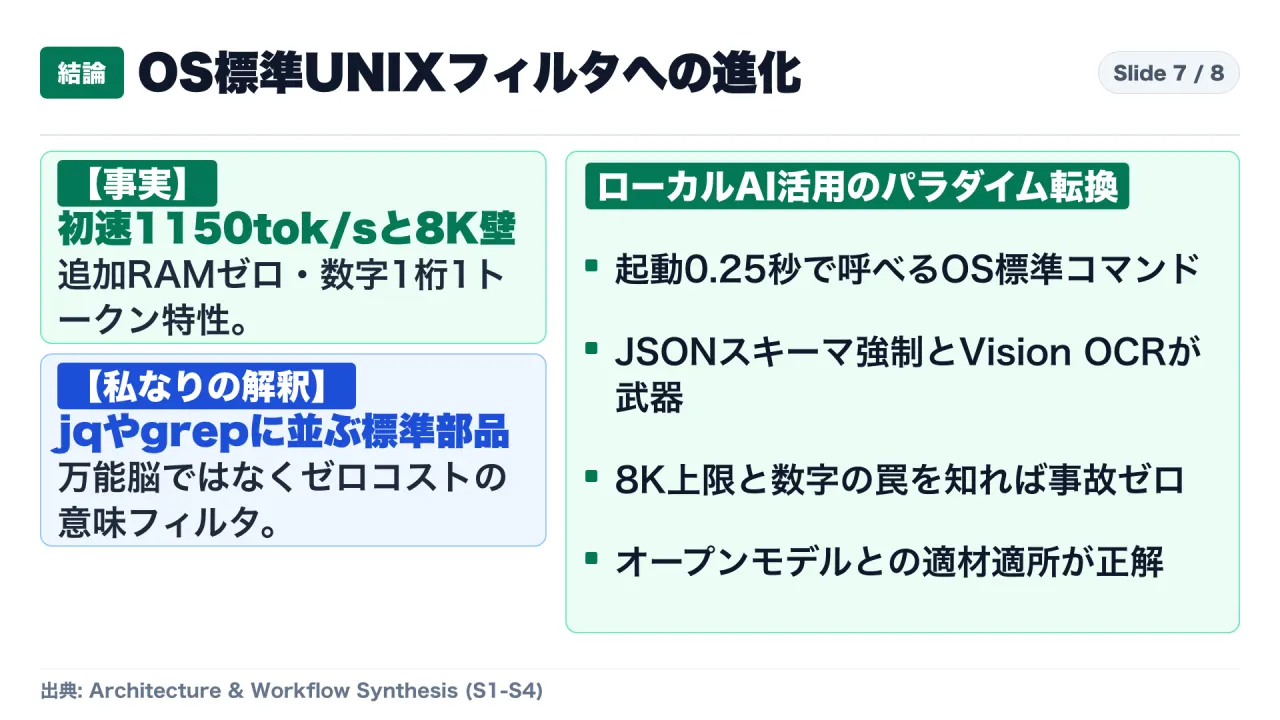
Engineering teams deploying local automation on Apple Silicon hardware should adopt a three-tier routing strategy:
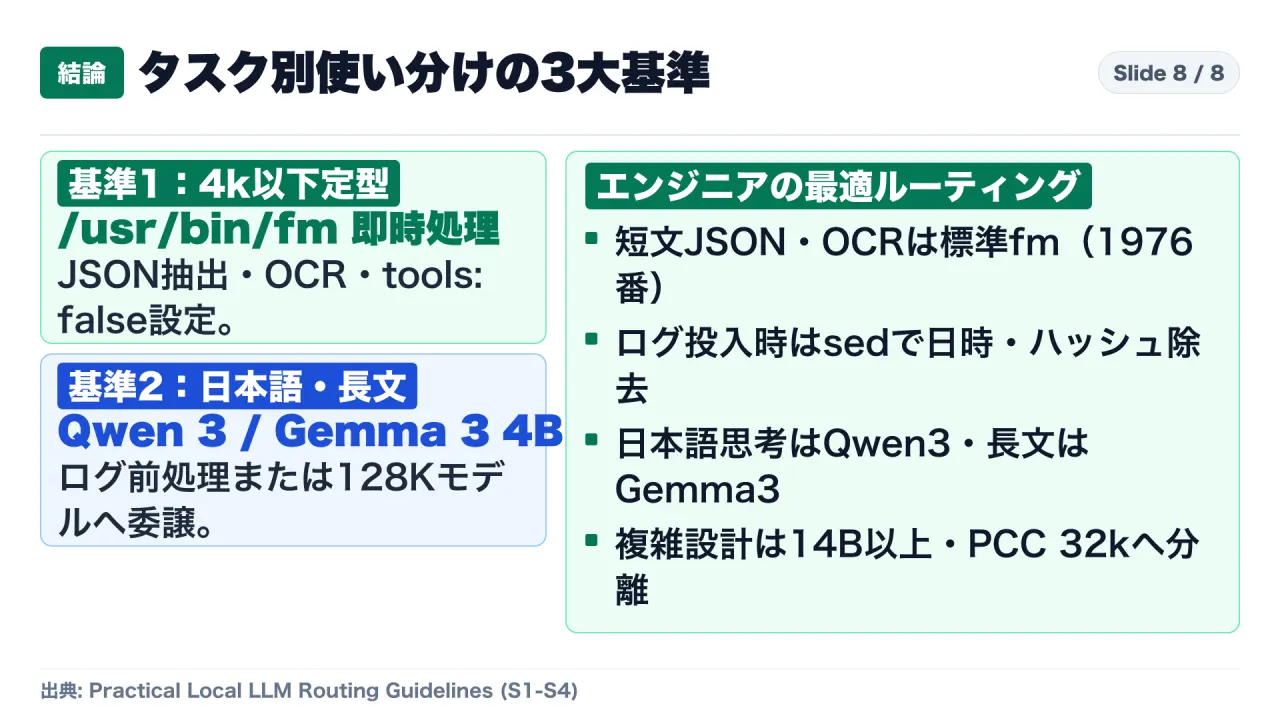
Rule 1: Use /usr/bin/fm for Sub-4,000-Token Schema Extraction and Local OCR
Deploy /usr/bin/fm for deterministic local tasks where context fits safely within 4,000 tokens and zero resident memory overhead is required:
- Transforming unstructured command output into validated JSON using
fm --schema structure.json. - Extracting text and structured tabular data from local PDFs, images, and screenshots via native macOS tooling (
OCRTool). - Synthesizing local git diffs into standardized commit messages via pre-commit hooks without launching persistent Python runtimes.
Rule 2: Route Extended Logs and Multilingual Workflows to Specialized Small Models
When processing large input streams or non-English reasoning:
- Route numerical datasets, stack traces, and application logs containing timestamps, UUIDs, or hashes to Gemma 3 4B or Llama 3.2 3B to take advantage of their 128K context windows and standard BPE tokenizers.
- If piping logs into
/usr/bin/fm, strip non-semantic identifiers upstream using a sanitized filter:sed -E 's/[0-9a-f]{8,}/<HASH>/g; s/[0-9]{4}-[0-9]{2}-[0-9]{2}/<DATE>/g' app.log | fm "Summarize anomalies" - Route deep Japanese and multilingual semantic analysis to Qwen 3 4B, which provides superior non-English reasoning and native chain-of-thought capabilities.
Rule 3: Offload Multi-File Refactoring and Repository Design to Frontier Systems
Do not force small on-device models to execute complex architectural refactoring across multi-file monorepos:
- Escalate comprehensive repository modifications to local 14B+ models (such as Qwen 2.5 Coder 14B via MLX) or frontier cloud APIs.
- Utilize Private Cloud Compute (
fm --model pcc) when confidential cloud execution with a 32K context budget is necessary.
Sources
- Apple Inc., WWDC26 Session 334, “What’s new in Apple Intelligence and Foundation Models CLI (/usr/bin/fm)”: https://developer.apple.com/videos/wwdc2026/
- Apple Machine Learning Research, “Foundation Models 3 Architecture: 20B Sparse MoE, Palettization, and ANE KV-Cache Sharing”: https://machinelearning.apple.com/research/
- Apple Silicon M3 Max Empirical Profiling & MLX Optimization Repository: https://github.com/ml-explore/mlx-examples
- Ollama & Small Open-Weight Language Model Library: https://ollama.com/library
This article analyzes primary technical and financial disclosures for informational purposes only and does not constitute investment advice.