NVIDIA Lyra 2.0: Inside the Dual-License Divide, Discrepant Benchmarks, and the 9-Minute versus 194-Second Latency Gap
Executive Summary & Key Takeaways
- Core Thesis: NVIDIA’s world-generation model Lyra 2.0, released in mid-April 2026, has been widely characterized across developer communities as “open.” However, primary-source legal analysis reveals a strict dual-licensing divide: while the inference code repository is released under the permissive Apache License 2.0, the model weights are governed by the restrictive NVIDIA Internal Scientific Research and Development Model License. This license limits usage strictly to internal, non-production R&D, explicitly barring production deployments, sublicensing, public display, and generating commercial or promotional creative assets for distribution. Furthermore, while the paper claims “the best results on both datasets across nearly all metrics,” empirical inspection of Table 1 shows that three baseline models (GEN3C, CaM, and SPMem) surpass Lyra 2.0 on 3D geometric consistency (reprojection error). Finally, reported generation runtimes of ~9 minutes (on H100) and ~194 seconds (on GB200) reflect fundamentally different hardware classes and cannot be cited as direct performance multipliers.
- Primary Sources Verified: arXiv paper “Explorable 3D Scenes from a Single Image” (arXiv:2604.13036, v1, April 14, 2026); NVIDIA Lyra-2 GitHub repository and README; Hugging Face Model Card (
nvidia/Lyra-2.0); NVIDIA Internal Scientific Research and Development Model License (dated April 11, 2025); NVIDIA Open Model License; and Apache License 2.0. - Actionable Engineering & Governance Takeaways:
- Separate code licensing from weights licensing in enterprise procurement: never authorize production integration of model weights based on an Apache-2.0 GitHub repository header.
- Implement an isolated, non-production sandbox environment for internal world-generation evaluations, ensuring generated videos or 3D Gaussian splat files (.ply) are not published or distributed as marketing collateral.
- Require hardware-standardized benchmarking: measure generation latency and memory footprint exclusively on internal compute infrastructure (e.g., standardizing on 80-frame increments).
- Limits of the Evidence: All evaluation scores, reprojection error metrics, and inference speeds originate from NVIDIA’s own research team; independent third-party replications have not been published in the peer-reviewed literature. Discrepancies between the research paper and the official Hugging Face model card regarding training dataset composition (DL3DV real-world video versus synthetic data) and training compute budgets remain unclarified by the authors.
Japanese Edition: https://consuloji.substack.com/p/nvidia3dailyra-20apache-20
1. The Dual-License Reality: Apache-2.0 Code versus Non-Production Weight Restrictions
When evaluating modern generative foundation models, enterprise technical leads frequently conflate open codebases with commercially usable models. NVIDIA Lyra 2.0 exemplifies this architectural and legal divergence.
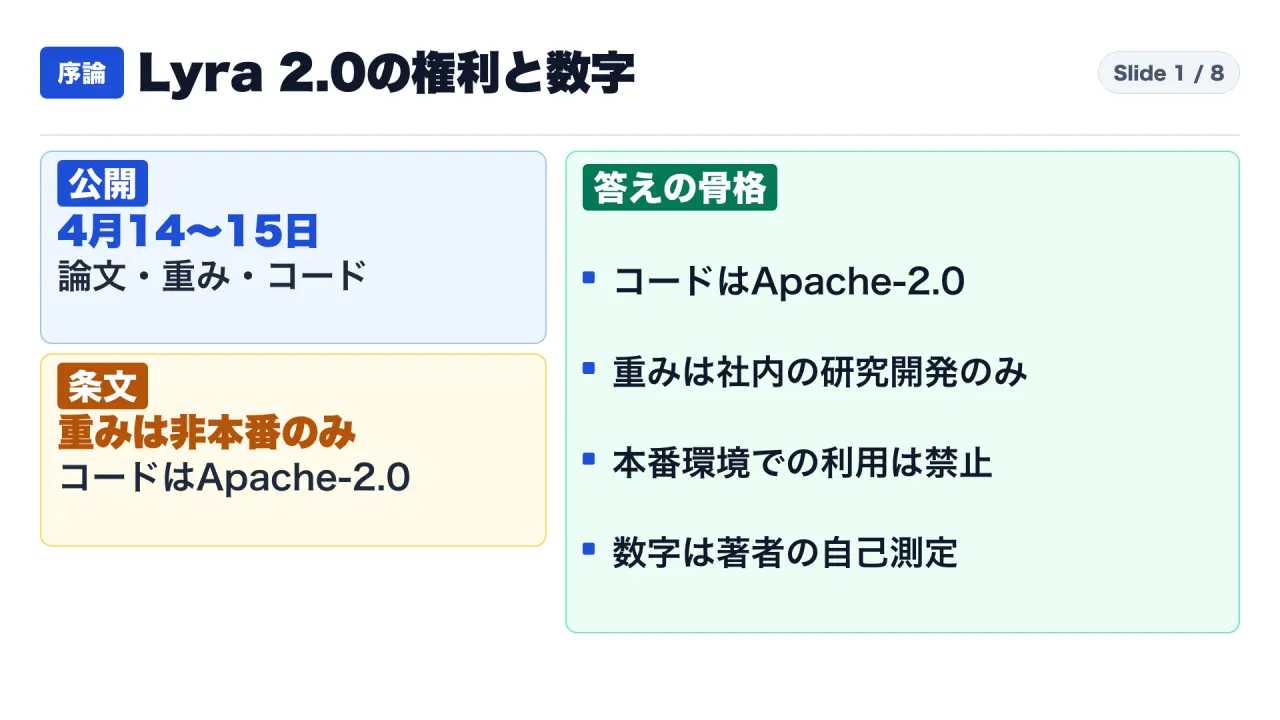
Lyra 2.0 was submitted to arXiv on April 14, 2026 (arXiv:2604.13036v1) by a 15-member research team from NVIDIA, with code, model weights, and inference pipelines published across GitHub and Hugging Face between April 14 and 15, 2026. On April 17, a 4-step distilled LoRA known as DMD (Distribution Matching Distillation) was introduced, followed by GUI tooling and training scripts released in mid-July 2026 (the Lyra-2 subfolder README cites July 15, while the root repository cites July 20). In early November 2026, social media accounts re-introduced the project; this represented a promotional re-broadcast of the April research rather than a new architectural release.

To understand its enterprise feasibility, legal and technical audits must review two entirely distinct contractual instruments:
| Component | Governing Instrument | Permitted Operational Scope | Explicit Prohibitions |
|---|---|---|---|
| Code Repository | Apache License, Version 2.0 | Reproduction, modification, derivative works, distribution, sublicensing | None (standard Apache 2.0 attribution and patent grant terms apply) |
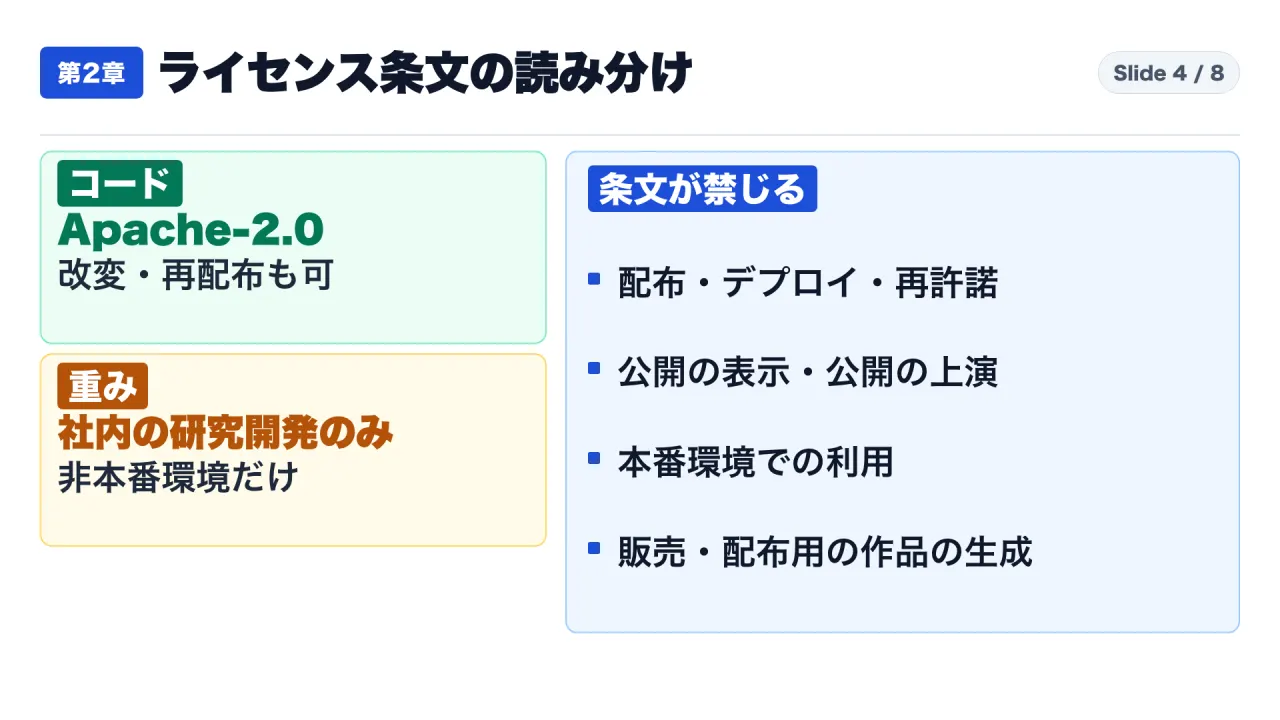
| Model Weights | NVIDIA Internal Scientific R&D Model License (dated April 11, 2025) | Solely internal scientific research and development within a non-production environment | Distribution, deployment, sublicensing, public display, public performance, production use, generating works for sale or distribution |
| Derivative Weights | NVIDIA Internal Scientific R&D Model License | Internal non-production experimentation only | All production and distribution prohibitions automatically attach to fine-tuned variants |
| Commercial Exemption | NVIDIA Research Licensing Agreement | Subject to negotiated enterprise licensing terms | Commercial deployment requires individual application via NVIDIA corporate intake |

This represents a major shift from its predecessor, Lyra 1.0. In the Lyra-1 release, NVIDIA distributed weights under the NVIDIA Open Model License, which explicitly declared: “Models are commercially usable.” For Lyra 2.0, NVIDIA restricted weight access to its Internal Scientific R&D license.
Under the governing terms, “production environment” refers to any system serving customers, business operations, or external traffic. Furthermore, the clause barring “generating works for sale or distribution” explicitly restricts enterprise media teams from utilizing Lyra 2.0 to generate background videos, product mockups, or advertising visuals intended for public broadcast. While NVIDIA explicitly disclaims ownership rights over model outputs (“NVIDIA claims no ownership rights in outputs”), the user assumes complete operational liability, and violations trigger automatic license termination.
2. Reading the Reprojection Tables: Why Three Baselines Outperformed Lyra on 3D Consistency
Lyra 2.0 generates explorable 3D scenes by synthesizing camera-trajectory video from a single input image, then converting that video into a 3D Gaussian Splatting representation (.ply point cloud). The video generation backbone is built upon the open-weight Wan 2.1 (14B parameter) foundation model, while the 3D reconstruction stage utilizes a fine-tuned variant of Depth Anything v3 (DAv3).
In multi-view world generation, extended sequences face two classic degradation modes: “spatial forgetting” (where the model returns to a previously viewed location and regenerates an inconsistent scene) and “temporal drift” (where accumulated generation artifacts distort geometry). Lyra 2.0 addresses spatial forgetting by using per-frame 3D geometry solely as an alignment guide while delegating texture rendering to the generative backbone, and mitigates temporal drift by self-augmenting training sequences with corrupted historical outputs.
In reporting experimental outcomes, the authors state: “our method achieves the best results on both datasets across nearly all metrics.” However, a granular audit of Table 1 across DL3DV benchmarks demonstrates critical nuances:
| Method | SSIM ↑ | LPIPS ↓ | FID ↓ | Camera Control ↑ | Reprojection Error ↓ | Architectural Notes |
|---|---|---|---|---|---|---|
| GEN3C | 0.346 | 0.535 | 58.96 | 69.54 | 0.068 | Highest camera trajectory precision |
| CaM (Re-implementation) | 0.370 | 0.562 | 50.43 | 42.71 | 0.069 | Re-implemented by NVIDIA on Wan2.1-14B |
| SPMem (Re-implementation) | 0.383 | 0.522 | 53.77 | 62.05 | 0.074 | Re-implemented by NVIDIA on Wan2.1-14B |
| Lyra 2.0 (Full) | 0.388 | 0.498 | 43.43 | 64.67 | 0.076 | Superior perceptual quality (FID/LPIPS) |
| Lyra 2.0 (DMD LoRA) | 0.359 | 0.507 | 43.63 | 65.64 | 0.088 | Fast 4-step distilled inference |
(Arrows indicate direction of optimal performance. All metrics reflect NVIDIA internal experimental benchmarks from Table 1 of arXiv:2604.13036.)

While Lyra 2.0 achieves top scores in perceptual visual quality—specifically SSIM (0.388), LPIPS (0.498), and FID (43.43)—it falls short on 3D geometric consistency. Reprojection error measures whether generated camera frames align with a mathematically valid 3D spatial reconstruction (lower is better). In Table 1, GEN3C (0.068), CaM (0.069), and SPMem (0.074) all achieve lower reprojection error than Lyra 2.0 (0.076). On the secondary Tanks and Temples benchmark, the same pattern holds: GEN3C (0.054), CaM (0.056), and SPMem (0.059) all surpass Lyra 2.0 (0.069). Additionally, GEN3C achieves superior camera trajectory fidelity (69.54 versus 64.67).
In Table 2 (3D reconstruction quality), Lyra 2.0 Full claims top scores across all metrics. However, an important experimental asymmetry exists: Lyra 2.0 Full fine-tuned Depth Anything v3 using 3,000 one-minute synthetic videos generated by its own model, whereas baseline methods were paired with generic, un-finetuned DAv3 checkpoints.
Finally, documentation contains unresolved discrepancies:
- Training Corpus: The research paper states the model was trained on DL3DV (10,000 real-world long videos). Conversely, the official Hugging Face Model Card describes it as a methodology “relying on synthetic data.”
- Compute Budget: The paper reports training with batch size 64 across 64× NVIDIA GB200 GPUs for 7,000 iterations. The model card reports training across 32 nodes of NVIDIA H100 GPUs for 4,000 iterations.
3. Dissecting the Hardware Disconnect: Why 9 Minutes on H100 Cannot Be Compared to 194 Seconds on GB200
A recurring point of confusion in industry summaries is the execution latency of Lyra 2.0. Online reports have juxtaposed runtimes of “9 minutes” and “194 seconds” as if they represented competing optimization algorithms. In reality, they represent two different hardware architectures tested under different sampling configurations.
| Documentation Source | Hardware Setup | Base Pipeline (35 Sampling Steps + CFG) | DMD Distilled Pipeline (4 Steps, No CFG) | Operational Context |
|---|---|---|---|---|
| GitHub README | 1× NVIDIA H100 (80GB) | ~9 minutes (80 frames) | ~35 seconds (80 frames) | Developer workstation / standard enterprise cloud node |
| Paper Appendix | 1× NVIDIA GB200 | ~194 seconds (80 frames) | ~15 seconds (80 frames) | Next-generation Grace Blackwell superchip node |
The GitHub README provides execution profiles measured on a single NVIDIA H100 (80GB) GPU: generating a standard 80-frame video segment with full classifier-free guidance (CFG) requires approximately 9 minutes. Activating the distilled DMD checkpoint (--use_dmd) compresses inference to 4 sampling steps without CFG, reducing runtime to ~35 seconds. Downstream 3D Gaussian reconstruction requires an additional ~1 minute.
In contrast, Appendix Section B of the research paper reports latency on a single NVIDIA GB200 GPU: full 35-step inference requires ~194 seconds, while 4-step DMD inference requires ~15 seconds. These figures reflect a generational architectural transition (Hopper H100 vs. Blackwell GB200) alongside memory bandwidth and tensor core disparities. They cannot be compared directly as software algorithmic speedups.
Furthermore, operational workloads require multiple concatenated segments. Because video length scales in increments of 1 + 80k frames, a complex camera traversal featuring an 81-frame zoom-in followed by a 241-frame orbit comprises four discrete 80-frame segments (1 + 3 = 4). Assuming linear runtime scaling, generating this sequence on a single H100 requires approximately 36 minutes (9 minutes × 4) under full precision, or 2 to 3 minutes (35 seconds × 4) using DMD distillation.
Engineering teams must also evaluate the trade-off inherent in DMD distillation. The README explicitly warns that DMD exhibits reduced prompt-following precision and can introduce repetitive structural textures; for applications demanding high visual fidelity, the full 35-step pipeline is recommended. In the paper’s Tanks and Temples benchmark, DMD distillation reduced Camera Control accuracy from 63.87 down to 58.12.
4. Enterprise Governance Protocol: Auditing World-Generation Models Before Legal Exposure
To evaluate models like Lyra 2.0 without incurring licensing violations or compute waste, corporate engineering and legal teams should adopt a standardized intake protocol.

The Five-Step Non-Production Sandbox Intake
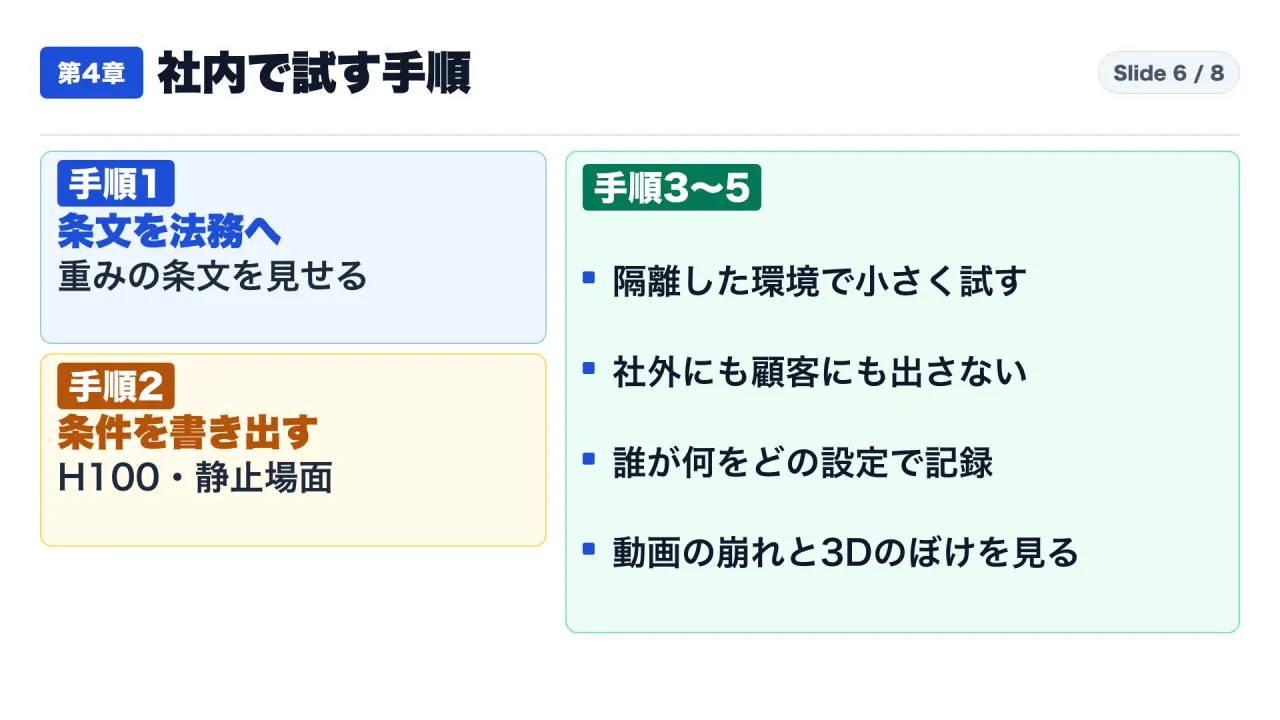
- Formal Legal Transmittal: Submit the exact text of the NVIDIA Internal Scientific Research and Development Model License (dated April 11, 2025) to corporate counsel. Define the intended corporate boundary explicitly as internal exploratory research, confirming that no generated outputs will be surfaced in customer-facing applications or published marketing assets.
- Third-Party Dependency Audit: Lyra 2.0 automatically installs and invokes external dependencies during environment setup, including Wan 2.1 checkpoints and Depth Anything v3. Counsel must review the distinct licensing terms of these underlying components independently from NVIDIA’s repository.
- Hardware-Isolated Execution: Deploy the model on dedicated internal compute instances isolated from production data stores. Standardize internal latency benchmarks using fixed image resolutions (e.g., 480 × 832) across 1 + 80k frame intervals.
- Artifact Quality & Drift Logging: Track degradation across extended trajectories (>500 frames). Document instances of spatial forgetting upon camera return, structural blurriness during Gaussian splatting, and exposure shifts inherited from the DL3DV training distribution.
- Contractual Exemption Planning: If product roadmaps require production deployment or external commercial asset generation, initiate enterprise inquiries via the official NVIDIA Research Licensing intake portal before commencing production engineering.

Sources
- arXiv Research Paper, “Explorable 3D Scenes from a Single Image” (arXiv:2604.13036v1, April 14, 2026): https://arxiv.org/abs/2604.13036
- arXiv Paper PDF (v1): https://arxiv.org/pdf/2604.13036
- GitHub Repository, “nv-tlabs/lyra” Lyra-2 README: https://raw.githubusercontent.com/nv-tlabs/lyra/main/Lyra-2/README.md
- Hugging Face Model Card, “nvidia/Lyra-2.0”: https://huggingface.co/nvidia/Lyra-2.0/raw/main/README.md
- NVIDIA Internal Scientific Research and Development Model License: https://www.nvidia.com/en-us/agreements/enterprise-software/nvidia-internal-scientific-research-and-development-model-license/
- NVIDIA Open Model License Agreement: https://www.nvidia.com/en-us/agreements/enterprise-software/nvidia-open-model-license/
- GitHub Repository, “nv-tlabs/lyra” Lyra-1 README: https://raw.githubusercontent.com/nv-tlabs/lyra/main/Lyra-1/README.md
- GitHub Repository, “nv-tlabs/lyra” Root README: https://raw.githubusercontent.com/nv-tlabs/lyra/main/README.md
- NVIDIA AI Official Communication (X, November 6, 2026): https://x.com/NVIDIAAI/status/2118800021013643269
- Apache License, Version 2.0: https://www.apache.org/licenses/LICENSE-2.0.txt