Why 3x Engineering Velocity Triggers Internal DDoS and a 75% Production Failure Rate: Inside the Economics of AI Slop and Taste
Executive Summary & Key Takeaways
- Core Thesis: The widespread adoption of AI coding agents has dramatically accelerated raw code generation, but it has shifted the primary constraint of software engineering from implementation speed to requirement preservation and non-functional verification. When implementation friction drops from two weeks to twenty minutes, organizations experience what Linear CEO Karri Saarinen describes as an “Internal DDoS attack”: teams and agents flood the organization with up to 1,000 pull requests per day, overwhelming code review, product coherence, and strategic steering. Quantitative findings from an Oracle AI Research benchmark across full-cycle Forward-Deployed Engineering (FDE) agents reveal that during requirement synthesis (Discovery), 21.2% of disclosed customer constraints (874 of 4,122 facts) vanish when transcribed into product requirement documents (PRDs). Consequently, during autonomous implementation (Delivery), despite achieving over 60% scores on standard development benchmarks, 75% of agent implementations (6 of 8 runs) fail production acceptance criteria due to excessive error rates or latency violations.
- Primary Sources Verified: Oracle AI Research (Full-Cycle FDE Agent benchmark, arXiv:2611.03551v1), Faire Engineering leadership (The Craft: Product Builder program across 214 engineers), Linear leadership (Karri Saarinen on Internal DDoS), Google DeepMind (Tulsee Doshi on Gemini product management and evaluation architecture), Spotify Engineering (Three Angles of AI Product Management), and Bellwether analytics (Revenue-at-Risk customer feedback prioritization).
- Actionable Engineering & Governance Takeaways:
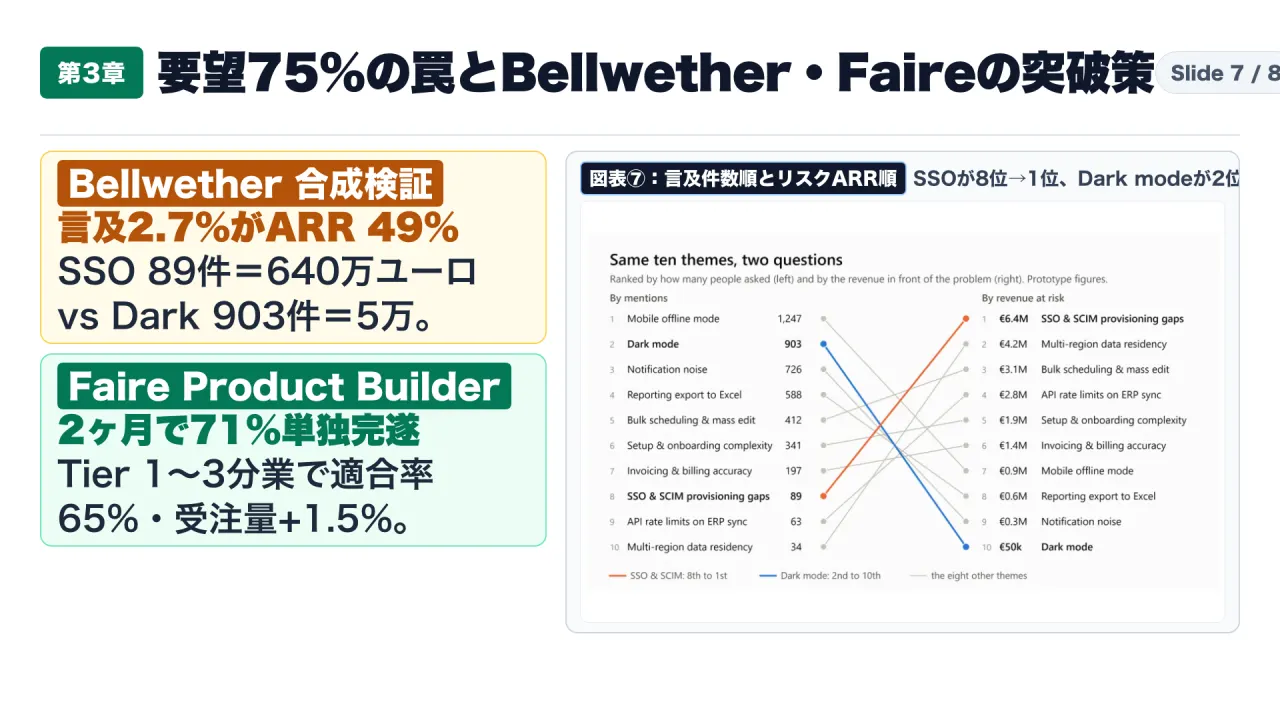
- Replace raw request-volume backlogs with Revenue-at-Risk prioritization: in simulated enterprise feedback distributions, popular feature requests representing 75% of customer mention volume accounted for only 8.5% of at-risk annual recurring revenue (ARR), whereas low-volume enterprise compliance requests (2.7% of mentions) represented 49% of at-risk ARR.
- Implement automated PRD fact-auditing and non-functional acceptance gates: enforce strict limits on execution failure rates (≤15%) and 90th-percentile response latency (≤15 seconds) inside CI/CD test suites before pull requests reach human reviewers.
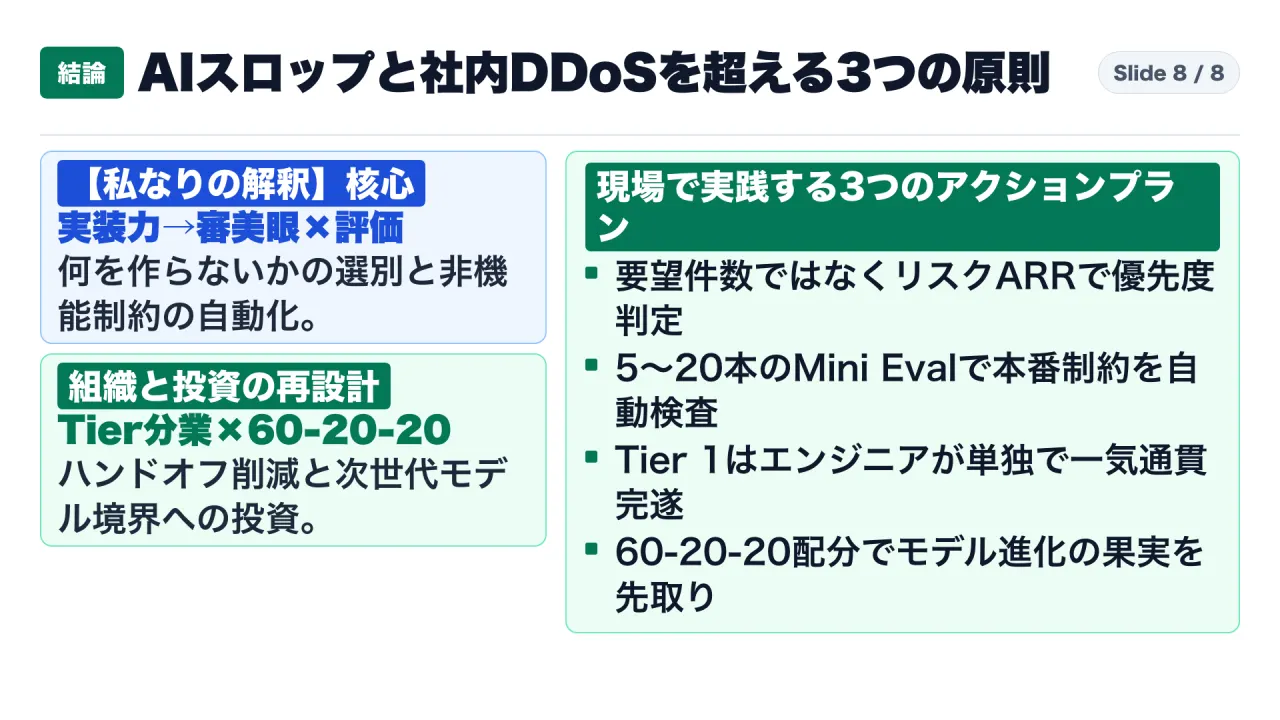
- Adopt a three-tier complexity framework with “Mini Evals”: enable engineers to own low-complexity features end-to-end without handoff delays (as demonstrated by Faire’s 71% independent release rate), while focusing product leadership on the 60-20-20 portfolio investment rule and curating targeted 5-to-20 prompt evaluation suites.
- Limits of the Evidence: Faire’s productivity metrics reflect an internal 1-year evaluation of 214 full-time engineers in an established e-commerce marketplace and may not transfer directly to smaller early-stage teams. Oracle’s FDE findings are based on three structured enterprise simulation domains (Text-to-SQL, Ticket Triage, Sales Proposals) under synthetic user simulator dialogs. Bellwether’s analysis is derived from a standardized benchmark model of a 19.4-million-euro B2B SaaS company rather than live financial accounting data.
Japanese Edition: https://consuloji.substack.com/p/ai3751000
1. The Velocity Paradox: Faire’s 14x Output and Linear’s Internal DDoS
Enterprise engineering leadership frequently equates higher pull request (PR) volume with organizational productivity. However, longitudinal empirical data from engineering teams operating with generative AI tools indicates that removing implementation friction exposes downstream bottlenecks that can paralyze product decision-making.
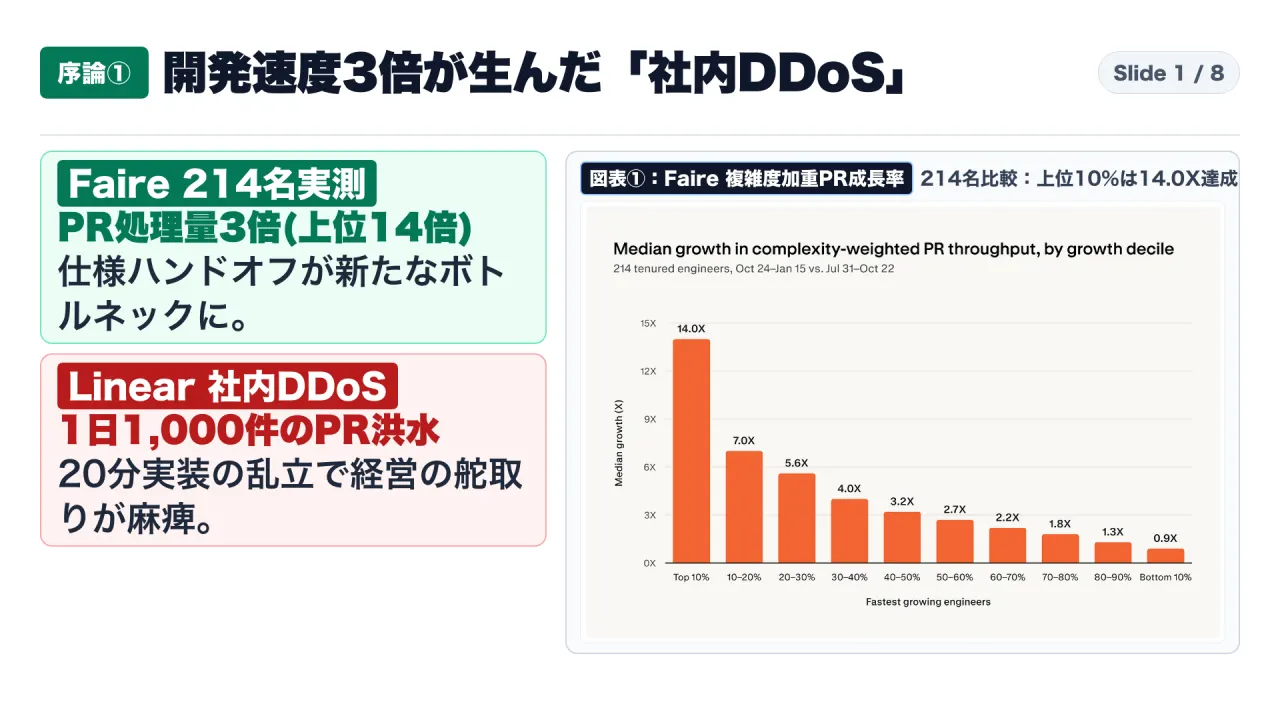
At B2B marketplace platform Faire, engineering leadership tracked 214 continuous full-time software engineers across a full calendar year (January 2025 to January 2026). To prevent distorted metrics caused by superficial commits, Faire evaluated output through “Complexity-Weighted PR Throughput,” normalizing pull requests by the architectural scope and structural difficulty of each code modification. Over the twelve-month observation period, average complexity-weighted PR throughput increased approximately threefold across the company. Among the top 10% of engineers most proficient in leveraging AI agents, throughput surged by 14.0×.
Yet Faire’s leadership observed an immediate systemic failure mode: as engineering output tripled, handoffs between product managers, UI/UX designers, and software engineers became severely congested. Features were produced faster than product teams could clarify edge cases, validate customer alignment, or resolve interface inconsistencies.
Linear CEO Karri Saarinen identified this systemic breakdown as an “Internal DDoS attack” on modern software organizations. Historically, the physical friction of engineering—the fact that translating a conceptual spec into production software required two weeks of focused development—served as an informal but essential institutional filter. Engineers and product managers debated trade-offs, discarded marginal ideas, and refined requirements because spending two weeks on the wrong feature imposed a visible opportunity cost.
When AI coding assistants and autonomous harnesses compress that two-week implementation cycle into twenty minutes, that protective friction disappears. Unvetted ideas, superficial redesigns, and half-formed feature suggestions are instantly converted into functional pull requests. In mid-sized and large enterprises, this dynamic generates up to 1,000 pull requests per day. Review queues overflow, CI/CD runner pipelines jam, and product leads spend their working hours triaging low-impact code changes rather than steering architectural strategy. Removing code generation friction without establishing upstream editorial discipline produces organizational denial of service from within.
2. The Oracle FDE Audit: Why 21.2% of Requirements Vanish and 75% of Implementations Fail
A common assumption among engineering teams is that the solution to Internal DDoS is to delegate requirement gathering and specification writing to AI agents as well. A research study by the Oracle AI Research team (Jie Liu, Minzhi Leticia Li, Caiming Xiong, et al., arXiv:2611.03551v1) investigated this hypothesis by establishing the first comprehensive benchmark for full-cycle Forward-Deployed Engineering (FDE) agents.
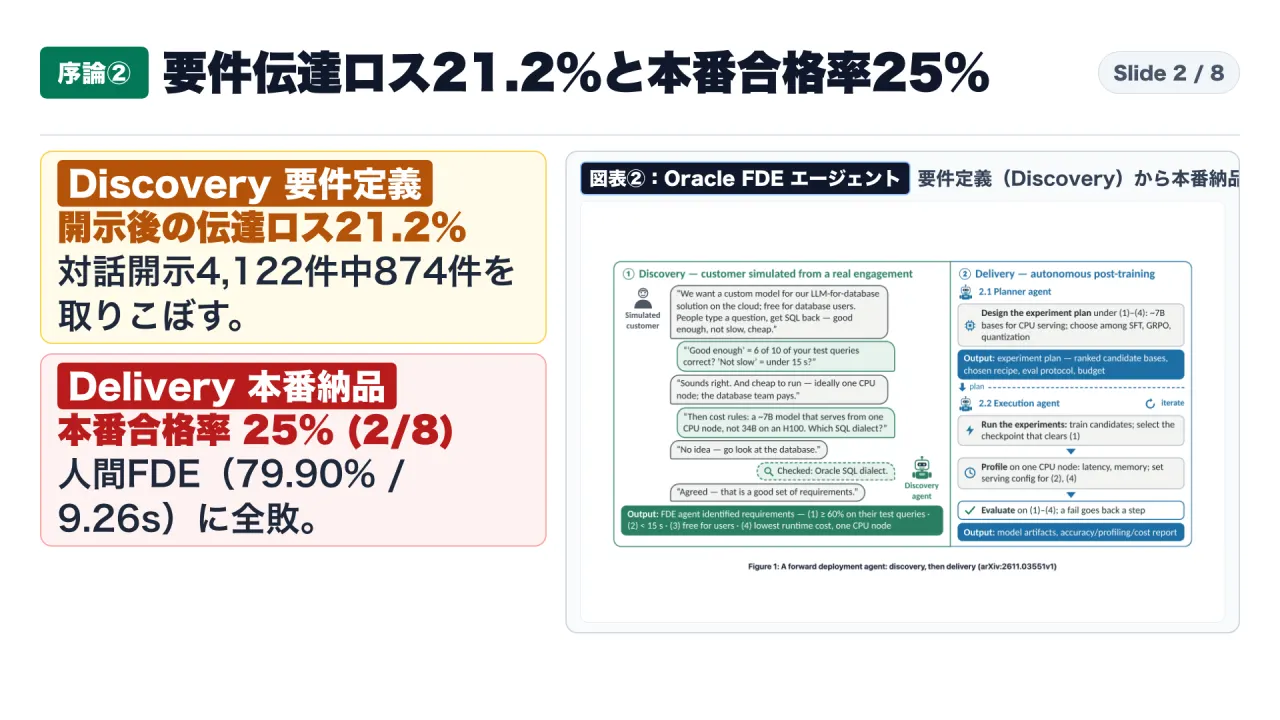
The FDE role, pioneered by enterprise analytics firms such as Palantir, requires engineers to embed within client organizations, interview stakeholders to uncover ambiguous operational needs (Phase 1: Discovery), synthesize structured product requirement documents (PRDs), and deliver fully integrated production code (Phase 2: Delivery). Oracle evaluated 15 foundation models across three complex enterprise domains: Text-to-SQL analytics engines, customer support ticket triage workflows, and medical/enterprise sales proposal generation.
In Phase 1 (Discovery), models conducted multi-turn interactive dialogues with user simulators that held latent business rules and operational constraints. The evaluation revealed wide disparities in interactive elicitation capability:
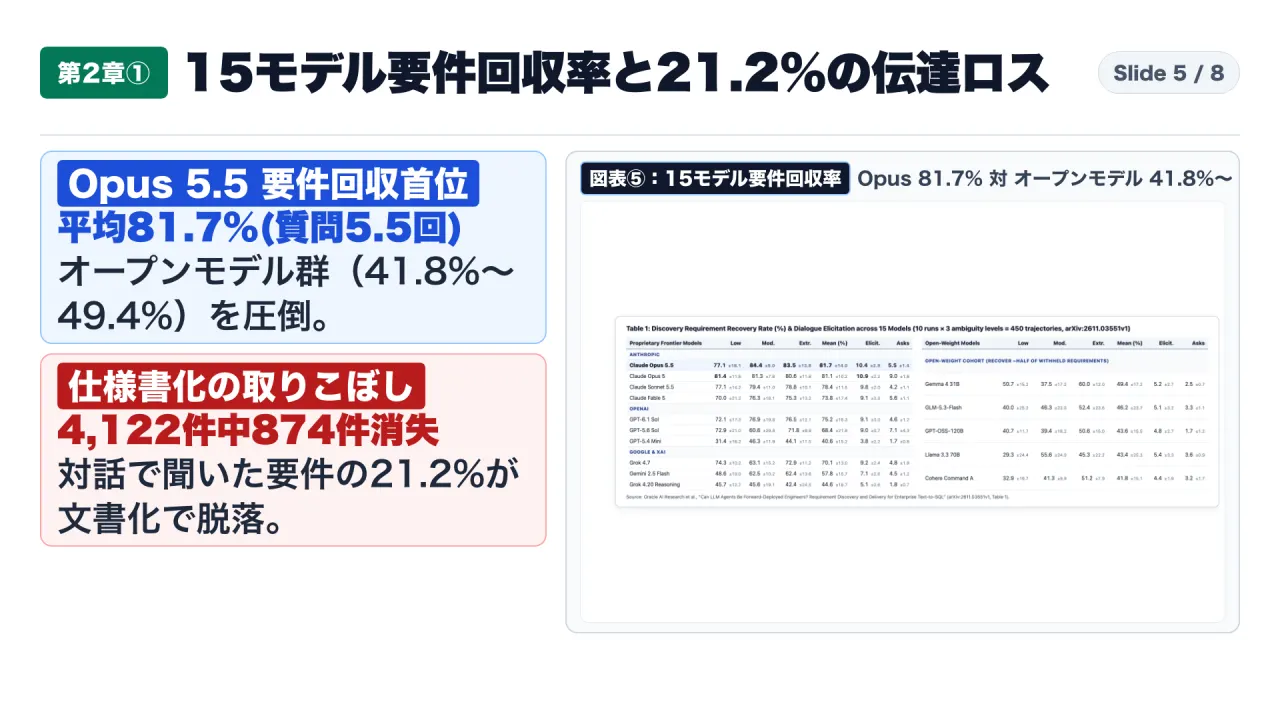
- Commercial Frontier Tier: Claude-Opus-5.5 led all 15 models with an average fact recovery rate of 81.7% (81.9% in Text-to-SQL, 83.2% in Ticket Triage, 79.9% in Sales Proposals), requiring an average of only 5.5 question turns per dialogue while acquiring 0.65 new facts per question. GPT-5.2 followed closely at 80.8%, with Claude-Sonnet-5.5 at 77.8%, GPT-5.4 at 77.5%, and Gemini-3.1-Pro at 77.1%.
- Open-Weight Tier: Open-weight architectures struggled to probe for unspoken enterprise constraints, failing to elicit more than half of latent requirements: Qwen3-32B recovered 41.8%, Llama-3.3-70B recovered 42.3%, Llama-4-Maverick recovered 45.1%, and DeepSeek-V3 recovered 49.4%.

However, the most consequential vulnerability appeared in Oracle’s audit of fact preservation between dialogue and documentation (Table 7: Post-Disclosure Fact Transmission Loss). Across all 15 models, customer simulators verbally stated a cumulative total of 4,122 requirement facts during interviews. Yet when the agent models transcribed those conversations into formal PRD specifications, only 3,248 facts were recorded. Exactly 874 facts—representing 21.2% of all disclosed requirements—disappeared entirely.
Models systematically dropped essential non-functional constraints in an effort to generate concise, cosmetically polished specifications. In Gemini-2.5-Pro, 38.7% of disclosed facts vanished; in Claude-Haiku-5.5, 30.9% were lost; in GPT-5.4, 28.1% were omitted. Dropped facts included mandatory database null-handling rules, maximum latency thresholds (such as 15-second response cutoffs), and strict negative filtering rules (disallowed keywords).

The operational penalty of this 21.2% requirement loss became visible during Phase 2 (Delivery). In the Text-to-SQL domain, Oracle subjected agent-generated code to three rigorous production acceptance criteria:
- Spider Execution Accuracy (EX): Must achieve ≥60.0%.
- Production Query Execution Failure Rate: Must remain ≤15.0%.
- 90th-Percentile Latency (p90): Must not exceed 15.0 seconds.
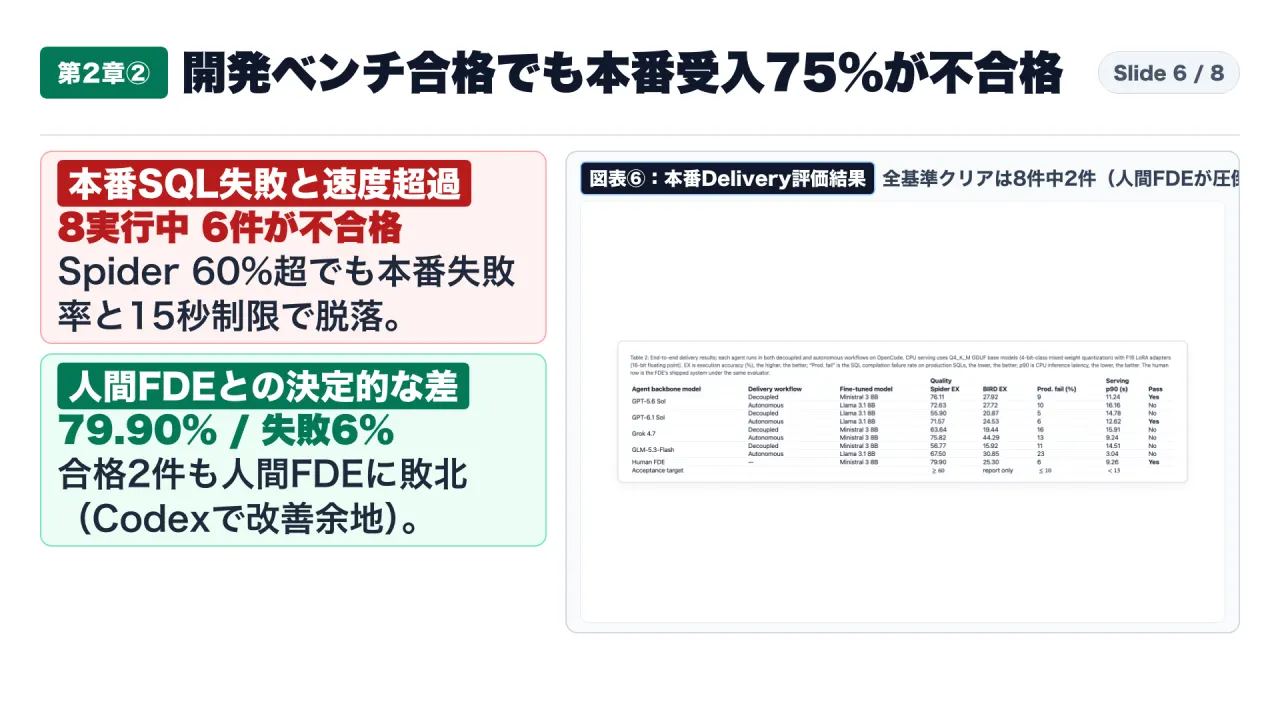
Evaluating eight distinct model-harness combinations across Claude Code and Codex CLI harnesses, five of the eight configurations achieved over 60% on Spider accuracy, appearing viable on paper. However, when tested against production failure and latency constraints, six of the eight configurations failed completely. Only 2 of the 8 runs (a 25.0% pass rate) satisfied all three criteria:
- Opus-4.6 Discovery + Opus-4.6 Delivery (Claude Code) scored 65.91% Spider accuracy but failed production criteria with a 30% execution error rate and a disqualifying 54.13-second p90 latency.
- GPT-5.4 Discovery + GPT-5.4 Delivery (Claude Code) scored 72.80% Spider accuracy but was rejected due to an 18.08-second p90 latency.
- The two configurations that passed (Sonnet-4.6 + Sonnet-4.6 at 67.05% accuracy, 10% failure, 14.88s latency; GPT-5.4 + Opus-4.6 at 77.40% accuracy, 10% failure, 14.37s latency) still performed below human engineering baselines: an experienced human FDE achieved 79.90% accuracy with only a 6% failure rate and a 9.26-second p90 latency.
This disconnect explains the emergence of “AI Slop” in engineering: code that satisfies unit tests in isolated development environments but collapses under production load and enterprise compliance rules.
3. The 75% Feedback Trap: Bellwether’s Revenue-at-Risk and Faire’s Complexity Tiers
When automated agents can build features in minutes, product teams often direct agent capacity toward customer feedback backlogs sorted by raw ticket frequency. Research from the Bellwether product intelligence project demonstrates that prioritizing by mention volume is financially destructive.
Analyzing a benchmark model of an enterprise B2B SaaS organization (Volta SA, generating 19.4 million euros in annual recurring revenue across 6,693 customer signals and 4,600 clustered mentions), Bellwether contrasted raw mention volume against Revenue-at-Risk ARR—weighting each feedback cluster by customer contract value and churn probability.
The rankings inverted completely:
- The High-Volume Trap: The top four feature requests by mention volume (led by requests for “Dark Mode” with 903 mentions) accounted for 75% of total customer feedback volume. However, because these requests came predominantly from low-tier or free users with negligible churn risk, they represented only 8.5% of total revenue-at-risk ARR. Dark mode, despite 903 requests, tied to just 50,000 euros in at-risk ARR.
- The Silent Enterprise Imperative: Conversely, core infrastructure and governance requirements—specifically “SSO & SCIM user provisioning” (89 mentions) and “Data Residency controls” (34 mentions)—represented a combined 2.7% of total mention volume. Yet these two topics accounted for 49% of the company’s total revenue-at-risk ARR: 6.4 million euros at risk for SSO & SCIM, and 4.2 million euros at risk for Data Residency.
If an engineering team deploys autonomous agents to exhaust customer backlogs sorted by popularity, it will churn through hundreds of PRs on cosmetic enhancements worth 50,000 euros while sleepwalking into a 10.6-million-euro enterprise churn event.
To prevent handoff friction from choking organizational velocity, Faire reorganized its product engineering structure around a three-tier complexity framework:
- Tier 1 (Low Complexity, Defined Scope): Engineers who completed Faire’s “Product Builder” training own the entire cycle independently—problem definition, PRD authoring, agent-assisted prototyping, implementation, experimentation, and production rollout—without dedicated PM or designer handoffs.
- Tier 2 (Medium Complexity, Multi-Domain Features): Product managers establish strategic guardrails, customer outcome metrics, and automated evaluation suites; engineers prototype multiple implementation options using AI harnesses.
- Tier 3 (High Complexity, Architecture & Strategy): Cross-functional leadership focuses exclusively on deep architectural coherence, system integration, and core user experience taste.
Within two months of launching this structure, 71% of Faire’s engineers shipped at least one production feature completely end-to-end without PM involvement. The proportion of engineers evaluated as “Capable or Strong” product builders rose from 41% to 65% (tracking toward an 85% year-end target). Crucially, this autonomy drove commercial impact: an engineer-led initiative introducing color-aware variant swatches directly increased Faire platform order volume by 1.5%.
4. Operational Playbook: Taste, Mini Evals, and Automated Non-Functional Acceptance Gates
When code generation is cheap, competitive differentiation migrates from programming speed to judgment, evaluation design, and architectural curation.
Google DeepMind Head of Product for Gemini Tulsee Doshi defines this organizational capability as “Taste”: in environments where generative systems produce infinite variations, human leadership must provide insight rather than raw data, applying the correct weights to trade-offs to decide what not to build. To govern product development alongside rapidly evolving foundational models, Doshi articulates the 60-20-20 portfolio investment rule:
- 60% Allocation: Invest in stable capabilities that current foundation models execute reliably in their current state.
- 20% Allocation: Deploy at the outer boundary of current model capabilities, accepting higher engineering friction.
- 20% Allocation: Invest in “glimmers”—areas where current models currently fail or produce marginal results, but where anticipated architectural leaps in the next model generation will unlock commercial value.
Spotify Engineering has formalized this approach by establishing three distinct AI Product Management disciplines: AI Research PMs (governing infrastructure leverage), AI Model PMs (overseeing domain-specific post-training and alignment), and AI Experience PMs (designing interfaces for unbounded natural language interaction). Binding these three tiers together is Spotify’s operating principle: “Evaluation is a product, not just a process.”
Three Concrete Institutional Controls
Engineering organizations seeking to eliminate AI slop and suppress Internal DDoS must implement three structural controls:
- Weight Backlogs by Revenue-at-Risk Rather Than Ticket Count: Audit incoming feature requests against account ARR and contract renewal timelines. Suppress agent PR generation for cosmetic requests with low revenue impact, redirecting development capacity to structural compliance, data residency, and enterprise integration.
- Automate PRD Fact Audits and Non-Functional CI/CD Acceptance Gates: Address Oracle’s 21.2% fact-loss finding by deploying automated cross-checking scripts that verify that every constraint identified during stakeholder interviews appears verbatim in generated PRDs. Furthermore, configure CI/CD test runners to enforce non-functional acceptance gates—mandating execution error rates ≤15% and p90 response latencies ≤15 seconds across production-scale datasets before code changes reach human review.
- Deploy 5-to-20 Prompt “Mini Evals” Before Scaling Autonomy: Following Doshi’s methodology, require engineers to author five highly targeted, adversarial stress-test prompts that probe edge cases, boundary conditions, and failure modes for any proposed feature. Expand that suite to twenty prompts once baseline behavior is understood. Code that fails these adversarial mini-evals must be rejected deterministically by the harness, preventing unvetted implementations from consuming human review bandwidth.
Sources
- Oracle AI Research, “From Discovery to Delivery: Benchmarking Full-Cycle Forward-Deployed Engineering Agents”: https://arxiv.org/abs/2611.03551 / https://arxiv.org/html/2611.03551v1
- Faire (The Craft), “Accelerating Product Development in the AI Age: How Faire Developed Product Builders”: https://craft.faire.com/accelerating-product-development-in-the-ai-age-how-faire-developed-product-builders-fe70044854b5
- Karri Saarinen (CEO, Linear), “Our organizations are being DDoSed from the inside”: https://karrisaarinen.com/posts/our-organizations-are-being-ddosed-from-the-inside/
- Jeff Gothelf, “How to Turn 1,000 Pull Requests a Day into the Few Your Customers Need”: https://jeffgothelf.com/blog/how-to-turn-1000-pull-requests-a-day-into-the-few-your-customers-need/
- Waydev, “A Denial of Service from Your Own People”: https://waydev.co/your-teams-and-agents-can-generate-change-faster-than-anyone-can-steer-it-a-denial-of-service-from-your-own-people/
- Lenny’s Podcast / Lenny’s Newsletter, “Tulsee Doshi (Head of Product for Gemini, Google DeepMind) — What it actually takes to build frontier AI products”: https://www.youtube.com/watch?v=qGf2Yvan4Wg / https://www.lennysnewsletter.com/p/what-it-actually-takes-to-build-frontier
- Spotify Engineering, “AI Product Management at Spotify: A View From Three Angles”: https://engineering.atspotify.com/2026/11/ai-product-management-at-spotify-a-view-from-three-angles
- Towards Data Science (Yassin), “How to Prioritize Product Feedback by Revenue at Risk (Bellwether)”: https://towardsdatascience.com/how-to-prioritize-product-feedback-by-revenue-at-risk/
- Bellwether GitHub Repository: https://github.com/YassinAnalytics/Bellwether-app
- Oguz Bilgic, “Maximum Viable Product”: https://research.oguzbilgic.com/theses/maximum-viable-product