Why Single-Model Agent Architectures Collapse: Inside the 74% Cost Reduction Across Claude Fable 5.2, Muse Ember, and Auto Code
Executive Summary & Key Takeaways
- Core Thesis: Standardizing autonomous AI agents on a single frontier model creates severe economic and operational failure modes. On the low-complexity side, running simple repository scans or log checks on flagship models consumes massive budgets: on Artificial Analysis Intelligence Index v5.0.1, Claude Opus 5.5 averages $10.04 per task, whereas Meta’s Muse Ember achieves a comparable intelligence score of 36 at just $0.14 per task ($0.10 input, $0.40 output, and $0.015 cached input per million tokens) with a 17% hallucination rate on AA-Omniscience v1.1. On the high-complexity side, general-purpose models hit structural plateaus: in a 30-hour formal proof of Fermat’s Last Theorem in Lean, Claude Opus 5.5 stalled at 27% progress after 12 hours, while Anthropic’s Claude Fable 5.2 ($8 input, $40 output per million tokens) reached 100% completion across ~1,000 coordinating agents. Bridging this gap, OpenRouter’s harness-aware Auto Code router preserves prompt caching by maintaining model stickiness across nearly 9 out of 10 agent turns, matching Claude Opus 5.5 benchmark accuracy while cutting per-task cost by 74% and rationing Opus 5.5 to just 9.0% of calls.
- Primary Sources Verified: Anthropic (Claude Fable 5.2 & Mythos 5.2 release documentation, Electronics Design research report), Meta AI Research (Muse Ember technical introduction), Artificial Analysis (Muse Ember independent benchmark audit and Intelligence Index v5.0.1), OpenRouter (Auto and Auto Code benchmark release and 24-hour live routing telemetry), and MongoDB Atlas (Ephemeral Clusters documentation).
- Actionable Engineering & Governance Takeaways:
- Restructure enterprise agent calls into a strict three-tier hierarchy: allocate ~55% of volume to Tier 3 subagents (Muse Ember or DeepSeek Flash at ~$0.14/task) for tool triage and file scanning, ~35% to Tier 2 implementation drivers (Claude Opus 5.5 or GPT-6.1 Sol), and reserve less than 10% for Tier 1 extreme-horizon reasoning (Claude Fable 5.2).
- Implement harness-aware routing with cache stickiness: naive per-turn routing invalidates prompt caches (up to 90% input discounts), causing severe latency and billing spikes. Ensure routing algorithms evaluate cache status and keep models constant across consecutive turns unless task requirements fundamentally shift.
- Deploy time-to-live (TTL) ephemeral database infrastructure (such as MongoDB Atlas Ephemeral Clusters) for automated testing: a 74% drop in API costs dramatically increases parallel agent runs, turning persistent staging database collisions and orphaned zombie clusters into major operational risks.
- Limits of the Evidence: Benchmark evaluations (Deep SWE, SWE-Atlas QA, Terminal-Bench 4.0, FrontierCode 2.0) measure synthetic environments and curated problem sets; production performance varies across legacy private monorepos. AutomationBench-AA scores diverge between Artificial Analysis independent tests (68.1%) and Meta’s reported figures (37.8%) due to harness harness-wrapper differences. The Fermat formalization represents a specialized Anthropic research experiment rather than standard production code generation.
Japanese Edition: https://consuloji.substack.com/p/ai1723ai74
1. The Breakdown of Single-Model Uniformity: From $10.04 to $0.14 Per Task
Engineering teams deploying autonomous agents across software development and infrastructure operations frequently attempt to standardize their stack on a single foundational model. This operational decision routinely triggers two failure modes. When organizations standardize exclusively on premium frontier models, routine subagent tasks—such as searching directory trees, parsing JSON payloads, or tailing build logs—consume outsized budgets. Conversely, when organizations standardize on mid-tier models to contain costs, multi-hour autonomous tasks hit reasoning deadlocks from which the agent cannot recover.
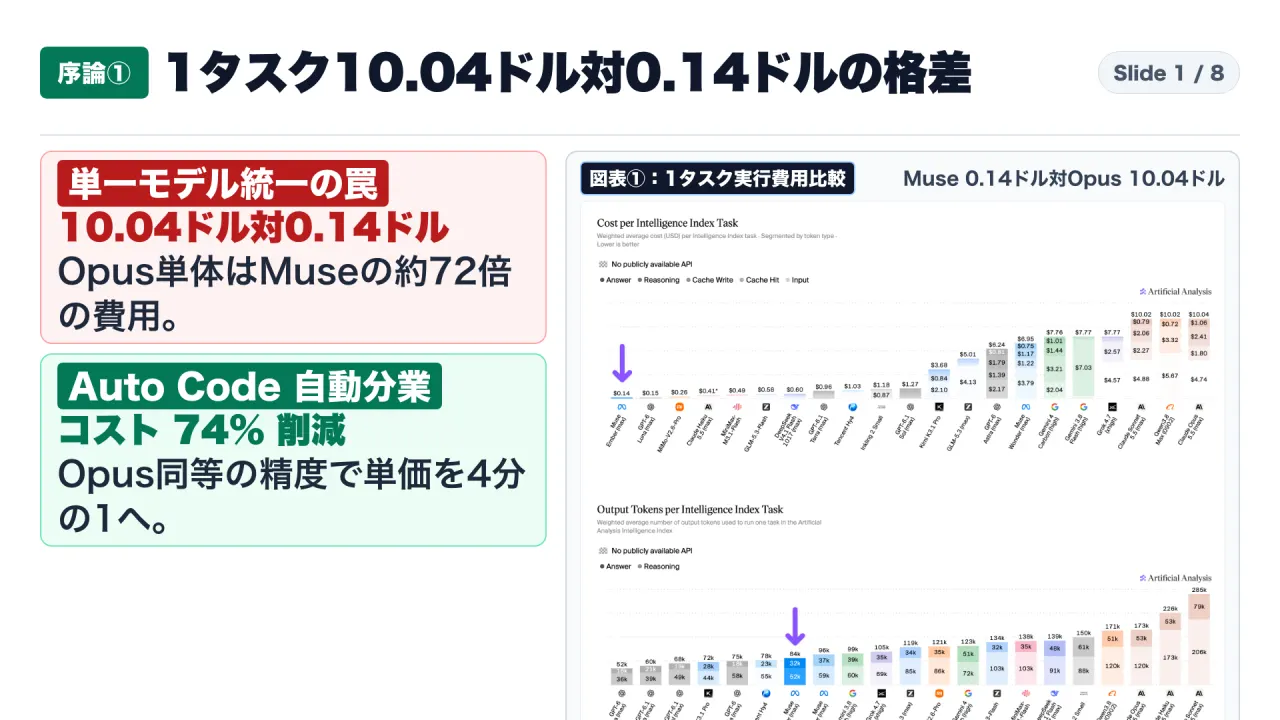
Quantitative measurements from Artificial Analysis Intelligence Index v5.0.1 demonstrate the scale of this economic distortion. Across standardized evaluation workloads, running Claude Opus 5.5 (max configuration) averages $10.04 per completed task, consuming an average of 173,000 output tokens (120,000 answer tokens and 53,000 reasoning tokens). Claude Sonnet 5.5 incurs a near-identical cost of $10.02 per task while generating 285,000 tokens. Even lightweight frontier options such as Claude Haiku 5.5 average $0.41 per task ($0.411 on raw plot data), burning 226,000 tokens (173,000 of which are expended in reasoning).
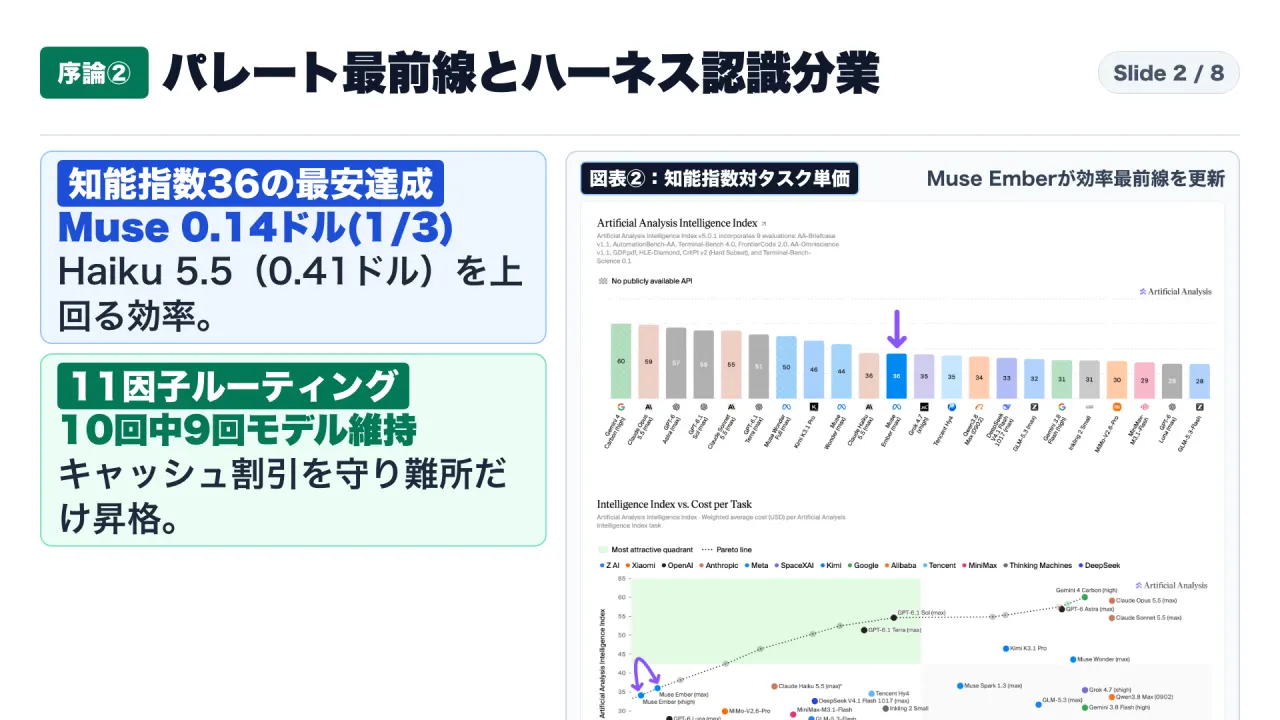
In sharp contrast, Meta AI Research’s Muse Ember establishes a new Pareto frontier for subagent economics. Priced at $0.10 per million input tokens, $0.40 per million output tokens, and $0.015 per million cached input tokens, Muse Ember achieved an overall Intelligence Index score of 36 (specifically 35.8, matching Claude Haiku 5.5 at 35 to 36.2 and exceeding GPT-6 Luna at 28) while incurring an average cost of just $0.14 ($0.136) per task. At its xhigh setting, task cost dropped to $0.116 with an intelligence score of 33.9.
This ~72× cost divergence between Claude Opus 5.5 ($10.04) and Muse Ember ($0.14) stems not only from base token pricing but also from token generation efficiency. While Claude Haiku 5.5 consumes 226,000 tokens and Sonnet 5.5 expends 285,000 tokens to navigate a task, Muse Ember completes the workload using an average of 84,000 tokens (32,000 answer tokens and 52,000 reasoning tokens)—roughly 37% of Haiku’s token volume. Peak generation throughput reaches 155 tokens per second on Meta infrastructure, with standard API throughput around 97 tokens per second and an Artificial Analysis verified median of 77 tokens per second.
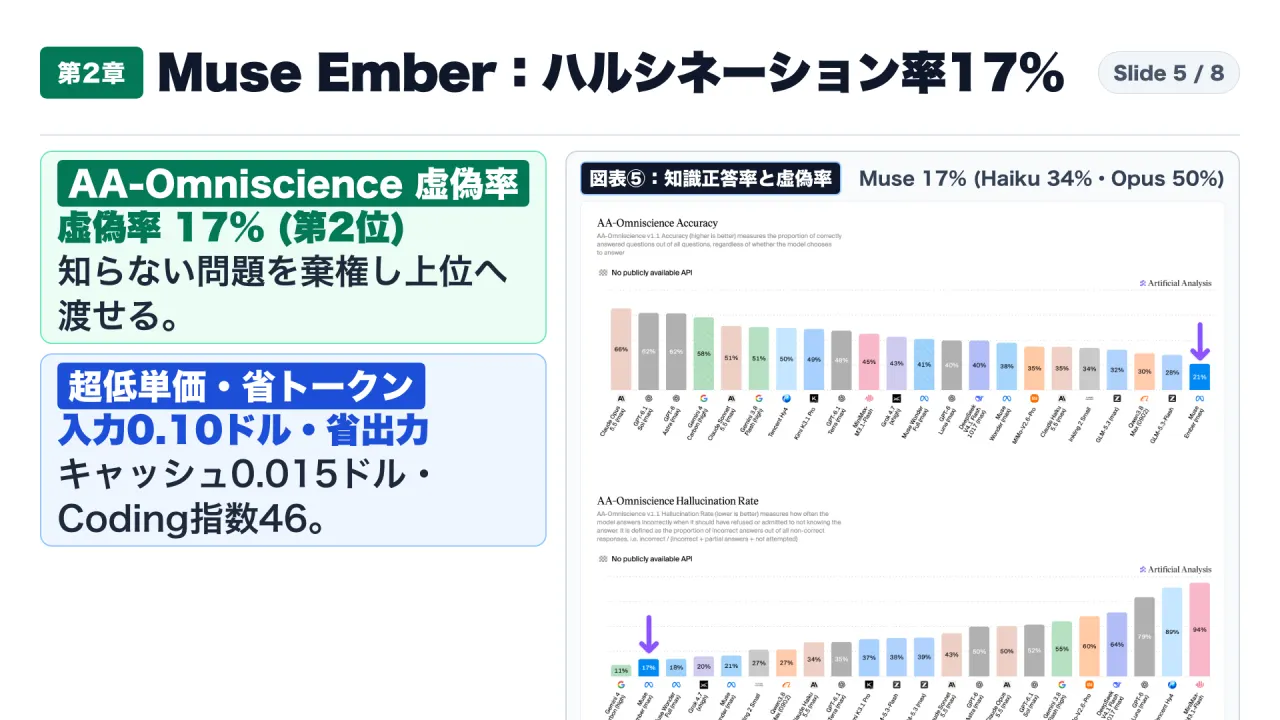
Crucially, in agent harness architectures where subagents perform preliminary triage, hallucination behavior dictates viability. On the AA-Omniscience v1.1 evaluation, which tests factual precision and calibrated abstention, Muse Ember demonstrated a 17% hallucination rate—the second lowest recorded across all evaluated models, surpassed only by Gemini 4 Carbon at 11%. For comparison, Claude Haiku 5.5 recorded a 34% hallucination rate, Claude Opus 5.5 reached 50%, and GPT-6 Luna hit 79%. Although Muse Ember’s raw factual recall accuracy is 21% (reflecting its compact parameter scale relative to Opus 5.5’s 66%), its willingness to abstain rather than fabricate ungrounded answers makes it exceptionally safe for triage: when it encounters an ambiguous problem, it routes execution upward rather than polluting the agent context window with corrupted state.
2. Extreme-Horizon Autonomy: Claude Fable 5.2 and the 30-Hour Reasoning Wall
While compact models solve the economics of high-frequency subagent loops, frontier technical challenges reveal where standard implementation models collapse. Anthropic’s release of Claude Fable 5.2 and its companion verification model Claude Mythos 5.2 addresses long-horizon autonomous tasks that exceed the reasoning endurance of Claude Opus 5.5.
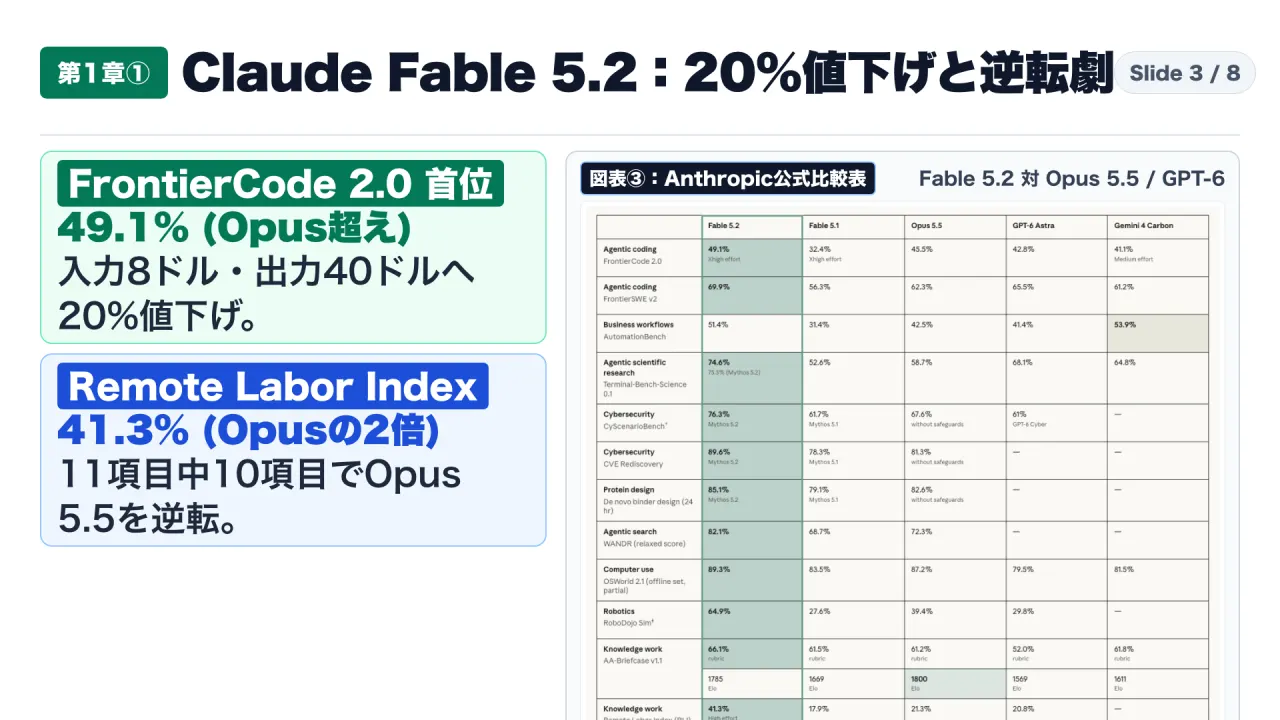
Priced at $8 per million input tokens and $40 per million output tokens—a 20% price reduction compared to the previous-generation Fable 5.1 ($10 input, $50 output)—Fable 5.2 features a 1-million-token context window with a 128,000-token maximum output limit and up to 30% faster generation speeds. A dedicated Fast Mode ($16 input, $80 output) provides up to 2.5× faster output generation for latency-critical debugging. Across 11 benchmark domains, Fable 5.2 surpassed Claude Opus 5.5 in 10 categories, including FrontierCode 2.0 (49.1% at Xhigh effort vs. Opus 5.5’s 45.5%), FrontierSWE v2 (69.9% vs. 62.3%), Terminal-Bench-Science 0.1 (74.6% vs. 58.7%), and the Remote Labor Index (41.3% vs. 21.3%).
The operational justification for reserving a dedicated Tier 1 model emerges clearly in long-duration reasoning workloads. In an Anthropic empirical experiment formalizing the proof of Fermat’s Last Theorem into the Lean interactive theorem prover over a continuous 30-hour window, approximately 1,000 coordinated agents were evaluated across progressive time horizons.
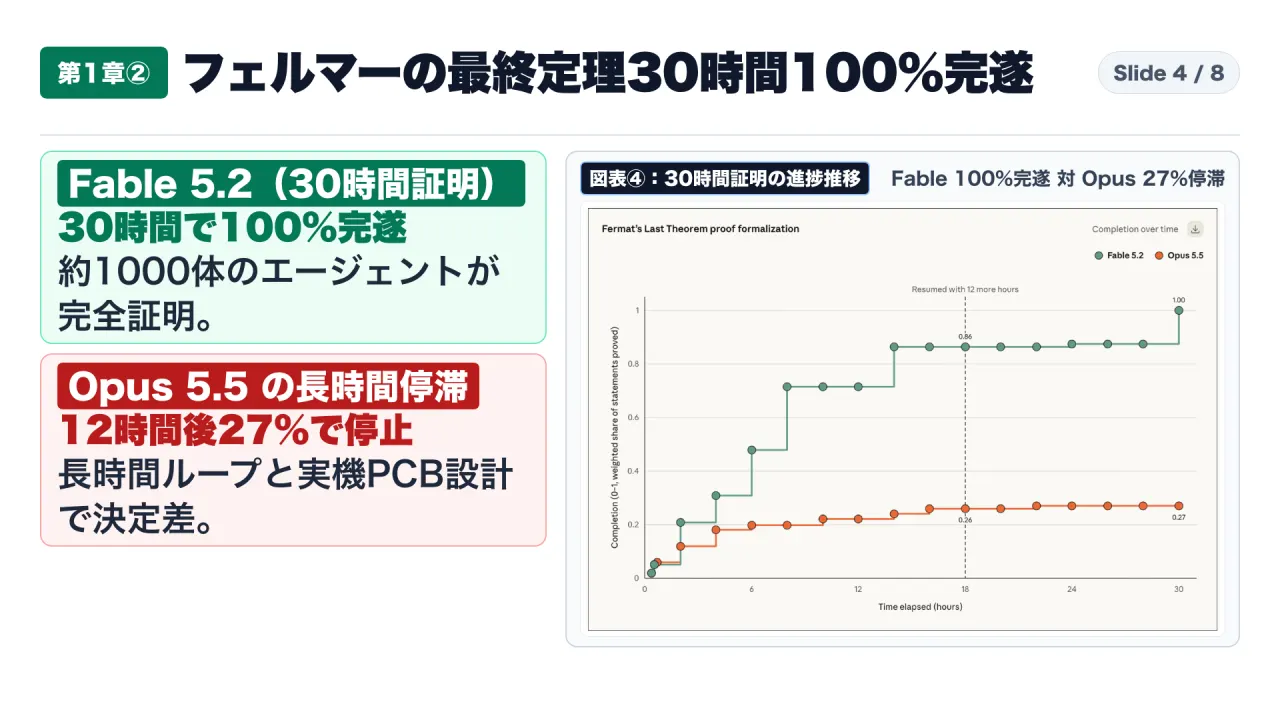
The progression trajectory revealed a structural divergence:
- 6 Hours Elapsed: Claude Opus 5.5 reached 17% proof completion, while Claude Fable 5.2 registered 15%, showing comparable initial exploration.
- 12 Hours Elapsed: Claude Opus 5.5 reached 26% completion, tracking closely alongside Fable 5.2 at 25%.
- 18 to 24 Hours Elapsed: Claude Opus 5.5 flatlined entirely at 26%, unable to resolve deeper proof branches or break out of circular subproof attempts. In contrast, Claude Fable 5.2 achieved a breakthrough, advancing to 86% completion by hour 18.
- 30 Hours Elapsed: Claude Opus 5.5 concluded at 27% completion. Claude Fable 5.2 achieved 100% formal proof completion.
Anthropic documented a parallel capability gap in physical hardware engineering in its research report Evaluating Claude on Electronics Design. Across digital circuit design (Verilog RTL), analog simulation (SPICE), and printed circuit board (PCB) layout using KiCad, earlier models suffered compounding error loops during component placement and autorouting. Fable 5.2 successfully executed end-to-end schematic capture, bill-of-materials component matching, automated trace routing, and firmware integration, generating valid manufacturing Gerber files that were fabricated and physically verified on live test benches.
3. Harness-Aware Routing: OpenRouter Auto Code and Prompt Cache Preservation
Deploying a multi-model architecture requires an intelligent routing layer. However, early dynamic routers introduced a critical operational penalty: cache thrashing. In modern coding harnesses (such as Claude Code, Codex, Cline, and OpenCode), every turn carries a cumulative execution context consisting of system instructions, tool definitions, file snapshots, and conversation history. Major model providers offer prompt caching discounts that reduce input costs by up to 90% while dramatically accelerating prefill latency. When a naive router switches models on every turn based on isolated prompt metrics, it invalidates provider caches, forcing full recalculation and driving effective API costs higher than static model deployment.
OpenRouter’s redesigned Auto Router (openrouter/auto) and specialized Auto Code (openrouter/auto-code) address this mechanism directly. Operating with zero additional routing markup ($0 fee) and processing over 2.5 trillion tokens monthly across 100,000 developers, the routing engine reduced 90th-percentile (p90) routing evaluation latency from 1.96 seconds in legacy versions down to 0.65 seconds.
The core algorithmic innovation in Auto Code is harness awareness. The router evaluates 11 distinct request dimensions—including task classification, estimated difficulty, required precision, marginal benefit of larger parameter scales, code integration depth, and visual context requirements—alongside real-time provider uptime, pricing, and cache residency state. In autonomous agent harness workflows, the router enforces model stickiness, keeping the selected model constant across nearly 9 out of 10 consecutive agent turns (approximately 90% of turns) to preserve prompt cache hits, switching models only when an execution phase shift demands higher reasoning capacity.
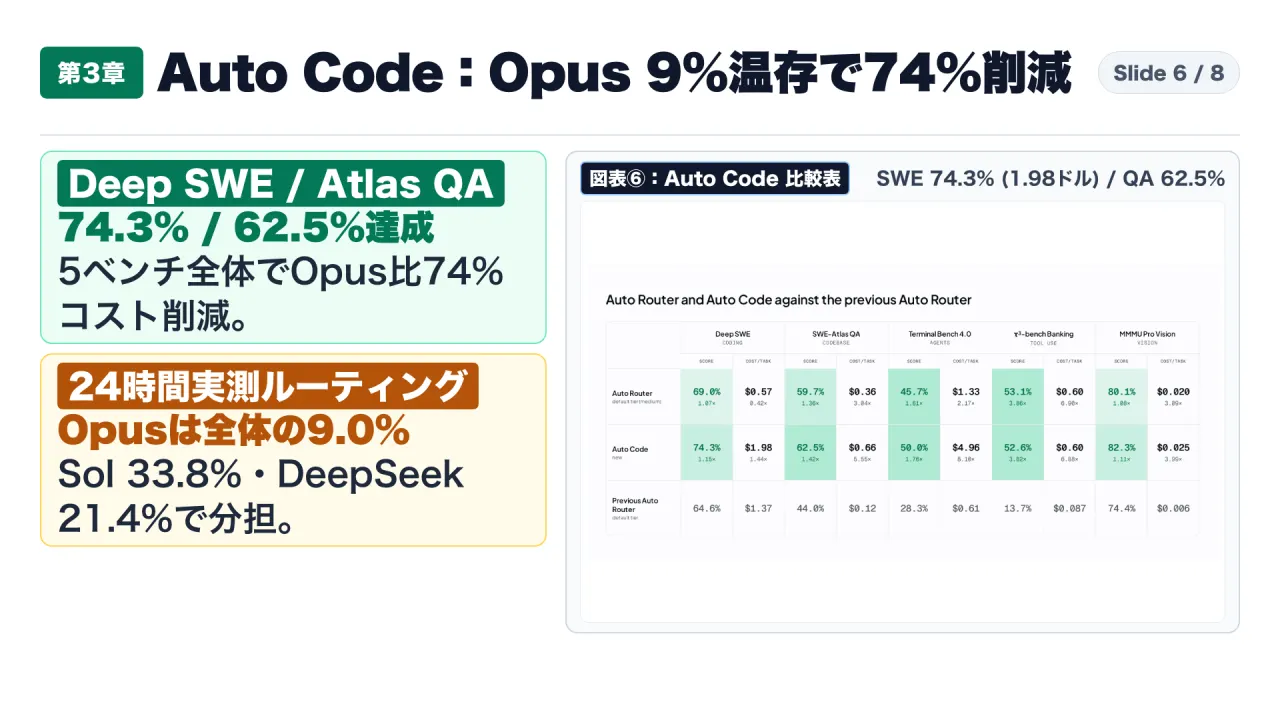
Across five comprehensive evaluation suites, Auto Code matched the baseline accuracy of Claude Opus 5.5 while cutting average per-task cost by 74%:
- Deep SWE (Coding): Scored 74.3% at $1.98 per task (vs. Previous Auto Router’s 64.6% at $1.37).
- SWE-Atlas QA (Codebase Navigation): Scored 62.5% at $0.66 per task (vs. Previous Auto Router’s 44.0% at $0.12).
- Terminal Bench 4.0 (Autonomous Agents): Scored 50.0% at $4.96 per task (vs. Previous Auto Router’s 28.3% at $0.61).
- Tau3-bench Banking (Deterministic Tool Use): Scored 52.6% at $0.60 per task (a 3.82× improvement over Previous Auto Router’s 13.7% at $0.087).
- MMMU Pro Vision (Multimodal Reasoning): Scored 82.3% at $0.025 per task (vs. Previous Auto Router’s 74.4% at $0.006).
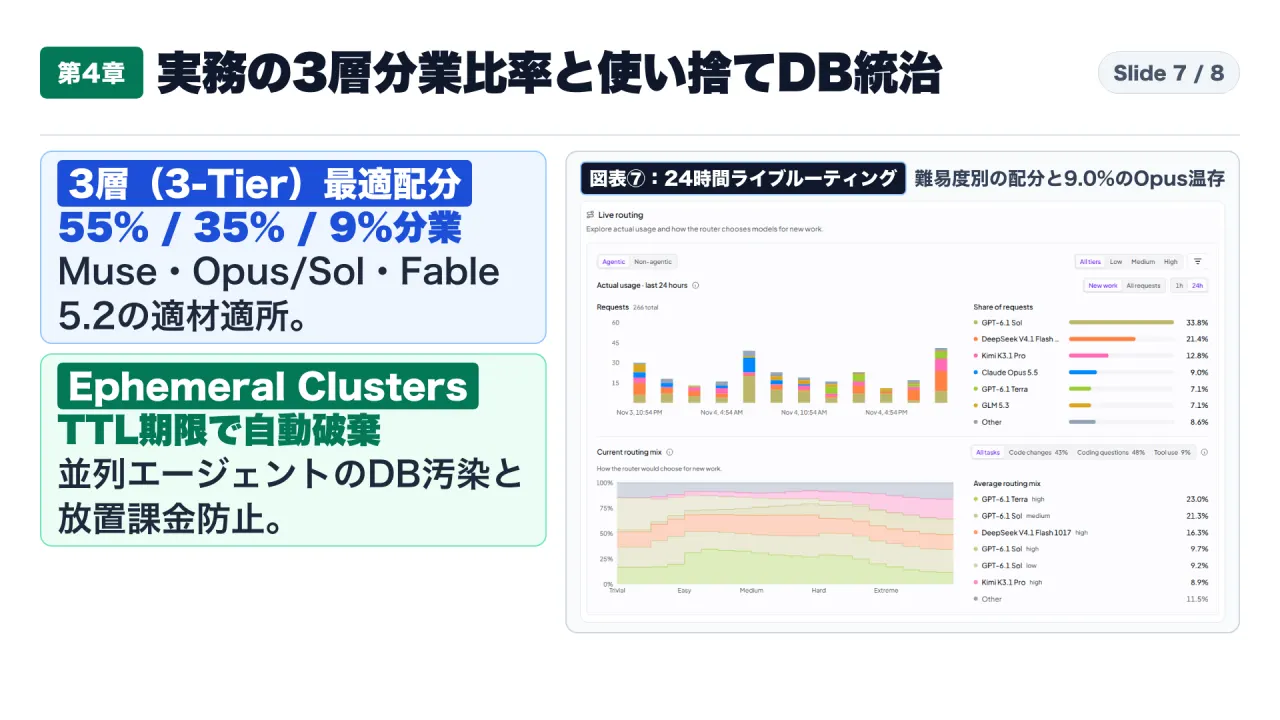
Empirical telemetry from 24 hours of live production routing on OpenRouter (comprising 266 agent requests: 43% code edits, 48% code queries, and 9% tool invocations) illustrates how Auto Code achieves this 74% savings. Rather than routing all traffic to Claude Opus 5.5, the router distributed actual execution share as follows:
- GPT-6.1 Sol: 33.8% (primary workhorse for standard implementation)
- DeepSeek V4.1 Flash: 21.4% (high-speed, low-cost subagent execution)
- Kimi K3.1 Pro: 12.8% (mid-to-high reasoning tasks)
- Claude Opus 5.5: 9.0% (strictly reserved for complex, high-uncertainty operations)
- GPT-6.1 Terra: 7.1%
- GLM 5.3: 7.1%
- Other Models: 8.6%
By rationing Claude Opus 5.5 to just 9.0% of total volume and relying on optimized mid-tier and subagent models for the remaining 91%, the system delivers enterprise-grade software engineering performance at a fraction of uniform frontier pricing.
4. Production Architecture: Three-Tier Allocation and Ephemeral Infrastructure Governance
Synthesizing verified data from Anthropic, Meta, and OpenRouter yields a clear blueprint for enterprise AI agent systems: a three-tier operational allocation supported by automated infrastructure cleanup.
The Three-Tier Production Hierarchy
- Tier 3: High-Frequency Subagent Layer (~50% to 60% of total calls)
- Target Models: Meta Muse Ember ($0.10 input / $0.40 output / $0.015 cached input) or DeepSeek V4.1 Flash.
- Responsibilities: File system traversal, AST symbol indexing, log parsing, preliminary test output inspection, and escalation filtering. Muse Ember’s 17% hallucination rate ensures safe abstention when unfamiliar code paths are encountered.
- Tier 2: Primary Implementation & Knowledge Work (~30% to 40% of total calls)
- Target Models: Claude Opus 5.5 ($4.00 input / $20.00 output) or GPT-6.1 Sol.
- Responsibilities: Feature authoring, complex refactoring, test suite generation, and pull request documentation. Managed with cache stickiness (retaining model choice across ~9/10 turns) to maximize prompt caching economics.
- Tier 1: Extreme-Horizon Autonomy & Verification (<10% of total calls)
- Target Models: Claude Fable 5.2 ($8.00 input / $40.00 output) or Claude Mythos 5.2.
- Responsibilities: Tasks requiring over 12 hours of unbroken autonomous search, hardware/PCB layout generation, formal mathematical proofs, and complex security vulnerability rediscovery (CVE Rediscovery score of 89.6%).
Preventing Infrastructure Exhaustion via Ephemeral Clusters
A direct consequence of cutting per-task API costs by 74% is a rapid expansion in concurrent agent instances. When engineers can execute full agent workflows for $0.50 to $2.00 rather than $10.00+, development organizations routinely scale from running 2 parallel agents to running 20 or more.
This volume surge introduces a critical infrastructure failure mode: staging database collisions and orphaned cloud resources. If multiple agents share a staging database while executing autonomous migration scripts, they corrupt shared schemas. Conversely, if each agent provisions dedicated database instances via CI/CD, abnormal agent terminations or unhandled exceptions leave orphaned clusters running indefinitely, rapidly generating thousands of dollars in cloud infrastructure waste.
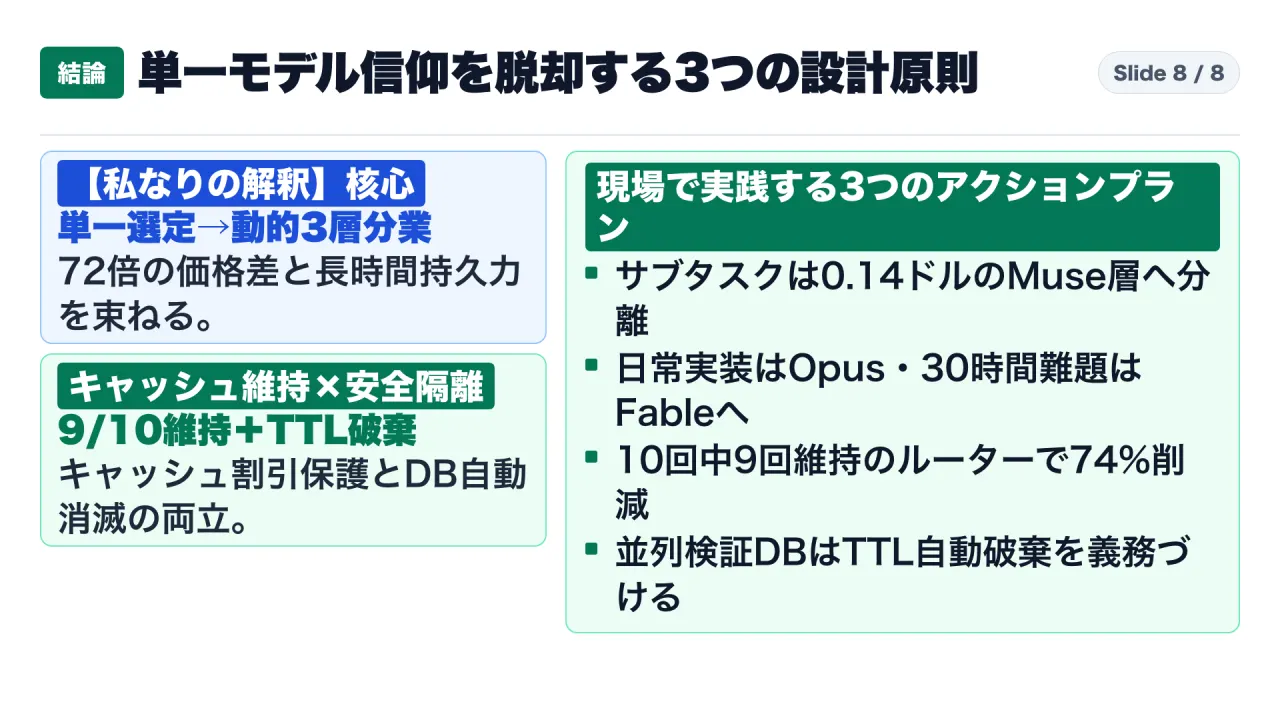
To resolve this bottleneck, production agent pipelines must integrate time-to-live (TTL) ephemeral database provisioning, such as MongoDB Atlas Ephemeral Clusters:
- Programmatic Provisioning: The agent harness initializes an isolated database cluster via API or CLI at the exact start of an evaluation or migration task.
- Deterministic Auto-Expiration: Every provisioned cluster enforces a mandatory TTL metadata tag. If an agent crashes, gets killed, or enters an infinite loop, the cloud control plane automatically destroys the cluster upon TTL expiration, guaranteeing zero persistent staging data pollution and zero runaway zombie cloud expenditures.
By combining three-tier model routing, prompt cache stickiness, and ephemeral infrastructure governance, engineering teams can escape the economic trap of single-model uniformity while unlocking continuous, long-horizon autonomous software engineering.
Sources
- Anthropic, “Introducing Claude Fable 5.2 and Mythos 5.2”: https://www.anthropic.com/claude-fable-and-mythos-5-2
- Anthropic Research, “Evaluating Claude on Electronics Design”: https://www.anthropic.com/research/claude-electronics-design
- AWS Machine Learning Blog, “Introducing Claude Fable 5.2 on AWS”: https://aws.amazon.com/blogs/machine-learning/introducing-claude-fable-5-2-on-aws/
- Meta AI Research, “Introducing Our Smallest, Most Efficient Model: Muse Ember”: https://research.meta.ai/blog/muse-ember
- Artificial Analysis, “Meta’s Muse Ember is the cheapest model scoring 36 on the Intelligence Index”: https://artificialanalysis.ai/articles/meta-s-muse-ember-is-the-cheapest-model-scoring-36-on-the-intelligence-index
- OpenRouter Blog, “Introducing the New Auto and Auto Code Routers on OpenRouter”: https://openrouter.ai/blog/announcements/auto-and-auto-code-routers/
- Artificial Analysis, “GDPval-AA Evaluation Leaderboard”: https://artificialanalysis.ai/evaluations/gdpval-aa
- MongoDB Atlas Documentation, “Create an Ephemeral Cluster”: https://www.mongodb.com/docs/atlas/tutorial/create-ephemeral-cluster/