Inside NVIDIA's $4.8 Billion CaaS Cloud Route and Governance Dilemma: MSS Intelligence, FISA 702 Lapses, and the Single Point of Failure Behind 60 Direct Reports
Executive Summary & Key Takeaways
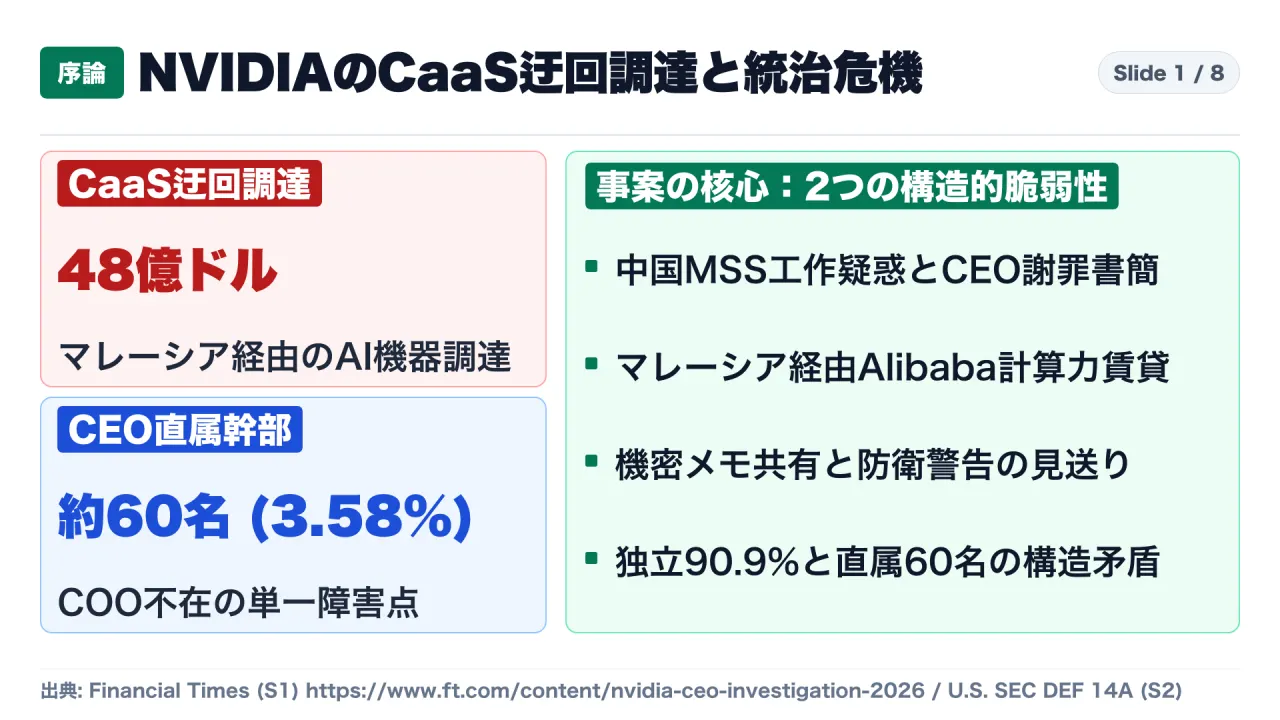
- Core Thesis: In early November 2026, an internal crisis at NVIDIA Corporation—the world’s preeminent AI hardware provider with a market capitalization of $4.506 trillion—revealed systemic vulnerabilities across U.S. export controls, intelligence coordination, and corporate governance. Following an all-employee letter from CEO Jensen Huang acknowledging an extramarital relationship with Alice Huang (former managing director of Singapore-based Megaspeed International), classified intelligence memos identified the executive as a recruited asset of China’s Ministry of State Security (MSS). The operation pursued a dual strategy: extracting advanced GPU supply-chain telemetry and steering executive lobbying against U.S. export controls, backed by Megaspeed procuring at least $4.8 billion in NVIDIA hardware across Southeast Asia to provide Compute-as-a-Service (CaaS) to Alibaba. While statutory authority under FISA Section 702 lapsed on June 12, 2026, foreign intelligence surveillance continued legally under a FISC reauthorization extending to March 17, 2027. Despite actionable intelligence, the executive branch withheld a defensive briefing from Huang due to geopolitical sensitivities. When the board formed an independent special committee, McKinsey 7S organizational diagnostic exposed an acute single point of failure (SPOF): despite a 90.9% independent board and a single-class voting structure where Huang holds only 3.58%, the absence of a Chief Operating Officer and an extreme flat structure with roughly 60 direct executive reports makes removing the CEO an operational impossibility.
- Primary Sources Verified: NVIDIA Corporation Form 10-K (FY2026) and Notice of 2026 Annual Meeting of Shareholders (Proxy Statement DEF 14A); Financial Times investigative reporting; Bloomberg News intelligence debriefs; Brennan Center for Justice legal analyses on FISA Section 702(j)(5)(B); U.S. House of Representatives joint committee inquiry letter (Select Committee on the CCP, Foreign Affairs, and Intelligence); FrameworkList corporate governance diagnostics.
- Actionable Engineering & Governance Takeaways:
- Conduct beneficial-ownership audits across global cloud providers: verify whether third-party Compute-as-a-Service (CaaS) hosts in Southeast Asia or the Middle East lease virtualized compute to restricted entities.
- Decouple founder culture from organizational structure: eliminate structural single points of failure by appointing a Chief Operating Officer (COO), delegating operational lines, and institutionalizing documented succession paths.
- Formalize private-sector counterintelligence defenses: technology firms designing dual-use critical infrastructure must establish formal defensive briefing channels with security agencies.
- Limits of the Evidence: Alice Huang and Megaspeed International have formally denied acting on behalf of the MSS or facilitating illegal chip diversions; Singaporean authorities are investigating corporate business practices rather than formal espionage charges. Details of the executive branch classified briefing and upcoming congressional testimony remain shielded under national security classification.
Japanese Edition: https://consuloji.substack.com/p/nvidia4860coo
1. The Intelligence Operation: MSS Influence Strategy and the FISA 702 Surveillance Mechanism
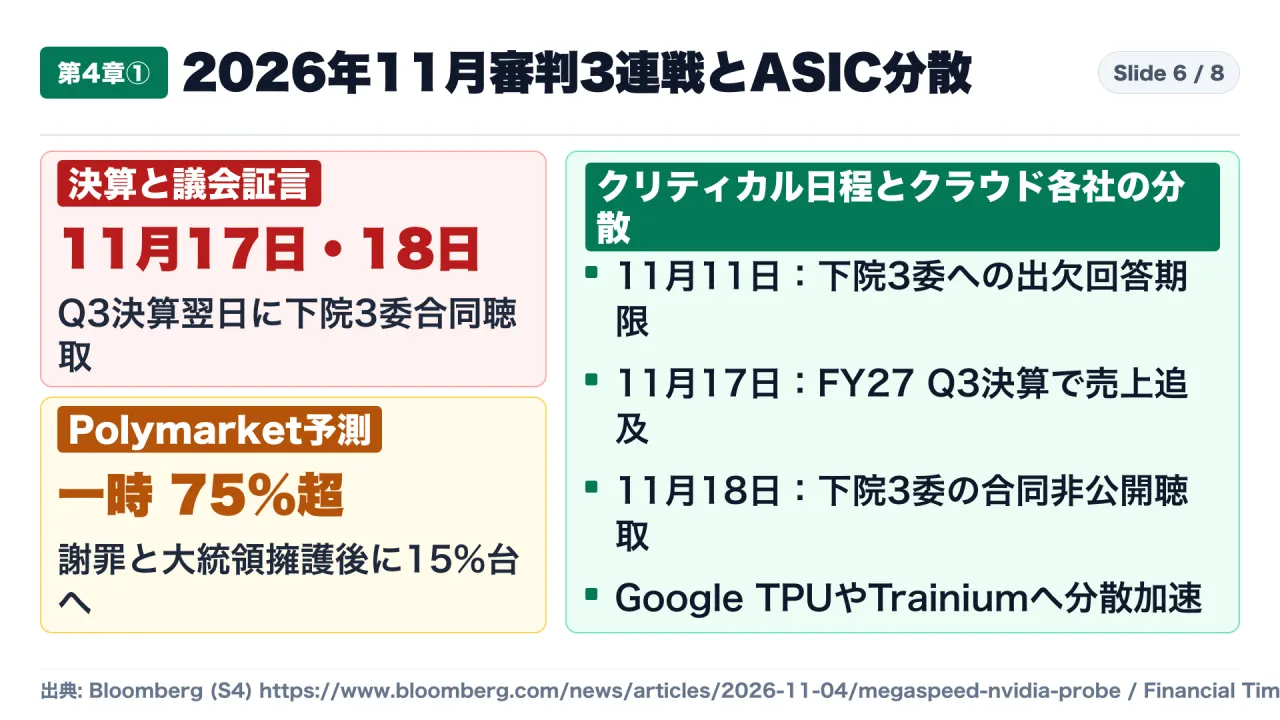
On November 8, 2026, Jensen Huang, the 63-year-old co-founder and CEO of NVIDIA, issued an internal letter to all employees apologizing for an extramarital relationship with Alice Huang (Huang Le), a Chinese national with no familial relation. The revelation triggered an immediate 7% drop in NVIDIA’s stock price, while prediction markets on Polymarket briefly priced the probability of Huang’s departure before year-end above 75%.
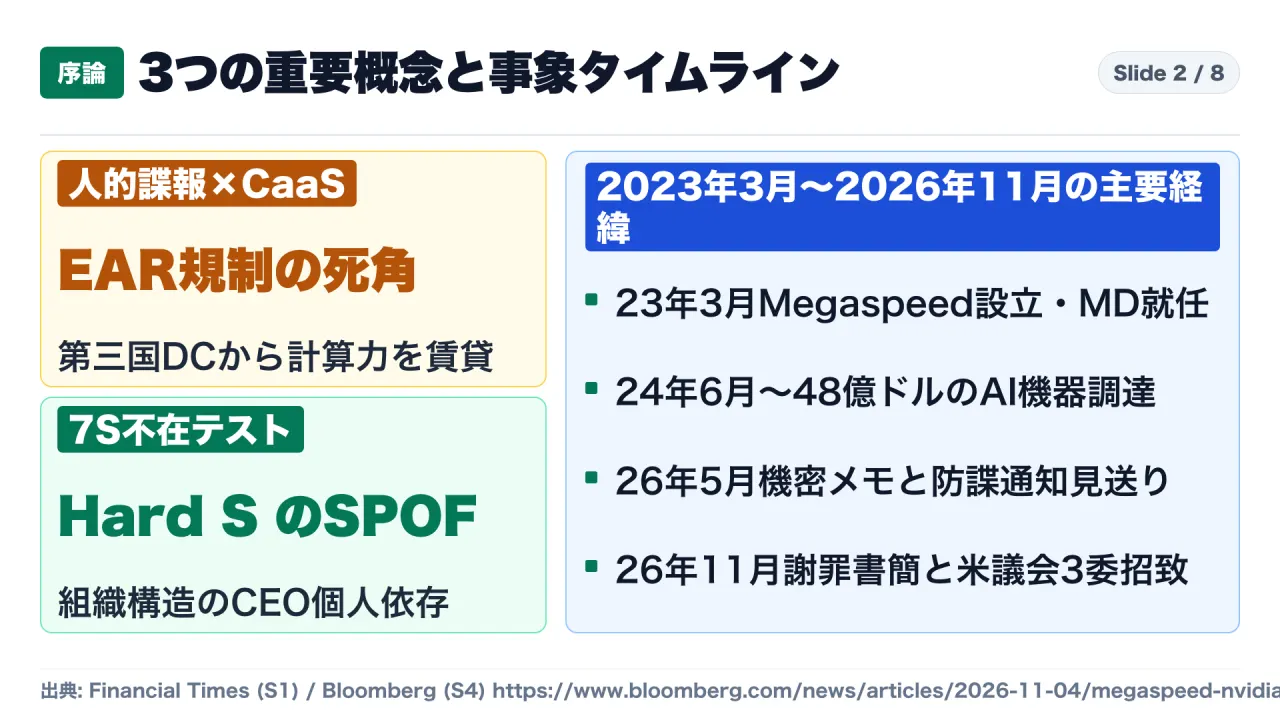
However, intelligence debriefs published by the Financial Times and Bloomberg established that the matter extended far beyond personal misconduct. The counterintelligence division of the Federal Bureau of Investigation (FBI) and the Central Intelligence Agency (CIA) had tracked Alice Huang since mid-2024, concluding in a formal intelligence memo that she had been recruited by China’s primary civilian intelligence and secret police agency, the Ministry of State Security (MSS).
The Dual-Mission Architecture of the MSS
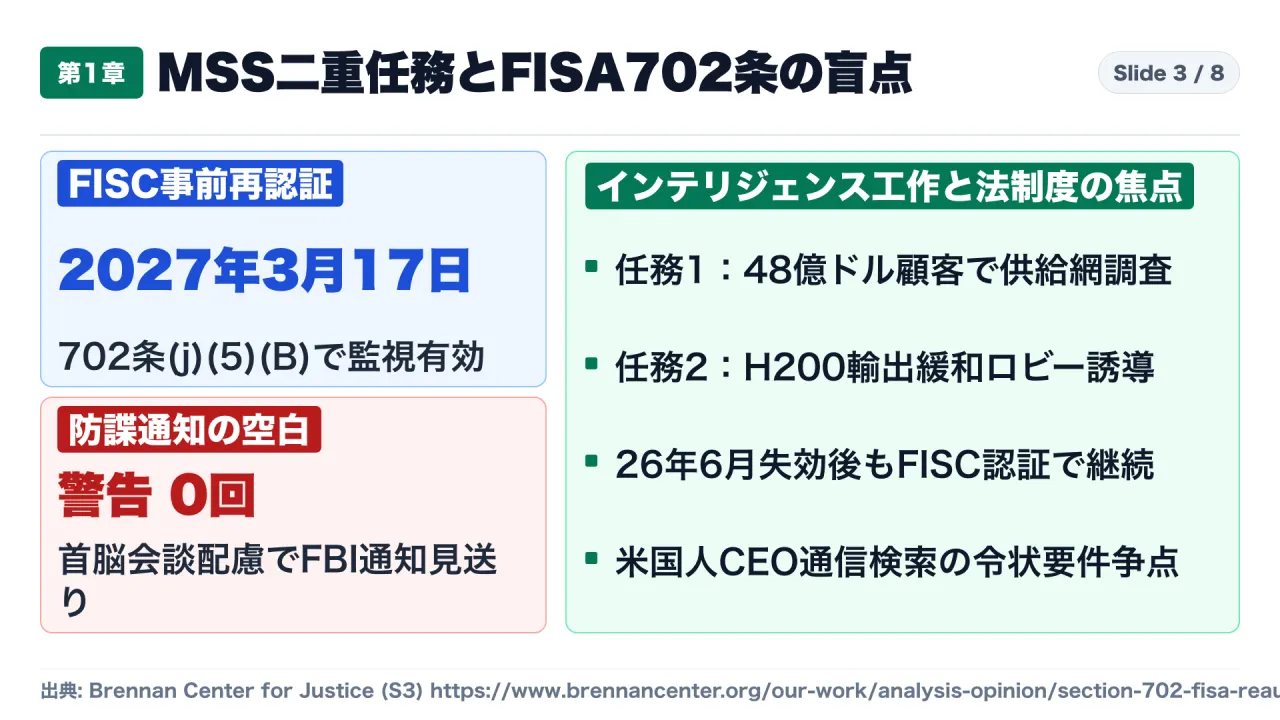
Intelligence analysts determined that the MSS targeted Huang through human intelligence (HUMINT) to execute two interdependent strategic objectives:
- Information Extraction (Technical & Supply Chain Telemetry): Leveraging Megaspeed International’s position as a major buyer that purchased over $4.8 billion in NVIDIA AI systems over 20 months, the asset collected detailed data on advanced GPU component allocations, chip packaging throughput at TSMC, and the physical delivery itineraries of cutting-edge architectures.
- Strategic Influence Operations (Export-Control Policy): By establishing access to Huang, the operation sought to reinforce and shape the CEO’s active lobbying against U.S. export controls. Throughout 2025 and 2026, Huang publicly and privately lobbied the White House and Commerce Department to permit sales of advanced chips (such as the H200 and custom Chinese-market variants), arguing that export bans were counterproductive and accelerated Chinese domestic semiconductor independence.
The Legal Mechanics of FISA Section 702: Statutory Lapse vs. FISC Reauthorization
The electronic surveillance that uncovered the communication channels between Alice Huang and Beijing operated under an intricate legal framework.
Under the Reforming Intelligence and Securing America Act (RISAA, P.L. 118-49), Congress extended Section 702 of the Foreign Intelligence Surveillance Act (FISA) through April 2026. Following legislative deadlock, FISA Section 702’s statutory authority formally lapsed on June 12, 2026.
However, surveillance operations continued lawfully due to a statutory transition rule. In March 2026, prior to statutory expiration, the Foreign Intelligence Surveillance Court (FISC) approved the intelligence community’s annual Section 702 certifications. Under FISA Section 702(j)(5)(B), judicial certifications issued by the FISC remain in legal effect for one full calendar year, preserving active surveillance authorities until March 17, 2027.
Because Alice Huang was a non-U.S. person located outside the United States, intercepts targeting her communications required no individual warrant under Section 702. However, the subsequent querying of incidental communications involving Jensen Huang—a U.S. citizen—became a major flashpoint regarding compliance with statutory Fourth Amendment querying standards.
The Breakdown of Defensive Briefings
The most severe institutional failure occurred within executive branch counterintelligence protocols. Typically, when a senior executive of a critical dual-use technology firm is targeted by a hostile foreign intelligence service, the FBI conducts a “Defensive Briefing” to formally warn the executive and neutralize the compromise.
Secretary of State Marco Rubio oversaw the compilation of the classified assessment detailing the relationship, and President Trump was briefed approximately one year prior to public disclosure. Yet the administration actively withheld a defensive briefing from Huang.
Officials feared that warning Huang would disrupt NVIDIA’s commercial relationships, imperil semiconductor market stability, and derail high-stakes bilateral trade talks surrounding the May 2026 U.S.–China presidential summit in Beijing—a summit delegation that Huang attended. This political intervention left a critical U.S. technology leader exposed to foreign intelligence manipulation for over a year.
2. The Megaspeed Supply Chain: $4.8 Billion in AI Hardware and the CaaS Regulatory Void
The commercial vehicle at the center of the intelligence inquiry is Megaspeed International, a cloud infrastructure and data center firm headquartered in Singapore.
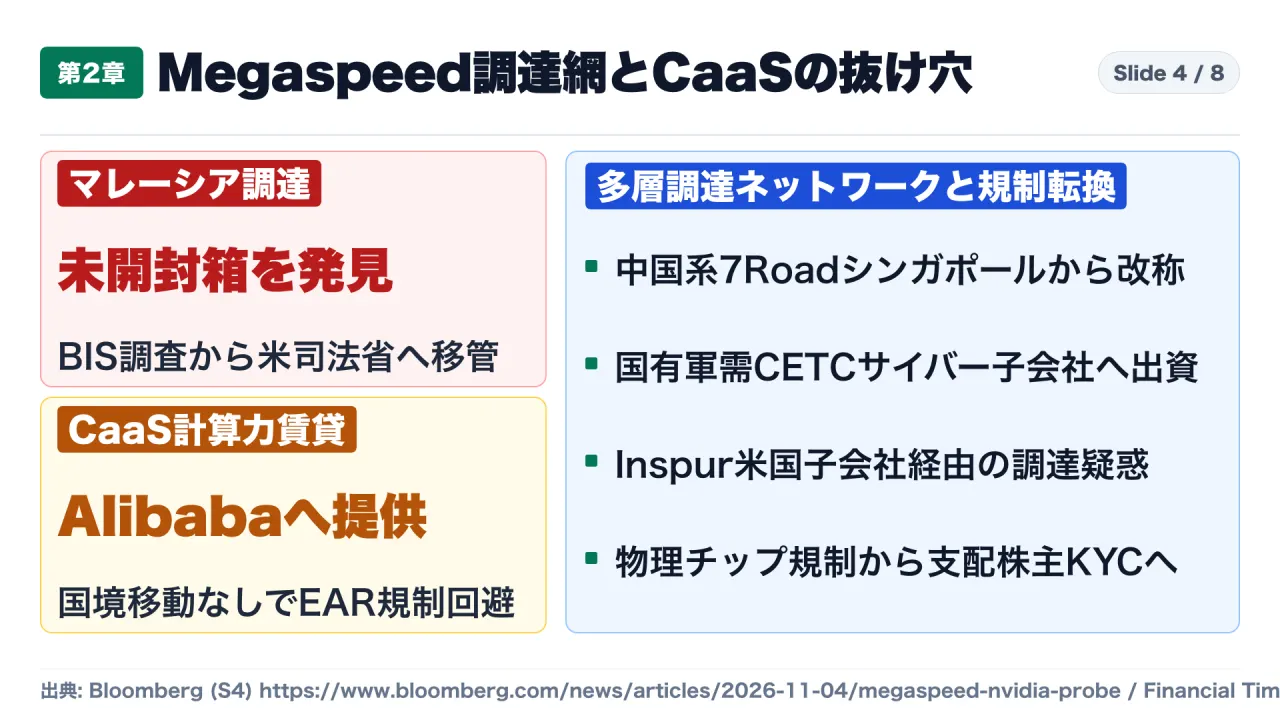
A forensic examination of corporate registries reveals Megaspeed’s ties to Chinese state and defense conglomerates:
- Corporate Genesis: Megaspeed was established in March 2023 via a corporate restructuring of 7Road International (第七大道), a Singapore entity partially owned by Chinese state-affiliated capital. Alice Huang was appointed managing director during its foundational eight months.
- Defense Equity Ties: Corporate records verify that Megaspeed executed direct minority equity investments into a cybersecurity subsidiary of the China Electronics Technology Group Corporation (CETC), a state-owned defense electronics manufacturer under comprehensive U.S. sanctions.
- OEM Assembler Alliances: Megaspeed cultivated relationships with executive leadership at Taiwan’s GIGABYTE Technology (技嘉科技), a Tier-1 server manufacturing partner for NVIDIA HGX platforms.
- Intermediary Routing: Senator Tom Cotton initiated congressional inquiries examining whether Megaspeed procured equipment through front entities connected to U.S.-based subsidiaries of Inspur Group (浪潮集団), a Chinese server conglomerate placed on the U.S. Entity List.
The CaaS Loophole: Circumventing the Export Administration Regulations (EAR)
Between June 2024 and February 2026, customs records indicate that Megaspeed’s Malaysian corporate affiliates purchased at least $4.8 billion (over 700 billion yen) in high-end NVIDIA AI servers.
In late 2024, U.S. Department of Commerce export enforcement officers conducted on-site end-use verifications in Malaysia, discovering crated, unopened NVIDIA server racks. Suspecting illicit transshipment into China, the Commerce Department referred the matter to the U.S. Department of Justice (DOJ), while Singaporean police launched a parallel inquiry into fraudulent business documentation.
However, the primary strategic threat was not physical smuggling, but Compute-as-a-Service (CaaS) leasing:
| Dimension | Physical Export Control (EAR / Entity List) | Remote Compute Leasing (CaaS / IaaS Model) |
|---|---|---|
| Transaction Vector | Physical shipment or re-export of silicon (H100/H200/B300) into mainland Chinese territory. | Legal purchase and deployment of servers inside neutral third countries (Malaysia, Singapore, Indonesia). |
| Access Mechanism | Clandestine cross-border freight forwarding through intermediary front companies. | Chinese developers connect remotely via encrypted APIs to train and run frontier models. |
| Statutory Coverage | Prohibited under standard item-based Export Administration Regulations (EAR). | Unregulated regulatory grey zone; physical goods do not cross sovereign borders. |
| Enforcement Barrier | Tangible customs seizures and physical end-use verifications (EUVs). | Requires complex beneficial-ownership tracking and real-time network traffic audits. |
By installing thousands of GPUs in data centers across Johor, Malaysia, and Jakarta, Indonesia, Megaspeed leased compute clusters directly to Chinese tech giant Alibaba. This allowed Chinese research teams to train frontier foundation models on bleeding-edge Blackwell and Hopper clusters via remote access, entirely bypassing U.S. physical export restrictions.
3. The Governance Paradox: 90.9% Board Independence Collides with 60 Direct Reports (McKinsey 7S)
In response to the intelligence crisis, NVIDIA’s Board of Directors appointed a Special Committee of independent directors, retaining independent legal counsel to conduct a comprehensive counterintelligence and data-leakage audit.
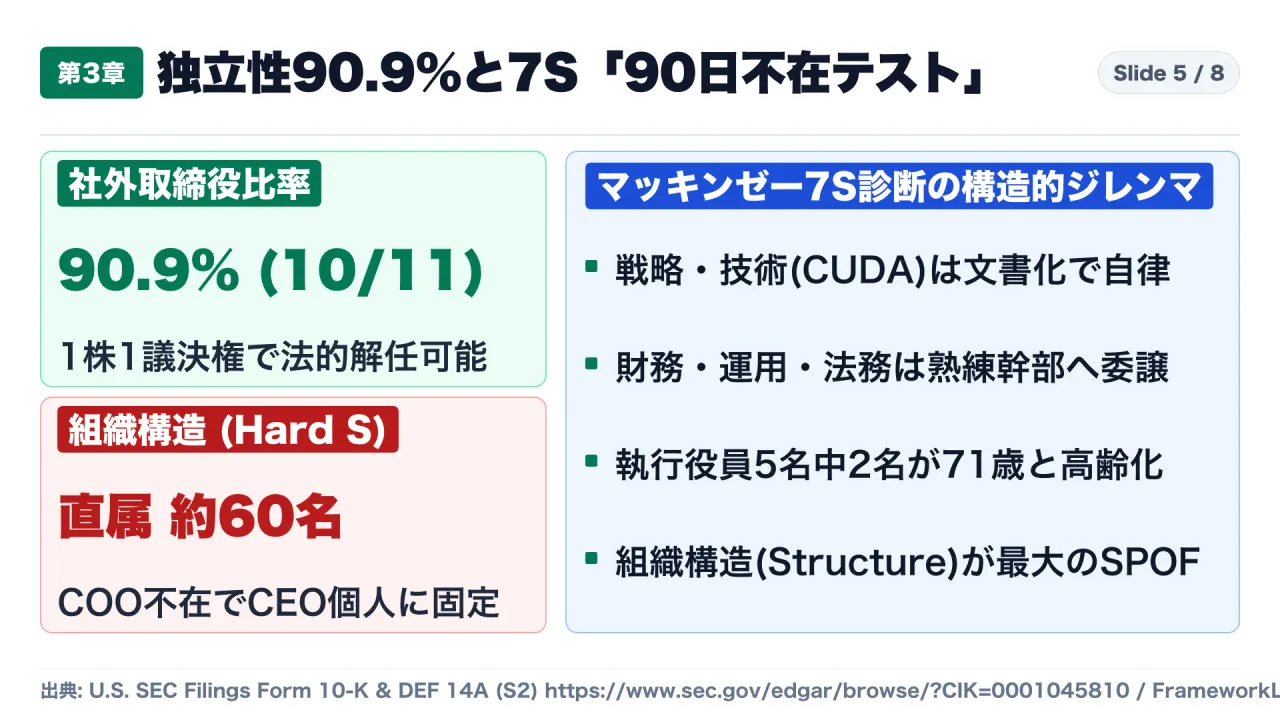
Regulatory filings—specifically NVIDIA’s FY2026 Form 10-K and Proxy Statement (DEF 14A)—illustrate a stark contrast between legal corporate authority and actual operational dependency.
Legal De-coupling: Single-Class Stock and Independent Board
Unlike tech peers featuring dual-class founder shares with super-voting rights (such as Meta, Alphabet, or Anthropic), NVIDIA adheres strictly to a one-share, one-vote capital structure:
- CEO Voting Power: Jensen Huang holds approximately 870.6 million shares, representing a 3.58% equity stake. He possesses no special blocking rights.
- Board Independence: In May 2026, the board expanded to 11 members, appointing former Goldman Sachs Vice Chair Suzanne Nora Johnson in July. 10 of the 11 directors are fully independent (90.9% independence); Huang is the sole internal management director.
- Legal Authority: The board has no permanent chairman; Stephen C. Neal (77), Chairman Emeritus of law firm Cooley LLP, serves as Lead Independent Director. Under company bylaws, the independent directors have the full legal authority to terminate the CEO by a simple majority vote.
The McKinsey 7S “90-Day Absence Test”: The Extreme Structural Single Point of Failure
Despite possessing the legal power to replace Huang, the board faced immediate operational paralysis. Applying the McKinsey 7S Framework through a “90-Day Absence Test” (diagnosing what happens if the CEO abruptly departs for 90 days) exposes the structural trap:
- Strategy (Hard S - Low Risk): Fully documented via multi-year hardware and CUDA roadmaps across annual GTC conferences and Form 10-K filings.
- Structure (Hard S - CRITICAL SPOF): NVIDIA’s fatal vulnerability. The company operates with no Chief Operating Officer (COO). Huang serves concurrently as President and CEO. Rejecting traditional middle-management hierarchies, Huang maintains an extreme flat structure where approximately 60 executive direct reports report directly to him as an unmediated operational hub.
- Systems (Hard S - Moderate Risk): Core operational functions are stabilized under long-serving executives: Chief Financial Officer Colette Kress, Operations EVP Debora Shoquist, and General Counsel Tim Teter.
- Skills (Soft S - Low Risk): Deep, institutionalized engineering capabilities across hardware micro-architecture, packaging, and the proprietary CUDA ecosystem.
- Staff (Soft S - Moderate Risk / Succession Void): While staff retention is exceptionally high, senior leadership is aging: two of the five named executive officers in the Form 10-K are 71 years old. The proxy statement designates no identified successor.
- Shared Values & Style (Soft S - Founder-Dependent): Operating on personal maxims (“no 1-on-1 meetings,” “all feedback delivered in open corporate reviews,” “weekly Top-5 priority emails sent to the CEO”).
Analytical Assessment: While founder-centric “Soft S” elements (culture, management style) are common in Silicon Valley, NVIDIA allowed a critical “Hard S”—organizational structure—to freeze around a single individual. Removing Huang would instantly sever the operational coordination connecting 60 disparate business divisions. This structural Single Point of Failure (SPOF) prevents the board from exercising its legal termination powers without inducing systemic corporate gridlock.
4. The November Crucible and Beyond: Earnings, Congressional Hearings, and the Shift to Custom Silicon
NVIDIA and its board now face a sequence of high-stakes milestones that will reshape the company’s regulatory posture and corporate organization.
The Three-Phase November Crucible
- November 11, 2026 (Congressional Attendance Deadline): House Committee Chairs John Moolenaar (Select Committee on the CCP), Brian Mast (Foreign Affairs), and Rick Crawford (Intelligence) issued a formal demand for NVIDIA to commit to an in-person, closed-door transcribed briefing. Rejecting the request risks the issuance of formal congressional subpoenas.
- November 17, 2026 (FY2027 Q3 Earnings Release): Management faces intense scrutiny from Wall Street analysts regarding Southeast Asian revenue lines, exposure to Megaspeed contract cancellations, and the legal expenses of the special committee investigation.
- November 18, 2026 (Joint Congressional Closed-Door Briefing): Scheduled immediately following earnings, Huang and corporate counsel must testify regarding counterintelligence protocols, export monitoring across Southeast Asian data centers, and foreign influence operations directed at export-control lobbying.
- January–March 2027 (Senate Inquiries & FISA Sunset): Senator Chris Coons leads a formal Senate Foreign Relations inquiry into corporate counterintelligence, coinciding with the March 17, 2027 expiration of FISC Section 702 certifications.
- May 2027 (Proxy Statement DEF 14A): The board is expected to formally institutionalize an executive succession blueprint, establish an independent Board Chair, and appoint a Chief Operating Officer to de-risk the flat management hierarchy.
Acceleration Toward Custom Silicon Alternatives
The instability surrounding NVIDIA’s supply chains has accelerated a macro shift across major cloud hyperscalers. To eliminate single-vendor dependency, Google, Amazon, and Meta are ramping capital investments into proprietary custom silicon:
- Google: Accelerating sixth- and eighth-generation TPU rollouts (
TPU 8i Max/TPU 8tx), capturing internal long-context agentic workloads. - Amazon Web Services (AWS): Broadening deployment of Trainium2 and Trainium3 chips for Anthropic and enterprise clients.
- Meta: Scaling deployment of the Meta Training and Inference Accelerator (MTIA) across ranking and recommendation pipelines.
Practical Engineering & Governance Takeaways
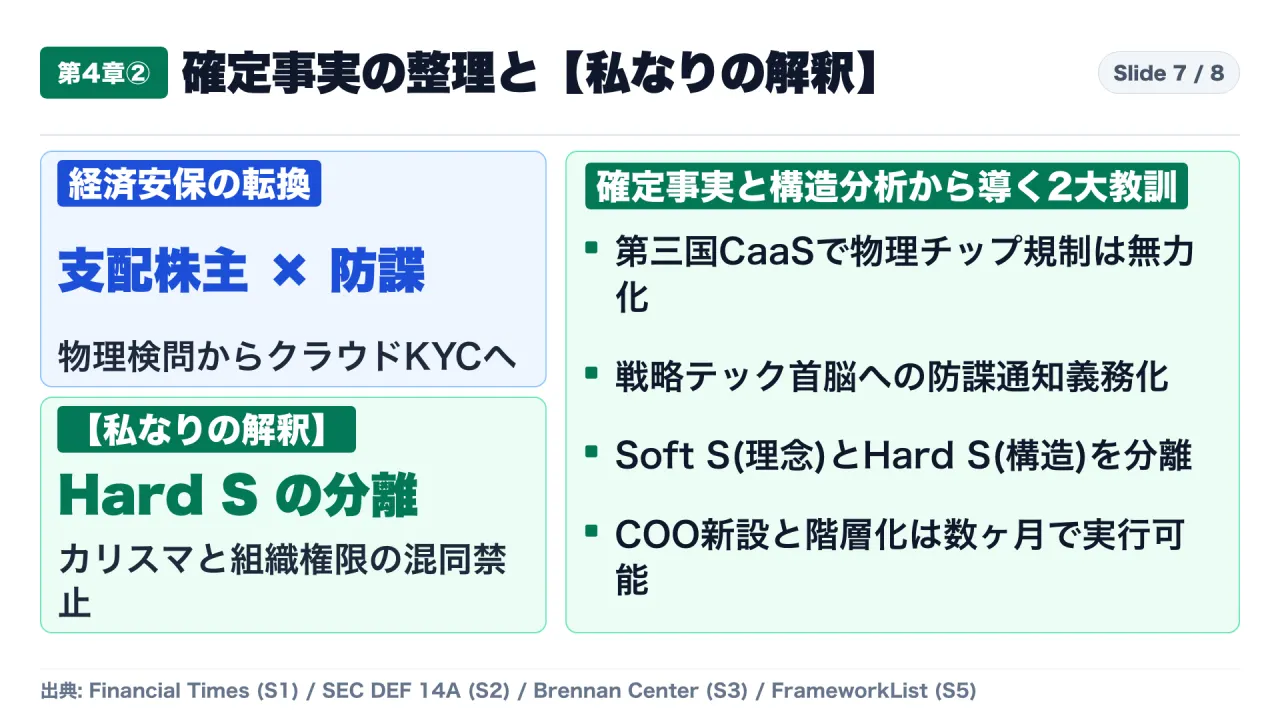
Enterprise organizations, infrastructure operators, and technology boards must implement three structural countermeasures:
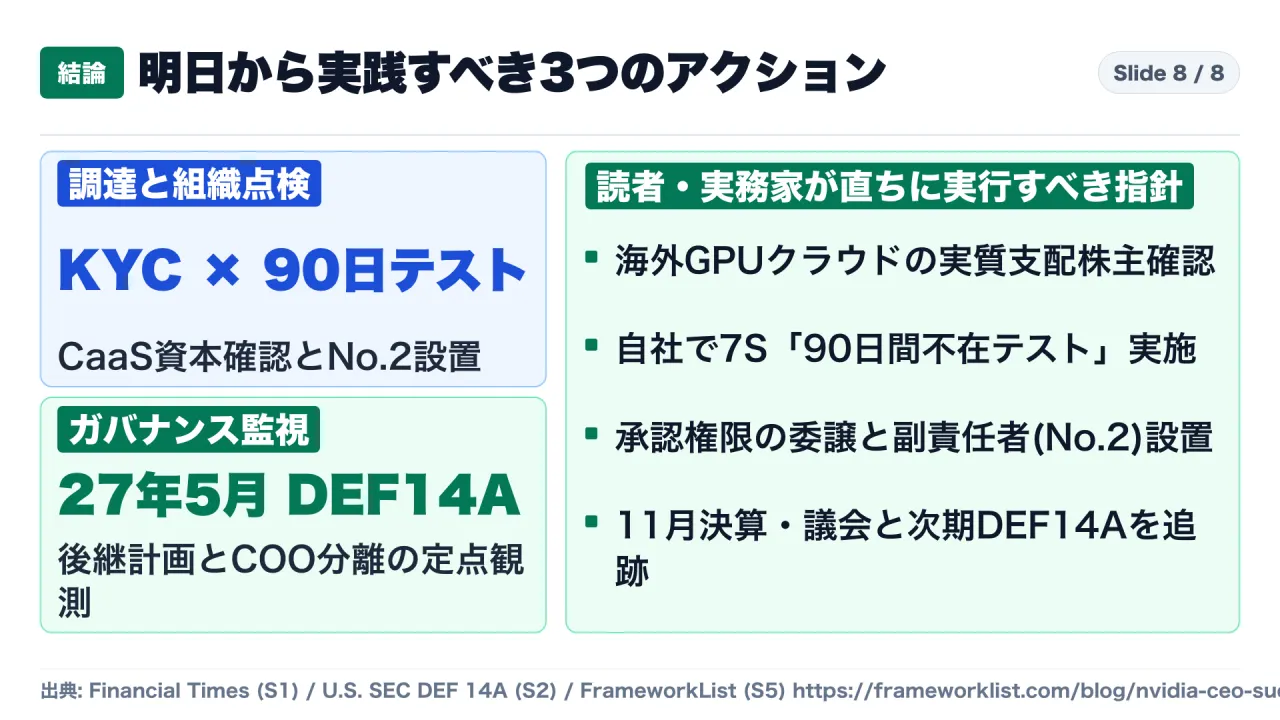
- Enforce Beneficial-Ownership KYC on Third-Party Compute Providers: Infrastructure teams procuring raw cloud compute must look beyond corporate registration addresses. Audit third-party providers for indirect equity ties to defense conglomerates, unmonitored CaaS subleasing agreements, and hardware physical security. As regulations like the MATCH Act take effect, unverified offshore cloud providers face sudden service cutoffs.
- Execute the McKinsey 7S “90-Day Absence Test” to Eliminate Organizational SPOFs: Audit internal corporate structures to ensure critical functions do not terminate at a single executive. Establish a formal Chief Operating Officer role, institutionalize emergency succession protocols, and limit direct-report ratios to prevent hub-and-spoke operational paralysis.
- Establish Formal Corporate Counterintelligence Protocols: Enterprises developing sensitive AI algorithms, proprietary weights, or national-security dual-use technologies must implement mandatory insider-threat screening and secure counterintelligence reporting lines with government defense agencies, ensuring executive leadership is insulated from foreign influence operations.
Sources
- U.S. Securities and Exchange Commission, NVIDIA Corporation Form 10-K (FY2026 Annual Report) and Proxy Statement DEF 14A (CIK: 0001045810): https://www.sec.gov/edgar/browse/?CIK=0001045810
- Financial Times, “NVIDIA CEO Jensen Huang Investigation, Alice Huang Ties, and the Megaspeed International Probe”: https://www.ft.com/content/nvidia-ceo-investigation-2026
- Brennan Center for Justice, “The Statutory Lapse and Judicial Continuation of Section 702 FISA Surveillance Authorities”: https://www.brennancenter.org/our-work/analysis-opinion/section-702-fisa-reauthorization
- Bloomberg News, “Megaspeed Procured $4.8 Billion in NVIDIA AI Hardware for Malaysian Data Centers Amid CaaS Export Review”: https://www.bloomberg.com/news/articles/2026-11-04/megaspeed-nvidia-probe
- FrameworkList Corporate Governance Analysis, “The 90-Day Absence Test: Deconstructing NVIDIA’s 60 Direct Reports and Founder Succession Vulnerability”: https://frameworklist.com/blog/nvidia-ceo-succession-plan-7s