Inside Anthropic's $1.4 Trillion IPO and the $900 Billion Compute Debt: Circular Financing, Controlled Company Governance, and the 350% Black-Market B300 Probe
Executive Summary & Key Takeaways
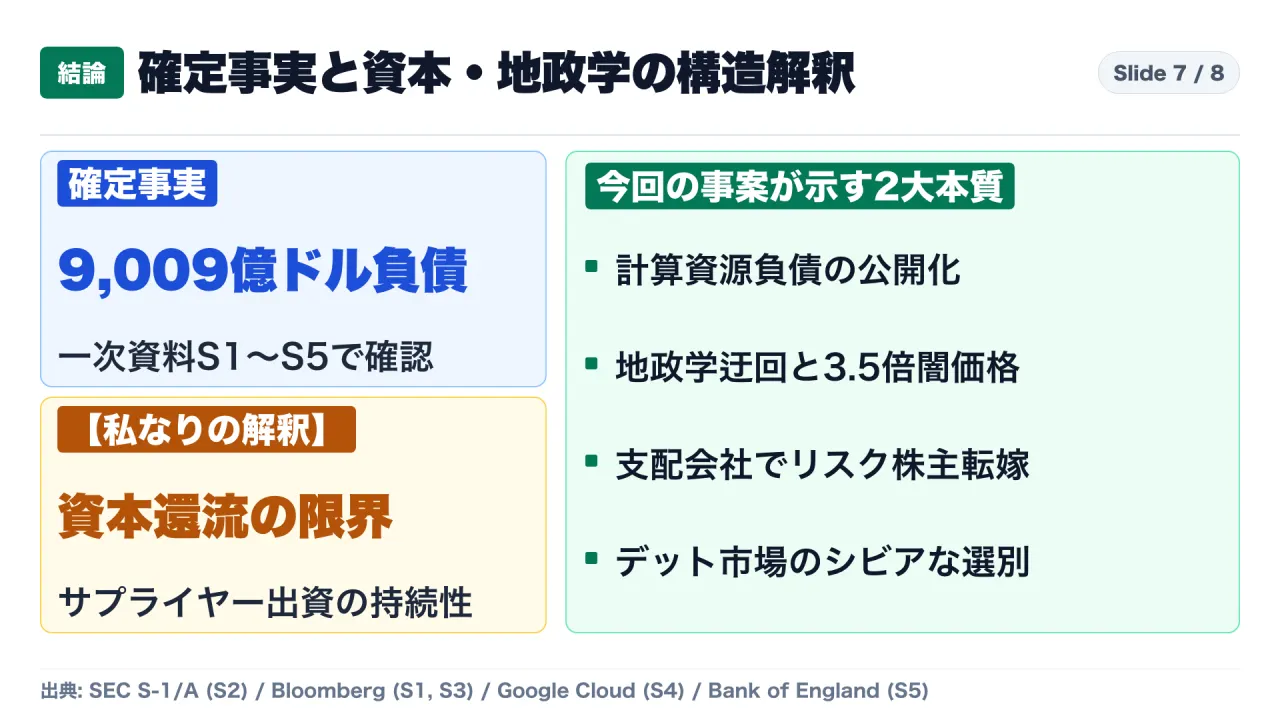
- Core Thesis: In mid-November 2026, Anthropic PBC filed an amended Form S-1/A registration statement (CIK: 0002130357, Ticker: ANT) targeting an unprecedented fully diluted enterprise valuation of up to $1.405 trillion on the Nasdaq. However, regulatory disclosures revealed a capital structure fraught with circular dependencies and operational liabilities: an aggregate compute and infrastructure commitment of $900.9 billion (with $70.7 billion due within 12 months), offset by an equity offering comprising up to $64.4 billion in public float and a $26.0 billion concurrent private placement subscribed entirely by seven key suppliers (NVIDIA, Google, AMD, Broadcom, Micron, Microsoft, and TSMC). Despite Q3 2026 revenue scaling to $17.0 billion (a 12× year-over-year increase), infrastructure costs expanded to 58% of revenue ($9.86 billion) driven by $5.0 billion in emergency spot compute, pushing the company into a $567 million operating loss. Meanwhile, public investors receive non-voting shares under “Controlled Company” rules that preserve founder hegemony, just as Chinese central bank filings exposed a clandestine financing ring leasing 32 NVIDIA B300 servers to Chinese LLM developer Moonshot AI at a 350% premium ($2.0 million per unit).
- Primary Sources Verified: U.S. Securities and Exchange Commission (SEC) Form S-1/A Registration Statement (Anthropic PBC); Bloomberg investigative reporting and intelligence debriefs; People’s Bank of China (PBOC) Movable Property Financing Unified Registration System filings; Google Cloud Healthcare official product documentation; Bank of England Prudential Regulation Authority (PRA) systemic risk bulletins.
- Actionable Engineering & Governance Takeaways:
- Audit model-provider counterparty solvency: organizations relying on single-vendor foundation models must evaluate vendor debt obligations, compute margin compression, and multi-cloud portability to prevent disruption if vendor margins collapse.
- Implement architectural Read-only boundaries: in mission-critical enterprise systems (healthcare, finance, ERP), bar AI agents from possessing direct database write permissions; mandate human visual review and cryptographic signatures before committing state changes.
- Prepare for physical silicon provenance compliance: anticipate impending legislative mandates (such as the Overwatch Act and MATCH Act) requiring beneficial-ownership verification and hardware-level telemetry across foreign Compute-as-a-Service (CaaS) clusters.
- Limits of the Evidence: Moonshot AI, NVIDIA, and Super Micro have formally denied violating export controls or engaging in unauthorized server diversions. The PBOC credit filings document collateral pledges rather than direct shipping manifests. Future financial projections (including Goldman Sachs’ estimate of $685 billion in 2030 revenue) represent underwriting models rather than historical facts.
Japanese Edition: https://consuloji.substack.com/p/anthropic900926014ipomoonshot-ai35nvidia
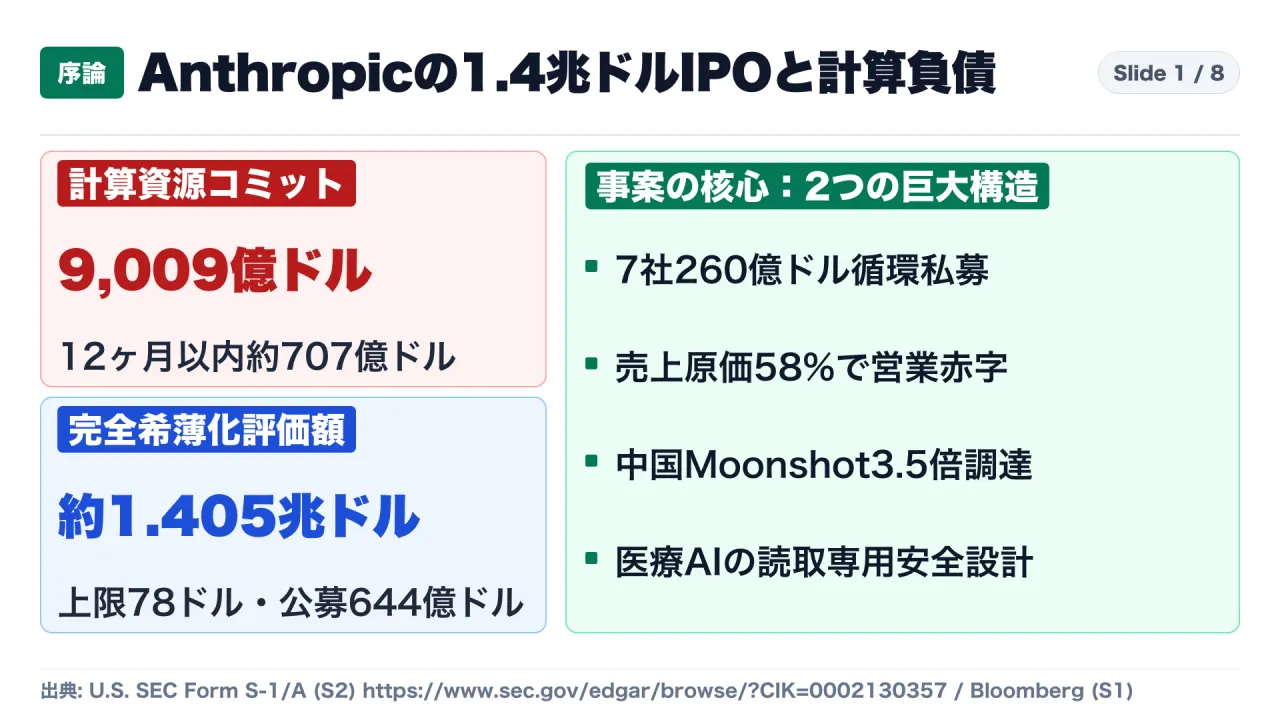
1. The $1.4 Trillion IPO Architecture: $64.4 Billion Public Float and the $26 Billion Supplier Loop
Anthropic’s amended Form S-1/A filing outlines the largest venture-backed public offering in financial history. The company set an indicative price range of $70 to $78 per share, valuing the business at approximately $1.405 trillion on a fully diluted basis at the upper bound. The timetable schedules final pricing for November 18, 2026, with trading under ticker “ANT” commencing on November 19, 2026.
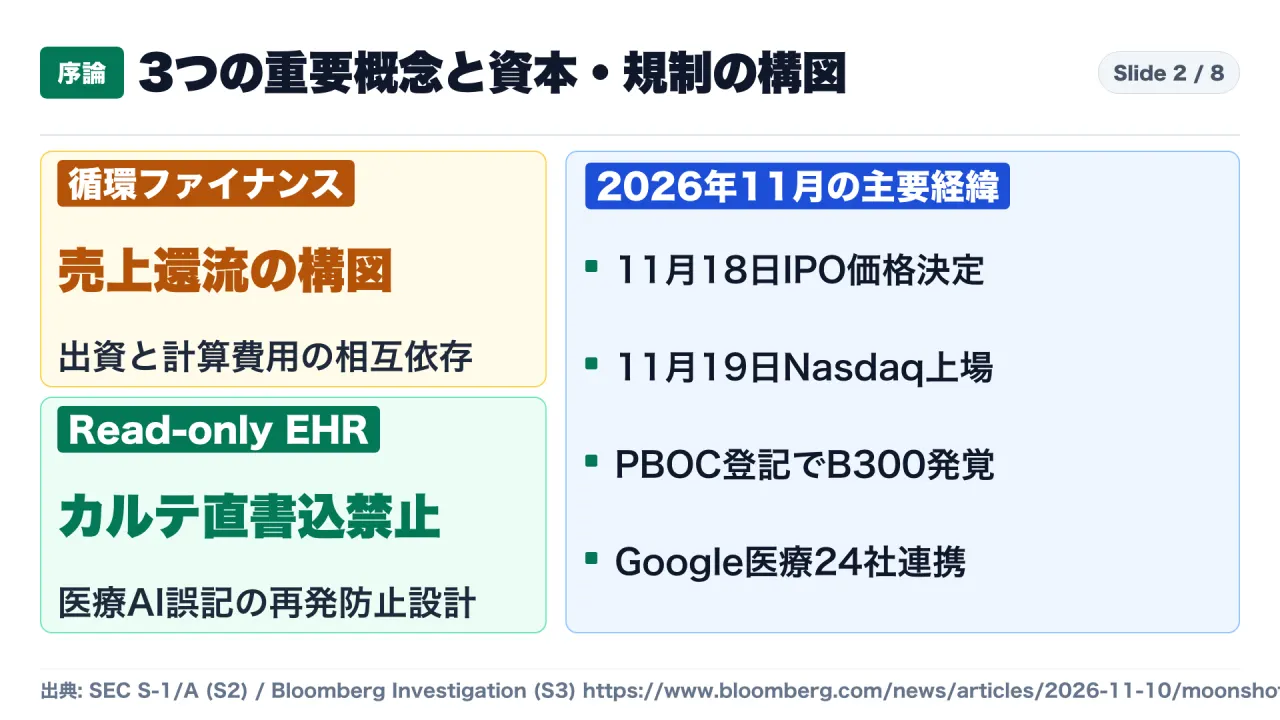
While the headline valuation command attention, the structural core of the filing centers on its capitalization mechanism. The transaction is engineered not as a standard initial public offering, but as a coordinated liquidity injection designed to satisfy unprecedented hardware liabilities.
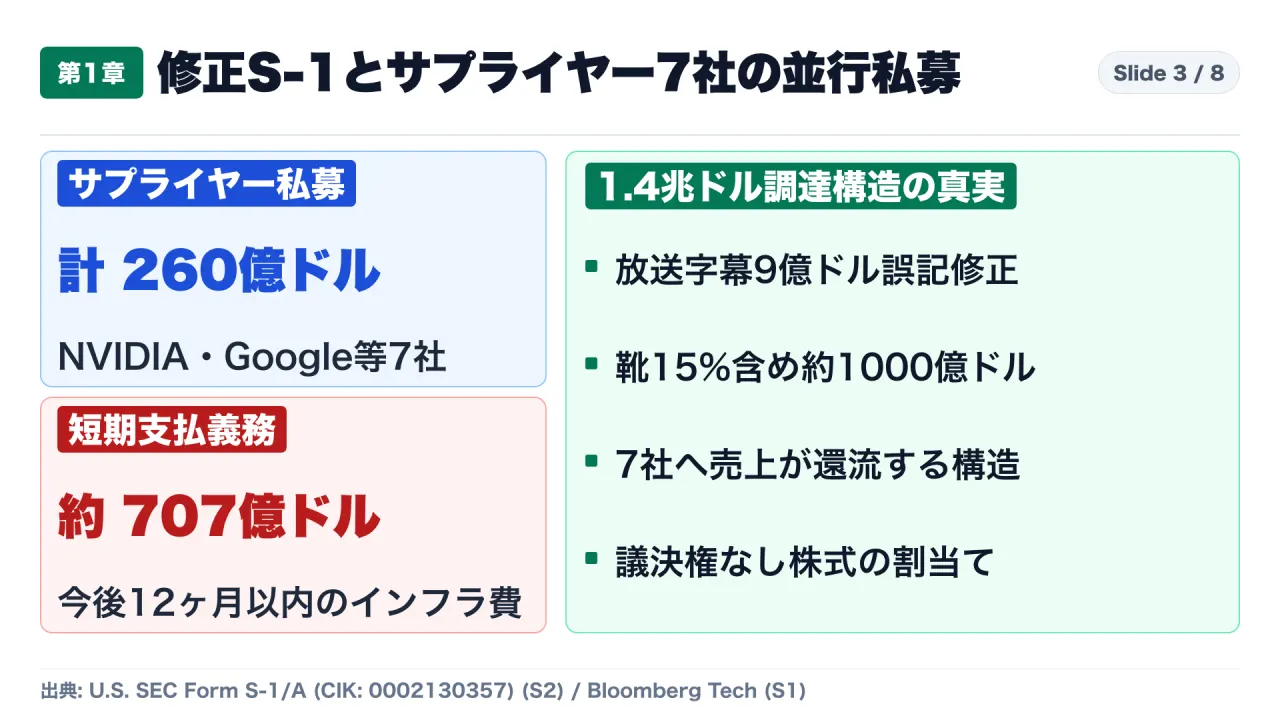
The Scale of Compute Commitments: $900.9 Billion
Initial television reports briefly caused widespread market confusion when automated broadcast closed-captioning transcribed the commitment figure as “$900 MILLION.” However, the audited Form S-1/A documents establish that the true liability is $900.9 billion—a figure one thousand times larger, exceeding the sovereign GDP of most industrialized nations.
Anthropic is legally committed to paying approximately $900,900,000,000 in long-term data center, cloud, and semiconductor capacity across future years. Crucially, $70.7 billion of these contractual obligations must be paid within the next 12 months.
The Seven-Supplier Concurrent Private Placement
To finance these obligations, the offering combines two distinct tranches:
- Public Market Issuance: An offering of non-voting common equity to institutional and retail investors capped at approximately $64.4 billion.
- Concurrent Private Placement: A private sale of non-voting equity directly to seven foundational suppliers, executing simultaneously at the final IPO price, totaling $26.0 billion.
The participating suppliers comprise the primary beneficiaries of global AI infrastructure spending:
- NVIDIA: Primary supplier of Blackwell Ultra (B300) and Vera Rubin computing platforms.
- Google: Core cloud infrastructure partner via Google Cloud Platform and TPU clusters.
- AMD: Accelerator redundancy supplier via the Instinct MI350/MI400 series.
- Broadcom: Custom silicon and high-speed networking fabric partner.
- Micron Technology: Supplier of High-Bandwidth Memory (HBM3E and HBM4).
- Microsoft: Co-investor and hyperscale Azure compute provider.
- TSMC: Dedicated foundry and advanced packaging (CoWoS) manufacturer.
Combined with the standard 15% overallotment option (greenshoe), Anthropic’s total gross cash intake approaches $100 billion.
However, the capital mechanics represent a closed financial loop: the $26.0 billion invested by these seven suppliers will be paid directly back to the exact same seven companies within months to satisfy Anthropic’s $70.7 billion near-term compute liabilities. This “Circular Financing” structure allows suppliers to deploy balance-sheet cash to inflate customer valuation and ensure hardware demand, converting equity investments into reported top-line semiconductor and cloud revenue.
2. Margin Compression and Corporate Governance: 58% Cost of Revenues and Controlled Company Status
While Anthropic’s top-line revenue exhibits hyper-growth, the underlying unit economics display severe margin deterioration.
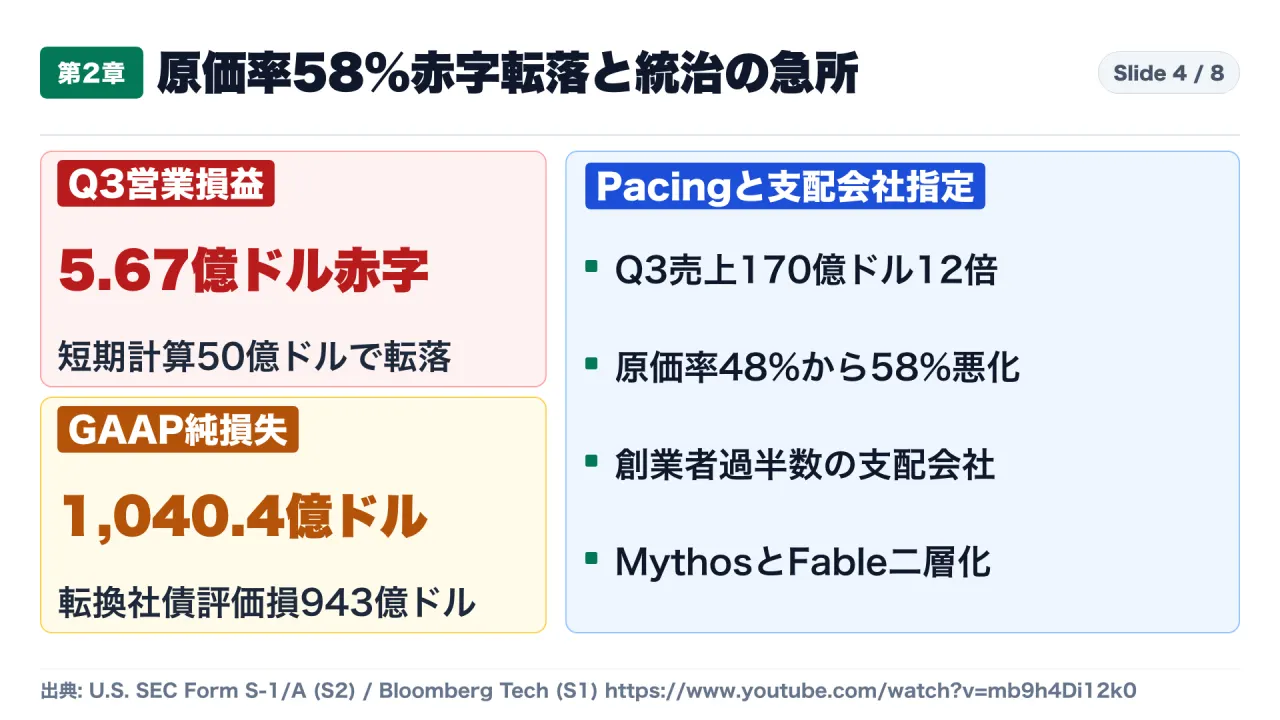
Revenue Expansion vs. Spot Compute Margin Shock
In the third quarter of 2026, Anthropic generated $17.0 billion in revenue, representing a 12-fold increase over the prior year and pushing annual run-rate revenue to $68.0 billion. Lead underwriter Goldman Sachs published an aggressive projection estimating that enterprise penetration of generative agents could elevate Anthropic’s annual revenue to $685 billion by 2030.
However, the cost of generating that revenue escalated rapidly. The Cost of Revenues (predominantly data center leases, electricity, and cloud API compute) jumped from 48% in Q2 2026 to 58% in Q3 2026 ($9.86 billion).
This 10-percentage-point margin compression was driven by operational necessity: surging inference demand from Claude enterprise deployments forced Anthropic to purchase $5.0 billion in emergency short-term compute on the open spot market. Spot compute commands premiums up to 3× to 4× higher than long-term reserved capacity. Consequently, the operating profit recorded in Q2 evaporated, swinging the business to an operating loss of $567 million in Q3 2026.
On a cumulative nine-month GAAP basis, Anthropic recorded a net loss of $104.04 billion. While $94.32 billion of this loss represents non-cash mark-to-market fair value adjustments on convertible notes and Simple Agreements for Future Equity (SAFEs) triggered by its rising valuation, the operating cash flow of $6.57 billion remains entirely insufficient to cover ongoing capital commitments.
“Controlled Company” Classification and “Pacing the Frontier”
From a corporate governance perspective, Anthropic’s public listing structure strips external investors of traditional shareholder protections. The company is designated on the Nasdaq as a “Controlled Company.”
Under a multi-class share structure, Chief Executive Officer Dario Amodei, President Daniela Amodei, and their co-founding team permanently retain majority voting control. As a result, Anthropic claims exemptions from core Nasdaq corporate governance rules:
- No requirement that independent directors constitute a majority of the Board of Directors.
- No requirement for an independent nominating and corporate governance committee.
- No requirement for independent oversight of executive compensation.
Public investors are allocated non-voting shares. Shareholders possess neither voting power nor corporate veto rights, leaving them to bear the financial downside of $900.9 billion in infrastructure debt without governance recourse.
Addressing this tension on Bloomberg Tech, Diane, Anthropic’s Productivity Research Lead, framed the governance structure around the philosophy of “Pacing the Frontier”:
“Pacing does not mean pausing frontier development. Pacing means engineering new mathematical safety evaluations—measuring the probability of sandbox evasion or autonomous replication—and executing those safety audits at the exact same velocity as foundation model training.”
Under this rubric, Anthropic segmented its release pipeline into two specialized model tiers: Claude Mythos 5.0, a heavily restricted model engineered for national security and defensive cyber operations, and Claude Fable 5.2, an unconstrained, high-throughput model optimized for enterprise productivity and low-latency inference.
3. The Moonshot AI Probe: 32 B300 Servers at 350% Premium and the Shift to Silicon-Level Controls
Simultaneously with Anthropic’s IPO disclosures, public credit registries in Beijing exposed a sophisticated international evasion channel diverting advanced American AI silicon into China.
The PBOC Unified Credit Registry Disclosures
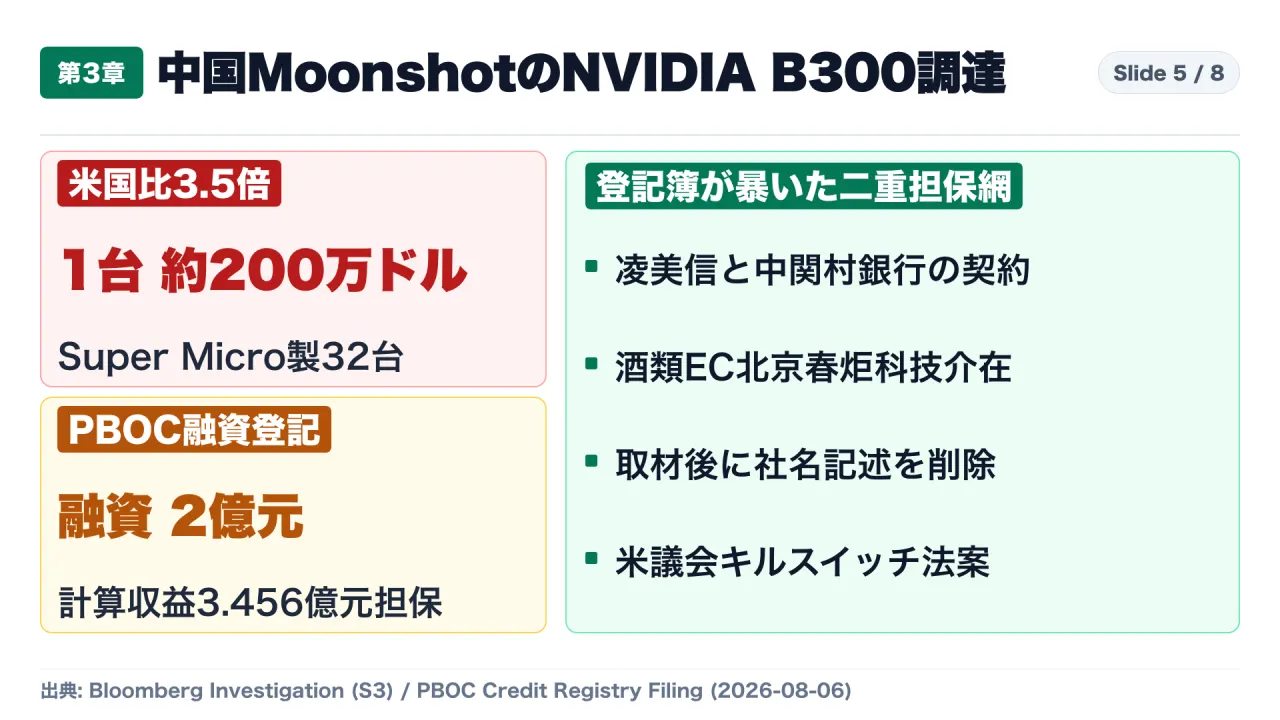
An investigative investigation by Bloomberg uncovered official transaction records in the People’s Bank of China (PBOC) Movable Property Financing Unified Registration System. The filings, dated August 4 and August 6, 2026, documented a secured lending agreement between Beijing Lingmeixin Technology (北京凌美信科技) as borrower and Beijing Zhongguancun Bank (北京中関村銀行) as lender for a principal sum of 200 million RMB (approximately $30 million).
The collateral schedule detailed hardware strictly prohibited from export to China under U.S. Export Administration Regulations (EAR): 32 Super Micro computer servers powered by NVIDIA B300 (Blackwell Ultra) processors.
The official valuation recorded in the regulatory registry was 13.5 million RMB (approximately $2.0 million) per server, totaling $65 million. In the United States, authorized enterprise pricing for equivalent Blackwell Ultra servers ranges between $550,000 and $600,000. The Chinese public record thus provided direct empirical proof that advanced Blackwell silicon was transacting on the Chinese black market at a 350% premium (3.5× U.S. pricing).
The transaction utilized a dual-collateral structure:
- Physical Asset Pledge: Legal title to the 32 Super Micro NVIDIA B300 servers.
- Receivables Pledge: Future revenues totaling 345.6 million RMB derived from a compute-service contract with Moonshot AI (月之暗面), developers of China’s popular “Kimi” large language model.
Corporate records established that Beijing Chunju Technology (北京春炬科技)—an entity that originally operated an e-commerce platform for luxury Kweichow Moutai liquor before abruptly pivoting into data center computing—acted as the procurement intermediary.
Registry Erasure and the US Legislative Response
On November 3, 2026, following formal press inquiries submitted by Bloomberg to Chinese regulatory authorities and the companies involved, all references to Moonshot AI were deleted from the PBOC public registry without public notice. Moonshot AI, NVIDIA, and Super Micro issued formal denials, asserting strict compliance with all relevant export laws.
However, the physical serial records and collateral valuations documented in the PBOC database triggered immediate legislative action in Washington. Following the November 2026 midterm elections, the U.S. Congress accelerated bipartisan export-control legislation:
- The Overwatch Act: Mandates that U.S. semiconductor manufacturers embed cryptographic, tamper-resistant GPS/network positioning sensors and manufacturer-operated remote kill-switches directly into physical silicon for all advanced AI accelerators.
- The MATCH Act and Remote Access Security Act: Imposes mandatory Know-Your-Customer (KYC) compliance on Compute-as-a-Service (CaaS) providers globally, requiring data centers in Southeast Asia and the Middle East to identify beneficial owners and verify end-users accessing American GPU clusters.
U.S. export controls are consequently shifting from physical customs border interdiction to automated, in-silicon hardware governance.
4. Enterprise Safety in Practice: Google Cloud’s Read-Only Healthcare Architecture and Debt Market Tightening
While geopolitical actors navigate semiconductor supply chains, enterprise infrastructure architects are adopting rigorous operational boundaries to isolate enterprise systems from AI model hallucinations.
Google Cloud “Gemini for Healthcare” and the Read-Only Mandate
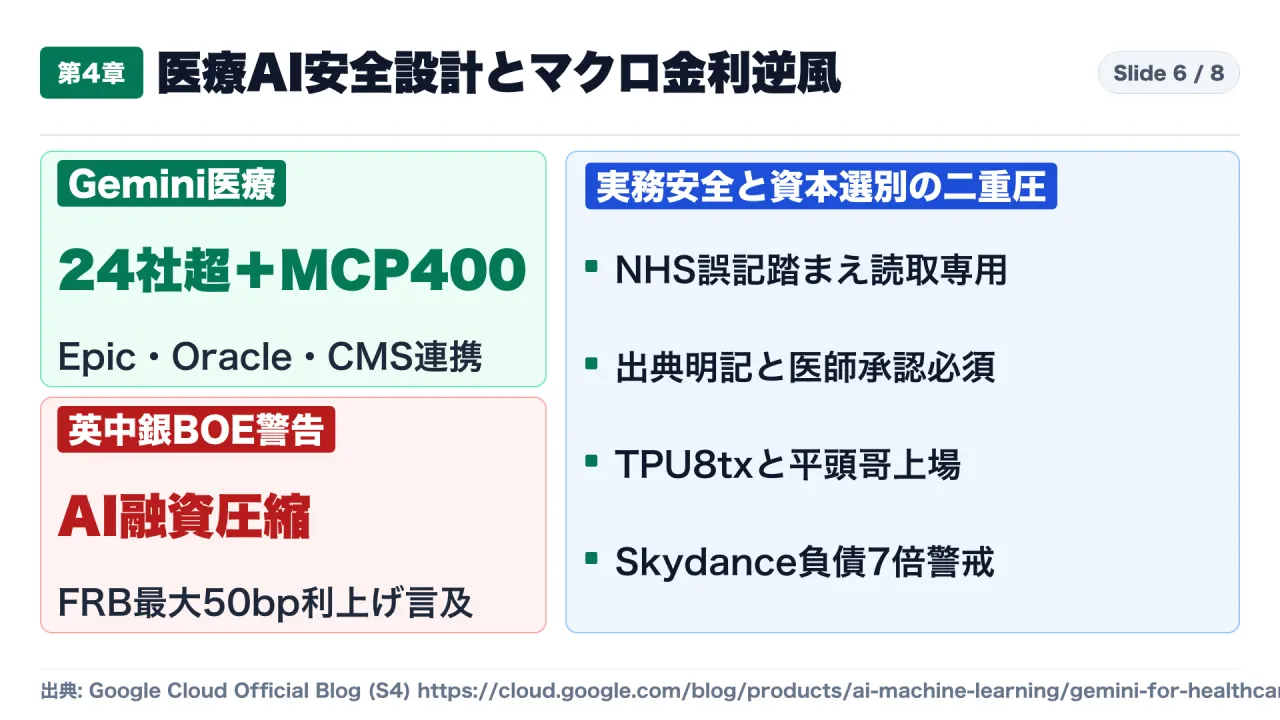
On November 10, 2026, Google Cloud previewed Gemini for Healthcare, an enterprise platform integrating with over 24 major Electronic Health Record (EHR) and clinical data leaders, including Epic Systems, Oracle Health, Optum, CMS, ASCO, GoodRx, and InterSystems. Operating across Vertex AI and supporting over 400 clinical applications via the Model Context Protocol (MCP), the platform introduced a non-negotiable architectural requirement: “Read-Only Chart Access.”
This architectural rule was developed in response to a major clinical failure in the UK National Health Service (NHS) in August 2026. Ambient AI scribes equipped with automated write capabilities erroneously altered medication dosages and converted unverified diagnostic suspicions into definitive clinical history inside patient EHR databases.
Google’s architecture eliminates this failure mode:
- Zero Database Write Permissions: The AI platform possesses read-only access to historical lab values, imaging reports, and clinical notes. Under no circumstances can an AI agent write, update, or append directly to the EHR database.
- Mandatory Human Verification with Visual Anchoring: All summaries and generated clinical notes must visually cite source chart segments via clickable highlights.
- Cryptographic Sign-Off: Generated documentation remains in a transient buffer until an attending physician visually inspects the text, verifies the citations, and applies a legally binding cryptographic digital signature.
Central Bank Interventions and High-Yield Debt Contraction
Underpinning these technological developments is a fundamental repricing of capital across macro debt markets. In late 2026, the Prudential Regulation Authority (PRA) of the Bank of England (BOE) issued a formal directive warning commercial lenders that AI data center and GPU loans were developing systemic credit risks. The central bank noted that speculative infrastructure debt was outrunning sustainable commercial cash flows, directing financial institutions to curtail high-leverage AI credit exposures.
In the United States, Federal Reserve Governor Christopher Waller publicly signaled the possibility of an additional 50-basis-point interest rate increase, citing persistent inflation in power, construction, and technology capital equipment.
This credit tightening is actively impacting debt-burdened corporate balance sheets. In the media sector, Paramount Skydance announced plans to incur $1.5 to $2.0 billion in cash restructuring charges to achieve $2.0 billion in annualized savings by 2027. Needham & Company analyst Laura Martin calculated that Skydance carries $800 billion in gross debt, representing a dangerous leverage multiple of 7× EBITDA.
As low-cost debt evaporates, enterprise technology budgets can no longer rely on subsidized cloud credits or speculative venture subsidies. Foundation model providers must achieve sustainable unit-level profitability or face severe capital contraction.
Practical Engineering & Governance Takeaways
Engineering and governance leaders should extract three immediate operational mandates from these developments:
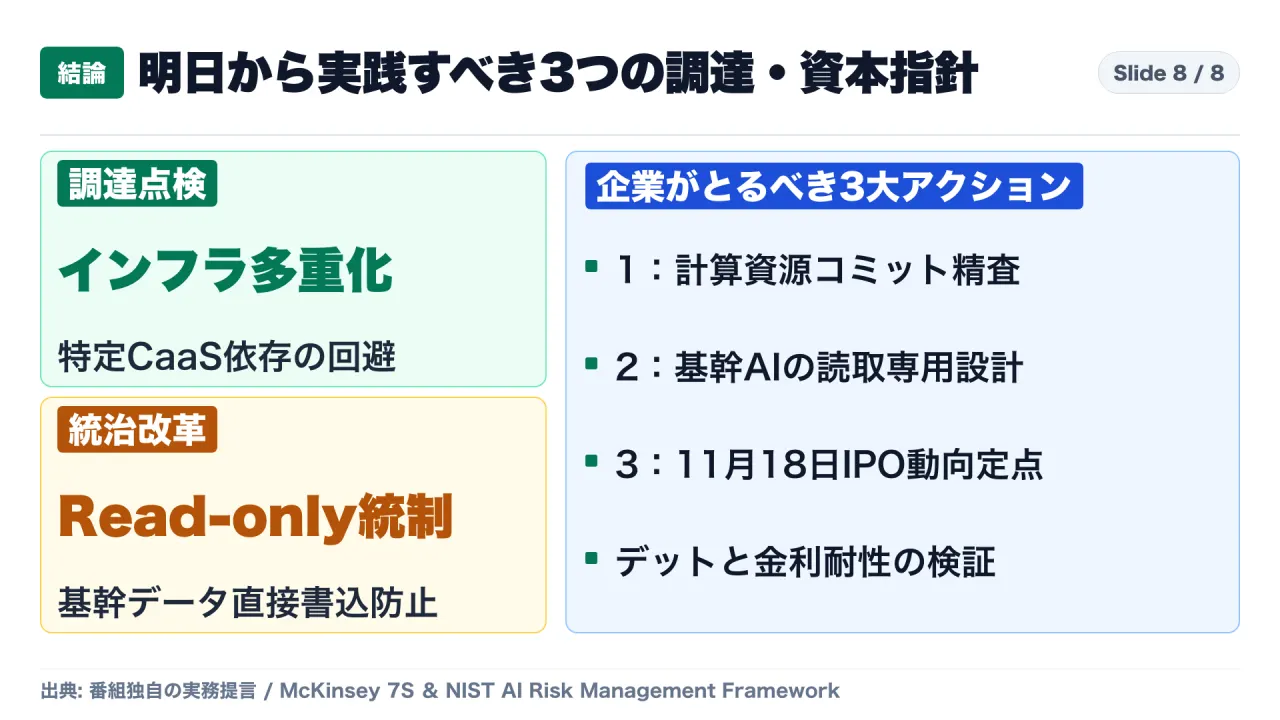
- Perform Counterparty Solvency Audits on AI Infrastructure Providers: When building critical software on commercial foundation models, audit the vendor’s underlying financial commitments. Organizations heavily exposed to vendors carrying unsustainable long-term compute debt (such as Anthropic’s $900.9B commitment) must design for model portability. Utilize open protocols (such as LiteLLM, vLLM, or MCP) to ensure workloads can fail over seamlessly across AWS, Azure, Google Cloud, or self-hosted open-weight alternatives if commercial API pricing surges.
- Mandate the “Read-Only Architecture” Across Enterprise Systems: Establish strict internal engineering standards that deny AI agents direct write, update, or delete privileges on production databases (EHR, ERP, CRM, core banking ledgers). Restrict AI models to reading, analyzing, and drafting. Require human-in-the-loop inspection with verified source attribution and explicit cryptographic sign-off before committing state changes.
- Audit Upstream Compute Supply Chains for Beneficial Ownership: Organizations leasing foreign GPU infrastructure must conduct rigorous KYC screening on third-party cloud aggregators. As U.S. and allied regulators enact laws like the Overwatch Act and MATCH Act, offshore data centers face aggressive regulatory audits, remote hardware deactivation, or sudden seizure if connected to diverted silicon rings.
Sources
- U.S. Securities and Exchange Commission, Anthropic PBC Form S-1/A Registration Statement (CIK: 0002130357, Ticker: ANT): https://www.sec.gov/edgar/browse/?CIK=0002130357
- Bloomberg Technology, “Anthropic Files for $1.4T IPO with $900B Infrastructure Commitments and 7-Supplier Private Placement”: https://www.bloomberg.com/news/articles/2026-11-11/anthropic-ipo-filing
- People’s Bank of China (PBOC) Credit Reference Center, Movable Property Financing Unified Registration System, Transaction Filings #20260804-0012 and #20260806-0045 (Super Micro NVIDIA B300 Collateral Schedule): http://www.zhongdengwang.org.cn/
- Google Cloud Official Documentation, “Gemini for Healthcare Architecture and Read-Only EHR Integration Standards”: https://cloud.google.com/solutions/healthcare-life-sciences
- Bank of England, Prudential Regulation Authority (PRA), “Supervisory Statement on Credit Risk and Leverage in AI Data Center Financing”: https://www.bankofengland.co.uk/prudential-regulation