Inside SoftBank's $3.7 Billion Power Equipment Impairment: SB7, Turbine Backlogs, and the Gridlock at PORTS-Pike
Executive Summary & Key Takeaways
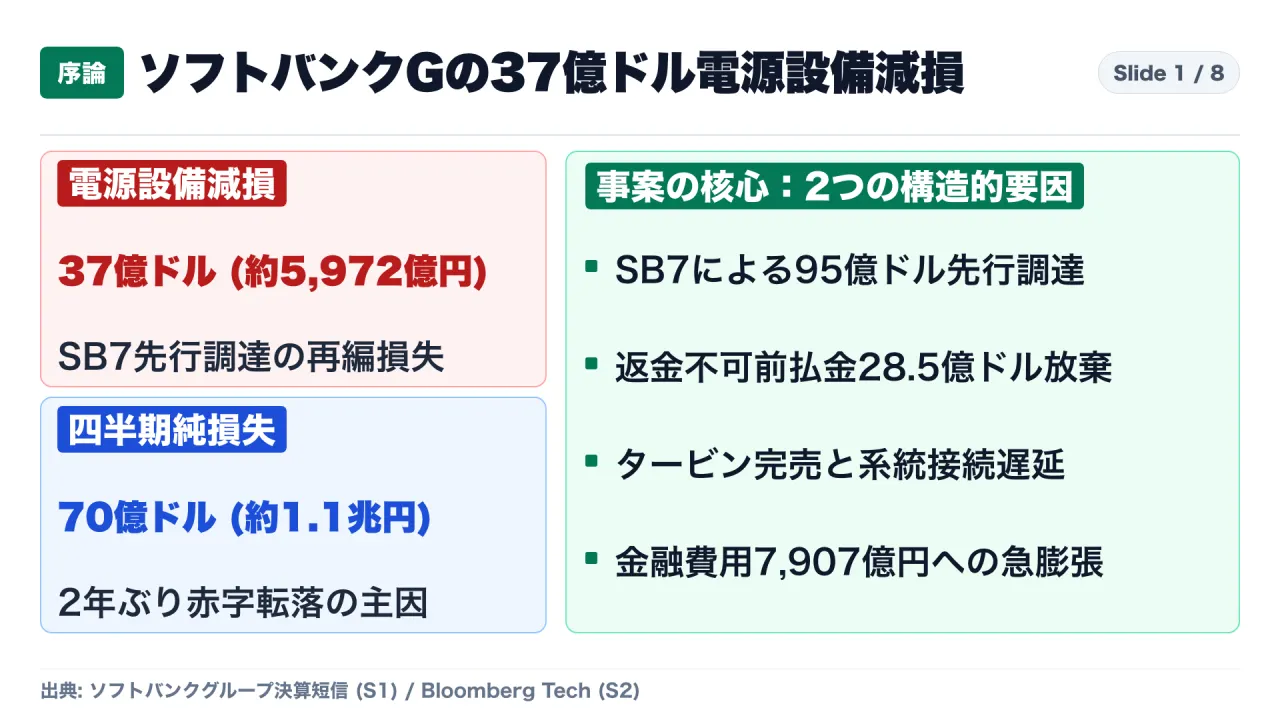
- Core Thesis: In its FY2026 second-quarter financial results, SoftBank Group Corp. (SBG) posted a quarterly net loss of $7.0 billion (approximately 1.1 trillion yen)—its first quarterly loss in roughly two years. The dominant driver was a $3.73 billion (597.2 billion yen) impairment and procurement restructuring charge on US AI data center power equipment. To circumvent global supply chain shortages, a dedicated procurement entity, Silver Bands 7 LLC (SB7), had deployed $9.5 billion in parent-backed bridge commitments for gas turbines and transformers. However, when equipment specifications and delivery schedules collided with environmental permitting and civil grading delays at the 8.0 GW PORTS-Pike campus in Ohio, SoftBank was forced to forfeit $2.85 billion in non-refundable advances and incur $880 million in contract modification and cancellation liabilities. While suppliers granted up to $2.1 billion in future purchasing rebates over 10 years, accounting standards prohibit offsetting these contingent credits against current losses, providing zero near-term cash relief against quarterly financing costs that surged to 790.7 billion yen.
- Primary Sources Verified: SoftBank Group Corp. FY2026 Q2 Earnings Release and Presentation Materials; Bloomberg Tech analysis featuring Pierre Ferragu (New Street Research); The Economic Times / Japan Times reporting; GE Vernova Gas Power market briefings; U.S. Department of Energy (DOE) PORTS-Pike Environmental Impact Documentation; Bank of England Prudential Regulation Authority (PRA) credit warnings.
- Actionable Engineering & Governance Takeaways:
- Never uncouple long-lead hardware procurement from local civil engineering, substation engineering, and environmental permitting milestones; uncoordinated delivery schedules trigger catastrophic take-or-pay or storage liabilities.
- Equipment advance agreements must include contractual flexibility, re-allocation rights across alternate project sites, and negotiated liability caps on cancellation penalties.
- Behind-the-meter generation for AI clusters cannot rely on unbuffered industrial gas turbines; fluctuating transient step loads induce thermal stress and blade cracking unless buffered by millisecond-response Battery Energy Storage Systems (BESS).
- Limits of the Evidence: SoftBank has not publicly broken down the vendor-by-vendor allocation of the remaining $6.6 billion in equipment assets held by SB7. The specific heavy electrical manufacturers party to the forfeited $2.85 billion advances were not disaggregated in regulatory filings. The formal completion timeline for revised Environmental Impact Statements (EIS) at the PORTS-Pike site remains pending before the U.S. Department of Energy and state regulators.
Japanese Edition: https://consuloji.substack.com/p/g37706pjm7
1. The Financial Anatomy of SB7: $9.5 Billion in Bridge Orders and a $3.73 Billion Hit
The root cause of SoftBank Group’s $7.0 billion quarterly loss lies in an aggressive procurement vehicle designed to bypass traditional infrastructure development cycles.
In standard energy and utility development, power generation and substation hardware are ordered only after developers secure land rights, finalize environmental impact assessments, sign interconnection agreements with regional transmission organizations, and execute long-term power purchase agreements (PPAs) with creditworthy off-takers. This sequence allows developers to secure non-recourse project financing, placing procurement risks within a bankruptcy-remote special purpose vehicle (SPV).
However, the explosive expansion of hyperscale AI compute between 2024 and 2026 disrupted this protocol. Facing manufacturing backlogs extending into the 2030s for critical electrical gear, standard project timelines risked leaving planned AI data centers without power for half a decade.
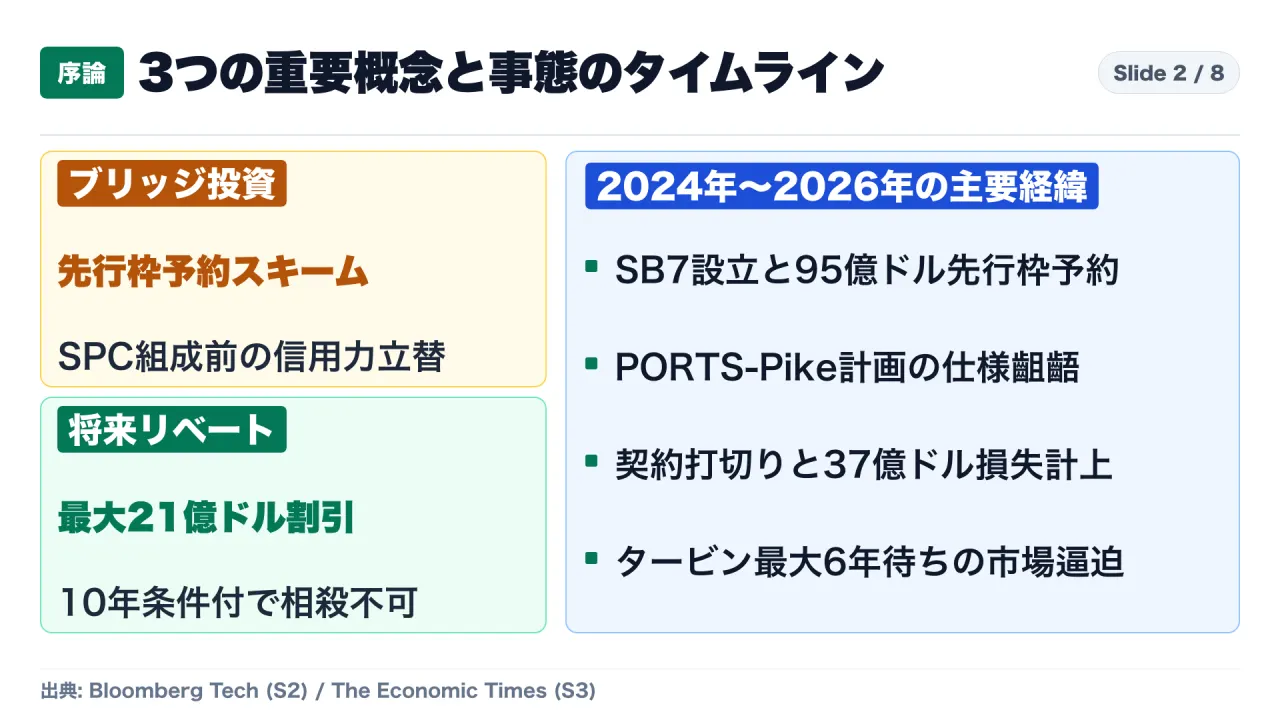
To preempt competitors, SoftBank bypassed its existing renewable development arm, SB Energy, and established a dedicated procurement vehicle: Silver Bands 7 LLC (SB7). Funded jointly by SoftBank Group Corp. and the SoftBank Vision Fund 2 (SVF2), SB7 utilized the parent company’s corporate balance sheet and credit facilities to execute $9.5 billion in speculative, parent-guaranteed bridge orders for industrial gas turbines, large power transformers, and switchgear. The strategy aimed to secure coveted manufacturing slots first, transferring the hardware into specific project-finance entities once site permits matured.
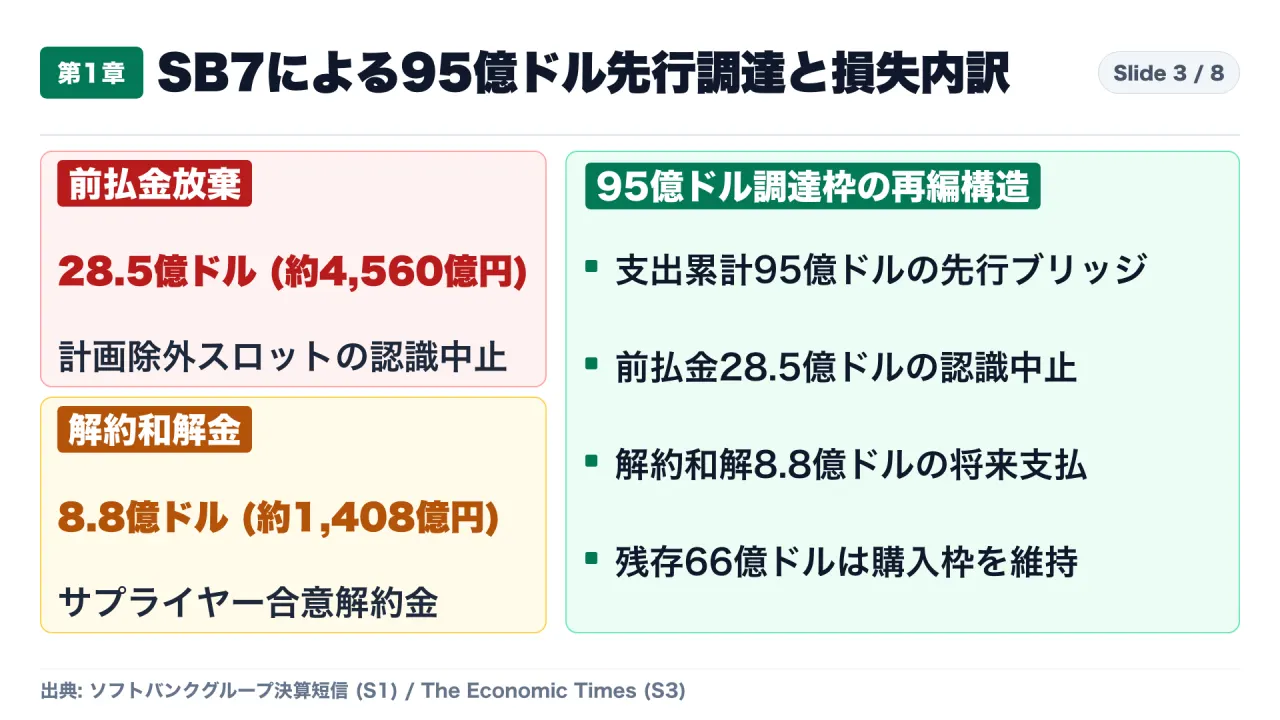
When project schedules in the United States misaligned with hardware delivery windows, this bridge strategy collapsed. In its Q2 FY2026 earnings, SoftBank recognized a total procurement restructuring charge of approximately $3.73 billion (597.2 billion yen). The audited components of this charge comprise:
- Derecognition of Non-Refundable Advance Payments ($2.85 billion / 456 billion yen): SB7 had made substantial down payments to reserve factory production queues. Because these manufacturing slots were canceled or permanently excluded from revised data center configurations, and because supplier contracts contained ironclad non-refundable clauses, SoftBank was required under IFRS to derecognize these assets entirely from its balance sheet.
- Contract Modification and Termination Settlements ($880 million / 140.8 billion yen): In addition to losing paid advances, SB7 incurred legally binding cancellation penalties and restructuring fees to release commitments on remaining production slots. These future liabilities were accrued as current-period losses.
- Retained Equipment Asset Pool ($6.6 billion / 1.05 trillion yen): Of the original $9.5 billion in commitments, SoftBank preserved approximately $6.6 billion as active capital assets. This remaining inventory represents equipment allocations that SoftBank intends to deploy across ongoing data center builds, including restructured phases of its Ohio campus.
2. The PORTS-Pike Mismatch and Why the $2.1 Billion Rebate Yields Zero Immediate Relief
The primary operational catalyst for this multi-billion-dollar restructuring was the PORTS-Pike Technology Campus in Pike County, Ohio.
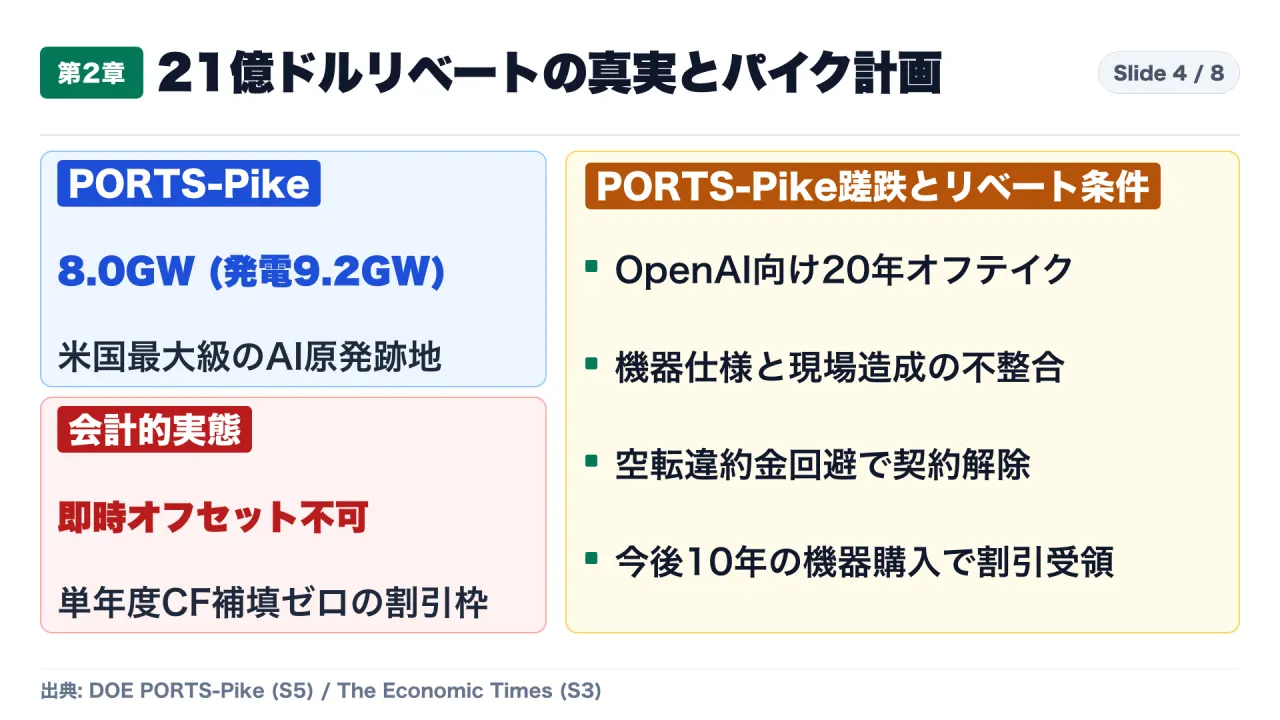
Planned on the site of a Cold War-era uranium enrichment facility in Piketon overseen by the U.S. Department of Energy (DOE), PORTS-Pike was conceived as one of the world’s largest co-located AI computing complexes. The project envisioned 9.2 GW of on-site natural gas-fired generation dedicated to supplying 8.0 GW of net IT load to high-density data center clusters, anchored by a 20-year off-take agreement with OpenAI.
As Pierre Ferragu, managing partner at New Street Research, explained in an analytical briefing on Bloomberg Tech, the failure at PORTS-Pike was not a collapse in compute demand:
“What happened was not an evaporation of demand. It was a fatal timing and specification mismatch between the specific megawatt ratings, turbine configurations, and voltage profiles ordered through SB7, and the realities of site grading, local environmental permitting, and substation engineering in Ohio.”
SB7 had ordered standardized, high-output gas turbine packages to lock in supplier queues. However, the DOE site’s environmental review timeline, coupled with regional air-quality permitting for nitrogen oxide (NOx) emissions and cooling water intake constraints, moved far more slowly than SB7’s hardware production schedule.
Had SoftBank allowed the original contracts to execute, thousands of tons of high-voltage electrical equipment and industrial turbines would have been delivered to an un-graded site lacking foundations, gas pipeline spurs, and grid tie-ins. SoftBank would have faced tens of millions of dollars in monthly equipment storage, maintenance, and idle-take penalties. Recognizing that the equipment specifications did not match the site’s evolving design, management elected to terminate the misaligned contracts, forfeit $2.85 billion, and absorb $880 million in fees to halt further operational hemorrhaging.
The Accounting Mechanics of the $2.1 Billion Supplier Rebate
In negotiating termination settlements, SB7 secured an agreement from heavy electrical equipment manufacturers for up to $2.1 billion in conditional purchase discounts (rebates) over a 10-year period. Early market coverage interpreted this as a partial offset that would reduce SoftBank’s net loss from $3.7 billion to roughly $1.6 billion.
Financial statements and international accounting standards reveal a starkly different reality:
- No Asset Recognition: Under IFRS, contingent assets cannot be recognized on the balance sheet unless realization is virtually certain. Because the $2.1 billion in credits is entirely contingent on SoftBank placing new, capital-intensive equipment orders over the next decade, it failed recognition thresholds as of September 30, 2026.
- Prohibition of Netting: Accounting rules prohibit using uncertain future price discounts to net out realized, contractual impairment losses. The $3.73 billion hit hit earnings in full.
- Zero Cash Offset: The rebate provides no near-term liquidity. To benefit from the credits, SoftBank must commit tens of billions of dollars in incremental capital expenditures across future projects.
3. The Four Physical Bottlenecks: 6-Year Turbines, LPT Shortages, 7-Year Interconnection, and Blade Cracking
SoftBank’s write-down exposes the physical constraints colliding with the AI infrastructure buildout across the United States. Software capital is accustomed to rapid iterations, but energy infrastructure is bound by multi-year manufacturing cycles, raw material limitations, and mechanical physics.
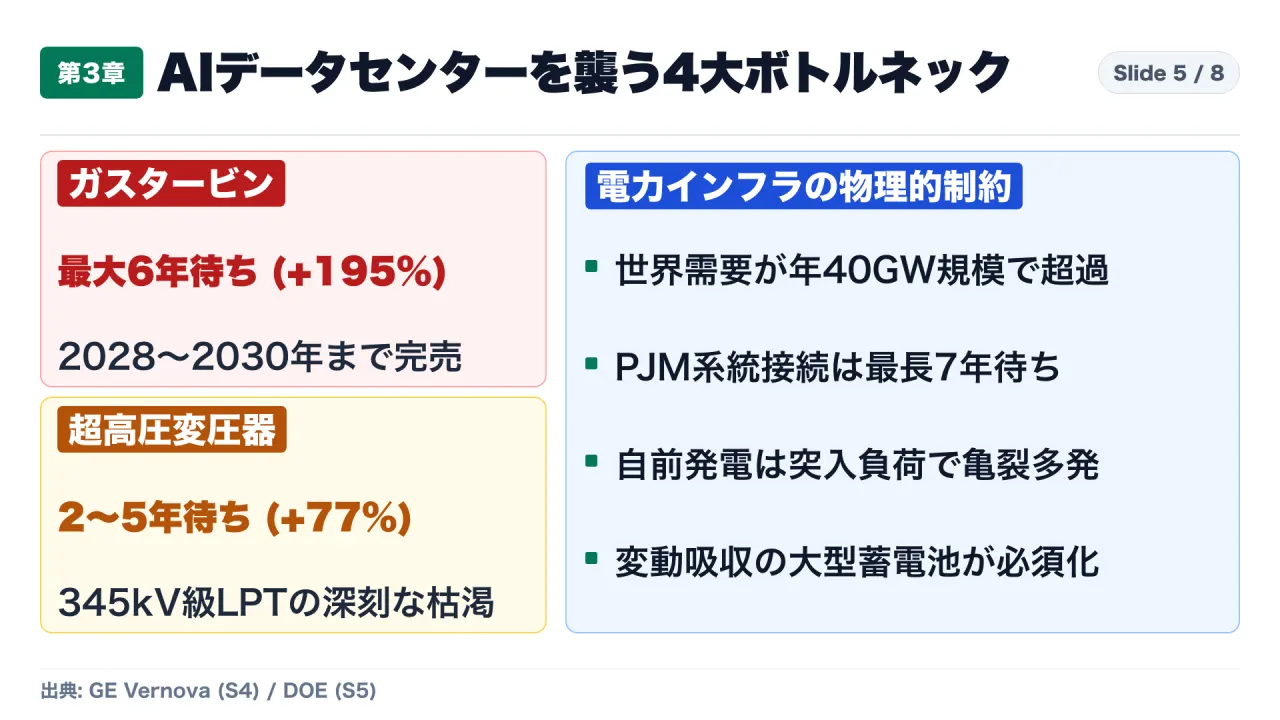
1. Gas Turbine Backlogs: Sold Out Through 2030, Lead Times up to 6 Years
The global market for utility-scale heavy-duty gas turbines is an oligopoly controlled by GE Vernova, Siemens Energy, and Mitsubishi Heavy Industries. Driven by data center developers attempting to bypass transmission lines, manufacturing slots for large frame turbines are completely booked through 2028–2030.
Current lead times for newly placed turbine orders stand at up to six years. Global annualized demand for utility generation exceeds 40 GW, outstripping combined OEM production capacity. This imbalance has driven equipment prices up by 195% compared to pre-pandemic baselines, sparking speculative hoarding of aeroderivative and industrial turbines.
2. Large Power Transformer (LPT) Shortages: 2–5 Year Delays, Prices +77%
Securing generation capacity solves only half the electrical equation; facilities must step voltage up or down via Large Power Transformers (LPTs). Stepping 345 kV or 500 kV bulk transmission down to distribution voltages requires specialized transformers facing acute manufacturing shortages.
Driven by a global scarcity of Grain-Oriented Electrical Steel (GOES) and a shortage of specialized high-voltage winding technicians, LPT lead times have stretched to between two and five years, with prices rising by 77%. Project developers routinely find themselves with completed power plants that cannot energize data centers because step-up transformers remain years away from delivery.
3. Grid Interconnection Queues: Backlogs of 3 to 7 Years
Developers seeking conventional grid power face procedural delays within Regional Transmission Organizations (RTOs). In the PJM Interconnection (covering 13 eastern states, including Ohio and Northern Virginia) and the ERCOT grid in Texas, interconnection queues have become severely congested.
Review queues for multi-hundred-megawatt interconnects require three to seven years. In Northern Virginia’s “Data Center Alley,” capacity exhaustion across local utility substations has institutionalized seven-year interconnection delays. These grid barriers drove developers toward behind-the-meter (BTM) on-site natural gas generation, inadvertently triggering the fourth bottleneck.
4. Behind-the-Meter Operational Failure: Transient Loads and Blade Cracking
Operating utility gas turbines in an islanded, behind-the-meter topology introduces severe mechanical stress. AI computational workloads do not consume steady baseload power; when clusters containing tens of thousands of GPUs initiate distributed training matrix multiplications or massive parallel inference batches, power demand spikes by hundreds of megawatts in milliseconds. When compute cycles finish, demand drops precipitously.
Industrial gas turbines are engineered for continuous, baseload rotation under stable thermal conditions. Subjected to rapid transient step loads, turbine combustion chambers experience thermal shocks, and rotating shafts suffer torsional fatigue.
In early islanded deployments—such as xAI’s Colossus cluster in Memphis, Tennessee, and Crusoe’s Stargate deployment in Texas—turbines suffered premature mechanical degradation, including micro-cracking across turbine blades. To stabilize turbine operations, developers must install utility-scale Battery Energy Storage Systems (BESS) between the generators and the server racks to buffer millisecond load transients. This requirement adds hundreds of millions of dollars in unbudgeted capital expenditure, eroding the projected cost benefits of on-site power generation.
4. Financial Strain and Policy Exposure: 790.7 Billion Yen in Financing Costs, CDS Widening, and NEPA Scrutiny
Deploying corporate balance-sheet leverage into illiquid, long-lead physical infrastructure in a high-interest-rate environment has introduced acute financial vulnerabilities for SoftBank Group.
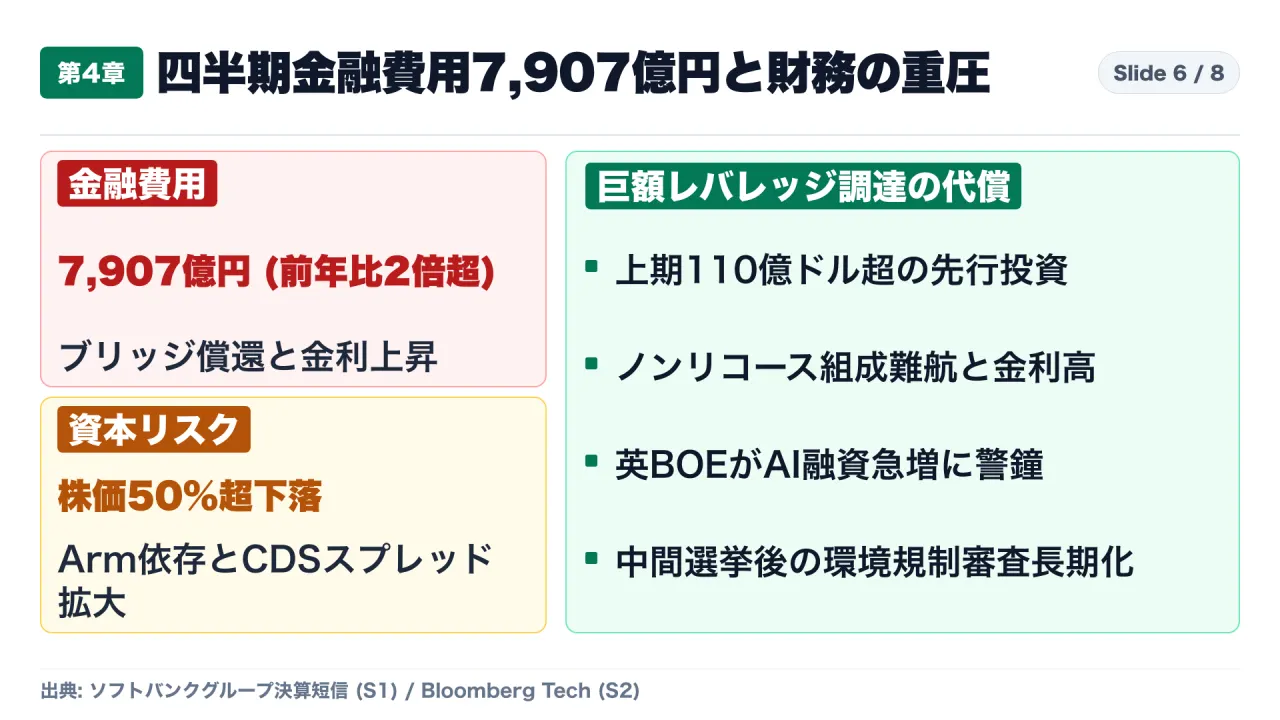
During the first half of FY2026, SoftBank poured approximately $11 billion into AI data center infrastructure and compute commitments. In the second quarter alone, SoftBank’s quarterly financial expenses doubled year-over-year to 790.7 billion yen, driven by debt service on bridge loans and early-termination financing fees.
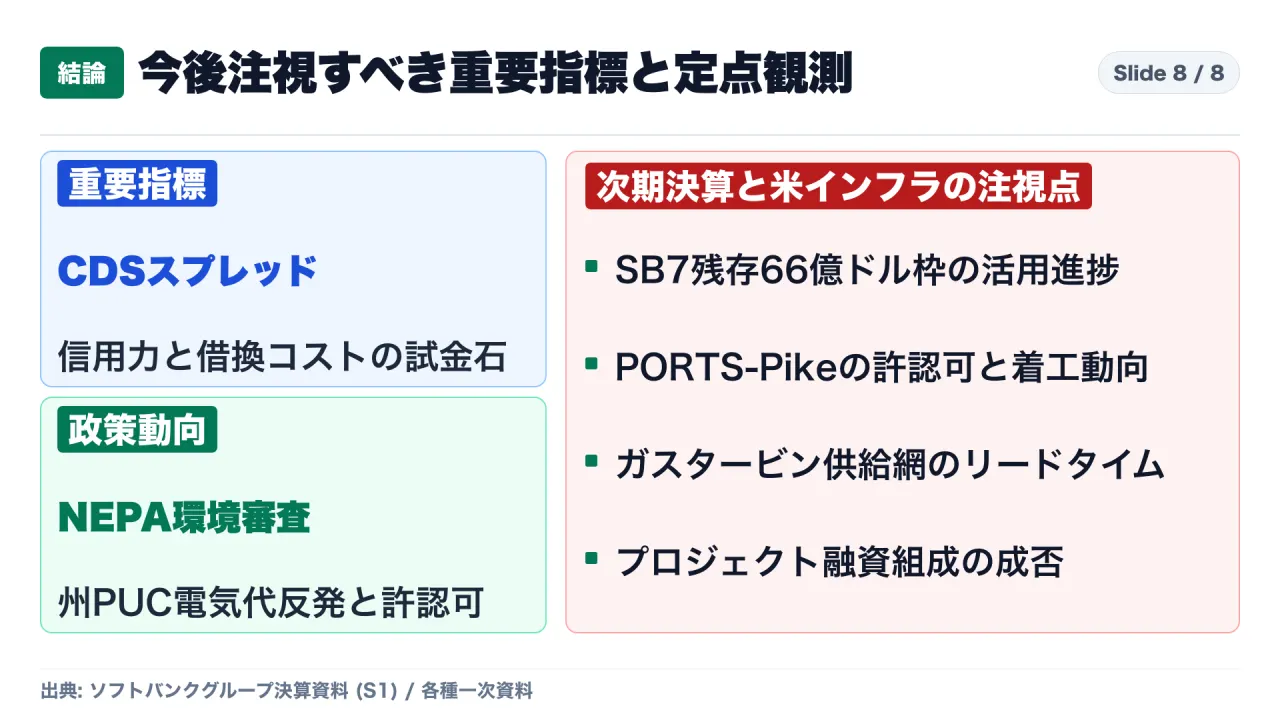
SoftBank’s market capitalization has fallen more than 50% from its peak in June 2026. Because SoftBank’s borrowing capacity and asset coverage are tied to the market value of its stake in British semiconductor designer Arm Holdings, market volatility in Arm shares directly tightens SoftBank’s leverage ratios. Combined with SoftBank’s reported $65 billion in aggregate commitments to OpenAI, the company’s Credit Default Swap (CDS) spreads widened significantly in late 2026, signaling rising credit-risk premiums in debt capital markets.
Central Bank Scrutiny and Post-Midterm Regulatory Tightening
The macro-financial environment for AI infrastructure debt is tightening rapidly. In November 2026, the Prudential Regulation Authority (PRA) of the Bank of England (BOE) issued a formal supervisory warning to commercial banks and private credit funds regarding their exposure to AI data centers and power infrastructure loans. The central bank highlighted the systemic risks of excessive credit concentration in assets vulnerable to rapid technological obsolescence and permitting gridlock, urging lenders to tighten loan underwriting standards.
In the United States, following the November 2026 midterm elections, federal and state regulatory hurdles for mega-scale energy projects have escalated:
- Environmental Opposition: Massive fossil-fuel generation projects adjacent to compute campuses face intense resistance from local communities over nitrogen oxide (NOx) air emissions and groundwater depletion caused by evaporative data center cooling.
- NEPA Review Extensions: Concentrated generation campuses like PORTS-Pike (9.2 GW gas) face comprehensive Environmental Impact Statement (EIS) reviews under the National Environmental Policy Act (NEPA). With public utility commissions under pressure to shield residential consumers from grid upgrade costs, state and federal approvals face multi-year extensions.
Practical Engineering & Governance Takeaways
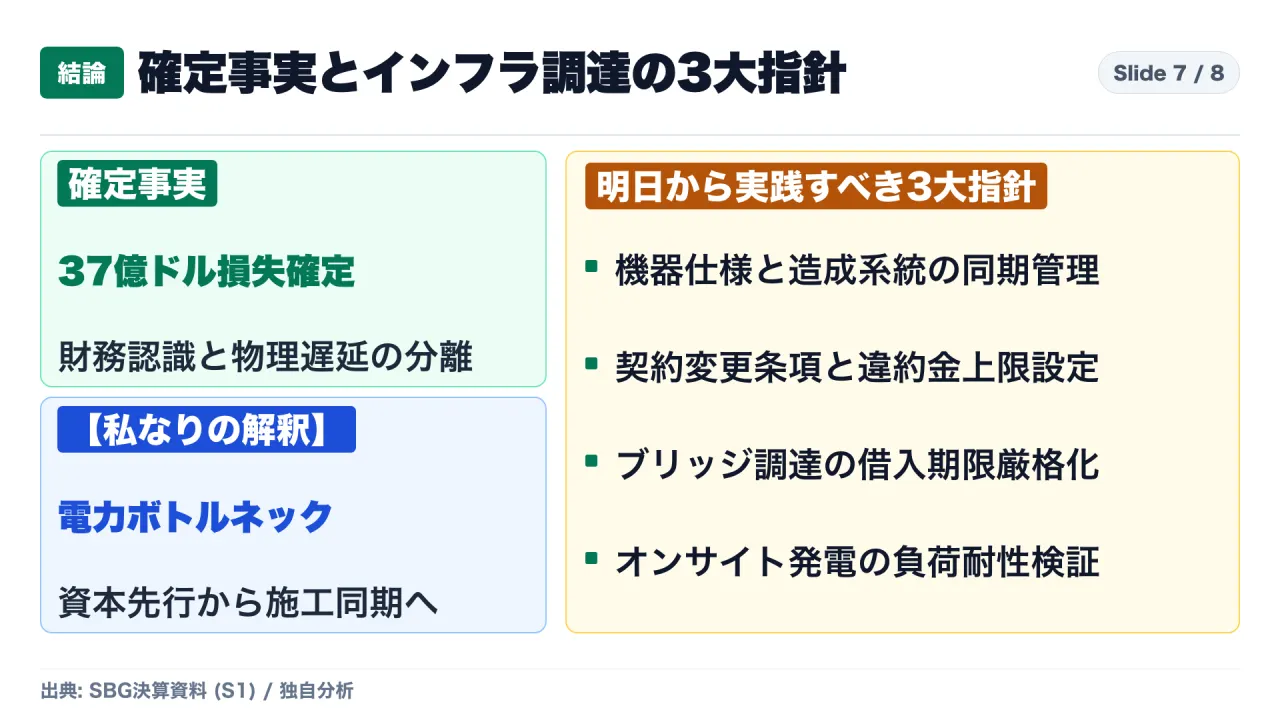
The SB7 write-down provides critical lessons for enterprise leaders, infrastructure architects, and investment officers navigating the AI physical buildout:
- Synchronize Equipment Procurement with Site Permitting (Strict Milestone Coupling): Never execute binding take-or-pay equipment manufacturing contracts based on projected timelines. Equipment fabrication schedules must be contractually linked to local civil engineering progress, environmental permits, and utility interconnection approvals. Contracts must give developers the right to delay delivery windows without triggering storage penalties or default conditions if site permits are delayed.
- Incorporate Contractual Flexibility and Liability Caps in Equipment Slot Reservations: When paying advance deposits to reserve factory capacity, ensure agreements contain explicit reallocation provisions (allowing hardware to be redirected to secondary project sites) and strict caps on liquidated damages and cancellation liabilities. Relying on future purchasing rebates as termination consideration fails to provide balance sheet protection under IFRS and GAAP.
- Budget for Transient Buffering in Islanded Microgrids: Organizations evaluating behind-the-meter generation for AI clusters must not model gas turbines as direct power sources for server racks. System designs must incorporate dynamic Battery Energy Storage Systems (BESS) capable of absorbing instantaneous load steps (0 to 100% capacity in milliseconds) to protect turbine blades from cyclic fatigue and thermal micro-cracking.
- Monitor SB7’s Remaining $6.6 Billion Asset Pool and Financing Spreads: Track how SoftBank manages its remaining $6.6 billion in equipment allocations and whether it successfully transfers these assets into non-recourse project finance SPVs. Widening CDS spreads and tightened bank underwriting will serve as a leading indicator for capital availability across the entire global AI data center sector.
Sources
- SoftBank Group Corp., “Consolidated Financial Report for the Six Months Ended September 30, 2026 (IFRS)” and Earnings Presentation Materials: https://group.softbank/ir/financials/financial_reports
- Bloomberg Tech, “SoftBank $7B Q2 Net Loss & $3.7B U.S. Power Equipment Writedown Analysis” (featuring Pierre Ferragu, New Street Research): https://www.youtube.com/watch?v=mb9h4Di12k0
- The Economic Times / Japan Times, “SoftBank records $3.7B power equipment writedown over U.S. AI data center supply reorganization and SB7 rebate structure”: https://economictimes.indiatimes.com/tech/technology/softbank-power-equipment-writedown-sb7-rebate
- GE Vernova Gas Power, “Global Gas Turbine Supply, Lead Time Dynamics, and Transformer Supply Chain Bottlenecks”: https://www.gevernova.com/gas-power
- U.S. Department of Energy (DOE), “PORTS-Pike Technology Campus Environmental Assessment and Interconnection Review Documentation”: https://www.energy.gov/nepa/ports-pike-technology-campus