Overcoming the AI Memory Wall and Power Crunch: Google TPU 8i Max, NVIDIA AutoCompress, and Cisco's 80% On-Premises Architecture
Executive Summary & Key Takeaways
- Core Thesis: The era of leasing homogeneous, general-purpose GPUs in the public cloud for unconstrained AI inference is hitting two simultaneous physical limits: the memory wall in serving multi-turn agent contexts, and regional grid power shortages that have driven short-term GPU rental rates from $3–$5 per hour to over $12–$13 per hour. In response, enterprise infrastructure design is pivoting toward three interdependent mechanisms: hardware specialization (Google TPU 8i Max delivering 17.2 TB/s HBM bandwidth and a 7-hop Boardfly topology), hardware-profiling model compression (NVIDIA AutoCompress pruning a 120B model down to 74B to run on a single B200 GPU with 95.1% benchmark retention), and high-utilization on-premises pooling (Cisco shifting 80% of steady-state inference on-prem and tripling GPU utilization across 90,000 employees).
- Primary Sources Verified: Google Cloud Infrastructure Briefing and Official Blog (Our newest TPUs: 8tx and 8i Max, built for the agentic era by Amin Vahdat), ServeTheHome hardware analysis, NVIDIA Research (AutoCompress: Automated Hardware-Guided Model Compression, arXiv:2611.08290v1), Cisco Official IT Blog (How Cisco Built an Enterprise AI Factory by Jon Woolwine and Gregory Sylvester II), Tomasz Tunguz / Theory Ventures (When Does the US Become a Net Importer of Tokens?), Goldman Sachs Commodities Research, Anthropic Form S-1/A filing, and daily.dev procurement reporting.
- Actionable Engineering & Governance Takeaways:
- Base AI hardware procurement on memory bandwidth and network hop latency rather than raw FLOPS; long-context agentic workloads are bound by KV-cache retrieval.
- Discard theoretical parameter counting in model sizing; measure real-device latency and VRAM overhead, applying layer-wise heterogeneous pruning and post-routing MoE output masking.
- Isolate predictable steady-state inference (target: 80% on dedicated, high-utilization clusters with automated idle reclaim) from bursty experimentation (20% public cloud).
- Limits of the Evidence: Google has disclosed technical specifications for TPU 8tx and TPU 8i Max, but general availability (GA) dates and hourly cloud pricing remain unverified in the public record. AutoCompress benchmark results are validated on specific hardware targets (RTX 5070, RTX 5080, H100, B200) and Nemotron-family architectures; transferability to arbitrary architectures requires custom cost-model profiling. The exact deployment sites and operational timeline for Anthropic’s 1.7 GW Caterpillar generator purchase remain undisclosed by the parties.
Japanese Edition: https://consuloji.substack.com/p/ai4ai5000
1. The Breakdown of General-Purpose Cloud GPU Scaling and the Memory Wall
Over the past three years, enterprise AI adoption focused heavily on raw compute capability measured in floating-point operations per second (FLOPS). However, as enterprise workloads transitioned from single-shot query completion to autonomous multi-turn agents, code generation, and long-context retrieval-augmented generation (RAG), the primary operational bottleneck shifted from compute cores to the memory subsystem and power availability.
When serving active agentic sessions with contexts ranging from 32,000 to over 128,000 tokens, the key-value (KV) cache grows proportionally with sequence length and batch size. Generating each subsequent token requires reading the entire accumulated KV-cache state from memory into the arithmetic units. As a result, powerful tensor cores routinely stall while waiting for data transfers across high-bandwidth memory (HBM) interfaces or inter-chip interconnects.
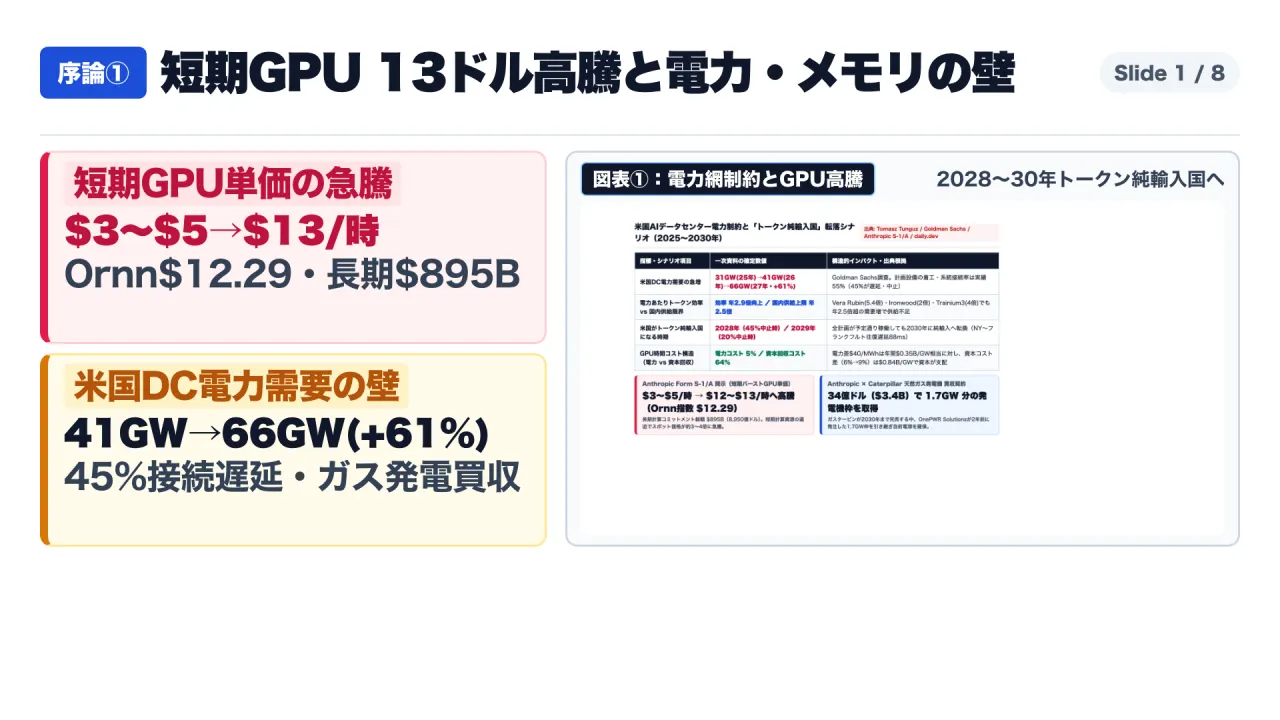
Concurrently, access to cloud compute has become severely constrained by regional electrical grids. According to Goldman Sachs Commodities Research, US data center power demand is projected to expand from 31 GW in 2025 and 41 GW in 2026 to 66 GW in 2027—a 61% year-over-year increase. Because grid interconnection queues across major transmission systems face delays or cancellations affecting approximately 45% of planned capacity, cloud providers cannot expand data center footprints at the pace of chip production. This dynamic caused short-term spot GPU rental rates to surge from historical baselines of $3–$5 per hour to between $12 and $13 per hour (reaching $12.29 on the Ornn Compute Index in October 2026).
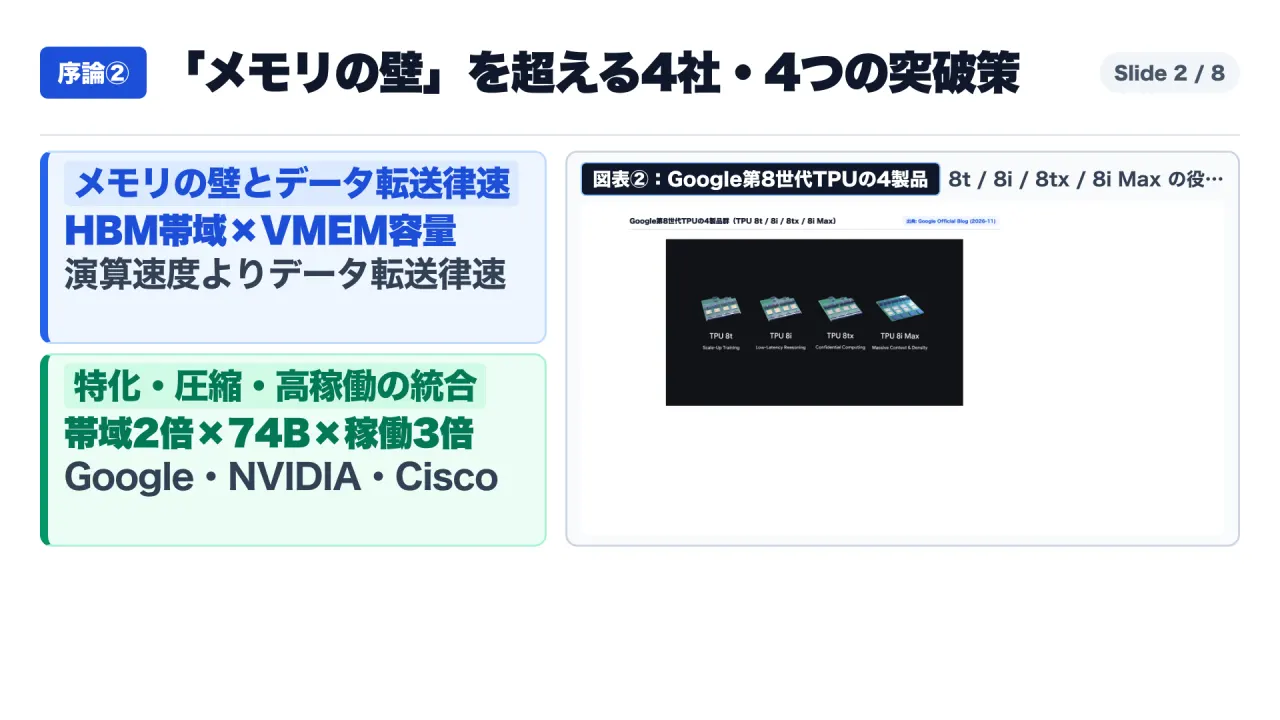
Under these macro conditions, continuing to lease general-purpose cloud GPUs on an on-demand basis for standard enterprise tasks leads to budget exhaustion. Addressing this challenge requires an integrated approach across three layers: specialized hardware topologies tailored to memory-bound agent serving, automated hardware-guided model pruning, and operational consolidation of steady-state enterprise inference.
2. Google’s 8th-Generation TPU Portfolio: TPU 8i Max and the Boardfly Topology
In November 2026, Google announced its eighth-generation Tensor Processing Unit (TPU) portfolio, formally abandoning the concept of a single universal chip for both training and inference. Led by Amin Vahdat, Vice President of Engineering for AI Infrastructure, Google split its architecture into four specialized configurations, headlined by the TPU 8tx and TPU 8i Max.
The Four 8th-Gen TPU Systems
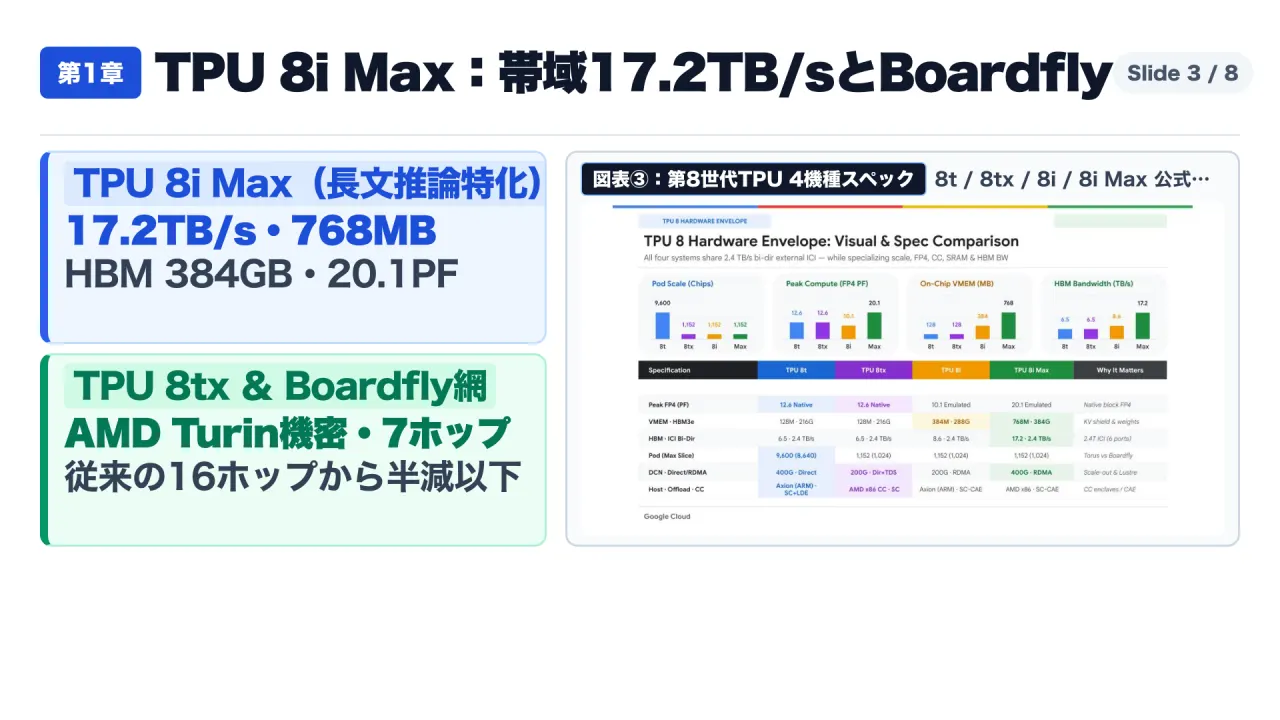
The systems standardize on 2.4 TB/s Inter-Chip Interconnects (ICI) across 6 bidirectional ports, but differentiate computational and memory architectures across distinct operational profiles:
- TPU 8t (Scale-Up Training): Designed for foundation model pre-training. Pods scale up to 9,600 chips (maximum single slice: 8,640 chips) in a 3D Torus topology. Delivers 12.6 PFLOPS of native block FP4, with 128 MB of on-chip SRAM (VMEM), 216 GB of HBM3e, and 6.5 TB/s memory bandwidth. Host processors are Google Axion ARM CPUs connected via 400G Direct networking.
- TPU 8tx (Confidential Inference & Fine-Tuning): Pods scale up to 1,152 chips (maximum slice: 1,024 chips) configured in the new Boardfly topology. Delivers 12.6 PFLOPS of native block FP4, 128 MB VMEM, 216 GB HBM3e, and 6.5 TB/s bandwidth. Critically, its host nodes utilize dual-socket AMD EPYC Turin (x86) CPUs with 128 PCIe Gen 5 lanes, integrating hardware-level Confidential Computing enclaves. This architecture allows regulated enterprises in finance, healthcare, and government to run fine-tuning and inference with encrypted memory states.
- TPU 8i (Low-Latency Reasoning): Tailored for inference tasks that demand immediate token response. Pods scale to 1,152 chips using Boardfly. Delivers 10.1 PFLOPS (emulated FP4), triples on-chip VMEM to 384 MB, increases HBM3e capacity to 288 GB, and raises memory bandwidth to 8.6 TB/s. Host nodes use Google Axion ARM CPUs over 200G RDMA.
- TPU 8i Max (High-Density & Massive-Context Agentic Serving): Designed specifically for long-context, multi-agent workloads. It integrates two TPU 8i chips into a single dual-chip logical package, scaling to 1,152 chips under the Boardfly topology. It provides 20.1 PFLOPS of emulated FP4 (a 2× increase over TPU 8i), doubles on-chip VMEM to 768 MB (6× the capacity of TPU 8t), expands HBM3e capacity to 384 GB (+33%), and doubles memory bandwidth to 17.2 TB/s. Host nodes feature AMD x86 CPUs with 400G RDMA networking.
Boardfly Topology and KV-Cache State Management
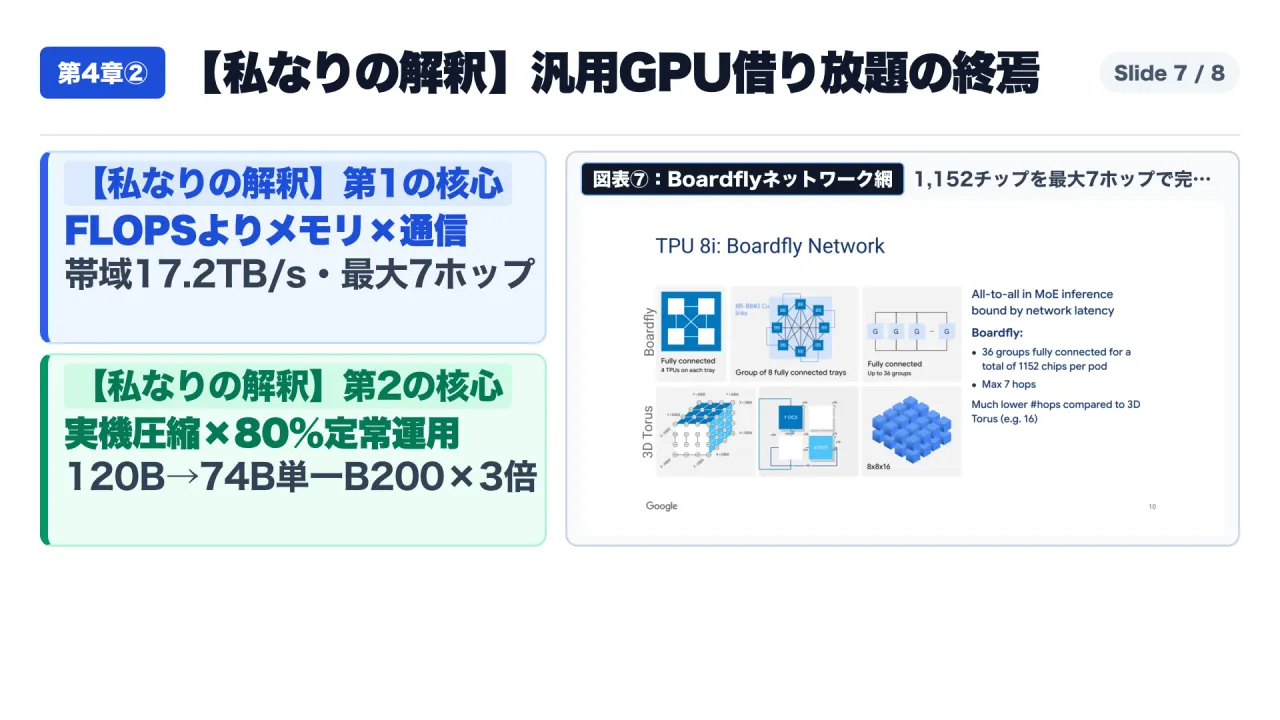
For Mixture-of-Experts (MoE) architectures, token generation requires routing all-to-all communications across distributed expert layers. In traditional 3D Torus networks (configured as 8×8×16 meshes), traversing from one corner of a pod to the opposite corner required up to 16 hops.
The Boardfly topology eliminates this latency bottleneck. Boardfly organizes 4 chips per tray into a fully connected group, links 8 trays into a fully connected copper domain, and cross-connects up to 36 groups (1,152 chips) via Optical Circuit Switches (OCS). This hierarchical design reduces the maximum network diameter across 1,152 chips from 16 hops to exactly 7 hops.
At the software layer, Google introduced TorchTPU, providing native support for PyTorch, vLLM, and SGLang without code modifications, paired with TPU Sync, which orchestrates hierarchical KV-cache movement across on-chip HBM, host DRAM, shared SSD storage, and cluster networking.
3. NVIDIA AutoCompress: Hardware-Profiling Pruning and Fitting 120B onto a Single B200
While custom accelerators address the memory wall through raw hardware bandwidth, model architectures must also be tailored to target hardware specifications. In November 2026, NVIDIA Research published AutoCompress: Automated Hardware-Guided Model Compression (arXiv:2611.08290v1, authored by Sheldon Liang, Sharath Turuvekere Sreenivas, Pavlo Molchanov, and Pavan K. Anasosalu Vasu), presenting empirical proof that standard industry sizing assumptions are fundamentally flawed.
The Breakdown of Parameter Counts and Theoretical Formulas
The NVIDIA researchers established two critical empirical findings:
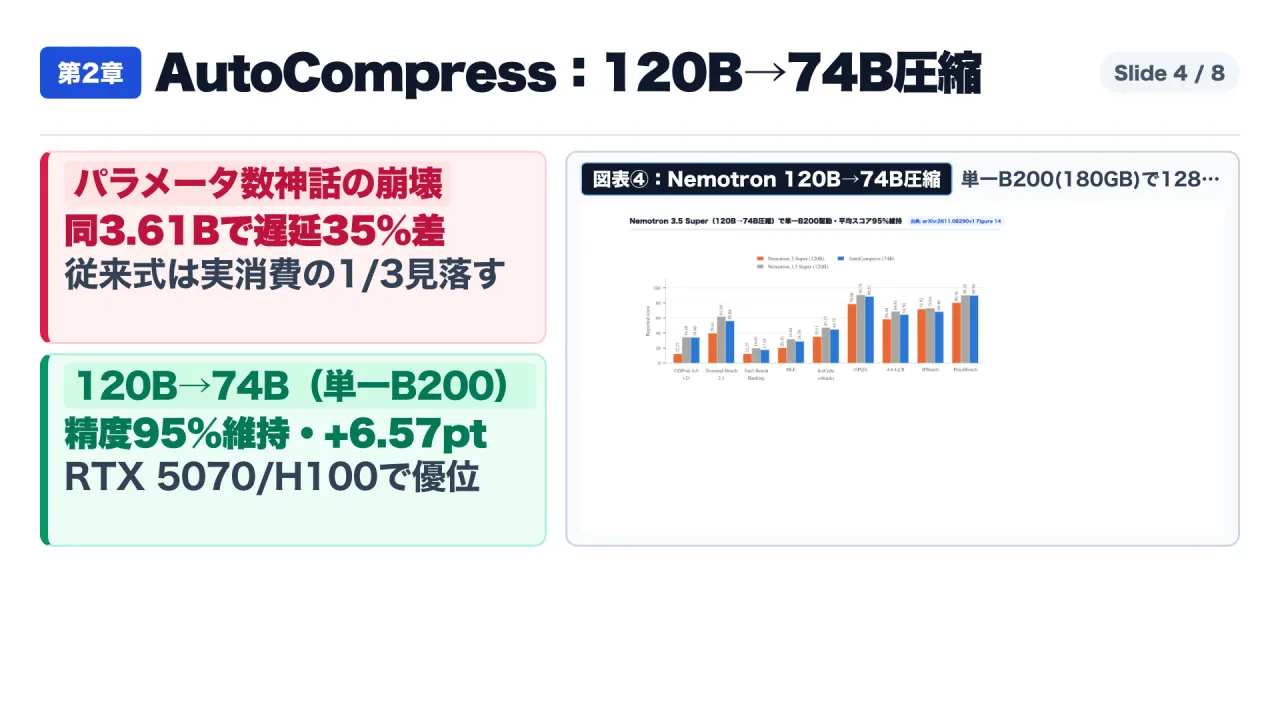
- Parameter count is a misleading proxy for inference cost: Evaluating two hybrid Mamba-Attention-MoE models sharing identical total parameter counts (3.61B) and active parameter counts (1.26B), the deep-and-narrow variant suffered 35% higher inference latency on an RTX 5070 GPU compared to the wide-and-shallow variant. In data center evaluations on an H100 GPU, a model with 15% fewer active parameters demonstrated 9% lower throughput due to memory alignment penalties.
- Theoretical memory formulas omit approximately one-third of actual consumption: Conventional formulas aggregate weight storage, sequence KV caches, and MoE activation buffers. However, they neglect CUDA runtime context allocations, CUDA Graph memory reservations, and inference-engine workspace buffers. In real-world deployments, models deemed theoretically viable regularly encounter out-of-memory (OOM) errors due to this roughly 33% overhead gap.
The AutoCompress Pipeline and Algorithmic Innovations
AutoCompress replaces heuristic pruning with a three-stage, hardware-in-the-loop pipeline:
- Lightweight Hardware Profiling: The target GPU (RTX 5070, RTX 5080, H100, or B200) and production serving runtime (TensorRT-LLM or vLLM) are profiled using NVIDIA Nsight Systems. The profiling measures prefill latency, decode latency, and physical memory footprint across varying layer depths, intermediate FFN widths, and MoE routing allocations. Profiling requires minimal compute: 3.5 GPU-hours for an RTX 5080 coding configuration, 4.5 GPU-hours for an RTX 5070 on-device gaming configuration, and 24.8 GPU-hours for an H100 data center configuration.
- Differentiable Search via Post-Routing Masking: AutoCompress optimizes global dimensions (hidden sizes from 2688 to 1408) alongside layer-specific intermediate FFN widths and MoE expert counts (128, 112, 96, 80, 64, or 32). A crucial algorithmic breakthrough involves applying expert pruning masks after top-k routing selection rather than before. This post-routing expert masking allows distillation gradients to propagate across all top-k candidate experts, reducing training loss by 23%. Initializing router weights to zero (yielding uniform initial distributions) further reduced distillation loss by 10.9%.
- Knowledge Distillation: The identified heterogeneous architecture is recovered via 30 billion tokens of knowledge distillation using the parent model as teacher.
Benchmark Results and Single-GPU 120B Serving
When benchmarked against Minitron under identical token budgets, AutoCompress demonstrated consistent gains across strict hardware deployment contracts:
- On-Device NPC Contract (1× RTX 5070 12GB; budget: latency ≤ 750ms, memory ≤ 4.0 GiB): The 12.4B parent model (2.1B active) failed the contract at 1,147.1ms and 8.76 GiB. AutoCompress pruned it to 3.6B parameters (739.7ms latency, 3.90 GiB memory), improving average benchmark accuracy across eight evaluations (AIME25, LiveCodeBench, MMLU-Pro, MATH-500, GSM8K, IFEval, IFBench, GPQA) by +6.57 points over Minitron (33.21 vs 26.64).
- Long-Context Local Coding Contract (1× RTX 5080 16GB; batch 1, 262k cache + 16k output; budget: latency ≤ 11.5s, memory ≤ 13.96 GiB): Pruned a 31.6B parent model to 13.6B parameters (11.1s latency, 13.61 GiB memory), exceeding Minitron’s eight-benchmark average by +2.35 points (51.40 vs 49.05).
- Data Center Throughput Contract (8× H100; budget: throughput increase ≥ +50%): Pruned the parent model to 17.7B parameters, achieving a +50.5% throughput gain while outperforming Minitron by +0.57 points (54.81 vs 54.24).
Most significantly, AutoCompress was applied to NVIDIA’s flagship 120B parameter model, Nemotron 3.5 Super. In native BF16, this model requires approximately 280 GB of memory, making it impossible to serve on a single 180 GB B200 GPU. AutoCompress compressed the architecture down to 74B parameters. This enabled native BF16 execution on a single B200 GPU at a 131,072 (128K) context length with a batch size of 16. Across nine benchmarks (including Terminal-Bench 2.1, Tau3-Bench Banking, HLE, SciCode, and GPQA), the 74B model retained 95.1% of the parent model’s unweighted average score (54.74 vs 57.58), outperforming the prior-generation full-size Nemotron 3 Super 120B (45.44) across every metric.
4. Cisco’s 80% On-Premises Architecture and Macro Power Economics
Hardware specialization and model compression find their operational integration in enterprise infrastructure strategy. In late 2026, Cisco’s IT leadership (Jon Woolwine, VP of IT, and Gregory Sylvester II, VP of Enterprise AI Platform) published production metrics from the deployment of their internal “Enterprise AI Factory.”
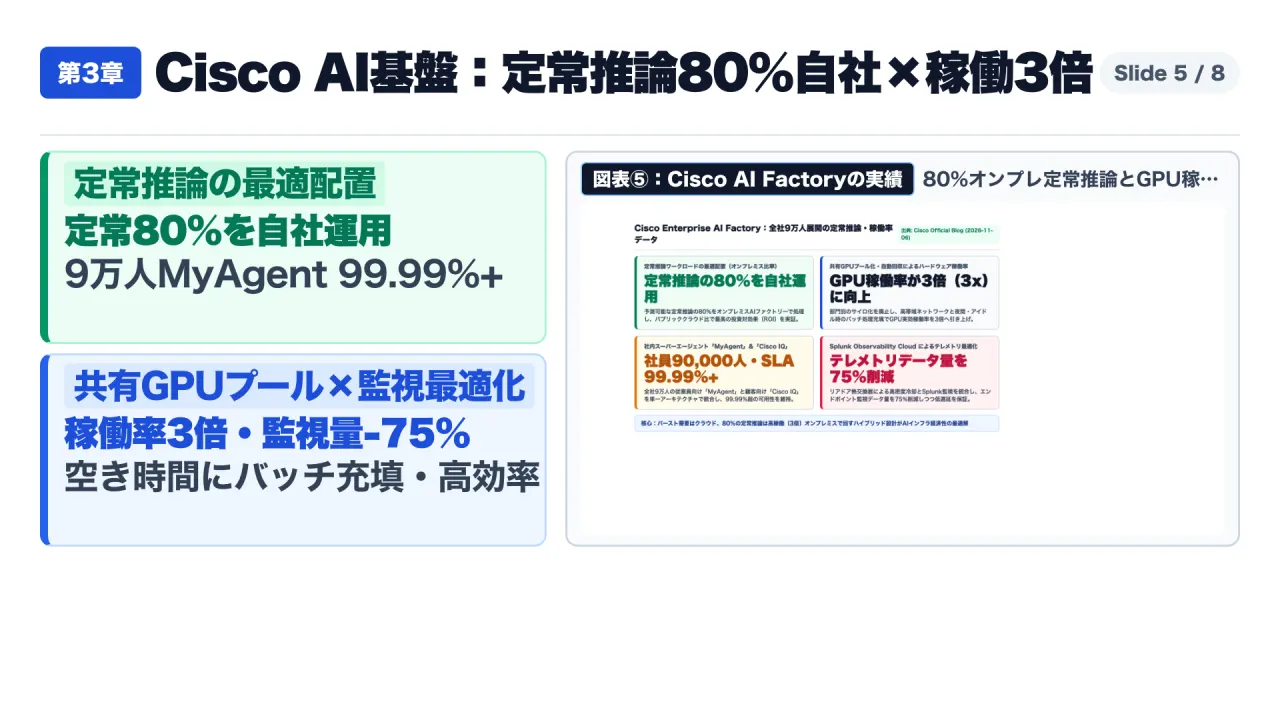
Cisco integrated two flagship services onto a unified enterprise platform: MyAgent, an enterprise assistant serving 90,000 internal employees, and Cisco IQ, a customer-facing support platform. The deployment achieved four notable operational milestones:
- The 80/20 Steady-State Rule: While public cloud elasticity remains optimal for prototyping and seasonal bursts, predictable daily enterprise inference is inherently steady-state. Cisco proved that running 80% of steady-state inference on dedicated, on-premises infrastructure while bursting the remaining 20% to public cloud delivers the lowest total cost of ownership (TCO) while maintaining over 99.99% service availability.
- Tripling GPU Utilization via De-siloing: Traditional corporate on-premises deployments fail due to organizational fragmentation, where individual business units hoard dedicated GPU servers that idle at 10–15% average utilization. Cisco pooled all GPUs over a Cisco Silicon One fabric and implemented automated idle reclamation: conversational interactive inference takes priority during business hours, while background batch workloads (data indexing, synthetic data generation, model distillation) automatically fill compute valleys, tripling effective GPU utilization (3×).
- High-Density Cooling and Telemetry Reduction: By pairing rear-door heat exchangers with Splunk Observability Cloud, Cisco cut endpoint telemetry volume by 75% while maintaining compliance monitoring.
The Macroeconomic Driver: Why Anthropic Spent $3.4 Billion on Gas Generators
The structural rationale behind Cisco’s consolidation becomes apparent when examining macro grid constraints. Analysis by Tomasz Tunguz (Theory Ventures) establishes that although chip energy efficiency improves at roughly 2.9× compound annual growth, domestic electrical grid capacity expansion is constrained to approximately 2.5× annually.
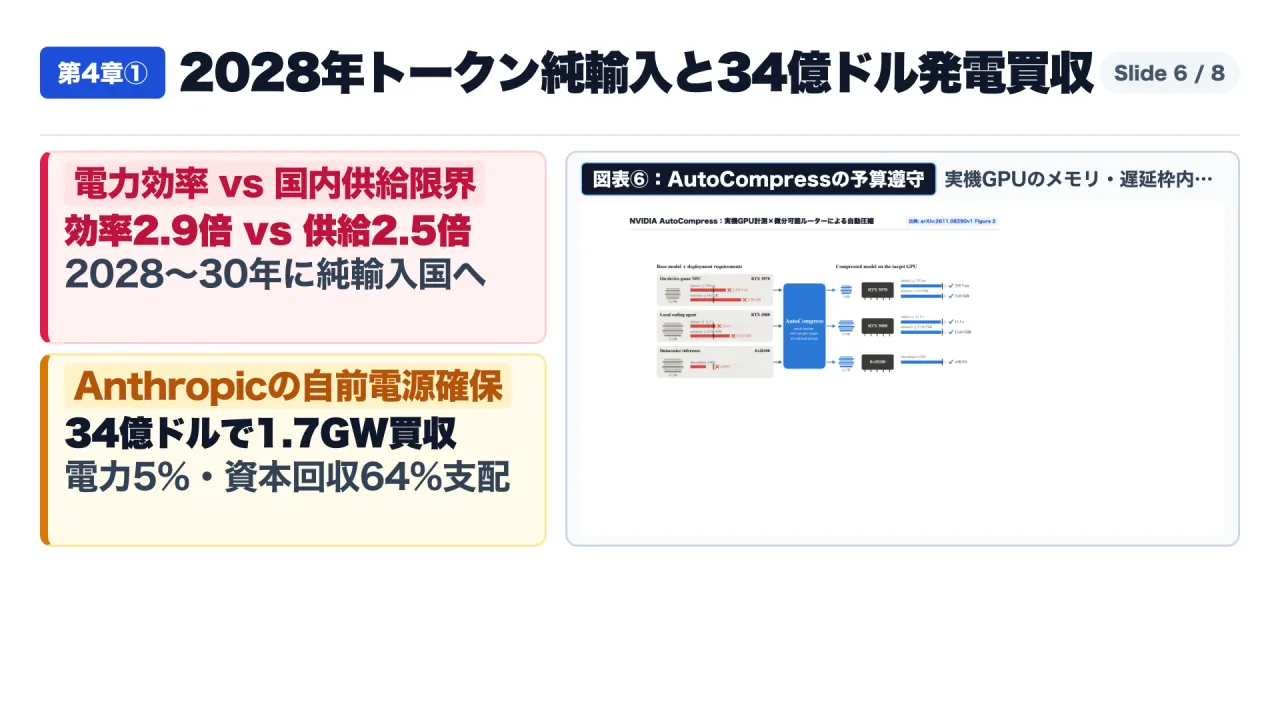
Under Tunguz’s model, the United States will become a net importer of tokens (importing inference over subsea fiber cables from overseas data centers) between 2028 (if 45% of planned US grid connections fail) and 2030 (even under 100% successful construction).
Furthermore, Tunguz’s cost-of-compute breakdown reveals that electricity represents only 5% of the hourly cost of operating a GPU server, whereas capital recovery (depreciation and debt servicing on high-cost hardware) represents 64%. A $40/MWh variance in electricity cost impacts a 1 GW data center by approximately $350 million annually. Conversely, a 3% shift in capital costs (from 6% to 9%) increases annual expenses by $840 million.
Consequently, the fatal financial risk for AI operators is not higher utility bills, but allowing capital-intensive GPUs to sit idle due to power delays. With utility gas turbine manufacturing backlogs extended to 2030, Anthropic—carrying $895 billion in long-term compute commitments according to its Form S-1/A filing—directly paid $3.4 billion to acquire 1.7 GW of Caterpillar natural gas generators previously ordered by OnePWR Solutions. Securing dedicated generation to ensure immediate 100% utilization of capital-intensive clusters is far more financially sound than waiting years for utility substation interconnection.
Practical Engineering & Governance Takeaways
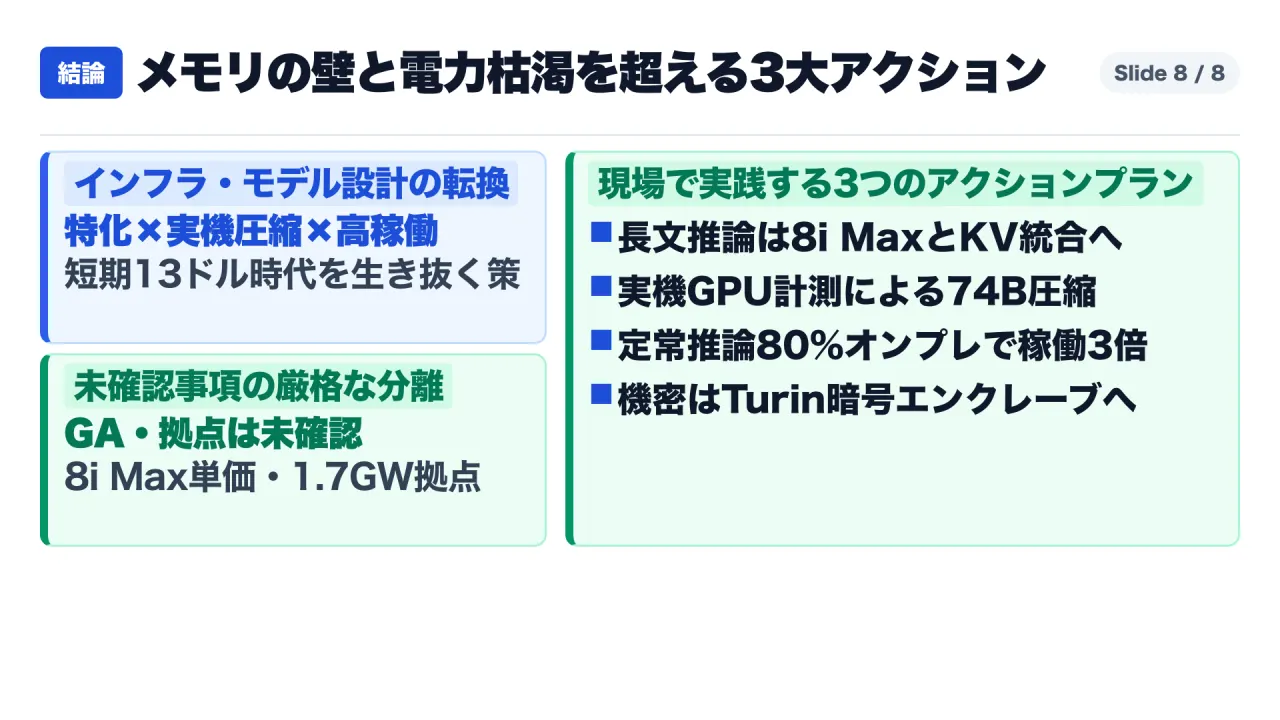
To adapt enterprise AI architectures to these realities, engineering organizations should adopt three concrete practices:
- Select Accelerators by Memory Hierarchy Rather Than FLOPS: For multi-turn conversational agents and long-context RAG, evaluate inference hardware primarily on HBM bandwidth, SRAM capacity, and inter-node network diameter. Workloads requiring multi-thousand token contexts benefit directly from configurations like TPU 8i Max (17.2 TB/s HBM bandwidth, 7-hop Boardfly interconnect) or dual-chip packages with unified KV-cache pooling (
TPU Sync), while regulated data requires confidential enclaves such as TPU 8tx with AMD EPYC Turin. - Implement Profiling-Driven Compression Prior to Scale Deployment: Discard uniform layer assumptions. Profile candidate models directly on the target production GPU and runtime engine using tools like NVIDIA Nsight Systems. Utilize hardware-guided heterogeneous pruning (AutoCompress methodology) with post-routing expert masking to compress models to fit within single-GPU or single-node memory envelopes (e.g., pruning 120B models to 74B for single B200 deployment), eliminating cross-node tensor-parallel communication overhead.
- Adopt the 80/20 Inference Hybrid Operating Model: Audit organizational GPU workloads to separate predictable steady-state inference from bursty demand. Consolidate steady-state workloads (80%) onto pooled infrastructure—whether on-premises or on reserved dedicated instances—and implement automated scheduling that backfills idle conversational capacity with batch jobs, targeting a 3× utilization multiplier. Rely on public cloud spot instances only for genuine demand spikes (20%).
Sources
- Google Official Blog, “Our newest TPUs: 8tx and 8i Max, built for the agentic era” (Amin Vahdat): https://blog.google/innovation-and-ai/infrastructure-and-cloud/global-network/tpu-8i-max-and-8tx/
- ServeTheHome, “Google TPU 8tx and TPU 8i Max Detailed with AMD EPYC Turin”: https://www.servethehome.com/google-tpu-8tx-8i-max-amd-epyc-turin/
- arXiv:2611.08290v1, “AutoCompress: Automated Hardware-Guided Model Compression” (Liang, Sreenivas, Molchanov, Vasu, NVIDIA Research): https://arxiv.org/html/2611.08290v1
- Cisco Blogs, “How Cisco Built an Enterprise AI Factory: Scaling Economics, Performance, and Security” (Jon Woolwine, Gregory Sylvester II): https://blogs.cisco.com/cisco-on-cisco/how-cisco-built-an-enterprise-ai-factory
- Tomasz Tunguz / Theory Ventures, “When Does the US Become a Net Importer of Tokens?”: https://tomtunguz.com/when-does-the-us-become-a-net-importer-of-tokens/
- daily.dev, “Anthropic pays $3.4B for 1.7GW of Caterpillar gas generators”: https://daily.dev/posts/anthropic-pays-3-4b-for-1-7gw-of-caterpillar-gas-generators-hlpvtuogd
- U.S. Securities and Exchange Commission, Anthropic PBC Form S-1/A Registration Statement (CIK: 0002130357).