Why Nominal Hit a $3B Valuation in 4 Years: Inside the Hardware AI Stack Compressing 6-Hour Tests into Minutes
By bridging fragmented test plans, high-frequency raw telemetry, and AI evaluation agents across defense primes and EV fleets, Austin startup Nominal tripled its valuation in eight months—exposing critical vulnerabilities in traditional industrial testing pipelines.
Published: November 12, 2026 | Read time: ~10 min | Watch Video (Japanese)
Executive Summary: The Physical Hardware Testing Bottleneck
In advanced hardware engineering—spanning orbital launch vehicles, supersonic aircraft, electric vehicle powertrains, and autonomous defense systems—the primary bottleneck delaying production cycles is rarely CAD modeling or physical assembly. Instead, it is the manual triage of validation data following live tests. After firing an engine, running a battery thermal cycle, or completing an avionics bench trial, test engineers routinely spend five to six hours manually converting proprietary sensor logs, aligning timestamps across disparate data loggers, plotting curves in spreadsheets, and cross-referencing thresholds against written test procedures.
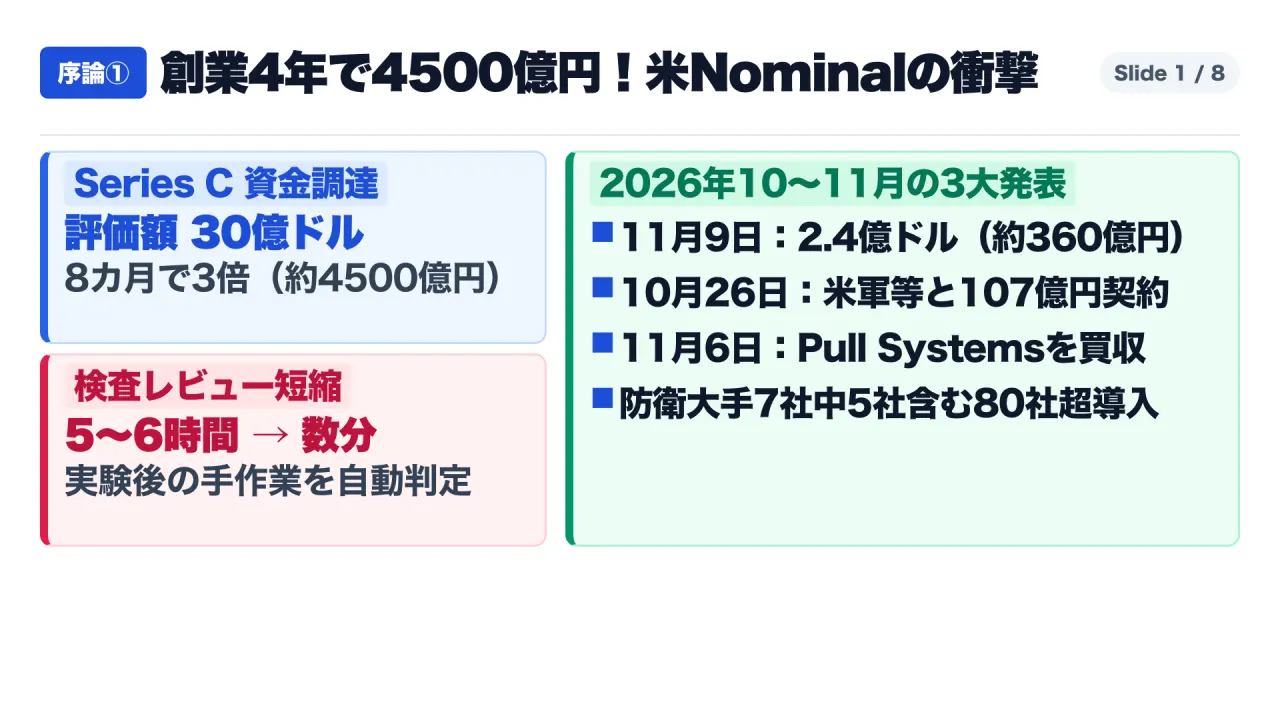
On November 9, 2026, Austin-based hardware intelligence startup Nominal announced a $240 million Series C funding round at a $3 billion post-money valuation. Nominal had raised its Series B extension at a $1 billion valuation just eight months earlier on March 5, 2026, tripling its corporate value in under a year. Cumulative private capital raised by the company surpassed $475 million. The round was led by Lightspeed Venture Partners, co-led by Insight Partners, with participation from Lux Capital, Sequoia Capital, General Catalyst, Founders Fund, Lockheed Martin Ventures, and Salesforce Ventures.
This capital influx follows two major operational milestones in late 2026:
- $71.2 Million STRATFI Defense Contract (October 26, 2026): The US Air Force and Navy awarded Nominal a four-year Strategic Funding Increase (STRATFI) contract to establish automated data verification across the Air Force Collaborative Combat Aircraft (CCA) autonomous wingman program, the Air Force Test Pilot School, DARPA Cipher Forge, and Navy PEO Unmanned Aviation and Strike Weapons (PEO U&W, EPIC Phase I).
- Acquisition of Pull Systems (November 6, 2026): Nominal acquired automotive analytics firm Pull Systems, which co-developed the “Workbench” vehicle telemetry engine alongside Porsche and Volkswagen Group, expanding Nominal’s footprint from laboratory test benches to live operating data from hundreds of thousands of production electric vehicles.
While software engineering underwent continuous integration (CI/CD) revolutions via unified text-based repositories, hardware engineering remained trapped in fragmented toolchains. By decoupling hardware testing from proprietary analysis silos and wrapping sensor streams in an AI evaluation harness, Nominal transformed five-hour post-test reviews into automated, near-real-time decisions.
Context Fragmentation and Bilateral Capital
To understand why an enterprise platform focused on hardware test analysis commands a $3 billion valuation within four years of its 2022 founding, one must examine two underlying structural mechanisms: the breakdown of operational context in physical testing, and the divergence between American public-private matching funds and traditional government grant architectures.
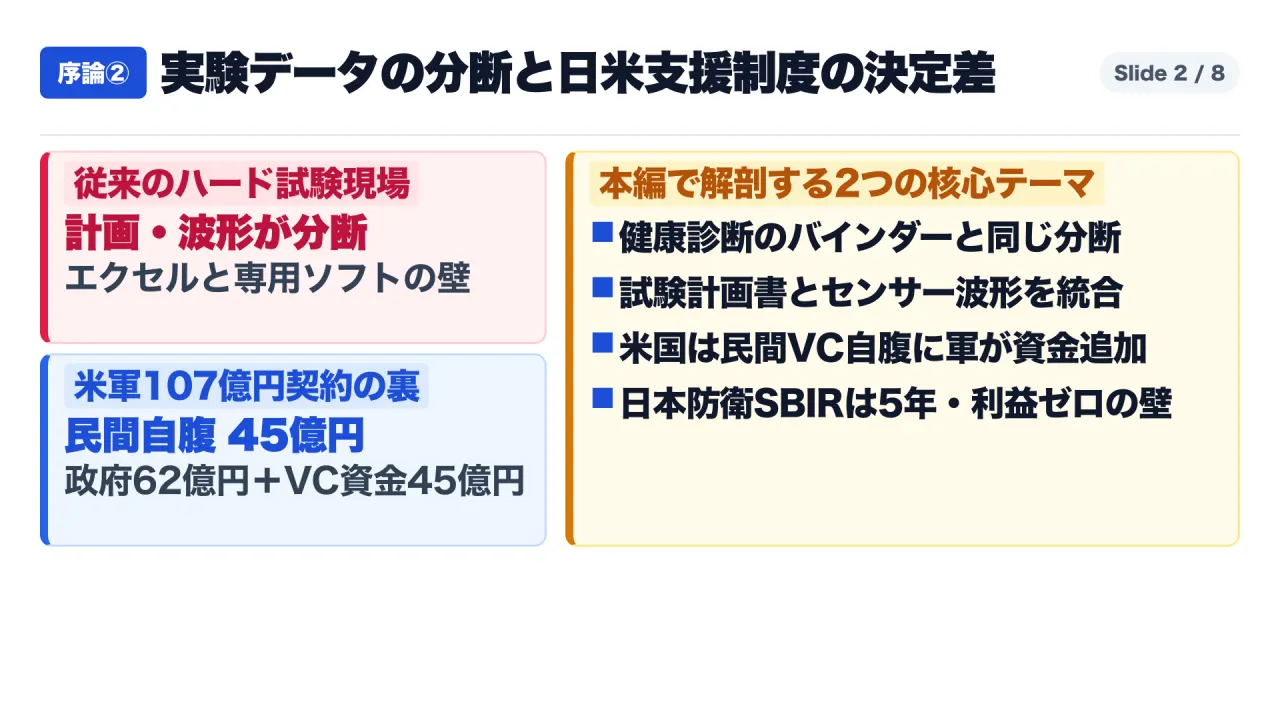
The Structural Rupture of Hardware Test Context
Consider an everyday clinical analogy. If a patient undergoes an examination, but the medical history remains in a paper binder, the ECG waveform is stored on an isolated terminal, the chest X-ray resides on an unindexed DVD, and the physician’s diagnostic notes are scattered across private chats, a doctor would require an entire working day simply to assemble records before determining whether the patient is healthy.
This exact fragmentation has crippled aerospace, automotive, and defense test benches for decades:
- Test Requirements: Formulated in Word documents or spreadsheets.
- Physical Telemetry: Captured by oscilloscopes, strain gauge loggers, and CAN bus sniffers in proprietary binary formats.
- Data Reduction: Handled through ad-hoc, individual Python scripts, MATLAB scripts, or National Instruments LabVIEW routines saved on local workstations.
Because sensor streams lack semantic linkage to original engineering requirements, any anomaly forces engineers to manually correlate timestamps, reconstruct physical bench conditions, and rewrite custom scripts.
Founders, Commercial Penetration, and Boundaries
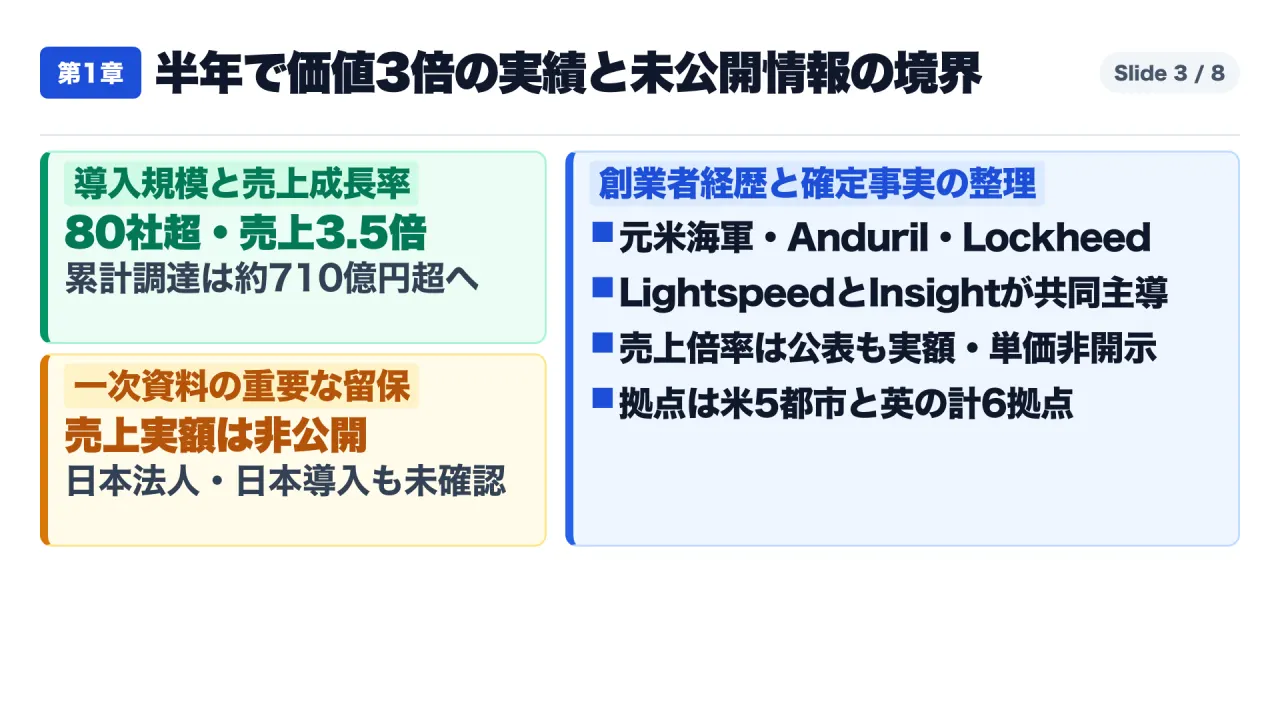
Nominal was founded in 2022 by Cameron McCord (CEO, former US Navy nuclear submarine officer, Anduril, Applied Intuition), Bryce Strauss (CTO, former Lockheed Martin flight test engineer on F-16 and F-35), and Jason Hoch (former Palantir federal/defense lead).
As of November 2026, Nominal’s platform is deployed across more than 80 commercial enterprises and government programs, including five of the top seven US defense prime contractors, alongside Anduril Industries, Hermeus, Huntington Ingalls Industries (HII), Varda Space Industries, Shift5, and Muon Space.
Crucial empirical boundaries must be maintained:
- Undisclosed Financials: While media reported that Nominal grew revenue by more than 3.5x year-to-date in 2026 (and 7x over the ten months leading to March 2026), Nominal does not publicly disclose its exact dollar revenue, Annual Recurring Revenue (ARR), or contract unit prices.
- Geographic Scope: Nominal operates across six hubs (Austin, Los Angeles, New York, Seattle, Washington D.C., and London) with no Japanese subsidiary or disclosed Japanese customers as of November 2026.
Primary Empirical Customer Deployments
The operational necessity driving defense and industrial enterprises to adopt Nominal is documented across four audited enterprise case studies.
- Anduril Industries: Deployed across 300+ daily engineers in six major programs across air, maritime, land, and space. Ingestion speed accelerated 40x; post-test data parsing and verification cycle collapsed from five to six hours down to minutes (near real-time).
- Hermeus: Developed, fabricated, and ground-tested the Quarterhorse Mk 1 Mach 5+ aircraft in seven months. Achieved an 80% reduction in wait time from data upload to active engineering review.
- Huntington Ingalls Industries (HII): In its unmanned systems division, analysis turnaround was compressed from hours to minutes, and physical production test steps were reduced by approximately 50%.
- Pull Systems (Acquired): Deployed across hundreds of thousands of production EVs for Porsche and Volkswagen Group, compressing fleet-wide anomaly root-cause isolation from months to minutes.
Architectural Breakdown: The 4-Layer Hardware Intelligence Stack
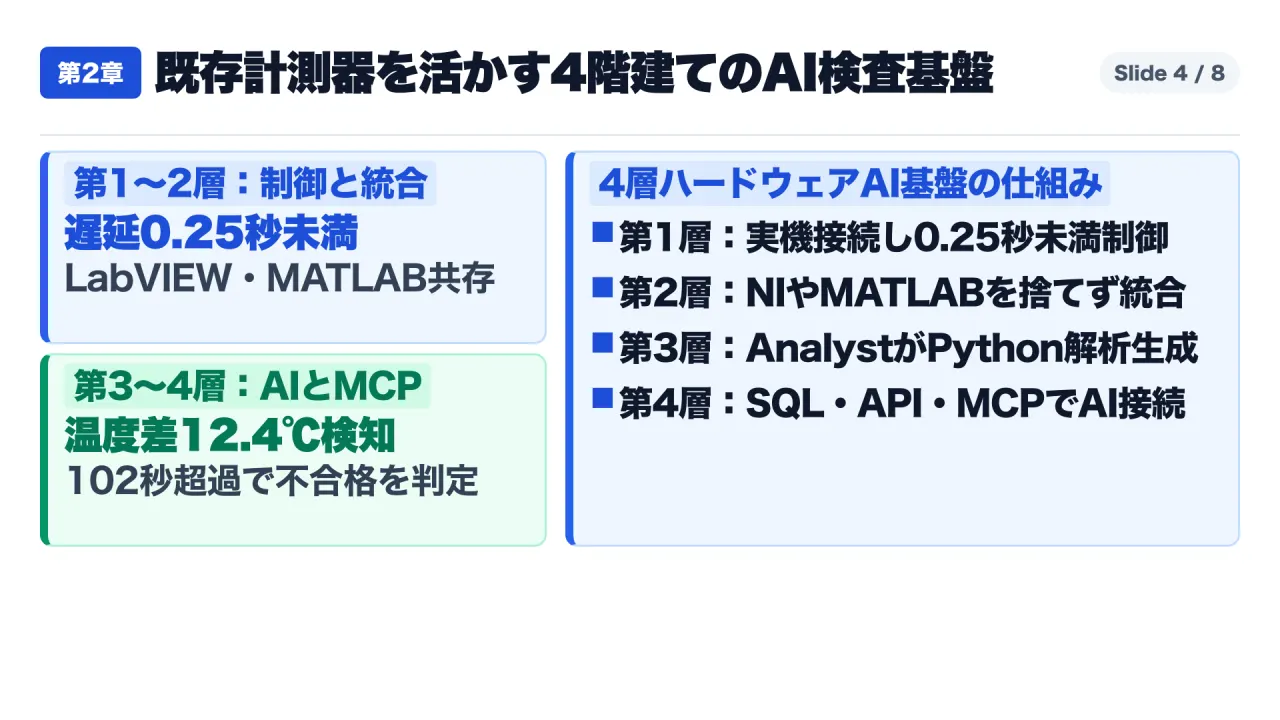
Nominal’s platform does not rely on a generic large language model prompt wrapper. The company constructed a four-tier vertical stack engineered for high-throughput, safety-critical telemetry.
Layer 1: Connected Control (Nominal Connect)
The foundational tier interfaces directly with test benches and Hardware-in-the-Loop (HIL) simulators. Operating with deterministic sub-250 millisecond latency, Nominal Connect ingests live telemetry streams directly from field sensors. Layer 1 executes in fully air-gapped environments, ensuring that abort limits engage locally without network dependency.
Layer 2: Data Infrastructure (Nominal Core)
Nominal avoids forcing engineers to abandon legacy tools. Through proprietary connectors and open-source data ingest modules (such as Ingestro), Nominal Core interfaces directly with National Instruments (LabVIEW, TestStand, VeriStand), MathWorks (MATLAB, Simulink), Parquet, HDF5, CSV, and CAN bus dumps. Certified against all 110 security controls of NIST SP 800-171 and fully ITAR compliant, it deploys identically across commercial cloud, on-premises racks, or air-gapped classified facilities.
Layer 3: Automated Evaluation Agents (Nominal Analyst)
Incorporating technology from Nominal’s acquisition of Fid Labs, Nominal Analyst functions as an autonomous technical reasoning agent. In a battery pack thermal runaway test (run BP17-054), test specifications mandated that cell temperature deltas must not exceed 8.0 degrees Celsius for more than 10 seconds. Nominal Analyst scanned 18 thermocouple streams simultaneously:
- Detected a peak divergence between Cell Max (56.4 degrees Celsius) and Cell Min (44.0 degrees Celsius), establishing a delta of 12.4 degrees Celsius.
- Identified that the 8.0-degree limit was continuously breached for 102 seconds—ten times the allowable limit—and marked the run as an immediate FAIL.
- In hover flight test H-18, the agent isolated an initial state-of-charge of 41% (prescribed 90%), which caused a bus voltage drop to 264.9V (below the 268.8V floor), generating executable Python frequency analysis scripts while preserving Human-in-the-Loop (HITL) engineering sign-off.
Layer 4: Engineering Applications & Model Context Protocol (MCP)
Layer 4 exposes indexed hardware telemetry via web dashboards, SQL interfaces, and the open Model Context Protocol (MCP). By deploying an MCP server interface, Nominal enables external AI coding agents to query laboratory telemetry programmatically without downloading 50-gigabyte binary files to local machines.
Public-Private Capital: US STRATFI vs. Japan’s Defense SBIR
A fundamental driver of Nominal’s growth lies in the public-private capital leverage structure of the United States Department of Defense, particularly when contrasted with defense procurement mechanisms in allied nations such as Japan.
The US STRATFI Bilateral Leverage Structure
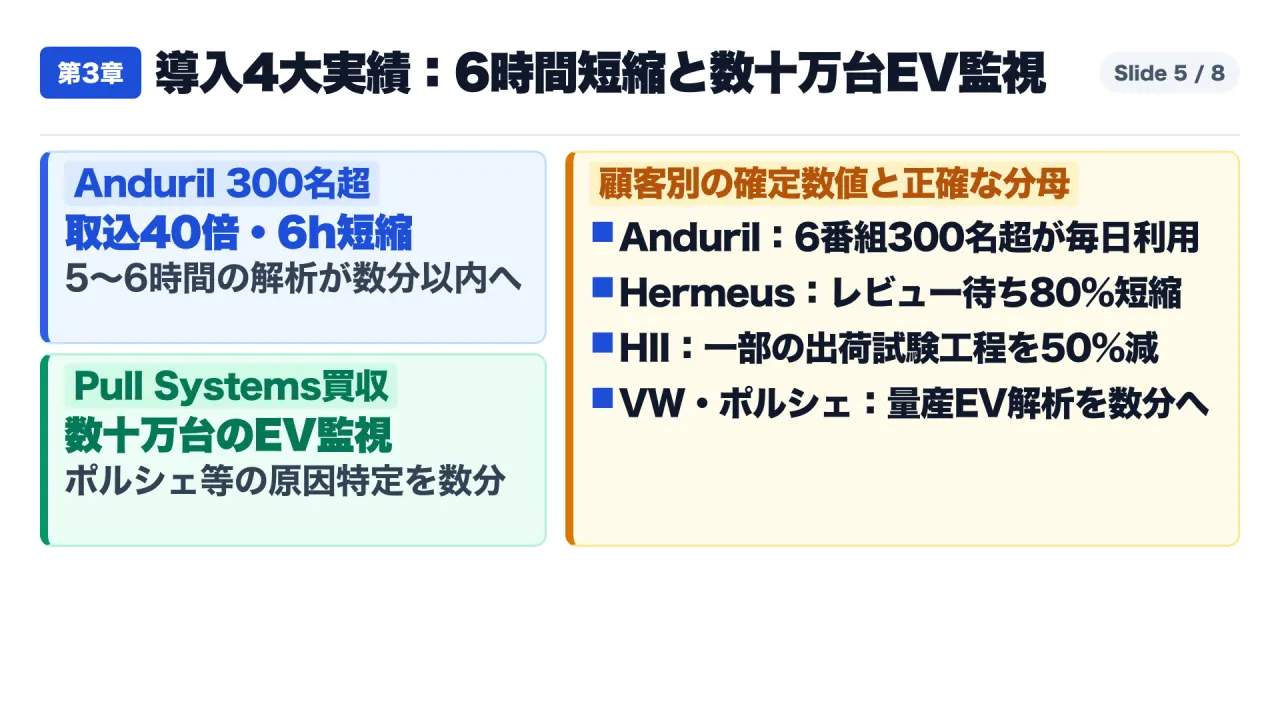
On October 26, 2026, the US Air Force announced a $71.2 million STRATFI contract for Nominal. A technical examination reveals the capital mechanics:
- Government Contribution: $41.2 million (~58% of total value), pooled across AFWERX, the Air Force Test Pilot School, DARPA, and Navy PEO U&W.
- Private VC Matching Funds: $30.0 million (~42% of total value), injected directly by Nominal’s institutional venture investors.
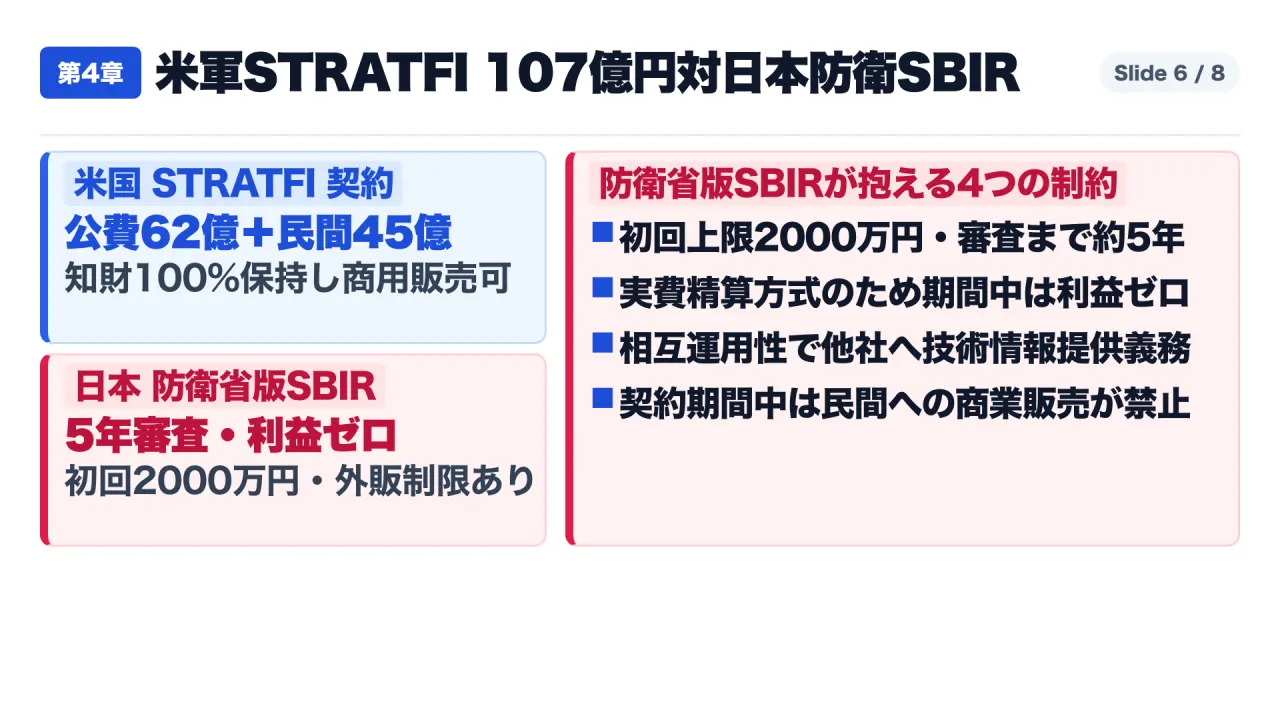
Under STRATFI, the military does not pick winners via micro-grants; it matches high-conviction private venture risk capital to accelerate an already viable commercial off-the-shelf (COTS) package. Crucially, Nominal retains 100% of its commercial intellectual property, licensing the identical core software to commercial satellite operators and automotive manufacturers.
The Structural Impediments of Japan’s Defense SBIR Framework
In contrast, Japan’s Ministry of Defense (MOD) SBIR framework imposes four severe constraints:
- Capital and Timeline Fragmentation: Phase 1 is capped at 20 million JPY (~5 months); Phase 2 provides several hundred million JPY (with a strict 5% advance payment ceiling); Phase 3 review requires approximately five years (around July/August 2031) with no volume production commitment.
- Zero Profit Margin: Cost-reimbursement rules cover only direct costs plus capped indirect costs (<=30%); corporate profit margins are entirely prohibited.
- Mandatory Third-Party Disclosure: Defense clauses compel startups to provide proprietary technical data to third-party defense manufacturers to ensure system interoperability.
- Commercial Sales Prohibitions: Startups are barred from selling contract deliverables commercially during the term, requiring advance approvals even for venture investor pitch decks.
Four Strategic Transmission Vectors Impacting Japanese Industry
While Nominal operates primarily in the US and UK, its platform architecture poses direct strategic implications for Japanese manufacturing, aerospace, and precision instrumentation.
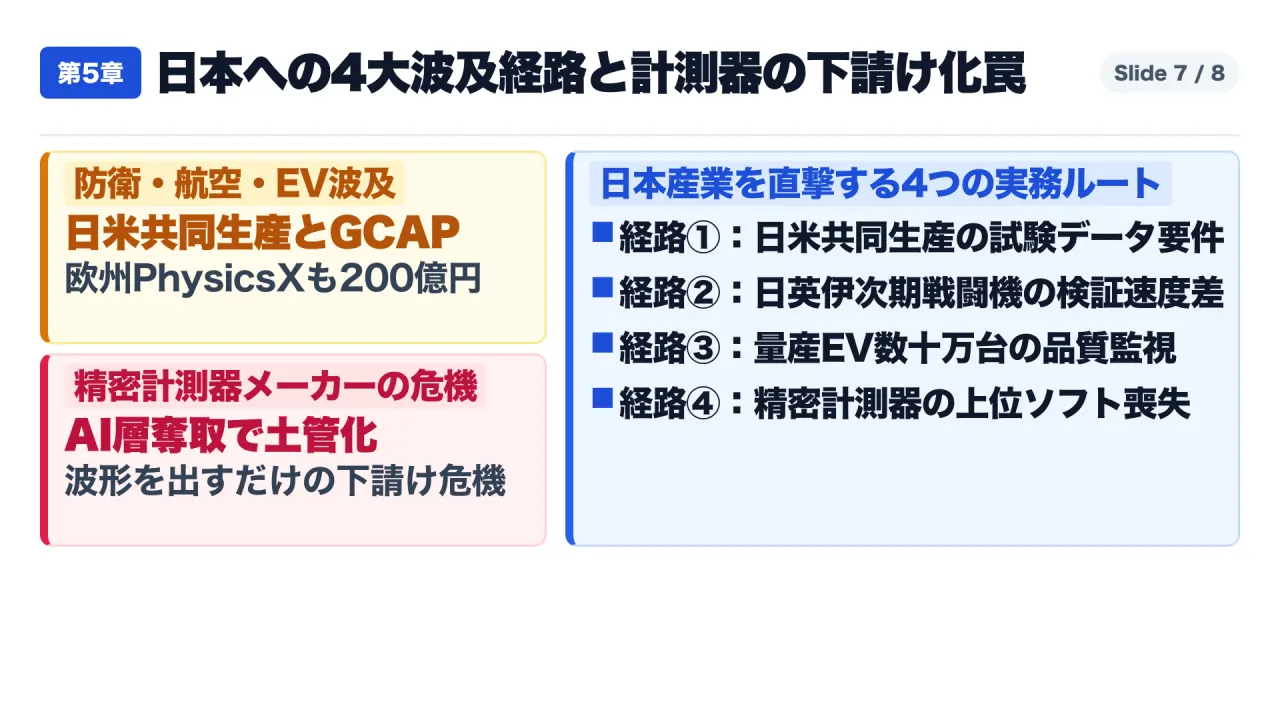
- Defense Co-Production Interoperability: Under bilateral defense agreements expanding domestic co-production and final assembly and checkout (FACO) for air-to-air missiles (e.g., AMRAAM), US primes utilizing Nominal will require Japanese suppliers to share test telemetry in NIST SP 800-171-compliant formats.
- GCAP Sixth-Generation Fighter Asymmetries: As Japan, the UK, and Italy jointly engineer the Global Combat Air Programme, European partners are integrating automated AI test platforms (Nominal London and PhysicsX with its $135 million round and Siemens alliance). If European partners execute test loops in minutes while Japanese teams rely on multi-hour manual reviews, operational friction will disadvantage Japanese technical leadership.
- Software-Defined Vehicle (SDV) Quality: Nominal’s acquisition of Pull Systems connects laboratory bench testing directly to fleet-wide telemetry across hundreds of thousands of production EVs for Porsche and Volkswagen Group. Japanese automotive OEMs must transition from reactive warranty defect analysis to automated continuous telemetry triage across production fleets.
- The “Dumb Pipe” Threat to Precision Instrumentation: Japan produces world-class physical sensors and test hardware through Horiba, Ono Sokki, Hioki, Anritsu, Keyence, and Yokogawa. However, Nominal’s architecture commoditizes raw measurement hardware by capturing the semantic reasoning, automated evaluation, and MCP server layers. If Japanese instrument makers sell only physical hardware while American platforms capture the AI evaluation tier, Japanese manufacturers risk becoming commoditized “dumb pipes” with compressed margins.
Strategic Blueprint: Three Action Mandates for Industry Leaders
To counter these vulnerabilities and capture value latent in physical testing pipelines, Japanese engineering organizations, equipment manufacturers, and deep-tech entrepreneurs should execute three operational strategies.
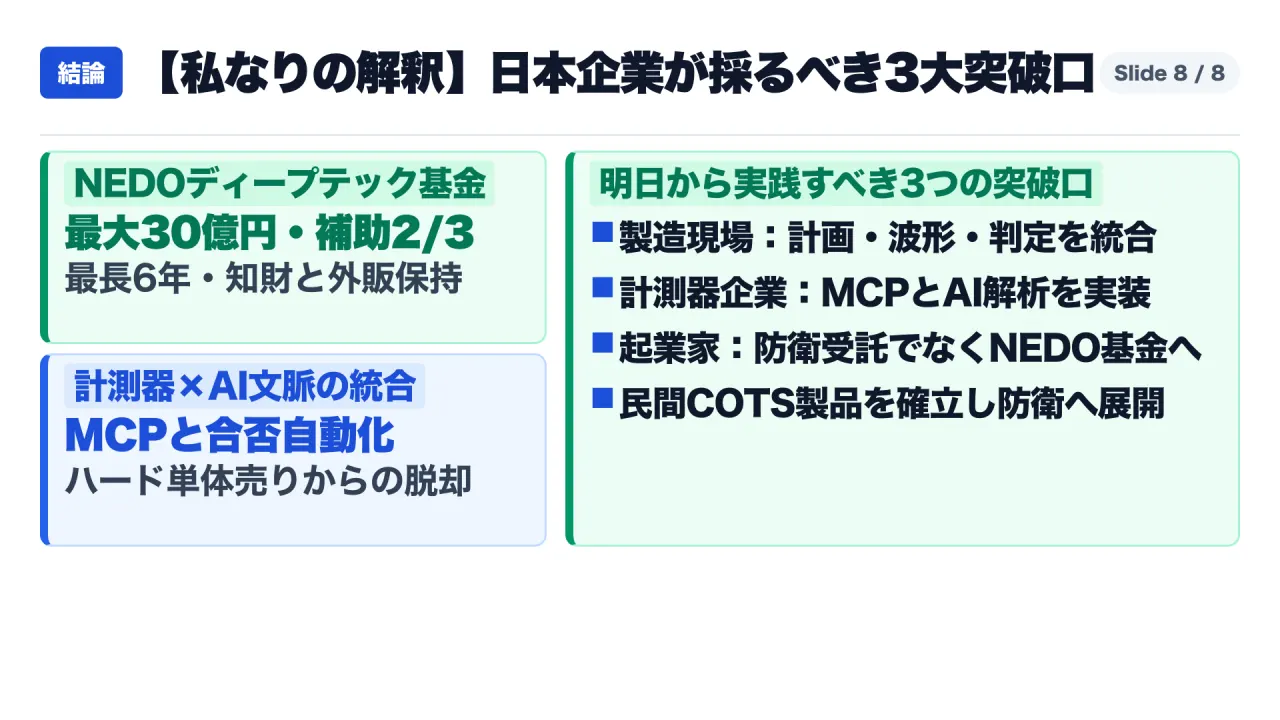
Action 1 (Manufacturing and R&D): Codify Test Verification into Version-Controlled Code
Engineering teams must dismantle manual spreadsheet bucket brigades:
- Audit post-test workflows to measure latency between test completion and formal pass/fail determinations.
- Codify written acceptance criteria (e.g., thermal deltas, voltage ceilings) into version-controlled Python verification routines stored alongside engineering models.
- Implement automated parsers that ingest raw binary files from laboratory loggers into centralized time-series stores, returning pass/fail verdicts within minutes.
Action 2 (Precision Instrument Makers): Build Native MCP and AI Semantic Reasoning Tiers
Makers of oscilloscopes and data loggers must expand beyond standalone hardware:
- Embed Model Context Protocol endpoints and standardized REST APIs directly into instrument firmware, enabling external AI agents to query waveform data programmatically.
- Provide software modules that ingest customer test specifications, cross-reference waveforms against tolerances, isolate physical root causes, and propose corrective engineering actions, protecting high-margin software value.
Action 3 (Deep-Tech Entrepreneurs): Anchor Growth in Commercial COTS Subsidies
Founders building hardware engineering platforms should avoid starting through restrictive defense R&D contracts:
- Utilize the New Energy and Industrial Technology Development Organization’s (NEDO) Deep Tech Startup Support Program (DTSU) rather than defense SBIR contracts.
- NEDO’s DTSU provides up to 3 billion JPY over up to six years at a two-thirds subsidy rate, allowing startups to retain 100% of their commercial IP, generate standard software profits, and sell unrestrictedly across automotive, robotics, and aerospace.
- Once the platform achieves commercial product-market fit, license the hardened commercial off-the-shelf software to defense agencies, maintaining high margins and full intellectual property autonomy.
Primary Sources and References
- Nominal Official Press Release, “Nominal raises $240M at a $3B valuation to build the intelligence platform for hardware engineering” (November 9, 2026): https://nominal.io/blog/series-c-news
- Nominal Engineering & Architecture Blog, “We raised $240M to build the intelligence platform for hardware” (November 9, 2026): https://nominal.io/blog/series-c
- Nominal Defense Technical Disclosure, “Nominal selected for $71.2M to advance Air Force and Navy air dominance capabilities” (October 26, 2026): https://nominal.io/blog/stratfi
- Nominal Enterprise Case Study, “Nominal Acquires Pull Systems & Anduril Case Study” (November 6, 2026): https://nominal.io/blog/pull-systems
- Anduril Industries Engineering Case Study, “Enterprise Hardware Intelligence at Scale” (2026): https://nominal.io/customers/anduril
- Magica & CREDX Independent Market Analysis, “Nominal’s $240M Bet That Hardware Needs Its Own AI Stack” (November 2026): https://magica.com/news/nominal-240-million-hardware-ai-platform
- Innovation Law Firm, “Legal and Contractual Framework of Japan’s Defense SBIR Program” (2026): https://innovationlaw.jp/defense-sbir-japan-law/
- New Energy and Industrial Technology Development Organization (NEDO), “Deep Tech Startup Support Program (DTSU) Application Guidelines”: https://www.nedo.go.jp/koubo/CA2_100521.html