The $14B Illusion vs. $7B Debt Reality: Inside Anthropic's Mega-IPO, CoreWeave's Credit Squeeze, and the Chip Location Verification Mandate
As Anthropic prepares a historic $90.4B public offering backed by tech giants, the physical infrastructure beneath generative AI is flashing red: CoreWeave faces debt pressure on $46.9B liabilities, Congress advances chip location verification mandates, and Texas freezes 500MW data center hookups.
Published: November 13, 2026 | Read time: ~12 min | Primary Source: GovInfo Congressional Record H.R. 3447, Rep. Foster Press Release, SEC Form 8-K EX-99.1, Bloomberg Technology
Executive Summary: The Structural Collision of Capital and Physics
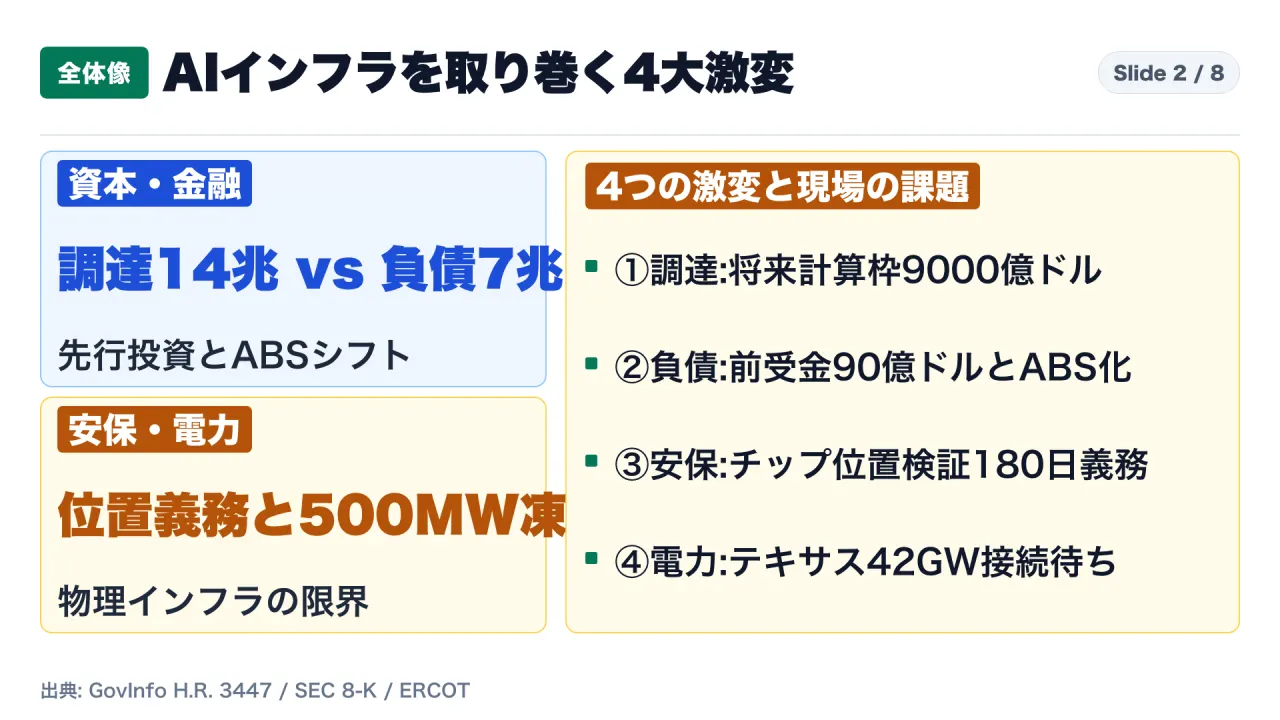
On November 12, 2026, the artificial intelligence industry experienced an unprecedented convergence of financial spectacle and hard structural limits. Across capital markets, credit rating agencies, Capitol Hill, and regional utility grids, four simultaneous developments exposed the growing chasm between software valuation and the physical economics of compute infrastructure.

At the top of the stack, foundation model developer Anthropic initiated formal preparations for an initial public offering (IPO) targeting up to $90.4 billion in valuation and new proceeds, anchored by a $26.0 billion private syndicate across seven technology incumbents. Yet just below this software layer, CoreWeave—the specialized neo-cloud operator providing clusters of Nvidia accelerators to Anthropic and Microsoft—reported third-quarter financial results showing total debt ballooning to $46.9 billion with $846 million in quarterly net interest expenses, driving a net loss of $709 million and prompting a strategic pivot toward customer prepayments and asset-backed debt.
Simultaneously, the regulatory and physical foundations of AI compute were shaken:
- Congressional Chip Security Act (H.R. 3447 / S. 1705): Passed unanimously (42-0) by the House Foreign Affairs Committee, the bill mandates that within 180 days, manufacturers implement location verification technology into all advanced AI accelerators (ECCN 3A090) and promptly report any unauthorized diversions or spoofing attempts to the Department of Commerce, raising severe industry concerns regarding cybersecurity backdoors, remote revocation risks, and the absence of allied carve-outs.
- Texas Grid Interconnection Moratorium: Governor Greg Abbott and grid operator ERCOT proposed an emergency freeze on new data center interconnection approvals exceeding 500 megawatts (MW), mandating 100% on-site firm power generation and 100% upfront developer financing for transmission infrastructure.
This analysis breaks down the primary data, contractual obligations, balance-sheet liabilities, and geopolitical dynamics transforming the AI infrastructure buildout from speculative momentum into an intense capital and legal bottleneck.
1. Anthropic’s $90.4B IPO and the $900B Take-or-Pay Trap
According to preliminary S-1 registration documentation, Anthropic is structuring its public debut through an extraordinary two-tier syndication designed to secure balance-sheet equity while cementing multi-cloud supplier commitments.
The Two-Tier Financing Package
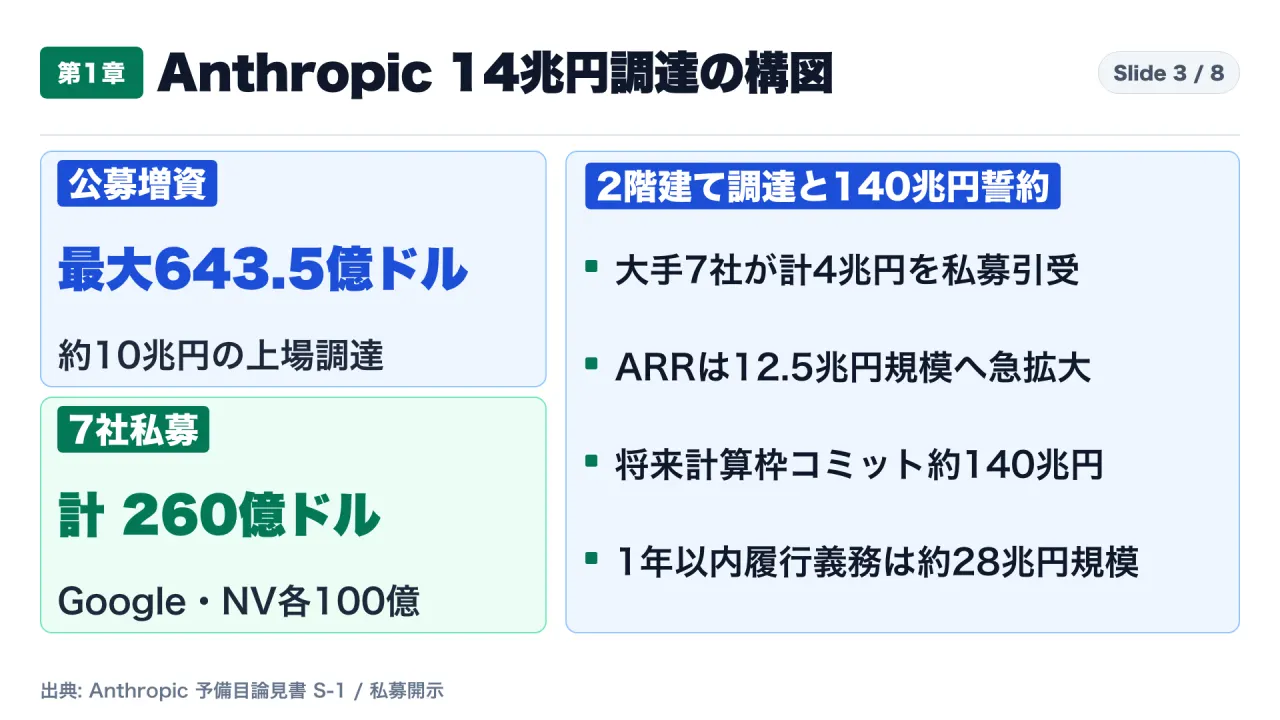
The targeted $90.4 billion capital structure comprises:
- Public Tranche (IPO Float): Up to $64.35 billion in newly issued common shares listed on NASDAQ.
- Cornerstone Private Placement Syndicate: $26.0 billion aggregate across seven strategic partners (yielding an implied fully diluted enterprise valuation of ~$1.4 trillion):
- Google: $10.0 billion
- NVIDIA Corporation: $10.0 billion
- AMD: $2.5 billion
- Broadcom Inc.: $1.0 billion
- Micron Technology: $1.0 billion
- Microsoft Corporation: $1.0 billion
- TSMC Partners: $0.5 billion
This consortium represents an unprecedented circular capital recycling structure. By investing equity directly into Anthropic, semiconductor designers, foundries, and hyperscalers ensure that the proceeds are immediately recycled into multi-year compute reservations, custom ASIC designs, and foundry wafer starts.
The Scale of Contractual Commitments
Anthropic’s operational metrics demonstrate hyper-growth: annualized run rate (ARR) reached $81.0 billion as of October 31, 2026.
However, the prospectus reveals an alarming underlying commitment: cumulative contractual obligations for cloud compute reservations and data center infrastructure totaling approximately $900 billion through calendar year 2033, with $69.8 billion due within the next twelve months alone. Because frontier model pre-training and low-latency enterprise inference require guaranteed access to high-density clusters, Anthropic has entered massive take-or-pay commitments that absorb the vast majority of inbound capital.
2. CoreWeave Q3 Results: 168% Revenue Surge Meets a $46.9B Debt Wall
The immediate beneficiary of foundation model compute commitments has been CoreWeave. Yet the company’s Form 8-K EX-99.1 filing for Q3 2026 illustrates the intense capital requirements of debt-financed hardware leasing.
Top-Line Acceleration vs. Balance Sheet Deterioration
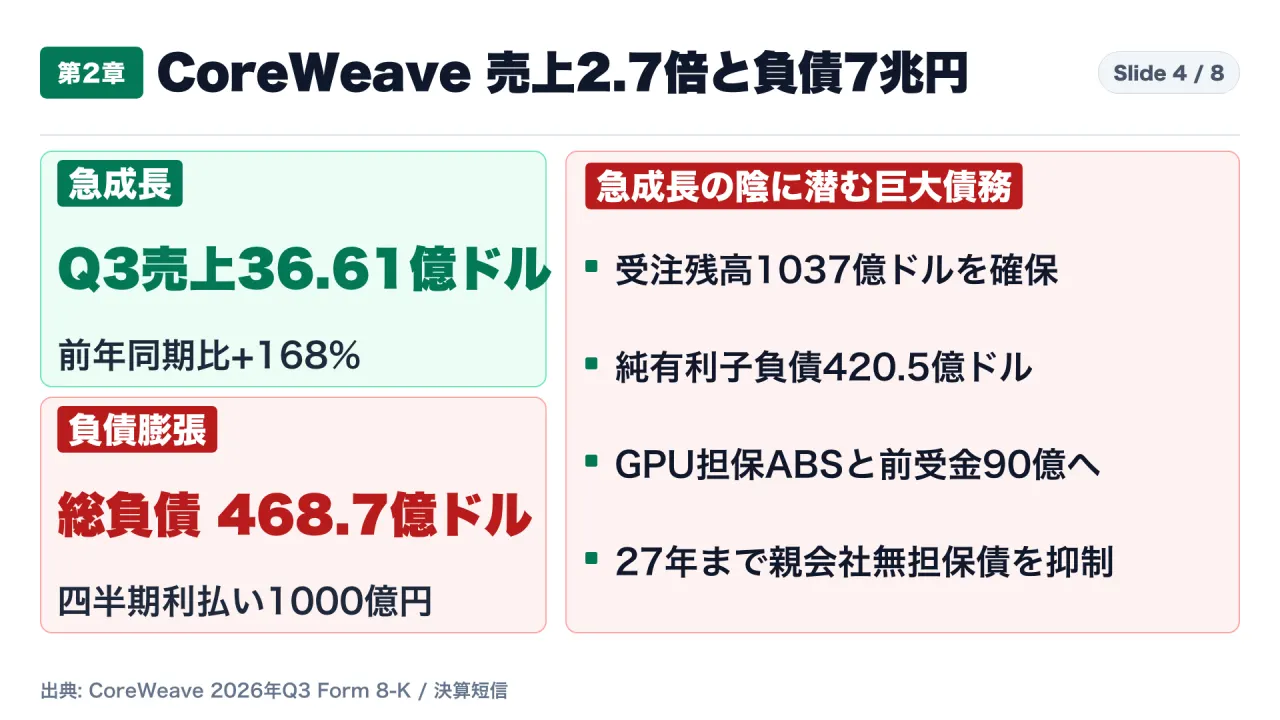
- Q3 2026 Revenue: $3,661 million ($3.66 billion), up 168% year-over-year from $1,365 million in Q3 2025.
- Contracted Backlog: ~$132.5 billion across multi-year enterprise commitments.
- Operating Performance: GAAP operating income of $207 million (6% margin); adjusted operating income of $379 million (10% margin).
- Total Outstanding Debt: Surged to $46,873 million ($46.9 billion) across recourse and non-recourse facilities.
- Net Interest Expense & Net Loss: Quarterly net interest expense reached $846 million, resulting in a net loss of $709 million.
The Shift to Customer Prepayments and Structured ABS
To manage balance-sheet strain, CoreWeave announced a clear financial discipline shift:
- Halting Unsecured Notes: The company explicitly stated it will refrain from issuing parent-company unsecured bonds through 2027.
- Customer Prepayments: CoreWeave is shifting financing toward approximately $9.0 billion in customer prepayments expected over the next three months.
- Diversified Facilities: Supported by ~$4.2 billion in convertible notes and a $2.6 billion delayed draw term loan (DDTL 5.5), CoreWeave is relying on asset-backed debt (ABS) tied to specific hardware deployments rather than parent corporate debt, leading to a +24.71% stock surge following the earnings release.
3. The Chip Security Act (H.R. 3447): Silicon Location Verification
While debt markets scrutinize balance sheets, the US Congress is advancing regulatory control over advanced semiconductor hardware. Bipartisan sponsors Bill Huizenga (R-MI), Bill Foster (D-IL, physicist and former chip designer), John Moolenaar (R-MI), and Raja Krishnamoorthi (D-IL) introduced the Chip Security Act (H.R. 3447) (with Senate companion S. 1705 introduced by Tom Cotton), which passed the House Foreign Affairs Committee 42-0 on March 26, 2026.
Legislative Mandates
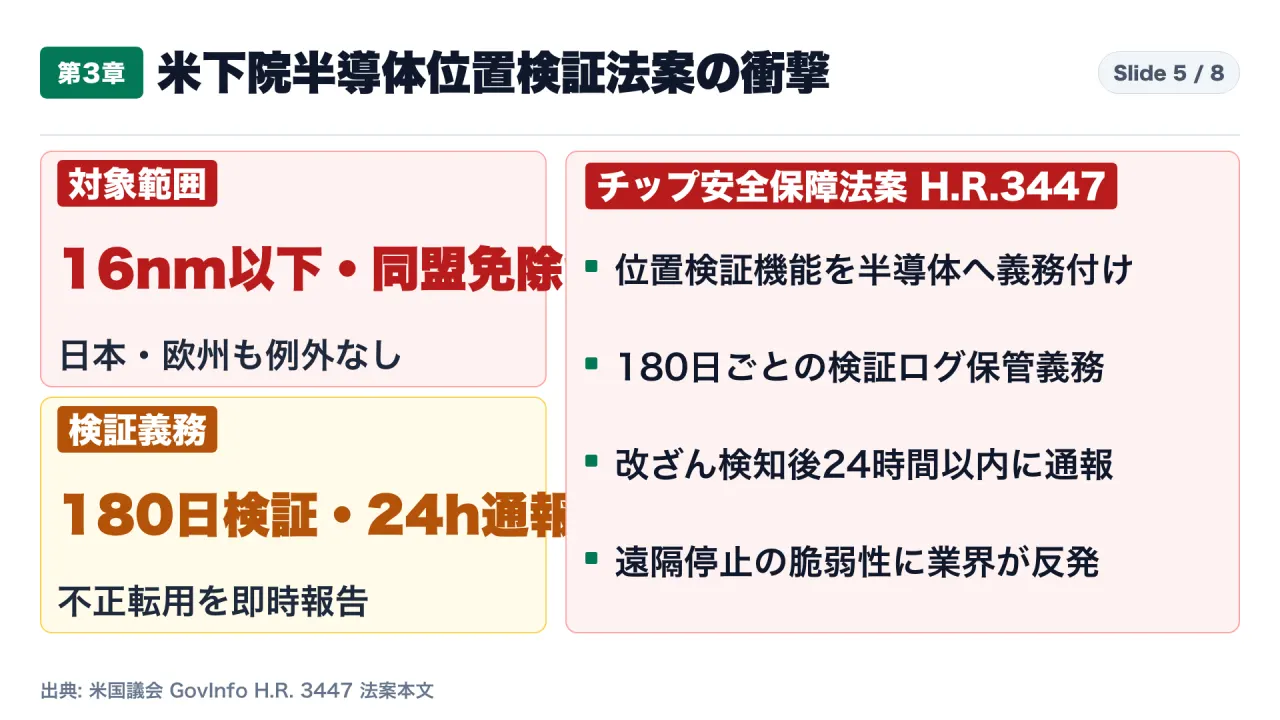
The statutory text of H.R. 3447 applies to advanced integrated circuits controlled under ECCN 3A090, 3A001.z, 4A090, and 4A003.z (encompassing Nvidia Blackwell architectures). The bill establishes two core statutory mandates:
- Location Verification Capability (Sec. 4(a)(1)): Beginning 180 days after enactment, manufacturers and exporters must ensure covered semiconductors possess technology enabling the verification of their physical location when exported, reexported, or transferred in-country.
- Prompt Reporting of Diversion and Tampering (Sec. 4(a)(2)): Entities must promptly report to the Under Secretary of Commerce for Industry and Security (BIS) any knowledge that a covered chip is being used in an unauthorized location or by an unauthorized user, or any known attempt to circumvent, alter, disable, or spoof location verification capabilities.
Industry Scrutiny, Remote Revocation Concerns, and Allied Gaps
While the statutory text does not mandate “72-hour periodic GPS pings” or explicitly legislate a “remote kill switch”, the practical enforcement of location verification has triggered intense industry debate:
- Cybersecurity Backdoor Risks: The Semiconductor Industry Association (SIA) and hardware security analysts warn that requiring verifiable tracking and communication interfaces into advanced accelerators creates potential backdoor vectors for state-sponsored threat actors.
- Hyperscale Reliability: False location verification faults in synchronized 100,000-GPU clusters could cause catastrophic downtime.
- Omission of Allied Carve-Outs: Crucially, the bill contains no statutory exemptions for key allies such as Japan, the United Kingdom, Germany, South Korea, or Taiwan. Consequently, sovereign data centers in allied nations deploying cutting-edge US chips remain subject to US export compliance reporting and tracking mandates.
4. Texas Grid Crisis: ERCOT’s 500MW Interconnection Moratorium
The final structural limit constraining the AI expansion is physical electricity. In Texas, the premier destination for hyperscale data center construction due to historically low power costs and streamlined permitting, the electric grid has reached capacity exhaustion.
The 42-Gigawatt Interconnection Queue
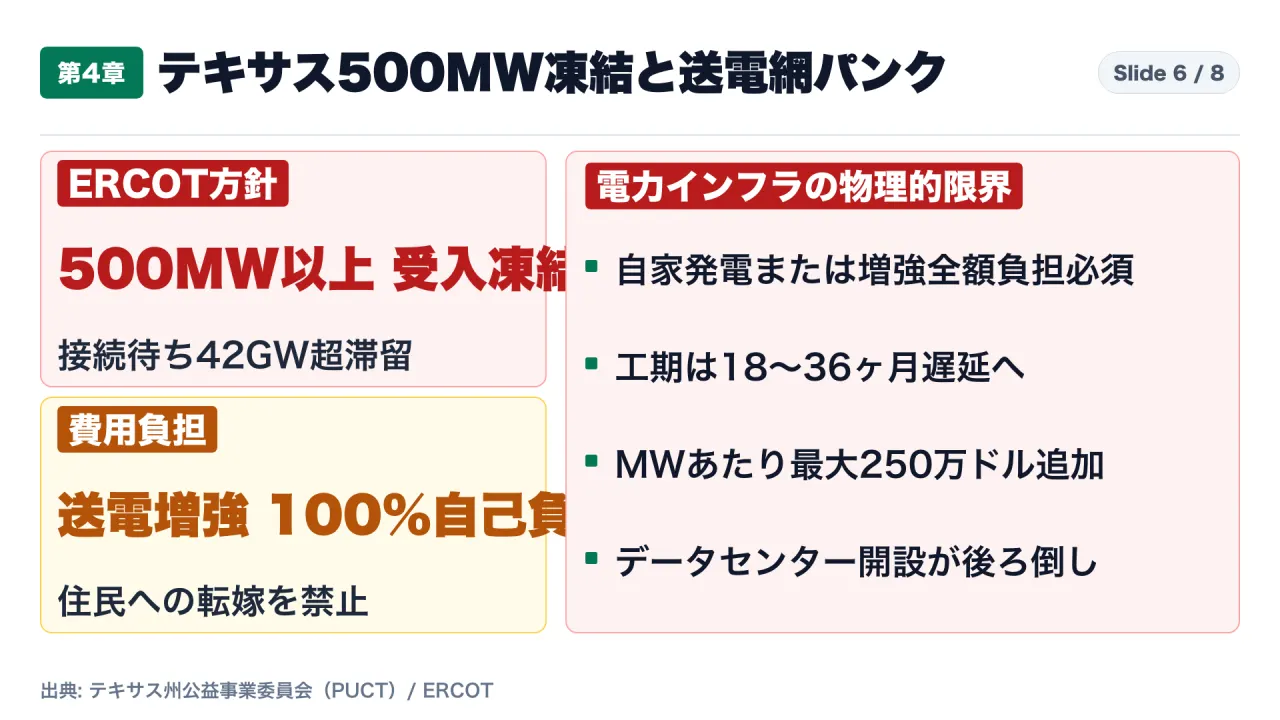
The Electric Reliability Council of Texas (ERCOT) reported that active data center interconnection study queues contain over 42 gigawatts (GW) of requested capacity—surpassing the state’s entire operating reserve margin during summer peak demand.
In response, the Office of the Governor and ERCOT proposed emergency regulatory directives establishing an immediate moratorium on new grid interconnection approvals for computing facilities requesting 500 megawatts or greater.
Mandatory Compliance Conditions
To secure future grid connectivity, developers must satisfy two stringent requirements:
- 100% On-Site Firm Generation: Facilities exceeding 500MW must construct dedicated, behind-the-meter generation assets (such as on-site natural gas turbines or 8-hour battery storage) capable of islanding 100% of critical IT load during grid emergency conditions (Energy Emergency Alert Level 2 or 3).
- Full Transmission Cost Allocation: Developers must pay 100% of upfront capital costs for dedicated high-voltage sub-stations and transmission expansions, eliminating historical ratepayer subsidies.
This policy imposes estimated schedule delays of 18 to 36 months on gigawatt-scale campus projects planned across North and West Texas, while inflating capital expenditure per megawatt by $1.2 million to $2.5 million.
5. Architectural Synthesis: The Collision of Virtual Dreams and Physical Realities
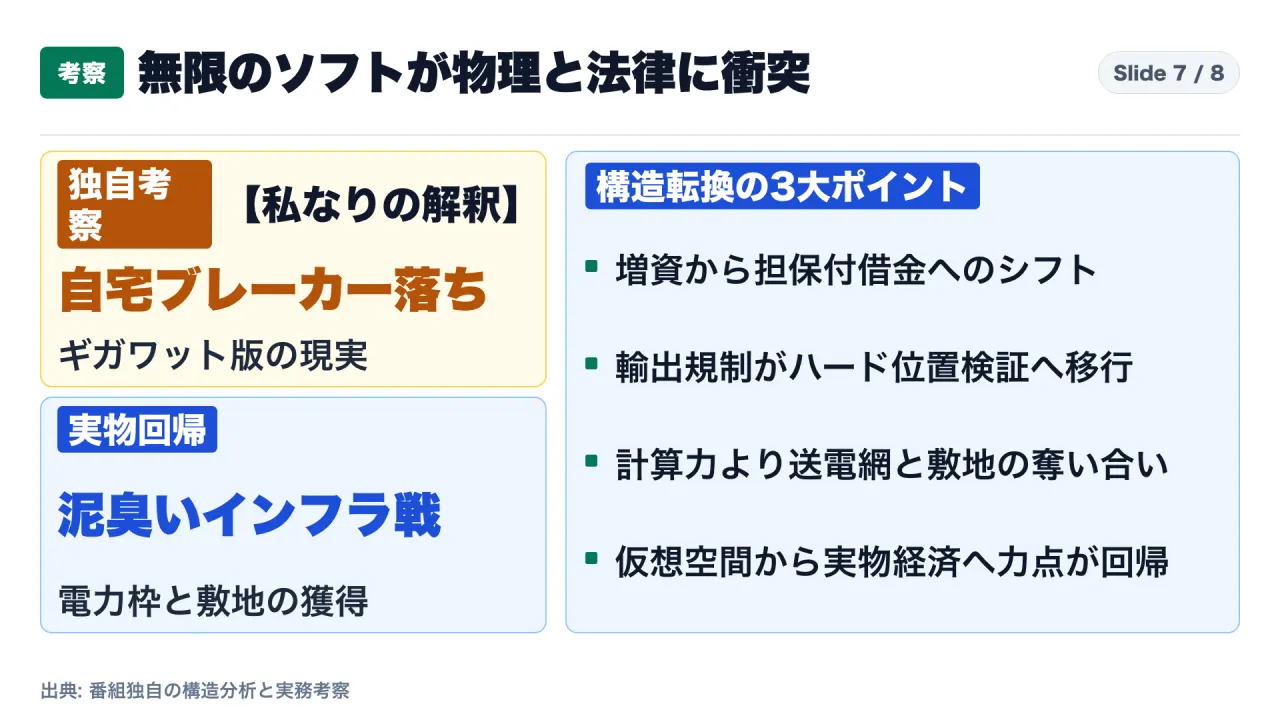
The macro dynamics visible in November 2026 mirror an everyday household experience: running two high-end workstations, an air conditioner, and an electric kettle on a single domestic circuit until the circuit breaker trips. No matter how sophisticated the software code executing inside the CPU, when total electrical draw exceeds physical copper capacity, everything goes dark instantaneously.
The global AI ecosystem has arrived at its collective circuit-breaker moment. Software algorithms iterate over weeks, and financial capital can allocate $90 billion across a single quarter. Yet constructing natural gas combined-cycle turbines requires five to seven years, high-voltage transmission lines require three to five years, and international export treaty architectures require years of contentious negotiation. The illusion that AI growth operates unconstrained in a frictionless virtual realm has collided decisively with physical thermodynamics, bond market mechanics, and national security statecraft.
6. Strategic Takeaways for Enterprise IT Leaders
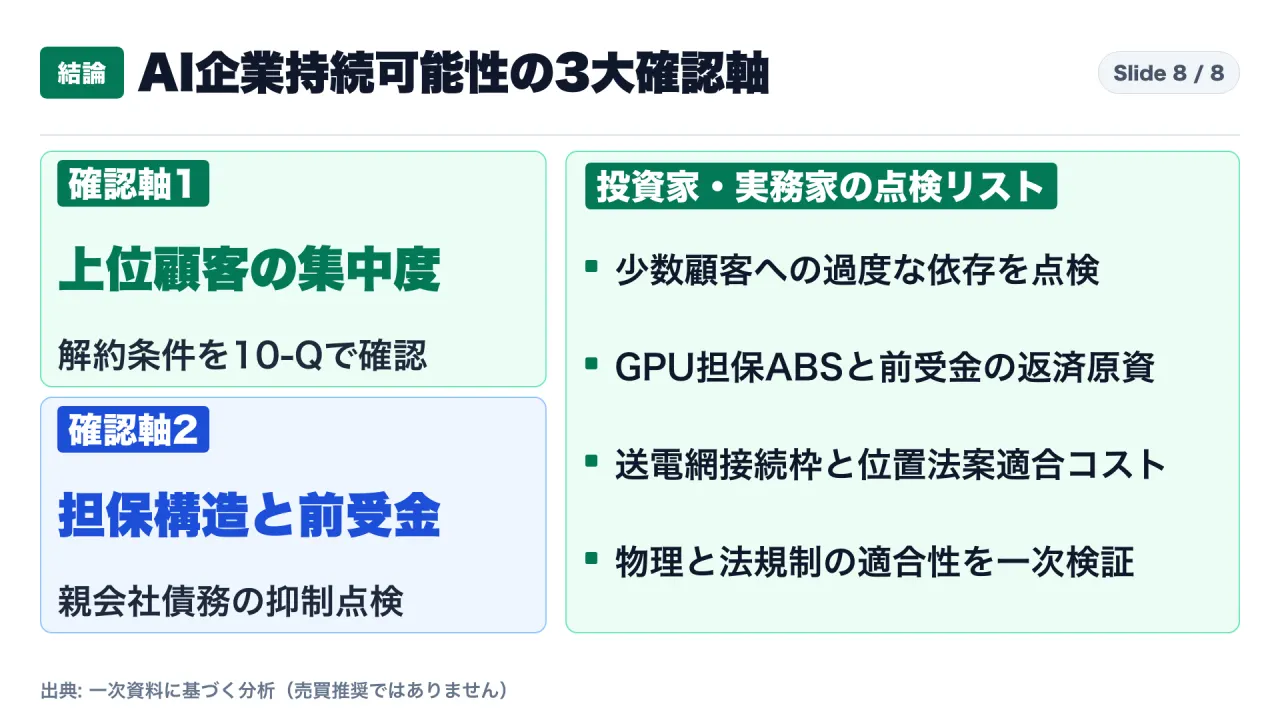
Enterprise technology executives evaluating cloud vendor roadmaps and foundation model partnerships should institute three rigorous verification criteria based on primary regulatory filings:
- Audit Vendor Counterparty Concentration: Examine SEC Form 10-Q and 8-K disclosures to determine whether your cloud infrastructure partner derives over 50% of revenue from two or three dominant foundation model clients. High concentration signals acute refinancing vulnerability if an anchor tenant shifts workloads.
- Scrutinize Debt Structure and Cash Buffers: Scrutinize the financing mechanisms of specialized neo-clouds. Operators managing billions in interest expenses must demonstrate sustainable non-debt cash buffers, such as customer prepayments, to weather silicon upgrade cycles.
- Verify Power Grid Firmness and Regulatory Compliance: Require prospective data center providers to demonstrate binding, fully funded utility interconnection agreements rather than speculative study queue positions. Furthermore, monitor location verification legislation (H.R. 3447) to anticipate tracking and compliance burdens on overseas cloud infrastructure.
Disclaimer: This report is provided exclusively for technical, operational, and macroeconomic analysis based on verified public disclosures and primary documents. It does not constitute investment advice or recommendations regarding the purchase or sale of any securities.